ChatGPT
 Perplexity AI
 Claude
Secure your future job with a business development resume that speaks volumes about your skills and experience!
Ultimately, it all comes down to presenting your potential just as you'd sell the business itself to prospects, suppliers, and customers. And to help you with that, we've prepared a detailed guide that brings you valuable writing tips, customizable templates, plenty of examples, and real-life resume samples.


 See more examples like these
Keep reading our guide to learn how to:
- Learn the dos and don'ts of resume writing from authentic samples
- Pick the right resume format for a business developer
- Choose between resume summary and resume objective
- Present the right skills on your business development resume
- Make the most out of your achievements and experience
- Elevate your resume through the use of action verbs
- Deal with the education section effectively
- Select relevant optional sections for your business development resume
- Steer clear of mistakes that can sabotage your resume
- Accompany your resume with a matching cover letter
- Find the best resources for job-seeking business developers
- Explore average salary and job outlook in business development
Business analyst CV example


Why does this resume example work?
- It contains a separate certification section: Including a dedicated “Certificates” section gives recruiters a quick, scannable view of the candidate’s additional qualifications. These extra credentials demonstrate curiosity, global perspective, and a commitment to learning beyond formal education. That kind of detail helps set the candidate apart in international business or diplomacy-related roles.
- It mentioned an impressive list of language proficiencies: Fluency in six languages is an enormous asset, especially in business development, where cross-cultural communication is often central to success. The presence of multiple languages signals versatility and adaptability. That's gold in roles that involve market expansion, client communication, or international negotiation.
What could be improved?
- Sharing less personal information: Listing date of birth and nationality might seem harmless, but it can open the door to unconscious bias. In many countries, recruiters are trained to ignore personal details like age, nationality, gender, or marital status to avoid discriminatory hiring practices. But the thing with biases is that they are mostly unconscious.
- Bullet-pointing the work experience for clarity: Right now, the job entries blend tasks into long, somewhat jumbled sentences. Breaking these into clean, concise bullet points would make each role easier to skim (and easier to absorb).
Business development officer resume example

Why does this resume example work?
- It quantifies results: This resume shows impact. Statements like “expanded international client base by 120%” and “increased brand awareness and website traffic by 500%” are excellent examples of what hiring managers love to see. Numbers like these make the candidate’s contributions feel tangible and convincing. It’s the kind of detail that separates an average resume from a standout one.
- It offers a varied skill set: From marketing and sales to client engagement and strategic planning, this applicant covers a wide spectrum of business development responsibilities. On top of that, the resume lists a healthy mix of tools (like Zoho, Netsuite, and Scoro) and soft skills (like time management and critical thinking).
What could be improved?
- Resume summary could be more effective: Phrases like “results-oriented,” “accomplished,” and “strong work ethic” are used so often that they’ve become resume filler. While the intention is good, this opening paragraph would carry more weight if it included specific strengths or results. For example, mentioning the 120% client base growth right up front would help hook the reader and immediately reinforce credibility.
- Education section could be more succinct: There’s no need to go into detail about high school achievements once a university degree is completed, especially when the college experience is so strong. The high school entry could be trimmed down or even removed altogether. Most hiring managers will focus on the highest level of education, and detailed high school info might feel like filler at this stage of the applicant’s career.
Business analyst resume example

Why does this resume example work?
- It catches the recruiter's attention with a standalone achievements section: Right off the bat, the resume highlights a series of high-impact projects in a dedicated "Achievements" section. Not only are these achievements specific, they also show scale (e.g. “twelve thousand university staff”) and technical complexity, which speaks volumes about the applicant’s experience level.
- Its work experience section is focused and specific: The work history tells a clear story. Each bullet point is anchored in real outcomes, whether it's “developed three-year IT road-maps” or “oversaw governance of over 50-million-dollar worth strategic investment.” It also shows progression, moving from assistant portfolio manager to full portfolio lead, which reinforces the candidate’s upward trajectory.
What could be improved?
- Work experience section could be moved above education: Right now, the education section comes before the work experience. But for someone with over a decade of experience in senior roles, that order should be flipped. Recruiters are most interested in recent, relevant experience first. Unless the education itself is a core selling point (for example, in academia or research roles), it should follow the career history.
1. How to format your business development resume properly
There are three main resume formats to choose from, and each one highlights something different.
The format you choose shapes the way hiring managers read your resume. And what they notice first.
So how do you pick the right one for you?
Simple: think about what you want employers to focus on most. Your resume should make your strengths stand out and quietly downplay anything that might raise questions.
- Reverse-chronological resume: This is the most common (and safest) option, especially if you’ve got a solid work history with no big gaps. This format highlights your work history, listing your jobs starting with the most recent and works backward. Go with this format if you’ve been working steadily in the same or similar field.
- Functional resume: A functional resume flips the script. Instead of focusing on where you’ve worked, it puts your skills front and center. This format can help if you’re trying to break into a new industry or if your job history isn’t as smooth or relevant. It's best for career changers, recent graduates, or anyone with big gaps in their resume.
- Combination (or hybrid) resume: This one blends elements from both formats. This is a flexible option that works well if you’ve built a lot of transferable skills or if your work history is a mix of different types of roles. It focuses on both your skills and your experience. There’s no single focus, so weaker areas can be padded out or positioned more gently.
More formatting tips to keep your resume clean and easy to read
Once you’ve picked a format, it’s time to think about how your resume looks on the page. The goal is to make it as easy as possible for someone to scan it quickly.
Here are a few formatting tips that apply no matter which layout you choose:
- Use a simple, professional font like Calibri, Arial, or Helvetica
- Keep the font size between 10 and 12 points
- Stick to a one-page layout unless you’ve got over 10 years of very relevant experience
- Use clearly labeled sections with bold headings like "Work Experience", "Education", or "Skills"
- Maintain consistent spacing and margins (typically 1 inch on all sides)
- Use bullet points to list responsibilities and achievements
- Avoid large blocks of text — white space is your friend
- Save your resume as a PDF unless the job posting asks for another format
Choosing the right resume format isn’t about picking the one that looks the nicest. It’s about choosing the one that works best for you. And if formatting isn’t your favorite part of the job search, feel free to check out our professionally designed resume templates.
Try our AI Resume Writer and have your resume ready in minutes!

2. How to choose between resume summary and resume objective
Hiring managers don’t read every resume from top to bottom. In fact, most only skim, especially when a role gets dozens (or hundreds) of applicants. That’s why the short section at the very top of your resume matters so much.
Whether you use a resume summary or a resume objective, this short paragraph acts like a highlight reel. It gives hiring managers a quick “taste” of what’s to come. And also helps them decide whether to keep reading.
But how do you know which one to use?
When to use a resume summary
A resume summary is best if you already have some real-world experience in business development — maybe as a sales rep, a BD manager, or even in a client-facing role with strong results.
Your summary should include:
- Job title or role (e.g., Business Development Manager, Sales Executive)
- How many years of experience you’ve got
- Key skills (like lead generation, client relationship management, or CRM software)
- A few measurable wins (like revenue growth, new clients, or key deals closed)
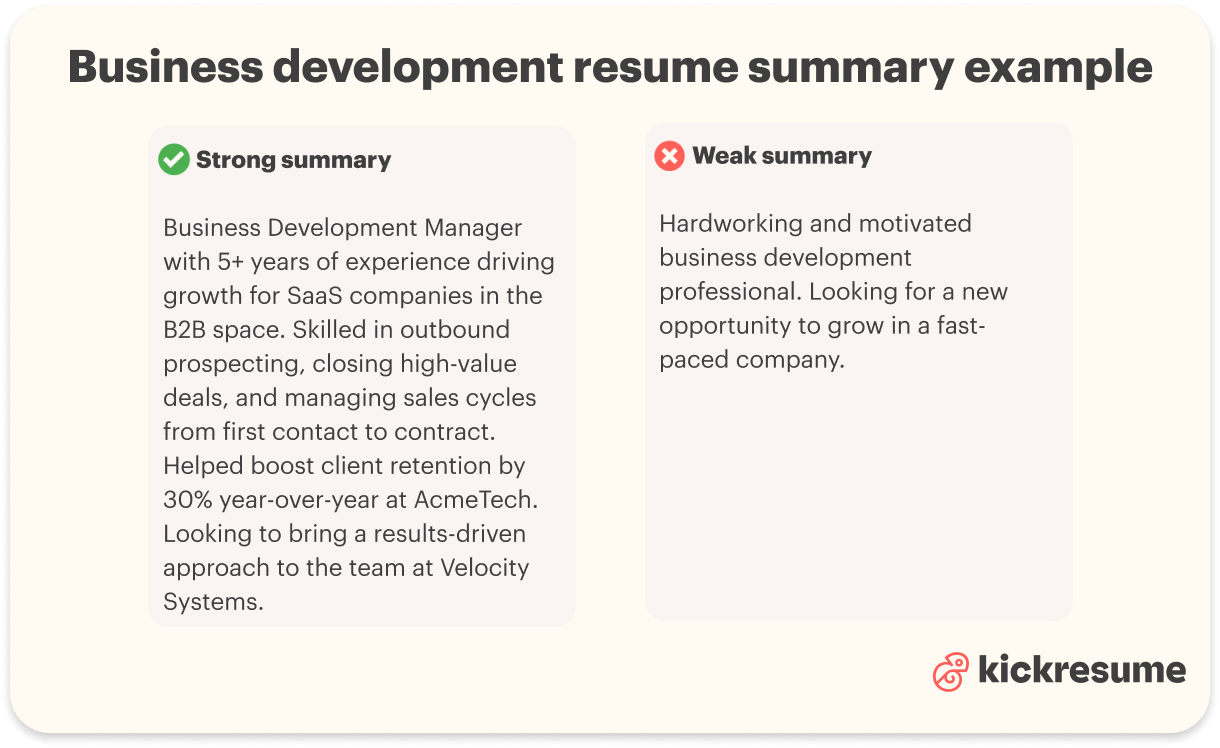
Bad business development resume summary
Hardworking and motivated business development professional. Looking for a new opportunity to grow in a fast-paced company.
Why doesn't this example work? Because it tells us almost nothing. It could apply to anyone and doesn’t highlight a single achievement or skill. Plus, “hardworking and motivated” are phrases every hiring manager has read a thousand times.
Good business development resume summary
Business Development Manager with 5+ years of experience driving growth for SaaS companies in the B2B space. Skilled in outbound prospecting, closing high-value deals, and managing sales cycles from first contact to contract. Helped boost client retention by 30% year-over-year at AcmeTech. Looking to bring a results-driven approach to the team at Velocity Systems.
What makes this example so much better? This version is clear, specific, and packed with useful info. It gives context, shows results, and makes it obvious what kind of value the candidate brings.
When to use a resume objective
A resume objective is the better choice if you’re just starting out in business development, switching careers, or coming back after a break. Instead of focusing on past jobs, you’re trying to sell your potential.
A good objective should include:
- Your professional goal (e.g., “to grow into a client-facing sales role”)
- Your most relevant skills or training
- What makes you a good fit for the role, even without years of experience
- A hint at your work ethic or motivation
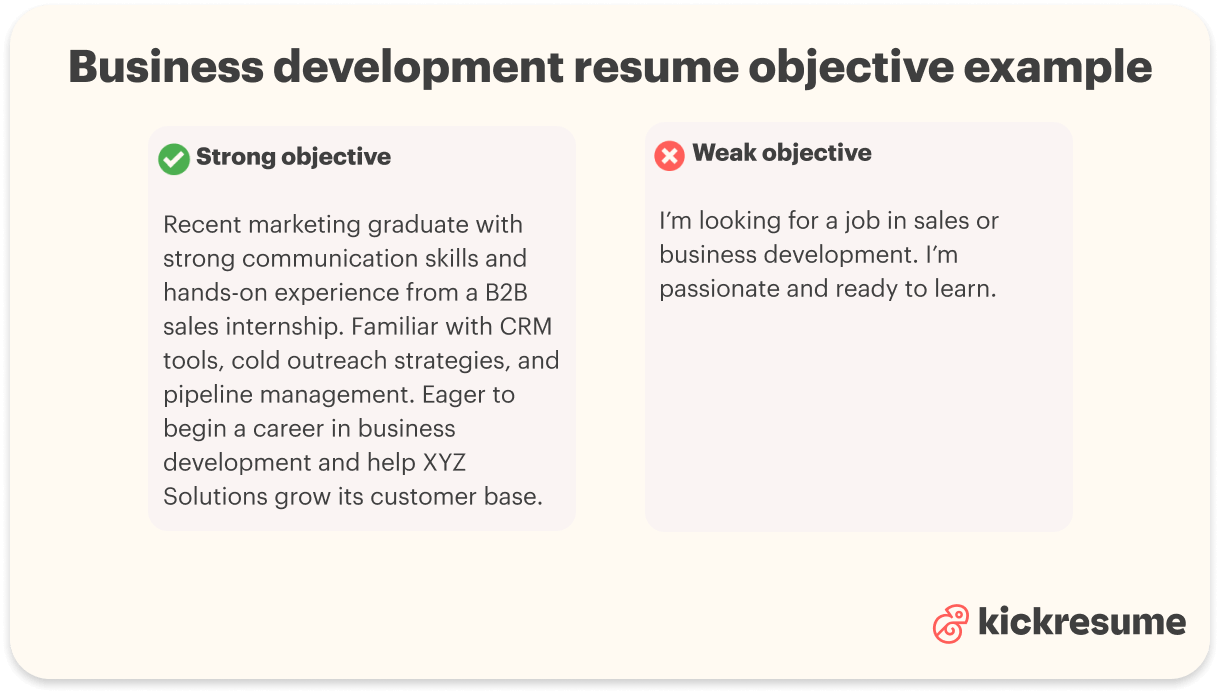
Bad business development resume objective
I’m looking for a job in sales or business development. I’m passionate and ready to learn.
What's the verdict? This objective isn't awful, but it's not memorable either. It doesn’t tell the hiring manager what skills you have or what you’re bringing to the role. “Passionate” and “ready to learn” are nice ideas, but they need backup.
Good business development resume objective
Recent marketing graduate with strong communication skills and hands-on experience from a B2B sales internship. Familiar with CRM tools, cold outreach strategies, and pipeline management. Eager to begin a career in business development and help XYZ Solutions grow its customer base.
Why is this example better? This version shows potential. It proves the candidate has taken steps toward a BD career, even if they’re new to it. It also shows focus, relevant skills, and enthusiasm.
Whether you go with a summary or an objective, keep it short (around 3 to 5 lines max). This section isn’t your life story. It’s a teaser that encourages the reader to keep going. Be clear, be specific, and avoid cliche phrases like “motivated” or “team player.”
3. How to present the right skills on your business development resume
If there’s one thing that makes or breaks a business development resume, it’s tailoring.
It’s tempting to list every skill you’ve picked up over the years. After all, you’ve probably got a pretty broad set. But writing a resume that actually lands you interviews isn’t about showing off everything you could do. It’s about showing you’re the person they’re looking for.
So how do you know which skills to put front and center?
- Read the job description.
Start here. Look for the skills that are mentioned directly. They’re usually listed under “requirements” or “preferred qualifications.” Pay attention to the ones that come up more than once, they’re probably key. - Compare the list to your own experience.
Now take a look at your own skill set. What lines up with what the job is asking for? That overlap — that’s your sweet spot. - Create a dedicated skills section.
Make a separate “Skills” section on your resume. Put your most relevant, job-specific skills right at the top of the list. This makes it super easy for a recruiter (or an applicant tracking system) to spot what matters most.
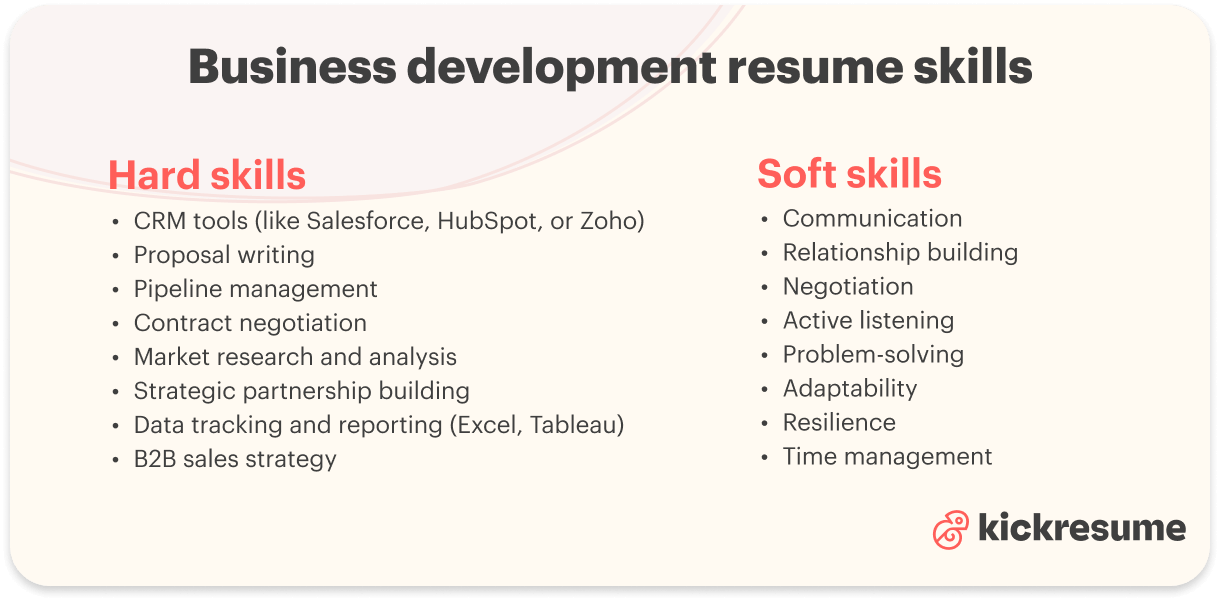
Here's a quick list of the most in-demand business development skills:
Top 10 hard skills for business development resume
- Lead generation
- Cold calling and cold emailing
- CRM tools (like Salesforce, HubSpot, or Zoho)
- Proposal writing
- Pipeline management
- Contract negotiation
- Market research and analysis
- Strategic partnership building
- Data tracking and reporting (Excel, Google Sheets, Tableau)
- B2B sales strategy
Hard skills like these are crucial, but they’re only half the picture. In business development, where trust, communication, and people skills go a long way, soft skills can carry just as much weight.
Top 10 soft skills for business development resume
- Communication
- Relationship building
- Negotiation
- Active listening
- Problem-solving
- Adaptability
- Resilience
- Time management
- Collaboration
- Emotional intelligence
Remember that these don’t just belong in your skills section. In fact, the most convincing resumes are the ones where skills are backed up by real examples throughout the document. But we’ll talk more about how to do that in the next chapter.
4. How to describe work experience on a resume effectively
Just like with your skills section, your work experience section shouldn’t be a one-size-fits-all list. It needs to be tailored based on the job ad you’re applying to.
A good place to start? Go back to the job description.
Focus on sections like “Requirements” or “You’ll be responsible for.” That’s where employers tell you exactly what they want from their next hire. Pay attention to the skills and responsibilities that come up again and again (those are the ones they care about most).
So what makes a strong work experience entry? Follow this formula:
- Start with your job title, organization, and location
- Add your dates of employment (month + year format is standard)
- Use bullet points to describe your key responsibilities and accomplishments
- Focus on outcomes, not just duties
- Back it up with numbers or metrics whenever possible
- Lead with action verbs (we’ll cover those in an upcoming chapter)
Take a look at these two examples and see which one work better:
Bad example of a business development work history entry
Business Development Associate
BrightEdge Partners, Boston, MA
March 2021 – Present
- I used to contact leads
- I was responsible for scheduling meetings
- I attended client calls
- I know how to work with CRM
- I wrote sales reports
Why is this example so lackluster? Because it doesn’t do much to set the candidate apart. It’s vague, it’s repetitive, and it doesn’t give the reader any sense of impact. We don’t know how many leads they handled, what kind of results they got, or what kind of clients they worked with. This could be describing anyone.
Good example of a business development work history entry
Business Development Associate
BrightEdge Partners, Boston, MA
March 2021 – Present
- Prospected and qualified over 200 leads per quarter, helping boost sales pipeline by 40% year-over-year.
- Booked and prepped 50+ client discovery calls monthly, consistently converting 30% into product demos.
- Partnered with the marketing team to refine outreach messaging, increasing email response rates by 22%.
- Maintained detailed records in HubSpot CRM, enabling better sales forecasting and lead tracking.
What makes this version so much better? This version uses real numbers to show the scale of the work, and every line gives a clear sense of how the candidate contributed to the team’s success. Instead of just listing tasks, it focuses on results. And this is exactly what recruiters want to see!
Tips for students and newcomers to the field
If you’re just starting out, you can still build a strong experience section even without years of official BD titles on your resume. The trick is to think about what’s transferable. You might have more relevant experience than you think.
Here are a few things you can include:
- Sales or customer service jobs
- Internships, apprenticeships, or business-related coursework
- Freelance work or entrepreneurship
- Volunteering or fundraising
- Projects where you researched, negotiated, or built relationships
Good example for someone with limited experience
Sales Intern
LaunchPoint Solutions, Remote
June 2023 – September 2023
- Assisted in generating 100+ qualified leads using LinkedIn and industry databases.
- Shadowed senior reps during client calls and compiled detailed meeting notes for follow-up.
- Created and presented a mock sales pitch to leadership as part of final project, receiving top marks for clarity and strategy.
- Learned fundamentals of CRM usage, including contact tracking, tagging, and pipeline updates.
Even if the job title was junior or temporary, you can still show initiative, curiosity, and a willingness to learn. You need to prove that you’ve already had your hands on some of the tools and processes used in real business development roles.
5. How to elevate your business development resume with action verbs
Want to give your resume that extra spark of clarity and confidence? Here's a trick that works every time: action verbs.
Instead of sounding passive or vague, you’ll come across as someone who takes initiative, drives results, and gets things done.
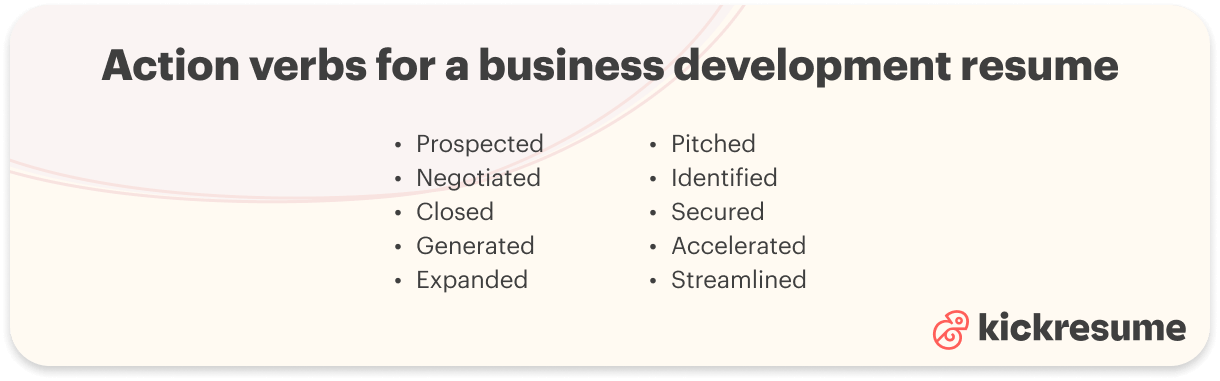
Action verbs to use on a business development resume
- Prospected
- Negotiated
- Closed
- Generated
- Expanded
- Pitched
- Identified
- Secured
- Accelerated
- Streamlined
What is an ‘action verb’ mistake you definitely want to avoid? Starting every bullet point with the same word. Even if you’ve used strong verbs, repetition makes your resume feel flat. Try to rotate between different verbs that describe your impact from various angles (like strategic, collaborative, results-driven, and so on).
Let’s look at an example of that in action:
Too repetitive:
- Conducted outreach to new clients.
- Conducted meetings with prospects.
- Conducted research on competitors.
More varied:
- Prospected and qualified 30+ leads per week through outbound outreach.
- Hosted tailored discovery meetings to assess client needs and present solutions.
- Analyzed competitor strategies to identify new market entry points.
6. How to flash out your education as a business developer
Does your education section really matter if you’ve already been working in business development for a while? Or if your degree doesn’t exactly scream “sales strategy and pipeline management”?
Short answer: yes, it absolutely matters.
However, how you present your education depends a lot on your background and where you are in your career. Here’s how to handle each situation:
Option 1: Your degree isn’t directly related to business development
Maybe you studied literature, psychology, or something else entirely and then pivoted into business development later. That’s totally fine. A degree in another field still tells employers a few important things:
- You know how to commit to something and follow through
- You’ve sharpened your communication, analysis, or research skills
- You’ve handled deadlines, group work, and challenging coursework
In this case, keep your education section clean and straightforward:
Education section example for business developers with an unrelated degree
BA in English Literature
University of Illinois, Urbana-Champaign
2015 – 2019
BTW, if there are any electives, minors, or academic projects that touched on business, marketing, communications, or analytics, don’t be afraid to mention them in a bullet or two. They can help build a bridge between your academic background and your current career path.
Option 2: Your degree is relevant to business development
If you studied business, economics, marketing, communications, or anything related, this is a natural opportunity to show how your education laid the groundwork for your current skills.
In this case, go beyond the basics. Include:
- Relevant coursework (e.g. Sales Strategy, Consumer Psychology, Market Research)
- Projects or case studies
- Business competitions or clubs
- Academic achievements
- Internships completed during school
Education section example for business developers with a related degree
BBA in Marketing & Sales Strategy
Texas A&M University
2018 – 2022
- Relevant coursework: Competitive Analysis, Business Communication, CRM Systems
- Capstone project: Developed a go-to-market strategy for a B2B SaaS product, leading mock sales pitches to industry mentors
- Honors: Dean’s List (4 semesters), Vice President of Sales Club
No matter what you studied or when you graduated, your education is never “just filler.” That being said, your education also doesn’t have to carry the whole resume. But if you present it thoughtfully, it can absolutely pull its weight in making you stand out (in a good way).
Find out your resume score!

7. How to select relevant optional sections for your resume
Resume summary? Check.
Skills section? Check.
Work experience and education? Double check.
If you’ve got all of those, you technically have a complete resume.
But what if you’ve got more to say? More value to add? In that case, don’t hold back. Optional resume sections give you the freedom to go beyond the basics and highlight the things that make you you.
That said, don’t just tack on extras for the sake of looking more “impressive.” Every additional section should serve a clear purpose.
When should you add optional sections?
Go for it if:
- You have something truly relevant that doesn’t fit neatly into the main sections.
- There’s still room on the page without making it feel cluttered.
- The section adds clear value or reinforces your suitability for the role.
Maybe skip it if:
- You’re adding content just to fill space.
- It’s not directly relevant to business development or transferable in some way.
- You have to stretch or exaggerate to make it sound resume-worthy.
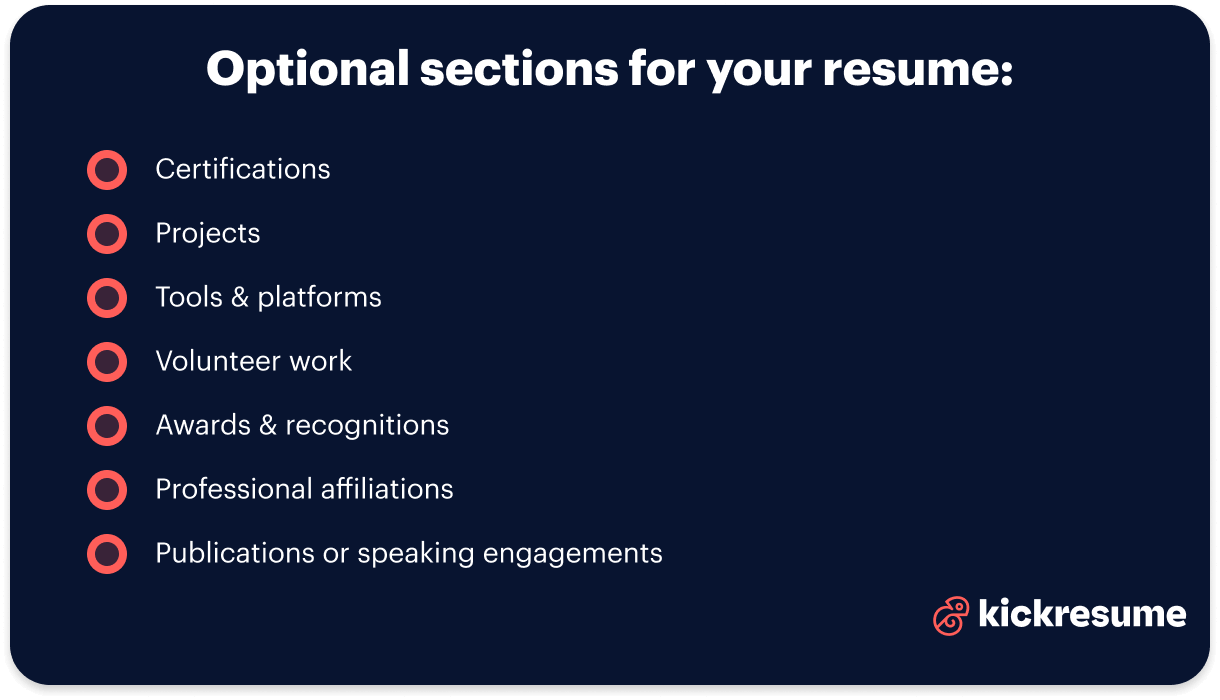
Here are some additions that can really boost your business development resume:
- Certifications
- Projects
- Tools & platforms
- Volunteer work
- Awards & recognitions
- Professional affiliations
- Publications or speaking engagements
Example of optional sections in a business development resume
Certifications
- HubSpot Sales Software Certification – April 2024
- Strategic Negotiation, LinkedIn Learning – October 2023
- Google Data Analytics Certificate – June 2022
Projects
Partnership Expansion Strategy | Freelance Consulting
- Developed and executed a strategy for identifying and onboarding five new B2B partnerships in the SaaS industry, increasing the client’s outreach capacity by 40% within three months.
Awards & Recognitions
- “Top Sales Performer,” Growth Division, RevUp Inc. (2023)
- “Outstanding Contribution to Client Success,” BrightPath Solutions (2022)
Optional sections shouldn’t be used as a resume padding! If a section adds context, shows off a strength, or sets you apart from other candidates, keep it in. If not, it needs to go.
8. How to steer clear of mistakes that can sabotage your resume
You’ve spent time building a resume that shows off your skills, experience, and potential. Great. But before you start sending it out, take a moment to make sure it’s not holding any hidden red flags that could hurt your chances.
Even the most experienced candidates can fall victims to these common mistakes:
Mistake #1: Typos, grammar slips, and clunky language
Business development is all about communication — written, spoken, and everything in between. If your resume has obvious errors, it sends the wrong message. Run it through a grammar checker, then ask someone else to take a look. A second pair of eyes can catch what spellcheck misses.
Mistake #2: A “one-size-fits-all” resume
Each company has its own style, its own tools, its own goals. If you’re applying for a role that’s focused on outbound sales strategy, and your resume leans heavily into account management, it might miss the mark. Tailor your resume to reflect what this company is looking for (especially in the top sections like your summary, skills, and bullet points).
Mistake #3: Listing responsibilities, not results
Writing “Managed client accounts and led meetings” doesn’t really tell hiring managers anything. How many accounts? What was the outcome? Instead, show what you achieved: “Managed 12 enterprise accounts and increased annual contract value by 22% through upselling and relationship management.”
Mistake #4: Forgetting the numbers
Metrics are your best friend. Revenue generated, deals closed, growth rates, client retention percentages, all of these add clarity and credibility. Don’t just say you “drove growth.” Show it.
Mistake #5: Ignoring keywords from the job description
Most companies use some form of applicant tracking software (ATS). If your resume doesn’t reflect the specific terms they’re looking for (like “pipeline development,” “CRM management,” or “strategic partnerships”) you might not get past the first filter. Don’t keyword stuff, but do align your phrasing where it makes sense.
Mistake #6: Sloppy formatting
A messy layout, inconsistent bullet points, or multiple fonts can make your resume hard to read. And easy to skip. Keep it clean. Use consistent spacing, clear section headers, and one professional font throughout. A recruiter should be able to skim your resume in under 30 seconds and still get the key info.
Mistake #7: Outdated or unprofessional contact details
Double-check your phone number. Use a professional-sounding email. And if you link to your LinkedIn profile, make sure it matches the content and tone of your resume.
Mistake #8: Adding filler
Business development is a results-oriented role. If something doesn’t contribute to your value as a candidate, cut it. That summer you spent bartending might have been fun, but unless you’re drawing a clear line to customer engagement or upselling, leave it off.
By this point, you’ve already put too much time and effort into crafting your resume to let small, avoidable mistakes ruin it. So muster that last bit of energy and give it one more careful look. Double-check it, triple-check it if you have to. Those five extra minutes you invest in your resume could be the difference between ghosting and a callback.
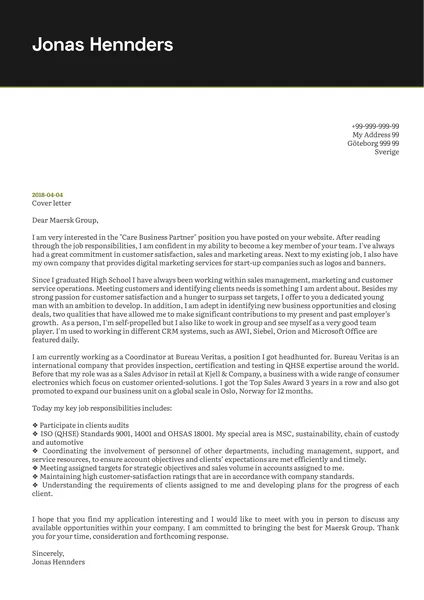
9. How to pair your business development resume with a matching cover letter
You’ve already distilled your achievements and tailored your resume, but if you really want to stand out as a business development pro, your job application still misses one ingredient: the cover letter.
Sure, some job ads say a cover letter it’s optional. But in a field as people-oriented and competitive as business development, a well-written cover letter shows your communication skills and a knack for building strong, persuasive messages.
What should your cover letter do?
In just a few paragraphs, you should answer:
- Who are you?
- Why do you want this role, at this company?
- How does your background connect to what they’re looking for?
- What value can you bring?
You don’t need to retell your entire resume. Instead, use your cover letter to add context, explain transitions, and make a more personal connection.
Resume vs. cover letter: what’s the difference?
While they work together, each has its own job:
- Your resume follows a conventional structure. It's clean, concise, and uses bullet points.
- Your cover letter is more conversational. It communicates with the reader in complete sentences.
For example, your resume might say:
- Generated $1.2M in new revenue by launching outbound campaigns across underperforming regions.
While your cover letter can expand:
Over the last year, I’ve led regional prospecting efforts that resulted in $1.2M in new revenue. It wasn’t just about volume, it was about identifying underserved markets, tailoring our messaging, and nurturing the right partnerships at the right time.
Keep your documents visually in sync
Your cover letter and resume don’t have to be identical twins, but they should at least look like they’re part of the same family. Here’s how to keep things consistent:
- Same header: Use the same layout for your name and contact info.
- Same fonts: Stick with one typeface throughout both documents.
- Matching layout and spacing: Align your margins, line spacing, and paragraph breaks.
- Same design style: If you’ve used bold colors or section dividers in your resume, lightly echo them in your cover letter.
The truth is, most people won’t bother sending a cover letter. So when you do, it immediately sets you apart. It doesn’t have to be long or formal. Just pen something relevant, tailored, and full of personality. Sometimes, that little extra effort is exactly what gets you in the door.
Let your cover letter write itself — with AI!

10. Top resources for job-seeking business developers
Now that you know how to put together a job-winning business development resume, let's move on to the heart of the matter — the actual job hunt. So, roll up your sleeves and get started with our recommended resources:
- Job boards for business developers: You can find job postings that cater specifically to your profession on websites like AngelList, Business Development Crossing, or NBDA’s Job Board.
- General job search platforms: Next, move on to pages like LinkedIn, Monster, Indeed, Glassdoor, or SimplyHired that aggregate job postings from all industries.
- Consulting firms: Don't hesitate to check out career centers of consulting firms, such as Deloitte, Accenture, McKinsey & Company, and Bain & Company or contact them directly with your standout resume.
- Professional associations: Get access to networking opportunities, job postings, further training and latest news with organizations like Capital Business Development Association (CBDA), The Global Business Development Association (GBDA), or the International Association for Business Development and Strategic Partnerships.
- Specialized publications: Stand out from competition by keeping in touch with the latest business news trends, innovations, and strategies. For example, by following media such as “Strategy+Business,” “TechCrunch,” “Forbes,” or “Fast Company.”
- Courses & certifications: Expand your skill set by enrolling in courses, such as those provided by online learning platforms. For example, by Coursera, LinkedIn Learning, Udemy, or edX.
The process of job searching may sometimes feel like an uphill battle, but with patience, resilience, and a stellar business development resume that impresses even the most demanding of recruiters, you'll land your dream job soon enough. Good luck!
Business Career Outlook in 2025
Employment in Business and Financial occupations is expected to grow faster than the average for all occupations from 2023 to 2033. (Source: U.S. Bureau of Labor Statistics)
Every year, about 963,500 Business job openings are expected to open, primarily due to employment growth and the need to replace workers who leave these occupations permanently.
Average US base salaries across popular Business roles:
- Account Manager: $69,875/year (excl. Commission)
- Business Development Manager: $86,012/year (excl. Profit sharing)
- Business Analyst: $85,143/year (excl. Cash bonus)
- Consultant: $94,841/year
- Investment Associate: $100,004/year
- Procurement Specialist: $68,710/year
- Procurement Coordinator: $99,814/year
- Procurement Engineer: $98,661/year
- Procurement Coordinator: $99,814/year
What key areas/markets attract Venture Capital Investments in 2025?
- Artificial Intelligence (AI): Focus on natural language processing, AI-powered cybersecurity, and healthcare diagnostics.
- Climate Tech and Sustainability: Investments in renewable energy storage, carbon capture, and eco-friendly consumer products.
- Fintech and Decentralized Finance (DeFi): Interest in blockchain lending platforms, digital wallets, and financial automation tools.
- Healthtech and Biotech: Growth in personalized medicine, digital health platforms, and mental health technology.
(Sources: The Successful Founder & Forbes)
Business Development Resume FAQ
How to use keywords effectively in my business development resume?
Keywords should be scattered naturally throughout the whole content. But which keywords to use? Take a look at your job posting.They'll likely be the specific skills, qualifications, or other requirements mentioned in the job description. So if they want someone with "exceptional negotiation skills", ensure that phrase finds a comfy spot on your resume. And also keep the same spelling to ensure maximum compliance with the ATS.
What common mistakes should I avoid in my business development resume?
By far the worst mistake you can make is NOT customizing your resume to fit with the requirements outlined in your job posting. Other common errors include typos, grammatical mistakes, and misspellings. All of these suggest a lack of attention to detail. Also, stay away from irrelevant information and filler phrases. Stick to the highlights that are relevant to business development.
How should I showcase my skills on a business development resume?
Always focus on skills related to business development, like strategic planning or client relationship management. Then pair each skill with a powerful example. Show how your strategic thinking increased efficiency, or your client management brought new business on board. And don't shy away from action verbs and quantifying your achievements. Saying "Increased client retention by 20% through strategic relationship management" showcases your impact more vividly.
What's the most important part of a business development resume?
This is a tricky question because they're all important, just in different ways. However, if we must pick one, the experience section takes the crown. This is where you reveal your past achievements, challenges overcome, and skills in action. But remember, no area should be neglected.
How do I focus my business development resume if I am aiming to change industries?
You need to focus on transferable skills and relevant achievements. Business development relies on skills like client relationship building, market research, and strategic planning—these are applicable across industries. Write a strong profile summary or objective statement to specifically address your desire for a career pivot. Spin your change as an asset, not an obstacle.








![How to Write a Professional Resume Summary? [+Examples]](https://d2xe0iugdha6pz.cloudfront.net/article-small-images/How_to_Write_a_Professional_Resume_Summary_.png)
![How to List Your Education on a Resume? [+Examples]](https://d2xe0iugdha6pz.cloudfront.net/article-small-images/How_to_Put_Education_on_a_Resume_.png)
![How to Describe Your Work Experience on a Resume? [+Examples]](https://d2xe0iugdha6pz.cloudfront.net/article-small-images/How_to_Describe_Your_Work_Experience_on_a_Resume_.png)