

 ChatGPT
 Perplexity AI
 Claude
TL;DR How to list awards and achievements on a resume
List each award or achievement with four details: its name, the organization that gave it, the date, and a short line on why you earned it, quantified wherever possible (e.g., "Increased regional sales by 22%"). Create a dedicated Awards & Achievements section if you have three or more, or if they're from well-known institutions; otherwise fold them into your summary, education, or work experience. Awards are third-party recognitions (scholarships, "Employee of the Month"); achievements are measurable results you produced. Keep it to bullet points, lead with numbers, and only include what's relevant to the job.
Format: Award name — Awarding organization — Date — Why you earned it (with numbers).
Awards and achievements on a resume elevate your CV by showcasing your successes. Recruiters often look for that “extra edge” that sets one candidate apart from another. And in 2026, they also increasingly expect resumes to highlight measurable impact — not just job duties.
Awards and achievements can be exactly that — whether it’s an academic scholarship, an “Employee of the Month” title, or an industry certification. Listing them properly on your resume can help you stand out, show credibility, and even improve your chances with Applicant Tracking Systems (ATS).
So without further ado, let’s show you how to list awards on a resume, describe your academic achievements, and how to put scholarships on your resume to make it stand out.
This guide will show you:
- What is the awards and achievements section on your resume?
- Why list achievements and awards in your resume?
- Where to list awards and achievements in a resume?
- How to list awards and achievements on a resume?
- How to put scholarships on a resume.
- Awards and achievements examples for different professions.
- Achievements and awards in resume examples.
- And more.
Use artificial intelligence to create your resume — FAST!

What is the awards and achievements section on your resume?
As the name suggests, awards and achievements on a resume are a separate section where you list relevant honors, achievements, awards, and acknowledgements you earned for going beyond average.
It can include scholarships, competitions, work-related awards, or even promotions to leadership positions in your job.
What's the difference between awards and achievements?
- Awards: Third-party recognitions from schools, employers, competitions, or institutions (e.g., Gold Award for Leadership). If you win an award, you'll also get an official document validating it.
- Achievements: Measurable results you accomplished through your work. They illustrate how you've exceeded expectations, excelled, and added value beyond your regular duties (e.g., Exceeded sales targets by 20% by onboarding 50 new clients.).
Hence, you can name the section as "Awards", "Awards and achievements", "Achievements", etc. depending on what you want to include.
Also, you don’t always have to create a separate awards and acknowledgements section for your resume. Instead, you can also incorporate them into your other sections, such as professional summary, education, or work experience.
But more on that later.

Have you included your awards and achievements in your LinkedIn profile, too? You can easily turn it into a polished resume with just one click.
Why should you list achievements and awards on a resume?
- To stand out. You're more likely to be invited for an interview if your resume is focused on your achievements, rather than mere responsibilities.
- To differentiate your resume from AI-generated descriptions. By highlighting verifiable, unique accomplishments, you make your resume more you.
- To distract from a lack of relevant work experience. If you’re a fresh graduate without much past work experience, any past scholarships, dean’s list mentions, or academic awards can help you secure an internship or entry-level job.
- To highlight your value. As an experienced professional, you show real value that you've brought to previous roles or projects.
- To demonstrate your skills. For example, winning an award for a project demonstrates project management, leadership, and other relevant skills.
- To show you're committed to your career. Achievements show potential employers that you're dedicated to your field and are always striving to improve and excel. This signals that you'll bring a similar level of commitment and enthusiasm to their organization.
In short: achievements and awards prove you're capable of delivering results.
Find out your resume score!

Where do you put awards and achievements on a resume?
There are generally two ways to include your accomplishments in your resume. You can either:
- Distribute them across other resume sections. Do this if the award you were given isn't widely recognized within the industry, or it's an award/achievement you were given as a part of your job or within the company. Additionally, do this if you want to include less than three awards/achievements.
- Create a separate section on your resume. Do this if you were awarded for doing something outside of the usual scope of your work, you were recognized by a notable and reputable institution, or you simply want to highlight it. Moreover, create a separate section if you have 3 or more awards/achievements to highlight.
If option number 2 sounds better for you, then the placement of the Awards and achievements section within your resume depends on the resume format you choose.
- A chronological resume format is the OG, classic format, and it’s best suited for experienced professionals or those who want to showcase their career progression. The focus here is on the work experience section, which is placed first and is very detailed.
- A functional resume format is best for those changing careers or those with little actual work experience, like recent graduates or entry-level professionals. This format focuses on your skills and achievements (and education if you’re a recent grad) instead of your work experience.
This means that...
If you’re going with the classic chronological resume, the awards and achievements section should be placed towards the end of your resume, after the Skills section.
If you’re going with a functional resume, place the awards and achievements section after Skills, towards the beginning of your resume. That is, of course, only if your achievements are relevant to the desired job.
🎯 Pro Tip: Need help writing a polished summary for your achievements? Kickresume’s AI Resume Writer can generate tailored bullet points in seconds.
Christy Morgan, Kickresume's Resident HR Expert, comments:
"Sometimes, having a Key Achievements section above Work History is OK, because it helps recruiters to see immediately what your accomplishments are if they are significant. Otherwise, I'd say incorporate achievements in the work descriptions. That's where they’re the most relevant and where the context of your achievements is, so it makes more sense to the reader. But you can also mention anything particularly awesome in your summary. Something like “Award-winning salesperson” will immediately catch the attention of recruiters. Then you can mention the specific award/s in the job descriptions.”
How do you list awards and achievements on a resume?
Listing your achievements on a resume is always a very effective way of catching employers’ attention. But, how to write the awards section in a resume?
You should follow certain rules to ensure you include your accomplishments in an ATS-friendly and professional way.
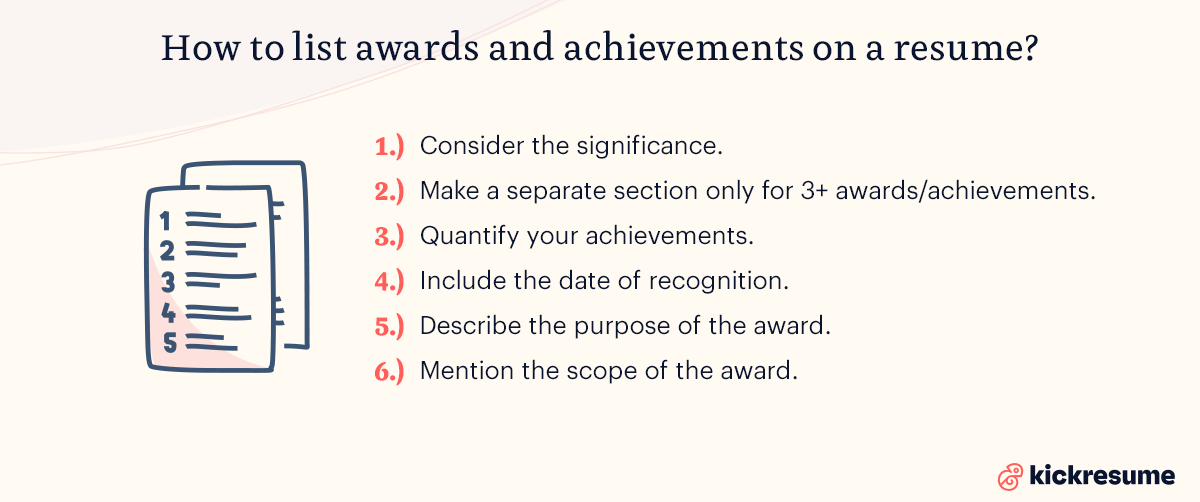
Here's how to do that:
- Consider significance. Only list achievements in a separate section if they’re relevant and notable enough. If they're not, either exclude them completely or use other sections instead.
- Three or more rule. If you only have one or two awards/achievements, it's best to incorporate them into other sections rather than create a separate section.
- Quantify your achievements. A measured achievement is particularly impressive. Claiming that you “Cut client costs” doesn’t sound as impressive as “Cut client costs by 16 % in 12 months.” Be specific!
- Include the date of recognition. Including the date you earned the award is considered the norm. Let an employer know you still have all the skills that earned you the prize.
- Describe the purpose of the award. For example: Earned Clio Music Award 2016 for Use of Music in the Best Ketchup advertisement campaign.
- Mention the scope of the award. Was it a regional, national, or international award? Are you the only one who received it? What did you have to do to accomplish it?
- Format properly. Use clear bullet points and quantify the impact where possible. Don't just write "Employee of the Month", but rather use "Employee of the Month (3x) for exceeding monthly sales quotas by 20% and mentoring two junior associates."
- Use ATS-friendly wording. Instead of writing "Best Student", connect the award to a skill or achievement. Tie your award to keywords ("Economics", "research") so that ATS can pick it up. For example, "Awarded Best Student in Economics (2024) for research on international trade, published in a university journal."
💡 Pro Tip: Not sure if your awards are formatted correctly for ATS? Try our ATS Resume Checker to see how recruiters and software will read your resume.
Good vs bad achievement example
Not all achievements are created equal. A weak description can make even an impressive award disappear in a sea of text. Here’s the difference:
Bad achievement example
- Improved team performance and helped with project success.
Why doesn't it work?
- too vague
- no numbers
- no context
- doesn’t show scale or impact
Good achievement example
Improved team delivery speed by 22% by redesigning workflow check-ins and removing redundant approval steps.
Why this works?
- clear action
- measurable result
- specific method
- instantly more credible
Recruiters don’t want to guess how good you were — they want proof. Quantified achievements perform significantly better in both ATS scoring and manual reviews.
When should you leave awards off your resume?
Not every award belongs on your resume. Avoid including:
- Outdated awards from high school (unless you're a recent graduate).
- Awards unrelated to the job you're applying for.
- Informal or humorous recognitions ("Best Dressed" at the office party).
Even though some awards might be funny, they are often not job-related or relevant, so be careful what you include, as it might have unwanted results.
What are good awards and achievements examples by professions?
Are you still not quite sure which achievements and awards belong in a resume? Or perhaps you're unsure which awards are obtainable in your industry?
Here’s what kind of awards and accomplishments you can include:
Academic awards and achievements example
- Grants and scholarships you received (e.g., Vivienne Camp College Scholarship)
- Dean’s list mentions (e.g., Dean's list 2015/6)
- Graduation distinctions (e.g., Magna Cum Laude graduate)
- Awards for specific activities or subjects (e.g., Fine Art Award for portfolio excellence)
- High GPA (E.g., Graduated with 3.6 GPA (top 10% of class))
IT and Programming awards and achievements example
- Maurice Wilkes Award for outstanding contribution to computer architecture
- Software Process Achievement Award for innovative contributions to the field of software quality
- Computer Entrepreneur Award
- Contributed to an open-source project adopted by 1,000+ users
- Developed a tool that reduced build time by 25% for my team
Sales awards and achievements example
- Employee of the Year Award
- Sold 600 products per month
- Received a 90% positive customer survey results
- Raised revenue by 15%
- Achieved Top Sales Performer (Q2 2025) for closing 48 new B2B accounts
Education and teaching awards and achievements example
- NEA Foundation Award for Teaching Excellence
- Teacher ofthe Year 2017 award
- Managed to maintain an average exam score above 70% in GG302 course in the last 4 academic years
- Supervised 6 MA theses and 2 PhD dissertations
- Introduced new curriculum module adopted across three departments
Science awards and achievements example
- Published over 30 articles in peer-reviewed journals, including Science and Nature
- Batchelor prize for outstanding research in fluid dynamics
- Royal Society of Chemistry Award
- My article, "An optical innovation for meteorology at the quantum limit of predictive precision," was published by Nature.com
- Led research project funded with a €50,000 grant
Graphic design awards and achievements example
- Designed a customer site that won a Shopify Ecommerce Design Award in 2020
- Leibowitz Branding & Design Award
- AGDA Best Design Award
- Developed 200+ templates for infographics creation
Volunteering or personal awards and achievements example
- Volunteer of the Year
- Ran a marathon to raise funds for charity
- Increased annual donations for a charity by 32%
- Learned a new programming language (Python)
- Organized a local charity event with 300+ attendees
Modern achievements examples
- Completed Google AI Essentials certification
- Automated a reporting workflow using AI, saving 8 hours per month
- Led a fully remote team across 3 time zones to deliver a project ahead of schedule
- Contributed to open-source with PRs merged into a widely used library
- Recognized as a LinkedIn “Top Voice” in Data & Analytics (2025)
What do awards and achievements look like on real resume examples?
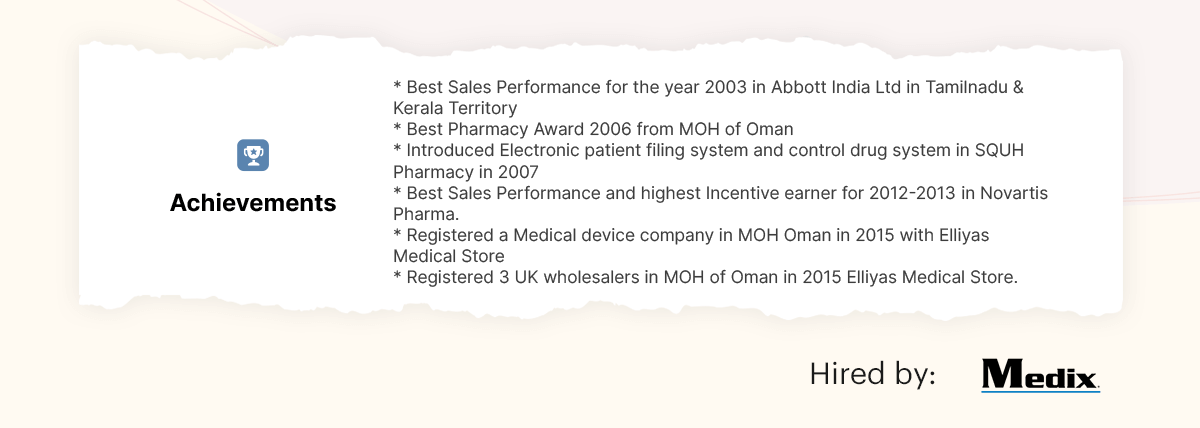
Since sometimes one picture is worth a thousand words, here are some examples of awards and achievements sections from resumes belonging to real people who got hired by well-known companies like Amazon or Maersk.
These people created their well-crafted resumes by using Kickresume’s Resume Builder.
Awards and achievements in resume example #1

Awards in resume example #2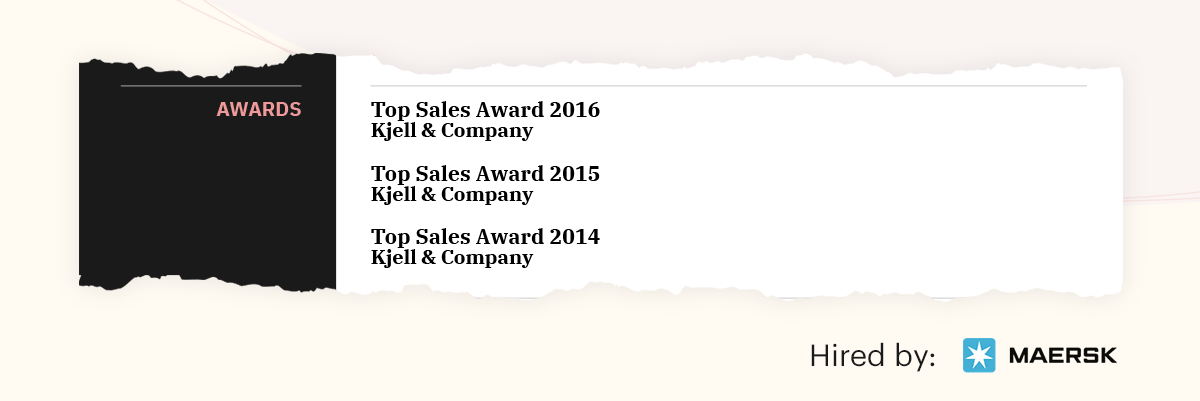
Achievements in resume example #3
It goes without saying, but read the job description carefully and ditch anything irrelevant.
For instance, if you’re a seasoned professional, you should skip your academic achievements and accomplishments.
Additionally, you should only include irrelevant awards and achievements if they’re from very prominent institutions or companies.
Student awards and achievements in resume for freshers
If you’re about to make a resume for your first job, awards and achievements carry extra weight.
Why?
Because when recruiters deliberate whether they should hire you despite having little to no professional experience, awards and achievements can be very persuasive.
Here's what awards and achievements can do for freshers:
- Prove your competence. They show that someone else evaluated you and found your work excellent.
- Act as third-party validation. They show that universities, professors, or organizations vouch for you.
- Show consistency and effort. This is especially true for academic or long-term achievements.
- Help replace missing work experience. Strong awards can help balance a shorter resume.
What counts as student awards and achievements?
You can include awards and achievements from college, university, or even high school (if you’re still a fresher).
Common examples include:
- Dean’s List / Honor Roll
- Academic excellence awards
- Best thesis / project awards
- Competition wins (case competitions, hackathons, science fairs)
- Subject-specific awards (e.g., Best Accounting Student)
- Leadership or extracurricular awards
- GPA
- Scholarships
So, if the award or achievement stands for something competitive, selective, or required consistent performance, make sure it's visible on your resume.
How to write student awards and achievements on resume
There are two correct ways to list student awards and achievements in a resume for freshers:
- Under the Education section (most common)
- In a separate “Awards & Achievements” section (if you have several)
Here's what each of these strategies look like on a resume:
.png)
.png)
How do you put scholarships on a resume?
Now that you’ve seen what a strong, well-written achievement looks like, let’s take a look at a special category of accomplishments many job seekers (specifically students and graduates) ask about: scholarships.
Here’s how to include them on your resume the right way.
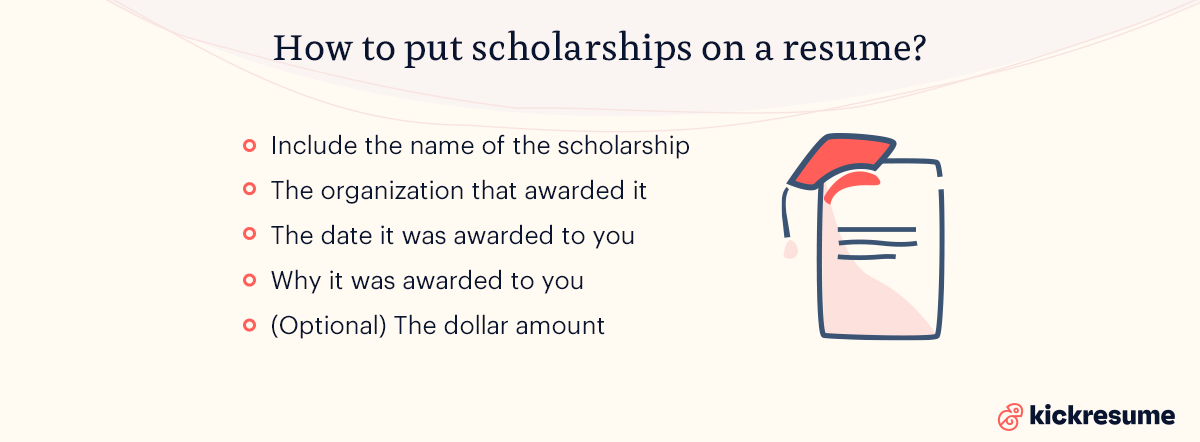
Ascholarship is a grant or payment made to support a student's education and is awarded based on academic or other achievement. Hence, it belongs on a resume!
Here are a few tips on how to list scholarships on a resume:
- Include the name of the scholarship
- The organization that awarded it
- The date it was awarded to you
- Why it was awarded to you or what you did to get it
- (Optional) The dollar amount
You can include your awards or scholarships in several sections of your resume.
Include a scholarship in a separate "Awards and achievements" section on a resume if it was awarded by a reputable organization, or if there are multiple scholarships, not only one.
On the other hand, if the scholarship is awarded by your university, you should include it in the education section.
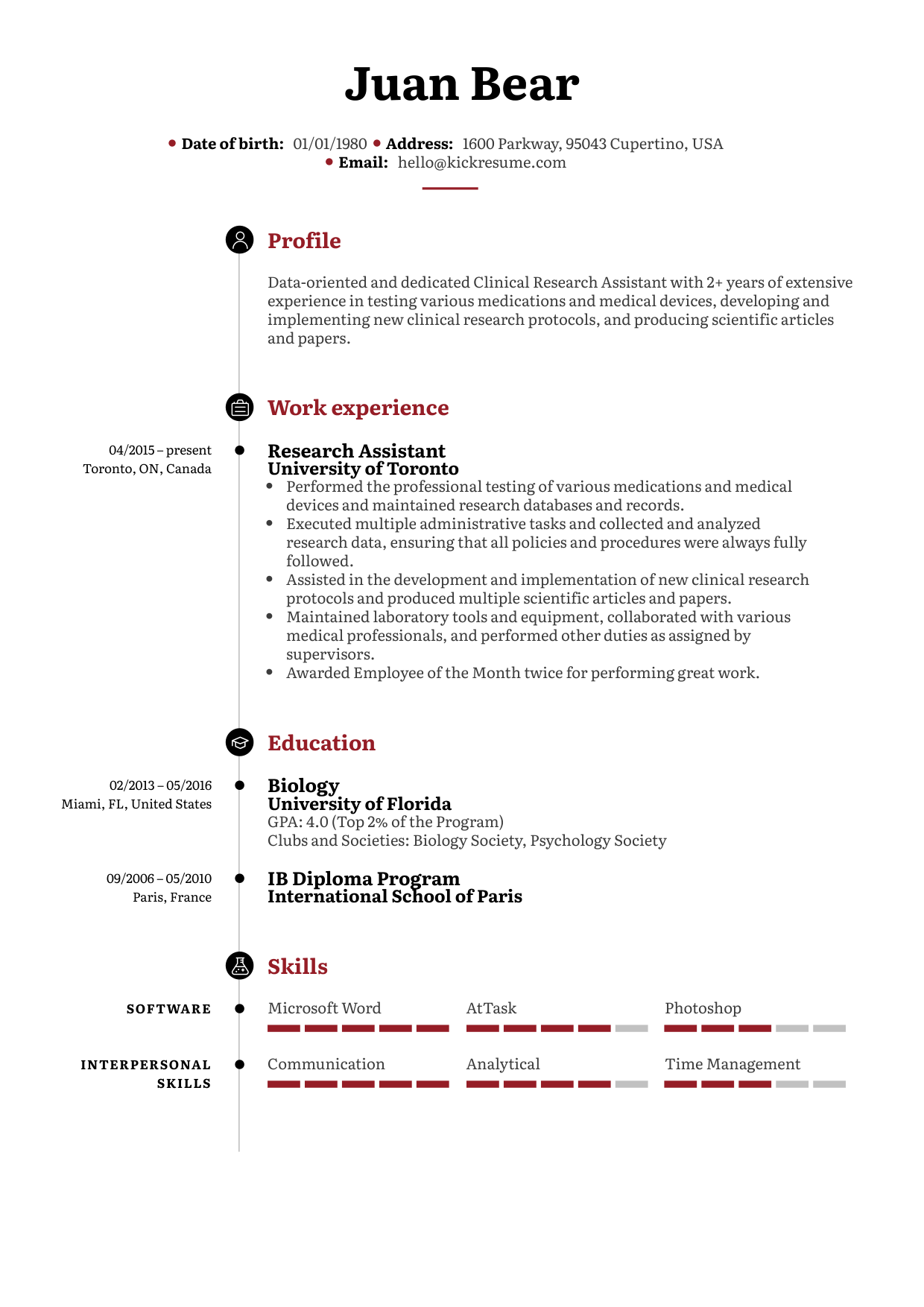
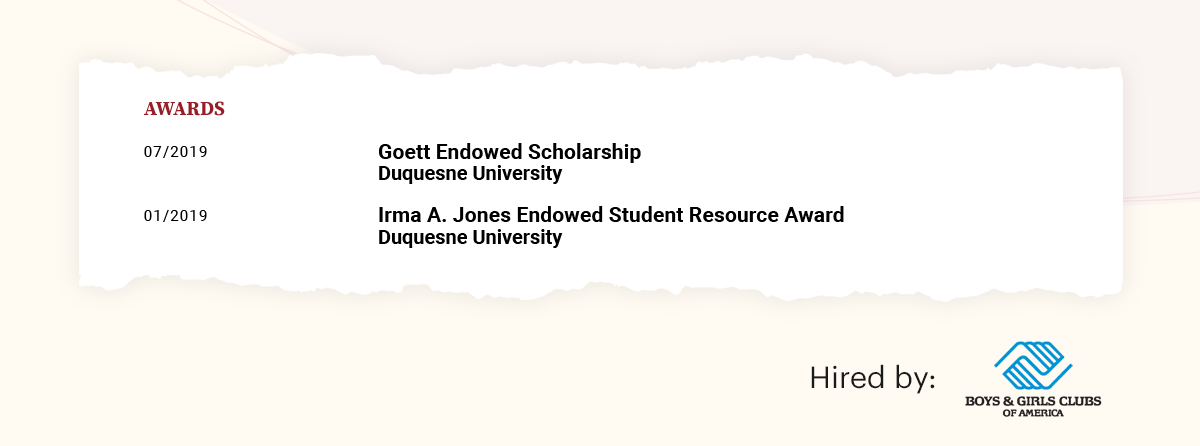
However, it's really up to you. You can list your scholarship in either of these two sections and still be correct. For instance, check the sample below.
How to list scholarships on a resume example
Final piece of advice: Awards and achievements on a resume
- Keep it short. Avoid writing long paragraphs and use bullet points instead.
- Prioritize. If you decide to designate an entire section to your achievements, think about which accomplishments are the most significant. Would you be impressed by it if you were a hiring manager?
- Avoid controversy. Some awards and achievements may be too personal or controversial. Avoid listing any political or religious accomplishments.
- Don’t exaggerate. Avoid making something up. You might be asked about your award and accomplishments in your job interview. Or they might contact your references. Lying or exaggerating can cost you a job.
- Mention your biggest accomplishments in your resume summary. If you’re a seasoned professional with many notable achievements, they deserve to be placed at the top of your resume. Impress hiring managers from the get-go.
![How to Write a Professional Resume Summary? [+Examples]](https://d2xe0iugdha6pz.cloudfront.net/article-small-images/How_to_Write_a_Professional_Resume_Summary_.png)

![How to Describe Your Work Experience on a Resume? [+Examples]](https://d2xe0iugdha6pz.cloudfront.net/article-small-images/How_to_Describe_Your_Work_Experience_on_a_Resume_.png)