What does resume tailoring actually mean?
Tailoring a resume really just means adjusting it to fit one specific job instead of sending the same version everywhere. That way your resume reads like it was written specifically for that role.
But... why bother?
Because sending the same CV to every job just isn't enough anymore.
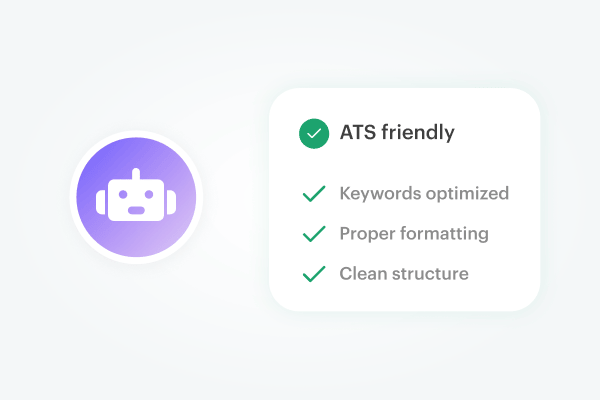
Most companies now use an Applicant Tracking System (ATS). It's software that filters and ranks resumes before a human ever sees them.
If yours doesn't include the right keywords from the job description, it can get filtered out, no matter how good you actually are.
And it's not just the software. A recruiter reads whatever gets through, so you're writing for both.
Is it worth the effort, though?
You're 31% more likely to land an interview when your resume is tailored.
In fact, 63% of recruiters favor a resume that matches the role.
The average attention your resume gets is 7.4 seconds, so the fit has to be obvious.
Tailoring itself is pretty simple. It comes down to a few steps.
How to tailor your resume (manually)
- Start with the job description and read it closely.
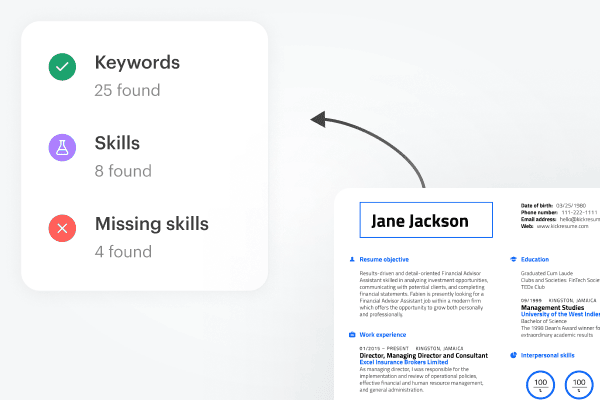
- Look for the keywords that keep coming up, the skills listed as required, and the phrases the company repeats, because those are the things they care about most.
- Then go back to your resume and match it as closely as you honestly can.
- Mirror the job title, work in the keywords, and include the specific skills, tools, and certifications the role asks for.
The annoying part? You have to do all of this again for every single job you apply to.
And let’s be honest, who has the time for that?
Nobody does, and you shouldn't have to.
So we built something to do it for you.
Meet Kickresume's Resume Tailoring tool
Resume Tailoring by Kickresume tailors your resume to a specific job, so you don't have to redo it by hand every time.
You paste the job description (or job post URL), it does the matching and rewriting, and you get a resume tailored for that role.
The whole process takes about 2 minutes.
And no, before you ask, this isn't another AI gimmick. Here's why:
Tailoring with ChatGPT / Claude
AI has no context. So, you have to explain what tailoring even means, paste your resume text section by section, and then the job description. Write the right prompt, then fix what it invents, go back and forth 100 times. Then you're on to the next chore: formatting it or designing it yourself.
Kickresume's Resume Tailoring
A specific tool for a specific job. Resume Tailoring was built in house together with a Certified Professional Résumé Writer (CPRW) and HR experts who tested and refined it round after round. For months.
Every decision was shaped by what users told us the old version was missing. So, you now see every edit it makes, where it appears, and the reason behind it.
While you're the one in control the whole time.
Your tailored resume comes back already in your design, formatted, and ready to download and send.
PS: We banned the AI slop words and phrases (you know the ones... "spearheaded"). No need to argue with a chatbot to make it more human.
We've spent years helping people write better resumes, and we put that experience straight into this tool.
Here's what that looks like when you use it.
You choose how far it goes
Tailoring means different things to different people. Some want a light touch that keeps their resume mostly as-is. Others want to squeeze every last keyword out of the job ad.
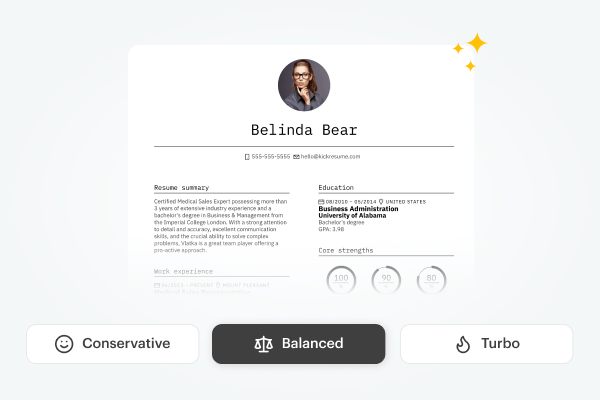
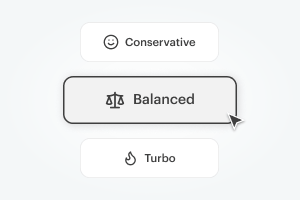
So before it changes anything, you pick the level:
- Conservative sticks close to your own words. It won't invent or oversell.
- Balanced reworks a bit more, while keeping you recognizable.
- Turbo goes all in on matching the job. It's the boldest setting, so we recommend you to read it over before you send.
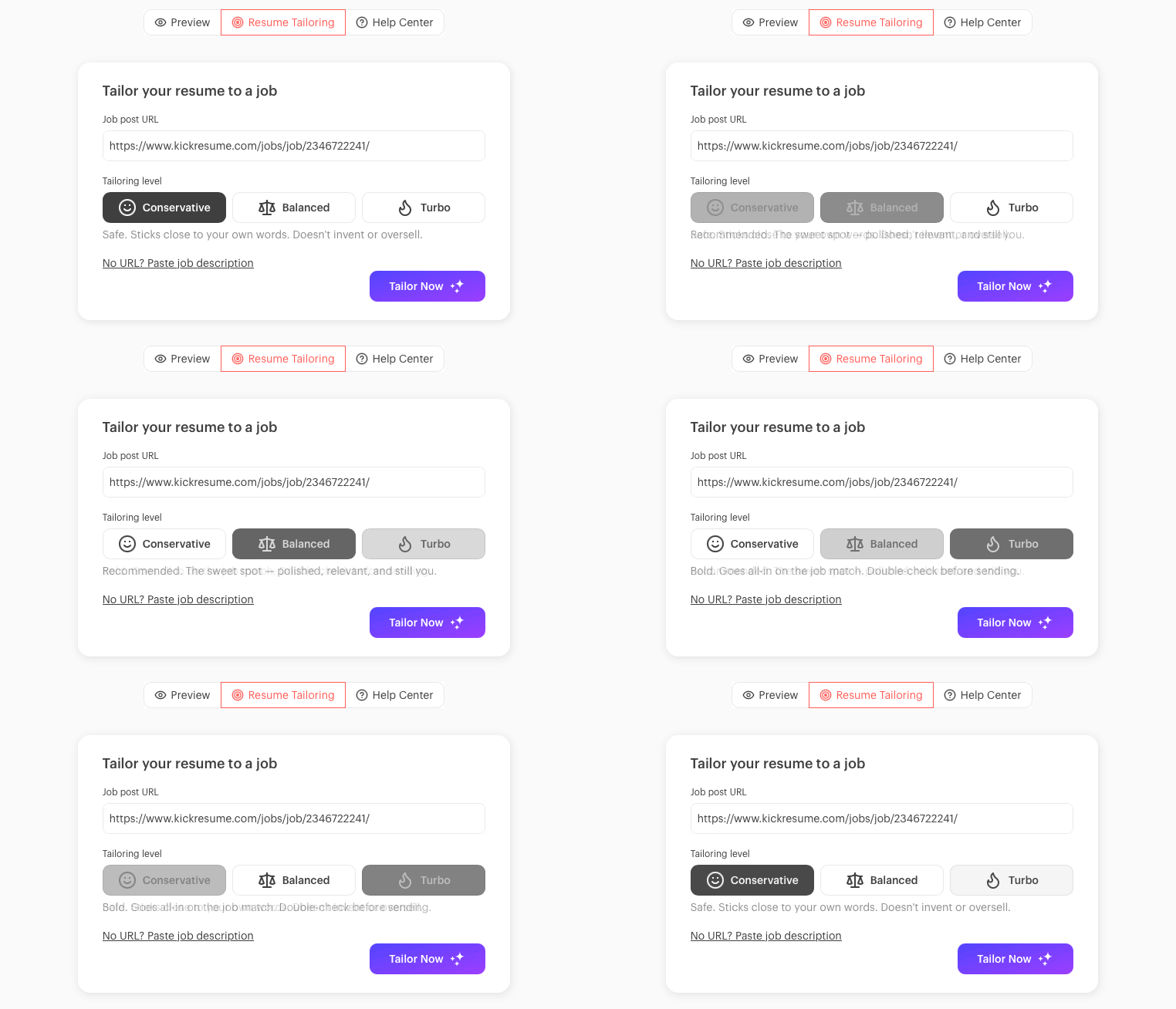
Most tools decide this for you. We let you set the tone so you have more control over what your tailored resume looks like.
You see exactly what changed
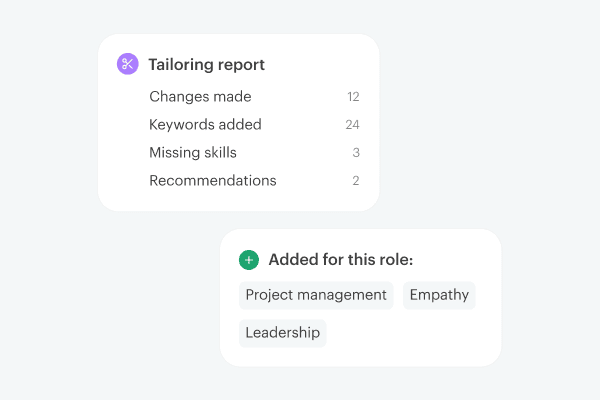
Literally. Every tailored resume comes with a "What we changed" panel.
There, you can see every change it made in each resume section and the reason behind each one. Added a keyword? Click it, and it lights up everywhere it now appears.
Then there's "Things to consider" where the tool points you toward the things only you can decide on:
- points worth addressing in a cover letter instead,
- lines you should double-check,
- skills that would be worth building,
- and things it held back from adding because it couldn't be sure they were true for you.
That's what makes the difference in an interview. You can stand behind every line, because you know exactly what changed and why.
And you never lose your original. The tailored resume is a separate copy, with the original safe in your Documents tab.
Tailored approach to tailoring
A student going for their first job and a senior manager don't need the same resume, so they shouldn't get the same tailoring.
Words like "architectured" or "orchestrated" can make a seasoned leader sound sharp, but on a first-timer's resume they just sound off.
A career-changer gets tailored differently from someone going for a promotion.
And someone in tech gets tailored differently from someone in marketing.
That's why we made it read your resume for context before it tailors anything.
We'll just say it: we think this is the most advanced AI resume tailoring tool out there right now.
We know how much work and how many rounds of iteration went into it, and the feedback from our users to this new version tells us we got it right.
But... of course we would say that it's the best AI for resume tailoring. So, you should try it on your own resume and see.
The first tailoring is free. If it wins you over (which it probably will), Kickresume Premium unlocks unlimited tailoring and the rest of our tools and features too.
The generic CV had its run. Time to tailor your resume.



 Trusted by 8 million successful job seekers worldwide.



 Ya'el Courtney, Ph.D., Postdoctoral Fellow at Stanford University
 Dennis Bondarev, Key account manager at Philips
 Steve Dominguez, Graphic Designer at K-Brite
 Giamnys Valdés Lastre, Research Intern at University of Kentucky
 David Mantic, Product Manager at Telekom
 Peter Trenkner, Product Line Manager at Dell
 Bastien Vidé, Full-stack Developer & Team Manager at Airfrance