 ChatGPT
 Perplexity AI
 Claude
This comprehensive management resume guide brings together real resume samples, practical examples, and proven templates to help you turn your leadership experience into a clear, compelling application. You’ll learn how to highlight strategic thinking, people management, and measurable results, so hiring managers can immediately see the value you bring.


 See more examples like these
In this guide, you’ll learn:
- How to choose the right resume format for management roles
- How to format your management resume to be ATS-friendly
- The difference between a resume summary and a resume objective
- How to select the most relevant management skills for your resume
- How to present achievements and work experience with real impact
- Which action verbs strengthen management resumes the most
- How to write the education section professionally for management positions
- How to choose optional resume sections that add real value
- Common mistakes to avoid when creating a management CV
- How to create a matching cover letter that complements your resume
- What to expect in terms of salary and job outlook in management roles
- Where to find the best resources for management job searching
Still looking for your next job? Kickresume gives you access to professionally designed resume templates, real-world resume examples, and career tools that help you get hired faster at every level.
Junior product manager resume sample


Why does this resume example work?
- Clear product management context: The resume makes it immediately clear that the candidate operates in a structured product environment by working with roadmaps, features, internal stakeholders, and data-driven decision-making. That context is essential for junior PM roles, where hiring managers want to see exposure to real product processes, not just theoretical knowledge.
- Strong alignment with cross-functional collaboration: The candidate highlights cooperation with developers, designers, and business teams, which is a core expectation for any product manager. This shows they understand that PM work is about coordination, prioritization, and communication, and not just working in isolation.
- Good use of analytical and business-oriented skills: Mentioning metrics, reporting, market analysis, or user feedback demonstrates that the candidate thinks beyond feature delivery and understands how product decisions connect to business outcomes. That mindset is especially valuable at the junior level.
What could be improved?
- More emphasis on ownership and decision-making: While collaboration is well presented, the resume could benefit from clearer examples of personal ownership, for instance, features the candidate led end-to-end, decisions they influenced, or priorities they helped define. This would strengthen the perception of autonomy and responsibility.
- Stronger quantification of impact: Some responsibilities would be more compelling if paired with measurable outcomes. Adding numbers such as adoption rates, usage improvements, reduced churn, or delivery timelines would help hiring managers better assess the candidate’s real-world impact.
- Clearer positioning toward a specific PM track: The resume currently touches multiple areas (business analysis, coordination, reporting), but it could be even stronger if it leaned more clearly toward a specific product management focus, such as growth, platform, or customer-facing products. This would help recruiters quickly understand where the candidate fits best within a product team.
Business development manager resume sample

Why does this resume example work?
- Clear alignment with strategic business goals: The resume immediately positions the candidate around strategic priorities by identifying opportunities, driving partnerships, and contributing to long-term growth. That level of business focus is vital for a Business Development Manager role, especially at a company like Apple, where strategy and long-term impact matter.
- Strong emphasis on measurable outcomes: Performance metrics such as revenue growth, partnership expansion, and target achievement show that the candidate delivers results, not just activity. Quantified achievements make it easier for hiring managers to see real impact rather than generic duties.
- Industry and company context are evident: The resume reflects experience in high-tech and competitive markets, which aligns well with Apple’s business environment. Language about cross-functional collaboration, product launches, and market expansion signals familiarity with both product-driven and enterprise contexts.
What could be improved?
- More detail on specific initiatives owned: The resume could further emphasize individual ownership of key business development initiatives. For example, explicitly stating which partnerships were originated or which deals were closed by the candidate would strengthen the sense of autonomy and leadership.
- Broader context around cross-functional influence: While collaboration is mentioned, it could be even more compelling to note how the candidate influenced other teams (product, marketing, operations) and what that collaboration yielded. Specific examples of stakeholder management or cross-department alignment would deepen the narrative.
- Balance executive presence with concise language: Some bullet points are longer and more descriptive than necessary. Trimming overly detailed sentences while keeping the key achievements would improve readability and make the top accomplishments stand out even more. A simpler structure helps both ATS and humans scan faster.
Senior director of production resume sample

Why does this resume example work?
- Leadership at strategic scale is clearly communicated: The resume quickly highlights seniority, broad scope, and production leadership experience, all of which are essential for an executive-level position. This gives hiring managers immediate context about the candidate’s level and the complexity of the responsibilities they’ve handled.
- Strong emphasis on measurable outcomes and production impact: Including specific achievements such as production volume improvements, budget outcomes, cost savings, or delivery efficiencies helps demonstrate impact beyond day-to-day responsibilities. Senior roles require proof of strategic results, and this resume does that well.
- Effective cross-disciplinary collaboration and stakeholder management: The candidate clearly articulates involvement with directors, creative teams, finance, and other executives. This signals that they’re not just operationally capable but also adept at navigating complex organizational relationships is a key strength for senior leaders.
What could be improved?
- More contextual narrative around big initiatives: While achievements are present, the resume could be strengthened by adding brief context to highlight the why behind major initiatives, e.g., market conditions, organizational goals, or competitive challenges that framed those achievements. This adds strategic depth to the results.
- Clearer demonstration of transformational leadership: For a senior director role, it helps to see not just incremental improvements but examples where the candidate led transformation, such as evolving production processes, adopting new technologies, or reshaping teams. More emphasis here would better align with C-suite expectations.
- Reduce internal jargon and increase universal language: Some sections contain organization-specific terminology or internal project names that may not be understood outside of Paramount. Rewriting these using more universally recognized production and leadership terms would broaden the resume’s appeal across networks and studios.
1. How to choose the right resume format for management roles
Before you start writing your management resume, one of the most important decisions you’ll make is choosing the right resume format.
Why does this matter?
Because each resume format highlights a different part of your professional background, and as a manager, the way you present your experience should reflect the type of leader you are and the level you’re aiming for.
Whether you’re leading a small team, managing departments, or overseeing company-wide operations, your resume format should support the story you want to tell.
Here are the three formats you can choose from:
Reverse-chronological resume (also called a traditional resume)
The reverse-chronological resume format puts your work experience front and center, starting with your most recent role. It’s the most widely used and recruiter-friendly option.
It works best if you’ve progressed naturally through management roles (e.g. team lead -> manager -> senior manager -> head of department) and want to clearly show career growth, increasing responsibility, and leadership impact.
Functional resume (skills-based resume)
Instead of focusing on job titles and timelines, the functional resume format emphasizes your core competencies, leadership skills, and areas of expertise.
It can be useful if:
- You’re transitioning into management from a specialist role
- Your career path isn’t linear
- You’ve worked in short-term roles, consulting, or project-based management
That said, purely functional resumes can be risky for management roles, especially when applying through ATS systems.
Hybrid resume (combination resume)
As the name suggests, this format blends both approaches. It highlights key leadership skills at the top, followed by a clear and structured work history.
This is often an excellent choice for managers who combine hands-on leadership with strategic responsibilities. For example, managers with experience in operations, people management, process optimization, and cross-functional collaboration.
Matching resume formats to management seniority levels
- Entry-level or junior management roles: If you’re stepping into management for the first time (for example, moving from senior individual contributor to team lead), a hybrid resume can help you emphasize transferable leadership skills, project ownership, and early management experience, even if “manager” hasn’t always been in your job title.
- Mid-level managers: If you already manage teams, departments, or key business functions, a reverse-chronological resume is usually the strongest option. It clearly shows your progression, scope of responsibility, and measurable outcomes such as team performance, operational improvements, or business growth.
- Senior, regional, or multi-team managers: For higher-level management roles, a reverse-chronological or hybrid resume works best. This allows you to combine a strong career narrative with a skills section that highlights strategic leadership, stakeholder management, budgeting, scaling teams, and cross-functional initiatives.
Pro tip
If you’re applying through an Applicant Tracking System (ATS), the reverse-chronological format is almost always the safest choice. Many ATS tools struggle to correctly parse purely functional resumes, which can hurt your chances before a recruiter ever sees your application.
But always make sure to check the job description, because if a traditional resume is requested, stick with reverse-chronological formatting, regardless of your management level.
Try our AI Resume Writer and have your resume ready in minutes!

2. How to format your management resume (and make it ATS-friendly)
Choosing the right resume format is a great start, but formatting is where many strong management resumes fail.
Even the most impressive leadership experience can get overlooked if your resume is hard to scan, poorly structured, or unreadable for ATS.
And here’s the reality:
Most mid-sized and large companies use ATS software to screen resumes before they ever reach a hiring manager. That means your resume needs to work for both humans and algorithms.
Resume formatting fundamentals for management roles
To keep your management resume clean, professional, and ATS-compatible, follow these core rules:
- Use a simple, one-column layout: While creative layouts might look appealing, complex designs, multiple columns, tables, or text boxes can confuse ATS systems. A clean, single-column structure ensures nothing important gets skipped.
- Choose a professional, readable font: Stick to safe, widely supported fonts such as Arial, Calibri, Helvetica, or Times New Roman. Avoid decorative fonts, because clarity always wins in management hiring.
- Keep font sizes consistent: This balance makes your resume easy to scan quickly, both for recruiters and software.
- Body text: 10.5-12pt
- Section headings: 14-16pt
- Use standard section headings: ATS tools are trained to recognize conventional resume sections. Creative alternatives may look original, but they often hurt parsing accuracy. Stick with headings like:
- Work Experience
- Skills
- Education
- Certifications
- Use bullet points, not paragraphs: Bullet points help hiring managers quickly identify leadership responsibilities, achievements, and outcomes, plus they allow ATS software to correctly extract individual data points.
- Save your resume as PDF or DOCX: These file formats are the safest and most widely supported by ATS systems. If a job posting specifies a preferred format, always follow that instruction.
How to optimize your management resume for ATS scanners
ATS software doesn’t read resumes as humans do. Instead, it scans them for keywords and phrases and compares them directly to the job description.
To improve your chances of passing the ATS stage:
- Mirror keywords from the job posting: If the role emphasizes terms like team leadership, process improvement, stakeholder management, or budget oversight, use the same language naturally and truthfully in your resume.
- Include management-specific terminology: Management resumes tend to perform better when they include role-relevant keywords such as:
- Team leadership
- KPIs and performance metrics
- Strategic planning
- Process optimization
- Budgeting and forecasting
- Cross-functional collaboration
- Change management
- Operational efficiency
- Avoid graphics, icons, and rating bars: Visual skill bars or icons may look modern, but many ATS systems can’t interpret them correctly, which means valuable information may be ignored.
- Never hide keywords: Using white text, invisible sections, or keyword stuffing can backfire and may even trigger automatic rejection.
- Use a clear and recognizable job title: Many ATS systems filter resumes by job title. If your official title was unusual or company-specific, consider adding a clearer equivalent in brackets, for example: Operations Lead (Operations Manager) or People Partner (HR Manager)
Use ATS-friendly templates to save time
Manually formatting a management resume can be tricky, especially if you’re unsure how ATS software interprets design elements.
That’s why many professionals choose ATS-friendly resume templates. These templates are already optimized for:
- Clean structure
- Keyword parsing
- Readability for recruiters
Kickresume’s resume templates are designed to strike the right balance between professional appearance and ATS compatibility, helping your management resume pass automated screenings while still making a strong impression on hiring managers.
Find out your resume score!

3. How to differentiate between a resume summary and a resume objective
One of the most important sections on your management resume comes right at the top: your opening statement. This will be either a resume summary or a resume objective.
Both have the same goal, and that’s to immediately capture the hiring manager’s attention and give them a clear reason to keep reading.
Why does this matter so much?
Because recruiters don’t study resumes line by line. They scan. Often for just a few seconds. Your summary or objective is your chance to quickly answer three critical questions:
Who are you? What level do you operate at? And what value do you bring as a manager?
In just a few short sentences (typically 3–5), you should highlight your strongest experience, core management skills, and one or two results that prove your impact. Done well, this section can be the difference between landing an interview and being skipped.
So which one should you choose? Let’s break it down.
Writing a resume summary (for experienced managers)
A resume summary is the right choice if you already have solid management experience, for example, if you’ve worked as a team leader, department manager, operations manager, or senior manager.
This approach focuses on what you’ve already accomplished and the level at which you operate.
What should a management resume summary include?
- Your professional title (e.g. Operations Manager, Team Lead, Project Manager, Department Head)
- Your years of leadership or management experience
- Key management skills relevant to the role (team leadership, process optimization, stakeholder management, budgeting, etc.)
- The type of environment you’ve worked in (corporate, startup, fast-paced, regulated, cross-functional, remote teams, etc.)
- One specific, measurable achievement that shows impact (efficiency gains, revenue growth, cost reduction, team performance improvements)
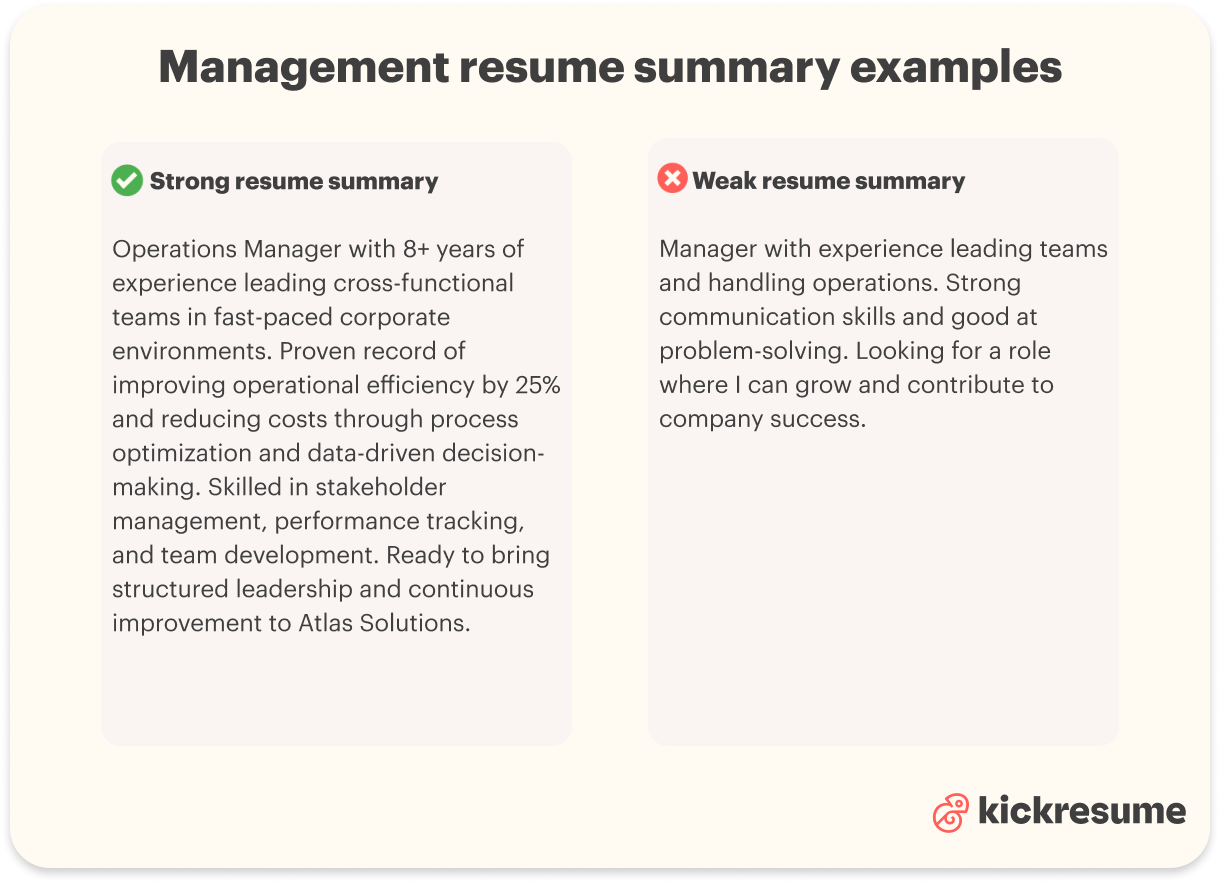
Bad management resume summary example
Manager with experience leading teams and handling operations. Strong communication skills and good at problem-solving. Looking for a role where I can grow and contribute to company success.
Why doesn’t this work? It’s generic, vague, and could describe almost any manager. There are no numbers, no scope, and no clear indication of the candidate’s level or impact. Hiring managers will forget this instantly.
Good management resume summary example
Operations Manager with 8+ years of experience leading cross-functional teams in fast-paced corporate environments. Proven record of improving operational efficiency by 25% and reducing costs through process optimization and data-driven decision-making. Skilled in stakeholder management, performance tracking, and team development. Ready to bring structured leadership and continuous improvement to Atlas Solutions.
Why does this work? It’s specific, measurable, and clearly communicates seniority, scope, and value. The hiring manager immediately understands what kind of manager this person is and what they’re capable of.
Writing a resume objective (for early-stage managers)
A resume objective is better suited if you’re earlier in your management career, for example, if you’re moving from an individual contributor role into management, or stepping up from supervisor to manager.
Instead of focusing on long-term achievements, an objective highlights your direction, potential, and readiness to take on more responsibility.
What should a management resume objective include?
- Your current role or background
- The type of management position you’re targeting
- Key leadership-related skills you already use (coaching, coordination, planning, performance support)
- A hint of results or training that shows growth
- Your motivation to contribute and develop as a leader
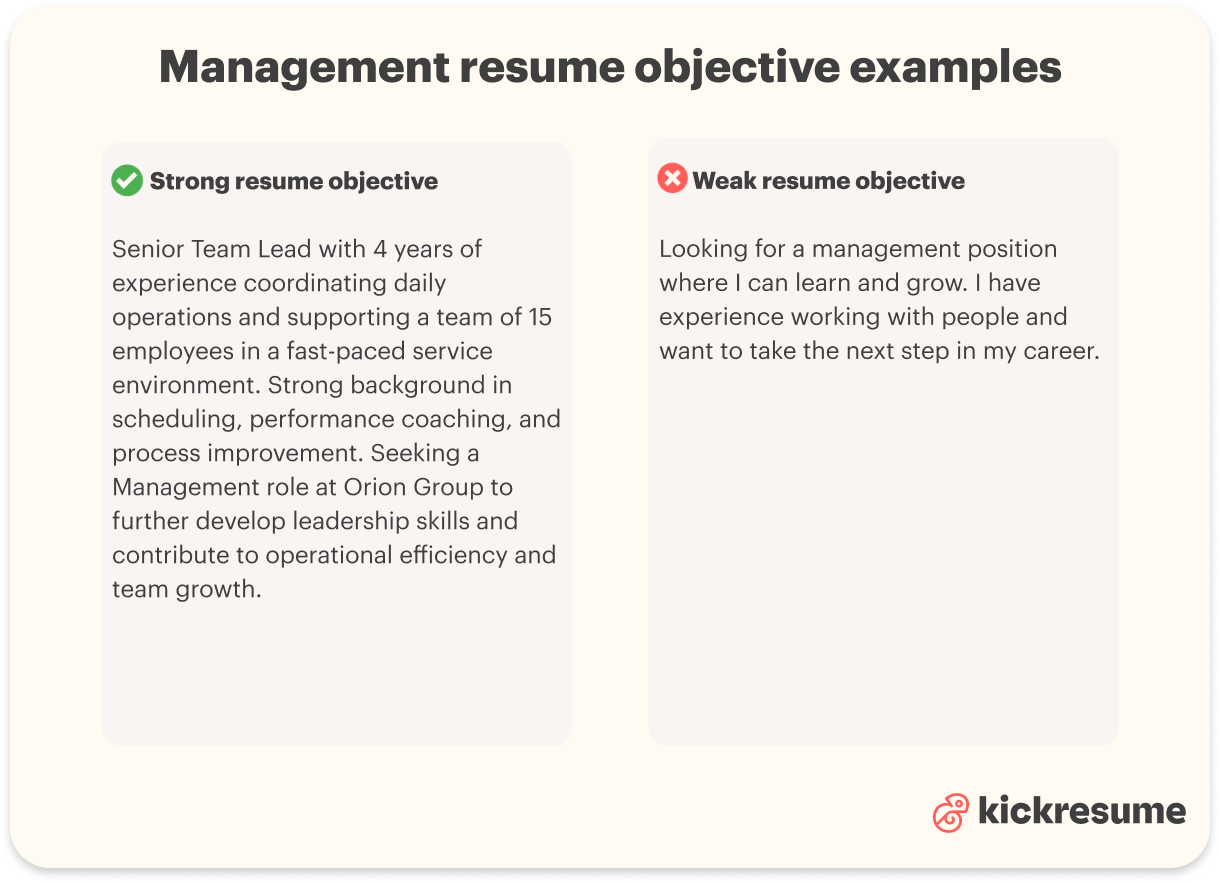
Bad management resume objective example
Looking for a management position where I can learn and grow. I have experience working with people and want to take the next step in my career.
What’s the problem here? It’s unfocused and tells the employer nothing concrete. There’s no context, no skills, and no indication of what kind of manager this person wants to become.
Good management resume objective example
Senior Team Lead with 4 years of experience coordinating daily operations and supporting a team of 15 employees in a fast-paced service environment. Strong background in scheduling, performance coaching, and process improvement. Seeking a Management role at Orion Group to further develop leadership skills and contribute to operational efficiency and team growth.
Why does this work? It shows relevant experience, clear direction, and realistic career progression. Even without a formal “manager” title, the candidate demonstrates management readiness.
Pro tip
Whether you choose a summary or an objective, avoid empty buzzwords like “hard-working,” “motivated,” or “people-oriented.”
As a manager, your value is measured through results, leadership scope, and impact, so let those speak for you.
4. How to choose the right skills for your management resume
In management roles, your skills are often what differentiate you from other candidates with similar job titles. Two people can both be called “Manager,” yet operate on completely different levels.
That’s why your goal isn’t to list everything you’ve ever learned, but to highlight the skills that matter most for this specific role.
The best way to do that? Let the job posting lead the way.
Before you start building your Skills section, ask yourself:
- Are they emphasizing people leadership, coaching, or team development?
- Do they focus more on operations, processes, and efficiency?
- Are KPIs, performance metrics, or financial responsibility mentioned?
- Is cross-functional collaboration or stakeholder management a priority?
The answers will tell you exactly which skills should appear at the top of your resume, and which ones can stay in the background.
Key hard skills to include on a management resume
Hard skills show that you understand the operational and strategic side of management, not just leading people, but running things effectively.
Here are some of the most relevant hard skills for management roles across industries:
- Team scheduling and workload planning
- Hiring, onboarding, and performance evaluation
- Process optimization and operational improvement
- KPI tracking and performance reporting
- Budgeting, cost control, and basic financial oversight
- Project management and deadline coordination
- Data analysis and decision-making
- Cross-functional collaboration
- Risk management and compliance awareness
- Use of management tools (CRM systems, project management software, reporting dashboards)
These skills signal that you can translate strategy into execution, and that you’re comfortable making decisions based on data, not guesswork.
Essential soft skills for management roles
While hard skills show what you manage, soft skills show how you lead.
Strong managers are expected to guide teams, handle pressure, and create an environment where people can perform at their best.
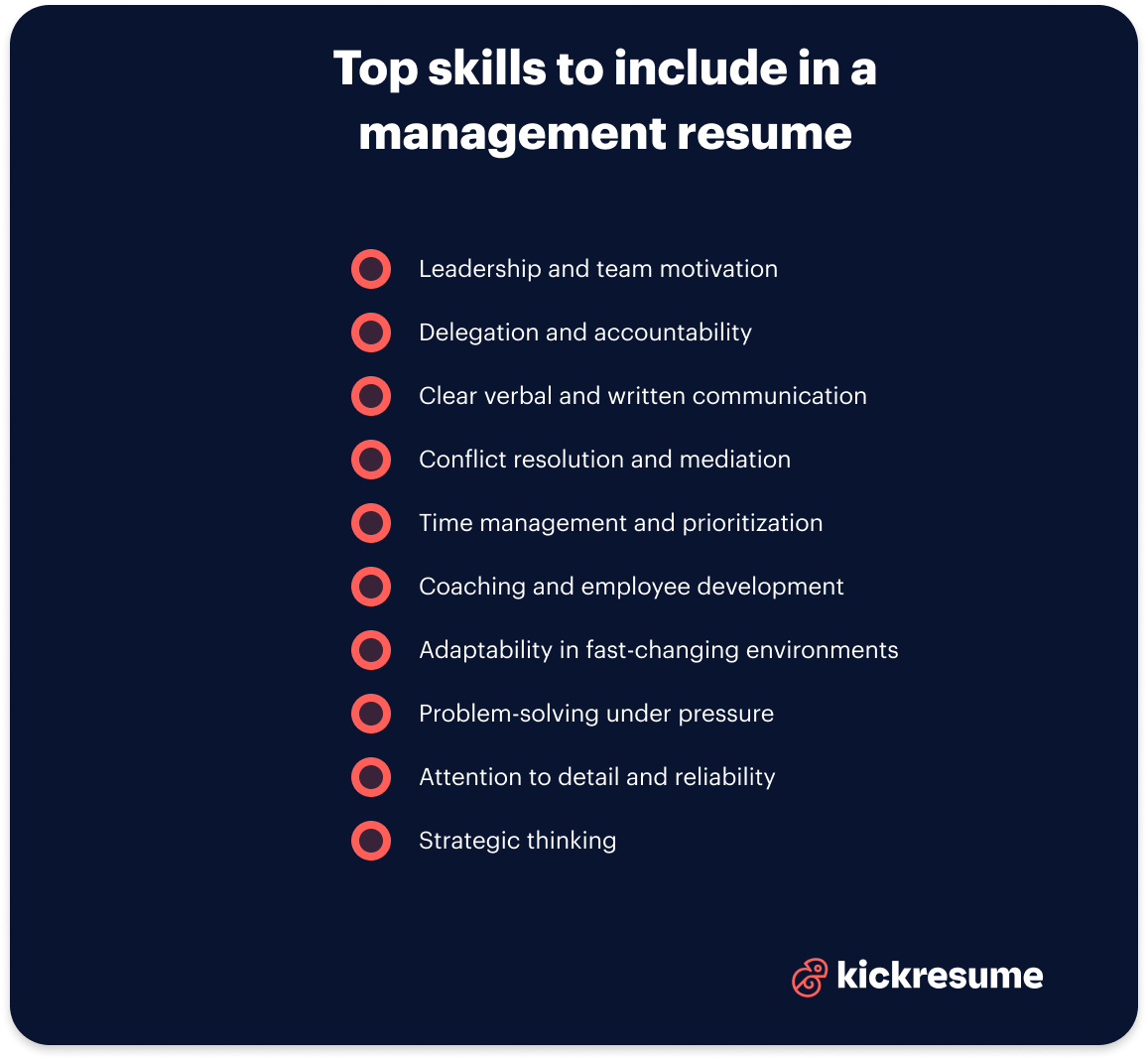
Top soft skills to highlight on a management resume include:
- Leadership and team motivation
- Delegation and accountability
- Clear verbal and written communication
- Conflict resolution and mediation
- Time management and prioritization
- Coaching and employee development
- Adaptability in fast-changing environments
- Problem-solving under pressure
- Strategic thinking
- Attention to detail and reliability
These skills are especially important for roles where you’re responsible for both results and people, which is the reality of most management positions.
Pro tip
Great managers operate at the intersection of people, processes, and performance. Your skills section should reflect that balance.
When your listed skills closely mirror the language and priorities used in the job description, it becomes much easier for both ATS software and human recruiters to recognize you as a strong match without having to guess what kind of manager you are.
5. How to effectively list your achievements and work experience
Listing your job titles is easy. Showing real impact is where most management resumes fall short.
Your work experience section shouldn’t read like a generic job description. Instead, it should clearly answer:
- What type of team or function did you manage?
- How large was your scope of responsibility?
- What goals or KPIs were you accountable for?
- What measurable results did you deliver?
The more clearly you can connect your responsibilities to outcomes, the stronger your resume becomes. And whenever possible, support those outcomes with numbers.
Bad management work experience resume example
Manager
ABC Company
June 2020 – Present
- Responsible for managing daily operations
- Supervised team members and created schedules
- Worked with stakeholders on various initiatives
- Ensured processes were followed
- Handled issues as they arose
What’s missing here? Everything that helps a hiring manager evaluate performance. There’s no context, no scope, and no results. This could describe an average manager, or an exceptional one. There’s no way to tell.
Good management work experience resume example
Operations Manager
ABC Company, Chicago, IL
June 2020 – Present
- Led a cross-functional team of 22 employees across operations, customer support, and logistics, ensuring consistent delivery against quarterly performance targets.
- Improved operational efficiency by 18% by redesigning workflows, reallocating responsibilities, and introducing clearer performance tracking.
- Reduced employee turnover by 20% within one year by improving onboarding processes, introducing regular feedback cycles, and supporting internal career development.
- Managed departmental budgets exceeding $3.8M annually, identifying cost-saving opportunities that reduced overhead by 12%.
- Partnered with senior leadership on strategic initiatives, contributing to a 25% increase in overall departmental output year over year.
Why does this work? It combines responsibility, scope, and results. The reader immediately understands what the manager was accountable for and how well they performed.
Tips for professionals stepping into management roles
If you’re moving into a full management position for the first time (for example, from team lead, senior specialist, or assistant manager), your experience may not look identical to that of a long-time manager, and that’s completely fine.
The key is to frame your experience in terms of leadership impact, not job titles.
You can highlight:
- Responsibilities you took on when your manager was unavailable
- Coaching or mentoring you provided to colleagues or junior staff
- Process improvements or initiatives you proposed and implemented
- Situations where you handled escalations or decision-making independently
- KPIs or results you directly influenced, even if you weren’t fully accountable for them
Good work experience resume section for less experienced managers
Assistant Operations Manager
Belk, Inc., Chicago, IL
June 2019 – May 2023
- Supported the Operations Manager in overseeing daily performance for a department generating $4.5M in annual revenue.
- Coordinated schedules and workloads for a team of 18 employees, improving on-time task completion by 15%.
- Led onboarding and training initiatives for new hires, reducing average ramp-up time from 6 weeks to 4 weeks.
- Identified workflow inefficiencies and implemented process adjustments that improved team productivity by 12%.
- Served as escalation point for operational and customer-related issues, maintaining satisfaction scores above 90%.
Final takeaway
Your work experience section should tell a story of impact, not just attendance.
Ask yourself:
Where did I make things work better, faster, more efficiently, or more sustainably?
Then build your bullet points around those moments. That’s what turns a management resume from “acceptable” into compelling.
6. How to select the right action verbs for your management resume
Action verbs may seem like a small detail, but in a management resume, they carry a lot of weight. They’re what transform your experience from passive job descriptions into clear demonstrations of leadership and impact.
Strong action verbs help hiring managers immediately see how you lead, influence, and deliver results, not just what your role was on paper.
Compare the difference:
No action verbs included
Responsible for team training and operational tasks.
vs.
Action verbs included
Led and developed a team of 18 employees, improving productivity and service quality across the department.
The difference is that the first example sounds like a checklist, and the second one displays ownership.
Why action verbs matter in management resumes
Management roles are evaluated differently from individual contributor roles. Recruiters and hiring managers are looking for signals of:
- Ownership and accountability
- Decision-making and initiative
- Influence on people, processes, and outcomes
The verbs you choose should reinforce those signals.
Strong action verbs for management resumes
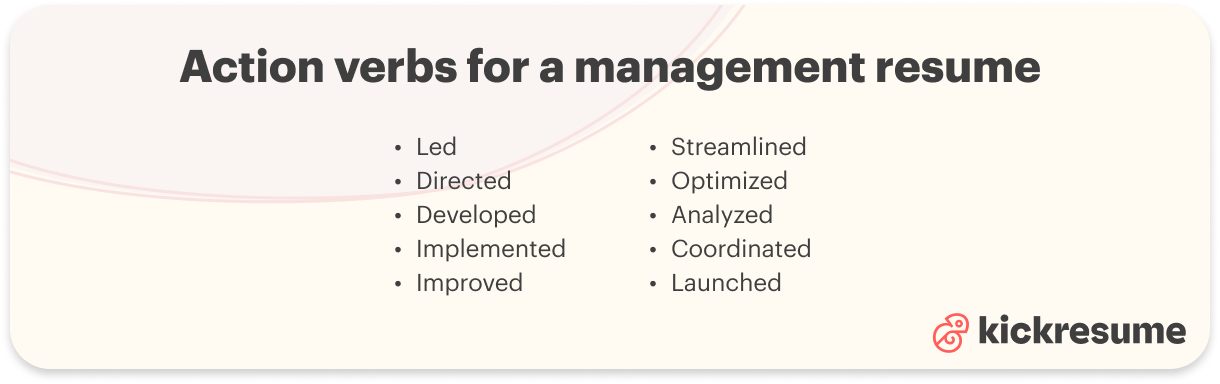
Instead of generic or passive phrases, lean into verbs that reflect leadership and execution, such as:
- Led
- Directed
- Developed
- Implemented
- Improved
- Streamlined
- Optimized
- Analyzed
- Coordinated
- Drove
- Launched
- Reduced
- Scaled
- Resolved
These verbs naturally position you as someone who acts, not just someone who observes or assists.
Action verbs in practice: before and after
Before (weak, passive wording)
Before including action verbs
- I was responsible for supervising team members.
- I helped with process improvements and reporting.
- I handled issues when they came up.
After including action verbs
- Led a team of 20+ employees, providing regular coaching and performance feedback that improved overall productivity.
- Implemented process improvements and reporting standards that increased operational efficiency by 15%.
- Resolved escalated operational and personnel issues, maintaining service levels and team morale during high-pressure periods.
They share the same responsibilities but convey a very different impression.
How to use action verbs effectively
- Start every bullet point with a strong verb
- Avoid repeating the same verb over and over (variety matters)
- Match verbs to the seniority of the role (e.g., coordinated vs. directed, supported vs. led)
- Focus on verbs that imply impact, not just activity
Also, watch out for weak phrases like:
- “Was responsible for”
- “Helped with”
- “Assisted in”
These downplay your contribution, especially in management roles where ownership is expected.
Pro tip
Before submitting your resume, do a quick scan of your bullet points. If too many start with soft phrases, rewrite them using decisive, leadership-oriented verbs.
The goal is simple:
Make it obvious that you don’t just participate in management, but show that you lead it.
7. How to write the education section professionally on a management resume
In management roles, hands-on experience often carries more weight than formal education, but that doesn’t make your education section optional or unimportant.
Hiring managers use this section to quickly understand your business foundation, leadership training, and commitment to professional growth.
Depending on your career path, you may have:
- Worked your way up from an entry-level or specialist role into management
- Earned a degree in business, management, economics, or a related field
- Completed shorter programs, certifications, or leadership training while working full-time
No matter which route you took, the goal is the same:
Show that your decision-making and leadership skills are backed by structured knowledge.
What to include in a management education section
Focus on education and training that supports leadership, strategy, and operations, such as:
- Bachelor’s or Master’s degree: Business Administration, Management, Economics, Finance, Marketing, HR, Operations, or a related field
- Associate’s degree or professional diploma: Business management, organizational leadership, or industry-specific programs
- High school diploma or equivalent: Especially important if this is the minimum requirement listed in the job description
- Professional development: Leadership courses, people management training, project management programs, or executive education
Good management resume education section example
Bachelor’s Degree in Business Administration
Mesa Community College, Mesa, AZ
2018 – 2020
Relevant coursework: Organizational Behavior, Operations Management, Financial Accounting, Business Communication, Strategic Planning
High School Diploma
Mesa High School, Mesa, AZ
Graduated 2018
Relevant coursework: Business Studies, Economics, Communication Skills
What if you don’t have a formal degree?
That’s more common in management than many people think, especially for professionals who grew into leadership roles through performance and experience.
If you don’t hold a degree, shift the focus toward:
- Leadership and management training programs
- Internal company leadership academies or fast-track programs
- Certifications (project management, people leadership, agile, etc.)
- Industry-specific courses or workshops
Even short, targeted programs show that you take your role seriously and actively invest in improving how you lead, manage, and make decisions.
Pro tip for senior management roles
As you move into higher-level positions, your education section should become cleaner and more selective. Recruiters at this level care less about course lists and more about:
- Degree level
- Field of study
- Ongoing executive or leadership development
If your experience already speaks loudly, your education section should support it, not compete with it.
8. How to choose relevant optional sections for a management resume
Once you’ve covered the core sections of your resume (summary, skills, work experience, education), you can decide whether adding optional sections will strengthen your application.
Used well, these sections help you stand out. Used poorly, they just add noise.
The rule is simple:
Only include optional sections if they clearly support your leadership profile and the role you’re applying for.
Add optional sections if:
- You have certifications, awards/achievements, or training that reinforce your management or leadership capabilities
- You’ve led meaningful projects, initiatives, or transformations worth highlighting
- You want to show strategic, technical, or organizational depth beyond your job titles
Skip them if:
- You’re only trying to fill space
- The information is outdated or irrelevant to management roles
- The section doesn’t clearly connect to leadership, decision-making, or business impact
Useful optional sections for a management resume
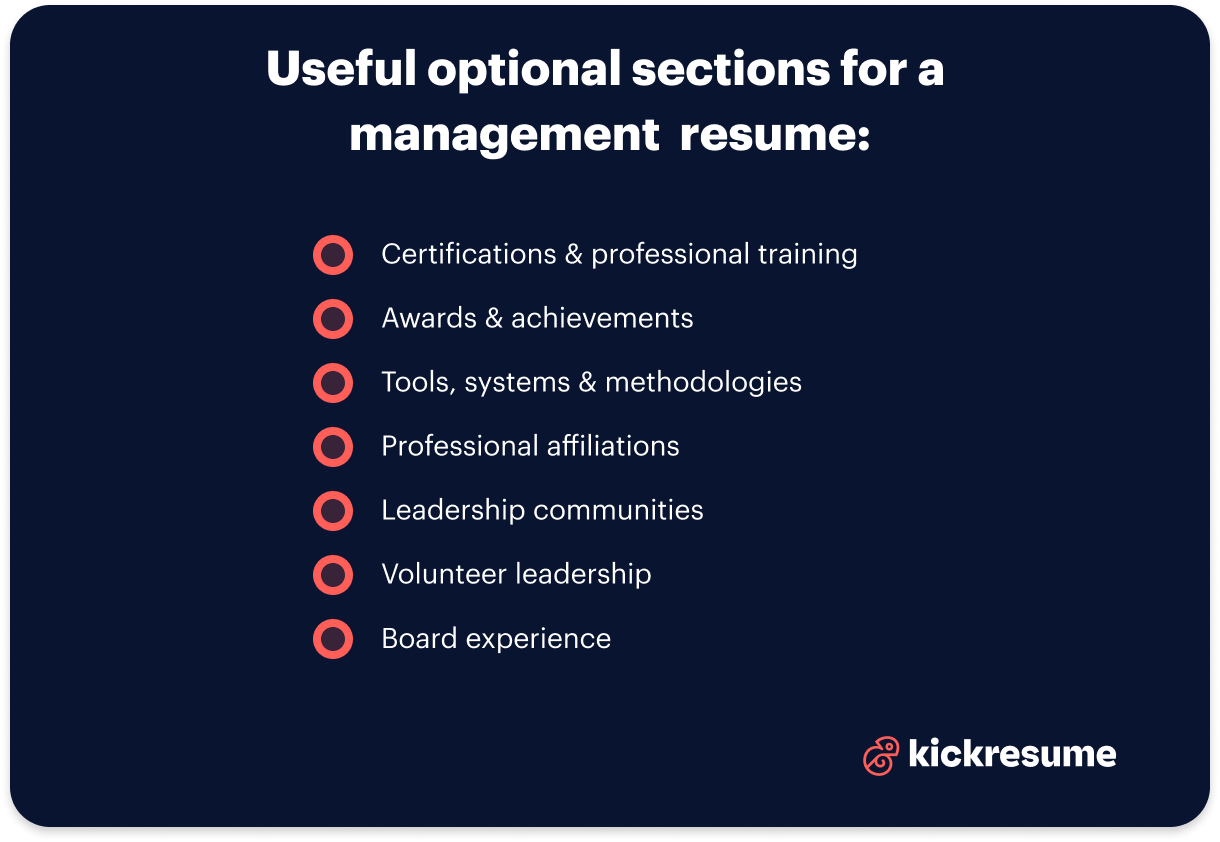
1. Certifications & professional training
These are especially valuable if they support leadership, strategy, or operational excellence.
Certifications & professional training examples
- Project Management certifications (PMP, PRINCE2, Agile, Scrum)
- Leadership or people management programs
- Change management or process improvement training (Lean, Six Sigma)
- Industry-specific management certifications
- Executive or business-focused online programs
2. Awards & achievements
Awards help validate your impact and performance, especially when they’re results-driven.
Awards & achievements examples
- “Manager of the Year” or leadership recognition awards
- Company awards for performance improvement, growth, or turnaround results
- Recognition for leading high-impact initiatives or teams
- Internal programs highlighting excellence in leadership or execution
3. Tools, systems & methodologies
This section works well for managers involved in operations, planning, or cross-functional leadership.
Tools, systems & methodologies examples
- Project management tools (Jira, Asana, Monday.com)
- CRM or ERP systems (Salesforce, SAP, Oracle)
- Analytics and reporting tools (Excel, Power BI, Tableau)
- Workforce planning or HR systems
- Strategic frameworks or methodologies (OKRs, Agile, Lean)
4. Professional affiliations & leadership communities
Memberships show that you’re engaged in your profession beyond your day job.
Professional affiliations & leadership communities examples
- Management or leadership associations
- Industry councils or advisory boards
- Business or executive networking groups
- Mentorship or leadership development communities
5. Volunteer leadership & board experience
Leadership outside of paid roles, such as volunteer work, still counts, especially when it involves responsibility and coordination.
Volunteer leadership & board experience examples
- Leading volunteer teams or nonprofit initiatives
- Board or committee membership
- Organizing events, fundraisers, or community programs
- Mentoring junior professionals or students
Final tip
Optional sections should support your story, not distract from it. A few well-chosen additions can reinforce your leadership credibility and make your resume more memorable, but only when they’re relevant to the role you’re targeting.
When in doubt, ask yourself:
Does this help a hiring manager better understand how I lead, decide, and deliver results?
If the answer is yes, keep it. If not, cut it.
9. How to avoid common mistakes when creating a management resume
You’ve built leadership experience, taken responsibility for people or projects, and delivered results. That already puts you ahead of many candidates.
That’s exactly why it’d be a shame if some silly and avoidable mistakes undermined all that hard work.
Here are the most common resume pitfalls managers should watch out for and how to avoid them.
#1 Typos and careless errors
It may seem like a small issue, but mistakes signal a lack of attention to detail. For management roles, where accuracy, decision-making, and accountability matter, this can be a red flag.
#2 Inconsistent or cluttered formatting
Crowded text, mismatched fonts, or uneven spacing make your resume harder to scan for both for recruiters and ATS systems.
How to avoid it: Stick to a clean layout, consistent headings, clear bullet points, and one professional font. White space improves readability and makes your achievements stand out.
#3 Using the same resume for every role
Management roles can vary widely in focus, such as people leadership, strategy, operations, transformation, or delivery. A one-size-fits-all resume rarely performs well.
#4 Listing responsibilities instead of outcomes
Saying you “managed a team” or “oversaw projects” doesn’t show how effective you were as a leader.
How to avoid it: Focus on impact. Show what changed because of your leadership, such as growth, efficiency, cost savings, performance improvements, or risk reduction.
#5 Not using numbers and metrics
Management is about results. Without data, your achievements feel abstract and harder to evaluate.
How to avoid it: Whenever possible, quantify your impact, because even approximate numbers are better than none. You can use, for example:
- Revenue growth
- Cost reductions
- Productivity improvements
- Engagement or retention increases
- Project delivery timelines
#6 Ignoring soft skills
Leadership isn’t only about strategy and execution, because it’s also about people.
#7 Outdated or unprofessional contact details
An old email address or incorrect phone number can cost you interviews simply because recruiters can’t reach you.
How to avoid it: Double-check all contact details and use a professional email address. Include LinkedIn only if it’s updated and aligned with your resume.
#8 Keyword blindness (ATS issues)
Many employers use Applicant Tracking Systems to filter resumes before a human ever sees them.
#9 Adding irrelevant or outdated information
Old roles, unrelated side jobs, or personal hobbies can distract from your leadership profile.
How to avoid it: Be selective. Every line should reinforce your suitability for a management role. If it doesn’t add value, remove it.
Final takeaway
A strong management resume isn’t about perfection, as it’s mostly about clarity, relevance, and impact.
Taking a final pass to eliminate these common mistakes only takes a few minutes, but it can significantly improve how professional, credible, and leadership-ready your application appears.
When hiring managers skim your resume, make it easy for them to see one thing clearly:
You lead with purpose, and you deliver results.
10. How to create a complementary and matching cover letter for your management resume
Your resume shows what you’ve accomplished.
Your cover letter explains how you achieved it and why it matters.
While a management resume is built around concise bullet points, metrics, and scope, your cover letter gives you space to add context, motivation, and leadership perspective.
Think of it as the narrative layer that connects the dots.
What should a strong management cover letter do?
A well-written management cover letter should clearly answer:
- Who are you as a leader?
- What kind of teams, projects, or initiatives have you led?
- Why are you interested in this company, role, or industry?
- What results have you delivered and how will you create impact here?
Instead of repeating your resume line by line, use your cover letter to add meaning to your achievements.
Management cover letter opening statement example
In my current role, I led a cross-functional restructuring initiative that reduced employee turnover by 20% and improved delivery timelines across three departments. I’m excited to bring that same people-first, results-driven leadership approach to your organization as it scales its operations.
This kind of example shows leadership style, scope, and outcome, not just listing responsibilities.
Resume vs. cover letter: what’s the difference?
They work best as a pair, but they serve different purposes:
- Resume: Structured, factual, and scannable. Focused on roles, achievements, skills, and timelines.
- Cover letter: Narrative and strategic. Focused on motivation, leadership approach, and fit.
Your resume proves you can do the job.
Your cover letter proves you want this job, why you want it at this particular company, and that you want it for the right reasons.
How to keep your resume and cover letter aligned
Consistency matters, especially for management roles where professionalism and attention to detail are expected.
Here’s how to make your documents feel like a cohesive set:
- Use the same header: Your name, email, phone number, and LinkedIn profile should appear in the same format on both documents.
- Keep fonts and layout consistent: Stick to the same font family, sizing, and spacing to create a unified look.
- Align margins and spacing: Matching margins and paragraph spacing makes your application feel polished and intentional.
- Match accent colors (if used): If your resume uses subtle color for headings or dividers, mirror it lightly in your cover letter.
If design isn’t your strong suit, using matching resume and cover letter templates can save time and ensure visual consistency without extra effort.
Final thought
A strong management application isn’t just about what you’ve done, as it’s also about how clearly and confidently you present it.
When your resume and cover letter work together, your application feels deliberate, credible, and leadership-ready, and that’s exactly the impression hiring managers are looking for when filling management roles.
Create your cover letter fast with artificial intelligence.

11. Top resources for job-seeking managers
The fact that you've made it here means that you’re now more than well-equipped to write a memorable resume. But, do you know where to search for work opportunities? To make your job hunt a bit easier, we've curated the following list of helpful resources:
- General job search engines: Websites like Indeed, SimplyHired, Monster, or Glassdoor can be a good entry point for your job
- LinkedIn: The Holy Grail of all job seekers! LinkedIn's job search functionality allows you to find opportunities across industries, connect with potential employers, and use your network for introductions and recommendations.
- Professional associations: These offer a wealth of resources including networking opportunities, professional development, access to industry research, and sometimes job listings tailored to management roles. Look at, for example: the American Management Association (AMA), the Institute of Leadership & Management (ILM), or the Chartered Management Institute (CMI).
- Networking: Never underestimate the power of making connections. Try attending industry events and meetups, where you might meet your future employer.
- Specialized publications: Keep up with the latest industry trends, developments and news by following specialized media like “Harvard Business Review,” “Forbes,” or “McKinsey Quarterly.”
- Continuous learning: Boost your managerial skills with online platforms with wide selection like Corusera, edX, or LinkedIn Learning.
Remember, job search is a process that requires time, patience, and a proactive approach. And in this process, one item can make or break your chances at landing the managerial role you desire is your resume. So, make yours count!
Management Career Outlook in 2026
Employment in management occupations is projected to grow faster than the average for all occupations from now to 2034. (Source: U.S. Bureau of Labor Statistics)
On average, around 1.1 million management job openings per year are expected, with strongest demand in management roles tied to healthcare, finance, and technology, where organizations increasingly rely on skilled leaders to navigate growth, regulation, and digital transformation.
Furthermore, research analyzing large-scale job posting data shows that as AI adoption increases, demand for managerial roles actually rises, particularly for leaders who can guide AI-enabled teams and make strategic decisions.
Average US base salaries across popular Human Resources roles:
- Executive Manager: $85,812/year
- Product Manager: $128,110/year
- Project Manager: $96,616/year
- Risk Manager: $117,095/year
- Strategy Manager: $123,692/year
Salary estimates are based on data from Indeed as of January 2026, combining anonymized salary submissions and job posting data. Actual salaries may vary depending on location, company size, and experience level.
All in all, if you’re currently thinking about starting a career in Management or growing within the field, now is a great time to look into the opportunities available in this industry.
Management Resume FAQ
How long should my management resume be?
While one-page resumes are often recommended, for management-level positions, two pages are generally acceptable. It all depends on how many years of professional experience are under your belt. If you've got 8+ years with plenty of accomplishments, two pages can give you room to detail your experience and impact without cramming information.
Should I include references in my management resume?
While references can increase our chances at getting hired, it's not necessary to include them directly in your resume. Instead, you can prepare your references in a separate document in case recruiters ask for them. Then, you can mention that “references are available upon request” at the end of your cover letter.
How much of my work history should I include in my management resume?
Concentrate on roles where you had managerial or supervisory responsibilities and ensure to highlight tangible achievements from these roles. You can include work experience from your entire career, but not older than 10-15 years. We recommend going into detail describing only your 2-3 most recent relevant jobs on your resume. The older the job, the less bullet points it needs to have.
What common mistakes should I avoid when creating my management resume?
The biggest mistake is listing responsibilities, rather than accomplishments. Also, avoid long paragraphs - use bullet points for easier reading. Lastly, proofread your resume carefully. Minor mistakes like misspellings and typos carry major weight when seeking a leadership role.
How can I showcase my problem-solving skills in a management resume?
You can use instances where you faced challenges or conflicts and how you resolved them. Remember to clearly outline the situation, the actions you took, and the results of those actions. This demonstrates your problem-solving capabilities in a real-world context.




![Representante de ventas en Adidas currículum ejemplo [ES]](https://d1xn1bcogdo8ve.cloudfront.net/472/thumbnail.webp)







![Coop Project Manager Cover Letter Sample [SV]](https://d1xn1bcogdo8ve.cloudfront.net/231/thumbnail.webp)




![How to Write a Professional Resume Summary? [+Examples]](https://d2xe0iugdha6pz.cloudfront.net/article-small-images/How_to_Write_a_Professional_Resume_Summary_.png)
![How to List Your Education on a Resume? [+Examples]](https://d2xe0iugdha6pz.cloudfront.net/article-small-images/How_to_Put_Education_on_a_Resume_.png)
![How to Describe Your Work Experience on a Resume? [+Examples]](https://d2xe0iugdha6pz.cloudfront.net/article-small-images/How_to_Describe_Your_Work_Experience_on_a_Resume_.png)