ChatGPT
 Perplexity AI
 Claude
Making the best digital marketing resume is all about customization. Digital marketing is a broad area that encompasses disciplines like SEO, PPC, content marketing, social media, analytics, email marketing, … and the list goes on and on. That's why your resume needs to be specific.
Our guide is here to make the journey easier. We've collected practical examples, real-life digital marketing resume samples, customizable templates, and our best writing tips to help you out. Enjoy!


 See more examples like these
Keep reading to learn how to:
- Dos and don’ts of resume writing from our digital marketing resume samples
- Select the correct resume format for your experience level
- Make your digital marketing resume ATS-friendly
- Pick between a resume summary and an objective
- Choose key digital marketing skills to highlight your diverse abilities
- Describe your work experience with specific and quantifiable details
- Give your digital marketing resume a boost with action verbs
- List your education as a digital marketer correctly
- Add optional resume sections (if appropriate)
- Avoid silly mistakes when writing your digital marketing CV
- Create a complementary cover letter for your resume
- Find the best resources for job-seeking digital marketers
- What to expect in terms of salary and job outlook as a digital marketer
Still seeking employment? Kickresume can help you find a job and tell you everything needed to get hired faster.
Lead digital marketing strategist


Why does this digital marketing resume example work?
- The work experience shows clear career growth: The progression from junior role to lead strategist is easy to follow and very compelling! Employers immediately see that the candidate grew, took on more responsibility, and earned promotions. That promises a long-term potential and the ability to stick with challenges instead of plateauing.
- The resume summary hits all the right points: The summary states the job title, years of experience,core competencies, and backs it all up with measurable results. Numbers like traffic growth and conversion increases make the claims believable. A recruiter can quickly understand the candidate’s level, focus, and value without having to dig through the rest of the resume.
What could be improved?
- The template may not be ideal for ATS scanning: This resume is close to perfect, but the one thing to be careful about is the template. It appears more design-heavy, which can cause issues when applying through ATS systems. If the candidate is applying through an ATS, switching to a simpler, more text-based layout would be a safer choice.
Digital marketing manager resume sample

Why does this resume example work?
- The skills section is rich and well organized: The skills section is strong and clearly structured into logical sub-sections. Languages, computer skills, and interpersonal skills are separated cleanly, which makes the resume easy to scan. It also shows a wide range of abilities without feeling messy or overwhelming, which is exactly what employers want to see.
- The resume makes great use of action verbs: The work experience bullets rely on action verbs like “monitored,” “analyzed,” “contributed,” and “managed.” This makes the candidate sound proactive and involved instead of passive. It helps recruiters understand the role the candidate played and the level of responsibility they held.
What could be improved?
- The education section could be trimmed: The education section includes a high school diploma, which is no longer necessary at this career stage. With two relevant university degrees and practical work experience, the candidate’s competence is already well established. Removing the high school entry would tighten the resume and keep the focus on what matters most.
- Soft skills could be shown more through experience: Soft skills are listed in the skills section, but they would be even stronger if demonstrated inside work experience bullets. Showing how communication, leadership, or teamwork played out in real projects would make those skills feel more credible than listing them on their own.
Social media intern resume example

Why does this resume example work?
- Language proficiencies are valuable: The languages section is a real strength here. For an intern, listing multiple languages immediately adds value, especially in marketing and social media roles where global audiences matter. It shows cultural awareness and communication range, which can help a candidate stand out even with limited experience.
- Internship experience is used correctly as professional experience: The candidate does a good job treating the internship as real work and not as something secondary. The bullet points are detailed, results-focused, and include a clear achievement with follower growth.
- The education section is expanded in the right way for an intern: Because this is an intern-level resume, the education section is handled well. GPA, academic standing, and student activities all make sense here. For candidates just entering the workforce, education often carries more weight, and this section supports that nicely.
What could be improved?
- The profile section is too verbose: The profile tries to do too much at once. It includes several buzzwords, adjectives, and broad phrases that could be trimmed without losing meaning. Replacing some descriptive language with specific tools, platforms, or social media strengths would make the profile feel more grounded and aligned with the actual experience listed below.
Email marketing specialist resume example

Why does this resume example work?
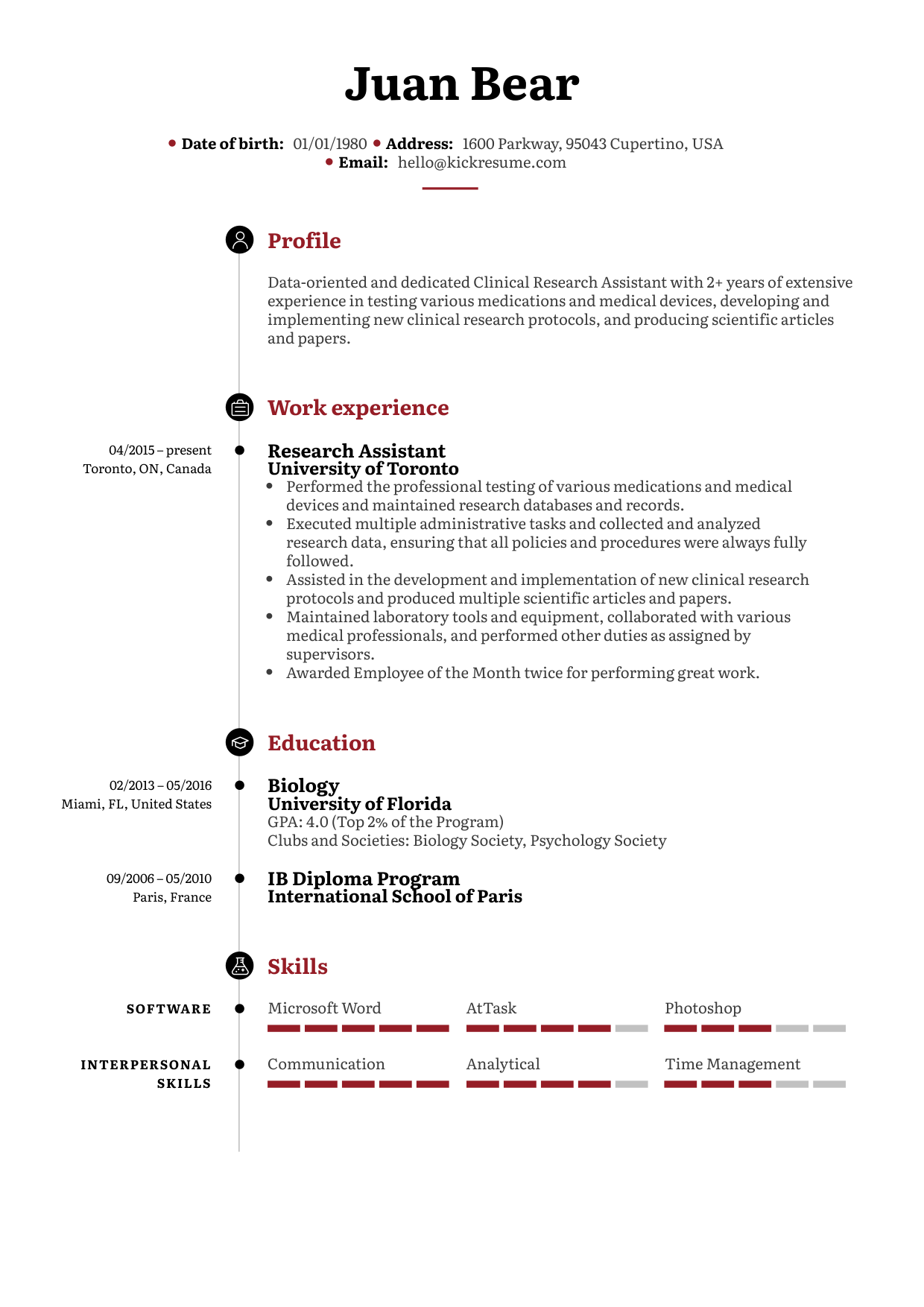
- Mentioning the award adds real credibility: Drawing attention to the Employee of the Month award is smart. It shows that the candidate’s work was noticed and formally recognized. For hiring managers, awards like this act as third-party validation and make the achievements feel more trustworthy.
- The work experience shows a clear area of specialization: The resume is very focused on email marketing, and that clarity helps. There is no confusion or dilution with unrelated marketing tasks, which makes this resume especially strong for email-focused roles.
What could be improved?
- The education section could be moved lower on the resume: At this stage, the candidate’s professional experience is more important than academic background. Placing education above skills pulls attention away from practical abilities and real results. Moving education below the skills section would improve the overall flow.
1. Pick a resume format that makes you look good
You can make your experience look better just by choosing the right resume format. Nothing about your background changes, but what stands out does. Each format is designed to enhance certain parts of your resume while downplaying others.
There are three basic resume formats:
- Reverse-chronological resume: This format centers your work experience starting with your most recent role and moves backward. It's a great choice for anyone wishing to draw attention to their steady career growth. Go with this format if you're a digital marketer with consistent work history in the same field.
- Functional resume: This format focuses on skills instead of job history. It will work in your favor if you have gaps in employment or limited experience in digital marketing. This format will be especially appreciated by career chargers, entry-level marketers, and those returning to work after a break.
- Combination resume: This one blends skills and work experience into one layout. It allows you to highlight your strongest digital marketing skills first, then support them with a clear work history. Go with this option if you have a solid skill set, mixed experience, or are moving into a more specialized digital marketing role.
Julia Belak, Certified Professional Résumé Writer (CPRW), recommends:
If you’re going for a digital marketing role, it only makes sense to have your own corner of the internet. A professional website or online portfolio is a must at this point. And employers love to see them too. It gives them a taste of your skills and creativity in action. You should also incorporate a link to your online space into your résumé, ideally somewhere close to your personal information.
If the employer asks for a specific resume format, use the one they request in the job posting. When no preference is listed, choose the format that makes your background easiest to understand and most relevant to the role.
Try our AI Resume Writer and have your resume ready in minutes!

2. Make your digital marketing resume ATS-friendly
Most large companies use software called an Applicant Tracking System (ATS) to collect applications.
An ATS scans resumes, organizes them, and filters candidates based on keywords and structure. Recruiters then get to review only the resumes that pass this first screening.
If the system can't read your resume properly, your application may never reach the hiring manager. That is why formatting and wording matter just as much as your experience, especially when applying to larger companies, agencies, or well known brands.
This is how you can make your resume ATS-friendly:
Use simple, readable formatting
- Use a single column layout: Avoid multiple columns, sidebars, tables, and text boxes. These can confuse ATS scanners and cause parts of your resume to disappear.
- Stick to common fonts: Use fonts like Arial, Calibri, Helvetica, or Times New Roman.
- Keep font sizes simple: Around 11 to 12 pt for body text works well. Section headings can be slightly larger.
- Use clear section headings: Standard titles like “Work Experience,” “Skills,” “Education,” and “Certifications” help the system understand your resume.
- Use bullet points for experience: Bullet points make it easier for ATS systems to take in the content of your digital marketing resume.
- Avoid graphics and visual elements: Icons, skill bars, charts, and images can definitely make your resume look more sophisticated, but many ATS systems can't read these elements correctly.
Optimize your resume for ATS keyword scanning.
Keywords are specific words or phrases related to the job that you can find in the job ad. Keywords can basically be anything the employer considers important in their future employee:
- Technical skills: SEO, PPC campaign management, conversion rate optimization (CRO), email marketing automation, keyword research, A/B testing
- Specific tools: Google Analytics, Ahrefs, SEMrush, HubSpot, Mailchimp, Screaming Frog
- Platforms: Google Ads, Meta Ads Manager, LinkedIn Campaign Manager, Shopify, WordPress
- Soft skills: communication, project management, collaboration, analytical thinking, attention to detail
- Education: Bachelor’s degree in Marketing, Digital Marketing certification, Google Ads Certification
- Years of experience: 3+ years in digital marketing, 2 years managing paid search campaigns
- Competencies: campaign optimization, performance analysis, lead generation, marketing automation, content strategy
If your resume doesn't include the specific terms the employer is searching for, the system may rank it lower even if you have the right experience.
You also need to think about your wording. For example, if the job description mentions “Google Ads campaign management”, use that exact phrase if it reflects your experience.
Use ATS-friendly templates to save time
Formatting a resume manually can be frustrating, especially if you’re not sure how ATS software reads design elements. That’s why many job seekers use templates built with ATS in mind.
Kickresume’s ATS-friendly resume templates are designed to stay clean, readable, and easy to scan. That way, your security officer resume gets past the software and still looks professional to hiring managers.
3. Create impactful resume summary (or resume objective)
This section sits right at the top of your resume. When hiring managers skim through dozens of applications, these few lines (3-5 lines) can determine whether they keep reading yours or move onto the next.
What this section should NOT include:
- Personal backstories or unrelated details
- Vague phrases like “results-driven professional”
- Buzzwords that don’t show proof
- Experience that has nothing to do with digital marketing
- Generic career goals that could apply to anyone
Because this section is short, every word has to earn its place.
When to choose resume summary
A resume summary focuses on your past experience and accomplishments.
Choose a summary if you already work in digital marketing. It's a strong option for marketers with a few years of experience, specialists applying for similar roles, or professionals with proven campaign results.
A good summary usually includes:
- Your marketing role or specialization
- Years of experience
- Core skills or marketing channels you work with
- Key tools or platforms
- One clear result or achievement
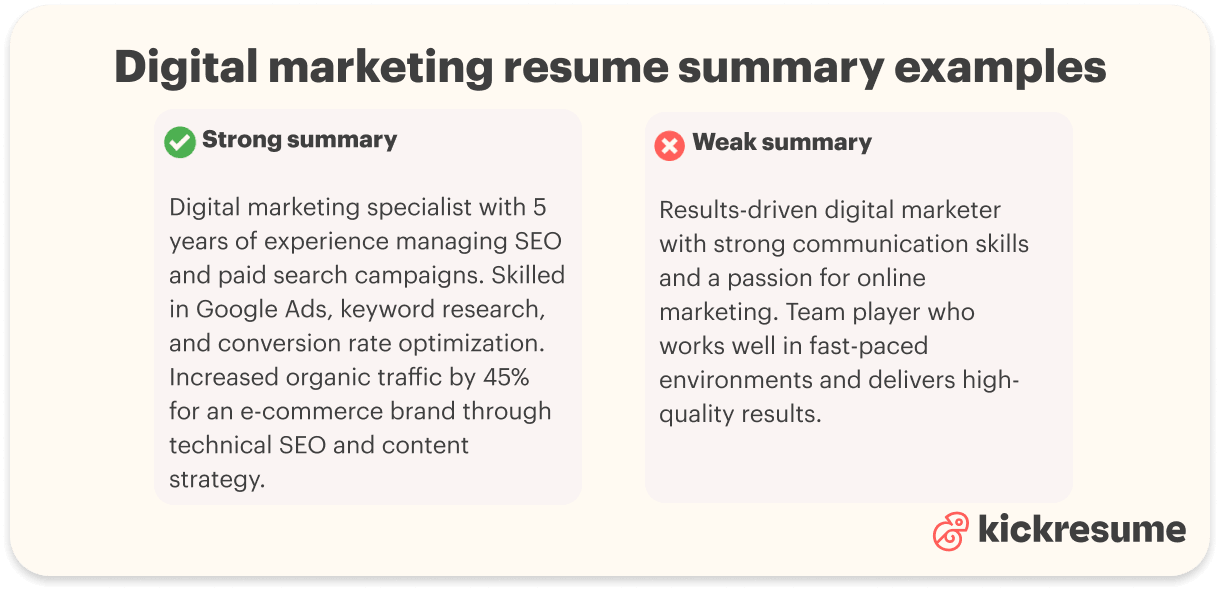
Bad digital marketing resume summary example
Results-driven digital marketer with strong communication skills and a passion for online marketing. Team player who works well in fast-paced environments and delivers high-quality results.
Why does this example fall flat?: This summary sounds polished but says nothing specific. There is no experience level, no marketing channels, and no proof of results. Almost any candidate could write the same thing.
Good digital marketing resume summary example
Digital marketing specialist with 5 years of experience managing SEO and paid search campaigns. Skilled in Google Ads, keyword research, and conversion rate optimization. Increased organic traffic by 45% for an e-commerce brand through technical SEO and content strategy.
Why does this example work so much better? This summary quickly tells the recruiter what the candidate does, how long they have been doing it, and what results they have delivered. It gives recruiters specific reasons to keep reading.
When to choose resume objective
A resume objective focuses on where you want to go next and how your current skills can support that objective (pun intended).
This option works best if you are new to digital marketing, changing careers, or applying for your first marketing role.
A strong objective should include:
- The role you're targeting
- Relevant training, certifications, or education
- Transferable skills from previous roles
- Your professional direction
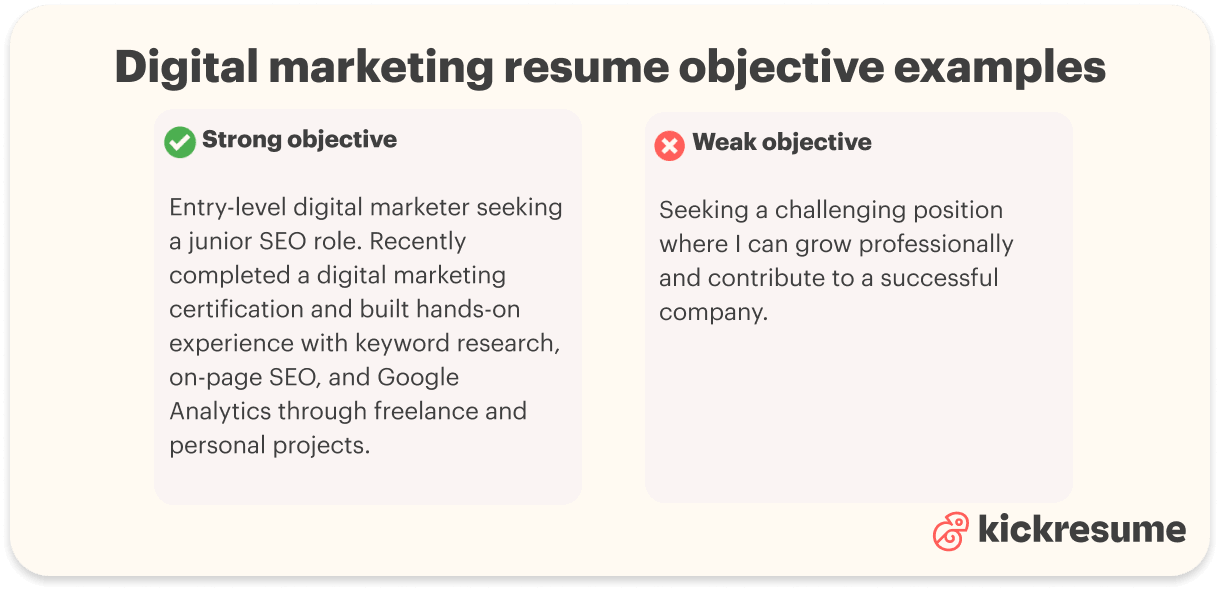
Bad digital marketing resume objective example
Seeking a challenging position where I can grow professionally and contribute to a successful company.
Why doesn't this objective work? Because it's vague and employer-focused in the wrong way. It talks about what the candidate wants but gives no information about anything they could do for the employer.
Good digital marketing resume objective example
Entry-level digital marketer seeking a junior SEO role. Recently completed a digital marketing certification and built hands-on experience with keyword research, on-page SEO, and Google Analytics through freelance and personal projects.
Why does this one work? This example shows relevant preparation and connects learning experience to real marketing skills that employers find useful.
Whichever option you choose, avoid empty buzzwords like “hard-working,” “motivated,” or “people person.” Let your results, skills, and examples say those things for you.
4. Choose your strongest digital marketing skills
Not every skill belongs on your resume. Listing everything you've ever done only makes the document harder to read. You need to be selective and tailor your resume so it caters to the needs of your potential employer.
The easiest way to choose the right skills is to start with the job posting:
- Read the job description carefully
- Highlight the tools, skills, and responsibilities they mention
- Compare those with your own experience
- Add the matching skills to your resume using the same wording
If a skill shows up in the ad, and you genuinely have it, that’s a priority skill.
If you possess skills that aren't explicitly mentioned in the job ad and you feel like they would make your job application stronger, you can still put them on your resume. You just need to make sure that they clearly support the role you're after.
Hard skills vs soft skills in digital marketing
Hard skills are the technical abilities tied to platforms, tools, and marketing tactics. These are usually gained through work experience, training, or certifications.
Here are examples of hard skills for different digital marketing roles:
Skills for a SEO specialist
- Keyword research
- On-page SEO optimization
- Technical SEO audits
- Google Search Console
- SEO tools like Ahrefs or SEMrush
- Link building strategies
- Competitor analysis
- Content optimization
Skills for a SEO content writer
- SEO writing and content optimization
- Keyword integration
- Content research
- Blog and article writing
- On-page SEO basics
- CMS platforms like WordPress
- Headline and meta description writing
- Search intent analysis
Skills for a PPC specialist
- Google Ads campaign management
- Paid search strategy
- Keyword bidding and targeting
- Conversion tracking
- A/B testing ad copy
- Campaign optimization
- Budget management
- Performance reporting
Skills for a Social media manager
- Social media content planning
- Community management
- Platform analytics
- Meta Ads Manager
- Content scheduling tools
- Social media campaigns
- Audience engagement strategies
- Influencer collaboration
Skills for a Email marketing specialist
- Email campaign creation
- Marketing automation workflows
- List segmentation
- A/B testing email campaigns
- Email deliverability optimization
- CRM platforms
- Newsletter strategy
- Campaign performance analysis
Technical skills are going to be the thing employers notice first. But that doesn't mean that you shouldn't give your soft skills some love too. matter too.
Things like communication, analytical thinking, creativity, and attention to detail are highly valued in digital marketing roles. Just avoid listing them in isolation. They work best when you show them in context within your work experience (put a pin in this!).
Where to place skills on your resume
The most straightforward way of including your skills on your resume is to do so through a dedicated skills section.
But your resume should not just list skills. It should show how you used them in practice.
For example, instead of simply listing Google Analytics, you might include a bullet point in your experience section that explains how you used it to analyze traffic or improve campaign performance.
Find out your resume score!

5. Make your work experience specific and quantifiable
Skills on their own don't persuade employers. Results do.
Hiring managers want to understand how you used your skills in real campaigns and what kind of outcomes you produced.
This is exactly what the work experience section should show!
What a strong work experience entry includes
- Job title
- Company name and location
- Dates of employment
- Key responsibilities
- Measurable achievements when possible
- Numbers that show scale or results
The more specific your examples are, the easier it is for a recruiter to understand your impact.
Bad digital marketing work experience example
Digital Marketing Specialist
XYZ Marketing Agency
- Responsible for managing digital campaigns
- Worked on SEO and social media
- Helped improve website traffic
Why does this entry fall short? This example is simply too vague. It describes duties, but not results. There is no scale, no tools, and no measurable outcomes. It could describe almost any marketing job, which makes it forgettable.
Good digital marketing work experience example
Digital Marketing Specialist
XYZ Marketing Agency | 2021–2024
- Managed Google Ads campaigns with a monthly budget of $25,000 and improved conversion rates by 32%
- Grew organic traffic by 48% within one year by SEO optimization of a large e-commerce site
- Developed and executed a content plan that produced 10 blog articles per month and drove 120,000 monthly visits
- Regular performance analysis in Google Analytics uncovered underperforming landing pages and increased lead generation by 40% after optimization
- Collaborated with designers and copywriters to launch new landing pages for paid campaigns
What works here? Each bullet shows a clear action and measurable outcome. The numbers add context and help the reader understand the scope of the work.
What digital marketers can quantify on their resume
Many marketers assume their work is hard to measure. In reality, digital marketing is one of the easiest fields to quantify because almost everything is tracked.
Take a look at these example for inspo:
Campaign performance
- Conversion rate improvements
- Cost per acquisition (CPA) reductions
- Click-through rate (CTR) improvements
- Return on ad spend (ROAS) increases
Traffic and audience growth
- Organic traffic growth
- Monthly website visitors
- Social media follower growth
- Newsletter subscriber increases
Content performance
- Number of articles or landing pages published
- Engagement rates
- Keyword rankings
- Leads generated through content
Paid advertising performance
- Monthly advertising budgets managed
- Number of campaigns optimized
- Cost per lead improvements
- Revenue generated from campaigns
Engagement and user behavior metrics
- Click-to-open rate (CTOR) in email campaigns
- Average session duration on landing pages
- Bounce rate improvements
- Engagement rate on social media content
Marketing tools and analytics
- Platforms used (Google Analytics, HubSpot, SEMrush, etc.)
- Reports or dashboards created
- Insights used to improve campaign performance
How to structure your work experience section
You might have gauged this already from the examples we showed you, but a little repetition never hurts. This is the formula that makes your work experience entry impactful and easy to read:
- Use about 5 to 7 bullet points for recent roles
- Use fewer bullets for older positions
- Focus mainly on the last 10 to 15 years of experience
- List roles from most recent to oldest
- Prioritize relevant experience over listing every job you ever had
Tips for fresh graduates and digital marketing newbies
Many new marketers worry they cannot build a strong resume without formal work experience. The truth is that digital marketing offers many ways to build relevant skills before you make a resume for your first job.
Some examples include:
- Marketing internships
- Freelance projects
- Personal blogs or niche websites
- Social media pages you grew and managed
- Volunteer marketing work for nonprofits or student groups
- Case studies or portfolio projects where you analyzed campaigns or built marketing strategies
All of these experiences can show initiative and practical learning. Recruiters understand that entry-level candidates are still developing, so they mainly look for evidence that you're actively building marketing skills.
Example of entry-level digital marketing experience
Digital Marketing Intern
BrightWave Startup | 2023
- Assisted with SEO research and helped identify 40 new keyword opportunities for the company blog
- Wrote and optimized 8 blog articles targeting long-tail keywords, helping two posts reach the first page of Google within three months
- Scheduled and monitored social media posts across LinkedIn and Instagram, increasing engagement by 25%
- Used Google Analytics to track blog traffic and prepare weekly performance summaries for the marketing team
Even without years of experience, this example shows initiative, tools used, and measurable outcomes. That is exactly what recruiters want to see from someone starting out.
6. Give your digital marketing resume a boost with action verbs
Action verbs place you in control of the task and help recruiters quickly understand your role.
Action verbs also help remove weak wording like “responsible for” or “helped with.” Those phrases slow the reader down and make your contribution feel smaller than it really was.
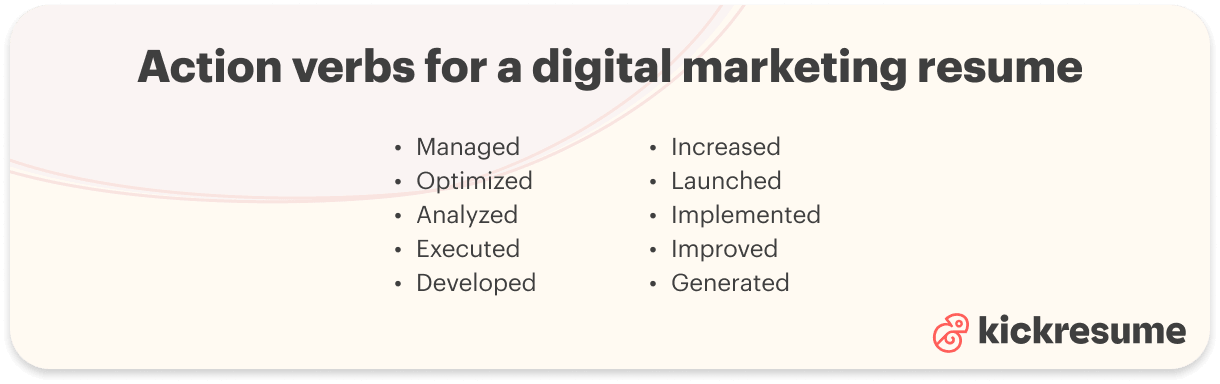
Action verbs for digital marketing resumes examples
- Managed
- Optimized
- Analyzed
- Executed
- Developed
- Increased
- Launched
- Implemented
- Improved
- Generated
To give you a better idea of how exactly action verbs can help you sound more confident and proactive, we've prepared a few examples below:
Digital marketing resume without action verbs
Before:
- I was responsible for managing social media posts
- I helped improve website traffic through SEO
- I worked on Google Ads campaigns
- I was in charge of writing blog content
- I helped track marketing performance
This version sounds passive and vague. The recruiter has to work harder to understand what the candidate actually did.
The same experience with action verbs
After:
- Managed daily social media publishing across LinkedIn and Instagram
- Optimized blog content using targeted keywords to improve organic search visibility
- Launched and monitored Google Ads campaigns focused on lead generation
- Wrote SEO-focused blog articles designed to capture high-intent search traffic
- Analyzed campaign performance using Google Analytics and prepared weekly reports
Now the same responsibilities sound more confident and specific. The reader can quickly see what exactly your role was in each of these tasks.
Action verbs can highlight soft skills too
Action verbs can also help demonstrate soft skills (this is that pin from before).
For example:
- Collaborated with designers and developers to launch campaign landing pages
- Presented campaign results to marketing managers during monthly reviews
- Coordinated cross-team efforts for product launch campaigns
These verbs show teamwork (collaborated), communication (presented), and leadership (coordinated) without needing to list those skills separately.
Before you finalize your resume, scan it quickly for weak phrases like “responsible for,” “helped with,” “was in charge of,” or “worked on.” Replace them with action verbs that are more representative of what you actually did.
7. List your education as a digital marketer correctly
In digital marketing, experience and results usually matter more than formal education. Employers care most about the campaigns you ran, the traffic you generated, and the tools you know how to use.
That said, the education section still belongs on your resume. Leaving it out can make your background look incomplete, even if your experience is strong.
People enter digital marketing from many different paths. Some studied marketing or communications in college. Others came from completely different fields and picked up marketing skills later through courses, certifications, or hands-on projects.
No matter which path you followed, the key is to present your education clearly and keep it relevant.
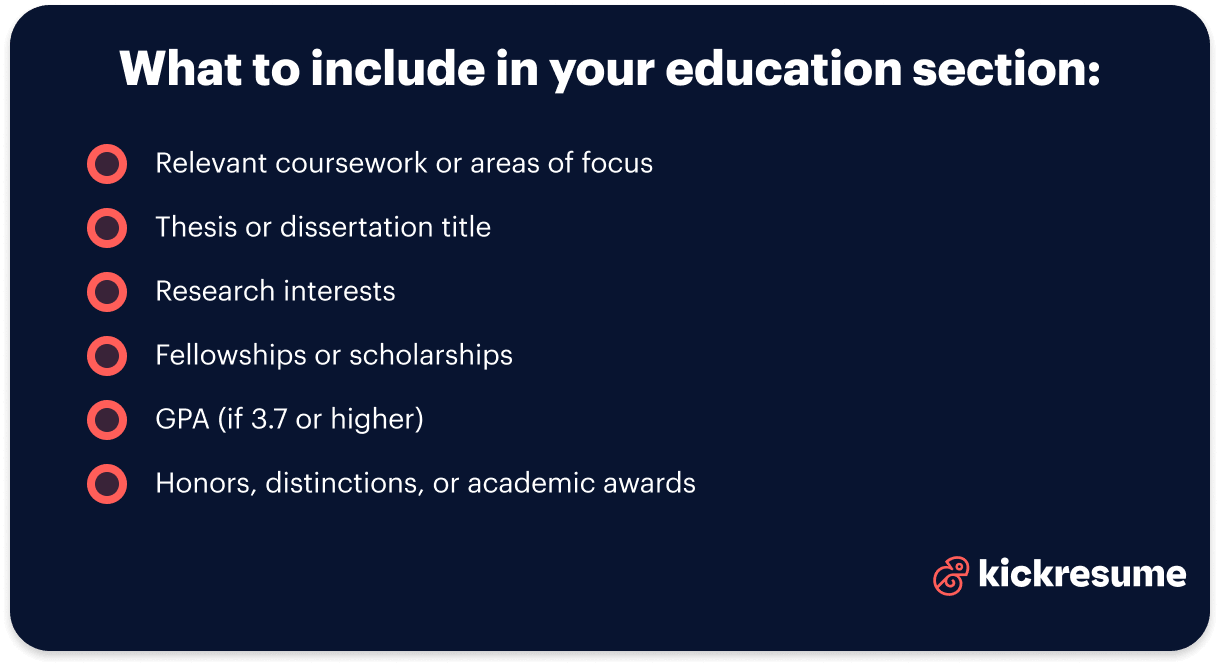
What to include in your education section
Depending on your background, your education section might include:
- Bachelor’s or master’s degree
- Marketing, business, or communication programs
- Relevant coursework
- Academic projects related to marketing or analytics
A typical education entry should look something like this:
Education section example for a digital marketing resume
Bachelor’s Degree in Marketing
Arizona State University, Tempe, AZ
2019 – 2023
- Relevant coursework: Digital Marketing Strategy, Consumer Behavior, Marketing Analytics, Content Marketing, Data Analysis
If your degree is related to marketing
If you studied marketing or a closely related field, your education section can support your professional experience.
Degrees that often connect well with digital marketing include:
- Marketing
- Business administration
- Communications
- Advertising
- Media studies
- Data analytics
If your degree isn't related to marketing
Many digital marketers started in completely different fields. That is normal in this industry.
If your degree is unrelated, simply list it as usual but shift the focus toward marketing skills you developed elsewhere.
For example, your resume might include:
- Digital marketing certifications
- Online courses focused on SEO, PPC, or analytics
- Marketing bootcamps or training programs
- Workshops or short professional courses
Certifications from recognized platforms can help strengthen your resume and show that you actively built the skills needed for the role.
Example of an education section with an unrelated degree
Bachelor of Science in Psychology
University of Colorado Boulder — Boulder, CO
Graduated: May 2022
Google Analytics Certification
Issued by: Google Skillshop
Credential ID: GA-4Q7K2L9
Issued: March 2025 | Expires: March 2027
Google Ads Search Certification
Issued by: Google Skillshop
Credential ID: GADS-S-8P1T6X4
Issued: February 2025 | Expires: February 2027
Content Marketing Certification
Issued by: HubSpot Academy
Credential ID: HSCM-3K5L8N2
Issued: January 2025 | Expires: January 2027
Even if your degree is in something unrelated like psychology, engineering, or literature, these certifications show that you invested time in learning digital marketing tools and techniques.
8. Add optional resume sections (if appropriate)
Your resume summary, skills, and work experience form the backbone of your digital marketing resume. If those sections are strong and your resume already fills a full page, you may not need anything else.
But sometimes you have more relevant information that deserves a place on your resume. In those cases, you should definitely consider adding one or two optional resume sections.
When should you add extra sections?
YES: If you still have relevant information that strengthens your application.
NO: If the additional sections would only fill space without adding real value.
Unnecessary sections can easily backfire. They can make your resume feel cluttered and distract recruiters from the most important parts of your experience. If a section doesn't support your candidacy, it's better to leave it out.
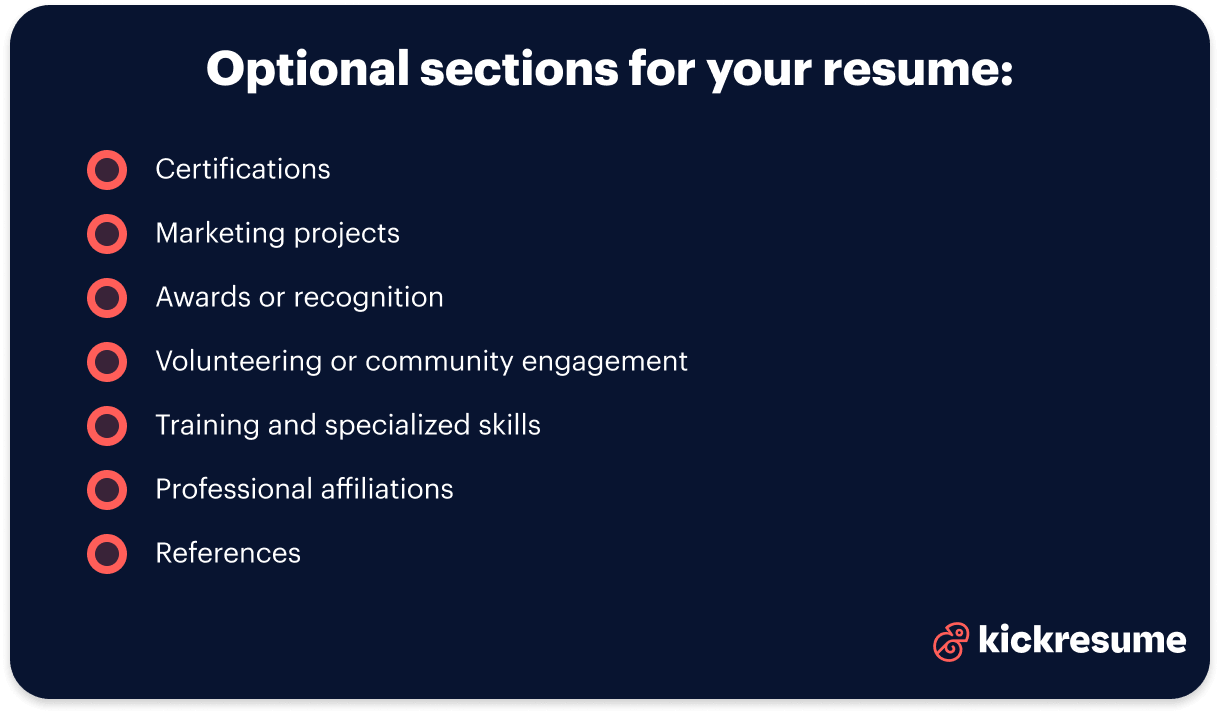
Optional sections that work well for digital marketers
- Certifications: Certifications are very common in digital marketing and can strengthen your resume, especially if they come from well-known platforms.
- Marketing projects: Projects can be very valuable, especially for junior marketers or freelancers. This section allows you to highlight hands-on work that might not appear in your job history.
- Professional development: This section can include workshops, short courses, marketing bootcamps, or specialized training programs that expanded your skills.
- Awards and recognition: If you have received professional recognition, it can add credibility to your resume.
- Professional affiliations: Membership in marketing communities or organizations can show commitment to the industry.
- Volunteering: Volunteer projects still count as experience even though you didn't get paid for your work.
Example of optional sections on a digital marketing resume
Certifications*
- Google Ads Search Certification — Google Skillshop
Issued: February 2025 | Credential ID: GADS-S-8P1T6X4 - HubSpot Content Marketing Certification — HubSpot Academy
Issued: January 2025 | Credential ID: HSCM-3K5L8N2
Projects*
- Personal SEO Blog: Built and managed a niche blog focused on productivity tools, reaching 15,000 monthly organic visitors within one year.
Awards
- Top Performing Campaign Award — XYZ Marketing Agency, 2024
*If you've already listed certifications or projects in another section, avoid repeating them here.
Optional sections should always support your application! If they strengthen your resume and make your experience clearer, include them. If not, keep your resume focused and concise.
9. Avoid silly mistakes when writing your digital marketing CV
Can you imagine a bigger agony than sending your job application and then realizing you made a mistake on your resume? Neither can we!
So, before emailing your resume, take a few minutes to check for common problems that often turn recruiters away. Here are some mistakes worth watching out for:
#1 Typos and spelling errors
Imagine writing “contant marketing” or “Gooogle Analytics” on a resume. It's embarrassing. But in a field like digital marketing, where attention to detail matters, this can also raise doubts about your work quality.
#2 Vague job descriptions
Phrases like “managed marketing campaigns” or “worked on SEO” don't tell the recruiter much. They describe activity but not impact.
#3 Including too much unrelated experience
Old or unrelated roles can dilute your message. Listing every job you've ever had makes it harder for recruiters to focus on your marketing experience.
#4 Sending the same resume to every employer
Different marketing roles require different strengths. A social media manager position focuses on very different skills than an SEO specialist role.
#5 Listing tasks without showing results
Many resumes list responsibilities but forget to show outcomes. Hiring managers want to understand what your work actually achieved.
#6 Ignoring soft skills completely
Digital marketers regularly work with designers, developers, clients, and other teams every day. Your resume needs to make it obvious that you can handle collaboration and teamwork.
#7 Messy formatting and layout
A cluttered resume can be frustrating to read. Long blocks of text, inconsistent fonts, or poor spacing can make recruiters lose interest quickly.
#8 Forgetting keywords from the job description
Many companies rely on ATS software to scan resumes. If your resume doesn't include the terms the employer is searching for, it might never reach the recruiter.
#9 Adding details that do not support your application
Extra information can distract from your main message. Listing hobbies or personal interests that have nothing to do with marketing rarely helps your case.
Taking a few minutes to review your CV before sending it can make a big difference in how recruiters respond to your application. You don't want to waste all the time and effort you've already put into shaping your resume!
10. Create a complementary cover letter for your resume
A resume shows what you’ve done, but it doesn’t explain why you want this job or why you care about the role. That's what a digital marketing cover letter is for.
Resume and cover letter: what's the difference?
Both documents are part of the same application, but they serve different purposes.
Your resume is structured and factual. It focuses on:
- Job titles and companies
- Dates of employment
- Skills, tools, and platforms
- Results and numbers
Your cover letter is more flexible. It gives you room to:
- Explain why you're applying
- Show interest in the company or brand
- Highlight motivation and mindset
- Connect your experience to the role in plain language
How your resume and cover letter should work together
Your resume presents the facts while your cover letter explains the story behind them.
A cover letter is the right place to:
- Add context to your experience
- Explain a career shift or employment gap
- Share why a specific marketing role excites you
- Show how your skills solve the employer’s problems
For example, your resume might say you managed SEO for three years. Your cover letter can explain why you enjoy SEO work, what kind of challenges you like solving, and why that experience fits this role in particular.
How they should NOT work together
There is one rule that matters most. Your cover letter should NOT repeat your resume!
You need to avoid things like:
- Rewriting your resume bullet points verbatim
- Copying your resume summary into the letter
- Listing job duties without adding insight
If something is already clear from your resume, there's no need to restate it. Expand on it.
Keep your resume and cover letter visually aligned
Try to keep both documents visually consistent by:
- Using the same font in both documents
- Matching font sizes and spacing where possible
- Using the same color accents if you include any
- Aligning headers and section styling
When your resume and cover letter support each other in both content and appearance, your application feels complete. Recruiters notice that level of care, even if they don't admit it out loud.
Create your cover letter fast with artificial intelligence.

11. Find the best resources for job-seeking digital marketers
Job hunting in digital marketing can feel messy and exhausting. There is no single path, and advice often comes from all directions at once… so there's a few more:
- Industry-specific job boards: General job boards work, but marketing-focused platforms save you time. Places like LinkedIn Jobs, Indeed, Wellfound, and Glassdoor tend to surface more relevant digital roles and give insight into companies before you apply.
- Continuous education and upskilling: Digital marketing rewards people who keep learning. Platforms like Google Skillshop, HubSpot Academy, Coursera, and Udemy help you sharpen skills without committing to another degree.
- Recognized certifications: Recruiters commonly recognize credentials from Google Ads Certification, Google Analytics Certification, and HubSpot Content Marketing Certification, especially for entry-level and mid-level roles.
- Industry blogs and marketing publications: Reading marketing blogs keeps you current and gives you language to use in interviews. Sites like the Moz Blog, Search Engine Journal, or Ahrefs Blog help you understand how professionals think about trends and tactics.
- Portfolio and personal branding platforms: A resume tells your story, but your work proves it. Platforms like Medium, WordPress, Notion, and GitHub let you show case studies, content, and projects in a way a resume cannot.
- Freelancing platforms: Freelance work is one of the easiest ways to gain hands-on experience, build a portfolio, and earn while you learn. Platforms like Upwork, Fiverr, PeoplePerHour, and Toptal are commonly used by digital marketers at different experience levels.
Pick what fits your current stage and build from there. Stay consistent, keep learning, and apply with intention. That approach carries much further than chasing every new tool or trend.
Marketing / PR Career Outlook in 2026
Employment opportunities in Marketing and Public Relations are projected to grow by 6% and 5%, respectively, between now and 2034. That’s slightly faster than the national average for all occupations. (Source: U.S. Bureau of Labor Statistics).
Each year, roughly 36,400 Marketing positions and 27,600 Public Relations positions are expected to open as the industry grows and workers retire or change careers.
In 2026, AI will continue to fundamentally transform the marketing industry. A new Spencer Stuart survey found that 90% of marketing leaders anticipate significant workforce changes:
- More than a third of CMOs plan to cut jobs in the next two years
- 54% expect to keep headcount steady but shift capabilities toward AI adoption
The research also points out that company size matters. While smaller companies tend to use AI as a way to “do more with what they have”, larger corporations ($20B+) often treat it as a cost-cutting tool.
The outlook for 2026 is clear: marketers who upskill to manage AI tools will stay competitive, while those who don't risk falling behind.
Average US base salaries across popular Marketing / PR roles:
- Marketing Manager: $81,908/year
- Advertising Manager: $106,778/year
- Brand Ambassador: $56,998/year
- Content Manager: $79,313/year
- Event Specialist: $41,599/year
- Marketing Specialist: $64,757/year
- Public Relations (PR) executive: $75,227/year
- Digital Marketer: $62,064/year
Salary figures are based on Indeed's January 2026 data from anonymous submissions and job listings. What you actually earn will depend on location, company size, job type, and how much experience you have.
If you’re considering a career in Marketing/PR or looking to advance in the field, success increasingly depends on working with AI, not against it. Focus on building strategic thinking, creative judgment, and comfort with AI tools. Those will be the skills that keep you competitive as the industry evolves.
Digital Marketing Resume FAQ
How long should a digital marketing resume be?
How long should a resume be? For most candidates, one page is enough. Two pages are fine if you have several years of relevant experience and real results to show. The goal is to make your resume focused and precise.
What skills should I list on a digital marketing resume?
List skills that match the job description. Focus on tools, platforms, and channels like SEO, paid ads, analytics, email marketing, or social media. Soft skills matter too, but they work best when shown through your experience instead of listed on their own.
How do I write a resume if I have no digital marketing experience?
If you’re new, lean on what you do have. Internships, freelance work, personal projects, certifications, and even coursework all count. What matters is showing hands-on experience and a willingness to learn, not having a perfect job title.
Why is my digital marketing resume getting rejected?
Often it comes down to one of three things. The resume is too generic, it’s not optimized for ATS systems, or it doesn’t match the job description closely enough. Tailoring your resume and using the right keywords usually fixes this.
How do I make my digital marketing resume stand out?
Specific results make the biggest difference. Numbers like traffic growth, conversion rate improvements, or budget size immediately catch attention. Clear structure, strong action verbs, and a focused summary also help your resume stand out fast.




![How to Write a Professional Resume Summary? [+Examples]](https://d2xe0iugdha6pz.cloudfront.net/article-small-images/How_to_Write_a_Professional_Resume_Summary_.png)
![How to List Your Education on a Resume? [+Examples]](https://d2xe0iugdha6pz.cloudfront.net/article-small-images/How_to_Put_Education_on_a_Resume_.png)
![How to Describe Your Work Experience on a Resume? [+Examples]](https://d2xe0iugdha6pz.cloudfront.net/article-small-images/How_to_Describe_Your_Work_Experience_on_a_Resume_.png)