
 ChatGPT
 Perplexity AI
 Claude
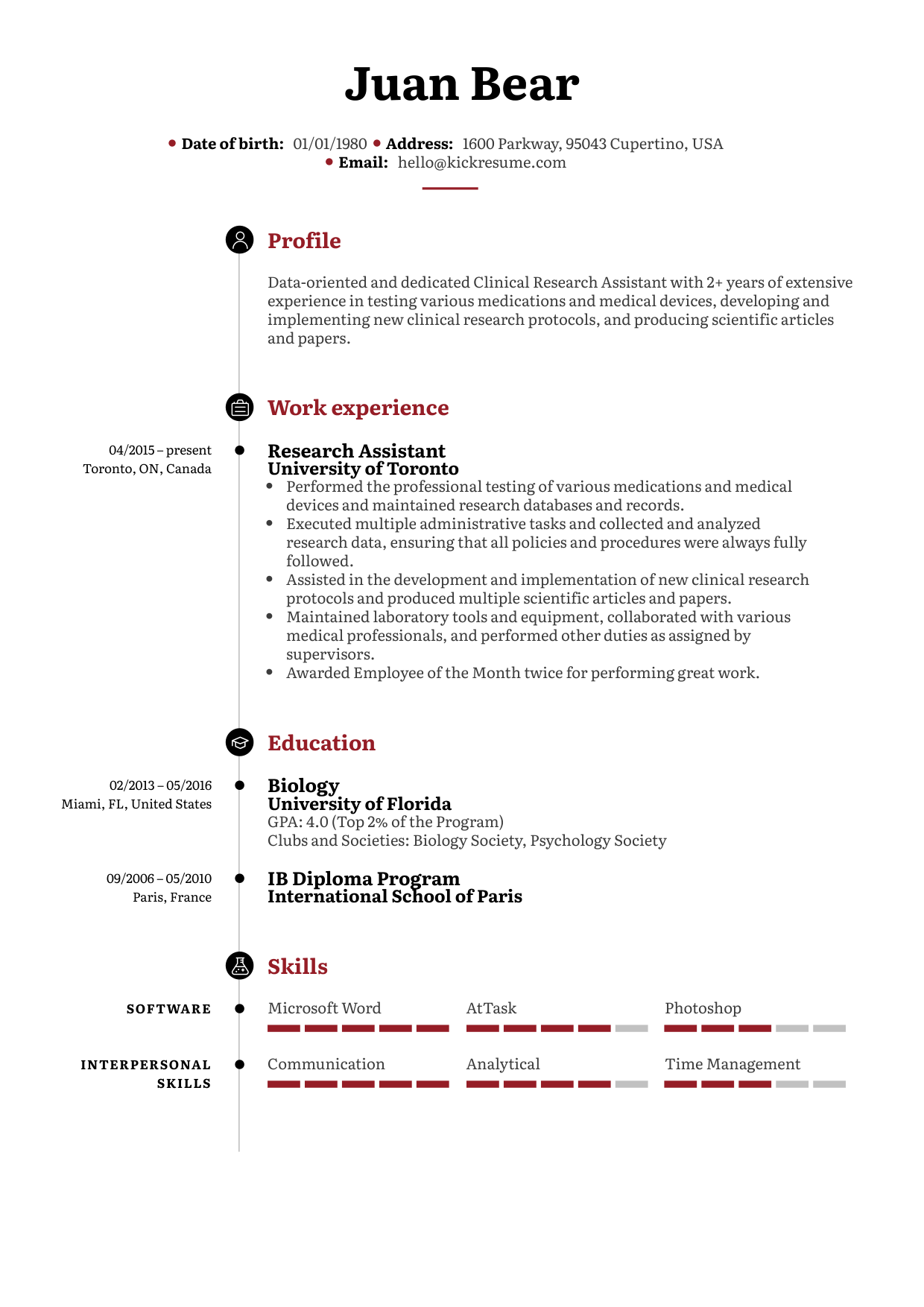
Writing a healthcare resume shouldn't feel like performing emergency triage. All you have to do is present your qualifications and experience clearly and show employers you have what it takes to deliver quality patient care.
In this comprehensive guide, we'll walk you through building a strong healthcare resume that gets noticed. You'll find expert tips for highlighting your clinical skills, real healthcare resume examples from hired professionals, and templates designed to work for both ATS systems and hiring managers.


 See more examples like these
In this guide, we will cover crucial components of your resume to pay attention to, including tips for tailoring each section for the job you are applying for. Keep reading and learn how to:
- Choose the right resume format for your healthcare experience level
- Write a healthcare-specific resume summary
- Pick key healthcare skills to select for inclusion on your resume
- What details to include in your work experience descriptions
- List your educational background in healthcare properly
- Choose relevant extra resume sections for your healthcare resume
- Where to find the best job search resources for healthcare professionals
Healthcare resume example (Physical Therapist)


Why does this healthcare resume work?
- Demonstrates progressive clinical experience: Ali shows a clear trajectory through multiple specialized rotations—neurological rehab, sports/ortho, acute care, and ICU—proving exposure to diverse patient populations and treatment settings that prepare him for real-world practice.
- Strong academic foundation with recognition: Graduating Magna Cum Laude, making Dean's list, and earning multiple academic grants and scholarships immediately establishes his capability and dedication to the profession.
- Extensive volunteer work shows commitment: The volunteering section demonstrates genuine passion for physical therapy beyond just employment—working with underserved populations, veterans, and children with disabilities shows well-rounded community engagement.
What could be improved?
- Contact information in the footer gets overlooked: Important details like phone number and email are easy to miss when placed at the bottom. Choose a resume template that puts contact information in the header where hiring managers expect to find it.
- Profile uses generic soft skills language: Phrases like "hard working, motivated" and "positive and supportive" are filler words. Replace with specific expertise: "Physical therapist specializing in neurological and orthopedic rehabilitation with clinical experience across acute care, outpatient, and sports medicine settings."
- Strengths section adds no real value: Listing "Time Management" and "Ambitious" without context doesn't differentiate him from other candidates. Remove this section entirely and use that space to expand on clinical certifications, specialized techniques (manual therapy, dry needling), or specific outcome achievements from rotations.
Hospital Lab Technician resume example

Why does this lab technician resume work?
- Quantified performance metrics: Martha provides concrete numbers—accessioning 386 cases monthly, QCing 472 cases with less than 1% error, and increasing productivity by 33%—which proves her efficiency and accuracy in laboratory operations.
- Shows leadership and cross-functional collaboration: Successfully leading lab aides across two hospital systems (UCHealth and Banner) while maintaining relationships with pathologists, radiologists, and technicians demonstrates strong interpersonal and management skills.
- Relevant technical systems listed: Including LigoLab LIS, Epic Systems, and Cerner in the skills section shows she's familiar with the laboratory information systems that hospitals actually use—critical for healthcare IT compatibility.
What could be improved?
- Profile is too vague and passive: "Seeking an enriching leadership position" doesn't sell her strengths. Replace with: "Laboratory Technician with 2+ years in pathology, proven track record of 33% productivity improvement and <1% error rate across multi-facility operations."
- Restaurant experience takes up too much space: The bartending role isn't relevant to laboratory work and uses valuable real estate. Either remove it entirely or condense to one line mentioning team leadership if trying to show management experience.
- Missing critical laboratory certifications: There's no mention of certifications like ASCP, lab safety training, or biosafety credentials that are often required or preferred for pathology positions. If she has any, they should be prominently featured; if not, this gap could hurt her application.
Healthcare resume sample

Why does this healthcare resume work?
- Extensive and diverse clinical experience: John shows real breadth across pediatric outpatient, skilled nursing, vision rehab, and acute care—proving he can handle different patient populations and treatment settings.
- Formal assessment competencies clearly listed: Independently administering standardized assessments like BOT-2, PDMS-2, MOCA, and COPM shows he has hands-on evaluation skills, not just theoretical knowledge—which is exactly what OT positions require.
- Bilingual capability with certification: The Spanish Health Care Professionals Certification from UCSD plus volunteer translation work in Tijuana means he can serve Spanish-speaking patients—a huge asset in diverse healthcare settings.
What could be improved?
- Missing a professional summary: The CV jumps straight into work experience without establishing who John is as a clinician. Adding a summary at the top with his OTR credentials, years of experience, pediatric focus, and bilingual skills would immediately show hiring managers what he brings to the table.
- Certifications are buried on page two: BLS/CPR and Crisis Prevention certifications matter for healthcare roles but they're easy to miss at the bottom (you'll find them on the full resume when you click the sample and scroll down). Move these up or mention them in the summary.
- No references section included: Healthcare employers typically expect references, especially for clinical positions. Adding "References available upon request" or listing 2-3 professional references from clinical rotations or previous OT roles would make the application feel complete.
1. Choose the right resume format for your healthcare experience level
There are many different types of positions within healthcare – and the position you are applying for effects which resume format will best suit your needs.
These positions include:
• Medical Doctors and Assistants
• Mental Health Professionals
• Nurses
• Pharmacy Technicians
• Physical Therapists
• Dentists
• Veterinarians
As for resumes, there are two main formats you can choose between for a standard resume: reverse-chronological and functional.
- Reverse-chronological resumes are well-suited for experienced job candidates who have enough relevant work history to fill out a large, main section on the resume. This is also the most common type of resume format, so employers will have an easier time navigating this format visually and textually.
- Functional resumes take the emphasis off work experience and place it instead on skills, education, certifications, and any other sections a resume may have. This format is sometimes preferred by recent college graduates who may have unpaid internship experience, but few formal jobs to showcase.
Pro tip: For highly experienced healthcare professionals, consider a CV-style resume. CV stands for Curriculum Vitae and is a long-form resume with multiple pages. If you are applying for a high-level healthcare position, such as an executive, a CV will give you a greater opportunity to list all of your qualifications – including research and publications.
Use artificial intelligence to create your resume — FAST!

2. Write a summary of your healthcare qualifications
Grab attention with a strong health care resume summary or objective statement at the top of the document.
In the healthcare field, recruiters often receive a flood of resumes for each position. They spend just a few seconds scanning each one.
Your resume summary acts as a concise introduction that grabs their attention right from the start. It allows you to highlight your key qualifications, relevant experience, and the value you bring to the table. Crafting a compelling summary helps you stand out among the sea of applicants and ensures that your resume is given the attention it deserves.
Bad healthcare resume summary example
"Healthcare professional with many years of experience working in medical administration and office management. Strong understanding of medical terminology and excellent communication skills."
What's wrong with this example? Though there are some good details included here, such as the candidate’s experience as a medical administrator, this summary lacks specificity. For this type of summary, you want to highlight your best accomplishments and qualifications to help your resume stand out from your competition’s.
Good healthcare resume summary example
"Driven healthcare professional with more than 5 years of experience in medical administration and office management. Highly knowledgeable in managing patient records, medical billing, and hospital expenses. Implemented a new patient scheduling system that boosted patient retention by 20% in previous position."
Why is this better? In this example, the candidate provides specific details regarding their years of experience and the types of responsibilities they held. Additionally, they include a notable achievement of boosting patient retention – thus, highlighting the value they can bring to a new employer.
3. Select key healthcare skills to include on your resume
The skills you include on your resume will ultimately depend on what position in healthcare you are applying for.
Job descriptions are often rich with keywords and skills that the employer wants from applicants. Finding and including these on your resume will not only help you impress employers but will show that you have a close attention to detail as well.
Best hard skills to include on a healthcare resume
- CPR & First Aid
- HIPAA Knowledge
- Customer Billing
- Patient Record Management
- Quality Assurance
- Medical Budgeting
- Data Entry
- Outbound/Inbound Calling
- Urgent Care
- Pharmaceutical Sales
Best soft skills to include on a healthcare resume
- Communication
- Positivity
- Active Listening
- Compassion & Empathy
- Emotional Support
- Conflict & Stress Management
- Time Management
- Work Ethic
- Professionalism
- Attention to Detail
Find out your resume score!

4. Include specific and quantifiable details in your work experience section
As you write out your work experience section, it is crucial to include as many of your achievements and key responsibilities as possible.
You don’t want your work experience descriptions to come across as too bland or ordinary. Using action verbs to emphasize your participation in previous jobs is key, as well as including specific and quantifiable details regarding your achievements.
Here's an example of a well-written work experience entry on a healthcare resume
Medical Administrator | Kindred Hospital Denver
Denver, CO | June 2017 to January 2021
- Onboarded and coordinated care for more than 200 patients.
- Implemented a new scheduling system that increased patient retention by 20 percent and decreased scheduling expenses by 35 percent.
- Reviewed more than 100 medical applications on a weekly basis.


 See more examples like these
5. List your educational background in healthcare properly
The education section is critical for healthcare professionals. Unlike other fields where experience can sometimes trump credentials, healthcare roles have strict educational requirements—and hiring managers will check that you meet licensing and accreditation standards.
Here's how to get the education section on your healthcare resume right.
What to include in your healthcare education section
At minimum, your education section should include:
- Degree title: Be specific. Write "Doctor of Physical Therapy (DPT)" not just "Doctorate" or "Bachelor of Science in Nursing (BSN)" instead of "Nursing Degree."
- Institution name: Include the full, official name of your school or university.
- Location: City and state (or country if applicable).
- Graduation date: Month and year. If you're still studying, write "Expected May 2025" or similar.
But healthcare resumes often benefit from additional details:
- Accreditation status: If your program was ACOTE-accredited (for OT), CAPTE-accredited (for PT), or LCME-accredited (for MD), mention it, especially for newer programs where employers might question legitimacy.
- Clinical rotations or concentrations: If you specialized in a particular area (pediatrics, geriatrics, oncology), list it to show focused expertise.
- Academic honors: Dean's List, cum laude distinctions, or scholarships demonstrate excellence and work ethic.
- Relevant coursework: Only include this if you're a recent graduate with limited experience. Focus on courses directly tied to the job (e.g., "Advanced Pharmacology" for a nurse practitioner role).
- Thesis or capstone projects: If your project relates to the position (e.g., research on fall prevention for a geriatric PT role), briefly mention it.
Let's have a look at how the education section should (and should not) look like in a healthcare resume:
Good example of education on a healthcare resume
Master of Science in Nursing (MSN) – Family Nurse Practitioner
Johns Hopkins University, Baltimore, MD
Graduated: May 2022
CCNE-Accredited Program
- Clinical Focus: Primary Care and Chronic Disease Management
- Capstone Project: Diabetes Self-Management Education Program for Underserved Communities
- Dean's List (2021, 2022)
Bachelor of Science in Nursing (BSN)
University of Virginia, Charlottesville, VA
Graduated: May 2019
Graduated Magna Cum Laude
- Clinical Rotations: ICU, Emergency Department, Pediatrics
Why this works: It's specific, includes accreditation, shows clinical focus areas, and highlights academic achievement—all things that build credibility fast.
Bad example of education on a healthcare resume
Master's Degree
Johns Hopkins University
2022
Bachelor's Degree
University of Virginia
2019
Why this doesn't work: It's too vague. Hiring managers can't tell if this candidate is qualified for a clinical role or an administrative one.
One more thing, if you're an experienced healthcare professional with 5+ years in the field, move your education section toward the bottom of your resume (after your work experience). Your hands-on clinical expertise matters more at this stage than where you went to school.
But if you're a recent graduate or still completing your degree, keep education near the top. It's your strongest credential right now.
Tip: Certifications like BLS, ACLS, PALS, or specialty credentials (CCRN, CEN, etc.) should have their own dedicated section, don't mix them with your education. We'll cover how to format your certifications section in the next chapter.
6. Include relevant extra sections in your healthcare resume
Once you've covered the standard resume sections (summary, work experience, education, and skills) you might have some room left on your resume. Or maybe you just have more relevant information that could strengthen your application.
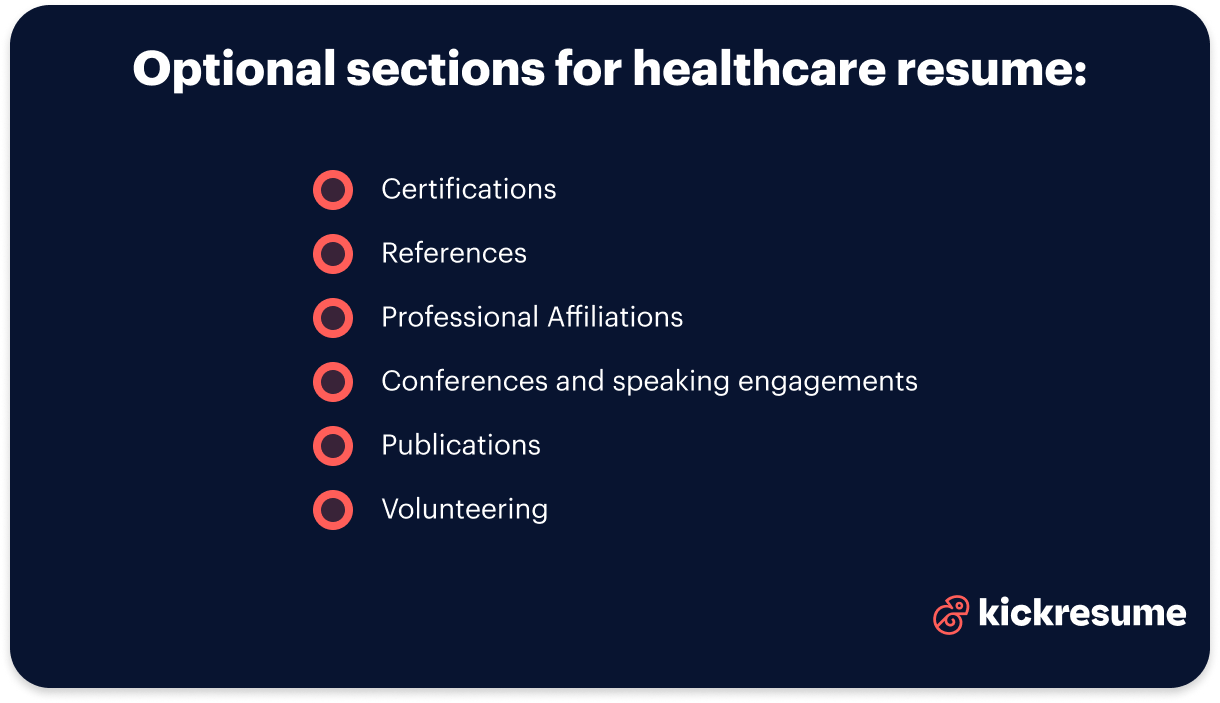
Here are the optional sections that actually matter for healthcare professionals:
Certifications
Certifications are huge in healthcare. They show you've gone beyond basic requirements and have specialized training that makes you more valuable.
This section deserves its own dedicated space—don't bury certifications in your education section or mix them with skills.
Include:
- Certification name: Be specific (e.g., "Certified Critical Care Nurse (CCRN)" not just "Critical Care Certified")
- Issuing organization: Like American Heart Association, ANCC, or NBCOT
- Date obtained and expiration date: Healthcare certifications expire, so employers need to know yours are current
- Link to your online certificate: Or and ID of your certificate. It helps recruiters quickly verify your credentials and shows that your certification is legitimate.
Certifications on a healthcare resume example
Certifications
- Basic Life Support (BLS) – American Heart Association, Valid through June 2026 (View Certificate)
- Advanced Cardiovascular Life Support (ACLS) – American Heart Association, Valid through August 2025 (Certificate ID: 9767)
- Certified Emergency Nurse (CEN) – Board of Certification for Emergency Nursing, Obtained March 2023 (Online Certificate)
- Pediatric Advanced Life Support (PALS) – American Heart Association, Valid through December 2025
References
Unlike most industries, healthcare employers often expect references on a resume / CV—and they actually check them. Clinical supervisors, preceptors, and former managers can vouch for your patient care skills, reliability, and professionalism.
You have two options:
Option 1: List them directly on your resume
If the job posting asks for references or if you have strong ones you want to highlight, include them like so:
References on a healthcare resume example
References
- Dr. Sarah Chen, Clinical Supervisor – Memorial Hospital ICU
Phone: (555) 123-4567 | Email: schen@memorial.org - Michael Rodriguez, RN, BSN – Charge Nurse, Emergency Department
Phone: (555) 234-5678 | Email: mrodriguez@healthsystem.com
Option 2: Note that references are available
If space is tight or you'd rather provide them when asked, you can do something like this:
References upon request on a healthcare resume example
References
- Available upon request
Either way works, but having references ready shows you're prepared and have people who can back up your qualifications.
Professional memberships & affiliations
Being a member of professional organizations shows you're committed to staying current in your field and connected to the healthcare community.
Only include memberships that are:
- Active (you're currently a member, not someone who joined once in 2015)
- Relevant to your role
- Recognized in the industry
It can look something like this in your healthcare resume:
Professional affiliations on a healthcare resume example
Professional Affiliations
- American Nurses Association (ANA), Active Member since 2020
- Emergency Nurses Association (ENA), Member since 2021
- Sigma Theta Tau International Honor Society of Nursing
Here are some common organizations by specialty:
- Nurses: ANA, ENA, AACN (American Association of Critical-Care Nurses), ONS (Oncology Nursing Society)
- Physical Therapists: APTA (American Physical Therapy Association), specialty sections like Neurology or Orthopedics
- Occupational Therapists: AOTA (American Occupational Therapy Association)
- Physicians: AMA, specialty boards like AAP (pediatrics) or ACEP (emergency medicine)
If you hold leadership positions in these organizations (like committee member or chapter president), mention that—it shows initiative and leadership beyond your day job.
7. Useful job search resources for healthcare professionals
If you're angling for a role in the dynamic world of healthcare, having the right resources can power up your job search. Let's focus on some key platforms that can provide invaluable help:
- Healthcare-specific job boards: Websites like HealthJobsNationwide and Health eCareers specialize in healthcare positions, from entry-level to senior roles, across multiple specialties.
- LinkedIn: This professional networking site is not just for techies and marketers. Many healthcare organizations use LinkedIn for recruitment. Make sure your profile is up-to-date and optimized with relevant keywords to appear in recruiters' searches.
- Professional associations: Many healthcare professions have associations like the American Medical Association (AMA) or the American Nurses Association (ANA) that post job opportunities for their members.
- Industry publications: Publications such as Modern Healthcare and Healthcare IT News often feature job postings alongside industry news.
- Hospital job boards: Don't forget to check the career pages of hospitals in your area. They often post job openings on their websites before listing them on other platforms.
Remember, while these resources can be great aids, they can't replace the power of networking. Always be ready to make connections, whether online or in person, who can help propel your healthcare career forward.
Healthcare Career Outlook in 2025
Employment in Healthcare is expected to grow much faster than the average for all occupations from 2023 to 2033. (Source: U.S. Bureau of Labor Statistics)
Every year, about 1.9 million healthcare jobs are expected to open, primarily due to employment growth and the need to replace workers who leave the occupations permanently.
Average US base salaries across popular Healthcare roles:
- Dentist: $229,645/year
- Medical Assistant: $46,824/year
- Medical Doctor: $215,629/year
- Mental Health Therapist: $72,108/year
- Nurse: $89,868/year
- Pharmacy Technician: $38,098/year
- Physical Technician: $90,475/year
- Veterinarian: $126,451/year
- Chiropractor: $87,434/year
- Sonographer: $129,582year
- Paramedic: $48,966/year
- Occupational Therapist: $93,569/year
Salary estimates are based on data submitted anonymously to Indeed by individuals working in these roles, as well as information from past and present job postings on the platform over the last 36 months.
These numbers may vary based on location, employment type, and experience level.
As you can see, salaries can vary significantly across roles in Healthcare. If you’re considering a career in this field, be sure to explore and compare your options carefully. Nevertheless, if you’re thinking about starting a career in Healthcare—or you want to grow within the field—now is a great time to explore the opportunities the industry provides.
Healthcare Resume FAQ
I'm a Nurse - Will these tips apply when I'm designing my healthcare resume?
Absolutely! The advice in this healthcare resume guide applies across various healthcare roles, nursing included. The emphasis on formatting, highlighting skills, and detailing experiences can benefit all healthcare professionals. Just remember, specificity counts - tailor each aspect of your resume to reflect your unique nursing skills and experiences.
I just graduated in healthcare studies. Without much experience, how can I make my healthcare resume attractive?
As a new graduate, focus on your academic accomplishments, coursework that ties in directly with the job you're applying for, internships, and any practical training or projects that you were part of. Your soft skills, such as communication, teamwork, and problem-solving, are valuable too. Aim to show your potential and your enthusiasm for a career in healthcare.
Can I reference a specific patient case or scenario on my healthcare resume?
Yes, you can reference specific cases or instances as long as they illustrate your professional achievements and skills, and you ensure patient confidentiality is maintained. Never include identifiable patient information.
I have gaps in my employment history. How should this be shown on a healthcare resume?
If you have significant employment gaps, the best way to handle them on your healthcare resume would be a functional or skills-based resume, which emphasizes your skills rather than your chronological work history. If needed, briefly address these gaps in your cover letter while focusing on what you did during these periods (like further studies or voluntary work) that could enhance your healthcare profession skills or knowledge. Remember, there's no one-size-fits-all career path in healthcare.
I have experience in multiple healthcare roles. How should I structure my resume?
In such a case, your healthcare resume should highlight the diversity of your experience. Create a "Professional Experience" section and categorize your roles under each relevant position. Alternatively, sort it based on medical specialty, depending on which approach presents your skills and experiences best. Remember, your goal is to show an employer the full range of your healthcare proficiencies.






![How to Write a Professional Resume Summary? [+Examples]](https://d2xe0iugdha6pz.cloudfront.net/article-small-images/How_to_Write_a_Professional_Resume_Summary_.png)
![How to List Your Education on a Resume? [+Examples]](https://d2xe0iugdha6pz.cloudfront.net/article-small-images/How_to_Put_Education_on_a_Resume_.png)
![How to Describe Your Work Experience on a Resume? [+Examples]](https://d2xe0iugdha6pz.cloudfront.net/article-small-images/How_to_Describe_Your_Work_Experience_on_a_Resume_.png)