ChatGPT
 Perplexity AI
 Claude
Crafting a persuasive account manager cover letter doesn't have to be a headache. Certainly not with our guide, which brings you detailed tips, specific examples, and, of course, cover letter samples. Follow our advice, and you can create your very own cover letter that showcases your enthusiasm, skills, and key accomplishments in no time.



 See more examples like these
Here's what we'll cover:
- A breakdown of 3 account manager cover letter samples
- Formatting basics that make your letter readable (not just pretty)
- Header dos and don'ts
- How to write a headline that actually pulls people in
- Why generic greetings hurt you (and what to do instead)
- How to open your cover letter without putting anyone to sleep
- How to talk about your skills, wins, and numbers like a pro
- The best action verbs for account managers
- How to close strong and make the next step easy
- Common mistakes account managers make (and how to dodge them)
- How to make your account manager cover letter and resume actually feel like a pair
- Average salary and job outlook for account managers
- A few extra job search resources
Still looking for that next role? Kickresume can help you find a job faster and walk you through every step of the process.
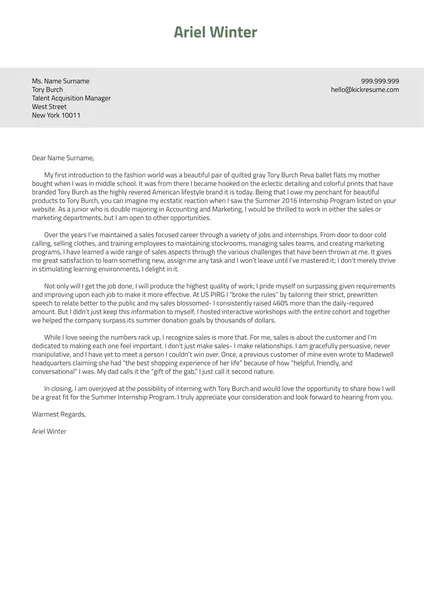
Account executive cover letter sample


Why does this cover letter example work?
- The opening hook pulls you in with a personal story: Instead of the usual "I am writing to apply for..." snooze-fest, the letter kicks off with a specific, sensory memory: a pair of quilted gray ballet flats bought in middle school. It immediately shows a genuine, long-standing connection to the brand (not the kind of thing you can fake or copy-paste into another application). Hiring managers read hundreds of these things, and a story is far more memorable than a credential dump. If you take one thing from this letter, let it be this: open with something only you could have written.
- The voice has real personality and isn't afraid to show it: Phrases like "I don't just make sales, I make relationships," "gracefully persuasive, never manipulative," and the cheeky "gift of the gab" line about a parent's nickname all give the letter a distinct character. This matters a lot for client-facing roles, where the ability to be warm, confident, and a little charming on the page is itself a signal that the candidate can do the job.
- Sales and customer relationships stay at the center the whole way through: Notice how every example circles back to the same theme: the cold-calling job leads to a concrete sales stat (460% above the daily requirement), the workshops show team-lifting through sales know-how, and the Madewell anecdote uses a customer's own words to prove the relationship-building claim.
What could be improved?
- The closing paragraph fizzles out instead of landing: After four punchy, story-driven paragraphs, the ending settles for "I am overjoyed... I truly appreciate your consideration and look forward to hearing from you" - which is the same generic sign-off you'd find in any random application. There's no proposed next step, no nudge toward a conversation, no repeat of contact details, no confident "I'd love to chat next week about how I can contribute."
- A few small writing slips chip away at the polish: There's a missing word in "sales is more that" (should be "more than that"), a clunky "Being that I owe my penchant..." that reads stiff next to the otherwise breezy tone, and some sentences run long enough that the punch gets lost. None of these are dealbreakers on their own, but in a letter that's trying to convince someone of attention to detail and persuasive communication, every typo or awkward phrasing costs a little credibility.
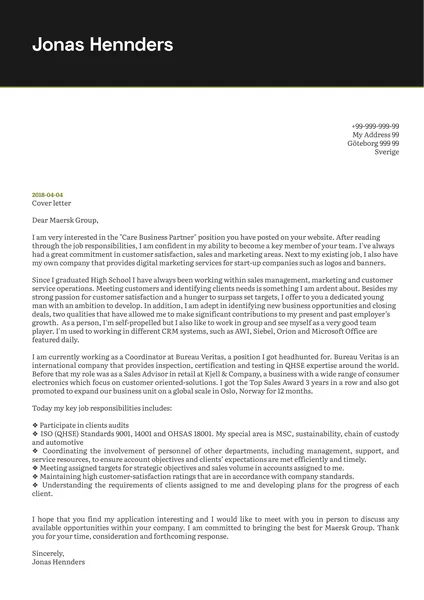
Enterprise account consultant cover letter sample

Why does this cover letter example work?
- The internal-candidate angle is established right up front and used as real leverage: Within the first two paragraphs, you learn this is a 12-year veteran of the company applying for an internal move, and that fact does a lot of heavy lifting. It immediately answers a bunch of questions a hiring manager would have: ramp-up time will be minimal, the candidate already knows the products, the mission, the competitive landscape, and the internal partners.
- Specific numbers and specifics back up the claims: "$650,000+ in additional revenue over the past 12 months" is the kind of line that makes a hiring manager actually pause and reread. The same goes for naming the specific awards received (Customer 1st, Business Excellence, Hero) rather than vaguely saying "I've been recognized for strong performance." This is exactly how sales candidates should write about themselves, because sales is a numbers job and decision-makers want to see proof you can move the needle.
- The structure is clean and easy to skim: The letter follows a logical arc: thank-you opener, big-picture experience, current role with bulleted responsibilities, prior experience, soft skills and recognition, close. A busy reader can scan it in under a minute and still walk away with the key points, partly thanks to the bullet list breaking up the wall of text in the middle.
What could be improved?
- "Dear Sir/Madam" is a cold-open in a letter that should feel warm: This is especially jarring because the candidate has been at the company for 12 years, which means almost certainly there is a way to find the hiring manager's name, whether through the internal directory, a quick chat with HR, or just asking around. Falling back on "Sir/Madam" makes the letter feel like a mass-mailed application rather than a thoughtful internal move, and it sets a slightly stiff, formal tone that doesn't match the strong personal story the rest of the letter is trying to tell.
- The middle section drifts into generic soft-skill territory: Phrases like "I respond well to a challenge," "valuable team member," "high ethical standards," and "positive team environment where every individual is valued" are the kind of lines you'd find in literally any cover letter on the internet. The fix isn't to cut soft skills entirely, it's to show them through a brief example instead of asserting them.
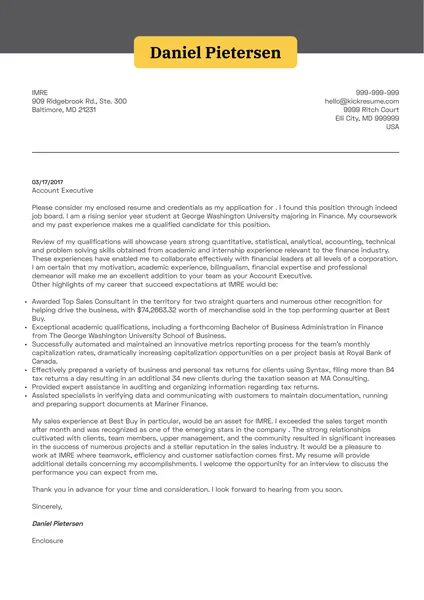
Account executive cover letter example

Why does this cover letter example work?
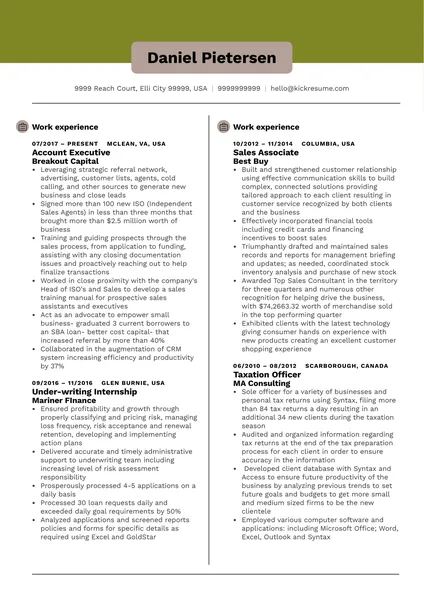
- The achievements section is packed with the kind of specifics hiring managers love: That middle bulleted list is genuinely the strongest part of the letter. Naming a "Top Sales Consultant" award for two straight quarters, mentioning a specific dollar figure of merchandise sold, automating a metrics reporting process at RBC, filing 84+ tax returns a day and bringing in 34 new clients at MA Consulting. Each bullet ties a specific action to a measurable result, which is exactly how achievements should be presented.
- The range of experience tells a coherent finance-and-sales story: Best Buy for retail sales, Royal Bank of Canada for analytics, MA Consulting for tax work, Mariner Finance for client support - on paper that could read as scattered, but the letter does a decent job of framing it as a finance-flavored journey that also has strong sales chops. The takeaway worth borrowing here: when your background covers multiple areas, find the thread that connects them to the role you want, rather than listing experiences and hoping the reader connects the dots themselves.
What could be improved?
- There are several typos and slips that really need to be cleaned up: "Please consider my enclosed resume and credentials as my application for ." has a blank where the job title should be - the sentence literally trails off. "$74,2663.32" has a number that doesn't parse (is it $74,266.32? $742,663.32? hard to tell). "Other highlights of my career that succeed expectations" should be "exceed expectations." The good news is this is the easiest category of fix: one careful read-aloud pass, or one trusted friend's eyes, would catch all of it.
- The letter doesn't show much specific interest in IMRE itself: Beyond the line about IMRE valuing "teamwork, efficiency and customer satisfaction" (which honestly could describe almost any company), there's not much evidence the candidate has researched what IMRE actually does, who their clients are, or why this particular Account Executive role appeals to them. One or two sentences referencing something specific (a recent campaign, a client industry IMRE works in, a value or specialty the company is known for) would go a long way.
1. How to format your account manager cover letter properly
Good formatting isn't just about making things pretty. It's about making your cover letter easy to scan. Because that's what hiring managers actually do. They scan first, read later (maybe).
Here's how to make your account manager cover letter look the part:
- Pick a clean, no-drama font: Calibri, Arial, Times New Roman, Helvetica. Skip anything that looks like it belongs on a wedding invitation.
- Use 11 or 12 point text: Smaller than 11 and it feels cramped. Bigger than 12 and it looks like you're padding for length.
- Set one-inch margins on all sides: Pages with healthy margins feel calmer. Crowded pages feel… stressful.
- Keep paragraphs short: Two to four sentences each, with space between them. Long paragraphs get skipped. Always.
- Left-align your text: Centered or fully justified text creates weird gaps and makes lines harder to read.
- One page. That's it: A short intro, a few focused middle paragraphs, a tight close. If it's spilling onto page two, you're saying too much.
- Use bold and italics sparingly: A little emphasis works. Bolding half your sentences works against you.
- Let white space do some heavy lifting: Empty space isn't wasted. It guides the eye and helps key points pop.
- Bullet points are fine in moderation: A short bulleted list of key wins or skills can work well for account managers. Just don't turn your whole letter into one.
Honestly, the easiest way to skip this entire headache? Use a professionally designed cover letter template. It handles the layout for you and you can focus on what actually matters — what you're going to say.
Create your cover letter fast with artificial intelligence.

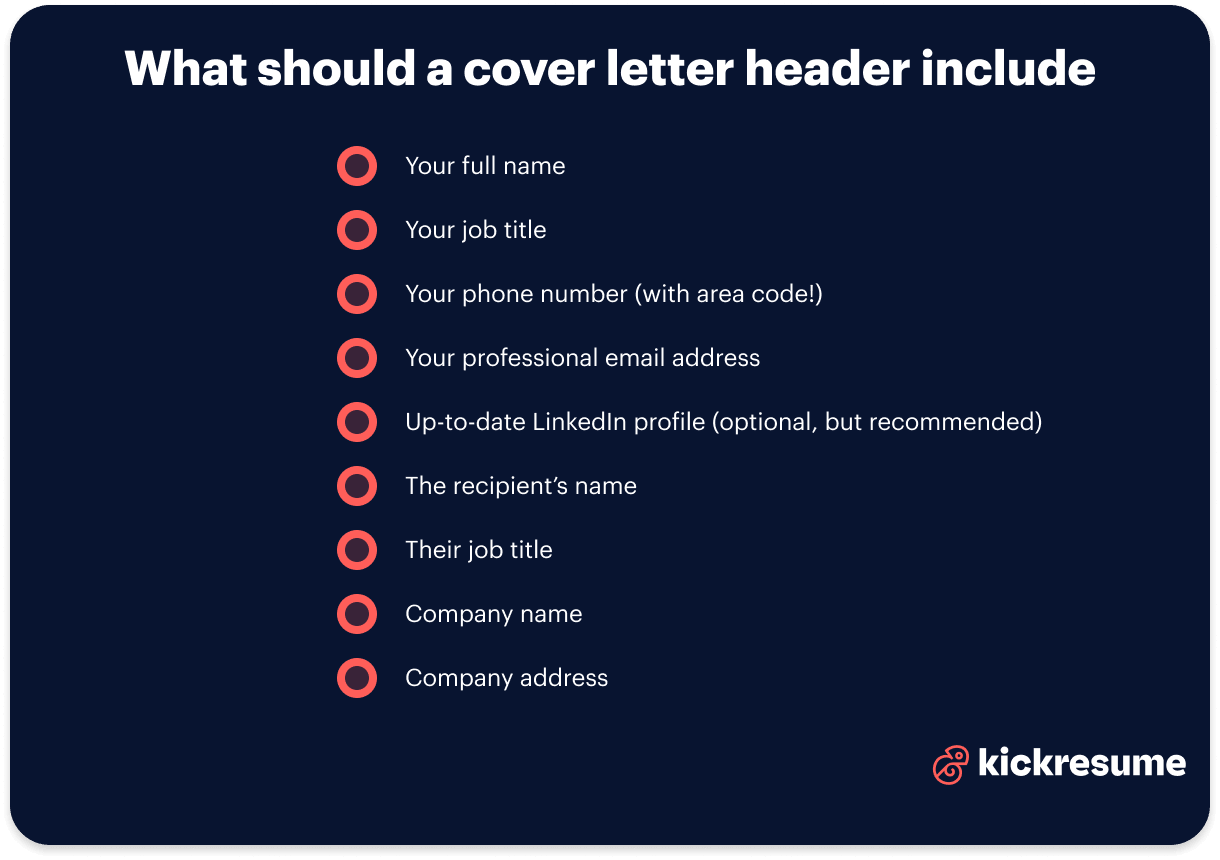
2. What makes a good cover letter header
The header is the strip of contact info at the very top of your cover letter. Your details on one side, the employer's on the other (or right below). It looks old-fashioned. It kind of is old-fashioned. And it's still expected.
So, why does it matter? A recruiter might print your cover letter, save it as a PDF, or pass it to someone in another department. If your contact info isn't right there at the top, finding it becomes their problem. And nobody wants to be the candidate whose contact info was a problem.
Start with your contact info
Put this at the top. Double-check it's accurate (a typo in your email address is a real career-ender):
- Your full name
- Phone number with area code
- A professional email address
- LinkedIn profile (if it's actually up to date)
-
Optional: a portfolio or personal website if it adds something
Then add the employer's info
Right below your details, include:
- Hiring manager's name (more on this in chapter 4)
- Their job title
- Company name
- Company address
- Date
Bad account manager cover letter header example
Tay
sellsell123@email.com
555-2002
To whom it may concern
The company
What's the problem here? Almost everything. The name is a nickname at best. The email reads like a spam account. The phone number is incomplete. There's no LinkedIn, no title, no company name, no address. It looks like Tay slapped this together in 90 seconds.
Good account manager cover letter header example
Taylor Hughes, Senior Account Manager
(555) 200-2543
taylor.hughes@email.com | linkedin.com/in/taylorhughes
Sarah Chen, Director of Client Services
BrightPath Marketing
425 Lakeshore Drive
Chicago, IL 60601
May 10, 2026
Much better. It's clean, professional, and every piece of info is doing its job. Once your header is dialed in, you don't have to think about it again. You can carry the same format from one application to the next and just swap out the company details.
3. How to perfect your account manager cover letter headline
Do you really need a headline? Technically no. Realistically yes.
Here's why.
Recruiters don't sit down with a cup of tea and read every cover letter top to bottom. They skim. Quickly. Sometimes brutally quickly. A headline is the one line (sitting right under your header) that gives them a reason to slow down and actually read what comes next.
A great headline needs to make people want to see the full thing. It needs to be:
- Specific: Mention your role, your specialty, or the type of accounts you handle. Vague titles do nothing for you.
- Relevant to the job: Tailor it to what this employer actually needs. Don't try to sum up your entire career.
- Confident: State what you do clearly. No hedging, no apologizing, no "looking for a new opportunity."
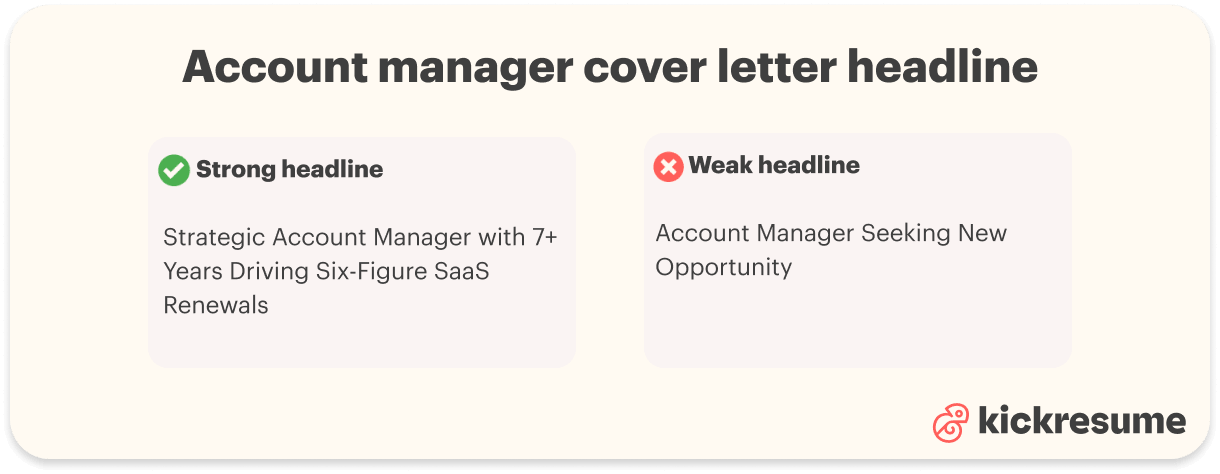
Bad account manager cover letter headline example
Account Manager Seeking New Opportunity
Why is this not great? It tells the recruiter nothing they don't already know. You're an account manager. You're applying. Cool. What kind of account manager are you? What's your specialty? What have you actually done? This headline is a yawn.
Good account manager cover letter headline examples
- Strategic Account Manager with 7+ Years Driving Six-Figure SaaS Renewals
- Key Account Manager Specializing in Enterprise Retention and Upsell Growth
- Bilingual Account Manager Managing $5M+ Portfolios in the Financial Services Sector
See the difference? Each of these tells the recruiter exactly who you are and what you bring in one quick line. Specialty, scale, and value, all packed into a single sentence.
Headline ideas for early-career account managers
If you don't have years of experience to lean on, that's totally fine. Lean on what you do have. Stuff like your education, certifications, internships, or related sales/customer experience are perfectly valid alternatives.
Good account manager cover letter headline examples for freshers
- Recent Marketing Graduate with Hands-On Agency Experience and a Passion for Client Success
- Sales Coordinator Ready to Transition into Full Account Management
- Customer Success Specialist with 2 Years of Retention and Upsell Experience
A headline alone won't get you hired. But a good one buys you a few extra seconds of attention. And in a hiring process that often comes down to first impressions, that's gold.
4. Why personalized greetings actually matter
One of the biggest, most avoidable mistakes account managers make? Skipping the personalized greeting and defaulting to "To Whom It May Concern."
What's wrong with that? Account management is literally about relationships. It's about treating people like people, not like inboxes. If your cover letter opens like a mass email, you're already contradicting the whole point of the role you're applying for.
How to actually find the right name
A few places to start:
- The job posting: Sometimes the hiring manager's name is sitting right there in the contact info or near the bottom.
- The company website: Check the "About," "Team," or "Leadership" page. For account manager roles, look for sales directors, client services leads, or VPs of customer success.
- LinkedIn: Search the company. Scan job titles. Anyone in client services, sales leadership, or HR is usually a safe bet.
- A quick phone call: Sounds bold. Works almost every time. Just ask the receptionist who's hiring for the role.
Good examples of personalized greetings
- Dear Sarah Chen,
- Dear Ms. Chen,
- Dear Hiring Manager Sarah Chen,
If you're not sure about a person's title or honorific, just use their full name. Easy out, no awkwardness.
When you can't find a name
Sometimes you really can't. Some companies keep things locked down and even the best LinkedIn sleuthing turns up nothing. That's okay. You can still address a cover letter without a name.
General but still personal-sounding greetings
- Dear Hiring Manager,
- Dear Client Services Team,
- Dear BrightPath Marketing Recruitment Team,
"To Whom It May Concern" should be a last, last, last resort. It feels like spam. It also concerns no one.
Find out your resume score!

5. How to nail your cover letter introduction as an account manager
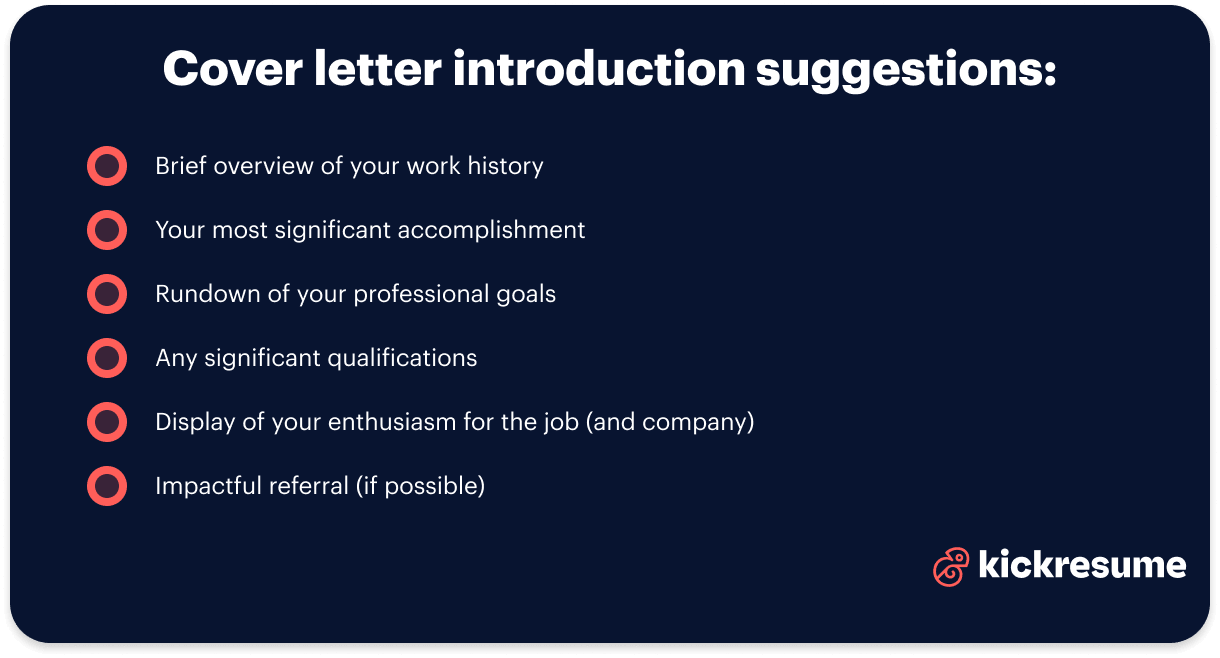
How to start a cover letter without making everyone fall asleep? Step one: never open with "I am writing to apply for…" Recruiters already know why you're writing. The job posting told them. Your subject line told them. Your cover letter's existence told them.
A strong account manager cover letter introduction should answer at least one of these:
- What kind of account manager are you?
- What have you actually accomplished?
- Why this company, specifically?
- What makes your background relevant to this role?
If your intro doesn't answer any of those, it's just filler. And filler gets skipped.
Bad account manager cover letter introduction example
I am writing to apply for the Account Manager position at your company. I have several years of experience in account management and would be excited to join your team.
Yeah, no. There's nothing here. No specialty, no numbers, no hook. It could've been written by anyone, about any company, for any role. That's exactly the problem.
Now let's look at a few intros that actually do something.
Good introduction example: SaaS account manager
Over the past five years as a SaaS Account Manager at Mercer Technologies, I've grown a portfolio of 35 enterprise clients from $4.2M to $7.8M in annual recurring revenue. I'd love to bring that same growth mindset to the strategic accounts team at Cloudwave.
Why does this work? It opens with a specific result (portfolio growth from $4.2M to $7.8M), names the type of accounts (enterprise), and ends with a clear pivot to why this employer matters. Direct, confident, and built around real impact.
Good introduction example: Advertising account manager (with referral)
Jamie Park suggested I reach out about the Account Manager role at Halo Creative. Jamie and I worked together at Buford & Co. on the Patagonia campaign launch, and she mentioned the team is looking for someone who can balance creative collaboration with sharp client communication. That's basically the job description I've been writing for myself for years.
What's happening here? A referral. And referrals are pure gold. Hiring strangers is always a leap of faith for employers. Having someone on the inside say "yeah, this person is the real deal" cuts through so much hesitation. If you have a referral, lead with it.
Good introduction example: Key account manager (value-driven)
What initially caught my attention about Northwind Logistics is your "client-for-life" philosophy. As a Key Account Manager who has personally renewed and expanded every single account I've handled for the past four years (with a 100% retention rate across 18 enterprise clients), that mindset isn't a marketing line for me. It's how I work.
Why does this work? It connects the candidate's personal values and track record to something specific about the company. That's the dream combo. It shows the candidate actually read about the company, didn't just paste their name in.
Good introduction example: Customer success / account manager hybrid
After 6+ years bridging sales and customer success at TechFlow, I've learned one thing: retention isn't a metric, it's a strategy. I expanded our top-tier accounts by an average of 38% year-over-year while cutting churn by half. I'd love to bring that approach to the customer-facing team at Lumen.
What is the magic here? It opens with a sharp opinion (retention isn't a metric, it's a strategy), which gives the candidate a voice and a perspective. Then it backs that opinion with two strong numbers.
Good introduction example: Digital agency account manager
At Brixton Digital, I managed a $2.3M book of business across 12 mid-market clients, from initial pitch through campaign optimization. My favorite project? Helping a B2B client triple their qualified lead volume in two quarters. I'm reaching out because your work with B2B clients caught my attention, and I'd love to talk about what I could bring to the team.
Why does this work? There's a little personality in it ("my favorite project?") without sacrificing substance. It tells a small story, then ties it to the employer.
Tips for entry-level or career-changing account managers
If you’re just starting out, changing careers, or still building experience, focus on things like internships, customer-facing roles, sales experience, certifications, or relevant skills from another industry.
Entry-level introduction example
After two years as a customer success representative at HubFlow, where I personally onboarded over 80 small business clients and maintained a 96% satisfaction rate, I'm ready to take the next step into full account management. The dedicated client services team at Verity is exactly the kind of environment where I want to grow.
This works because it draws on real experience (customer success, not "nothing"), shows results, and gives a clear reason for the next step.
Whether you're a 10-year veteran or just starting out, the goal is the same: be specific, be honest, and give the reader a reason to keep reading past the first sentence.
6. How to present your skills and real achievements
Here's a rule worth tattooing somewhere: your cover letter is not your resume in paragraph form.
If you're just retyping your job history into prose, you're wasting prime real estate. Your resume lists the facts. Your cover letter adds the story (the context, the wins, the why behind the work).
This is also where you can tackle anything the resume can't fully explain. A career gap. A pivot from sales rep to account manager. A move from agency to in-house. Your cover letter has room to address that stuff naturally, while your resume just lists dates.
Customization is non-negotiable
- Open the job ad.
- Read it again, slowly.
- What skills are mentioned first? What keeps coming up? Those are the things the employer actually cares about.
- Make sure those exact concerns are addressed in your body paragraphs.
If the ad keeps emphasizing "client retention," "renewals," and "stakeholder management," don't write a letter mostly about new business acquisition. Mirror the priorities of the role.
Technical and operational skills for account managers
- Client relationship management
- Strategic account planning
- Contract negotiation and renewal
- Upselling and cross-selling
- Revenue forecasting and pipeline management
- CRM proficiency (Salesforce, HubSpot, Zoho, etc.)
- Account analytics and reporting
- Industry-specific knowledge (SaaS, advertising, finance, healthcare, etc.)
In 99% of cases, recruiters will be primarily interested in your technical prowess (hard skills). But that doesn't mean that you can't leverage your soft skills. Attributes like clear communication, attention to detail, and reliability will come especially handy in arrangements where you'll have to collaborate with other people.
Soft skills for account managers
- Communication and presentation
- Active listening
- Empathy and emotional intelligence
- Conflict resolution
- Cross-functional collaboration
- Time management and prioritization
- Adaptability under pressure
How to structure the body
Keep it simple and scannable:
- 2 to 4 short body paragraphs
- Each paragraph focused on one skill, win, or story
- Use context + numbers wherever possible
- Stick to what's relevant for this job
A handy little formula: Context + numbers = impact.
Tell me what the situation was, what you did, and what the measurable result was. That's it.
Examples of presenting skills like an account manager who knows their stuff
Client retention and renewal:
At Mercer Technologies, I managed a portfolio of 22 enterprise SaaS accounts ranging from $80K to $450K in annual contract value. By introducing quarterly business reviews and proactive risk-scoring, I improved renewal rates from 84% to 96% over two years — adding roughly $1.1M in retained revenue that would've otherwise churned.
Account growth and upselling:
After taking over a stagnant book of 14 mid-market accounts at Brixton Digital, I built a structured upsell program tied to client business goals (not product pushes). Within 18 months, average account value grew by 41% and three accounts more than doubled their original spend.
Relationship building and trust:
When a top-tier client at Halo Creative threatened to leave after a delivery issue, I led the response personally — flying out for a face-to-face conversation, owning the mistake, and rebuilding the engagement plan. Not only did we retain the account, but it became one of our highest-grossing relationships the following year.
CRM and analytics:
I rebuilt our Salesforce reporting from the ground up at TechFlow, creating dashboards that helped our team forecast quarterly revenue within 3% accuracy. The same dashboards became the foundation for our QBR template, which leadership later rolled out across all four account teams.
Still feeling stuck? Kickresume's AI cover letter tools can help you brainstorm, draft, and refine your cover letter based on a specific job ad. Worth a look if you're staring at a blank page.
Body paragraphs for new or career-changing account managers
If you're newer to account management, don't fake experience you don't have. Lean into what you do have. Customer service. Sales support. Internships. Project coordination. Anything client-facing or relationship-based counts.
What to focus on:
- Customer-facing roles, even if the title wasn't "account manager"
- Internships, apprenticeships, or junior roles
- Tools you've used (CRMs, project management software, analytics platforms)
- Wins from any role that show similar skills (communication, problem-solving, relationship-building)
- Industries or types of clients you have direct experience with
Body paragraph example for an entry-level account manager
During my year as a Customer Success Coordinator at Verity, I supported a senior account manager with a portfolio of 40+ mid-market clients. I owned the onboarding process end-to-end, prepared materials for quarterly business reviews, and was the first point of contact for renewal questions. Three of those clients specifically asked for me to continue supporting their accounts when my manager moved teams, which is what first told me account management was the right fit.
That's a strong paragraph for someone without a direct AM title. It shows ownership, hints at trust and relationship-building, and tells a small story that demonstrates fit.
7. The best action verbs for account manager cover letters
Action verbs are the words that make you sound like someone who did things, not someone who watched things happen. Used well, they make your cover letter feel active, confident, and capable.
Mine the job description
Job ads literally tell you which words to use. Look at the "Responsibilities" or "What you'll do" section. Note the verbs they use. Those words are your roadmap.
If the ad says:
"Responsible for growing existing accounts, negotiating renewals, and identifying upsell opportunities."
Your cover letter might say:
"I grew my book of business by 32% through proactive upsell identification and structured renewal negotiations."
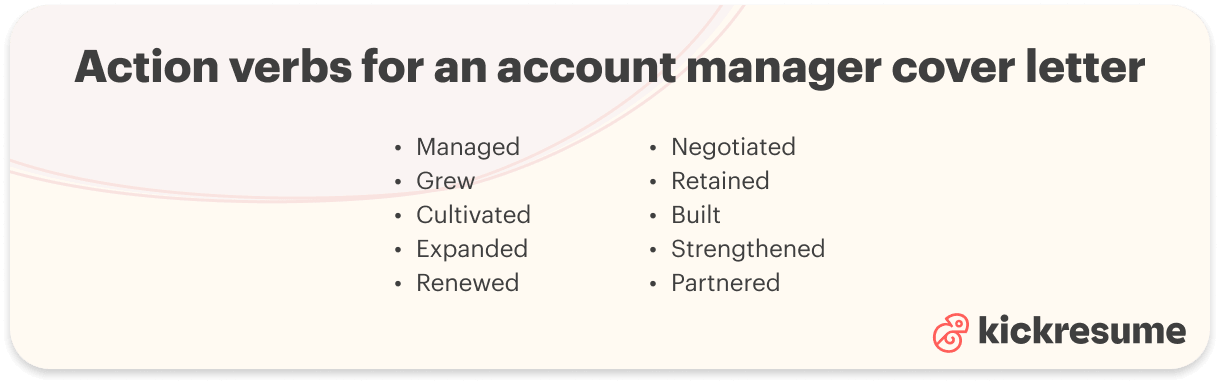
Action verbs for general account management
- Managed
- Grew
- Cultivated
- Expanded
- Renewed
- Negotiated
- Retained
- Built
- Strengthened
- Partnered
- Coordinated
- Delivered
Action verbs for sales-focused account managers
- Generated
- Closed
- Upsold
- Cross-sold
- Prospected
- Pitched
- Converted
- Forecasted
- Exceeded
- Outperformed
- Drove
- Secured
Action verbs for strategic and enterprise account managers
- Strategized
- Aligned
- Influenced
- Prioritized
- Consulted
- Advised
- Spearheaded
- Orchestrated
- Restructured
- Championed
- Mapped
- Scaled
Action verbs for customer-success-leaning account managers
- Onboarded
- Resolved
- Coached
- Educated
- Supported
- Mediated
- Listened
- Investigated
- De-escalated
- Recovered
- Improved
- Re-engaged
You don't need to use a different verb in every sentence. That actually starts to feel forced. Just don't lean on the same three verbs over and over either. ("Managed… managed… managed…"). Find the balance.
8. How to write a strong cover letter conclusion
You've introduced yourself. You've shown your wins. You've made a case. The conclusion is where you tie a bow on the whole thing and leave the recruiter with a clear, confident final impression.
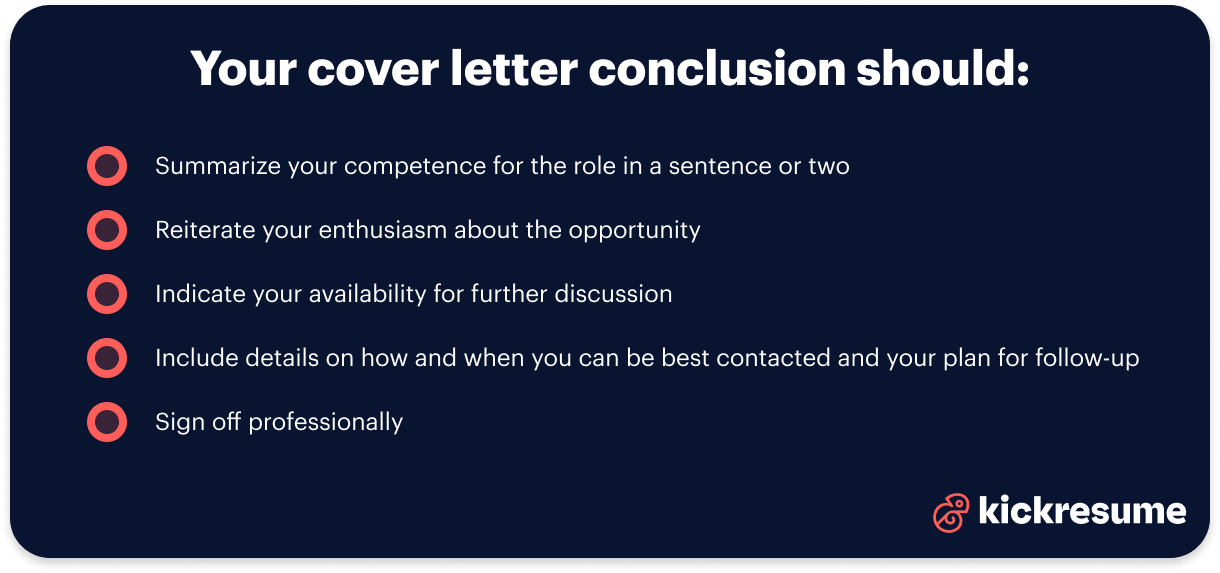
How to end a cover letter? Do this:
- Briefly remind them of your value: One last reinforcement of what you bring.
- Show genuine interest in this specific role: Not just "any account manager job."
- Make next steps obvious: How can they reach you? When are you available?
- End professionally: A clean, respectful sign-off.
You don't need to be pushy. You don't need to promise you'll call on Tuesday. You just need to wrap things up clearly and confidently.
What to AVOID in your conclusion
- The empty "thank you": "Thank you for your time" by itself is fine, but it's not a fully formed closing.
- The apologetic tone: "I hope you'll consider me" makes you sound unsure. You shouldn't be.
- Rehashing your resume: The conclusion is for summary, not recap.
- Being aggressive about follow-up: "I'll be calling next Friday at 2pm" feels demanding, not eager.
- Forgetting your contact info: This is the prime spot for it. Don't make them dig.
Bad account manager cover letter closing example
Thank you for considering my application. Please let me know if you need anything else.
Best,
Jamie
Why does this fall flat? There's no value reinforcement, no specific interest in the company, no real call to action. It's not bad. It's just forgettable. And forgettable is the worst thing your cover letter can be.
Good account manager cover letter closing example
Thank you for taking the time to review my application. With seven years of growing and retaining enterprise SaaS accounts, including a 96% renewal rate across my last portfolio, I'd love to bring that same client-first approach to the strategic accounts team at Cloudwave.
You can reach me at (555) 200-2543 or taylor.hughes@email.com. I'm available for a conversation any time this week or next, and I'd be happy to share a few specific ideas for how I could contribute right away.
Sincerely,
Taylor Hughes
Why does this work? It reminds the reader of one specific, impressive number. It signals genuine interest in this company. It gives clear contact info and even hints at follow-up value ("a few specific ideas"). And it closes with professional confidence, not desperation.
9. Mistakes to avoid as an account manager
Even strong candidates with the right experience can torpedo their own application with a sloppy cover letter. Here are the most common ones….and how to dodge them.
Mistake #1: Sending the same letter everywhere
If your cover letter could go to five different companies without changing a single word, you're not really applying. You're spam-firing.
Mistake #2: Writing way too much (or way too little)
Walls of text feel exhausting. So do three-sentence cover letters that look like you couldn't be bothered.
Mistake #3: Making it all about you
I get it. You want the job. But the employer cares about what you can do for them, not what they can do for you.
Mistake #4: Copy-pasting your resume
If your cover letter just retypes your resume in paragraph form, you've added zero value to the application.
Mistake #5: Ignoring instructions in the job ad
If the posting asks for a salary expectation, a reference number, or a specific subject line and you ignore it, that's an instant red flag. Especially for account manager roles, where attention to detail and following client instructions is literally the job.
Mistake #6: Letting typos slip through
Account managers communicate professionally with clients all day. A cover letter with typos sends one message: this person isn't careful.
Mistake #7: Messy or cluttered formatting
If the page is hard to look at, it's hard to read. And if it's hard to read, it won't get read.
Mistake #8: Being vague about results
"Managed accounts." "Supported clients." "Drove growth." Cool. By how much? For how many clients? Compared to what?
Mistake #9: Forgetting to update the company name
This is so common it's almost a meme. Writing about how excited you are to join Company B in a letter addressed to Company A is a one-way ticket to the rejection pile.
Mistake #10: Treating it like a formality
If you're writing your cover letter at 11pm the night before applying, just to "tick the box," it shows. Lazy cover letters cost you interviews you might've otherwise gotten.
10. How to match your account manager cover letter with your resume
When you're writing your cover letter, your account manager resume should be sitting right next to you. Not so you can copy it word for word (please don't) but so you can make sure the two documents are working together as a team.
- Your resume gives the facts.
- Your cover letter gives the voice.
Here's how to keep them in sync:
1. Match your contact info exactly
Same name. Same phone number. Same email. Same LinkedIn URL. If your resume says "Taylor M. Hughes" and your cover letter says "Tay Hughes," that's a tiny but real moment of friction for the reader. Pick a version of your name and stick with it across everything.
2. Use the same font and style
If your resume uses Calibri at 11pt, your cover letter should use Calibri at 11pt. Same font, same size, same line spacing. Switching fonts between documents looks careless and breaks the visual flow.
3. Mirror the formatting
If your resume has section headers in a specific style (bold, all caps, with a thin underline, whatever), echo that style in your cover letter where it makes sense. You don't need to copy and paste, just make the visual DNA recognizable.
4. Keep margins and spacing consistent
Same one-inch margins on both. Same paragraph spacing. It's a small detail, but it makes the whole application feel intentional.
5. Use color carefully and consistently
A small accent color (maybe for your name in the header, or a line under your contact info) can look polished. Just make sure you use the same color in both documents. Don't go navy blue on your resume and forest green on your cover letter.
6. Let the content complement, not repeat
Your resume lists what you did. Your cover letter tells the story of one or two of those things in more detail. If your resume says "Grew enterprise portfolio by $3.6M over three years," your cover letter might say "I'm especially proud of growing the enterprise portfolio from $4.2M to $7.8M — here's how that happened…"
If formatting isn’t your favorite part of the process, don’t worry! We've got tons of professionally designed resume and cover letter templates that can help you nail the look without the layout headache. Some even come as a bundle, so your documents match right out of the box.
Use artificial intelligence to create your resume — FAST!

11. Top resources for job-seeking account managers
Now that you know how to make your account manager cover letter, it's time to start looking for the right job vacancies. Uncover the best work opportunities with these first-rate job search resources tailored specifically for you:
- Industry-specific job boards: Niche websites that gather job postings pertaining to your profession alone, like AccountManagementCrossing and Account Management Jobs, are the perfect option if you want to make your job search as straightforward as possible.
- General job search platforms: Still, platforms like Indeed, Glassdoor, Monster, and SimplyHired can also yield compelling results. But, of course, you'll have to do a bit of sifting.
- LinkedIn: Use LinkedIn for job searching, networking, and joining groups related to account management, such as the Account Managers Network.
- Professional associations: Joining organizations such as the Strategic Account Management Association (SAMA), the Account Management Skills & Development (AMSD), and the Business Relationship Management Institute (BRM Institute) can give you access to job listings, networking events, and training programmes.
- Specialized media: To impress hiring managers during the job interview, you need to demonstrate knowledge of the latest industry developments, news, and strategies. Media like “Selling Power Magazine,” “Sales & Marketing Management Magazine,” or “Customer Strategist Journal” are great sources of the relevant information you might need.
- Continuous education: Lastly, don't forget to grow your skill set. Thanks to online learning platforms like Coursera, edX, or LinkedIn Learning, finding courses that fit your career goals is easier than ever.
Remember, every application and interview is a step closer to your goal. With determination and the right resources, you'll find the job that's meant for you. Keep believing in yourself and stay focused on your path!
Business Career Outlook in 2026
Business and Financial occupations are projected to expand faster than the nationwide average between now and 2034 (Source: U.S. Bureau of Labor Statistics).
Each year, roughly 942,500 openings in Business roles will become available, fueled by a combination of industry expansion and workers retiring or changing career paths.
Venture capital is flowing heavily into AI, climate tech, fintech, and healthtech sectors. (Sources: The Successful Founder & Forbes)
For business professionals, this means opportunities are concentrating in companies building AI-powered solutions, renewable energy storage, blockchain platforms, and digital health tools
Average US base salaries across popular Business roles:
- Account Manager: $77,109/year (excl. Commission)
- Business Development Manager: $87,290/year (excl. Profit sharing)
- Business Analyst: $67,294year (excl. Cash bonus)
- Consultant: $92,502/year
- Procurement Specialist: $71,764/year
- Procurement Manager: $98,639/year
- Procurement Engineer: $95,583/year
These salary estimates come from Indeed (as of January 2026), and are based on anonymous submissions from workers, along with salary data from job postings on the platform over the last 36 months. Exact figures vary by location, company size, and experience level.
If you’re thinking about starting a career in business or advancing within the field, the outlook remains strong, with steady demand and a wide range of opportunities across growing industries.
Account Manager Cover Letter FAQ
How should I use keywords in my cover letter to make it pass the ATS?
First of all, you need to closely examine the job posting and highlight any specific skills, qualifications, and industry terms mentioned. Then, make sure you incorporate them naturally throughout your cover letter to show that you meet the job requirements. For example, if the job description emphasizes "client retention" and "strategic planning," include these phrases when describing your relevant experiences and achievements.
What are some common mistakes to avoid in my cover letter?
The most common mistakes include: being too generic, using a one-size-fits-all approach, and focusing too much on what you want rather than what you can offer. Also, make sure your cover letter is free from any spelling and grammatical errors.
How can I ensure my cover letter stands out from the competition?
The best way to do this is by personalizing its content for the company and position you're applying for. Address the hiring manager by name, if possible, and mention something specific about the company that excites you. Additionally, include a compelling opening sentence to grab their attention. For example, you can share a unique success story that highlights your abilities and shows why you’re the perfect fit for the role.
How can I show my ability to handle difficult clients in my cover letter?
By demonstrating your ability to handle difficult clients. For example, share a specific scenario where you successfully managed a challenging situation. Describe the context, the actions you took to resolve the issue, and the positive outcome you've reached.
What is the ideal length for a cover letter when applying for an account manager position?
Your cover letter should be concise and to the point, ideally no longer than one page. Aim for 2-4 body paragraphs, plus an engaging introduction and a conclusion that reinforces your enthusiasm for the role and includes a call to action. This tried-and-true format ensures you provide enough detail to make a strong case for your candidacy without overwhelming the reader.