One opened with a story about the first time he saw Jurassic Park. Another added a big, beaming photo because a friend had tipped him off that a real person — not a machine — would be reading it.
Both got hired: one at Disney, one at Shopify. And both of them did it with resumes that break some of the rules you're usually handed — trim the personality, drop the word "I," keep it to one page, write for the applicant tracking system.
We at Kickresume studied their resumes, plus 55 others from people who confirmed they'd been hired at a well-known company — and read them alongside our data on more than two million ordinary resumes for reference.
A pattern showed up quickly: the resumes behind these hires leaned more personal, more detailed, and less optimized than the norm.
One caveat, because it matters: these are all resumes that worked. So we can describe what the winners have in common — not promise that copying them guarantees an offer.
Tobi Oluwole: seven tries, a smile, and a Shopify offer
Tobi Oluwole had been trying to get into Shopify for a while — and by his own count, it wasn't going well: seven applications, five interviews, four final rounds, and no offer. "It was very frustrating," he says.
What changed was the resume. A friend who'd just been hired there showed him hers — built with Kickresume — so he rebuilt his from the same template, making a run of deliberate choices to feel like a person, not a profile. The most visible: a big, genuine smile at the top of the page. A friend already working there as a recruiter at Shopify, had told him something most applicants never hear — at Shopify, a human reads every resume:
"I got insider information from a friend who was already working there as a recruiter. She said that recruiters look at each resume, so I put a big smile on it — and I knew that it would feel more personal. The recruiter sped up the process because of how well I communicated my values on the resume and during the interviews. It made me really stand out." — Tobi Oluwole, hired at Shopify
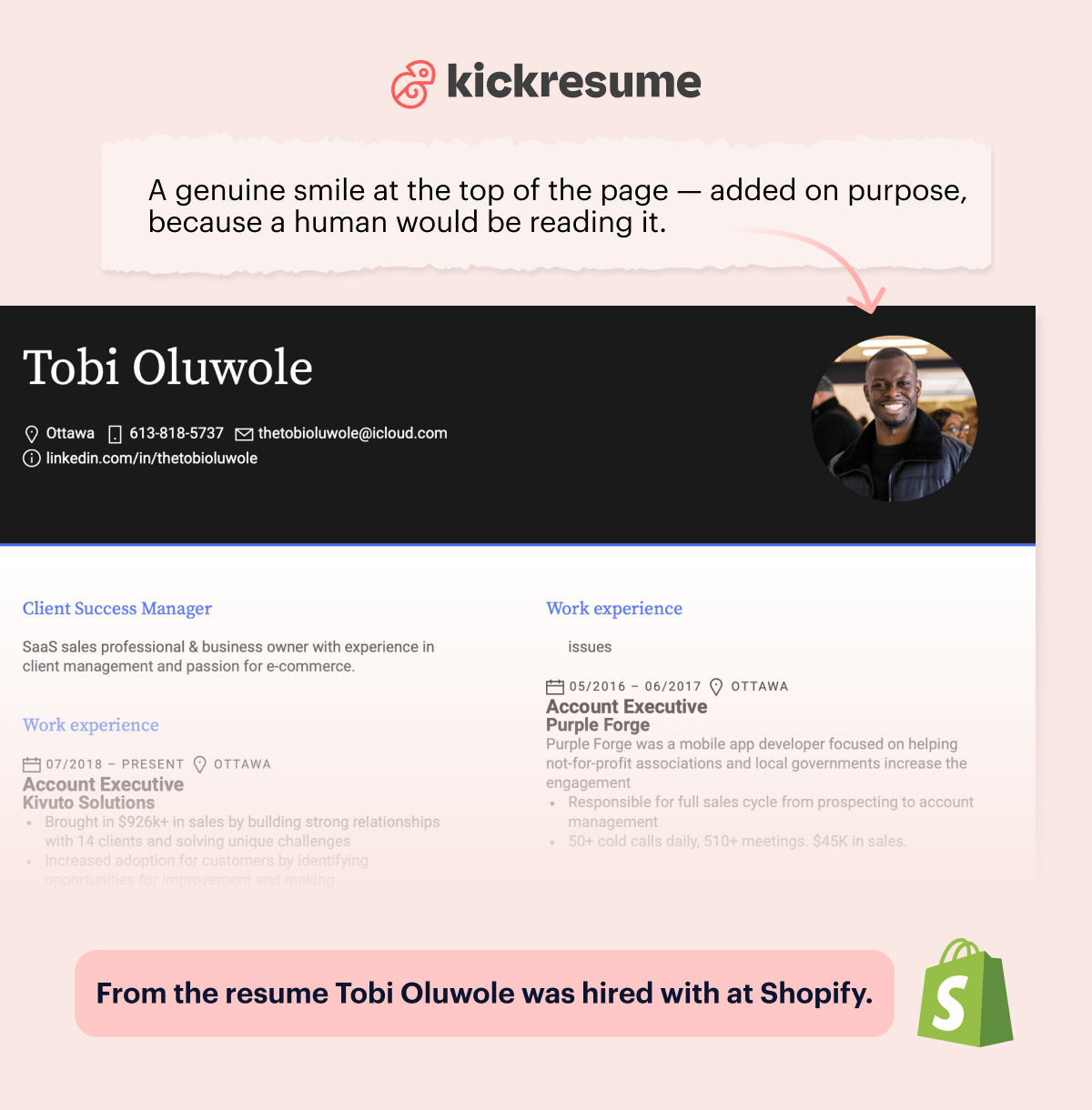
Screenshot from Tobi’s resume: Client Success Manager hired at Shopify
This time the turnaround was dramatic: the recruiter called back within eight hours, skipped him past the second-stage interview he'd already sat through five times, and he had the job in twelve days.
And the personality was backed by hard proof. His experience led with results, not just duties: $926K+ in sales across 14 clients in one role, 133% of quota and $200K in new business in another, Fortune 500 names spelled out (Shell, Marathon Petroleum). He even quantified a side venture he co-founded — one that added $1.4M to the local economy.
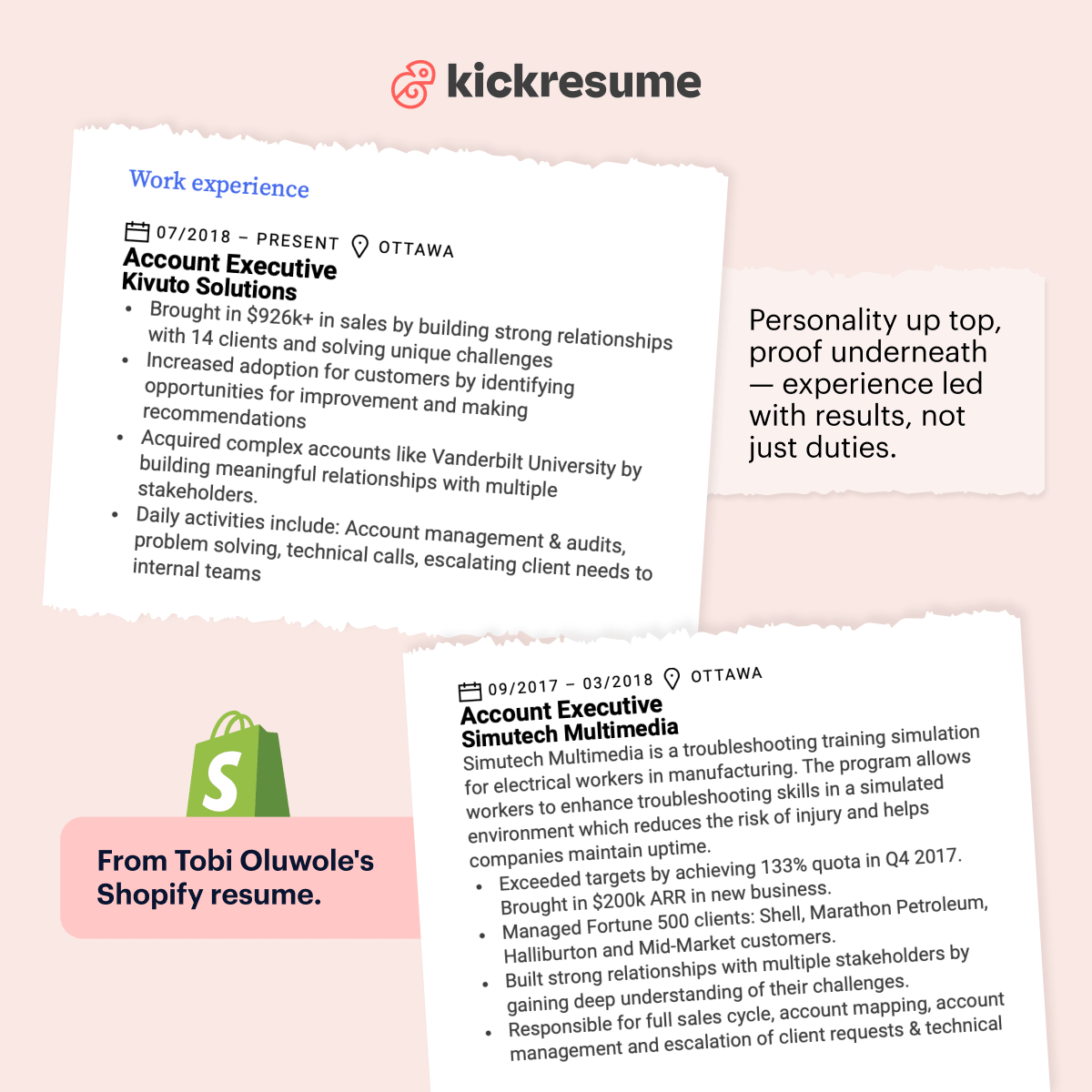
Screenshots from Tobi’s resume: Client Success Manager hired at Shopify
Personality got him read; the numbers made him credible.
Ibrahim Mahdi: a Jurassic Park story, a portfolio, and a Disney offer
Ibrahim Mahdi wanted to work in media, and the resume that got him into Disney read like it — starting with two deliberate moves at the very top.
First, he tailored it precisely: his objective named the exact role and team he was chasing — a Media Operations Assistant role at BAMTech Media-Disney — not a generic "seeking a challenging opportunity."
Then, instead of a dry professional summary, he opened with a story: "Call me lucky! I was 7 years old when I first saw Jurassic Park. I instantly knew that I wanted to be a part of an industry that creates riveting stories…" It's the kind of first-person opener you almost never see on a resume, and exactly the voice that makes a reader remember a candidate.
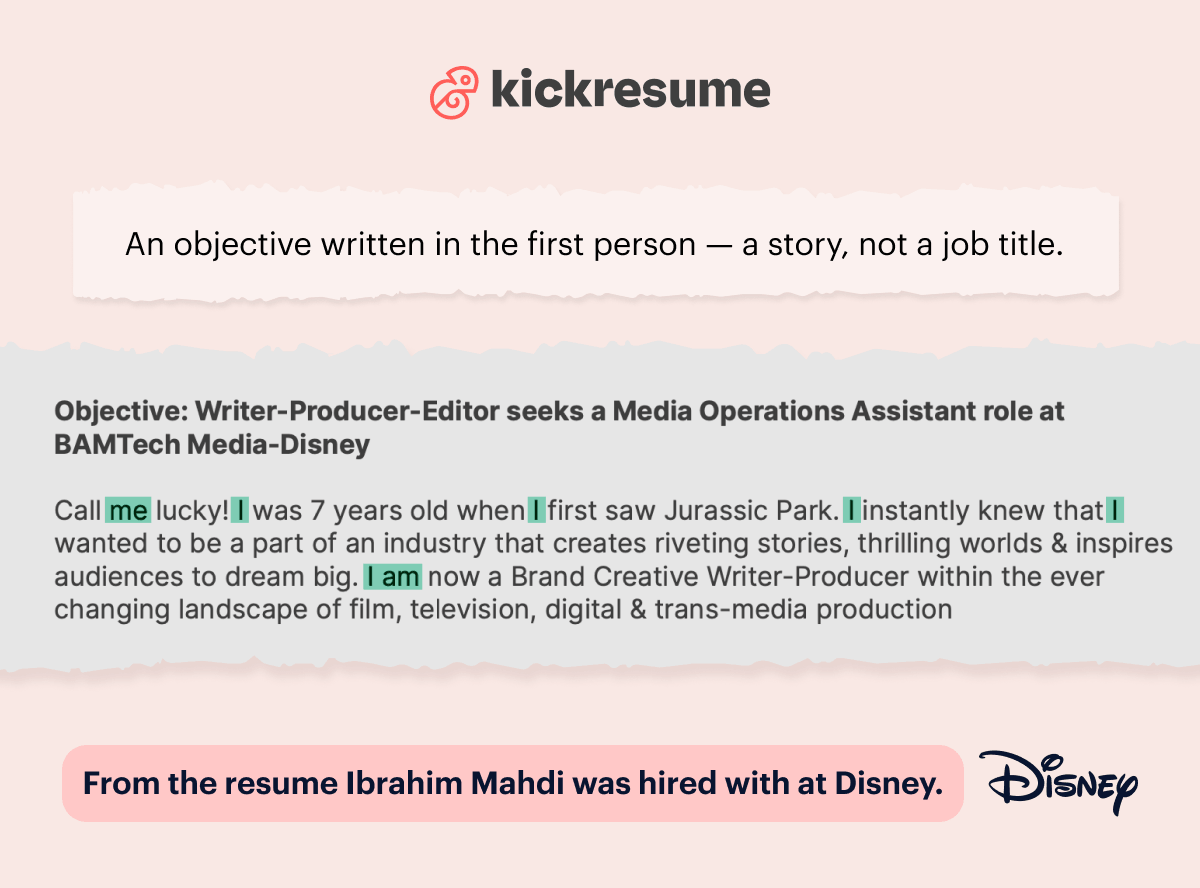
Screenshot from the version Ibrahim originally applied to Disney with — he has since updated the summary on his published sample.
But the story sat on top of a genuinely media-heavy resume: Associate Writer-Producer at AMC Networks, an Audio-Visual Specialist role, and bullets written in the language of the work — scripts, VO talent, sizzle reels. His skills named the tools a hiring manager screens for.
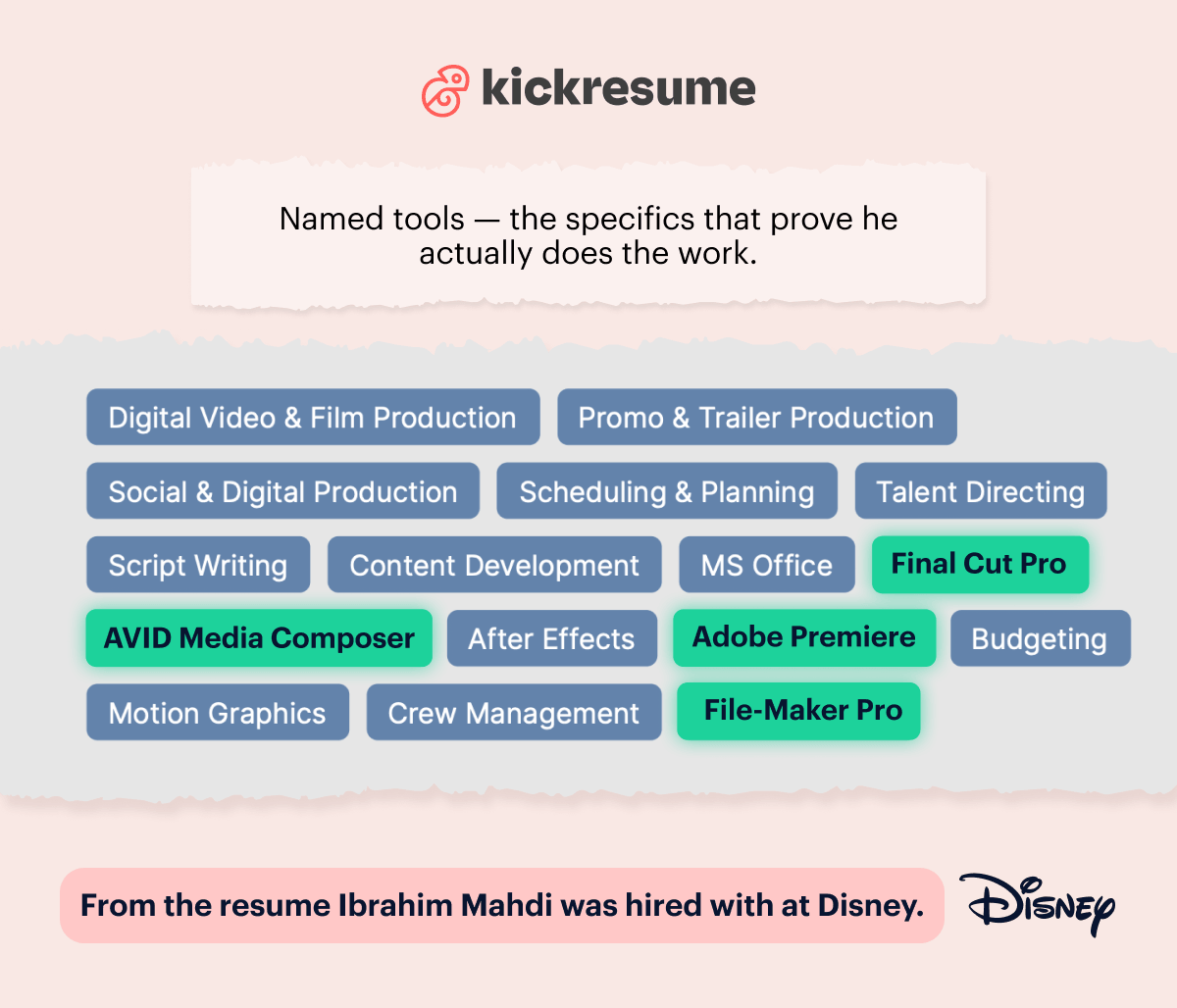
Screenshot from the version Ibrahim originally applied to Disney with — he has since updated the skills on his published sample.
And for a creative field, he did the thing that matters most — he pointed the reader to the work itself by including a portfolio link in his resume:
"I think it's very important to have an online portfolio and at least an online persona. That definitely helped. At the very least you have something to show… It's great to have an online or video resume, especially if you're in the media industry." — Ibrahim Mahdi, hired at Disney (full interview)
The whole package worked fast: the Disney process was one phone call, a one-day interview, and an offer within a week. The lesson isn't "open with a childhood anecdote" — it's that Ibrahim made a hiring manager see the creative they'd be getting, in the story, the track record, and the work itself.
What the two have in common
What connects them isn't personality for its own sake — it's that each made himself memorable, then proved he could deliver. Tobi paired persistence and a warm photo with a track record of hard numbers; Ibrahim paired a personal story with a portfolio and real craft. Memorable, and backed up — that's the thread.
"A resume with personality but no proof is just a claim — and recruiters have read thousands of claims," says Marta Říhová, HR expert at Kickresume. "What these resumes get right is the pairing: a voice that sounds like a real person, backed by results a reader can actually check. Say something only you would say, then prove it a line later. Personality earns the read; the evidence earns the interview."
And when we looked beyond these two, the pattern held.
Two of fifty-seven
These two happen to be people we interviewed, so we can tell their stories in full — but they're not the whole picture. We gathered 57 resumes from people who confirmed they'd been hired at a well-known company, and read them against our data on more than two million ordinary resumes for reference.
Here's what they shared:
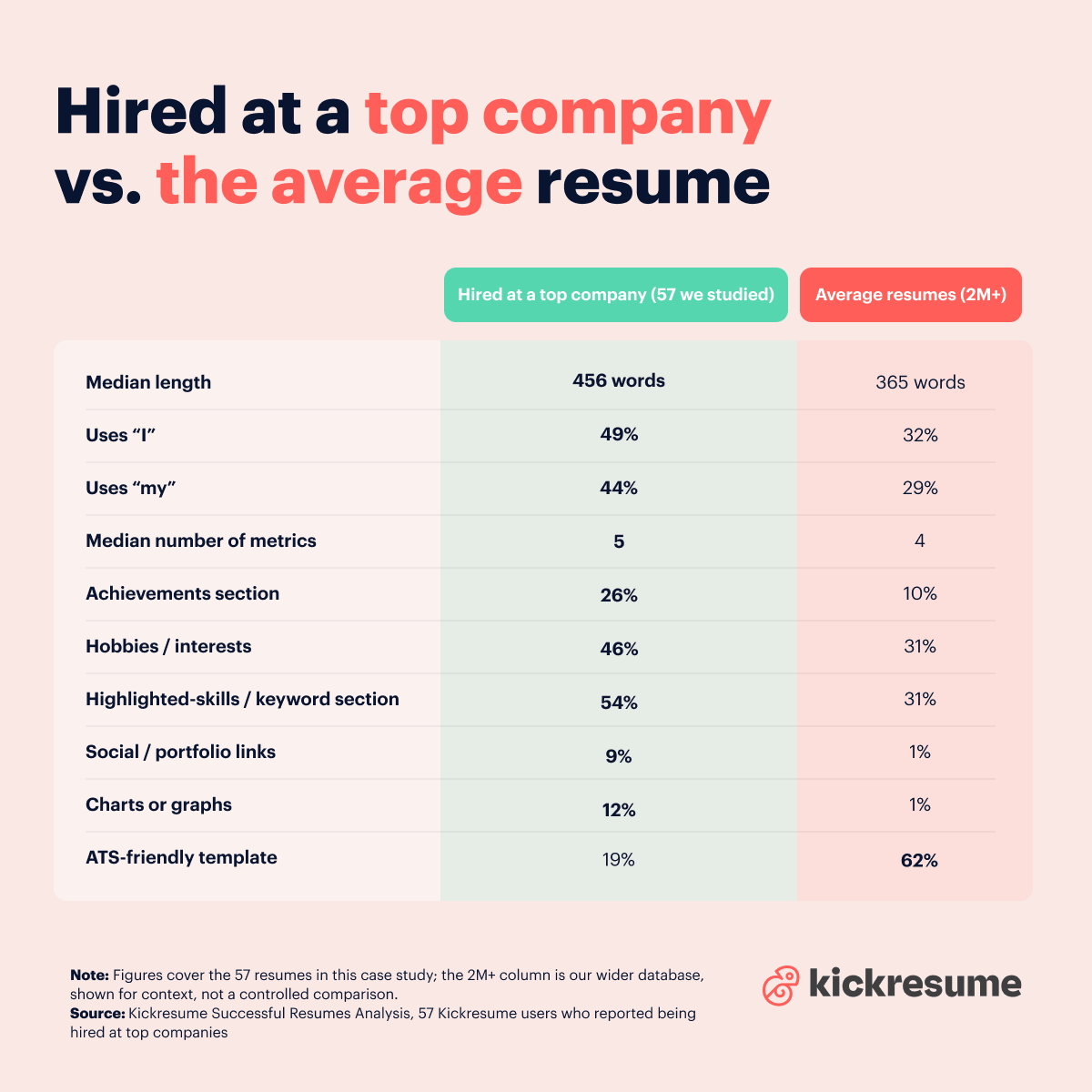
- They read more like a person. Nearly half (49%) used the word "I" and 44% used "my" — versus 32% and 29% across all resumes.
- They're longer, but don't list more jobs. A median of 456 words vs. 365 — yet the same median of 3 roles. More is said about the same career, not more positions.
- They quantify more, and curate it. A median of 5 metrics vs. 4, and 26% pulled their best ones into a dedicated achievements section, vs. 10%.
- They show more personality. Hobbies appear on 46% of them (vs. 31%) and charts or graphs on 12% (vs. just 1%).
- They're less ATS-optimized, not more. Only about 1 in 5 used an ATS-friendly template, compared with 62% of all resumes.
A note on the sample
This is a focused, qualitative case study — 57 resumes, each from someone who confirmed they were hired at a recognizable company and consented to share it — designed to complement our large-scale research, not repeat it. It describes what these resumes have in common rather than proving what won the job.
They span six industries — big tech, enterprise tech, finance, consumer and retail, media, and automotive — and include names like Amazon, Google, Disney, Nike, J.P. Morgan and Shopify (the full list is in the methodology). Several are published as anonymized Kickresume samples, with names and contact details replaced by placeholders; the people we name — Tobi, Ibrahim, Michelle and Ya'el — shared their stories (or agreed to be named) with us directly.
At a glance: what stood out in resumes hired at top companies
The gaps were consistent — these resumes were more personal, more detailed, and less "optimized" than the average:
They read more like a person
The clearest pattern is voice. Traditional resume advice — including our own analysis of 1.8 million resumes — says to avoid personal pronouns: no "I," no "my." Yet the resumes behind these hires broke that rule far more often than average. Nearly half used "I" (49% vs. 32% across all resumes), and 44% used "my" (vs. 29%).
That looks like a contradiction until you read them. The pronouns aren't scattered carelessly through bullet points; they show up in summaries and personal sections where someone is deliberately telling their story — like Ibrahim's Jurassic Park opener. It's the difference between careless "I did this, I did that" clutter and a considered first-person voice at the top of the page.
"This isn't a green light to fill your resume with 'I' and 'my,'" says Julia Belak, Certified Professional Resume Writer (CPRW) at Kickresume. "The advice to drop pronouns still holds for bullet points, where they mostly add clutter. What these resumes show is subtler — a clear personal point of view, usually in the summary or a custom section, that makes a reader feel there's a real person behind the page. You can create that with or without a pronoun; what matters is that the voice is deliberate."
They give the work room — without padding
For all the noise about the one-page rule, these resumes were longer than usual: a median of 456 words, well above the 365 typical across resumes generally, with only 12% between 200 and 299 words (compared to 38% of all resumes). That tracks with an earlier Kickresume analysis of successful resumes, which found a median of 443 words.
Here's the observation that makes it useful, though: they didn't list more jobs. The median was 3 roles — identical to the average resume. The extra length comes from saying more about the same career: richer descriptions, and more supporting sections. These candidates gave their best material space rather than compressing it to fit a page.
For example, Michelle D’Aquino had three previous jobs before she was hired at Google, and described her last role at IBM in nine bullet points:
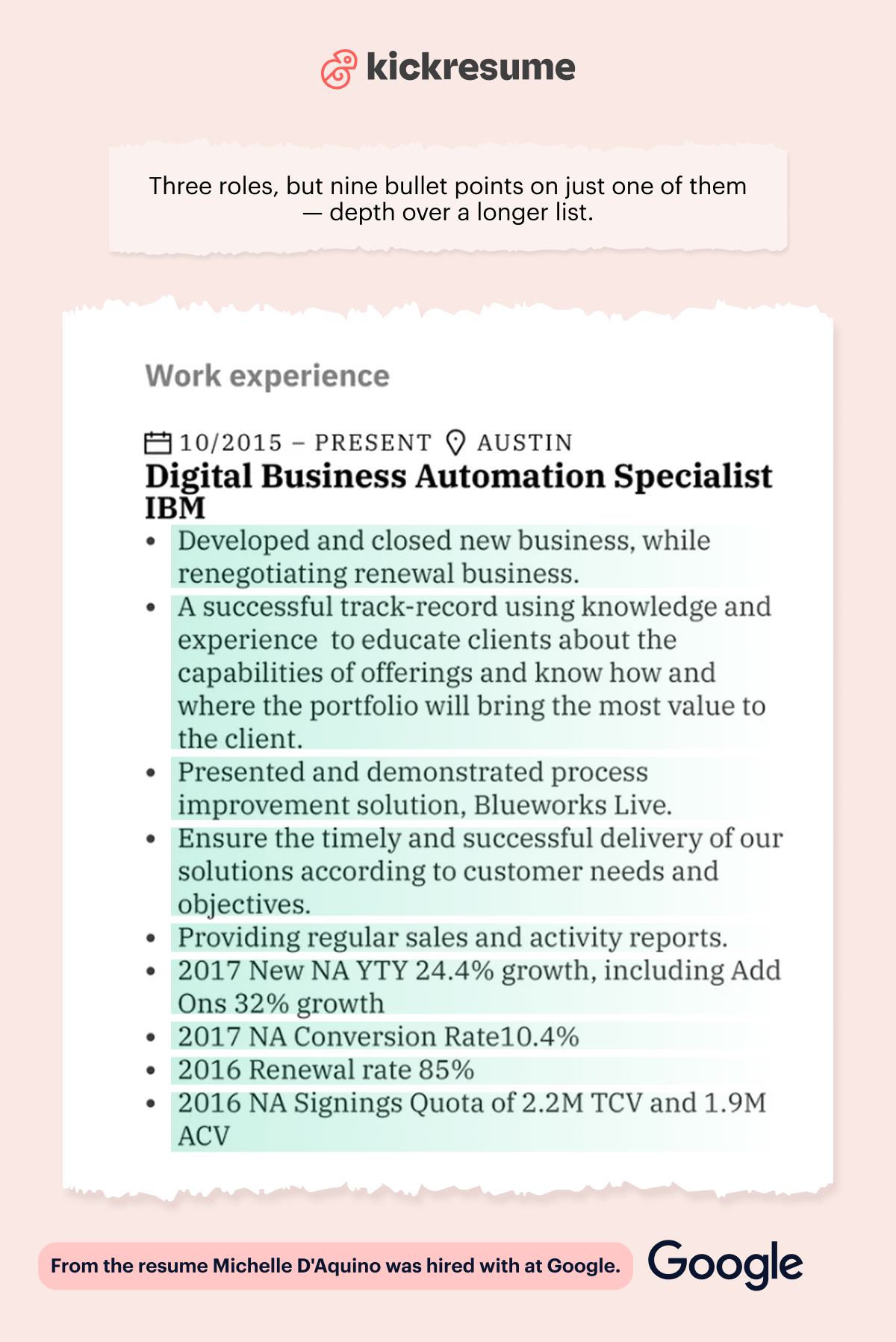
Screenshot from Michelle D'Aquino's resume: Hired as Account Executive hired by Google
They prove it — with more numbers, and a highlight reel
Nearly everyone puts a number on their resume: 84% of the hired set did, essentially matching the 82% baseline. What set these apart was density and placement. They carried a median of 5 metrics versus 4, with a quarter of them packing in 11 or more.
They were also far more likely to pull their best results into a dedicated achievements section (26% vs. 10%) rather than burying them in job duties. They didn't just include numbers; they curated a highlight reel. This is the part of the picture where these resumes genuinely were more polished than average — bigger results, better organized — which partly reflects who gets hired at these companies, and partly the care they took to show it.
A physical-distribution manager hired at Philips, for instance, pulled their best wins into a dated "Achievements" section — its strongest lines clean before-and-afters, like on-time delivery climbing from 82% to over 95% and supply-chain-security scores from 65% to 95%:
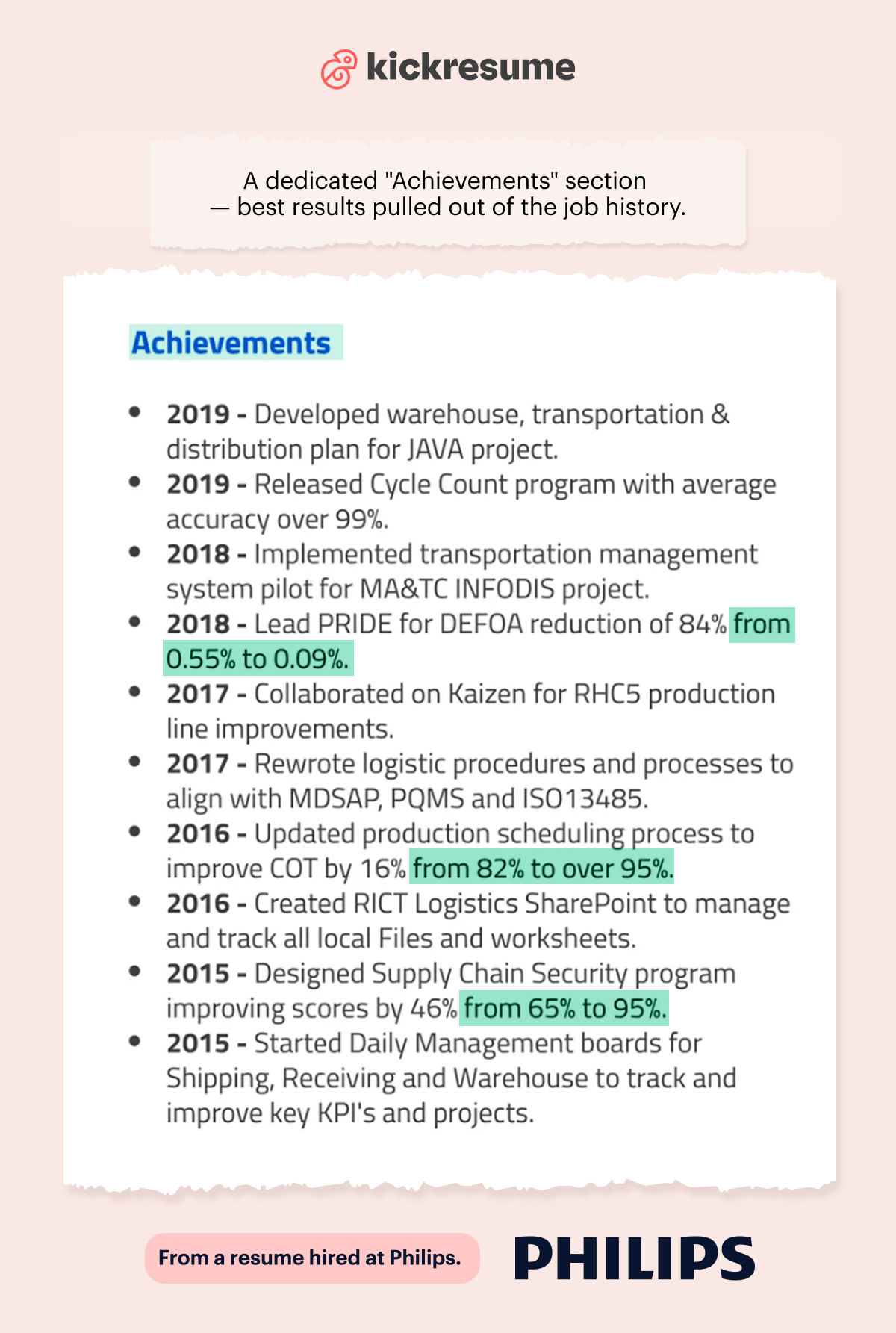
Screenshot from a resume: Physical Distribution Manager hired by Philips
They were built for a human, not a filter
The most counterintuitive thing we noticed: these resumes were less ATS-optimized than average. Where strictly ATS-friendly templates are the norm across our wider dataset (62%), only about one in five of the resumes we looked at used one.
They skewed more visual and design-forward — full of the human touches a machine struggles to read: hobbies and interests appeared on nearly half of them (46%, vs. 31% of resumes generally), and about one in eight used charts or graphs (vs. just 1%).
That's no reason to ignore applicant tracking systems — most online applications still pass through one, and for those, a clean, parseable layout matters. But it fits what Tobi found at Shopify, where a human reads every resume rather than a machine screening for keywords.
When you know a person will read yours — a direct application, a referral, a creative field — leaning into design and personality helps you stand out. When software screens it first, play it safer. The skill is knowing which room you're in.
A value-engineering consultant hired at Cisco, for example, rated their skills as circular charts (90% customer relations, 80% business analysis) and showed hobbies like travel and cricket as icons — polished and instantly scannable to a recruiter, but close to invisible to an applicant tracking system:
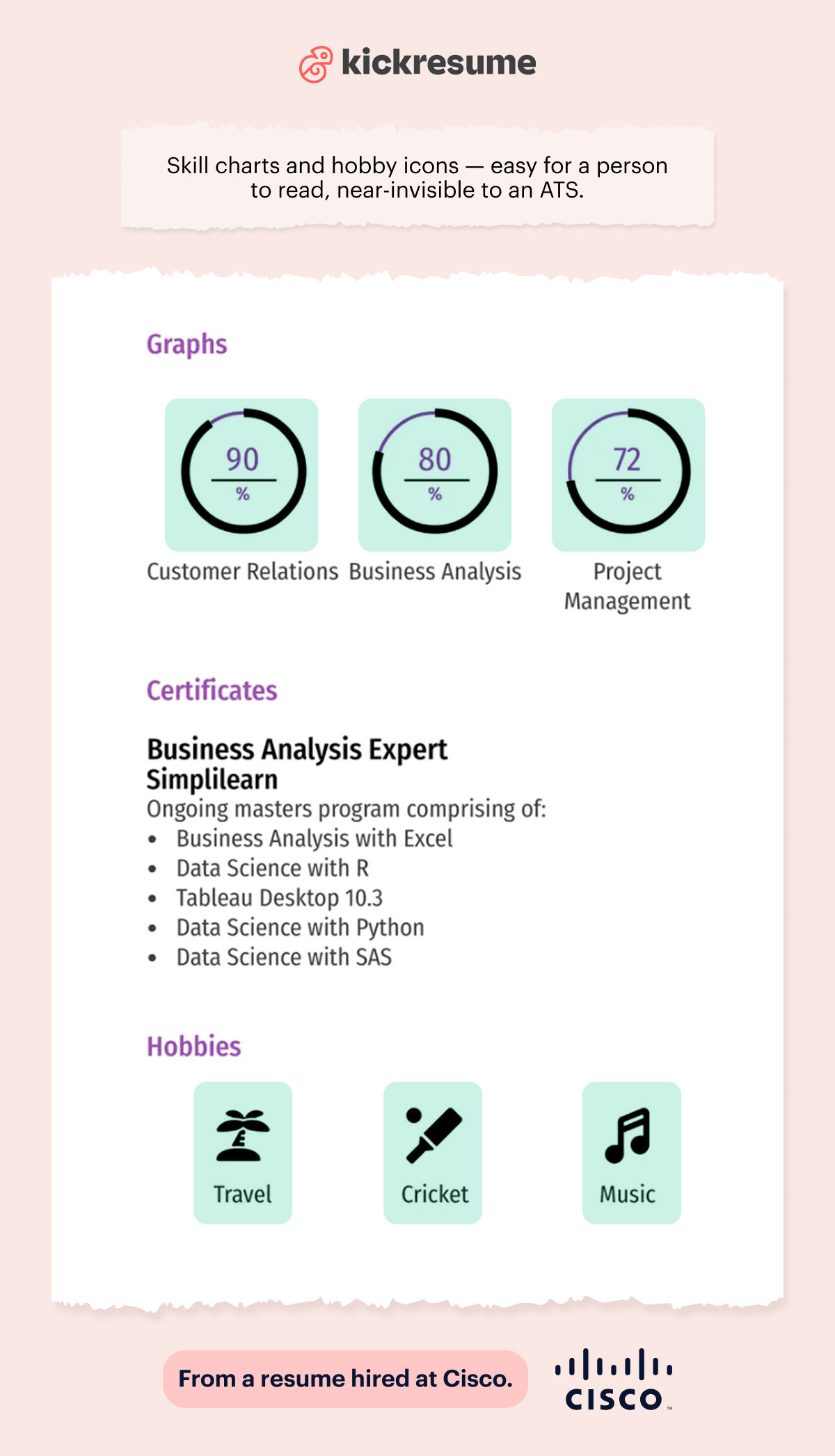
Screenshot from a resume: Value Engineering Consultant hired by Cisco
One exception: when the record is the story
There's one clear exception. In some fields — academia especially — the resume's currency is the record itself, not personal voice. A postdoctoral researcher now at Stanford — outside the 57, but whose CV makes the contrast clear — told us her edge was the sheer density of her track record, and her advice is really about presentation:
"Competitive fellowships do a lot of work on an academic CV — they tell a reader that other rigorous committees have already vetted you. Awards, talks, and posters are only persuasive if a reader can absorb them at a glance, so give them their own clearly labeled sections and let the volume speak for itself." — Ya'el Courtney, Postdoctoral Research Fellow at Stanford University
Different content, same principle — make your strongest evidence impossible to miss.
What this means for your resume
- Lead with a first-person summary. Two or three lines in your own voice — what you do and why it matters to you — is where "I" belongs.
- Add a "things I'm proud of" or achievements section. Beyond the job history, list three to five moments that show who you are — an award, a project you loved, a milestone. It gives a reader something to remember you by.
- Put a number on most bullets, then gather the best. Don't stop at one metric — aim for a figure on the majority of lines (a percentage, a dollar amount, a headcount, a timeframe) and pull your three-to-five biggest wins into a dedicated achievements section instead of leaving them buried in duties.
- Don't crush it to one page. With real experience, two pages is fine — the successful resumes ran longer by saying more about each role, not by adding more roles.
- Link proof a stranger can verify. A portfolio, a GitHub, a published piece — or, in a creative field, a video or work sample. As Ibrahim put it, at the very least you have something to show, and one real link beats a paragraph of adjectives.
- Show personality, anchored to results. A short, genuine interests line, a values statement, or — where local norms and the role allow — a real photo, like the smile Tobi added because he knew a person would be reading it.
- Package it for the reader. Go visual and design-forward when a person will see it, and clean, ATS-safe when software screens it first.
Methodology
This is a focused case study of 57 resumes, each from someone who confirmed they were hired at a well-known, competitive company, reviewed individually and read alongside our large-scale resume research. Unlike those studies — which look at every resume regardless of outcome — this set was deliberately narrowed to confirmed hires at recognizable employers, which is why it is a smaller, qualitative sample rather than a statistical survey.
It spans six industry groups:
- enterprise tech, hardware & telecom (Microsoft, IBM, Intel, Samsung, Cisco, Dell, Ericsson, SAP, Siemens, Philips)
- big tech & internet (Amazon, Google, Shopify)
- finance & professional services (J.P. Morgan, American Express, Deutsche Bank, EY, KPMG, Scotiabank)
- consumer & retail (Nike, PepsiCo, Lowe's, L'Oréal, American Eagle, Adidas)
- media & entertainment (Disney, NBCUniversal, Paramount)
- and automotive (Ford, Volvo, Volkswagen)
Figures from our structure and language studies (2.1M and 1.8M resumes) are cited here for context, not as a control group. Because every resume in the set led to a confirmed hire, this study describes traits these resumes shared rather than proven causes, and at this size each figure reflects only a handful of people. Testimonials were lightly edited for length and clarity.
About Kickresume
Kickresume is an AI-based career tool that helps candidates source jobs and raise salary with powerful resume and cover letter tools, skills analytics, and automated job search assistance. It has already helped more than 8 million job seekers worldwide.