

Your resume might feel unique. But chances are, it sounds just like everyone else's.
Kickresume analyzed nearly 1.8 million English-language resumes created in 2025 (all longer than 200 words, so no half-filled profiles skewing the results) to see how job seekers actually write when it matters most. Not how they're told to write. How they actually do it.
What we found is that most job seekers are reaching for the same words. The same clichés, the same weak verbs, the same vague modifiers showing up hundreds of thousands (sometimes millions) of times across resumes from completely different people, industries, and career levels.
Key findings:
- Only 1 in 5 resumes is entirely free of clichés. "Dynamic" alone appears in 14% of all resumes—nearly 1 in 7 candidates.
- 95% of resumes contain at least one weak verb like "helped," "used," or "assisted in"—each appearing in roughly 4 out of 10 resumes.
- Nearly 1 in 5 resumes contains no numbers whatsoever. The median resume includes just 4 metrics across an entire career.
- 1 in 3 resumes uses the word "I," and more than 1 in 4 uses "my"—breaking one of the most basic conventions of resume writing.
- Words like "hope," "probably," and "maybe" appear thousands of times across the dataset—on documents that are supposed to be a candidate's most confident piece of writing.
So if your resume has ever felt like it wasn't quite landing, this might explain why.
Everyone is 'dynamic'—the words that have lost their meaning
Our data makes one thing clear: job seekers consistently reach for the same buzzwords. Across nearly 1.8 million resumes, certain phrases and modifiers appear so often they've essentially lost all meaning—some because they were always vague, others because sheer repetition wore them out.
Only 1 in 5 resumes is cliché-free
A cliché is a phrase that started out meaning something, but at some point, enough people reached for the same word that it stopped landing. Resumes—formal, high-stakes, frequently used as templates for inspiration—are exactly where that tends to happen.
Here are the ten most overused clichés we found, ranked by how widely they spread across resumes:
- "Dynamic" — 14% of all resumes (302,554 occurrences)
- "Innovative" — 13%
- "Track record" — 10%
- "Responsible for" — 9%
- "Proactive" — 7%
- "Passionate" — 6%
- "Results-driven" — 5%
- "Proven track record" — 5%
- "Reliable" — 5%
- "Attention to detail" — 4%
To put that in perspective: nearly 1 in 7 candidates describes themselves as "dynamic," and roughly 1 in 8 calls themselves "innovative."
When a recruiter reads hundreds of resumes a week, phrases like "proven track record" or "detail-oriented professional" stop registering. They become noise.
So why do so many people write this way? These words are everywhere—in job postings, in career advice, in other resumes people use as inspiration. But there's also a quieter fear behind it: sounding too direct or too bold might come across as arrogant. So people hedge with adjectives instead of letting their actual experience speak.
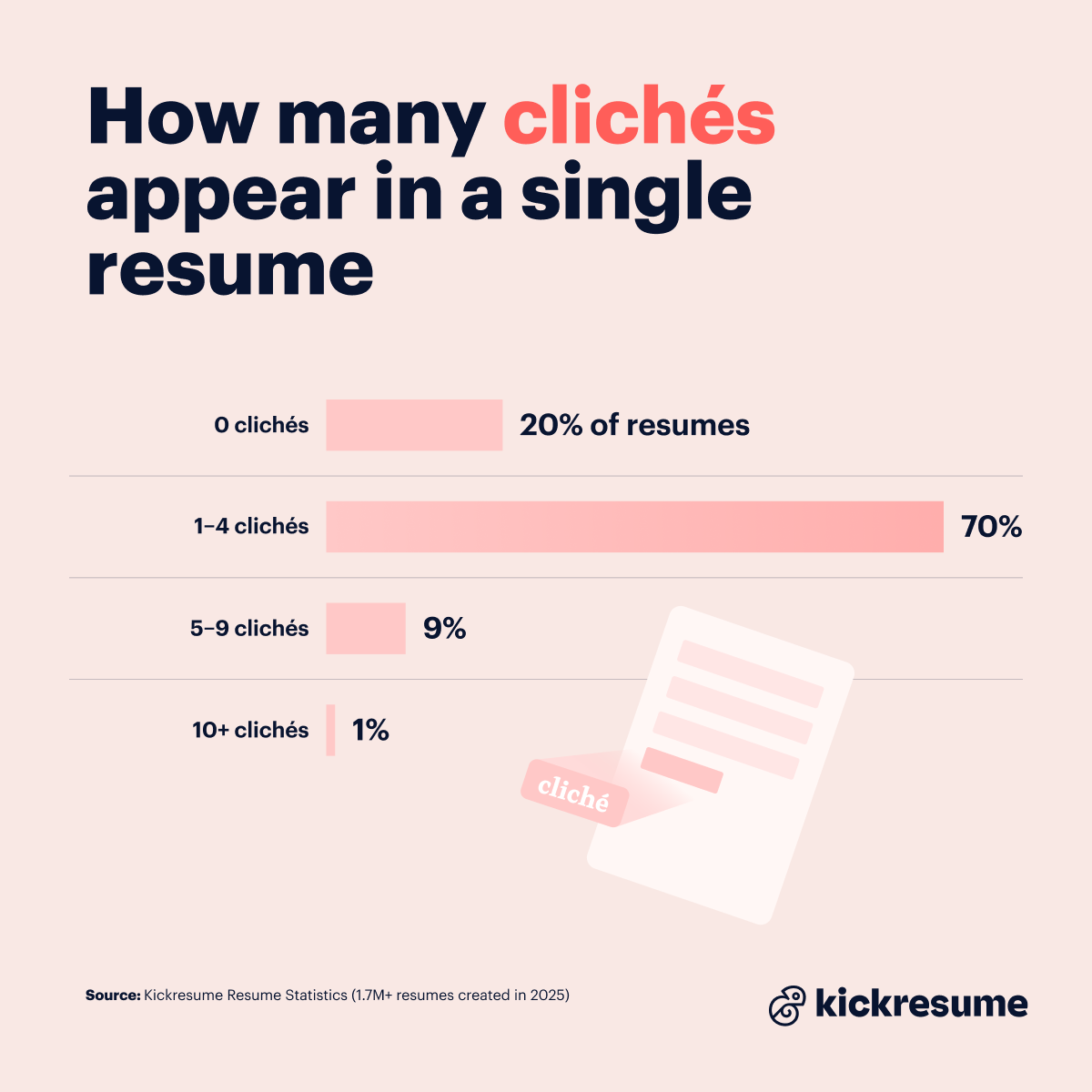
The pattern becomes clearer when we look at how many clichés appear in a single resume: only 1 in 5 is entirely cliché-free, more than 80% contain at least one, and roughly 1 in 10 contains five or more.
The fix isn't to strip your resume of all descriptive language. Calling yourself "results-driven" or "detail-oriented" isn't wrong—those words have a place. The issue is when they do all the talking. If your summary says you're innovative but your experience section is full of vague responsibilities, the claim falls flat.
"It's not the cliché phrase itself that holds a resume back. It's what's often missing around it," says Marta Říhová, HR Expert at Kickresume. "A line like 'innovative problem-solver' tells a recruiter very little until it's followed by a concrete example of an actual problem solved."
Words that quietly undermine your resume
Beyond outright clichés, there's a second group of words worth paying attention to—ones that aren't tired phrases exactly, but cause a similar problem.
These are empty modifiers, spoken-language fillers, and hedging words. What they share is the same underlying instinct: the desire to signal effort or quality when the bullet point alone doesn't feel like enough. The trouble is, without something concrete backing them up, they end up raising questions rather than answering them.
The most common modifiers and intensifiers across the dataset:
- "Successfully" — 26% of all resumes (576,926 occurrences)
- "Actively" — 6%
- "Always" — 3%
- "Very" — 2%
- "Clearly" — 1%
"Managed a project" becomes "successfully managed a project"—it feels like it's adding something, and the instinct behind it is reasonable. After appearing more than half a million times across our dataset, though, the word has stopped doing that job.
"Actively managed" wants to tell you this wasn't passive or incidental, but without specifics, it only invites the question: actively how?
Then there are spoken-language fillers that have somehow migrated onto the page:
- "Really" (4,784 occurrences)
- "Actually" (2,125)
- "Basically" (1,878)
They belong in conversation, not in a document you've carefully composed. When someone writes that they "actually led" a team or "basically rebuilt" a process, they're not being modest—they're hedging in a way that quietly undermines everything around it.
Which brings us to perhaps the strangest finding in the data: outright doubt. Thousands of resumes contain the word "hope" (5,305 occurrences), while hundreds reach for "probably" (452) or "maybe" (494).
"Seeing words like 'hope' and 'maybe' on a resume is genuinely surprising," says Marta Říhová. "A resume is meant to be the most confident piece of writing a candidate produces—it's a structured argument for why they're the right hire. Hedging language sends the opposite signal, even when used unintentionally."
Weak action verbs are quietly working against your resume
Clichés and fillers aren't the only thing holding resumes back. The verbs job seekers reach for matter just as much—and our data shows that most people are selling themselves short without realizing it.
These are the ten most common weak action verbs across the dataset:
- "Used" — 39% of all resumes (1,940,535 occurrences)
- "Helped" — 39%
- "Contributed to" — 32%
- "Met" — 20%
- "Brought" — 19%
- "Made" — 18%
- "Handled" — 17%
- "Followed" — 12%
- "Assisted in" — 10%
- "Checked" — 9%
"Used" and “helped” appear nearly 2 million times each—in roughly 4 out of every 10 resumes. These aren't trends. They're habits.
So what makes a verb weak? It usually comes down to one thing: ownership. Weak verbs describe involvement—they tell a recruiter you were present, that you participated, that you were somewhere nearby when something happened.
Strong verbs, on the other hand, describe action—they tell a recruiter you drove something, built something, changed something. "Assisted in launching a new product" and "launched a new product" can describe the exact same contribution. But one sounds like you were in the room, and the other sounds like you made it happen.
Verbs like "used," "helped," and "handled" read like a job description, not a story of impact. Recruiters aren't looking for what your role involved—they're looking for what you actually delivered.
"The shift from 'helped with' to 'led' or 'launched' isn't about exaggeration—it's about giving yourself credit for the work you actually did," says Marta Říhová. "Most candidates dramatically undersell their own contributions, often because they don't want to seem boastful. But understatement on a resume reads as lack of ownership, not modesty."
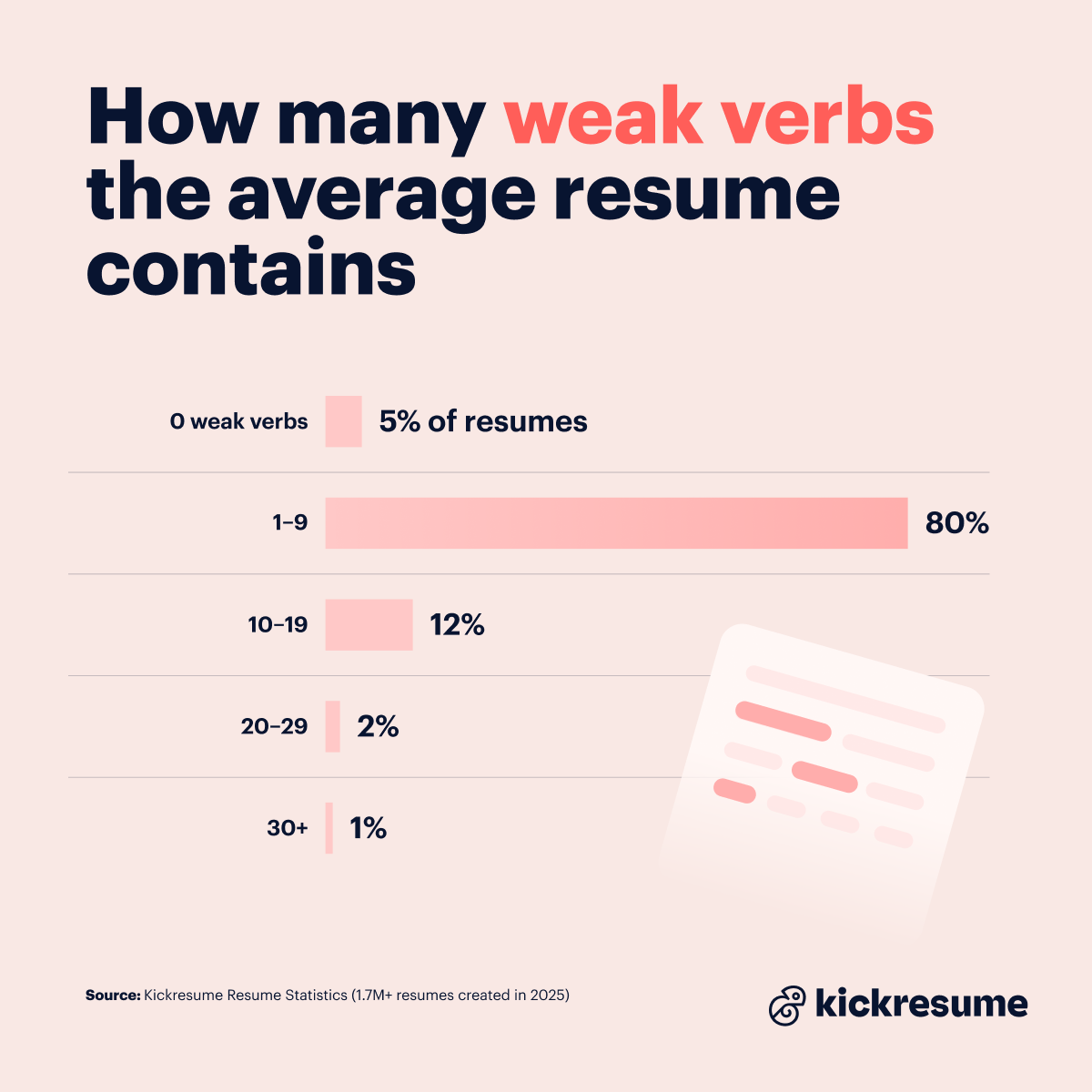
Looking at how weak verbs are distributed across resumes makes the habit even clearer:
- 0 weak verbs — 5% of resumes
- 1–9 — 80%
- 10–19 — 12%
- 20–29 — 2%
- 30+ — 1%
In other words, 95% of resumes contain at least one weak verb—and roughly 1 in 7 contains ten or more.
How to fix it? Lead with verbs that show what you did and what came of it:
- "Helping with client onboarding" → "Onboarded 30+ enterprise clients in the first quarter"
- "Contributing to product development" → "Co-developed a feature now used by 15,000 active users"
- "Assisted in preparing reports" → "Compiled and presented weekly performance reports to the executive team"
- "Responsible for managing budgets" → "Managed a $2M annual budget across three departments"
The pattern is the same every time—start with a verb that shows ownership, follow it with context, and anchor it with a result wherever you can.
Most resumes reach for strong verbs—and that's a good thing
For balance, our data also shows which strong action verbs job seekers reach for most often—and the picture here is more encouraging.
The ten most common strong verbs are:
- "Developed" — 54% of all resumes (1,841,469 occurrences)
- "Implemented" — 43%
- "Led" — 38%
- "Improved" — 35%
- "Managed" — 34%
- "Conducted" — 30%
- "Enhanced" — 26%
- "Reduced" — 23%
- "Designed" — 20%
- "Increased" — 20%
More than half of all resumes (54%) include the verb "developed"—making it the single most-used strong action verb in the dataset. That's a positive signal: most job seekers do reach for ownership-led language at least somewhere on the page.
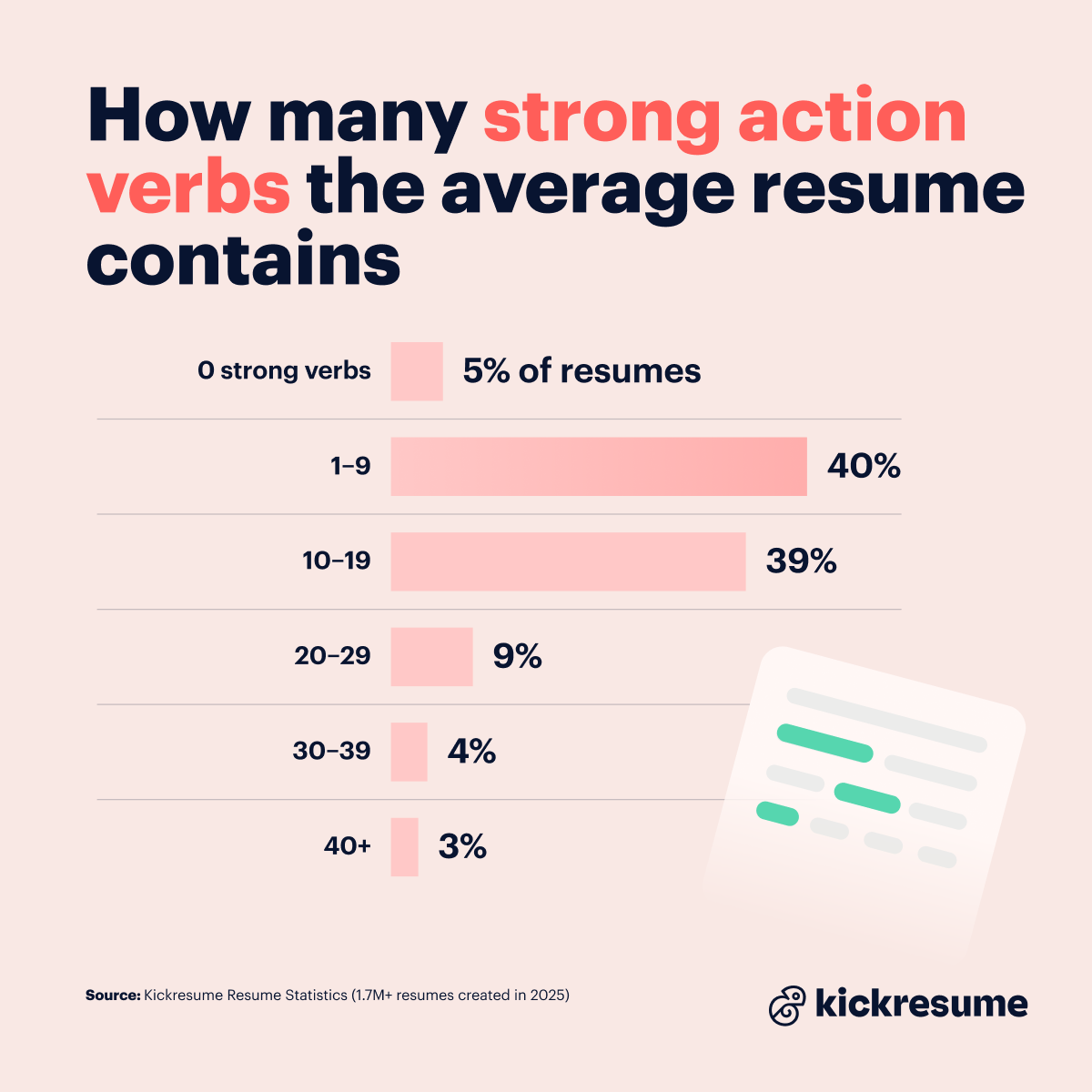
The challenge is in variety. Looking at how many strong verbs appear in a single resume:
- 0 strong verbs — 5% of resumes
- 1–9 — 40%
- 10–19 — 39%
- 20–29 — 9%
- 30–39 — 4%
- 40+ — 3%
84% of resumes use fewer than 20 strong verbs across the entire document. That suggests most candidates rely on a relatively narrow set of go-to verbs—"developed," "managed," "led"—and rarely venture beyond them.
Nearly 1 in 5 resumes uses no metrics at all
If swapping weak verbs for strong ones is the first thing every career guide recommends, anchoring those verbs with numbers is usually the second.
Quantifying achievements—"$2M budget," "30+ clients onboarded," "reduced costs by 22%"—is the most reliable way to turn a vague claim into a credible one.
To see how often candidates actually do this, we ran a separate analysis counting numerical achievements across our resume database. Because numbers themselves don't depend on the language a resume is written in, this analysis was expanded beyond English to include the full multilingual dataset of 2.1 million resumes created in 2025.
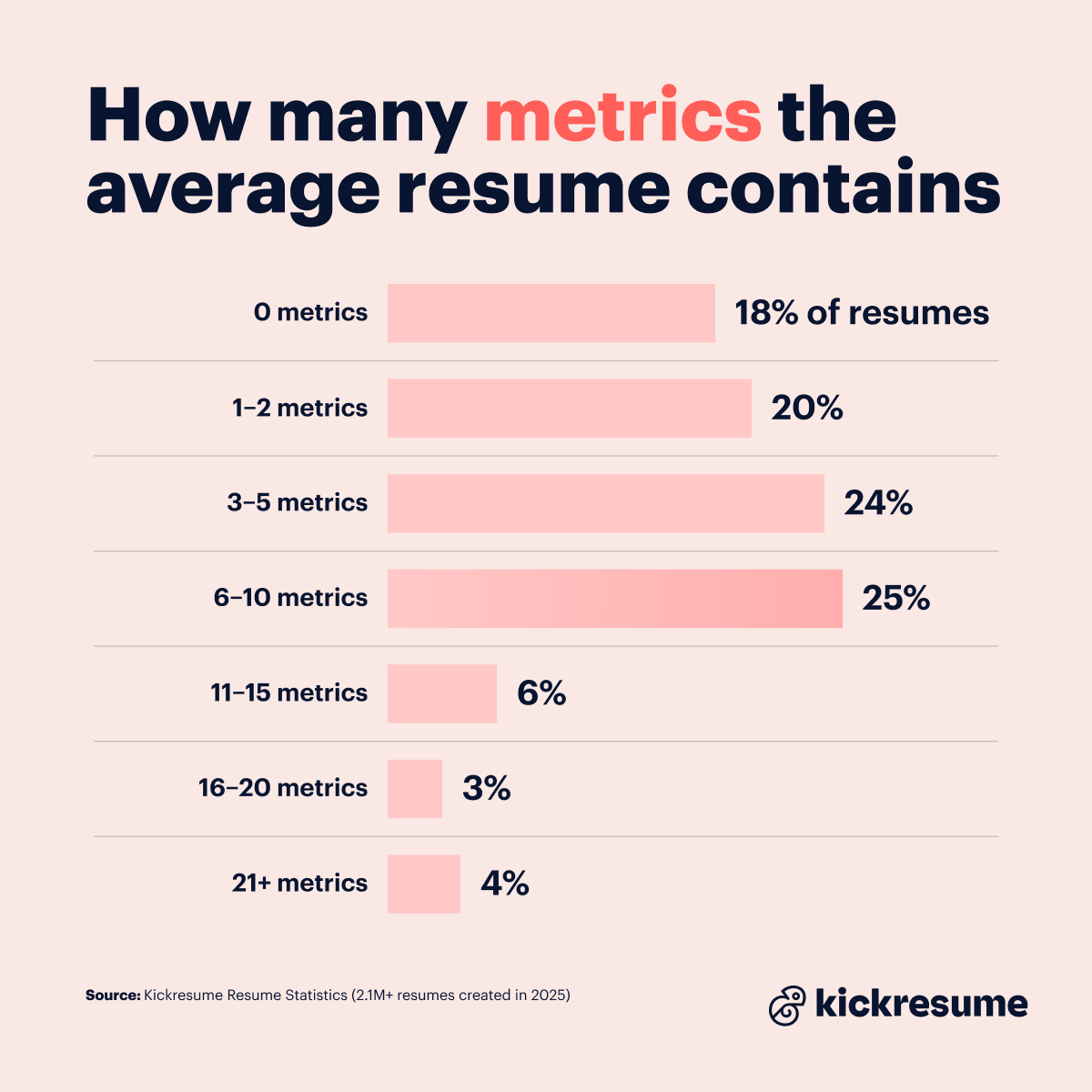
We found that 18% of resumes contain no numbers at all. Not a single percentage, dollar amount, headcount, or time-bound figure.
The rest of the picture isn't much more encouraging:
- 0 metrics — 18% of resumes
- 1–2 metrics — 20%
- 3–5 metrics — 24%
- 6–10 metrics — 25%
- 11–15 metrics — 6%
- 16–20 metrics — 3%
- 21+ metrics — 4%
The median resume contains just 4 numbers across an entire career. For a document meant to summarize years of professional output, that's surprisingly thin—often one or two figures per role at most.
Where the numbers live (and where they don't)
When numbers do appear, they're concentrated almost entirely in one place:
- Work experience — 66% of all metrics
- Summary — 17%
- Education — 12%
- Achievements — 5%
Most numbers in resumes live in the work experience section (66%), which makes sense—that's where day-to-day accomplishments are described. The summary, education, and achievements sections add fewer figures by design, with the achievements section in particular tending to highlight just a handful of standout wins rather than restating every metric from the experience above.
"The single fastest way to strengthen a resume is to look at every bullet and ask: is there a number that could go here?" says Marta Říhová, HR Expert at Kickresume. "It doesn't have to be a revenue figure or a percentage—headcount, project size, deadline, frequency, or anything specific will do. What matters is replacing the vague claim with something a recruiter can picture."
The fix follows the same pattern as the weak-verbs advice earlier: start with a strong verb, follow it with context, and anchor it with a number wherever you can.
- "Improved customer satisfaction" → "Improved customer satisfaction scores from 76% to 91% in 12 months"
- "Led a marketing team" → "Led a 6-person marketing team across three regions"
- "Reduced costs" → "Reduced operational costs by $1.4M annually"
The "I" in resumes: personal pronouns where they shouldn't be
Traditional resume advice has been consistent for decades: avoid personal pronouns. No "I," no "my," no "me." The reasoning is simple—a resume isn't an essay or a letter. The reader already knows the entire document is about you, so pronouns add length without adding information. They also shift the tone away from achievement-focused and toward narrative.
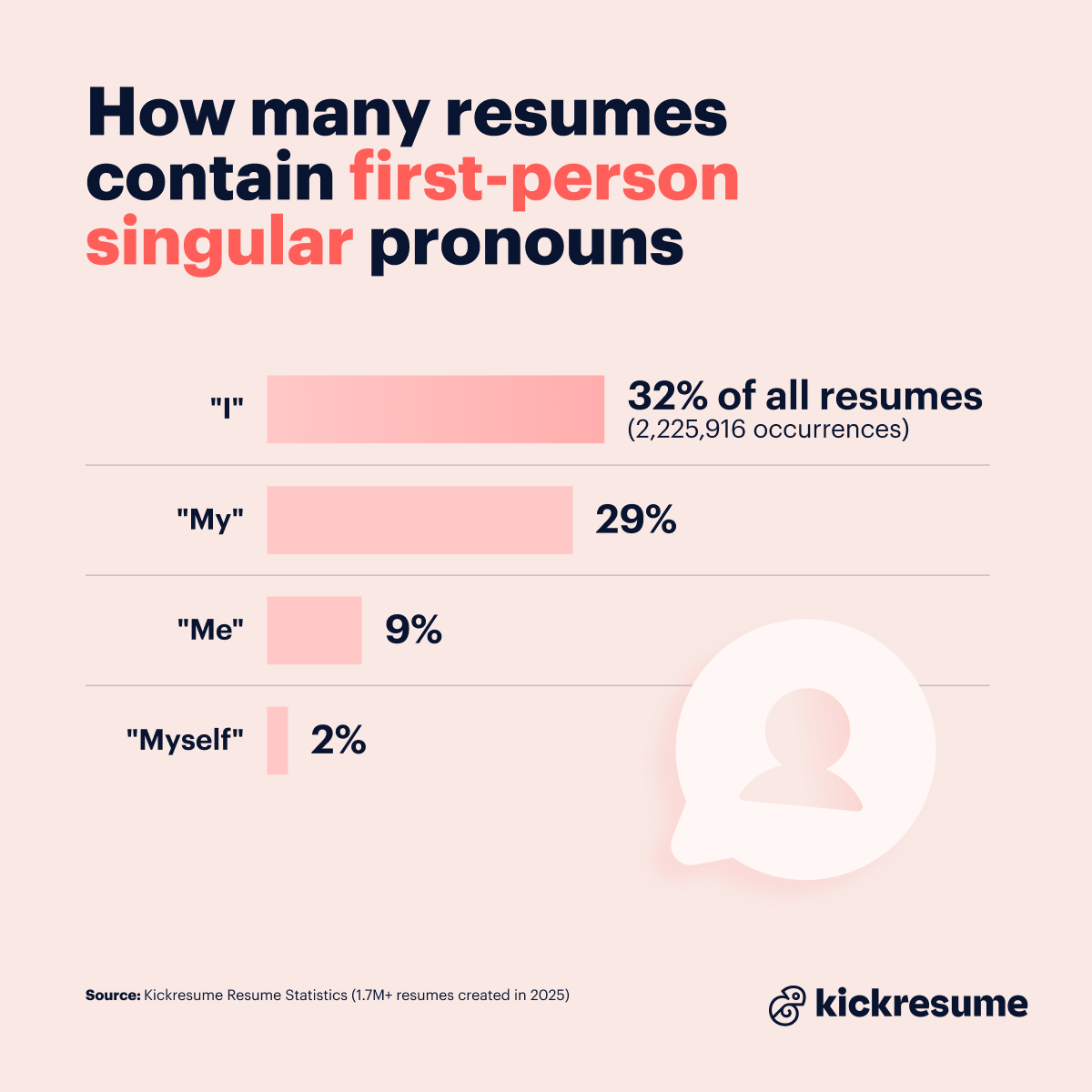
Yet, our data shows the convention is widely ignored. The most common first-person singular pronouns in our dataset:
- "I" — 32% of all resumes (2,225,916 occurrences)
- "My" — 29%
- "Me" — 9%
- "Myself" — 2%
Nearly 1 in 3 resumes contains the word "I." More than 1 in 4 contains "my." These are arguably the two most basic rules of modern resume writing—and roughly a third of candidates are breaking each of them.
The first-person plural isn't far behind either, most often appearing in descriptions of past teams or employers:
- "Our" — 14% (498,082 occurrences)
- "Us" — 7%
- "We" — 5%
This group is slightly more forgivable—"our team launched X" is a different problem than "I led X"—but it still adds words where direct attribution would be cleaner. A bullet like "our team grew revenue 30%" almost always reads better as "Grew team revenue 30%."
"The use of 'my' and 'I' in a resume usually signals that the document hasn't been edited with a recruiter's eye," says Marta Říhová. "It's an easy fix—and one of the simplest ways to instantly tighten the writing. You don't need a pronoun to claim your own work; the bullet point is doing that already."
Final thoughts
Across nearly 1.8 million resumes, the same pattern repeats: candidates reach for words that feel safe, soften their own contributions, and leave the most convincing details—the numbers, the ownership, the specifics—off the page entirely. Some matter more than others. But what they share is the cumulative effect—stacked together, they explain why so many resumes blur into each other.
They aren't signs of bad writers or weak candidates—they're the natural result of a million people independently reaching for what feels like the safest version of the same document. Recognizing that is usually the first step toward writing something that sounds a little less like everyone else.
If you're interested in how resumes are put together beyond the language—length, sections, and formatting patterns—our earlier analysis of resume structure and statistics covers that in detail.
Methodology
This analysis is based on 1,780,829 English-language resumes created by Kickresume users throughout 2025. Only resumes longer than 200 words were included, in order to exclude incomplete or test profiles that might skew the results.
The section on quantifiable achievements draws on a larger dataset of 2,133,734 resumes across all languages, since detecting numbers and percentages doesn't depend on the language the resume is written in.
All percentages reported in this article are rounded to the nearest whole number; raw occurrence counts are exact.
Resumes were analyzed across six language categories:
- Cliché phrases: words and expressions traditionally considered overused in resumes (e.g. "dynamic," "innovative," "results-driven")
- Fillers: words that add little informational value, including modifiers and intensifiers (e.g. "successfully," "actively") and spoken-language fillers (e.g. "basically," "really")
- Weak action verbs: verbs that describe involvement or participation rather than ownership (e.g. "used," "helped," "contributed to")
- Strong action verbs: verbs that describe direct ownership or measurable action (e.g. "developed," "led," "improved")
- Personal pronouns: words such as "my" and "I," which are traditionally avoided in resume writing
- Quantifiable achievements: numbers, percentages, and other concrete metrics used to evidence impact (e.g. "increased revenue by 30%," "managed a team of 12")
Phrases were counted in two ways: total occurrences across the full dataset, and the number of unique resumes in which they appeared.
The dataset spans resumes built across a wide range of industries, experience levels, and geographic markets. No personally identifying information was used in the analysis; only aggregated, anonymized text patterns were processed.
About Kickresume
Kickresume is an AI-based career tool that helps candidates source jobs and raise salary with powerful resume and cover letter tools, skills analytics, and automated job search assistance. It has already helped more than 8 million job seekers worldwide.