ChatGPT
 Perplexity AI
 Claude
Building an impressive engineering resume can be a complex task. But one that doesn't have to be stressful. Through this guide, equipped with practical tips, solid examples, and professionally designed templates, we'll help you to piece together a resume that commands attention.


 See more examples like these
Ready to build your career blueprint? Read on and learn how to:
- Recognize the good and the bad in actual engineering resume samples
- Properly format your engineering resume
- Write an engaging resume summary or objective
- Present the best engineering skills
- Craft a strong work experience and key projects section
- Elevate your resume with strong action verbs
- Include relevant extra sections in your engineering resume
- Pair your resume with a matching cover letter
- Avoid common resume mistakes
- Make your engineering resume ATS-friendly
- Find the best resources for job seeking engineers
Civil engineering technician resume sample


Why does this resume example work?
- It has a well-rounded skillset: The skills section shows a good balance between technical and interpersonal abilities. The applicant lists software knowledge such as AutoCAD, MicroStation, and SketchUp, along with project management tools like Asana and Podio. These are paired with soft skills like communication, leadership, and time management. This mix gives an impression of someone who can handle both the technical side of engineering and the teamwork that every project requires.
- Effective use of bullet points: The work experience section uses bullet points to list responsibilities. This layout makes the resume easy to read and keeps each point focused. Recruiters can quickly pick out key tasks such as “developed detailed construction plans” or “visited and supervised construction on site.” This helps ensure that important details are not lost in large blocks of text.
What could be improved?
- Profile section could be more concise: The profile paragraph uses a lot of formal adjectives and phrases that could be shortened. For example, instead of saying “highly motivated and detail-oriented Civil Engineering Technician with a history of successfully completing projects on time and within budget,” it could simply say “Civil Engineering Technician experienced in completing projects efficiently and within budget.” A tighter summary would make the introduction stronger and easier to read.
- Limited focus on measurable results: The work experience lists duties and responsibilities, but only one bullet point mentions a result (“Recognized as Employee of the Month”). Adding more examples with measurable outcomes, such as “reduced project costs by 10%” or “helped complete a bridge renovation three weeks ahead of schedule,” would make the resume more powerful. Employers look for results that show real impact.
Mechanical engineer resume sample

Why does this resume example work?
- Informative and effective header: The header includes all the key contact details an employer needs clearly presented at the top. It gives a professional first impression and makes it easy for a recruiter to reach the applicant.
- Use of action verbs: The work experience section uses strong, active verbs like “designed,” “developed,” “improved,” and “conducted.” These verbs show initiative and responsibility. They make the applicant sound like someone who takes ownership of tasks and contributes real results, rather than simply listing duties.
What could be improved?
- Skills section could be better balanced: While the resume lists both technical and interpersonal skills, some entries feel too broad or vague. Terms like “technological expertise” and “manual dexterity” don’t communicate specific abilities. Replacing these with more concrete skills, such as “proficiency in finite element analysis” or “experience with product lifecycle management tools,” would make the section more informative and useful to an employer.
Assistant engineer resume example

Why does this resume example work?
- Mentioning organization membership: Including membership in the Saudi Council of Engineers shows professional credibility and also that the applicant is part of a recognized engineering body. This gives employers confidence that the applicant meets certain standards and is serious about their professional development. It also adds weight to the resume, especially for someone early in their career.
- Clear display of education details: The education section provides specific information such as GPA, honors, and the university name, which helps establish the applicant’s academic foundation. This is particularly valuable for recent graduates or early-career professionals who may not yet have extensive work experience. The inclusion of the graduation date and GPA shows transparency and helps employers quickly gauge academic performance.
What could be improved?
- Work experience could be moved before the education section: Placing the work experience section before education would make the resume flow better. Employers usually want to see practical experience first, especially internships and co-op placements that show how academic knowledge has been applied in real situations. Reordering the sections would make the resume more appealing to hiring managers.
- Replace weaker expressions with action verbs: The work experience section uses phrases like “working with” and “applying,” which sound passive. Replacing these with stronger action verbs such as “collaborated,” “implemented,” or “analyzed” would make the descriptions more dynamic. This small change would make the applicant sound more confident and proactive, which is essential in technical fields like aerospace engineering.
Optical engineer resume sample

Why does this resume example work?
- Reverse-chronological organization of work experience: The work experience section is arranged from the most recent position to the oldest. This order helps recruiters see the applicant’s current and most advanced experience first, which is exactly what hiring managers expect. It also gives a clear sense of career growth, showing a natural progression from associate to full optical engineer. This layout makes the resume easy to follow and presents the applicant as someone with steady professional development.
- Diverse language proficiencies: Listing several languages shows cultural adaptability and the ability to work in international or cross-functional environments, which is especially useful in global engineering industries. This range of language skills helps the applicant stand out and signals good communication ability, an important quality even in technical roles.
What could be improved?
- Removing the high school entry: Because the applicant already holds both a bachelor’s and a master’s degree, the high school information is unnecessary. Employers rarely look for that level of detail once higher education has been completed. Removing this section would make the resume cleaner and more focused on relevant academic and professional qualifications.
- Simplifying overly formal or repetitive language: The profile section uses several phrases that could be simplified, such as “relentless drive for success” or “exceptional analytical abilities.” These expressions sound exaggerated and take attention away from the applicant’s real strengths. Replacing them with more direct language like “experienced in optical system design and testing” would make the introduction sound more confident and authentic.
Electrical engineer resume sample

Why does this resume example work?
- Highlighting awards in a separate section: Placing awards in a distinct section draws attention to important achievements without getting lost among other details. The Charles Stark Draper Prize is a major accomplishment, and giving it its own space ensures that employers notice it right away.
- Including quantifiable data: The resume uses clear, measurable results in the work experience section, such as “20% increase in efficiency” and “cost savings of $170,000 per year.” This is an excellent practice because numbers immediately show the applicant’s real-world impact. Employers value candidates who can back up their claims with evidence, and these results make the achievements tangible and convincing.
What could be improved?
- Hobbies could be more relevant: The hobbies listed here don’t add much value to an electrical engineering resume. It would be more effective to include hobbies that show technical curiosity or professional engagement, such as robotics, renewable energy, or open-source electronics projects. Replacing vague hobbies with activities that connect to the field would make the section more meaningful or, if none fit, it could be left out entirely.
Assistant audio engineer resume sample

Why does this resume example work?
- Great use of optional sections: The film credits section shows real-world creative experience and provides proof of work, which is especially important in a field like music scoring. Listing specific film titles and roles adds credibility and helps the applicant stand out from others who might only describe their skills in general terms. The strengths section reinforces expertise in both technical and creative areas, giving a well-rounded view of the applicant’s capabilities.
- Clear focus on collaboration and creativity: The “My Approach” section gives the resume personality and direction. It communicates the applicant’s philosophy toward work and makes it clear that collaboration is a core value. This helps employers see not just what the applicant can do technically, but also how they approach teamwork and storytelling through music, all qualities that are crucial in the film and media industry.
What could be improved?
- Consider omitting less relevant strengths: Some of the strengths listed, such as “ambitious team player,” are general traits rather than specific abilities. The section would have more impact if it focused entirely on technical or creative strengths relevant to film scoring and production. For example, highlighting areas like “MIDI orchestration” or “sound design workflow optimization” keeps the focus on professional expertise and makes the section feel tighter and more purposeful.
1. Properly format your engineering resume
Just like having the right blueprints for an engineering project, the format of your engineering resume holds immense importance.
The right format will not only offer a structural backbone to your resume but also guide the reader's eye towards pivotal details. Let's check out the three primary types of resume formats:
- Chronological: This approach documents your work history in reverse chronological order, beginning with your most recent role. If your engineering career has followed a notably consistent trajectory, the chronological format can highlight your stable work history and showcase your role-specific experiences.
For example, if you worked as a Civil Engineer and steadily progressed to Project Engineer and then Chief Engineer, this format would effectively highlight that progression.
- Functional: If you've had a mix of positions, or if you're looking to transition into a slightly different field within engineering, a functional resume might be your best bet. This format focuses mainly on skills rather than work history.
For instance, if you've held roles in both Electrical Engineering and Risk Assessment and wish to meld these into a career in Safety Engineering, a functional resume can emphasize your diverse set of competencies.
- Hybrid: The Hybrid format, as its name implies, combines the strengths of the chronological and functional resumes. This format suits candidates with a wide array of skills stemming from different engineering roles and a rich career history to showcase.
For instance, a candidate who’s had substantial years of experience in Mechanical Engineering and has also developed strong project management skills can use this format to highlight both their career trajectory and diverse skill set.
A few formatting tips
If you're putting together an engineering resume, the format should help readers quickly see why you're a great fit for the role. That means clarity, brevity, and organization. Here's how to format your resume:
- Choose a clean, easy-to-read font like Calibri, Georgia, or Arial
- Set your font size between 10 and 12 points
- Keep it to one page if you can; two max if your experience really calls for it
- Break your resume into clear sections with headings like “Experience” or “Education”
- Use bullet points instead of long paragraphs (they’re faster to scan)
- Keep your margins consistent, around 0.75 to 1 inch on all sides
- Make sure there’s enough white space (crowded text is hard to read)
- Always save and send your resume as a PDF, unless the job posting specifically asks for another format
And if formatting isn’t your favorite part of the job search, feel free to check out our professionally designed resume templates. The less time you spend on formatting, the more you can focus on perfecting your content.
Try our AI Resume Writer and have your resume ready in minutes!

2. Write a strong resume summary or objective
The first thing a recruiter notices on your resume should be an engaging summary or objective. But which one should you use and how?
Writing a resume objective
Opt for a resume objective if you're a recent graduate or transitioning to a new field in engineering. This statement should outline your career goals and how they tie to the job you're applying for. However, broad or generic objectives won't cut it.
Bad resume objective example
Looking for an engineering position to start my career.
Why is this example weak? This objective is too vague. It fails to provide specific details about your relevant qualifications or the particular engineering field you're interested in.
Good resume objective example
Newly-graduated Civil Engineer with internship experience in infrastructure planning, seeking a Junior Civil Engineer role to apply my skills and contribute to large-scale projects.
Why is this example correct? This objective nails it because it clearly identifies your engineering specialty, highlights your experience, and relates your career goal to the specific role you're applying for.
Writing a resume summary
If you're a seasoned engineer, a summary should summarize your skills, experiences, and key achievements. However, remember to avoid using fluffy language or unnecessary jargon.
Bad resume summary example
Experienced engineer seeking a challenging role.
Why is this example incorrect? This summary doesn't hit the mark as it is unspecific and fails to convey any meaningful information about your skills, experience, or the type of role you're seeking.
Good engineering resume summary example
Mechanical Engineer with 10+ years of experience in product design and quality control. Patent holder for innovative industrial tools. Seeking a senior role where I can apply my leadership and technical skills.
Why is this example strong? The correct summary is on point as it showcases your specialized engineering field, quantifies your experience and highlights your achievements while clearly stating the kind of role you aim for.
In deciding between a summary or an objective, make sure it is brief, specific, and job post-aligned.

3. Select the best skills for your engineering resume
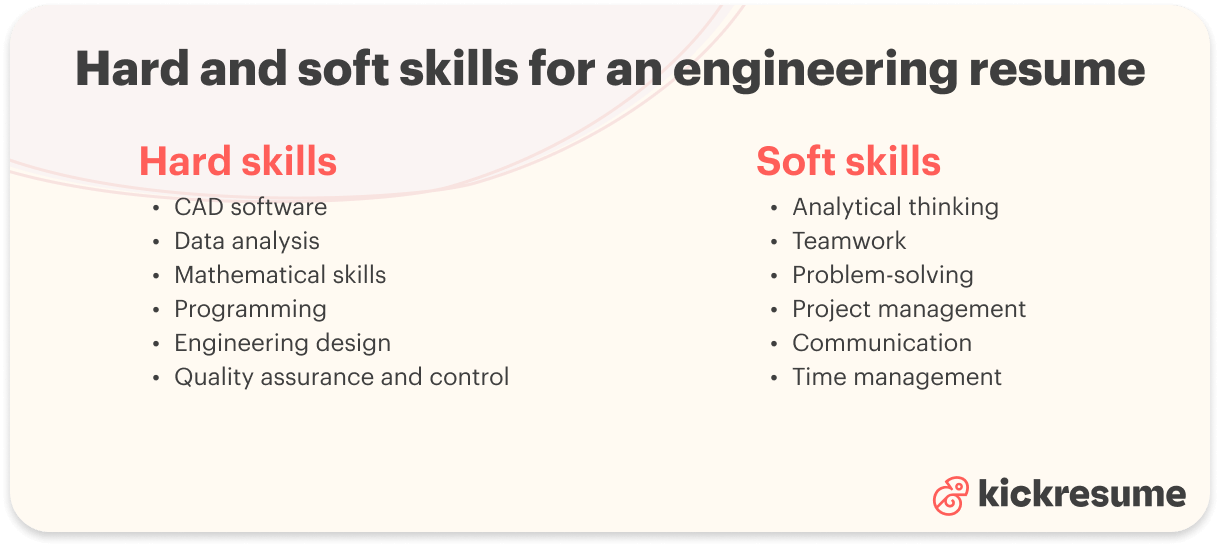
Choosing the right skills to feature on your engineering resume can make a substantial difference. These skills can be divided into two categories: hard skills and soft skills. Both are important, but how you choose and feature them matters greatly.
- Hard skills refer to technical knowledge or training you have acquired through experience. These are often job-specific and quantifiable.
- Soft skills, on the other hand, are transferable attributes or traits that affect your ability to work and interact with others.
Always ensure that the skills you highlight on your engineering resume are relevant to the role.
Here are some skills that might be included in your engineering resume:
Essential soft skills for an engineering resume
- Analytical thinking
- Teamwork
- Problem-solving
- Project management
- Communication
- Time management
Effective hard skills for an engineering resume
- CAD software
- Data analysis
- Mathematical skills
- Programming
- Engineering design
- Quality assurance and control
All in all, selecting the right skills for your resume is more than simply listing what you can do. It's about clearly showcasing that you possess a balanced mix of hard and soft skills that perfectly align with the engineering role on offer.
Tailor your skills section to reflect the requirements listed in the job ad; this will significantly aid your path to the interview shortlist.
4. Make your work experience and key projects section count
Your work experience and key projects play a leading role in your engineering resume. They demonstrate your applied skills and provide insights into your past roles and contributions.
So what exactly makes a strong work experience entry? Follow this formula:
- Start with your job title and organization
- Add your dates of employment (month + year format is standard)
- Use bullet points to describe your key responsibilities and accomplishments
- Focus on outcomes, not just duties
- Back it up with numbers or metrics whenever possible
- Lead with action verbs (we’ll cover those in an upcoming chapter)
Let’s compare take a look at two examples and see which one works better:
Bad work experience and key projects section example
Mechanical Engineer, ABC Technologies, 2016-2020
- Worked on projects
- Assisted team
- Used CAD software
- Solved problems
- Attended meetings
Key Projects:
- Project X
- Project Y
Why is this example weak? This example fails to impress. It gives no specifics about what projects you worked on, what your role was, the outcome of your tasks, or how your participation influenced the projects.
Good work experience and projects section example
Senior Mechanical Engineer, ABC Technologies, 2016-2020
- Directed a team of 6 in executing complex CAD designs for aerospace products.
- Innovated - cost-cutting measures, reducing project expenses by 20%.
- Oversaw quality assurance tests, enhancing product performance by 15%.
- Spearheaded weekly team coordination meetings to streamline workflow.
- Resolved complex machinery breakdowns, eliminating downtime by 25%.
Key Projects:
- Led Project X: Reduced machinery setup time by 10% utilizing precise, comprehensive process maps.
- Directed Project Y: Achieved 95% customer satisfaction by designing enhanced ergonomic features for the product line.
Why is this a strong example? It makes a strong impression. It uses strong verbs (Directed, Innovated, Oversaw, Spearheaded), adds specifics about your role, and provides outcomes. Furthermore, key projects are defined, highlighting your respective roles and the impact it made.
In summary, the work experience and key projects section can narrate a compelling tale of your professional engineering journey. Using concrete details, strong verbs, and engaging adjectives will help your story captivate the reader.
Find out your resume score!

5. Use action verbs to make your engineering resume stronger
If you really want to make your work experience pop, start your bullet points with action verbs.
Why does this matter?
Because action verbs show that you do things and not just that you were somehow involved in them. They make you sound proactive, capable, and results-driven. Instead of simply describing what your job was, they help you show what you actually accomplished.
Here’s a quick example:
Before:
Was responsible for testing and maintaining equipment in the production facility.
After:
Tested and maintained production equipment, improving operational efficiency by 18%.
See the difference? The second version sounds way more confident than the first version.
Here are some action verbs that work especially well in engineering resumes.
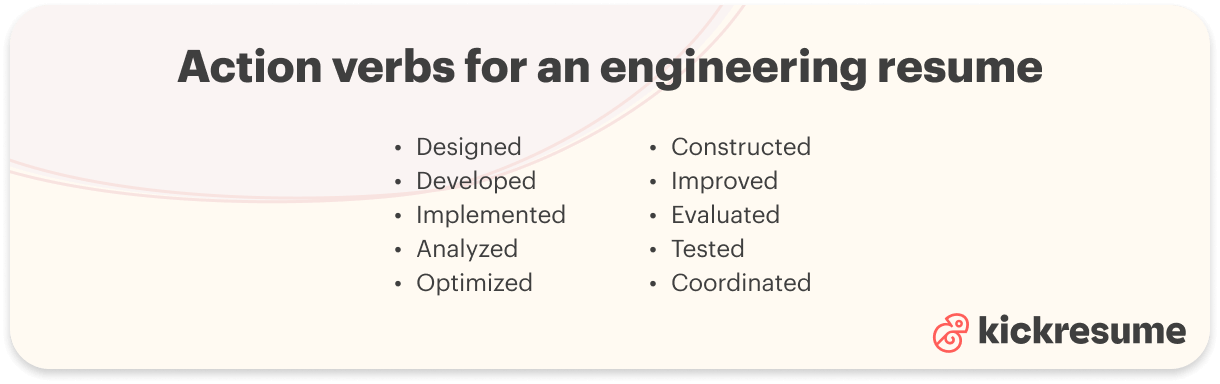
Examples of action verbs to use in an engineering resume
- Designed
- Developed
- Implemented
- Analyzed
- Optimized
- Constructed
- Improved
- Evaluated
- Tested
- Coordinated
Try to keep your wording varied. If every bullet point starts with “Improved” or “Optimized,” your achievements will blend together. Use specific, precise verbs that match your contribution.
6. Craft a great education section for your engineering resume
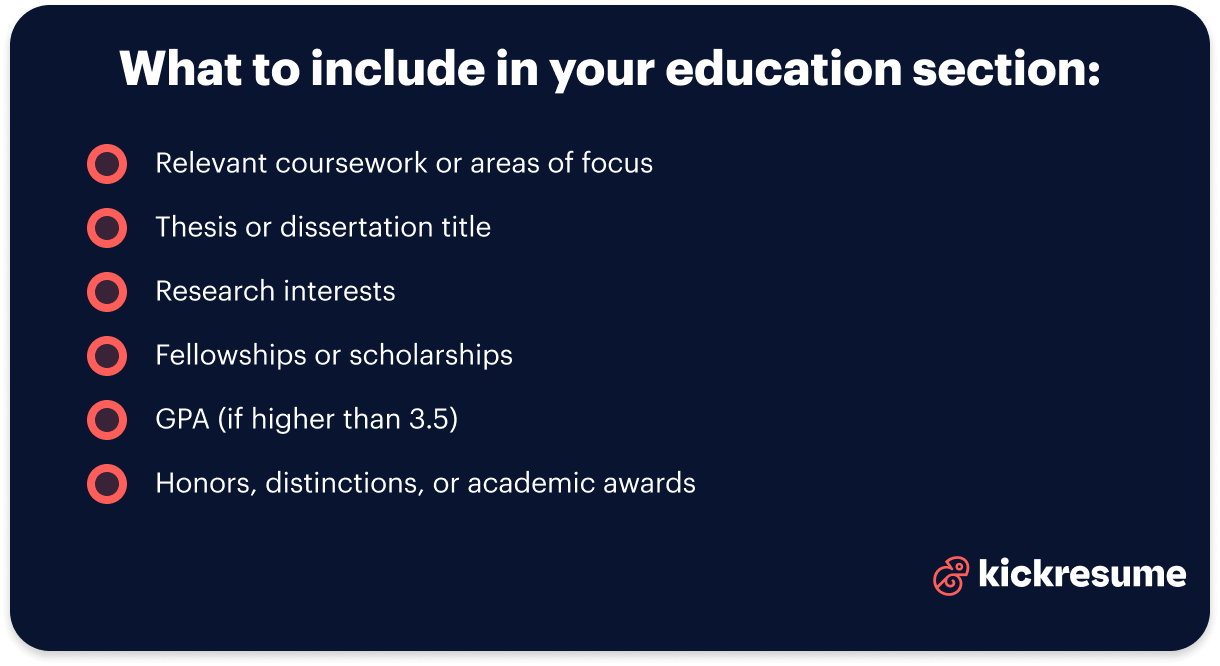
Degree or not, your educational background certainly matters in your engineering resume. It confirms your academic understanding of engineering principles and, if properly presented, can also speak volumes about your dedication, perseverance, and the depths of your knowledge.
If your education is not directly related to the engineering field you're venturing into, don’t let that dampen your spirits. You can awaken the recruiter’s interest by drawing attention to transferable skills, relevant courses, or projects you've undertaken during your studies.
Here’s an example of a non-directly relevant education section
Bachelor of Mathematics, University XYZ, 2010-2014
- Focused coursework: Statistical Methods, Mathematical Physics, Mathematical Modelling
- Key project: Applied mathematical modeling to optimize public transportation routes based on user demand in a city.
Why is this example strong? The focus on relevant coursework indicates a strong basis in areas important to engineering. The key project demonstrates the application of these areas to solve a real-world issue, mirroring the problem-solving aspect of engineering roles.
On the flip side, if your education is directly related to the engineering field you're aiming for, highlight your degree, specialized courses, academic achievements, or crucial projects demonstrating your prowess in the subject.
Here’s an example of a directly relevant education section
BSc in Electrical Engineering, University ABC, 2014-2018
- Specialized coursework: Control Systems, Electronic Devices, Digital Signal Processing
- Academic achievement: Achieved Dean's list for 6 semesters
- Key project: Developed a low-cost, energy-efficient lighting system for rural areas, serving as the project lead.
Why is this an effective education section? The degree instantly affirms a specialized understanding of the field. The specialized coursework provides a snapshot of the relevant skills honed. And the academic achievement serves as a testament to the applicant's persistent performance. Lastly, the key project demonstrates leadership and application of skills to design an impactful engineering solution.
In a nutshell, the education section of your resume, regardless of how related your degree is, can be cleverly presented to boost your appeal. It's about spotlighting those elements of your academic journey that show you're up for the job. So, polish this section to make it shine!
7. Choose relevant extra sections for your engineering resume
An engineering resume doesn't end with your work experience or education. Adding relevant extra sections can help you stand out. These sections can show you’re a well-rounded individual and not just about work.
It's important to select extras that resonate with your career trajectory and complement what’s expected in your field of engineering.
- Participating in volunteering efforts can showcase your commitment and leadership skills.
- A “Certifications and licenses” section is where you can build up your credentials as a credible professional engineer.
- A “Languages” section could communicate your adaptability, especially relevant for multinational companies or roles requiring international collaborations.
Here’s an example of how to list these extra sections on your resume
Volunteering experience
- Led a team of engineers offering pro bono services — Designed and implemented a sustainable lighting system for "City Shelter," a local non-profit organization, Jun 2017 - Aug 2017.
Certifications and licenses
- Professional Engineer (PE) certification, Licensed by the National Society of Professional Engineers, 2020.
Languages
- Proficient in Spanish and French, Certificate of Proficiency from the Instituto Cervantes and Alliance Française respectively.
By listing relevant extra sections, you're painting a richer picture of your skills and experiences. These "extras" illustrate your depth and range as a candidate, making you more memorable to a hiring manager.
8. Bolster your engineering resume with a cover letter
While your engineering resume presents an overview of your qualifications, a cover letter is your opportunity to delve deeper into your unique story. It allows you to expand on specific experiences or projects and clearly connect your skills and qualifications to the job's needs.
A cover letter is especially relevant when:
- The job posting specifically requests for one
- You're transitioning into a new engineering field and need to explain how your current skills translate
- You're relocating and need to clarify it
Your cover letter is different from your resume in that it's a narrative, a compelling story arguing why you're the ideal candidate. It's more personalized and displays your passion, communicative style, and why you're drawn to the particular engineering role.
On the other hand, a resume is a formal, succinct listing of your work history, education, skills, and achievements. It emphasizes hard facts and quantifiable information.
Remember: A well-crafted cover letter can serve as a powerful advocate, reinforcing the profile painted by your engineering resume. It not only adds a human touch to your application but also allows a deeper insight into the professional behind the credentials. So, consider including a tailored cover letter whenever you submit your engineering resume.
Let your cover letter write itself — with AI!

9. Avoid common mistakes on your engineering resume
Even seasoned engineers can trip over small mistakes while drafting their resumes. By avoiding these prevalent pitfalls, you can enhance your chances of catching a recruiter's eye. Here are several tips:
- Being too vague: Don't just state that you worked on a project. Specify your role, the tools you used, and its impact. Use numbers and facts where possible.
- Ignoring keywords: Many companies use automated tracking systems (ATS) to filter applications. Make sure you use relevant keywords from the job description in your resume to pass these scans.
- Listing irrelevant skills: Your ice carving skills may be impressive but might not be relevant for a Civil Engineering role. Prioritize hard skills that are directly pertinent to the job at hand, but do remember to sprinkle in some soft skills too.
- Focusing on responsibilities over achievements: Don't just list what you were supposed to do; mention what you actually achieved. Did you streamline the process? Reduce costs? Increase efficiency?
- Poorly organized layout: Make your resume easy to read with a clean layout. Use bullet points, concise sentences, and responsive formatting that’s comfortable to navigate on any device.
- Typos and grammar mistakes: Proofread your resume multiple times and consider having a friend or a mentor review it as well. Minor errors can project a lack of attention to detail.
By dodging these common resume missteps, you can make your engineering resume clearer, sharper, and more attuned to what employers are looking for. It can make a big difference in receiving that anticipated interview call email.
10. Optimising your engineering resume for ATS
When you apply for engineering jobs, your resume doesn’t just sit in front of a human right away. Many companies use an Applicant Tracking System (ATS) first.
What are ATS and how do they work?
An ATS gathers all the applications submitted for a job opening, then “parses” each resume — that means it reads the file, extracts things like names, contact info, skills, job titles, dates, and so on.
After that it matches what the applicant lists against the keywords and criteria the company set for the job (for example: “mechanical design”, “CAD proficiency”, “finite-element analysis”).
Based on that match the system then scores the applications and forwards only the higher-scoring ones to a human recruiter.
Why this matters for an engineer
As an engineer you bring technical expertise, certifications, software knowledge, project accomplishments and more. But if your resume isn’t formatted so the ATS can read it clearly, or if you haven’t used the right keywords, the system might never pass your resume on. That means you could be a great candidate and still get overlooked.
How to optimise your engineering resume for ATS
If you've never had to deal with ATS, all of this might seem pretty confusing. And while it's true that every single ATS is programmed differently, there are a few universal rules to follow to make your engineering resume ATS-friendly:
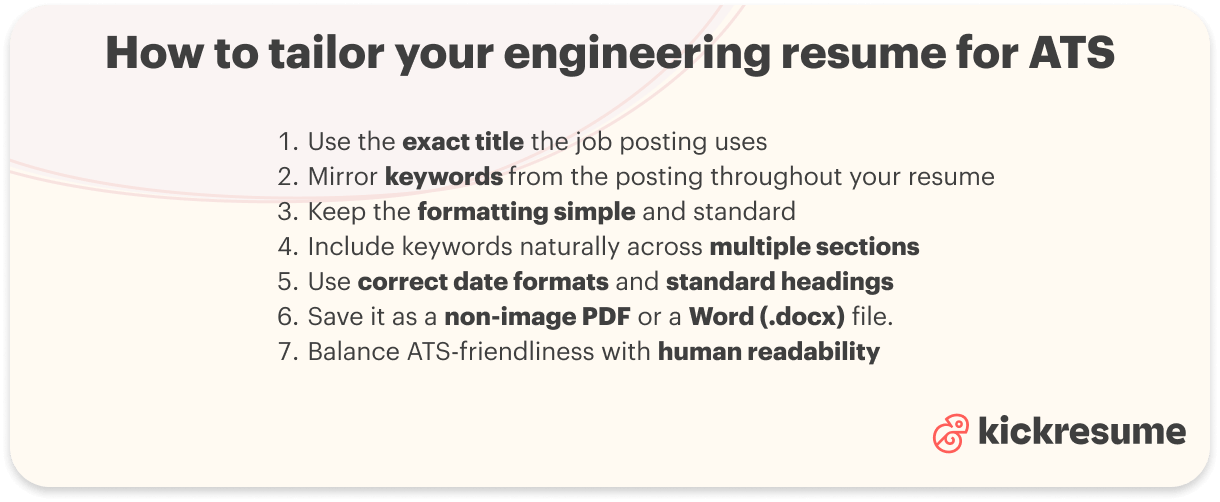
- Use the exact title the job posting uses
If the job says “Mechanical Design Engineer”, include that phrase in your summary or heading. The ATS will pick up matching phrases. If you use “Mechanical Engineer – Design & Analysis” but the posting says “Mechanical Design Engineer”, you risk missing a strong match. - Mirrors keywords from the posting in your technical sections
Look at the job posting: identify key skills, software or standards listed (for example “ANSYS”, “SolidWorks”, “ISO 9001”, “DFMEA”). Use those exact terms in your Work Experience or Skills section. For instance if they ask for “Finite Element Analysis (FEA)” use both the full term and the acronym somewhere on your resume. - Keep the formatting simple and standard
Avoid using fancy fonts, headers with images, or heavy graphics. Many ATS cannot parse text embedded in graphics or very unusual formats. Stick with plain, readable fonts like Arial or Calibri, use standard section titles (“Work Experience”, “Education”, “Skills”). - Include keywords naturally across multiple sections
Work important keywords into your summary, work experience, skills and education. But don’t over-stuff: if you repeat the same keyword too many times in an unnatural way the human reviewer may spot it and discount you. A realistic target is use of key terms 2-3 times across the resume. - Use correct date formats and standard headings
For engineering roles it’s best to write dates clearly (for example “06/2019 – 04/2022”) and keep it consistent across every job. Ensure you use well-known section headings so ATS recognises them (e.g., “Work Experience” not “My Jobs”). - Choose the right file type when you submit
If the job posting allows, save your resume as a non-image PDF or a Word (.docx) file. These formats are reliably readable by ATS systems. Avoid submitting resumes in purely image-based formats (NOT EVERY ATS CAN READ THEM). - Balance ATS-friendliness with human readability
Remember that after passing the system you’ll still need a human to read and be impressed. That means your resume must look good, make sense, and highlight your engineering achievements. Don’t sacrifice readability for keywords alone.
ATS-friendly keywords for engineers in different fields
If you're not sure which expressions from the job ad could be the target keywords, we've prepared a few cheat sheets for you!
Mechanical engineering keywords
Emphasis on technical skills, tools, and processes:
- CAD Design
- SolidWorks
- AutoCAD
- CATIA
- Pro/ENGINEER (Creo)
- Finite Element Analysis (FEA)
- ANSYS
- Thermodynamics
- Fluid Mechanics
- Heat Transfer
- Mechanical Systems Design
- Tolerance Analysis
- Manufacturing Processes
- Product Lifecycle Management (PLM)
- Root Cause Analysis
- 3D Modeling
- Prototype Development
- Failure Mode and Effects Analysis (FMEA)
Electrical engineering keywords
Emphasis on electrical design, testing, and system analysis:
- Circuit Design
- PCB Layout
- MATLAB
- Simulink
- LabVIEW
- Embedded Systems
- Microcontrollers
- Power Distribution
- Control Systems
- SCADA
- PLC Programming
- Signal Processing
- Power Electronics
- Electrical Schematics
- Root Cause Analysis
- Preventive Maintenance
- System Integration
- Testing and Calibration
Civil engineering keywords
Emphasis on design, construction, and compliance standards:
- Structural Analysis
- AutoCAD Civil 3D
- Revit
- Project Management
- Site Inspection
- Construction Supervision
- Cost Estimation
- Surveying
- Geotechnical Engineering
- Reinforced Concrete Design
- Steel Structures
- Hydraulics
- Transportation Engineering
- Environmental Engineering
- Safety Compliance
- Building Codes
- Infrastructure Design
- Quantity Takeoff
Software and computer engineering keywords
Emphasis on coding languages, tools, and frameworks:
- C / C++ / C#
- Python
- Java
- Embedded C
- VHDL / Verilog
- FPGA Development
- System Architecture
- Algorithm Design
- API Integration
- Data Analysis
- Software Testing
- Version Control (Git)
- Agile Development
- IoT Systems
- Hardware-Software Integration
- Microprocessor Programming
- Machine Learning
- Cloud Platforms (AWS, Azure)
Chemical and process engineering keywords
Emphasis on process design, safety, and optimization:
- Process Engineering
- Process Simulation
- Aspen HYSYS
- Chemical Process Design
- Heat Exchangers
- P&ID Development
- Process Optimization
- Safety Compliance
- Hazard Analysis (HAZOP)
- Quality Control
- Mass and Energy Balances
- Process Troubleshooting
- Environmental Regulations
- Pilot Plant Testing
- Root Cause Analysis
- Material Selection
- Project Coordination
- Production Efficiency
How to use these keywords effectively
- Tailor them to each job post. Pick the ones that actually appear in the description.
- Blend them naturally into your bullet points, summary, and skills section.
- Avoid keyword stuffing. It’s better to use a keyword once in context than to repeat it five times with no substance.
- Be specific. If you used SolidWorks for mechanical assemblies, say so; if you led SCADA system upgrades, mention the project’s scope.
Examples of ATS keywords in engineering resume work experience
- Reducing manual processing time* from 6 hours to 20 minutes per cycle by developing Python* scripts to automate* sensor data analysis*.
- Used MATLAB* to model dynamic systems*, reducing prototype testing time by 40%.
- Performed finite element analysis (FEA)* in ANSYS* to verify the strength of new gearbox designs, which led to a 30% improvement in durability under load testing*.
- Designed AutoCAD Civil* 3D layouts* for a €12M bridge project, completed on schedule and compliant with standards*.
*examples of possible keywords for your engineering resume (for different fields)
You can have the most impressive engineering resume out there, but if the organization you’re applying to uses an ATS and you don’t tailor your resume accordingly, it won’t give you much of an advantage! Follow the basic principles we outlined above and you’ll have a much better shot at moving to the interview stage.
11. Average salary and job outlook for engineering occupations
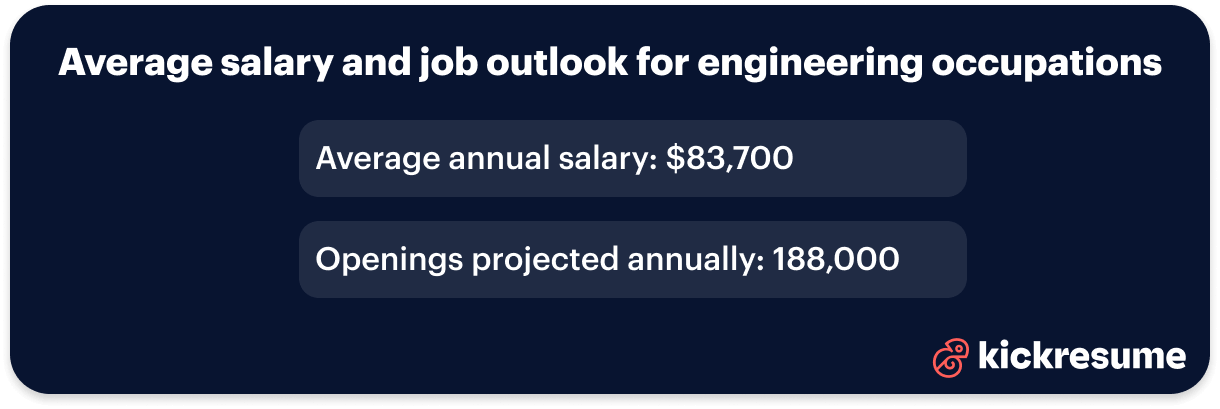
Engineering occupations offer exciting career prospects, both in terms of job growth and compensation. According to the most recent data from the Bureau of Labor Statistics (BLS), the average yearly salary for engineering occupations was $83,700, which stands well above the median annual wage for all occupations, set at $46,310.
Moreover, the job outlook for engineers also seems promising. The overall employment in architecture and engineering occupations is projected to grow at a pace higher than the average for all occupations from 2022 to 2032.
During this period, approximately 188,000 job openings are projected each year, on average, in engineering fields.
These figures indicate that pursuing a career in engineering can be both rewarding and stable. It's a field where your unique skills are likely to be in demand and fairly compensated, promising a strong career growth trajectory in the years to come.
12. Engineer's resources: Valuable aids for job seekers
Navigating your job search as an engineer can be more manageable with the right resources at your disposal. From professional organizations to online platforms, here are some resources to guide you on your engineering job hunt.
- Job boards: Websites like Engineering.com, or iHireEngineering focus specifically on engineering roles across the globe. They can be valuable for finding job listings and getting a sense of what qualifications are in demand.
- Professional organizations: Associations such as the National Society of Professional Engineers (NSPE), American Society of Civil Engineers (ASCE), and IEEE offer resources, networking opportunities, professional development, and industry news updates.
- Certification programs: Not only can these enhance your knowledge and credentials, but they also indicate your dedication to the field. Consider pursuing certifications like Professional Engineer (PE), Certified Manufacturing Engineer, or any other relevant to your subfield.
- LinkedIn: Creating a standout LinkedIn profile can expand your network, enable you to connect with industry professionals, and access job listings. What’s more, you can now turn your LinkedIn profile into a polished resume within seconds.
- Online courses: Websites like Coursera, Udemy, and MIT OpenCourseWare offer a wide array of engineering courses in various subfields. They could help you stay on top of the latest industry trends or learn new skills.
- Engineering blogs and podcasts: Following industry-specific blogs and podcasts such as 'Engineering.com' or 'The Engineering Career Coach Podcast' can provide valuable insights into current industry trends and give advice on career growth. These sources often also highlight emerging job opportunities and connect you to a broader professional community.
In essence, utilize these resources to polish your skills, network with professionals, stay updated with the industry, and yes, land your dream engineering role. These resources could essentially serve as the scaffolding that supports your engineering career progression.
Engineering Career Outlook in 2025
Engineering jobs are expected to grow faster than the average for all occupations from 2023 to 2033, creating about 195,000 openings each year, on average. (Source: U.S. Bureau of Labor Statistics).
Among the occupations in this field, Industrial Engineers, Chemical Engineers, and Electrical Engineers are expected to see the highest growth, with projected increases of 12%, 10%, and 9%, respectively, over the decade.
Average US base salaries across popular Engineering roles:
- Aerospace Engineer: $100,860/year
- CAD Designer: $69,119/year
- Chemical Engineer: $96,083/year
- Civil Engineer: $91,685/year
- Electrical Engineer: $102,649/year
- Mechanical Engineer: $96,362/year
- Production Manager: $81,597/year
- QA Engineer: $89,809/year
- Quality Engineer: $82,980/year
Salary estimates are based on data submitted anonymously to Indeed by individuals working in these roles, as well as information from past and present job postings on the platform over the last 36 months.
Please note that these figures can vary depending on factors such as location, company size, and experience level.
If you’re thinking about starting a career in Engineering—or you want to grow within the field—now is a great time to explore the opportunities the industry provides.
Engineering Resume FAQ
How long should my engineering resume be?
As a rule of thumb, try to keep your resume to a page or two, especially if you have less than 10 years of experience. If you have a more extensive career, additional pages can be used to detail your experience and skills. Focus on relevance and clarity.
Can I use the same engineering resume for every job application?
While it may seem time-efficient, it's generally not a good idea. Each job description will have unique requirements and priorities, so your resume should be tailored to match those as closely as possible. It's all about showing the recruiter that you're not only a fit for the industry but especially for the role in question.
Should I include a photo in my engineering resume?
In most cases, adding a photo to an engineering resume is not necessary, nor is it encouraged. Focus on your skills, experiences, and qualifications. Of course, if you are applying for a job in a location where it's customary to include a photo (some European countries), follow the local norms.
How should I handle employment gaps in my engineering resume?
The best way to address employment gaps is honestly and concisely. You can mention it in your cover letter if you feel it needs explanation, or be prepared to discuss it during your interview. Otherwise, just focus on the knowledge, skills, and experiences that make you a good fit for the job.
Should I include references in my engineering resume?
You should only include references if the job advertisement specifically asks for them. Otherwise, you can simply state, "References available upon request." Most employers will ask for references later in the interview process.






![Supervisor de fabricación del servidor en Google currículum ejemplo [ES]](https://d1xn1bcogdo8ve.cloudfront.net/481/thumbnail.webp)


![Software Developer [swedish] Systemutvecklare](https://d1xn1bcogdo8ve.cloudfront.net/119/thumbnail.webp)

![Bosch Maschinenbauingenieur Lebenslauf Sample [DE]](https://d1xn1bcogdo8ve.cloudfront.net/197/thumbnail.webp)


![How to Write a Professional Resume Summary? [+Examples]](https://d2xe0iugdha6pz.cloudfront.net/article-small-images/How_to_Write_a_Professional_Resume_Summary_.png)
![How to List Your Education on a Resume? [+Examples]](https://d2xe0iugdha6pz.cloudfront.net/article-small-images/How_to_Put_Education_on_a_Resume_.png)
![How to Describe Your Work Experience on a Resume? [+Examples]](https://d2xe0iugdha6pz.cloudfront.net/article-small-images/How_to_Describe_Your_Work_Experience_on_a_Resume_.png)