ChatGPT
 Perplexity AI
 Claude
Fueling your career in the fast-paced automotive industry? Like a precisely designed engine, your automotive resume must perfectly mesh every component. In this guide, we will walk you through how to rev up your resume with valuable tips and compelling examples.


 See more examples like these
Keep reading to learn all about:
- Reviewing actual automotive resume samples
- Giving your resume the right look
- Crafting an informative resume summary (or objective)
- Choosing which skills to present on your automotive resume
- Framing your work history for maximum impact
- Using action verbs to make your resume more dynamic
- Flashing out your education
- Adding optional sections to your automotive resume
- The many small mistakes that can hurt your application
- Making your automotive cover letter match your resume
- Accessing helpful resources for job-seekers in the automotive industry
- The average salary and job outlook for automotive workers
Still looking for a job? These 100+ resources will tell you everything you need to get hired fast.
Fleet manager resume sample


Why does this resume example work?
- Clear use of quantifiable data: The resume does a great job of showing measurable results. For example, the candidate mentions reducing vehicle breakdowns by 20%, cutting fuel consumption by 8%, and achieving a zero-accident record. These numbers make the accomplishments easy to understand and credible.
- Relevant, detailed work experience: The work history is well-developed and specific. Each bullet point describes what was done and how it made a difference. The focus on leadership, efficiency, and cost savings is spot-on for a fleet manager role. It shows the candidate has real-world experience managing people, budgets, and logistics—all core elements of the job.
What could be improved?
- Rearranging the order of sections: Right now, the education section appears before work experience. For a candidate with several years of professional experience, this isn’t ideal. Employers care more about recent achievements than past education, so the work experience should come first.
- Moving personal information to the header: The contact information and nationality take up several lines at the top, which uses space that could be put to better use. By moving those details (name, email, phone, web link) into a single-line header, the resume would look cleaner and more modern. It would also free up more space for the profile or skills section, which are more relevant to the reader.
Automotive engineer resume template

Why does this resume example work?
- Strong use of action verbs: The work experience section uses clear, active verbs like tested, designed, implemented, and managed. These words show ownership and make the candidate sound capable and engaged, rather than passive. Action verbs help hiring managers see the applicant as someone who takes initiative and gets things done.
- Easy-to-navigate layout: The resume is clean and organized, with clear section headings and a logical flow. The reader can quickly find the most important parts without feeling overwhelmed. The bullet points are short and easy to scan, which is great because recruiters often skim resumes first. This layout makes the document approachable and professional at the same time.
What could be improved?
- Removing high school details: Including high school information isn’t necessary once a candidate has earned a university degree, especially a specialized one like Automotive Engineering. Instead, the candidate could give more detail about their university experience. For example, mentioning specific courses, projects, or a thesis topic would show depth and reinforce the applicant’s technical foundation.
- Refreshing the profile section: The profile sounds polished, but it could use a little more personality and focus. Phrases like “adept at thriving in high-pressure settings” are fine, but they don’t reveal much about what makes the candidate unique. A stronger version might highlight specific strengths or interests, such as: “Automotive Engineer with hands-on experience in prototype testing, design, and performance analysis. Passionate about developing safer, more efficient vehicle systems through precision engineering and innovation.”
UAV technician resume sample

Why does this resume example work?
- Varied and well-organized skills section: The skills section is neatly divided into sub-categories, which makes it easy to navigate. Listing specific software like AutoCAD, Pix4D, and Mission Planner immediately shows the candidate’s technical range. This clear structure helps recruiters quickly understand what tools and systems the applicant is comfortable with, which is especially important in a specialized field like UAV technology.
- Relevant and valuable hobbies: The hobbies listed here actually work in the candidate’s favor. And that’s not always the case. Including FPV drone racing, aerial photography, and DIY drone building adds value because they directly relate to the field of UAV technology. They show genuine interest and hands-on curiosity that extends beyond work, which makes the applicant feel more authentic and passionate about their craft. Hobbies like these can help the candidate stand out, but it’s worth noting that this only works when they clearly support the professional story. If they weren’t connected to the role, it would be better to leave them out altogether.
What could be improved?
- Add a bit more detail about recent projects: The experience section is solid, but it could be even better with a few examples of specific projects or technologies the candidate worked on recently. For instance, mentioning a major drone model they helped develop or a project that improved flight stability would add color and show technical depth.
- Profile section is missing: The resume jumps straight into education without any kind of profile or summary. That’s a missed opportunity. A short, well-written introduction could quickly highlight the applicant’s specialization, years of experience, and career goals.
1. Choosing the best automotive resume format
Before you start writing your resume, it helps to know that there isn’t just one way to organize it. The format you choose shapes what employers see first and how they understand your background.
There are three main resume formats you can use. Each one works best for a different kind of job history.
- Reverse-chronological resume: This is the classic format most employers expect. It lists your most recent job first and works backward from there. If you’ve been working steadily in the automotive field or in similar roles, this format is your best bet. It shows your career growth clearly and makes it easy for hiring managers to follow your work story.
- Functional resume: A functional resume focuses on your skills rather than your job titles or dates. It’s useful if you’re new to the industry, changing careers, or have employment gaps. By putting your abilities up front, you show what you can do instead of where you’ve been. This can help when your experience doesn’t fit neatly into one straight line.
- Combination (or hybrid) resume: This format mixes both styles. It highlights your key skills first and then lists your work history underneath. It’s a good choice if you have a mix of technical and hands-on experience, or if your background includes different types of automotive work. It gives you the flexibility to emphasize your strengths without hiding your timeline.
Formatting tips for a clean, easy-to-read resume
- Use a clean, professional font such as Calibri, Arial, or Helvetica
- Keep your font size between 10 and 12 points
- Stick to one page if you have less than 10 years of relevant experience
- Use clear section headings like Work Experience, Education, and Skills
- Keep margins even on all sides (around 1 inch is standard)
- Use bullet points to describe your tasks and achievements
- Avoid large chunks of text and leave plenty of white space
- Save your resume as a PDF unless the job ad asks for another format
Choosing the right resume format isn’t about picking the one that looks the nicest. It’s about choosing the one that works best for you. And if formatting isn’t your favorite part of the job search, feel free to check out our professionally designed resume templates.
Try our AI Resume Writer and have your resume ready in minutes!

2. Crafting an informative resume summary (or objective)
Both a summary and an objective serve the same purpose: to introduce you. The difference lies in whether you’re focused on what you’ve already done or what you want to do next.
Let’s look at how to choose between the two.
When to use a resume summary
A resume summary is best if you already have experience in the automotive field. Maybe you’ve been a technician for a few years, worked in a dealership, managed a service department, or held other roles that show steady progress.
Include things like:
- Your job title or main area of expertise
- How many years of experience you have
- Key skills or specializations (diagnostics, repair, sales, etc.)
- A major achievement or result that shows impact
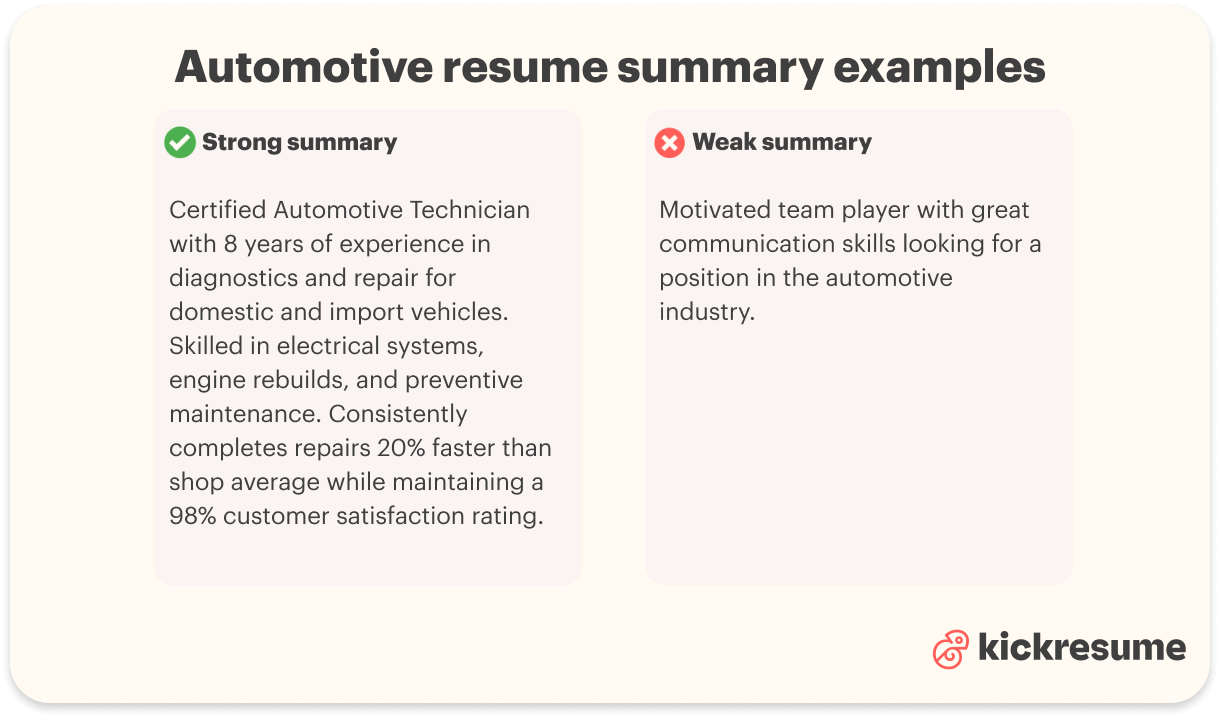
Bad automotive resume summary
Motivated team player with great communication skills looking for a position in the automotive industry.
Why does it sound so meh? Because it’s vague. It could fit anyone, in any field. There’s no mention of experience, skills, or specific strengths.
Good automotive resume summary
Certified Automotive Technician with 8 years of experience in diagnostics and repair for domestic and import vehicles. Skilled in electrical systems, engine rebuilds, and preventive maintenance. Consistently completes repairs 20% faster than shop average while maintaining a 98% customer satisfaction rating.
How is this so much better? This version gives a clear picture of the person’s background and makes it easy for the reader to understand what they do well.
When to use a resume objective
If you’re just starting out or shifting into the automotive field from another line of work, go with a resume objective. This version focuses on your goals and potential rather than your past.
It’s especially useful if you’re a recent graduate, an apprentice, someone returning to the workforce after time away, or switching careers.
A good objective should include:
- Your professional goal
- Your most relevant skills or training
- What makes you a good fit for the role, even without years of experience
- A hint at your work ethic or motivation
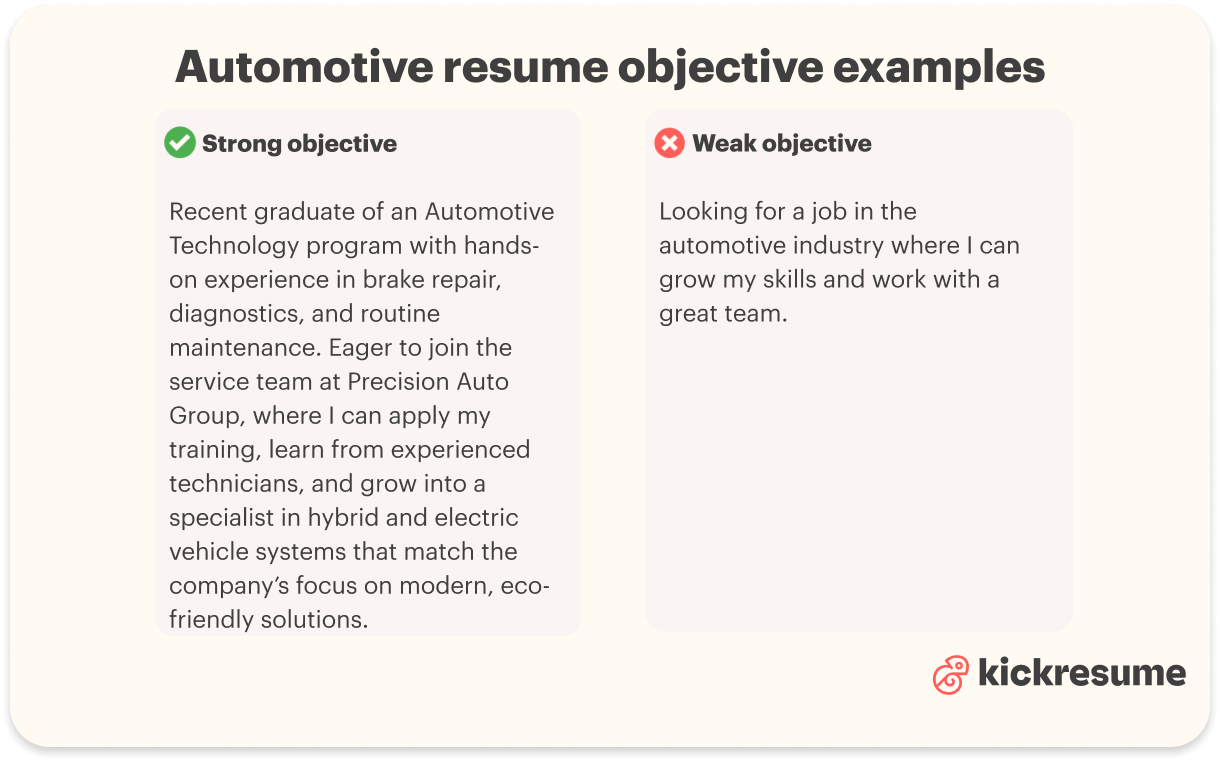
Bad automotive resume objective
Looking for a job in the automotive industry where I can grow my skills and work with a great team.
What is wrong with this one? Again, it's too general. There’s nothing specific about your skills, background, or career direction.
Good automotive resume objective
Recent graduate of an Automotive Technology program with hands-on experience in brake repair, diagnostics, and routine maintenance. Eager to join the service team at Precision Auto Group, where I can apply my training, learn from experienced technicians, and grow into a specialist in hybrid and electric vehicle systems that match the company’s focus on modern, eco-friendly solutions.
What makes this one feel more complete? Unlike the previous example, this one is specific. It shows real skills, training, and enthusiasm without sounding over-the-top. Plus, it is clearly geared towards this particular company. This kind of personalization adds character and emphasizes your interest in the position.
Whether you choose a summary or an objective, skip phrases like “hardworking,” “dedicated,” or “team player.” Those are assumed. Focus instead on your skills, experience, and career goals. Most importantly, make sure the reader can tell right away what kind of automotive professional you are and why you’re a strong match for the job.
3. Presenting the right skills on your automotive resume
If there’s one thing that makes or breaks an automotive resume, it’s tailoring.
It’s tempting to list every skill you’ve picked up over the years. After all, you’ve probably got a pretty broad set. But writing a resume that actually lands you interviews isn’t about showing off everything you could do. It’s about showing you’re the person they’re looking for.
So, how do you figure out which skills to highlight?
- Start with the job description: Pull up the job ad and read it closely. The employer is already telling you what they care about. Look for keywords like “diagnostics,” “customer service,” or “ASE certification.” These are your clues. The skills that come up more than once are usually the ones to prioritize.
- Match their needs with your strengths: Once you’ve marked the key skills, compare them to your own background. Which of your skills line up best with what they’re asking for? That overlap is where you want to focus your attention.
- Create a clear skills section: Add a separate “Skills” section on your resume. Keep it short and organized. You can even divide it into several sub-sections to keep it easier to scan.
Here's a quick list of the most in-demand skills in the automotive industry:
Top 10 hard skills for automotive resume
- Vehicle diagnostics and troubleshooting
- Engine and transmission repair
- Brake and suspension systems
- Electrical and electronic systems
- Preventive maintenance
- Hybrid and EV technology
- Welding and fabrication
- Use of diagnostic tools (OBD-II scanners, multimeters, etc.)
- Service documentation and repair order processing
- Safety inspections and quality control
Hard skills like these are crucial, but they’re only half the picture. The truth, your soft skills can carry just as much weight.
Top 10 soft skills for automotive resume
- Communication and customer service
- Attention to detail
- Time management
- Problem-solving
- Teamwork
- Reliability
- Adaptability to new technology
- Organization
- Multitasking under pressure
- Commitment to safety
Remember that these don’t just belong in your skills section. In fact, the most convincing resumes are the ones where skills are backed up by real examples throughout the document. But we’ll talk more about how to do that in the next chapter.
Find out your resume score!

4. Framing your work history for maximum impact
Just like with your skills section, your work experience section shouldn’t be a one-size-fits-all list. It needs to be tailored based on the job ad you’re applying to.
What to highlight based on your role
Think about what kind of automotive role you’re applying for and tailor your experience around that.
- Service technician role? Emphasize diagnostics, repairs, and customer service results.
- Shop foreman or service manager? Highlight leadership, workflow efficiency, and performance improvements.
- Sales or parts advisor role? Focus on communication, product knowledge, and sales numbers.
The key is to match your experience to what matters most for that job.
How to structure each entry
- Start with your job title, organization, and location
- Add your dates of employment (month + year format is standard)
- Use bullet points to describe your key responsibilities and accomplishments
- Focus on outcomes, not just duties
- Back it up with numbers or metrics whenever possible
- Lead with action verbs (we’ll cover those in an upcoming chapter)
Take a look at these two examples and see which one work better:
Bad example of an automotive work history entry
Automotive Technician
City Garage, Denver, CO
June 2019 – Present
- Performed vehicle inspections
- Repaired cars
- Helped customers
- Ordered parts
- Kept the shop clean
What's the verdict? This entry falls short on several fronts. Firstly, it lists duties only. Employers want to see your skills in action! Always try to show how you contributed to your past employers.
Good example of an automotive work history entry
Automotive Technician
City Garage, Denver, CO
June 2019 – Present
- Completed an average of 25+ vehicle repairs per week with a 98% customer satisfaction rate
- Diagnosed and resolved complex electrical issues, reducing repeat service visits by 15%
- Trained two apprentice technicians on shop procedures and safety protocols
- Introduced a new inventory tracking system that cut parts shortages by 30%
What makes this example stand out? This version shows measurable results, teamwork, and problem-solving. All of the bullet points show a singular action and its direct impact. The quantifiable data are nice-to.haves, but they aren't necessary in every single bullet point.
Tips for newcomers to the industry
If you’re just starting out, you might not have years of experience yet, and that’s okay. Focus on any hands-on training, apprenticeships, or related part-time work. Even classroom projects or volunteer repairs can show practical skill.
Good example for someone with limited experience
Apprentice Technician
SpeedLine Auto Service, Austin, TX
January 2024 – Present
- Assisted senior technicians with brake repairs, oil changes, and safety inspections on 50+ vehicles
- Learned diagnostic procedures using OBD-II tools and manufacturer software
- Earned positive feedback from supervisors for reliability and attention to detail
- Supported customer check-in process, improving workflow during peak hours
The more your work history lines up with what the employer is asking for, the easier it is for them to picture you as part of their team. That’s what turns a quick skim of your resume into a call for an interview.
5. Elevating your resume with action verbs
One of the quickest ways to make your resume sound more confident and professional is to start your bullet points with strong action verbs. These words bring your experience to life and show what you actually did, not just what you were “responsible for.”
Why action verbs matter
Let’s say you write:
- “Responsible for repairing customer vehicles.”
That doesn’t tell the reader much. Now look at this version:
- “Repaired and serviced customer vehicles to manufacturer standards, improving turnaround time by 20%.”
It feels sharper and more direct. Action verbs make it loud and clear that you took initiative and delivered results.
Strong action verbs for automotive resumes
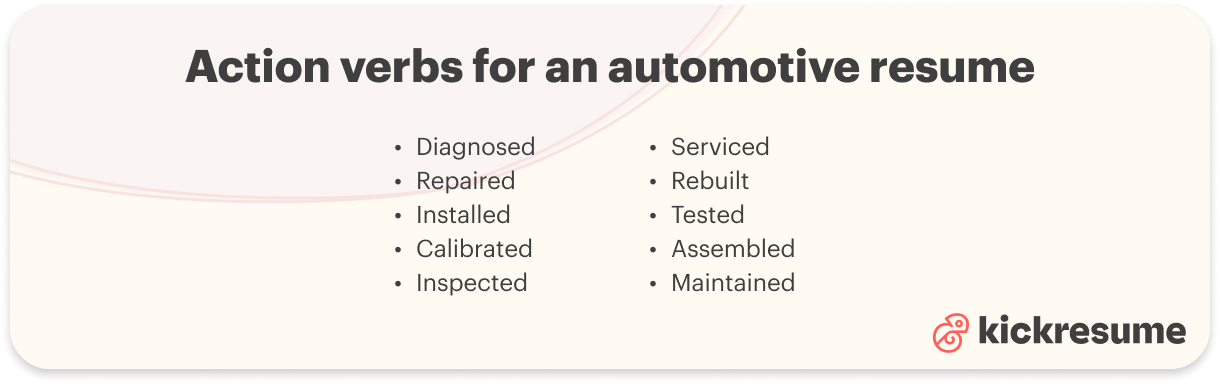
Here are some solid choices you can mix into your work experience section, depending on your role:
Action verbs for technical and repair-focused roles
- Diagnosed
- Repaired
- Installed
- Calibrated
- Inspected
- Serviced
- Rebuilt
- Tested
- Assembled
- Maintained
Action verbs for leadership and management roles
- Supervised
- Trained
- Coordinated
- Scheduled
- Delegated
- Improved
- Streamlined
- Managed
- Directed
- Oversaw
Action verbs for customer-facing and performance-driven roles
- Advised
- Explained
- Recommended
- Supported
- Resolved
- Increased
- Enhanced
- Delivered
- Communicated
- Achieved
As you can see, the possibilities are endless. So when you review your resume, circle any phrases that start with “helped,” “assisted,” or “worked on.” Replace them with action verbs that show your role more directly.
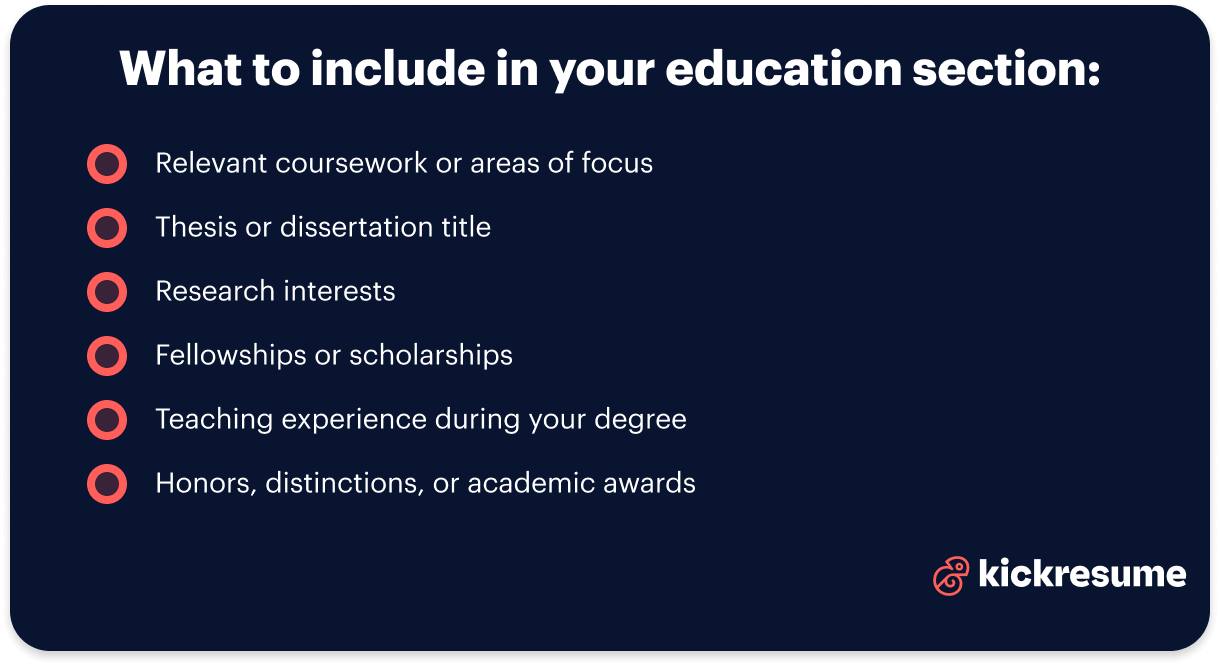
6. Flashing out your education section
No matter where you are in your automotive career, your education section helps employers understand your technical foundation and training. But how much detail you include depends on your experience level and how closely your education relates to the job you’re after.
Let’s look at two ways to handle this section:
Option 1: The succinct version
If you’ve been working in the field for a while, keep your education short and sweet. Your experience speaks for itself, so this section just needs to confirm your credentials.
Include:
- Degree or certification name
- School or training center
- Graduation or completion year (optional but helpful)
Succinct education section example for automotive resume
Automotive Technology Diploma
Universal Technical Institute, Houston, TX
Completed 2017
ASE Master Technician Certification
National Institute for Automotive Service Excellence (ASE)
Certified through 2025
This approach works well when your education supports your experience but doesn’t need to carry the spotlight.
Option 2: The detailed version
If you’re a recent graduate, an apprentice, or someone transitioning into the automotive field, your education might be your strongest asset. In that case, give it more context.
Include:
- Program name and institution
- Completion year (or expected graduation)
- Relevant coursework or areas of specialization
- Hands-on training or certifications
- Awards, honors, or notable achievements
Detailed education section example for automotive resume
Associate of Applied Science in Automotive Technology
Central Valley Community College, Fresno, CA
Graduated 2024
- Key Coursework: Engine Performance, Electrical Systems, Brake Service, Hybrid Technology
- Certifications: ASE G1 (Maintenance and Light Repair), EPA Section 609
- Achievements: Dean’s List (2022–2024), Outstanding Automotive Student Award (2023)
- Capstone Project: Diagnosed and rebuilt a hybrid vehicle powertrain as part of a 4-person team
Which version should you go with?
Not sure how much detail to include? Here’s a quick guide to help you decide.
Go with the succinct version if:
- You’ve got several years of hands-on experience
- Your certifications and licenses are up to date
- Your work history already proves your technical skill
- You’re applying for a mid- or senior-level position
Choose the detailed version if:
- You’re a recent graduate or currently enrolled in a program
- You’ve completed an apprenticeship or vocational training
- You’re changing careers into the automotive industry
- You want to highlight specialized training (like EV or hybrid systems)
No matter what you studied or when you graduated, your education is never “just filler.” That being said, your education also doesn’t have to carry the whole resume. But if you present it thoughtfully, it can absolutely pull its weight in making you stand out (in a good way).
7. Adding optional sections to your automotive resume
Once you’ve covered the main parts, your resume is basically complete. But sometimes, there’s more you can include to make your application stronger. That’s where optional resume sections come in.
These extra sections help you highlight things that don’t fit neatly into your work history but still show your expertise, dedication, or personality.
When to include optional sections
Add one (or a few) if:
- You have something relevant that adds real value to your resume
- There’s still space on the page without making it look crowded
- The section helps you stand out or reinforces your fit for the role
Skip them if:
- You’re adding filler just to make the page longer
- The information isn’t connected to the job
- It feels forced or off-topic
Optional sections to consider for your automotive resume
Certifications
These matter a lot in this field, especially if they show advanced technical knowledge or specialization. For example:
- ASE Master Technician
- EPA Section 609 Certification
- Hybrid and Electric Vehicle Safety Certification
- OEM-specific training (Ford, Toyota, GM, etc.)
Awards & recognitions
If you’ve earned shop awards, performance bonuses, or customer service recognition, list them here:
- Employee of the Quarter, Precision Auto Group (2023)
- Top Service Advisor Award, AutoPro Dealership Network (2022)
Professional memberships
However, watch out for relevancy! Mention only those organizations that have either something to do with the job you're applying for, or show a quality of a skill of yours that would be particularly handy in your new role.
- Member, Automotive Service Association (ASA)
- Member, National Institute for Automotive Service Excellence (ASE)
Personal projects
If you’ve worked on special builds, restorations, or group repair projects, this is a great way to show off your hands-on experience.
- Restored a 1970 Chevrolet Chevelle for a local auto show, earning second place in the “Classic Muscle” category
- Collaborated with classmates on a hybrid conversion project for a 2015 Honda Civic
Volunteer work or community involvement
Employers appreciate candidates who give back or use their skills outside of work. Plus, if the company you wish to join also participates in similar activities, that's a great sign because it means you probably share the same values and would fit right in.
- Volunteered at “Wheels for Families,” providing free car safety checks for single parents
- Mentored high school students in a local automotive repair program
Example of optional sections in an automotive resume
Certifications
- ASE Master Technician, National Institute for Automotive Service Excellence (2024)
- Hybrid Vehicle Systems Certification, Toyota Training Network (2023)
Awards & recognition
- Shop Productivity Award, City Garage (2022)
- Customer Service Excellence Award, AutoWorks (2021)
Professional affiliations
- Member, Automotive Service Professionals Network (ASPN)
- Member, International Automotive Technicians’ Network (iATN)
Don't forget that optional sections aren't meant to pad your resume! They need to add depth to it. Anything that doesn't add value to your application simply shouldn't appear on your CV.


 See more examples like these
8. Steering clear of mistakes that can hurt your application
You’ve spent time building a resume that shows off your skills, experience, and potential. Great. But before you start sending it out, take a moment to make sure it’s not holding any hidden red flags that could hurt your chances.
Even the most experienced candidates can fall victims to these common mistakes:
Mistake #1: Typos, grammar slips, and clunky wording
When your resume has spelling or grammar errors, it can make you look careless. In this line of work, precision is everything. If a hiring manager spots a mistake in your writing, they might wonder what your attention to detail is like.
Fix it: Read your resume out loud. Run it through a grammar checker. Then, ask someone you trust to look it over too. Fresh eyes can catch what you might miss after staring at it for hours.
Mistake #2: Using the same resume for every job
Every shop or dealership is different. One might focus on high-end imports, another on diesel trucks, and another on hybrid systems. If your resume looks the same for all of them, it can come across as lazy or unfocused.
Mistake #3: Listing responsibilities instead of results
A lot of resumes read like job descriptions: “Performed brake repairs,” “Completed oil changes,” “Maintained work area.” That’s fine, but it doesn’t show what you accomplished.
Mistake #4: Forgetting the numbers
Numbers are the easiest way to make your work stand out. They show scale, speed, and success. Without them, your resume can sound vague and flat.
Mistake #5: Skipping important keywords
Many employers now use software to filter resumes before a person ever sees them. If your resume doesn’t include certain keywords, it might never make it to a hiring manager.
Mistake #6: Messy formatting
If your resume looks disorganized or crowded, it’s easy for a reader to give up halfway through. A clean, consistent layout makes a big difference in how professional you appear.
Mistake #7: Missing or outdated certifications
Your certifications are a big deal in this industry. Forgetting to list them, or leaving expired ones on your resume, can cost you an opportunity.
Mistake #8: Unprofessional contact information
An email like “carjunkie91” might have felt clever in high school, but it doesn’t look great on a job application. Small details like that can send the wrong message.
Mistake #9: Adding irrelevant filler
Extra content doesn’t make your resume stronger. In fact, it can make it harder to find what matters. Hiring managers want to see that you’re focused.
Mistake #10: Not checking the final details
After staring at your resume for so long, it’s easy to miss small errors like a wrong date, a missing period, or uneven spacing. Those things might seem minor, but they add up.
You’ve already done the hard work of writing a solid resume. Don’t let small mistakes trip you up at the finish line. So muster that last bit of energy and give it one more careful look. Double-check it, triple-check it if you have to. Those five extra minutes you invest in your resume could be the difference between ghosting and a callback.
9. Complementing your resume with a tailored cover letter
You’ve already distilled your achievements and tailored your resume, but if you really want to stand out, your job application still misses one ingredient: automotive cover letter!
What your cover letter should do
A well-written cover letter can answers these simple questions:
- Who are you?
- Why are you interested in this job?
- Why do you want to work for this company in particular?
- What value will you bring to their team?
If your letter covers these points clearly and naturally, you’re already ahead of many applicants.
How a cover letter differs from a resume
- Your resume is factual: It lists your work history, certifications, and achievements in bullet points. It’s meant to be scanned quickly.
- Your cover letter is conversational: It tells a short story about who you are and what drives you. You get to connect the dots between your past experience and what the company is looking for.
Both documents should work together, not repeat each other. If your resume says you “boosted repair turnaround time by 20%,” your cover letter can explain how you achieved it and what that experience taught you about teamwork or customer care.
Making your cover letter and resume look consistent
Visual consistency makes your application feel professional and intentional. Here’s how to keep things aligned:
- Use the same header: Your name and contact details should look identical on both documents.
- Stick to one font: Don’t switch styles between your resume and cover letter.
- Keep margins and spacing consistent: This helps both documents look clean and balanced.
- Use the same color palette: If your resume uses a touch of color for section titles, repeat it in the cover letter.
PRO TIP: To make sure your resume and cover letter look consistent, you can use professionally designed resume templates paired with a matching cover letter template. The only problem you'll face is the dilemma of choosing which design you like the most!
Do you always need a cover letter?
Is a cover letter necessary? Not every job requires one. Some listings will say it’s optional, and yes, a few hiring managers skip reading them. But writing one is still worth the effort.
Here’s why:
- It shows you took the time to learn about the company.
- It gives you space to explain things that a resume can’t (like a career change, a gap, or your motivation for applying).
- It helps you sound human. Hiring managers remember genuine enthusiasm more than a perfect bullet point.
Even a short, focused cover letter can make a difference. Keep it under one page, stay clear and personal, and always tie your message back to what the company values.
Let your cover letter write itself — with AI!

10. Essential job search resources for automotive professionals
In the race for your dream job in the automotive industry, having the right pit crew can make all the difference. That's why we've assembled a pit-stop of top-notch resources for the job-seeking auto pro:
- Industry-specific job boards: Look beyond the generic job sites. Engines such as AutoCareersOnline or iHireAutomotiveProfessionals focus on positions within our industry, from technicians to executives.
- Professional networking sites: LinkedIn is a well-oiled machine for networking and posting jobs. But, don't overlook industry-specific platforms like Automotive Circle.
- Automotive trade associations: Groups like the Automotive Aftermarket Industry Association (AAIA) often post job listings and offer networking opportunities.
- Auto industry publications: Magazines like Auto News frequently carry job listing sections. They're also a worthy read to stay updated on industry trends and top companies.
- Trade shows and conferences: Rubbing elbows with industry insiders can offer exclusive job leads. Events like the North American International Auto Show aren't just for auto enthusiasts — they often double as excellent networking platforms.
So, take these resourceful pit stops on your job search race. Remember, even in the job market, the automotive world is all about speed.
Automotive Career Outlook in 2026
Jobs in the automotive industry are expected to grow by 4% between now and 2034, which is about as fast as the nationwide average for all occupations (Source: U.S. Bureau of Labor Statistics).
Still, over the course of ten years, approximately 70,000 openings per year are projected for mechanics and automotive repair workers, mainly due to the need to replace workers who transfer to different occupations or exit the labor force.
By 2026, demand is moving from traditional engine repair to EV skills like battery systems, high-voltage electrical work, and software diagnostics. Many shops are still not fully equipped to service EVs, according to TechForce Foundation, creating a strong advantage for mechanics who invest in EV training.
Average US base salaries across popular Automotive industry roles:
- Car Salesman: $91,865/year
- Mechanic: $65,946/year
- Production Worker: $41,046/year
- Auto Mechanic: $70,871/year
- Automotive Service Manager: $113,577/year
- Automotive Technician: $67,432/year
These salary estimates come from Indeed (as of January 2026), and are based on anonymous submissions from workers, along with salary data from job postings on the platform over the last 36 months. Exact figures vary by location, company size, and experience level.
The automotive industry continues to offer reliable opportunities for workers who build strong technical skills and keep pace with industry changes.
Automotive Resume FAQ
How long should my automotive resume be?
The length of your resume should ideally be one page for less experienced candidates and a maximum of two pages if you have ample experience in the auto industry. Remember, shorter, well-organized resumes often outpace their lengthier counterparts.
Should I include a photo on my automotive resume?
In western countries, adding a photo to your resume isn't typically necessary and is sometimes discouraged to avoid potential discrimination. If you're applying in a region where resume photos are standard, make sure it's professional.
What if I have gaps in my employment?
Employment gaps are not necessarily deal-breakers. Focus on the skills and experience you gained during those periods — maybe you took a course, completed an interesting project, or volunteered in a relevant area.
How should I handle industry jargon?
Think of your audience. If the hiring manager or HR team is not mechanically minded, avoid overusing jargon. If your resume will be reviewed by an automotive expert, judiciously include lingo to showcase your knowledge.
Do I need to customize my resume for each job application?
Absolutely yes. Tailor your resume to highlight the skills and experience that most directly relate to the specific requirements of each job. A well-tailored automotive resume can demonstrate your understanding of the role and highlight your suitability. So, always take that extra lap to personalize your resume.


![How to Write a Professional Resume Summary? [+Examples]](https://d2xe0iugdha6pz.cloudfront.net/article-small-images/How_to_Write_a_Professional_Resume_Summary_.png)
![How to List Your Education on a Resume? [+Examples]](https://d2xe0iugdha6pz.cloudfront.net/article-small-images/How_to_Put_Education_on_a_Resume_.png)
![How to Describe Your Work Experience on a Resume? [+Examples]](https://d2xe0iugdha6pz.cloudfront.net/article-small-images/How_to_Describe_Your_Work_Experience_on_a_Resume_.png)