Most job seekers know the pattern: you apply, hear nothing, and the ad stays up for weeks. However, the silence may have nothing to do with your application. The advert may have been a "ghost job": a role the company never filled, and possibly never meant to.
We analyzed 96,902 job adverts on Indeed to see just how many had warning signs of being a ghost job—looking for things like how long the job has been up for, whether it had been reposted exactly, and whether it mentioned “urgent hiring” but had no closing date listed.
Here are some of the key takeaways:
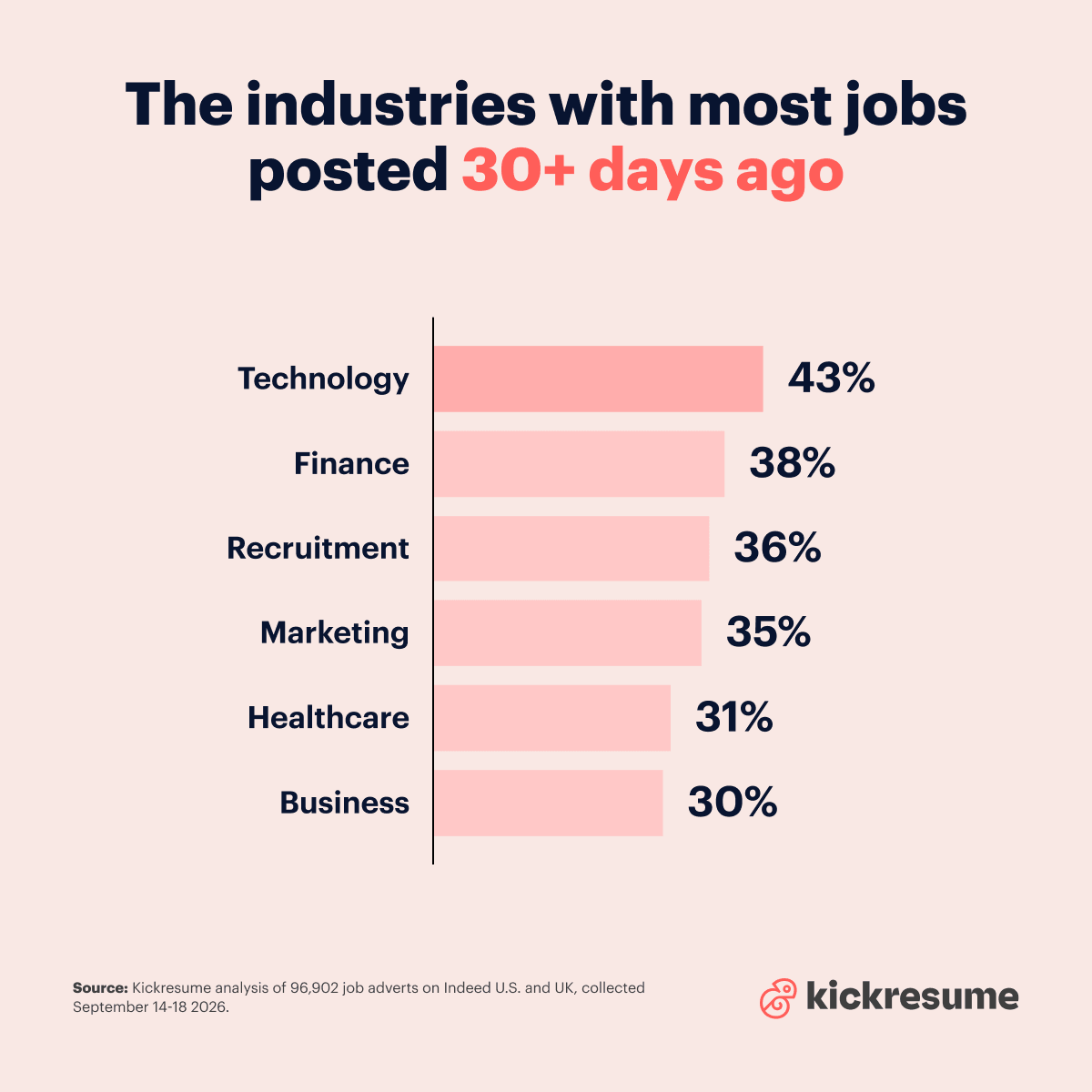
- Over a third of job adverts on Indeed were posted over 30 days ago (34%), with the tech industry having a much higher percentage (43%).
- Old ads were more common in the U.S. than in the UK (36% vs 27%).
- Other warning signs were surprisingly rare: exact reposts and "urgent hiring" ads with no closing date each made up just 0.1% of listings.
- Recruitment stood out across warning signs, with the highest rate of exact reposts in the U.S. (0.7%) and the most "urgent hiring" ads with no closing date in the UK (0.5%).
- An old ad isn't proof of a ghost job, but if a role has been up for over a month, check the company's careers page before applying. If it's not listed there, that's a red flag.
From fake growth to forgotten ads: why ghost jobs exist
Before getting into the numbers, it helps to know why a company would post a job it doesn't intend to fill. Here are the most common reasons:
- Building a talent pipeline. The company is testing the waters or collecting applications for future roles. You might still hear back, just much later.
- Testing salary expectations. The ad helps them find out the lowest salary they can offer and still get applicants.
- Creating a false impression. Open roles can make a company look like it's growing to competitors or investors, or convince an understaffed team that help is on the way.
- Ticking a box. They're required to advertise the role, but already have an internal candidate in mind.
- Honest mistakes. Some companies fully intend to hire, but budget changes stop them. Others fill the role and simply forget to take the ad down.
Knowing why ghost jobs exist is one thing. Spotting them is another. Below are the warning signs we looked for, and how often each one showed up in our data.
More than a third of job ads are over 30 days old
Of the 96,902 job adverts we analyzed, 34% had been posted more than 30 days ago. An older ad isn't automatically a ghost job, since some roles simply take longer to fill. But it’s worth a closer look, especially if the job isn’t listed on the company’s own careers page and has no closing date.
The industry most likely to have these potentially out-of-date adverts up was Technology, with 43% of ads up for over a month.
In recent years, the tech industry has been hit by waves of layoffs, tracked by websites like layoffs.fyi. So why would so many tech companies keep job ads online? There are a few possible explanations.
Some companies might gain by appearing to hire when they are not, to signal growth in an industry that’s currently experiencing some instability. They might also be gathering top candidates from thousands of laid-off tech workers, to prepare for their next wave of hiring.
Even the lowest-ranking industries, Healthcare (31%) and Business (30%), still had nearly a third of ads online for over a month.
We also broke down this data by U.S. vs UK. The UK had a lower percentage of jobs posted more than 30 days ago at 27%, compared to the United States, where 36% of adverts on Indeed were this old.
One possible reason is that American recruiters simply have more applications to work through. The U.S. job market is far larger than the UK's, and a remote role there is open to candidates across 50 states rather than a single city or region. A single advert can attract thousands of applicants, and working through them takes time.
We saw this firsthand in our recent job application experiment, where we sent 204 real job applications. We quickly ran out of well-matched jobs in New York City, so we expanded our search to remote roles. If many job seekers do the same, remote adverts fill up with applicants, and hiring takes longer.
Breaking the data down further to compare these sectors across the U.S. and UK, there are some notable similarities as well as differences.
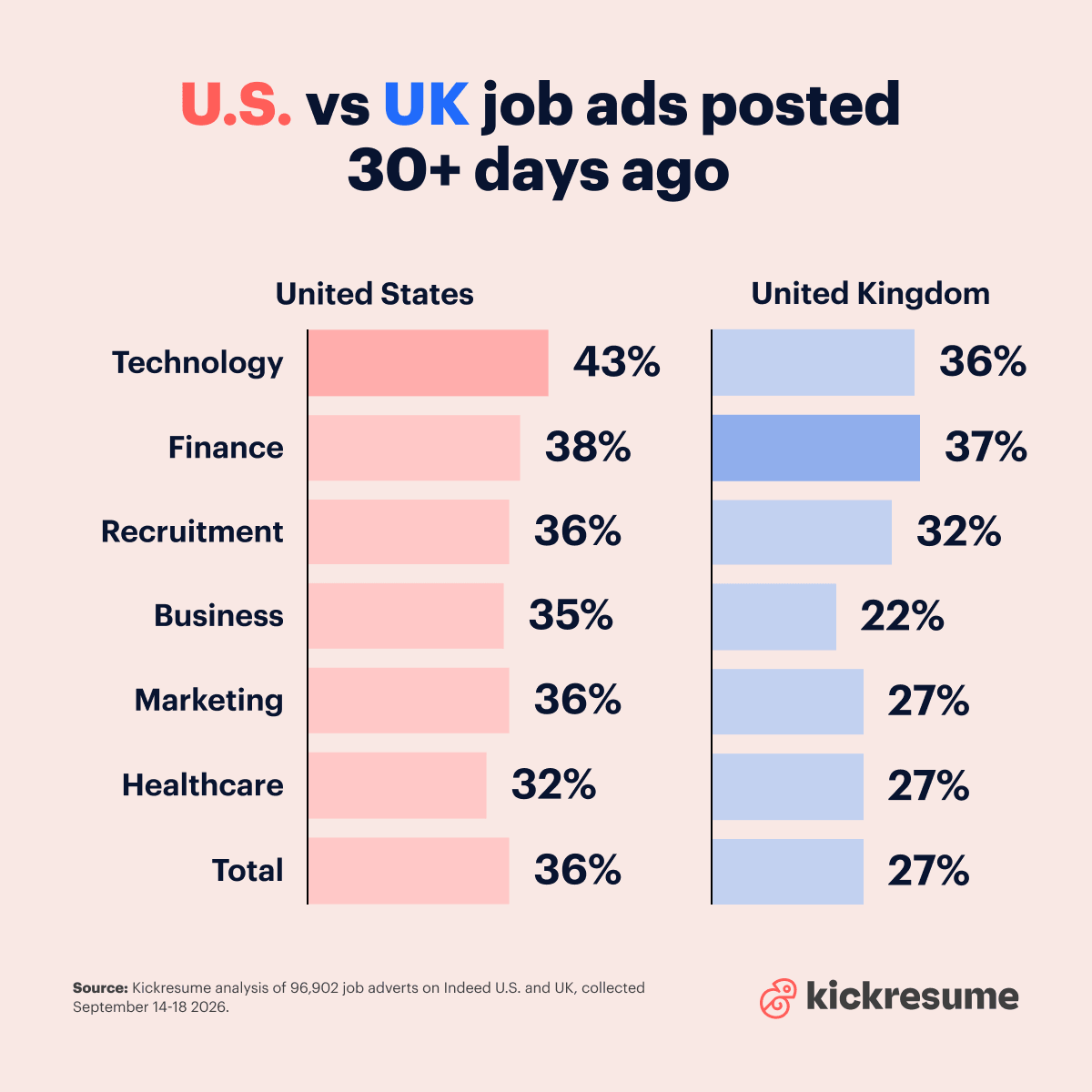
- While Technology still has a significantly high percentage of job ads over 30 days old, this industry doesn’t take the top spot in the UK—Finance does, at 37%.
- And while in the U.S. 35% of job adverts in the Business sector have been up for over a month, in the UK this percentage is much lower, at 22%.
- In the U.S., 36% of Marketing job adverts had been up for over 30 days, compared to 27% in the UK, a gap of 9 percentage points.
Exact reposts are rare, but U.S. recruitment ads lead the way
Reposting an advert with the same job title and description can be another warning sign of a ghost job. While it could just mean the company is still looking—or that a seemingly ideal candidate didn’t work out in the end—it could also be an indication that the company isn’t really intending to hire someone.
When we explored how many job adverts seemed to be an exact copy of a previous post, we were surprised by how few there were. In fact, combining U.S. and UK data, only two sectors reached 0.1% or more. Recruitment (0.6%) and Marketing (0.1%).
In Recruitment's case, high staff turnover could also play a part. Recruiters often work toward steep commission targets, and the pressure can lead to burnout, especially for people new to the industry. When roles keep emptying, the same advert keeps going back up.
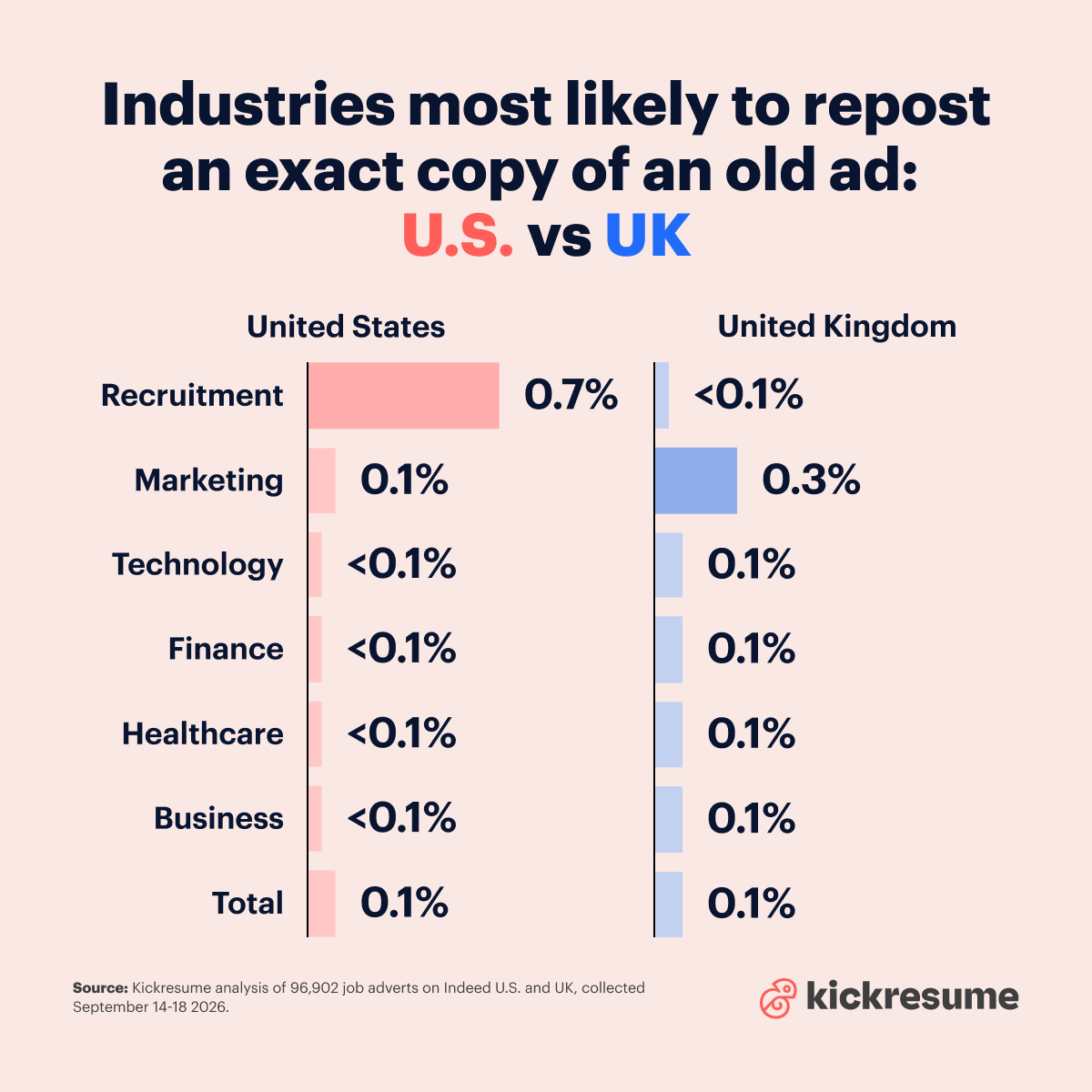
Comparing the U.S. to the UK once again, we found that in both regions, the percentage of job adverts that had been reposted exactly the same was 0.1%. However, in the UK the sector that did this the most often was Marketing, with 0.3% of job posts a copy of a previous advert. In the U.S., it was Recruitment, at 0.7%.
“Urgent hiring” but no deadline—ads that create false urgency
Another warning sign that a job post might not be genuine could be that it says the company needs someone urgently, but it doesn’t have a closing date attached.
We searched job ads to see how many used the phrase “urgent hiring” in the description but had no indication of when potential applicants would need to apply by.
On average, across the U.S. and UK, only 0.1% of job posts were guilty of this. In the U.S., this percentage was the same across every industry.
But in the UK, there was a little more variation, with 0.5% of Recruitment and 0.2% of Marketing posts fitting this description. Once again, Recruitment shows up as an industry that’s marginally more likely to post job adverts that are at best confusing and at worst may turn out to be ghost jobs.
Final thoughts
Two of the warning signs we looked for were rare: exact reposts and "urgent hiring" ads with no closing date each showed up in just 0.1% of listings. Old ads were a different story. Over a third (34%) had been online for more than 30 days.
An old ad isn't proof of a ghost job, but it's worth checking the company's careers page before you apply. If the role isn't listed there, or has been taken down, think twice before putting time into an application.
If you’ve applied to a job and have been waiting for weeks to hear anything back, you might be wondering whether it was ever a real opportunity at all. On our blog, this deep dive into how long you can expect to wait after an application might help. It can vary based on a number of factors including company size and any internal holdups, so don’t give up hope right away.
As our guide to follow up emails says, if you’re still waiting to hear back after your application one to two weeks down the line, it would be very reasonable to reach out with a polite message at this point—especially if the advert is still online.
Methodology
Kickresume analyzed 96,902 job adverts, with 19,221 adverts on Indeed UK and 77,681 on Indeed US. The data was collected during the period September 14-18 2026.
We looked for job adverts in six industry categories: Recruitment, Marketing, Healthcare, Finance, Business, Technology. We selected these categories ourselves in order to compare job adverts posted in several prominent industries. The industry was determined by inputting an industry into the search bar. Here’s an example: "https://www.indeed.com/jobs?q=Healthcare&l=California"
All of these searches were applied across all states and cities. A database was then created with each industry listed separately. Duplicates were removed and the data was cleaned.
We checked how many of these ads had been posted 30+ days ago, as well as how many ads were exact reposts. We identified how many mentioned the phrase “urgent hiring” despite not having a closing date.
Disclaimer: There are some limitations to this research. These are only warning signs, not solid proof of a ghost job, and the data covers only Indeed in the U.S. and UK at one point in time.
About Kickresume
Kickresume is an AI-based career tool that helps candidates find jobs and raise their salary with resume and cover letter builders, skills analytics, and automated job search assistance. It has helped more than 8 million job seekers worldwide.