At Kickresume, we asked 1,002 workers from around the world a blunt question: do you hate your job? We expected a confession. What we got was something stranger.
Most people, it turns out, don't hate their jobs. They don't love them either. The biggest group landed squarely in the middle—not miserable, not happy, just fine. But "fine" turns out to be doing a lot of heavy lifting.
Behind the shrug, people are putting on a show. They act more excited than they feel, smile for their boss and their clients, and many keep their doubts to themselves. Only 13% say they don't need the act at all. And many are quietly updating their CVs on company time.
The modern workplace isn't full of people who hate their jobs. It's full of people pretending to love them.
Here are some of the key findings:
- 82% have job hunted at work. 66% seriously considered leaving in the past six months—including 42% of those who like their job.
- 43% dread work every week. 16% feel dread before every single workday.
- Hate is rare. Only 27% dislike their job, while 38% feel neutral about it.
- Just over half would keep working even if they never had to—21% as is, 34% on fewer hours. 45% would quit.
- 86% faked enthusiasm at least once last week. Only 13% feel no need to put on an "everything's great!" face.
- The unhappy keep quiet. 37% of those who dislike their job haven't told anyone at work.
- Pay keeps people in and pushes them out. It's the #1 reason to stay (25%) and to leave (24%). Just 7% stay for fulfilment.
- Gen X is the most fed up. They're the most likely to dislike their job (34%) and to quit if money allowed (53%).
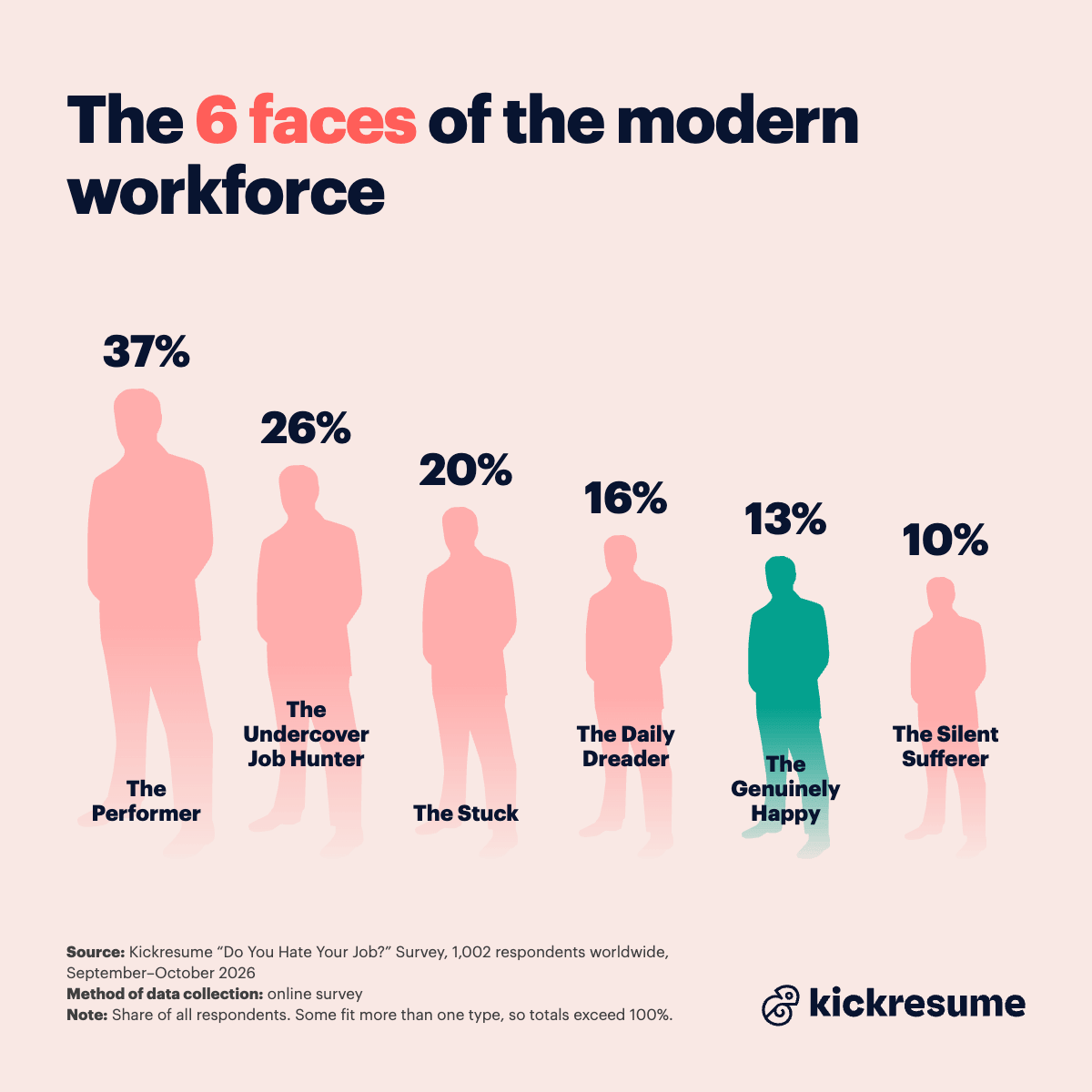
- Six faces of the workforce. The Performer (37%) is the most common type. Only 13% are Genuinely Happy.
Hate is rare, "fine" is everywhere: only 27% dislike their job
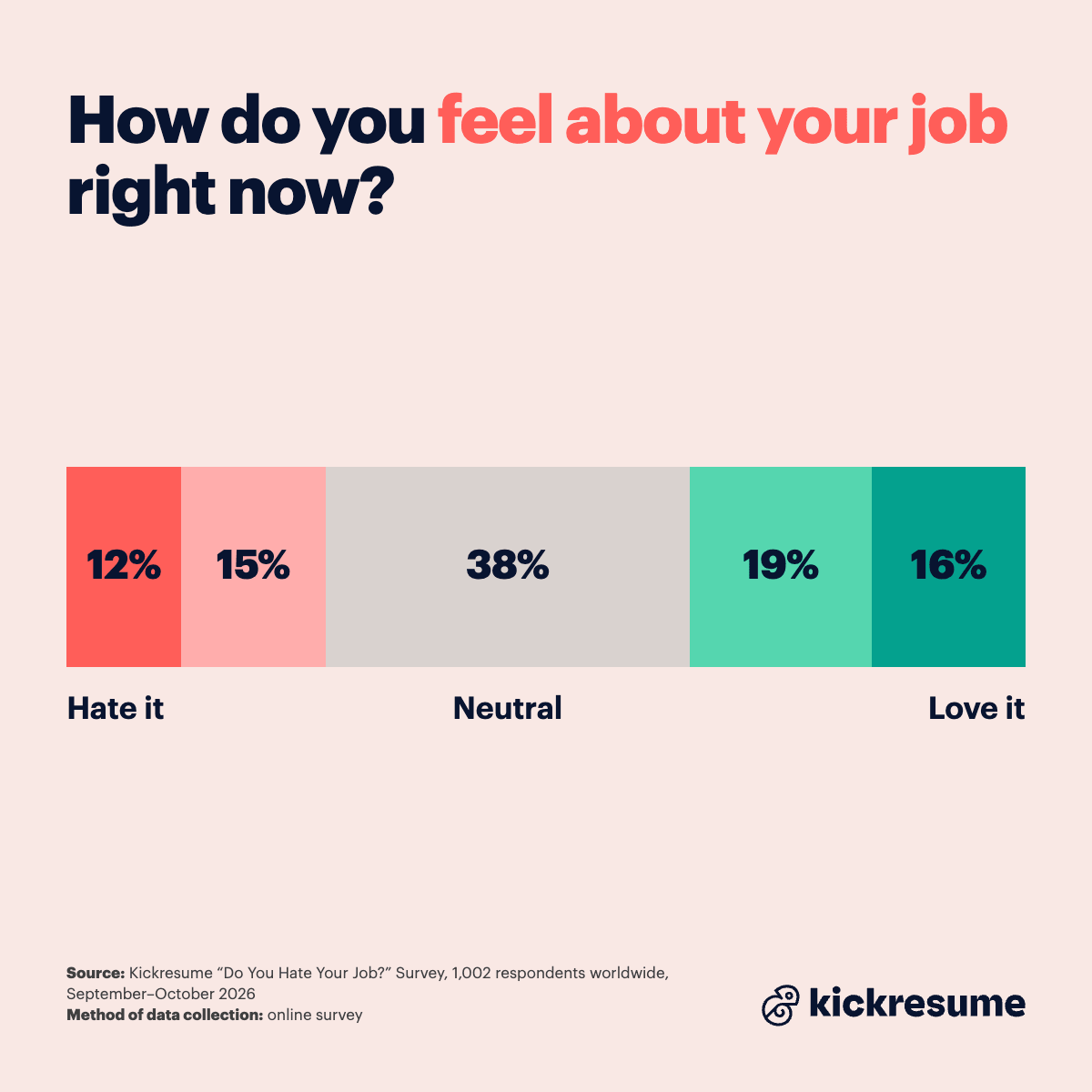
Asked to rate how workers feel about their job on a scale from 1 (hate it) to 5 (love it), the biggest group refused to commit:
- 38% feel neutral (3)—the largest group by far
- 19% like their job (4) and 16% love it (5)
- 15% dislike it (2) and only 12% hate it (1)
Add it up and 27% dislike their job, 35% like it, and 38% sit somewhere in between. In other words, most people aren't miserable at work. But as the rest of the survey shows, a neutral score doesn't necessarily mean people are content.
By industry, discontent peaks in sales and retail (38%), finance and banking (35%) and marketing, advertising and PR (33%). At the other end sit education (20%) and creative, design and media jobs (18%)—not famous for their salaries, but apparently better at keeping people engaged.
Pride, however, scores higher than happiness. When someone asks where they work, 51% are proud to say it (scoring 4 or 5), 32% are neutral, and 17% would rather not. And pride doesn't always follow happiness: one in four people who dislike their job (25%) are still proud to name their employer. A good logo on the badge, it seems, can outlast a bad day at the desk.
Would you keep your job if you never had to work again? 55% would
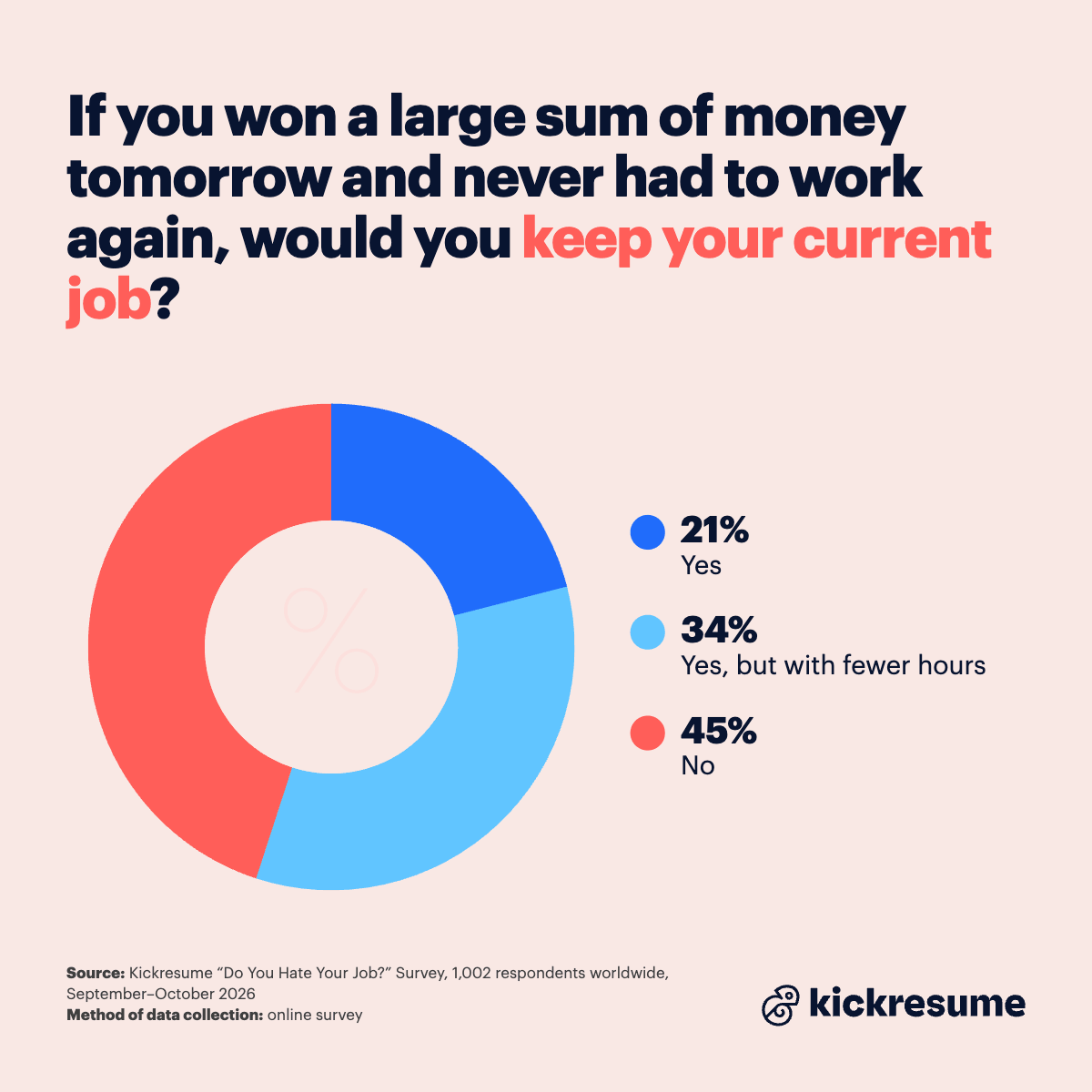
Picture this: you win a large sum of money tomorrow—enough to never work again. Would you still show up on Monday?
The answer was more balanced than you might expect. 21% would keep their current job exactly as it is, and another 34% would stay on fewer hours. That's 55% of workers who'd keep showing up even if their living no longer depended on it.
The fewer-hours group is the quietly interesting one. These aren't people desperate to escape. They seem to like their work well enough—they just don't want it to take over their whole life. Take away the financial pressure, and a job turns from something you need into something you choose. And a job you choose tends to be a lot easier to like.
Of course, the other side is just as telling: 45% would quit outright. When the money is enough to never work again, that's a clear sign of how many people see their job as nothing more than a paycheck.
Unsurprisingly, the answer depends on how people feel about their job. Even in the "fine" middle, 54% would keep working in some form. Among people who say they like their job, 21% would still quit, and even among those who gave their job a perfect 5, only 48% would keep it exactly as it is. On the other side, 74% of those who dislike their job would be gone the moment the money cleared.
And it's a decidedly Western fantasy. 55% of Europeans and 53% of Americans would quit, against only 31% in Asia.
The "everything's great!" face: 86% faked enthusiasm at work last week
If nearly half of workers would walk away given the chance, why does the average workplace look so cheerful? Because a lot of it is acting.
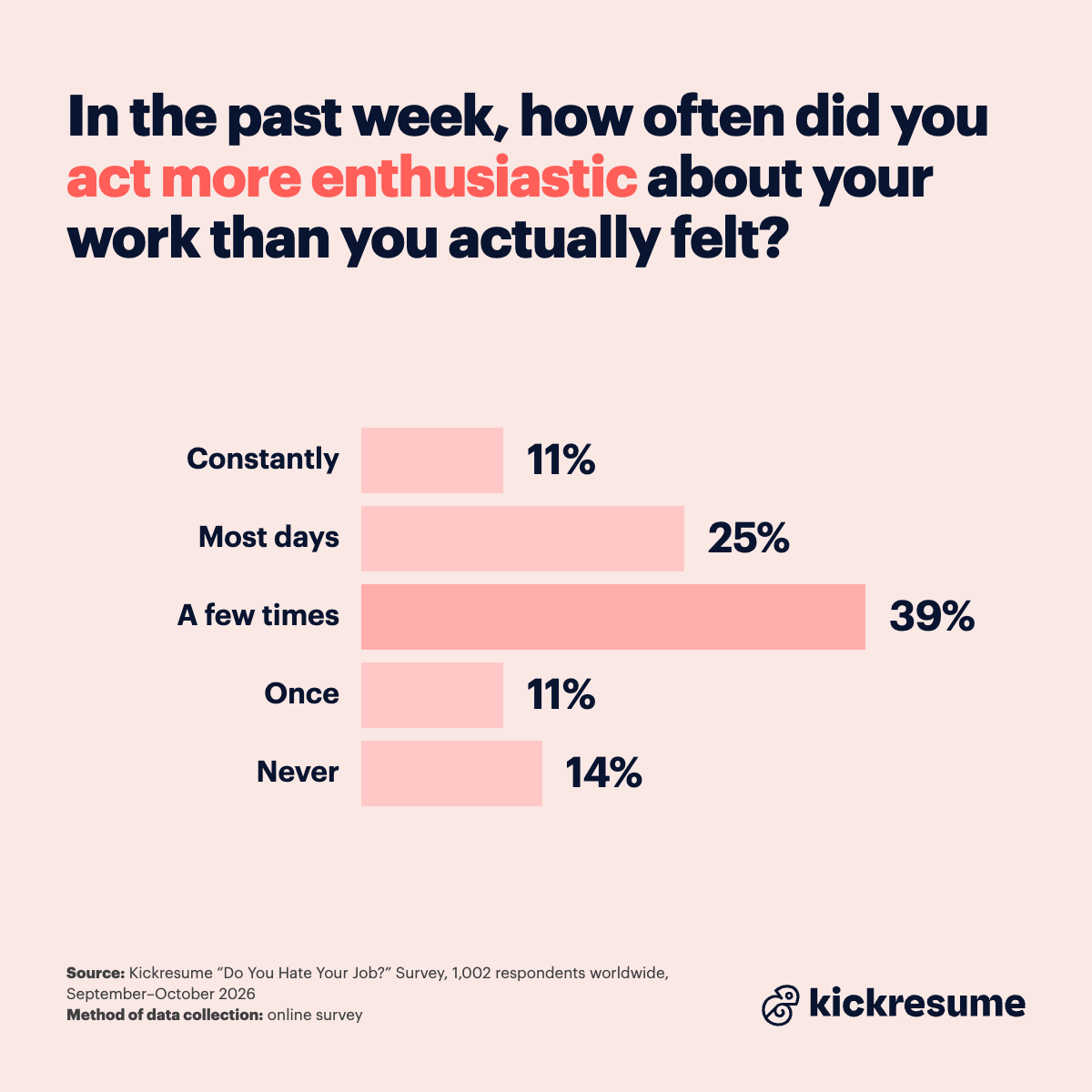
In the past week alone, 86% of workers acted more enthusiastic about their work than they actually felt at least once. 39% did it a few times, 25% most days, and 11% constantly. Only 14% didn't fake it at all.
This isn't just the unhappy covering their tracks. Even 80% of workers who rate their job 5/5 faked enthusiasm at least once last week. Enthusiasm, it turns out, is part of the job description whether you feel it or not.
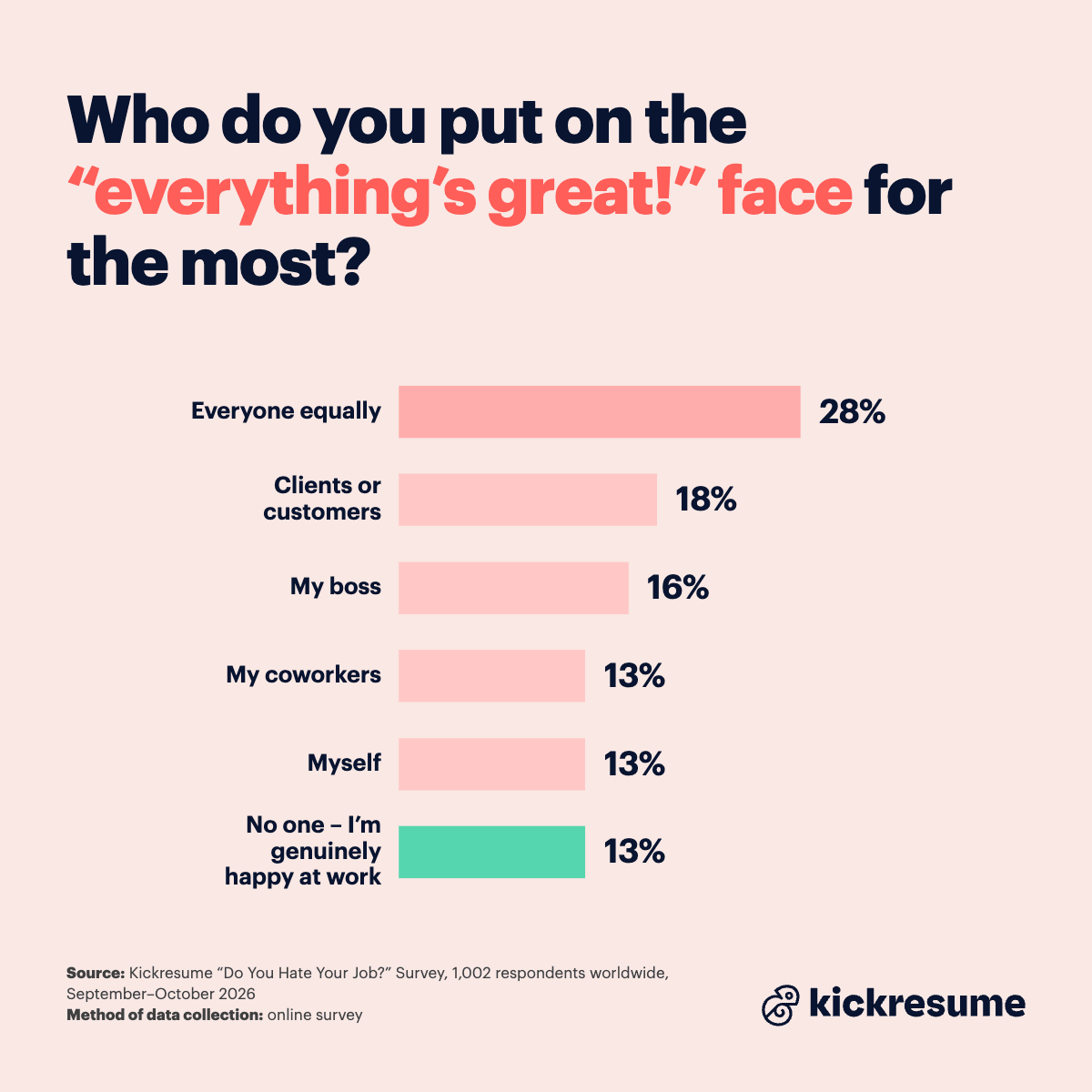
So who is the show for? Most often, everyone equally (28%). Then come clients or customers (18%), the boss (16%), coworkers (13%), and—perhaps most tellingly—themselves (13%). Just 13% say they don't put on a face because they're genuinely happy at work. That leaves 87% of workers putting on the "everything's great!" face for someone.
The performance also varies by country. Workers in the US (45%) act more enthusiastic than they feel most days or constantly, compared with 35% in Asia, while Europeans do it the least (30%) and are the most likely to say they never do (19%).
The unhappy: 37% haven't told a soul at work
Disliking your job is one thing. Admitting it at work is another. Among workers who dislike their job, 37% haven't told a single person.
The rest mostly confided sideways. 36% told their coworkers, 15% told multiple people, and just 9% told their boss. Only 3% admitted it to clients or customers.
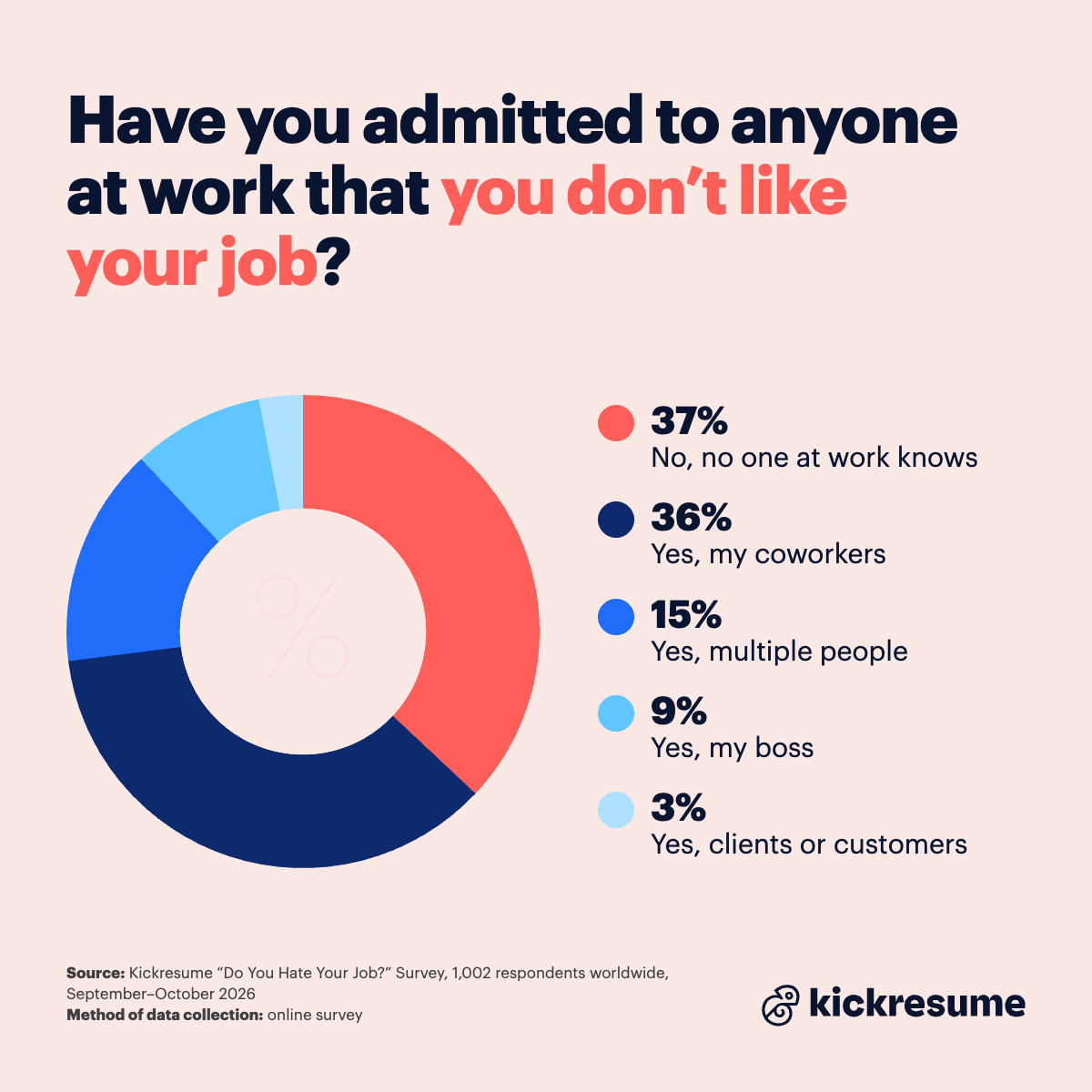
Women are far less likely to take it to the top: just 3% have told their boss, compared with 12% of men.
The result is a workplace where managers are often the last to know. The people who need the honest feedback most are precisely the ones receiving the most polished performance.
"When 86% of people act more enthusiastic than they feel, a smiling team tells you very little about how people are really doing," says Peter Duris, CEO at Kickresume. "The workers most likely to leave are often the ones who've stopped telling you anything. If managers want honest answers, they need to make it safe to give them—before a resignation letter does the talking."
Dread is a weekly ritual for 43% of workers
The Sunday scaries aren't just for Sundays. 43% of workers feel a sense of dread before a workday at least a few times a week, including 16% who feel it every single day. Another 28% feel it a few times a month, 23% rarely, and only 6% never.
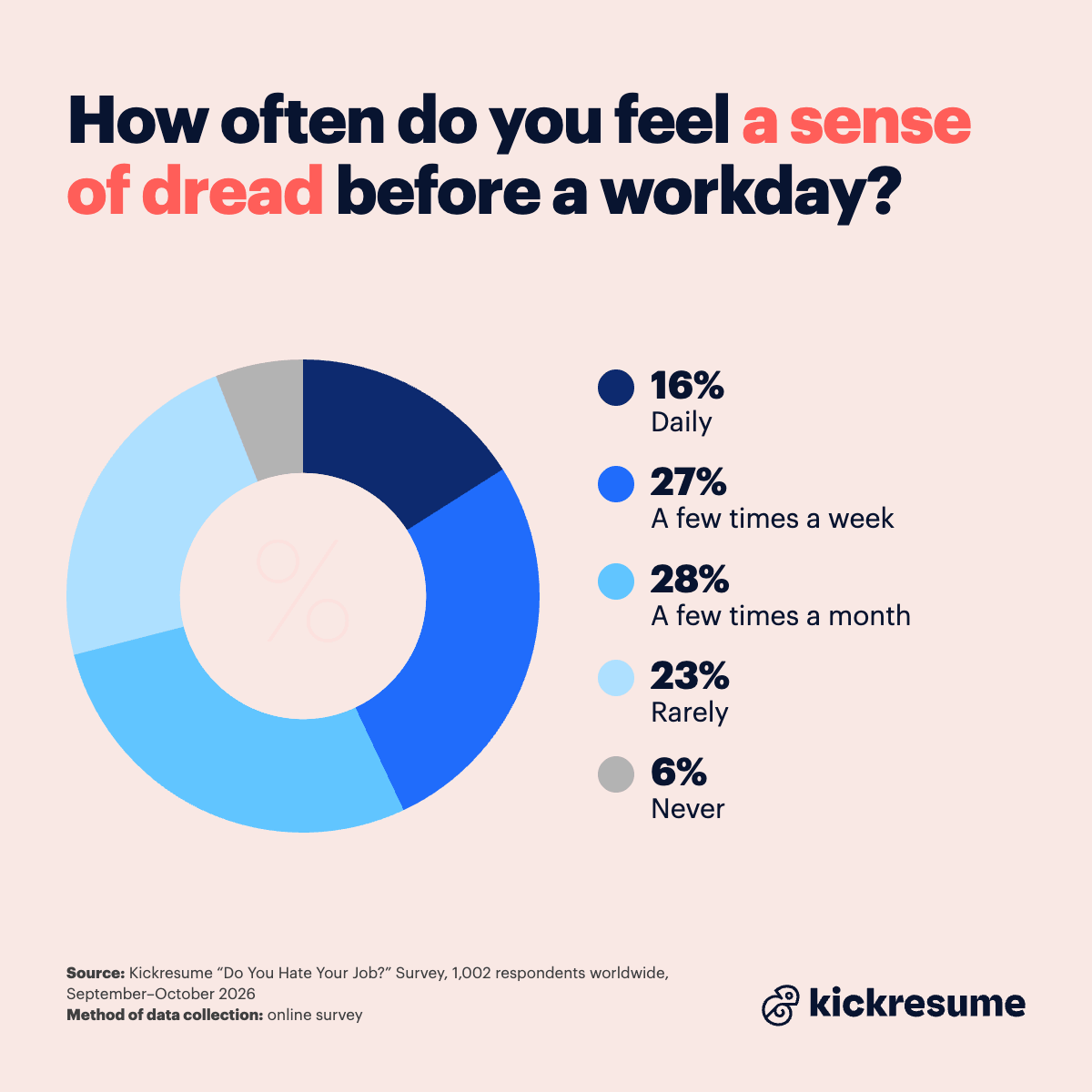
The youngest workers dread the most: 51% of Gen Z feel dread at least a few times a week, compared with 41% of Millennials and 43% of Gen X.
Unsurprisingly, a third of people who dislike their job (34%) wake up with dread daily. But liking your job is no vaccine: 23% of those who like their job still dread a workday at least a few times a week.
Two in three have one foot out the door—and 82% job hunt on company time
Feeling "fine" doesn't mean staying put. 66% of workers have seriously considered leaving their job in the past six months.
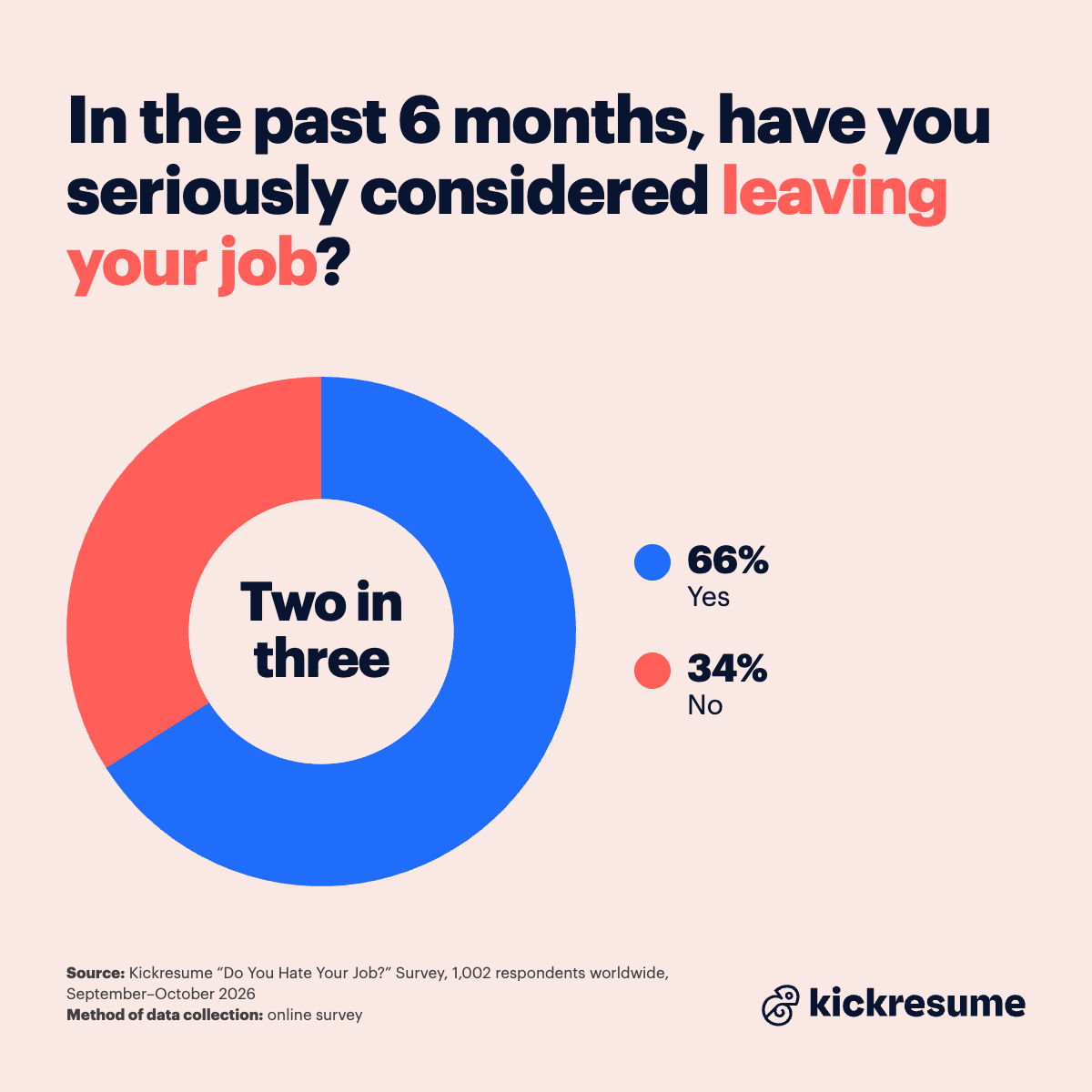
Job hunting itself is even more widespread—and it doesn't wait until after hours. 82% of workers have done at least one of these while at work:
- 55% updated their CV or LinkedIn
- 53% searched for a new job
- 44% applied to a job
- 28% built or updated a portfolio
- 26% took an interview call
- 24% messaged a recruiter
- 18% did none of the above
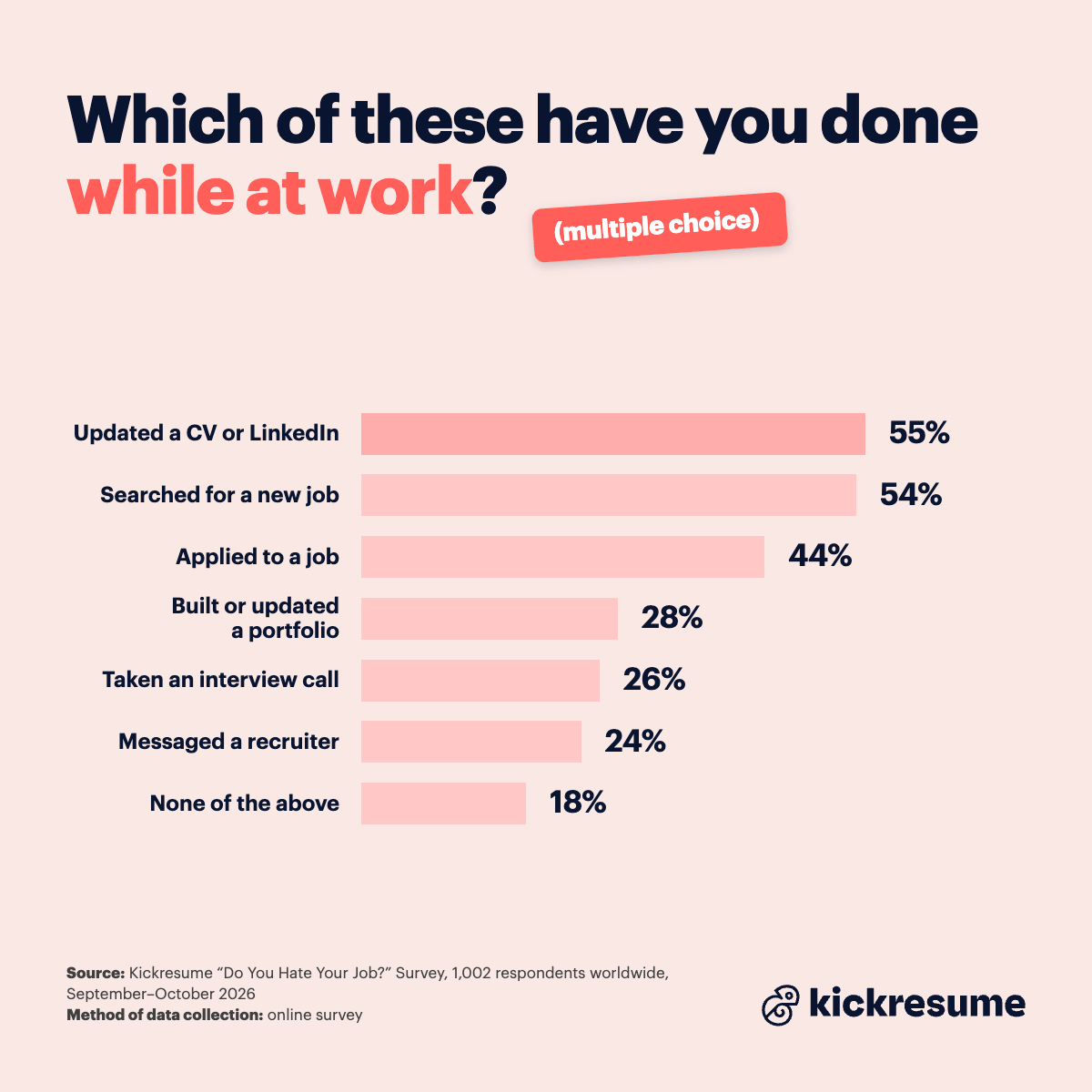
The job hunt has become a background habit rather than a crisis response. Even among people who hadn't considered leaving, 68% job hunted at work and 24% applied somewhere. Among those who like their job, 42% seriously considered leaving and 30% applied for another role.
Europeans are the most likely to have considered leaving (73%), ahead of Americans (69%) and Asian workers (56%). But American job seekers are the furthest along: 36% took an interview call, the highest share of any region.
Pay keeps 25% of workers in—and pushes 24% out
What's holding everyone in place? Above all, money and a lack of alternatives. Pay and benefits are the #1 reason people stay (25%), followed closely by "can't find anything better right now" (20%).
Then come flexibility (15%), career growth (10%), comfort because changing jobs is a hassle (8%), and the people (8%). Only 7% stay for fulfilment—the same share as those who say nothing keeps them there because they're actively trying to leave.
And the reasons to leave? Pay again tops the list (24%), followed by no growth (20%) and manager or leadership (14%). Next come workload or burnout (11%), job insecurity (9%), boredom (7%), company culture (7%) and lack of flexibility (5%). 1% said nothing would make them leave, and 2% gave other reasons, most often personal ones such as relocation, family, studies, or retirement.
Some of those "other" answers were more vivid than any statistic. "Company is so far behind the times. I still manually key 2000 hours weekly from paper time cards," one respondent wrote. Another didn't want to leave at all, just to add "a side gig or 2nd job that's less stressful but good money."
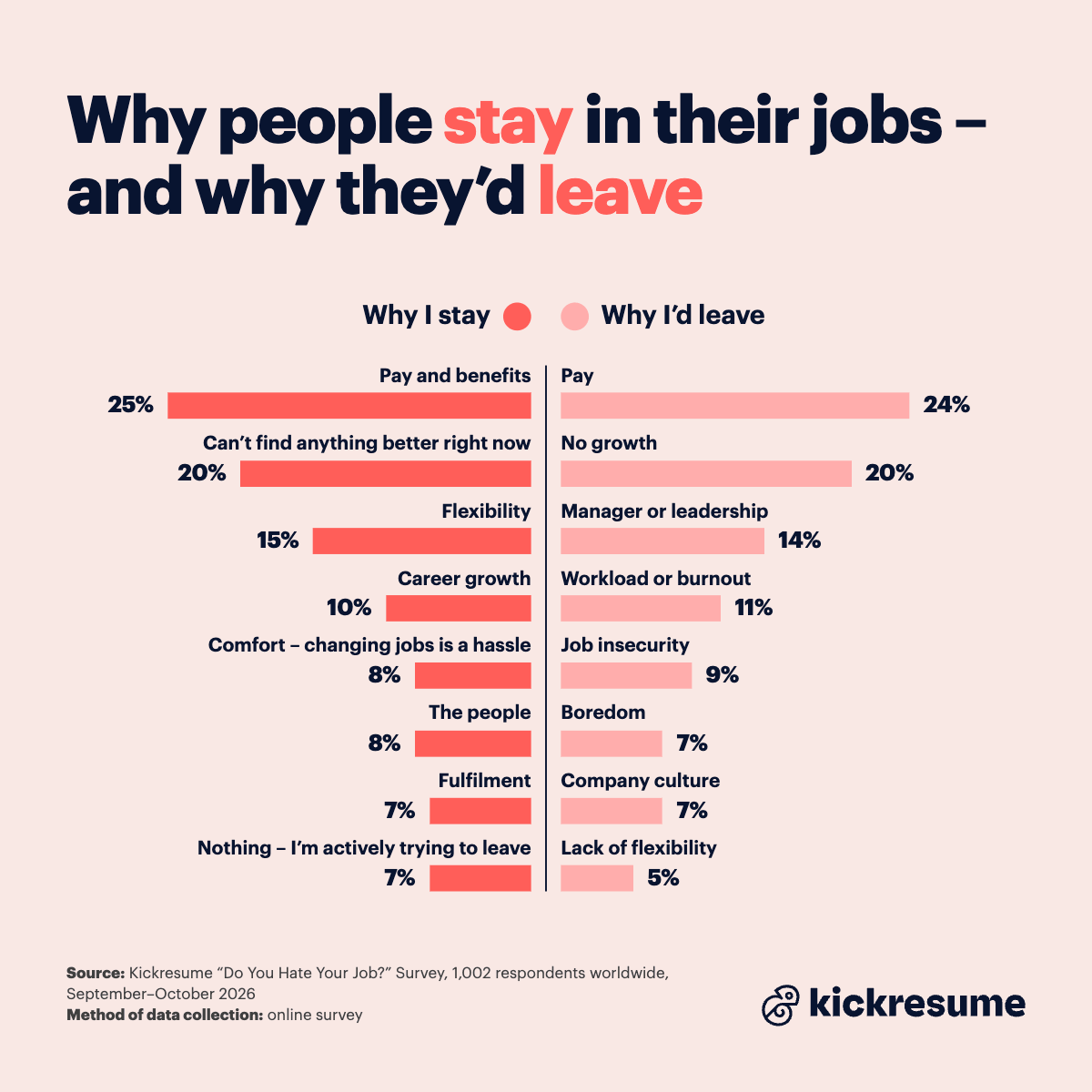
The same factor holding people in is the one pushing them out. Pay is the lock on the door, and pay is why they want to open it.
Among those who dislike their job, though, the story shifts. Their top reason to leave is a bad manager or leadership (21%), ahead of no growth (19%), pay (16%) and burnout (16%). And their top reasons to stay are pay (30%) and having no better option (29%). For unhappy workers, a bad boss outweighs the paycheck.
Burnout weighs more heavily on women: 15% name workload or burnout as their main reason to leave, compared with 9% of men.
Meet the six faces of the modern workforce
Based on how people answered, six familiar characters start to emerge. You've probably worked with most of them. You might even recognize yourself in more than one.
- The Performer (37%): Fakes enthusiasm at work most days or constantly. Always upbeat in the meeting, always "great, thanks!" in the hallway—the smile is part of the uniform. Behind it, though, half of them dread work at least a few times a week.
- The Undercover Job Hunter (26%): Likes their job, yet has job hunted at work. They're not unhappy, just curious about what else is out there. Many have already applied elsewhere, and their manager would never guess.
- The Stuck (20%): Stays only because they can't find anything better. They'd leave tomorrow if something came along—it just hasn't yet. Far from passive, most are actively applying for other jobs while they wait for the exit to open.
- The Daily Dreader (16%): Feels dread before every single workday. Mondays are bad, but so is every other day of the week. Unsurprisingly, almost all of them have thought about leaving.
- The Genuinely Happy (13%): Doesn't put on an "everything's great!" face, because they're genuinely happy at work. No mask, no act—more than anyone else, they stay because the job feels fulfilling. But being happy doesn't mean being off the market: even most of them have job hunted at work.
- The Silent Sufferer (10%): Dislikes their job and hasn't told a single person at work. They show up, do the work, and keep their head down. Nobody around them knows—but if money weren't an issue, most would be gone tomorrow.
Only one of these six is genuinely content. And even they are keeping an eye on the job market.
Gen X: the generation that's had enough—53% would quit if they could
If there's one group the survey points to, it's Gen X workers aged 46 to 61. On nearly every measure of discontent, they come out on top:
- 34% dislike their job (Millennials: 26%, Gen Z: 22%)
- 53% would quit if they never had to work again (Millennials: 46%, Gen Z: 36%)
- 73% seriously considered leaving in the past six months (Millennials: 70%, Gen Z: 56%)
- 29% stay only because they can't find anything better (Millennials: 19%, Gen Z: 18%)
- 44% of the unhappy ones haven't told anyone at work (Gen Z: 38%, Millennials: 34%)
This is a generation with decades of experience, often stuck between rising costs and a job market that doesn't always reward older candidates. They are disillusioned, quietly searching, and often staying because they have to.
Gen Z, meanwhile, feels the daily pressure more—dreading workdays most often—but still sees its job as a step toward something. They're the most likely to keep their job if money weren't an issue (30%) and the most likely to stay for career growth (16%).
Final thoughts
Most workers don't hate their jobs—only 27% do. But not hating your job isn't the same as enjoying it, and the gap between the two is filled with performance. 86% faked enthusiasm last week, only 13% feel no need to put on a face, and 43% dread a workday at least a few times a week.
Under the surface, the exit is always open. 66% seriously considered leaving in the past six months, 82% have job hunted while at work, and 45% would quit if money stopped mattering. Pay keeps them in, pay pushes them out, and just 7% stay for fulfillment.
For job seekers, the takeaway is reassuring: if you're quietly updating your CV between Monday meetings, you're not the only one. Keeping your options open has become a normal part of working life.
If you're one of the 66% thinking about leaving, a few basics go a long way. Keep your job search off your work laptop and company email. Make sure your resume shows what you've achieved in your current role, not just what's in your job description. And when the right offer comes, leave on good terms—a short, professional resignation letter protects the reputation you've built.
For employers, the warning is sharper. A cheerful office is not a reliable signal. When 37% of unhappy workers have told no one, and only 9% have told their boss, the first sign of trouble may well be a resignation letter.
Demographics
Age
- 18–29 (Gen Z): 26%
- 30–45 (Millennials / Gen Y): 46%
- 46–61 (Gen X): 23%
- 62–80 (Baby Boomers): 2%
- Under 18: 2%
- 81+: <1%
Gender
- Man: 65%
- Woman: 34%
- Non-binary or other: 1%
Location
- Europe: 26%
- Asia: 23%
- USA: 23%
- Africa: 11%
- Latin America: 10%
- Canada: 4%
- Australia / Oceania: 2%
Industry (Top 5)
- Technology / IT / Software: 21%
- Business / Management / Consulting: 12%
- Healthcare / Medicine: 7%
- Engineering / Manufacturing: 7%
- Education / Academia: 7%
Note
This anonymous online survey by Kickresume, conducted in September–October 2026, gathered insights from 1,002 respondents from around the world. All participants were reached via Kickresume's internal database.
Worker types methodology (all respondents, types can overlap):
- Performer = faked enthusiasm "most days" or "constantly" last week (368);
- Undercover Job Hunter = rated their job 4–5 and did at least one job-search action at work (256);
- Stuck = #1 reason to stay is "can't find anything better right now" (204);
- Daily Dreader = feels dread "daily" (157);
- Genuinely Happy = answered "No one—I'm genuinely happy at work" (132);
- Silent Sufferer = rated their job 1–2 and "no one at work knows" (98).
About Kickresume
Kickresume is an AI-based career tool that helps candidates source jobs and raise salary with powerful resume and cover letter tools, skills analytics, and automated job search assistance. It has already helped more than 8 million job seekers worldwide.