You can't get experience without a job, but apparently, you can't get a job without experience either. And it's not just experience employers expect. Some entry-level roles also ask for skills you'd normally associate with more senior positions.
To take a closer look at skill inflation and rising experience requirements, Kickresume analyzed 1,400 LinkedIn job ads across seven industries in the UK and U.S. We selected 11 skills and phrases typically associated with more experienced employees and compared how often they appeared in entry-level and associate-level (mid-level) roles.
Here’s a quick snapshot of our findings:
- 28% of all entry-level jobs require at least 1.5 years of prior experience, with 16% demanding at least 2 years.
- Technology has the highest percentage of entry-level jobs that require experience at 38%.
- 34% of U.S. entry-level job ads require at least 1.5 years of experience. This compares to the 22% in the UK.
- There’s higher demand for leadership at entry-level than associate level (25% vs 21%).
- AI is requested in more than 1 in 6 job postings across the board, and is the second most requested skill behind leadership.
Over a quarter of entry-level roles require at least 1.5 years of experience
“Entry-level” has lost its meaning. Our research found that 28% of entry-level roles now demand at least 1.5 years of experience—with 16% requiring at least two years and 12% asking for 1.5-2 years. This creates an impossible paradox for fresh graduates who may be thinking: How do I get the experience needed if even starter roles are demanding it?
And the biggest industry culprits of the entry-level paradox? Technology, recruitment, and marketing—which have the most junior job ads requiring experience.
- Technology: 38% of entry-level listings across both regions require at least 1.5 years of experience.
- Recruitment: 37% of entry-level roles in both regions require at least 1.5 years of experience.
- Marketing: 31% of entry-level ads in both regions demand 1.5+ years of experience.
Overall, 1 in 5 (20%) junior job ads in both technology and recruitment ask for at least two years of work experience, effectively locking recent grads out of these roles. In the U.S., 34% of entry-level ads ask for 1.5+ years, with 20% of them wanting 2+ years.
U.S. marketing ads ask for the most, with 44% of junior listings asking for 1.5+ years of experience, followed by technology and business at 38%. That leaves out a lot of candidates who are looking for their first job.
In the UK, 22% of advertised entry-level roles require experience. However, requirements vary by industry. Just 12% of entry-level business roles and 6% of junior education roles ask for at least 18 months of previous work history. At the higher end, 38% of junior technology and recruitment roles in the UK require at least 1.5 years of experience.
But one thing is clear: the U.S. has much steeper experience requirements in both entry-level (34%) and associate level (64%) than the UK (22% and 33%).
1 in 4 entry-level job ads ask for leadership—more than at associate level
Experience isn’t the only thing employers expect from junior candidates. We wanted to see whether entry-level roles also ask for more advanced skills, so we tracked how often 11 skills and phrases usually associated with more senior roles appeared in entry-level and associate-level postings, from leadership and stakeholder management to AI.
Here are the 11 skills and phrases we noted:
- Project management
- Data-driven decision making
- Cross-functional alignment
- Stakeholder management
- Conflict mitigation
- Process optimization
- Crisis management
- Leadership
- Extensive experience
- Systems thinking
- AI
Overall, associate-level postings asked for more of these skills. Across the U.S. and UK, 80% of associate-level postings mentioned at least one, compared with 61% of entry-level postings, and associate roles mentioned four of the five most common skills more often.
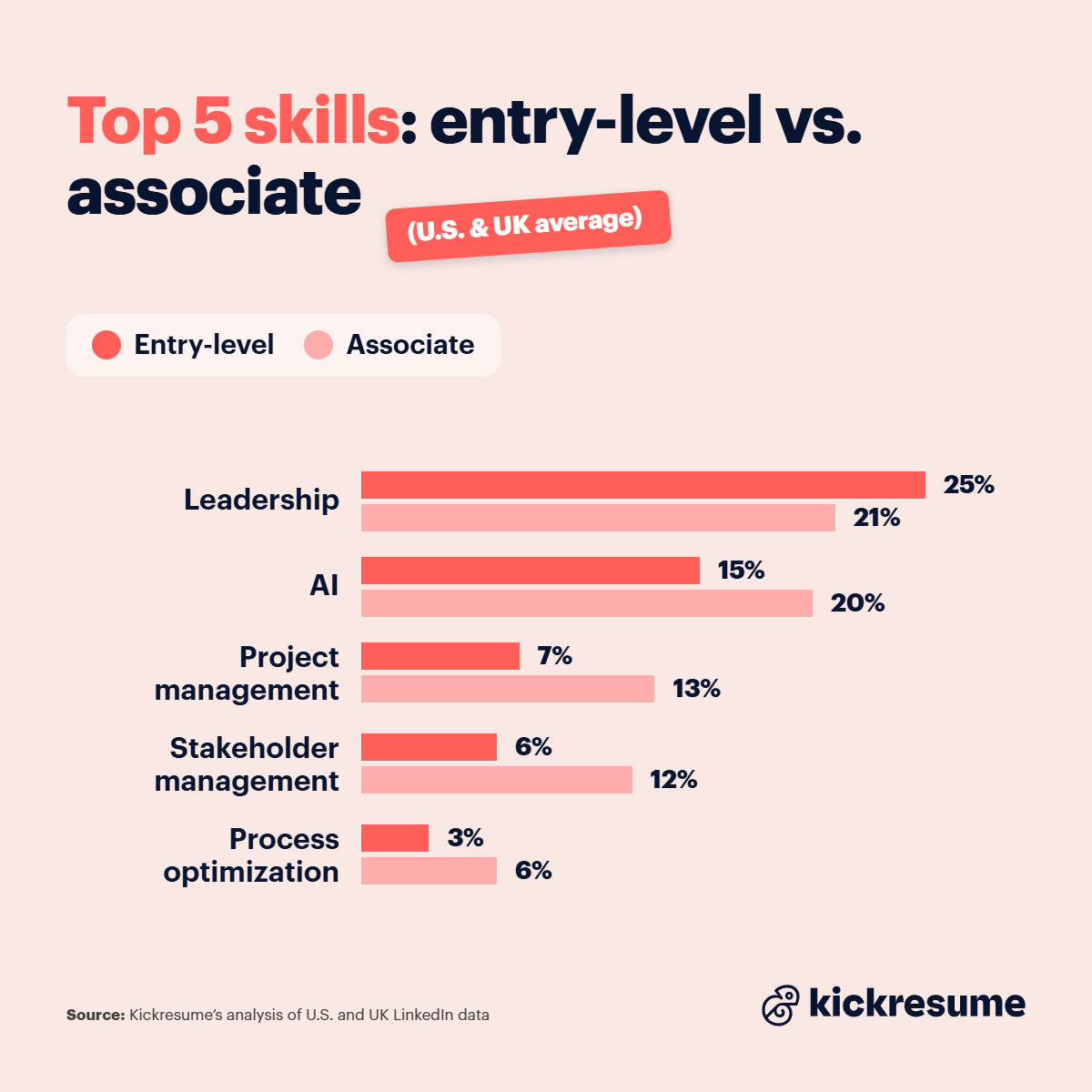
But there’s one notable exception: leadership. It’s the most requested skill at entry level, appearing in 1 in 4 (25%) junior postings, slightly more than in associate-level postings (21%). That’s a high bar for candidates just starting out: leadership can be developed outside work, but people with little work experience are unlikely to have led a team professionally.
The picture varies by country and industry. In the U.S., leadership appears in about 27% of postings at both levels, but in marketing, the gap is striking: 80% of entry-level postings mention leadership, compared with 42% of associate postings. In the UK, business has the highest entry-level figure of any industry, at 42%, dropping to 20% at associate level.
So while associate-level roles ask for more skills overall, leadership is one area where juniors are held to the same standard, or a higher one. This may be because recruiters and hiring managers add leadership as a generic requirement, regardless of seniority to match their team-wide expectations.
Stronger management skills set associate roles apart
So if leadership is more common in entry-level job ads, what skills really distinguish juniors from associates? AI comes up at both levels, appearing in 15% of entry-level postings and 20% of associate ones. But our research revealed that stakeholder and project management skills are much stronger indicators of associate-level roles.
If you’re applying for an associate role or looking to progress from an entry-level position, these are the skills worth building.
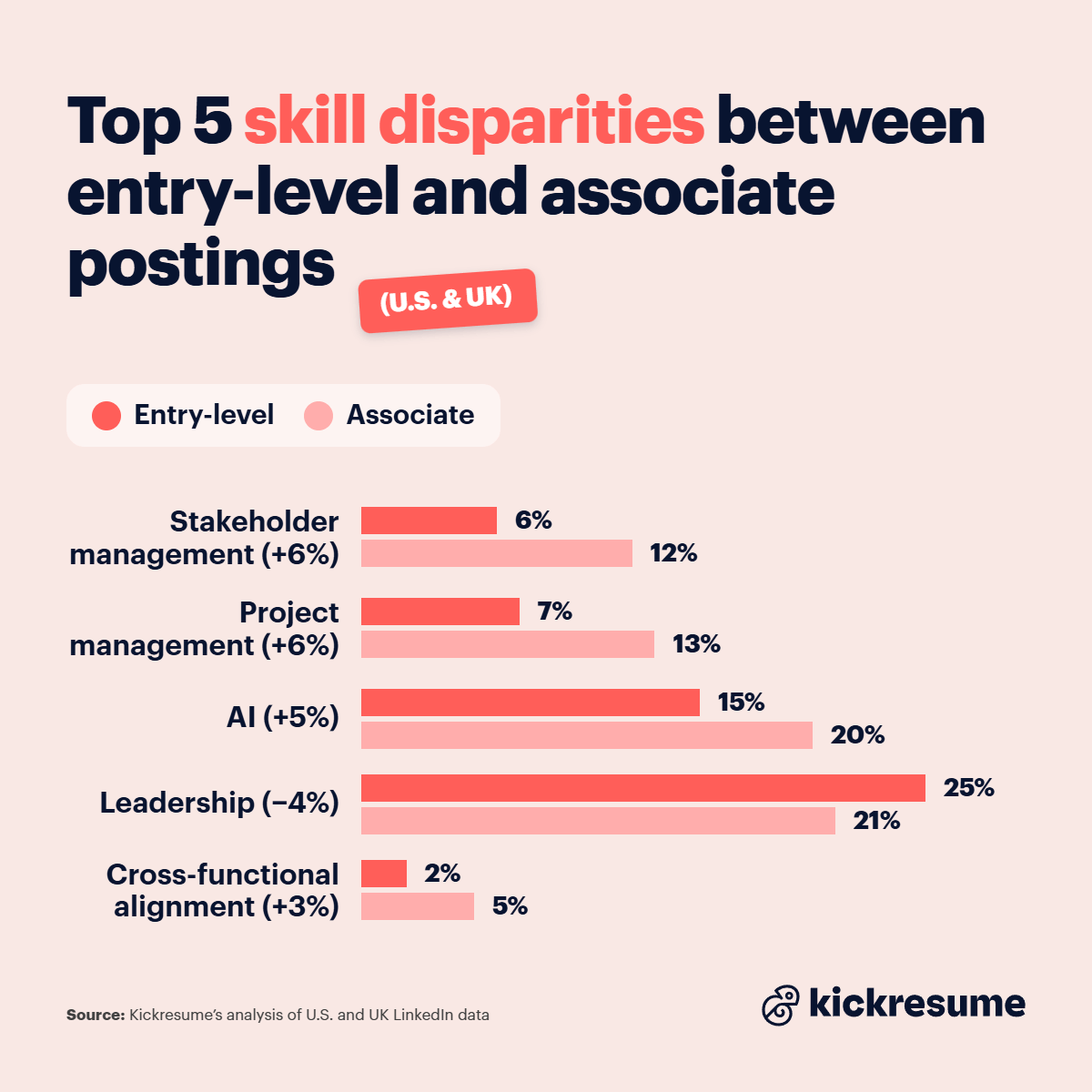
In the U.S. and UK combined, stakeholder management doubles in associate job posts from entry-level. Project management follows a similar pattern, nearly doubling from 7% to 13%.
In the U.S., project management shows the biggest gap, appearing in 15% of associate posts compared to 10% of entry-level ads. In the UK, it’s stakeholder management, featuring in just 6% of junior job ads compared to 15% of associate roles. This suggests that employers expect associates to coordinate projects and manage relationships, not just do the work.
This demand actually reflects our previous survey, which found management to be the most requested skill. But management isn't the only skill employers are looking for. In some industries, knowing how to use AI is becoming a bigger part of the job.
UK tech and U.S. finance expect more AI skills from junior hires
Tech and recruitment, the two industries that ask juniors for the most experience, also stand out for their demand for AI skills. Around a third of job postings in these industries mention AI. Recruitment leads at associate level in both countries (38% in the U.S. and 48% in the UK), while UK tech has the highest entry-level figure (46%).
AI ranks third for the biggest differences between seniority levels, behind stakeholder management and project management (both 6%). Across all industries, AI skill demand grows from 15% at entry-level to 20% at associate level.
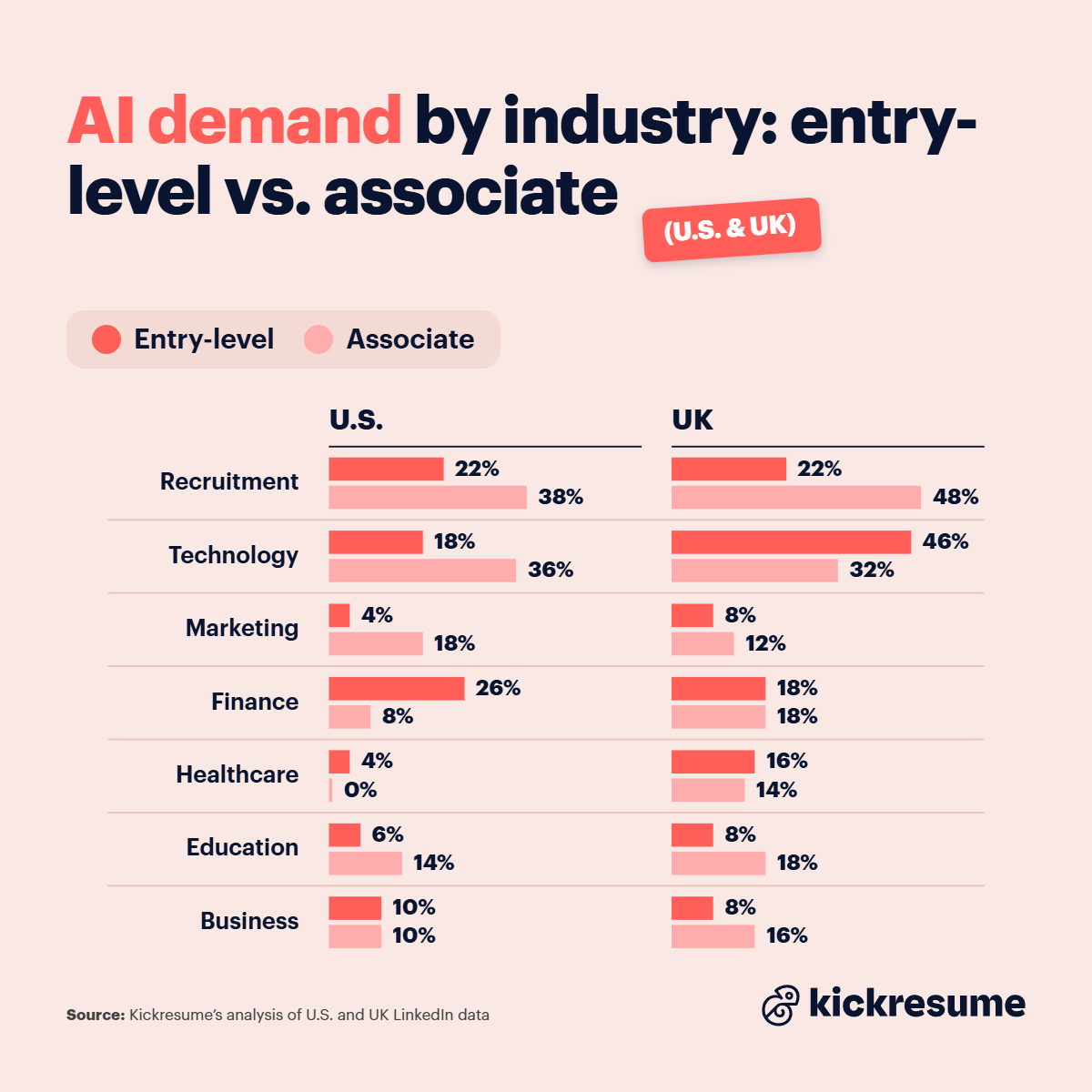
This means, on average, employers expect AI skills to be attained with experience, however, there are some outliers. In the UK, AI knowledge is expected in almost half (46%) of entry-level tech job posts, compared to 32% at associate level. In the U.S., over a quarter of entry-level job posts in finance request AI skills, compared to just 8% of those at associate level.
This may be because the AI boom has created expectations for tech-savvy junior hires, or because employers see an opportunity to bring new AI knowledge into their teams. However, these industries are exceptions to the wider trend: across the job market, employers are more likely to ask for AI skills as candidates move into more experienced roles.
Interestingly, this doesn't necessarily reflect how employees use AI. Our earlier study found that junior employees were the most likely to use AI on LinkedIn compared to their senior counterparts.
Final thoughts
It's clear that in many industries, in the U.S. especially, entry-level jobs are becoming harder to break into. While juniors are asked for fewer skills than associates, over a quarter of entry-level roles require at least 1.5 years of experience.
And that’s not the only thing impacting inexperienced job seekers; 1 in 4 junior job ads ask for leadership, a skill usually developed over the course of a career.
For young job seekers, it’s worth remembering that leadership experience doesn't have to come from a previous job. Examples of taking initiative at university, leading a group project or organizing extracurricular activities can all help demonstrate these skills. The same goes for technical abilities like AI proficiency, which candidates can showcase through a portfolio.
If you find a job that interests you but don't meet every requirement, don't rule yourself out. Job descriptions often describe an ideal candidate, so don't feel you have to tick every box.
For hiring teams, it's worth taking another look at what you ask for in junior job ads. Requiring two or more years of experience and leadership skills can put off promising candidates before they even apply. Focus instead on the skills that are genuinely needed for the role. Many graduates are eager to learn and quick to pick up new processes.
Note
Kickresume analyzed 1,400 entry-level (700) and associate (700) job ads from LinkedIn in the U.S. and UK, posted between May 2026 to October 2026. The sample was split evenly across seven industries: healthcare, finance, business (consultancy), marketing, technology, education, and recruitment (HR).
We searched each job description for 11 skills and phrases associated with more senior roles, including leadership, project management, data driven decision making, cross functional alignment, and AI. We also recorded the minimum years of experience each posting asked for, and compared the results by country and industry.
About Kickresume
Kickresume is an AI-based career tool that helps candidates source jobs and raise salary with powerful resume and cover letter tools, skills analytics, and automated job search assistance. It has already helped more than 8 million job seekers worldwide.