

 ChatGPT
 Perplexity AI
 Claude
Wondering how long it takes to hear back from a job? Most companies respond within one to two weeks, though it can stretch to a month or more depending on factors like company size, internal holdups, and how many applicants they're sorting through.
So if you find yourself staring at a silent inbox, nervously checking your phone and wondering why it's taking so long, know that this is far more common than you think, and it rarely means rejection.
In this article, we'll break down how long it really takes to hear back after applying or interviewing, what happens to your job application behind the scenes, and how to stay sane while you wait.
How long does it take to hear back after applying?
According to Careery's 2026 analysis, the median time to hear back after applying is about 6.7 days, with most replies landing somewhere between 4.5 and 8.1 days. Around 37% of people who get a response hear back within one week, and 44% within two.
So if you're sitting in that 7 to 14 day window, you're well within the norm, and there's a good chance you'll still hear from them. Silence at this stage rarely means rejection. It usually just means your application is still working its way through the process.
A role gets put on hold, a reorg shuffles priorities, or the company keeps interviewing "just a few more" candidates. None of it has anything to do with you, but any one of it can turn a one-week wait into three.
So if you've sailed past the two-week mark and still haven't heard anything, it's not necessarily a no. It often just means your application has hit one of the normal delays that come with hiring.
That's also a fair point to send a short, polite after application follow-up if you have a contact, and a good moment to understand why these things take so long, which is exactly what we'll get into next.
Why it takes so long to hear back from a job application
But you might be wondering: what's taking them so long? It's rarely one thing. Usually there are several factors shaping how fast (or slow) you hear back.
- Number of applications. Popular roles can pull in hundreds of applicants, and someone has to go through them all. The bigger the pile, the longer it takes to get to yours.
- Company size. At a small company where your resume lands straight in the founder's inbox, you might hear back in a day or two. A large company routing thousands of applications through ATS can take weeks just to finish the first screening round.
- Your qualifications. If you're a clear match, you may get fast-tracked. If you're a maybe, your application might sit to one side while they see who else applies.
- Internal hold-ups. Sometimes the delay has nothing to do with you. The hiring manager is swamped, a key decision-maker is away, or the role is waiting on budget sign-off.
- The job listing's closing date. Some companies wait until the posting officially closes before reviewing anyone, so applying early can mean a longer wait.
- Background and reference checks. In industries with stricter rules, like finance, healthcare, or government, employers run more thorough vetting and contact your references, which adds time later in the process.
- The season. Hiring slows around holidays, summer, and end-of-quarter crunches when decision-makers are out or buried in other priorities.
“The most common reason is that the candidate is neither a clear "yes" nor a "no"—they're a "maybe." In many cases, we're already in the final stages with one or more very strong candidates. I don't want to move another strong candidate forward unnecessarily and waste their time, but I also don't want to reject them. Sometimes the role is put on hold, the requirements change, or the hiring manager is unavailable for a period of time. In those situations, the candidate simply remains in the system while we wait to see how things develop.”
– Marta Říhová, HR expert
Most of these delays are normal and temporary. But there's one reason for silence that's worth calling out on its own, because it has nothing to do with timing at all.
Ghost jobs: when the role was never real
There's actually one more reason why you haven't heard back yet. The job you applied for might not even be real. It might be just a ghost!
"Ghost jobs" are postings companies put up without any real intention of hiring. Maybe they're building a resume pile for later, keeping up appearances of growth, browsing the market or, they already have someone lined up but need to look like they ran an open search, or just forgot to take the listing down.
And this is more common than you'd think. The Bureau of Labor Statistics counted 7.2 million job openings in August 2025, but not all of those are real opportunities. Some 2025 estimates suggest as many as 30% of job postings may be fake. So if you've been blaming yourself, it might genuinely not be you.
Here are a few signs your listing might be a ghost:
- It's been up for months. If a posting has been sitting on the job board forever, chances are they're not holding out for the perfect unicorn candidate. They just don't really intend to hire anyone.
- It keeps getting reposted. The same role disappearing and reappearing over and over is a classic pipeline-building move, not a sign of urgent hiring.
- The description is vague. A giant salary range, or two vague sentences about what you'll actually do, can mean they don't really care who applies.
- The company is weirdly quiet everywhere else. No recent hiring news, no employees mentioning the team growing, radio silence across their channels
You can't always tell from the outside, so the move is the same either way. Don't wait around on any single role, and keep your search moving.
What does "application under review" mean?
If you've logged into a careers portal and seen your status flip to "application under review," you've probably wondered whether that's good news, bad news, or just a holding screen.
In plain terms, it means your application has been received and is somewhere in the screening process.
Behind the scenes, a few things are usually happening. First, an applicant tracking system (ATS) scans your resume for relevant keywords and qualifications. If you clear that filter, a recruiter typically reviews your application to see whether you fit the basics of the role. From there, promising candidates get passed along to the hiring manager for a closer look.
This status can stick around anywhere from a few days to a couple of weeks, depending on how many applications they're working through.
The good news: "under review" is generally a neutral-to-positive sign. It means you haven't been rejected, and your application is still in the running. It's not a guarantee of an interview, but it's certainly better than silence.
What’s the behind the scenes of a job application?
By now you've probably figured out that hiring can move at the pace of continental drift. To help you understand what's actually going on in there, here are some of the steps you might encounter (and endure) along the way.
Once you've filled out and sent your application:
- The confirmation email. A simple note letting you know they received your application and will review it. Nice, but automated, so don't read too much into it.
- The ATS scans your resume. Usually the first thing to "see" your resume isn't a person at all. It's an applicant tracking system that scans for the right keywords, like specific tools and skills, and filters out resumes that don't have them.
- A recruiter reviews your resume. If you clear the ATS, an actual human recruiter checks whether you meet the core requirements for the role.
- The phone screen. If you're a match, you might be invited to a short phone call, usually with a recruiter. It's a quick check on the basics: your background, your interest in the role, your availability, and sometimes salary expectations.
- A survey or questionnaire. Being asked to fill out a survey can happen at any stage, though it's usually early on. Questions range from "how do you handle stress?" to the occasional curveball like "what kind of bird would you be?"
- The first-round interview. Finally, the real thing. Both sides meet, expectations get laid out, and you start figuring out whether you're a genuine fit for the role and the company.
- The second-round interview. Much like the first, but deeper. By now they're usually choosing between a small handful of candidates.
- Third to however-many rounds. Some companies struggle to make a decision and put candidates through several more rounds, sometimes with homework or trial tasks. So be ready to actually produce something here.
- The job offer. And finally, the offer, where you get to decide if this is really what you want and negotiate the details.
How long does it take to hear back after an interview?
You landed the job interview, it went well, and then... silence again, leaving you back where you started: refreshing your inbox and wondering if they'll follow up.
Most people hear back within a few days to two weeks. And just like with your application, once you hit the two-week mark with nothing, a polite follow-up is completely fair game.
The stage matters too. Early rounds like a phone screen or recruiter call usually move faster, since recruiters are actively scheduling. Final rounds tend to slow down, because the decision is bigger, more people are involved, and they're often weighing you against other strong candidates.
Or the final yes needs sign-off from several people, they're still interviewing others, or someone key is out on holiday and the whole process pauses until they're back.
7 signs you'll get the job after an interview
No one can read a hiring manager's mind, but interviews do tend to leave clues. A few signals that things may be going your way:
- The interview runs long. If they keep you well past the scheduled time, it usually means they're engaged and want to keep talking.
- They talk logistics. Questions about your start date, salary expectations, or notice period suggest they're already picturing you in the role.
- They introduce you to the team. An offhand "come meet a few people" is a strong sign they're seriously considering you.
- They use "when," not "if." Language like "when you're working with us" instead of "if you join" can hint at where their head is at.
- They follow up quickly. A fast, warm follow-up often means you've made an impression.
- They sell you on the role. When the interviewer starts pitching the perks, culture, or growth path, the dynamic has flipped. They're now trying to impress you.
- They give you a clear next step. A specific "here's what happens next, and when" beats a vague "we'll be in touch."
One important note: none of these is a guarantee. Interviews can feel great and still not work out, and plenty of people get offers after interviews they thought were just okay. Treat these as encouraging signs, not promises, and keep your job search moving either way.
When to follow up after an interview
Following up is not annoying. Done right, it shows you're genuinely interested. The trick is timing.
Start with a thank-you note within 24 hours of your interview. It's a small gesture that keeps you fresh in their mind and reinforces your interest.
After that, take your cue from whatever timeline they gave you. If they said you'd hear back by a certain date, wait until that date passes before reaching out.
If they didn't give you a timeline, a good rule of thumb is to wait about 5 to 7 business days before sending your first follow-up.
As for how many times to follow up: generally two is plenty. One thank-you, and one check-in if you don't hear back.
If you've followed up a couple of times and still get nothing, it's usually a sign to just leave it and mentally move on and put your energy into other opportunities
This is also the part where things get messy if you're applying to a lot of roles at once.
“The earlier a strong candidate applies, the better their chances of entering the hiring process before a strong shortlist has already formed. I also think a polite follow-up is completely appropriate. For example, this week a candidate messaged me on LinkedIn just to follow up on their application. We replied that they were a very strong candidate, but that we currently had another candidate who had already completed three interview rounds and was likely to receive an offer. At the same time, we told them that if things didn't work out, they would be the first person we'd contact. I see that kind of follow-up as a positive—it shows motivation and genuine interest in the role.”
— Marta Říhová, HR expert
How to keep track of your job hunt
The thing is, most people aren't waiting on one application. They're waiting on a dozen, each with a slightly different title, role, interview stage, and set of requirements.
Keeping the status of every one straight in your head is a genuine strategic nightmare, and no matter how sharp you are, remembering which of twelve near-identical applications is at what stage is almost impossible.
This is exactly where a job tracker earns its keep. Sure, a basic spreadsheet can limp along, but Kickresume's job tracker keeps every application and its timeline in one clear view, so you always know who's gone quiet and who's actually due for a nudge.
Better yet, you can tailor your resume to match any job ad with a single click, so you're not just organized, you're applying smarter.
What NOT to do while you wait
The hardest part of waiting is the urge to do something with all that nervous energy. A little is useful, too much can work against you.
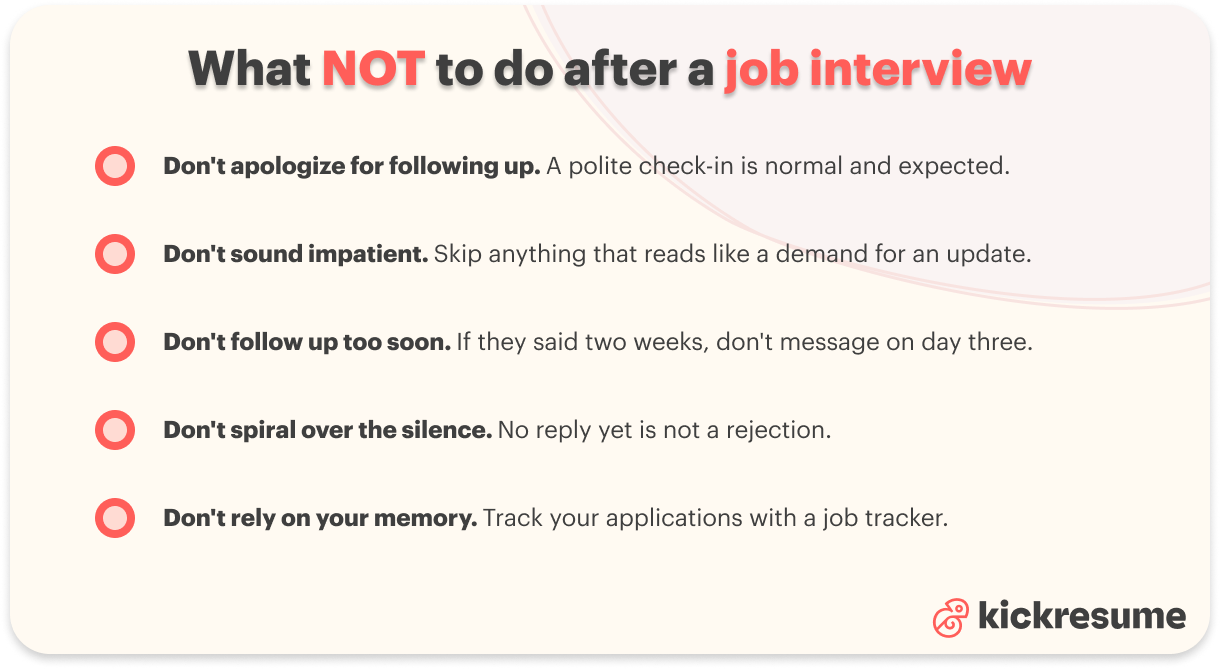
Here's some things you should avoid:
- Don't apologize for following up. A polite check-in is normal and expected. You're not being a nuisance, so don't open with "so sorry to bother you."
- Don't sound impatient or entitled. Skip anything that reads like a demand for an update or implies they owe you a faster answer.
- Don't follow up too soon. If they said they'd need two weeks, don't message them on day three. Give the timeline they gave you a chance to play out.
- Don't spiral over the silence. No reply yet is not a rejection. Reading meaning into every quiet day will only wear you down, and it changes nothing on their end.
- Don't rely on your memory to keep it all straight. A few applications deep, the dates blur and you're left guessing who said two weeks and who you already nudged. A tracker (or even a spreadsheet) saves you from that.
Key takeaways: How long does it take to hear back from a job?
The hardest part of waiting is not knowing what's normal, so every quiet day starts to feel like bad news.
Here's what to actually expect:
- After applying, expect around a week. The median is about 6.7 days, and most replies land within two weeks. Sitting in that window is completely normal.
- After an interview, give it a few days to two weeks. Early rounds move faster, final rounds drag because more people are involved.
- Silence usually isn't rejection. Holds, reorgs, busy hiring managers, and holiday lulls stretch timelines for reasons that have nothing to do with you.
- "Under review" is a good sign. It means you've cleared the first filter and you're still in the running.
- Follow up, but time it right. Thank-you note within 24 hours, then one polite check-in once their timeline has passed. Two follow-ups is plenty.
At the end of the day, the timeline isn't really yours to control. What you can control is how you handle the wait: stay organized, keep applying elsewhere, and try not to spiral over the silence. Do that, and the not-knowing gets a whole lot easier to sit with.

