"Is it illegal to lie on my resume?" It's a common question job seekers ask online, often right after they've already done it, and right before a background check.
The short answer, at least in the U.S.: in most cases, lying on your resume won't land you in court. But it can still cost you the job, sometimes years later. And in some cases, it may also expose you to a civil claim or criminal prosecution.
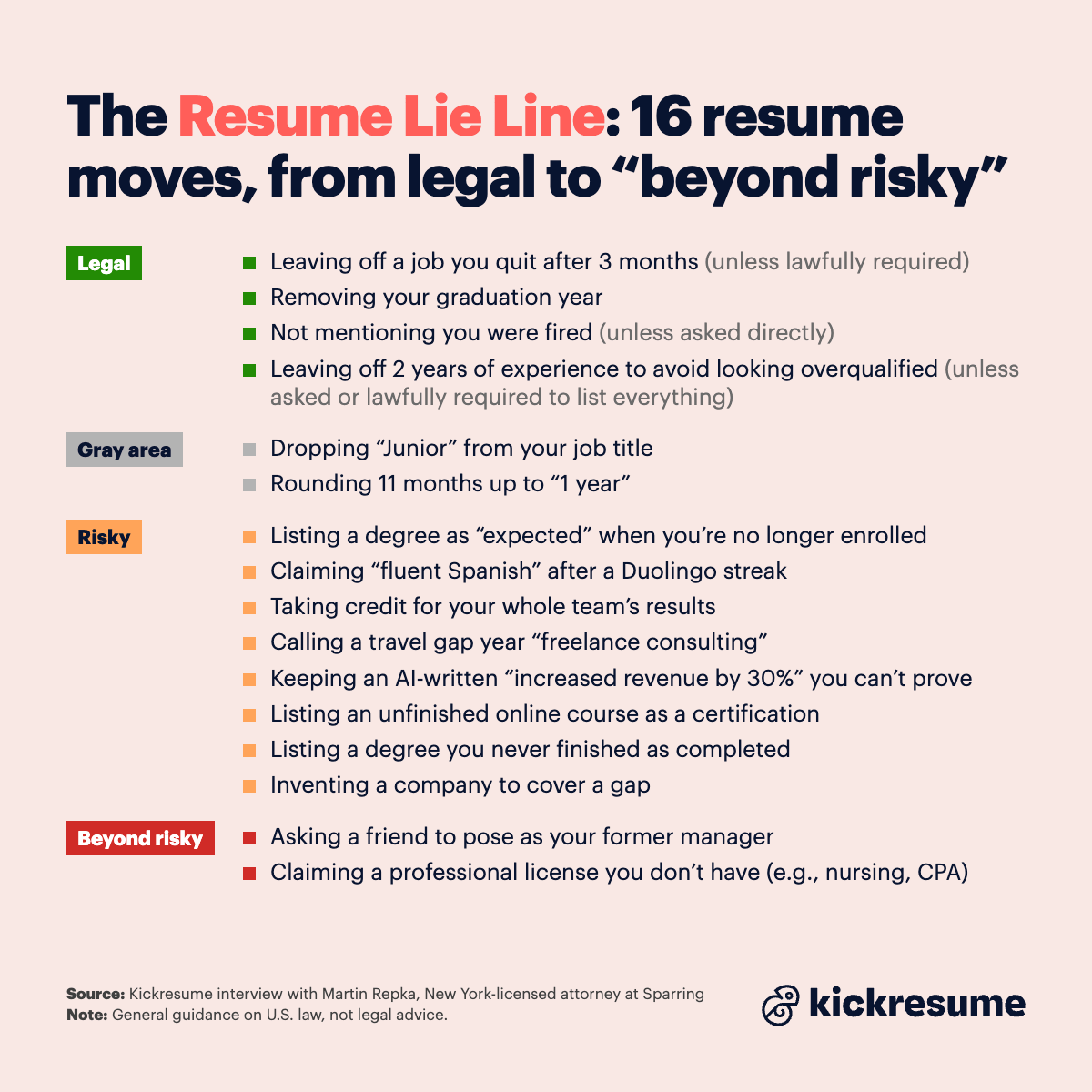
To find out where the legal line actually sits for U.S. job seekers, Kickresume combined its survey data with an interview with Martin Repka, a New York-licensed attorney at Sparring. We also asked him to review 16 common resume lies, from "that's legal" to "beyond risky."
About the expert

Martin Repka is a New York-licensed attorney at Sparring, a law firm working with technology companies and startups. He focuses on IT law, intellectual property, corporate governance, and employment law, and studied law at University College London. Sparring is Kickresume's legal partner.
Here are the key takeaways:
- 53% of U.S. respondents have exaggerated or omitted something on their resume. Most only polished the truth slightly (41%), 10% exaggerated responsibilities or impact, while only about 2% admit to making up job titles, dates, or qualifications.
- Lying on a resume isn’t automatically a crime, but it can cost you the job. The legal risk is highest for government jobs, professional licenses, academic degrees, and lying about where you live or whether you can work in the U.S.
- AI is no excuse. 49% of U.S. respondents would use an AI-suggested "tiny lie" on their resume, but legally, "the AI wrote it" doesn't shift responsibility.
- A resume can be selective. You generally do not need to mention being fired, every short job, or your graduation year, unless an employer lawfully asks about it or asks you to list everything.
- Of the 16 resume lies we asked about, the lawyer rated 4 as generally permissible, 2 as a gray area, 8 as risky, and 2 as "beyond risky."
Most job seekers polish. Very few make things up.
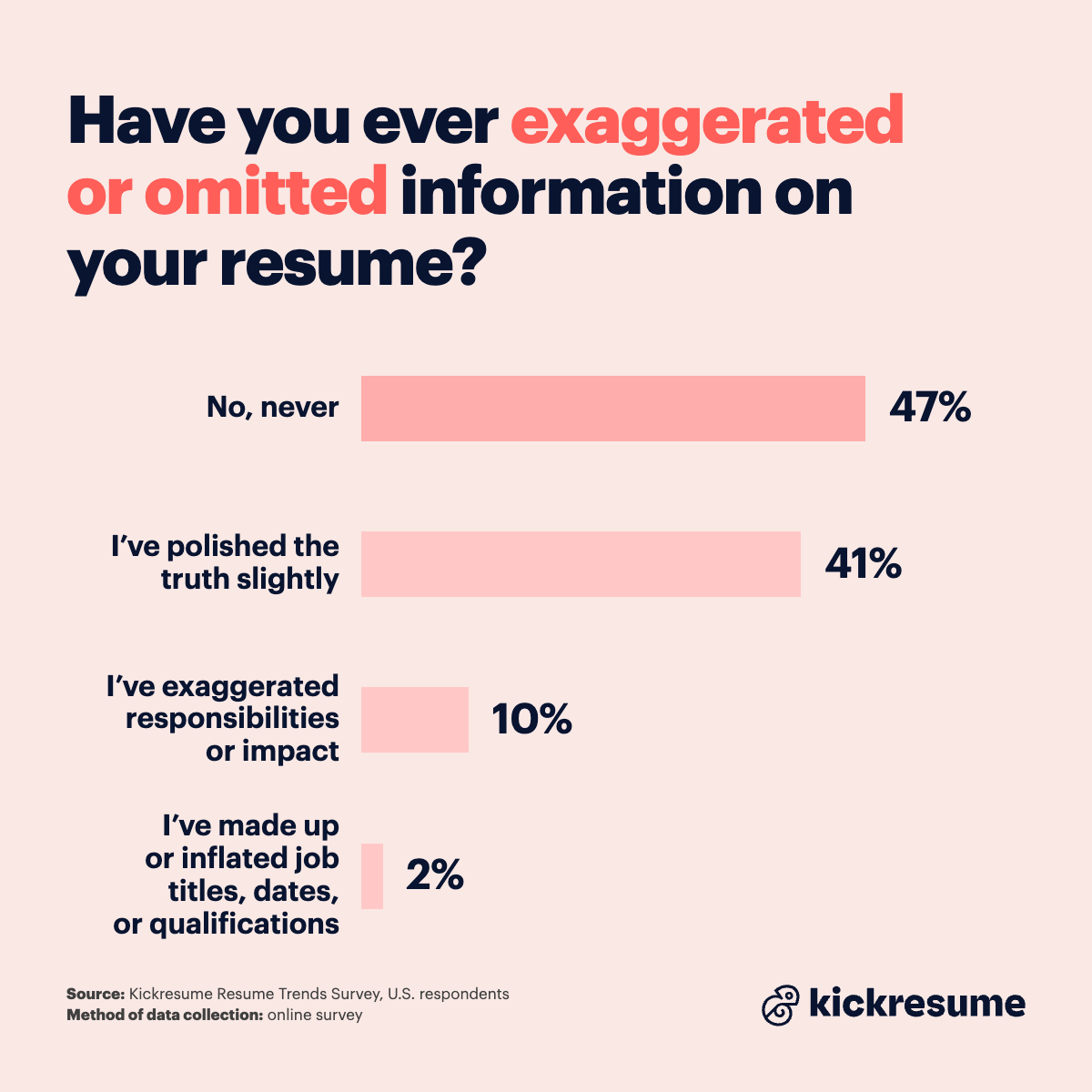
In our Resume Trends survey, we asked respondents whether they'd ever exaggerated or omitted information on their resume. Among U.S. respondents, just under half (47%) said no, never. The rest admitted to some level of adjustment:
- 41% said they've polished the truth slightly.
- 10% have exaggerated their responsibilities or impact.
- Only about 2% said they've made up or inflated job titles, dates, or qualifications.
Americans were also more likely to stay strictly truthful than respondents globally, where only 38% said they'd never adjusted anything.
And according to resume writers, the polishing is picking up. In our survey of resume writers, 51% said clients are more likely to exaggerate their achievements now than a year ago.
So where does polishing end and lying begin? According to Martin Repka, presenting yourself well is not the problem.
"There's nothing wrong with making yourself look as good as possible, but there's a difference between presenting yourself in the best light and lying about objective facts," says Martin Repka, a New York-licensed attorney at Sparring.
Legal, gray area, or risky? A lawyer rates 16 common resume lies
Here's how Martin rated 16 things job seekers commonly say (or are tempted to say) on their resume. As he put it, "there are a lot of caveats to every one of those answers," so treat these as a general guide, not legal advice for your situation. Below the graphic, he explains the risks.
So, is it illegal to lie on your resume?
Sometimes, yes. But for most people, the real risk is losing the job, not facing a judge.
"You can exaggerate a little, but there's a difference between highlighting your strengths and lying about objective facts. The risk is the highest if you're applying for a government job or you lie about having licenses or academic credentials you do not have. Depending on the circumstances, that can be a crime."
In practice, criminal cases are rare. "The most common repercussion that we deal with is just being fired," Martin explains.
One well-known example is George O'Leary, who resigned as University of Notre Dame head football coach just five days after being hired, once false claims about his athletic background and educational credentials came to light. "It's relatively rare for people to be actually prosecuted for lying on a resume," Martin says, "but it's relatively common that these lies get discovered, they surface, and then the person resigns, or they are terminated."
What George O'Leary's resume claimed, and what was true
|
Claim |
Fact |
|
A master's degree in education from New York University (1972) |
He studied at NYU but never earned the degree |
|
Three varsity football letters at the University of New Hampshire |
He graduated from UNH but never played in a game |
Sources: ESPN, Tampa Bay Times
Can you go to jail for lying on your resume? "I think this would really be the most extreme case, but it is not impossible," Martin says, pointing to highly regulated industries, government jobs, and situations where the lie hides something criminal, such as identity theft or working without authorization.
Getting caught years later still counts
In the U.S., getting fired over a resume lie is easier than many job seekers realize. Most jobs are at-will, which means an employer (or you) can end your employment at any time, for almost any reason except a discriminatory one.
"In most of Europe, it is relatively difficult to fire people, especially without a reason, and it might take months. In most U.S. states, most jobs are so-called at-will employment. And discovery that you lied on your resume or in an interview is a good reason to terminate your employment."
That also means time doesn’t necessarily protect you. Even if the lie happened years ago, the employer may still be able to let you go. As for criminal charges, a statute of limitations generally applies, but Martin warns that these periods "often run for long years, so I don't recommend relying on that."
Signing "everything is true" raises the stakes
Many applications ask you to confirm that the information you've provided is accurate. According to Martin, that signature matters.
"If there are some small mistakes that you make unintentionally, or you slightly round up a percentage, say 20% increase instead of 19%, that is still relatively fine. But if you sign a statement confirming that everything is true and correct to the best of your knowledge, deliberately providing false information about something important can get you in hot water."
What does “getting in hot water” mean in practice? Martin lists three possible outcomes: you don’t get hired, you get fired if the lie surfaces later, and in some situations, “this can have legal and criminal repercussions.” Once you've confirmed in writing that everything is true, it's much harder to call a false claim an honest mistake, especially if you are knowingly and willfully making a materially false statement or applying for a government position.
The three resume lies that can actually get you in legal trouble
The same pattern runs through Martin's answers: the biggest legal risk comes from lying about objective, verifiable facts, especially in regulated areas.
1. Professional licenses
Claiming a license you don't hold, such as a medical, nursing, legal, or CPA license, is one of the two most serious lies on the list. It's easy to check, and it can break professional rules on top of being a misrepresentation or fraud.
"Lying about being a lawyer isn't just about fraud and possible misrepresentation to the future employer, but it also breaches attorney regulations because you're not licensed to represent yourself as a lawyer. The same applies to CPAs, medical professions and other regulated fields."
What about online certificates? Falsely claiming a certificate is still misrepresentation, but the legal consequences may differ. The key question is whether the certification is a legal requirement for the job.
2. Academic degrees
You can list a degree you didn't finish, as long as you're clear about it. Claiming you earned a degree when you did not is a different story.
"Lying about actually having an academic degree is one of the most problematic things that you can do, because some states have specific laws on this and they can be relatively strict."
Several states do have laws like this. In Illinois, for example, knowingly using a false academic degree to get a job, a promotion, or higher pay is a Class A misdemeanor. Since July 1, 2026, Iowa added a provision treating knowingly and intentionally misrepresenting academic degrees or credentials to get a job as a simple misdemeanor. The law followed the case of the former superintendent of Des Moines Public Schools, who had falsely claimed a doctorate. Under the new Iowa law, violators can face up to 30 days in jail and a fine.
Martin's rule of thumb is to think about how a reasonable person would read your resume. "Write it in a way where a normal person reading it would understand that you don't have the degree," he says. Phrases like "studied X" or "coursework in X" make that clear. Simply listing "Degree in X, University of Y" doesn't.
3. Where you're based and whether you can work in the U.S.
This one surprised us. According to Martin, one of the most common examples of resume lies with possible criminal consequences is pretending to be based in the U.S. to land a remote job.
"There has been a string of cases of people misrepresenting that they are based in the U.S. even though they are not. Representing that you're based in the U.S. can lend you a significantly higher salary and opens positions that people outside of the U.S. wouldn't be legally allowed to apply for."
Working from outside the U.S. is not automatically unlawful. But you should be accurate about where you will work and whether you meet the role's location and work-authorization requirements. “The risk becomes more serious if you knowingly use false documents to prove your right to work in the U.S.,” Martin says. “That can lead to criminal charges.”
The gray zone: job titles, numbers, and team wins
Most resume "lies" aren't fake degrees. They're small upgrades: a slightly better title, a rounded number, or a team result written as "I." Here, Martin's answer is that consequences usually "depend on the extent."
Job titles
If your responsibilities grew but your title never caught up, using a title that matches your work is generally fine. Claiming you led a team you were part of is not.
"If you were hired as a junior marketing specialist, then did a bit more advanced work, and still worked in a team of five marketing specialists, and you said that you were the head of marketing even though you didn't lead the team, that is clearly verifiable lying, and could have consequences."
Numbers and metrics
Numbers are everywhere on modern resumes. In our analysis of 2.1 million CVs, 82% contained at least one quantified achievement.
Rounding is common and rarely a problem. "I don't think that this is something that would often lead to repercussions," Martin says. "But reasonable rounding should still give an accurate picture. If it is dramatic or intentionally done to cover something, then it is problematic."
Taking credit for the whole team
This is a very common exaggeration: a resume says "I increased sales by 25%" when it was a team effort.
"Ideally, you should say, 'I was a member of a team that raised company sales by 25%,' instead of saying, 'I raised company sales by 25%.' If you led the team, then sure, say that this is your achievement. But if you were a junior intern in a team, then don't say that this is your achievement. That is very clearly lying."
"AI wrote it" is not a defense
Many job seekers now draft their resumes with AI, and AI sometimes has a habit of making things sound a little more impressive than they were. Many people seem fine with that.
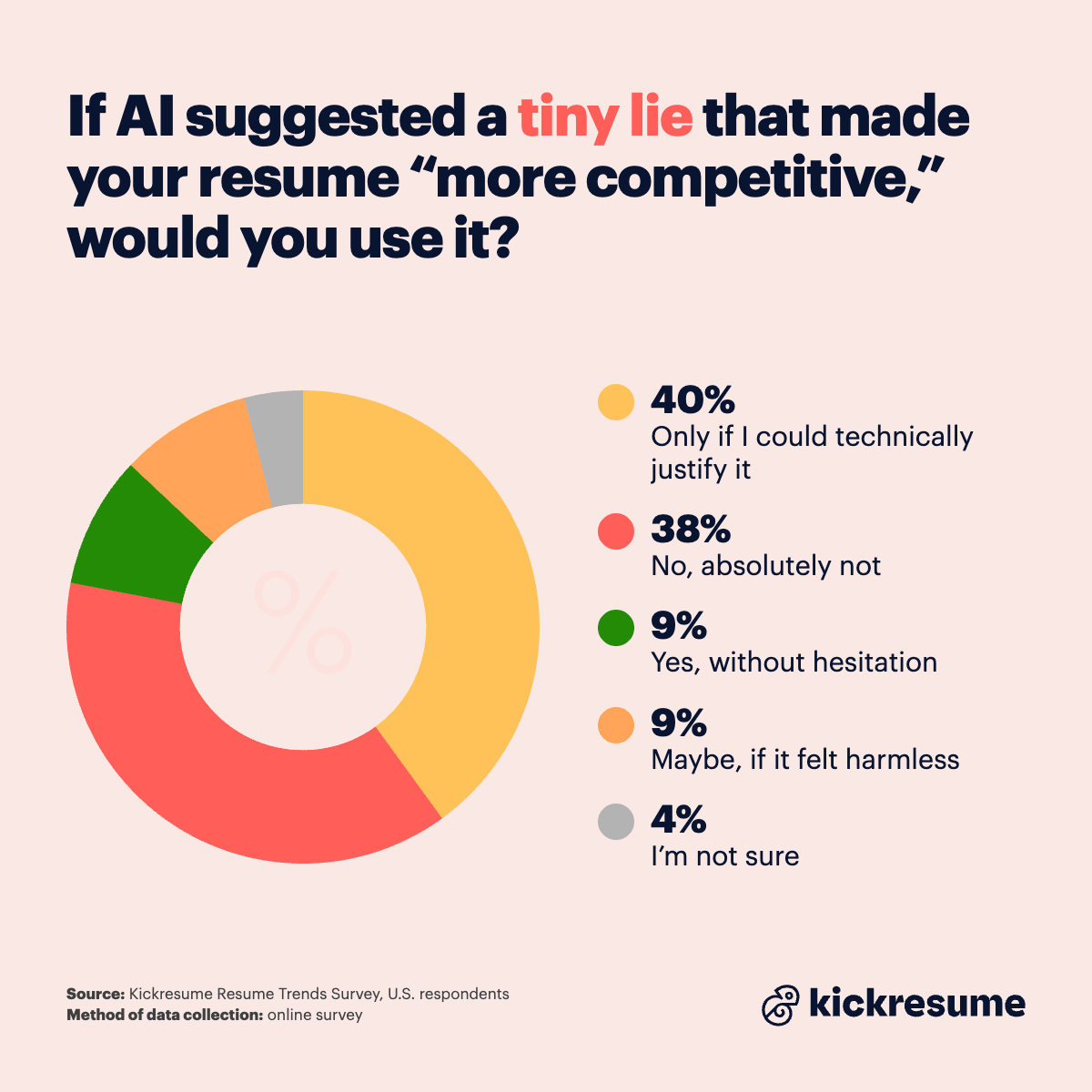
In our survey, 49% of U.S. respondents said they'd use an AI-suggested "tiny lie" to make their resume more competitive: 40% only if they could technically justify it, and 9% without hesitation. Only 38% said absolutely not.
So who's responsible when AI embellishes your resume? Martin's answer is short: "You are."
"Using an AI tool is no different from writing your resume in Word or any other tool, from a legal perspective. So you are responsible for anything that the AI generates, even if it embellishes and you didn't write the content."
There is one nuance. Fraud largely depends on intent, so if an AI error slipped in and you genuinely didn't notice it, that "might decrease your culpability, but it's still your responsibility," Martin says. It can still get you fired.
He isn't against using AI, though. "I think it's a great tool, especially because most employers will use AI to screen people's resumes," he says. It can help with keywords and phrasing. But his test is simple:
"You should be able to say everything that the AI wrote in an interview without feeling guilty for lying."
What you can legally leave off your resume
Here's the good news: a resume is a selection of relevant experience, not a full confession. Leaving something out is generally legal. The exception is when an employer lawfully asks you to list everything, for example, on an application form or questionnaire.
Being fired and career gaps
"Generally, you don't have to say that you were fired on your resume. You can just say that your job ended on this and that date. But if an employer actually asks you specifically for your reasons to leave, you might need to disclose that."
If you signed a severance or separation agreement, check it first. It may limit what either side can say about how the job ended.
Experience that makes you look overqualified
Can you leave off two years of experience so you don't look overqualified? "Yes, this is legal on your resume," Martin says. "You can choose to include only the relevant parts. But again, if you're filling out a specific employer questionnaire where you promise to include everything, then you should include the position as well."
Your current salary
Whether an employer can ask about your current salary depends on the state. For example, California and New York generally prohibit employers from seeking applicants' salary history, although they can ask about salary expectations. And where they can ask, you don't have to answer with a number. You can give a range or decline.
What you shouldn't do is inflate it. Rounding up slightly to include bonuses or equity is "relatively innocent," Martin says. "But if you intentionally double the salary that you received, then that is a verifiable lie and can backfire badly."
Photo, date of birth, and other personal details
In the U.S., leaving a photo or date of birth off a resume is common practice intended to reduce bias in hiring.
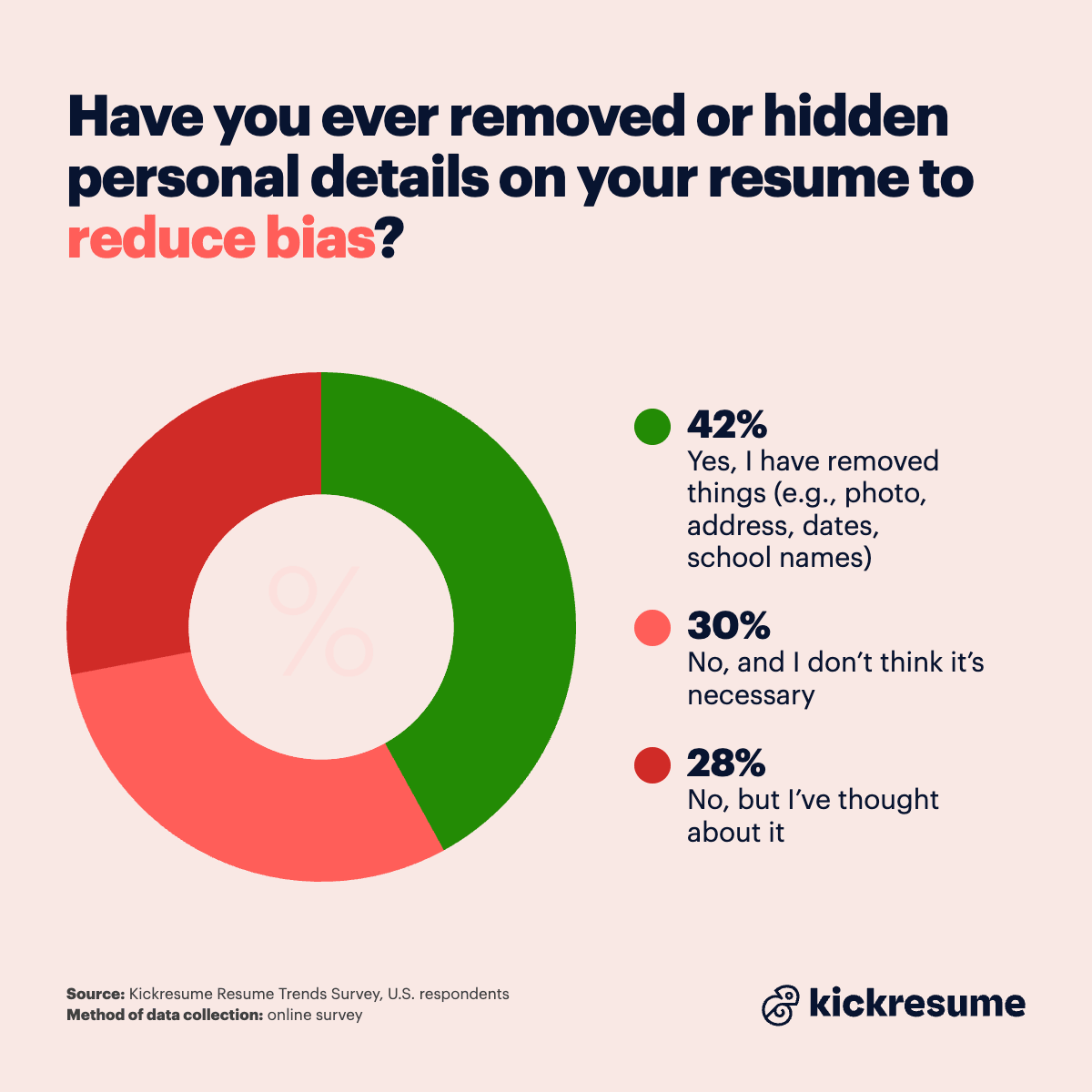
Many job seekers already do this: 42% of U.S. respondents said they've removed details like a photo, address, dates, or school names from their resume to avoid bias. Still, in our analysis of 2.1 million CVs created worldwide, 22% included a birth date.
No experience? Internships and projects count
For students and recent graduates, listing internships, school projects, or volunteering as experience is completely fine, as long as you label them honestly.
"In many situations, I can't imagine getting a position as a fresh graduate without any work experience during your studies. So yes, it's okay. You should mention that this is an internship or sort of study-related work. You shouldn't say that it's an independent full-time paid job."
If you're writing your first resume, these internship resume examples show how to present that kind of experience. And if you're starting from zero, our guide on how to write a resume with no experience walks you through it step by step.
Will they find out? Probably.
A common scenario online: someone stretched the truth on their resume, made it to the final rounds, and then heard the words "background check." What now?
According to Martin, there’s not much you can do at that point, but if you discover an error on your resume, correct it promptly. "In most cases, you cannot prevent an employer from running the background check. Generally, you can refuse the use of a third-party screening company, but I think it really hurts your job prospects if you do that."
His advice: "Always assume that your background will be checked."
There are two main ways employers verify your resume:
- Background checks. If an employer uses a background reporting company, the law generally requires your permission. State or local laws can add protections. If a report may lead to an adverse decision, the employer generally must first give you a copy and a summary of your rights. You can dispute inaccurate information. An employer's own research is much less restricted.
- References. Employers can call your former employers, and they can be surprisingly candid. "Generally, the employer is quite well protected from risks such as disparagement, and they can be quite honest about your performance," Martin says. In practice, due to employer policies or contractual obligations, many only give a neutral reference confirming your dates and general performance.
Can a friend be your reference?
Yes, as a character reference, and as long as you're open about the relationship. But asking a friend to pose as your former manager is a different story.
"That is misrepresentation, and in some cases, could be fraud. Then it exposes both of you to legal risk because you're both participating. You're both intentionally deceiving the third party, the future employer."
And even if a lie survives the hiring process, it rarely survives the job itself. If you lie about something that is relevant to the job, like saying you have experience that you don't, your employer will usually find out very quickly.
Final thoughts
Most resume polishing is legal, and most people who stretch the truth are unlikely to face criminal charges. But the risk isn't really legal. It's practical: lies tend to surface in background checks, reference calls, or simply in the first few weeks on the job.
Martin's rule of thumb is to only include what you can back up in an interview:
"The entire point of an interview is that the future employer will be asking you to provide details on the things that you listed. If you can't explain the thing that you put in without lying, then don't put it in. Because that can turn exaggeration into a direct lie when you get asked about it."
One more thing he'd leave off: confidential details. If you signed an NDA or have confidentiality obligations, don't name clients or describe internal projects without permission. Your resume can still show what you did without revealing what you shouldn't.
Methodology
The survey data comes from Kickresume's Resume Trends survey, conducted between December 4 and 17, 2025, with 1,004 respondents worldwide. Unless stated otherwise, the figures in this article refer to U.S. respondents. Resume writer data comes from a Kickresume survey of 152 resume writers, conducted with PARWCC. Resume statistics come from Kickresume's analysis of 2,133,734 CVs.
The legal commentary comes from an interview with Martin Repka, a New York-licensed attorney at Sparring, conducted on October 14, 2026. Quotes have been edited for length and clarity. This article provides general information about U.S. law and is not legal advice. Rules vary by state and by situation.
About Martin Repka and Sparring
Martin Repka is a New York-licensed attorney at Sparring, a law firm working with technology companies and startups. He focuses on IT law, intellectual property, corporate governance, and employment law. Sparring is Kickresume's legal partner.
About Kickresume
Kickresume is an AI-based career tool that helps candidates find jobs and raise their salary with resume and cover letter builders, skills analytics, and automated job search assistance. It has helped more than 9 million job seekers worldwide.