
Is the traditional university degree losing its influence? While higher education was once the golden ticket for career success—this perception is changing. Kickresume surveyed 1,052 people worldwide to explore the reality of ‘degree regret’, examining whether the investment actually pays off in today's job market.
We also looked into how many people regret not finishing their degree after dropping out, and if people think having no degree set back their career.
Here's a snapshot of our key findings:
- 1 in 5 (20%) say their degrees will never feel financially worth it.
- 25% that didn’t finish their degrees dropped out for financial reasons.
- 52% have some regret about their degree
- 47% of those that don’t have a degree instead went straight into work or an apprenticeship.
Most somewhat regret their college degree—but over half need it for work
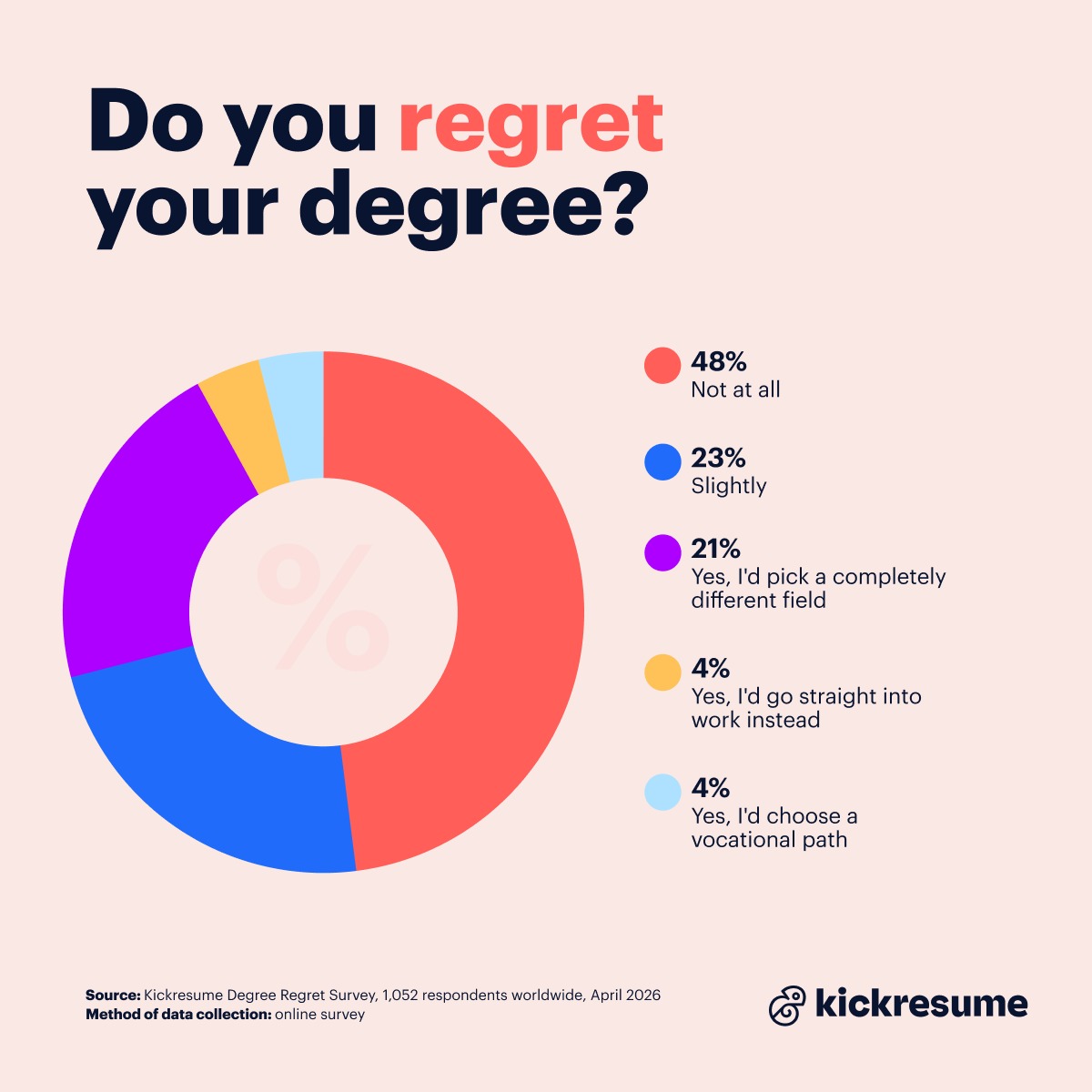
The results are in: degree regret is real. Over half of respondents had either slightly or totally regretted their degree. The most common reasons were that most people chose a field they ended up not enjoying, and some wished they went straight into work instead. Here’s the full breakdown:
We found that 23% had slight regrets, and another 21% would pick a completely different field. 4% would go straight into work instead, and the same percentage would choose a vocational path. However, 48% said they don’t regret their degree one bit.
Choosing what to do after high school is a big decision, and it's normal to look back with some doubts. For a lot of people, what they choose to study first isn’t what they end up doing in their career. In a previous study, we found that 31% of CEOs studied two different subjects!
While over half of respondents have some slight doubts—if not big regrets—55% said they needed their degree to get their current position. This means that while some people were successful in landing a role in their field after graduation, it doesn’t necessarily lead to job satisfaction.
While a degree is a required credential for many jobs, does what you take from it matter? We found that 36% of those with a degree use what they learned from it on a daily basis. The rest of the breakdown includes:
- Occasionally: 29%
- Weekly: 13%
- Rarely: 14%
- Never: 8%
This shows that often, what you learn in education has a lasting effect. Although some people are learning on the clock, what you take from a degree can definitely pay off in the real-world.
1 in 5 graduates say their degree was never worth the money
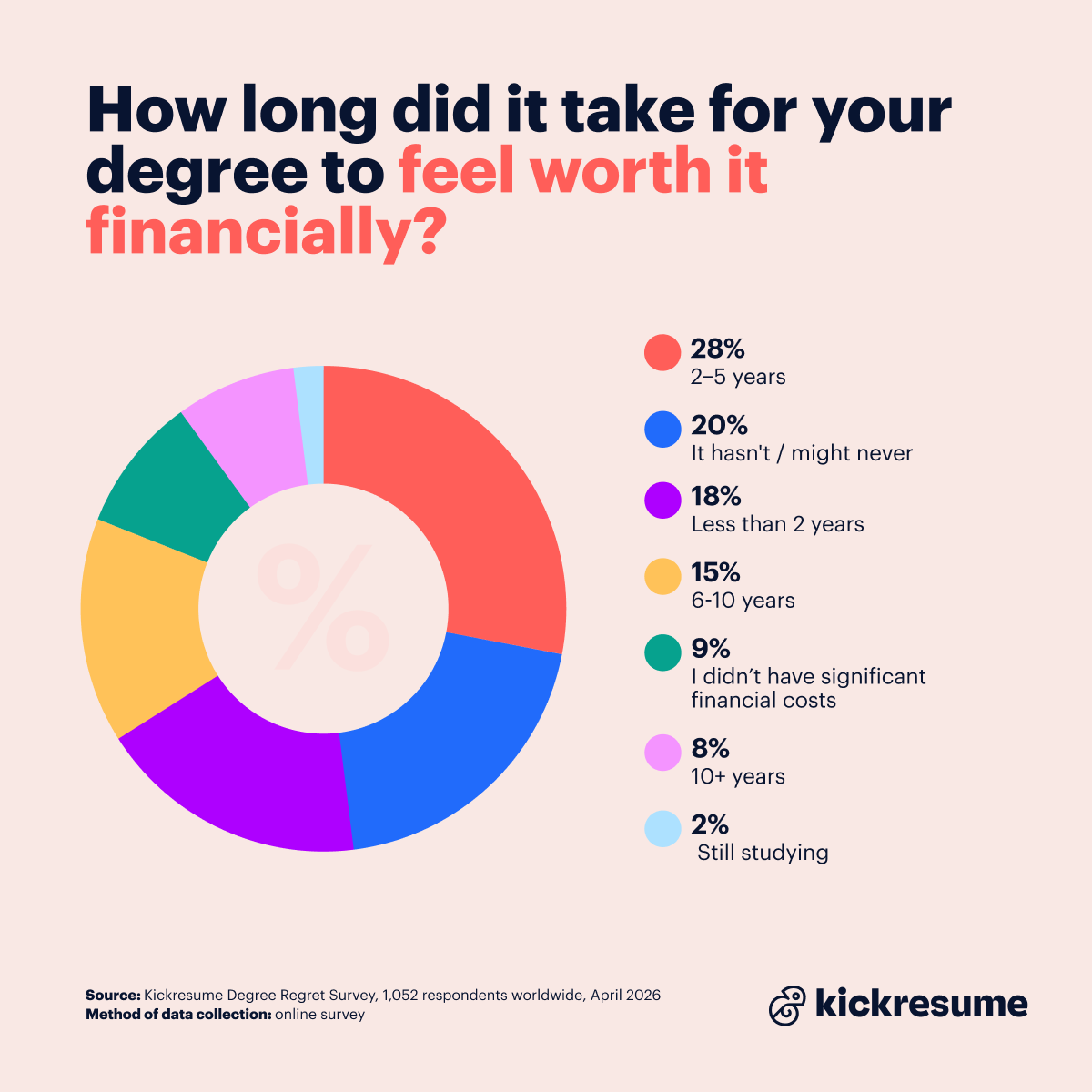
Does the value of a college education outweigh the financial costs? For 20%, the answer is no. That’s 1 in 5 who say their degree is not/may never be financially worth it. This could be because they chose to go into another field where they haven’t used their degree, or they may have extensive student loans.
We found that financial reasons were the most common cause behind why people dropped out. This indicates that degrees are becoming a pricier investment, perhaps because of tough job markets around the world that make finding a role that much harder. Graduates today know that a degree doesn't guarantee a job, and it seems that employers are looking for hands-on experience more than ever.
With that being said, 28% said that it took just 2-5 years for their degrees to feel worth it—which is the highest percentage of those surveyed. This group may have landed ideal roles because of their degree—making any financial cost worthwhile.
Another 18% said it only took less than two years, and 15% say it took 6-10 years. 8% said it took 10 years or more, and 9% didn’t have any financial costs. Only 2% of the surveyed participants are still studying.
Science, Law, and Education have the highest degree regret rates
While many graduates feel their degree eventually became financially worthwhile, that experience is far from universal. We also wanted to see whether regret levels differed depending on the field people studied—and some industries stood out more than others.
Our data shows that people working in science-related careers regret their degree the most, with 71% saying they either regret it or slightly regret it.
Law ranks second, with a 65% regret rate, followed closely by Education and Teaching at 64%. Art and Humanities also scored highly, with 61% expressing some level of regret. Meanwhile, 57% of people working in Marketing, Communications, and PR said they regret their degree as well.
There are several possible reasons behind these results. Some respondents may feel that a degree—or the specific degree they chose—ultimately wasn’t necessary to succeed in their industry. Others may be weighing the cost of higher education against the career outcomes they experienced, particularly when it comes to student debt and long-term financial return.
Do people end up in the industry they studied? 42% put their degree to work
Our results revealed that tech subjects are the most popular degree courses. According to our survey, Computer Science and IT degrees were the most common, followed by business degrees. Here's a rundown of the most popular subjects:
- Computer Science / IT: 20%
- Business & Economics: 19%
- Engineering: 14%
- Arts & Humanities: 9%
- Marketing, Communications & PR: 7%
But do people actually end up in their area of expertise? We found that 42% of respondents ended up in a job directly related to what they studied, and 24% work in a somewhat related field. Only 23% work in a totally different field and 11% are currently unemployed.
This could be because many jobs like doctors, nurses, and lawyers require a degree and further exams. Also, tech degrees that teach valuable skills like coding and build experience in using different software could help secure a job upon graduation.
But landing a job in your field is only part of the story. What actually helps people grow in their careers afterwards is a different question—and the answers might surprise you.
The degree is losing its edge: 36% credit work experience, only 6% credit their qualification
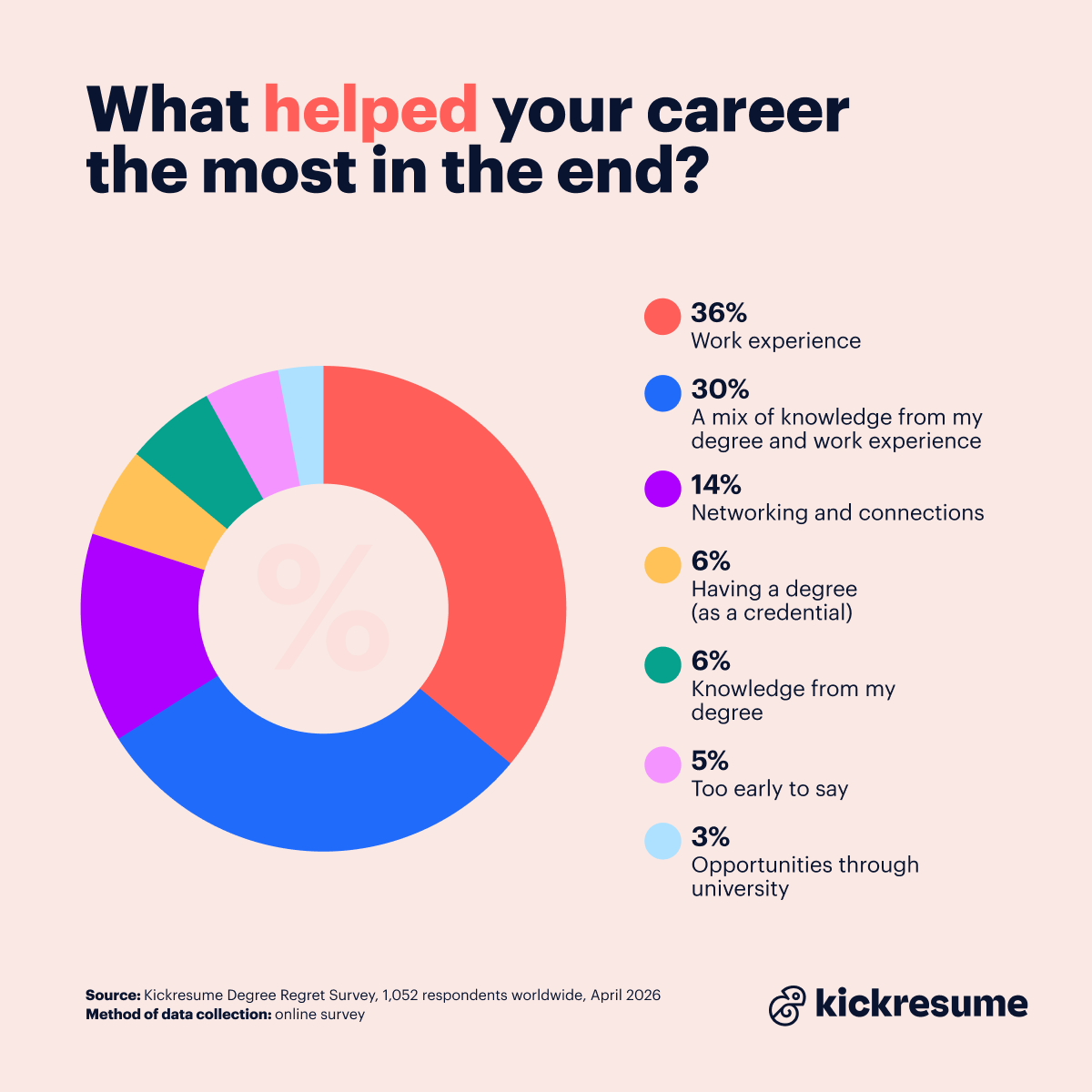
We asked people what helped their career more overall—their degree, or what they learned on the job. We found that while many go on to find employment in their field, work experience is what helped the most degree holders in the end, with 36% saying it proved the most valuable.
30% put it down to a mix of knowledge from their degree and work experience, and 14% say networking and connections is what really mattered. In a recent study, we found that 90% of workers had seen nepotism at some point in their careers, showing that who you know can play a big part in career success.
6% say having a degree as a credential really paid off, while the same percentage put their success down to the knowledge they learned from their degree.
If work experience and connections are doing the heavy lifting, where does that leave the degree itself? We asked those with degrees whether they think having one is becoming more or less important in their industry. The answers reflect a clear shift:
- Slightly less important: 30%
- Yes, much less important: 25%
- About the same: 24%
- Much more important: 13%
- Slightly more important: 7.5%
Why students are choosing jobs over lecture halls
For those who started studying and dropped out, we found that most (81%) have some regrets about not finishing their degree. 41% said they wish they had completed their studies, which may be because a qualification could have opened up more doors for them.
19% of people were firm in their decision, saying that not finishing their degree was the right choice for them. But what were the main reasons that students dropped out?
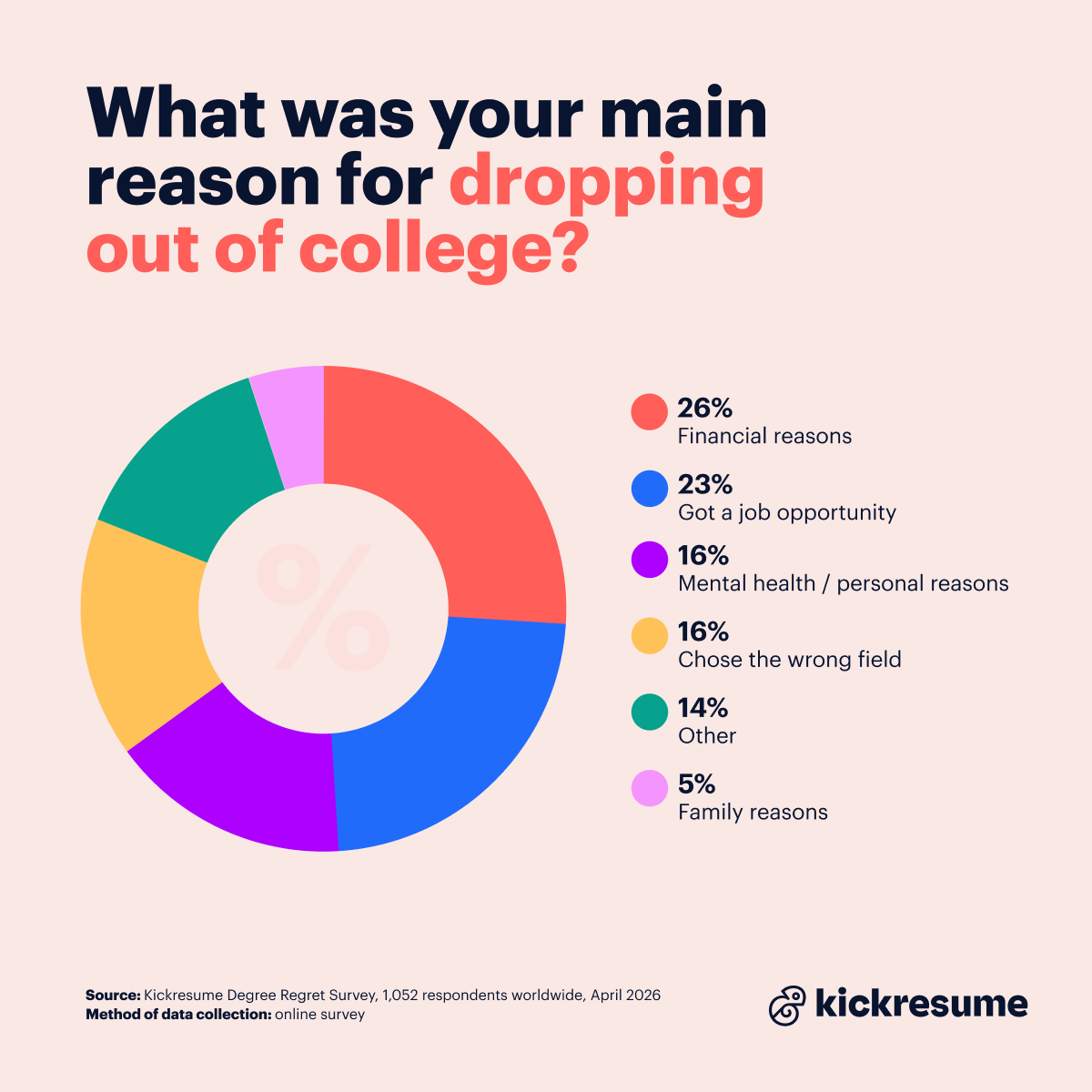
For the highest percentage of people, just over a quarter said they didn’t finish their degree because of financial reasons at 26%.
23% of those who didn’t finish their degrees said they had a job opportunity come up, so it makes sense that they would take it. 16% said they simply chose the wrong field for them.
16% left to prioritize their mental health, and 5% chose not to carry on for family reasons. The fact that some people felt they couldn’t continue because of personal or financial reasons goes to show that further education is a privilege, which isn’t always possible for everyone.
Whether it’s one year, two, or three, some of our respondents did end up getting something out of their time at university. 39% said that their partial study had a positive effect on their career. 34% said it somewhat helped them, indirectly, although 27% said studying didn’t prove useful for them.
47% chose work experience over a degree—but most are open to studying
For those without a degree, the majority either went straight into a job or an apprenticeship, or found something else to do. This could have been instead deciding to travel, volunteer and gain life experience.
Here's the full breakdown of reasons why people chose not to pursue a degree:
- 47% went into work or an apprenticeship.
- 17% answered that they did something else.
- 13% didn’t for financial reasons.
- 13% planned to but couldn't.
- 10% said it didn’t feel necessary.
It’s no secret that a degree is a costly investment. A job or apprenticeship not only gives you valuable experience, but means you can start earning money. With financial reasons ranking among the top barriers to higher education, it’s not surprising that many people choose work experience and a steady income over pursuing a degree.
While we know many of those with a degree have some regrets, most of the respondents without a degree are open to studying, or actively considering it. Our research shows that:
- 37% are open to studying for a degree.
- 33% are actively considering it.
- 20% said they don’t think it's necessary.
- 10% believe that that ship has sailed.
Finally we asked people if not having a degree limited their career at all, and found that for a significant chunk, it did. 37% said it occasionally impacted them, and 26% said it noticeably limited their careers. 20% said not really, and for 17%, it didn’t at all.
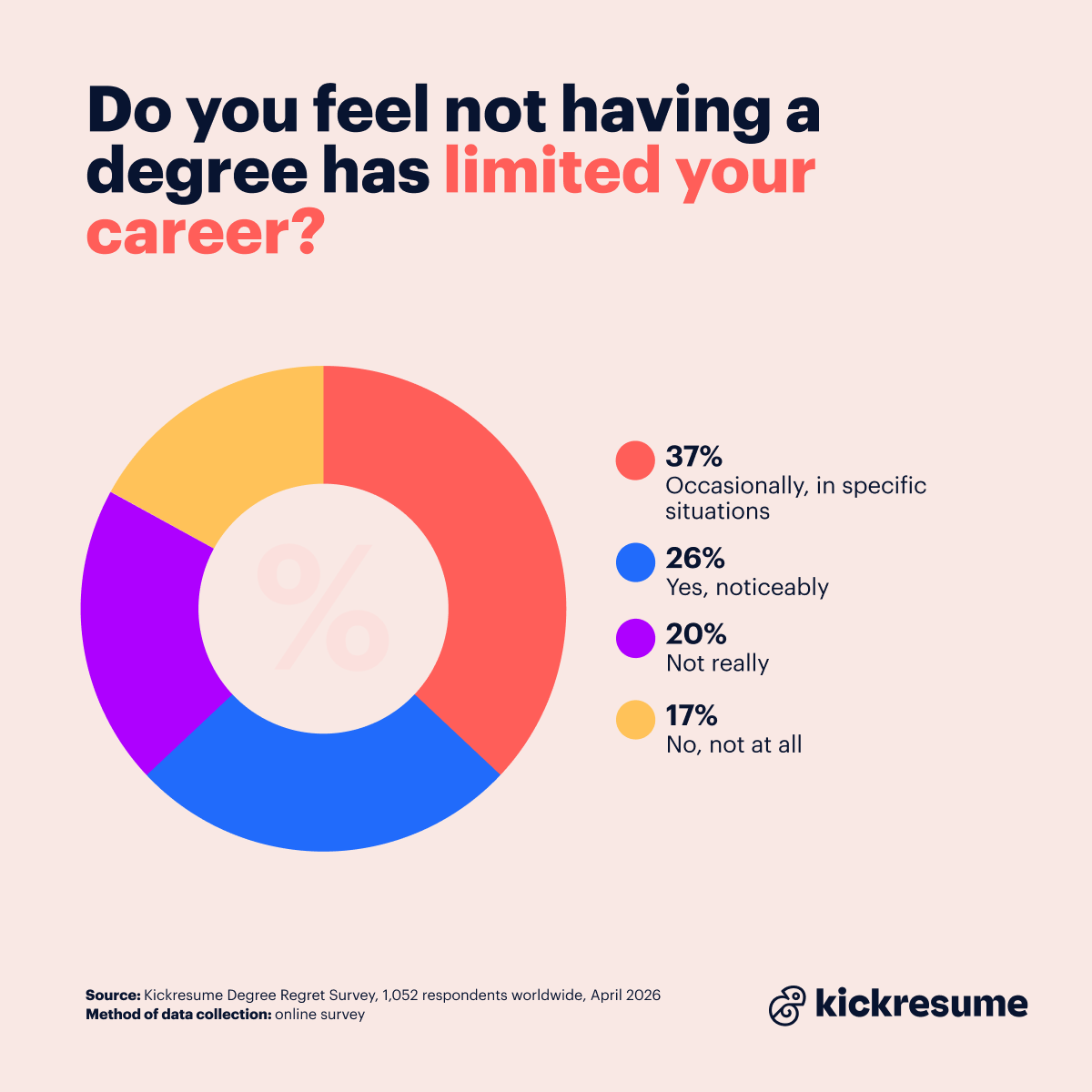
Having a degree can open more doors, and potentially put you ahead of candidates without one. While they’re not necessary for success, it seems the majority of people may have found having one useful at some point.
Regional trends in higher education
- Degree holders: The U.S leads with the highest percentage of those with degrees (28%) followed by Europe (26%), and Asia (19%).
- Alternative paths: Europe was found to have the highest percentage of non-degree holders (37%), followed by the U.S (30%) and Asia (10%).
- Leading industries for non-degree holders: Technology/IT/Software, Sales/Retail, and Hospitality/Tourism were found to be the most accessible industries for those that didn’t obtain a degree.
Final thoughts
The picture our survey paints is more nuanced than the old "degree vs. no degree" debate. Yes, degrees still open doors—but the data makes it clear that they're no longer the headline qualification they used to be. Only 6% of graduates say the degree itself was what helped their career most, while 36% credit work experience.
That doesn't mean college is losing its purpose. The knowledge people gain still sticks, and the connections, structure, and skills they build along the way still pay off in many careers. But it does mean the balance has shifted. Employers want proof you can do the job, not just proof that you studied for it.
For today's students and graduates, the takeaway is straightforward: a degree is no longer a finish line. It's a starting point—and what you build on top of it, through real work and real experience, is what increasingly defines a career.
Demographics
Age
- 29–44 (Millennials / Gen Y): 40%
- 18–28 (Gen Z): 32%
- 45–60 (Gen X): 23%
- 61–79 (Baby Boomers): 2%
- Under 18: 2%
Location
- Europe: 25%
- USA: 24%
- Asia: 20%
- Africa: 13%
- Latin America: 13%
- Australia / Oceania: 2%
Industry (Top 5)
- Technology / IT / Software: 21%
- Business / Management / Consulting: 12%
- Healthcare / Medicine: 8%
- Engineering / Manufacturing: 8%
- Marketing / Advertising / PR: 6%
Note
This anonymous online survey by Kickresume, conducted in April 2026, gathered insights from 1,052 respondents from around the world. All participants were reached via Kickresume's internal database.
About Kickresume
Kickresume is an AI-based career tool that helps candidates source jobs and raise salary with powerful resume and cover letter tools, skills analytics, and automated job search assistance. It has already helped more than 8 million job seekers worldwide.