


At Kickresume, we wanted to know how many people at a desk are quietly plotting a switch to something more hands-on—and what, if anything, would actually make them do it.
To get the full picture, we didn't just ask office workers: we surveyed 1,003 people spanning office workers, tradespeople, students, and the unemployed, so we could see the same question from every angle. And the answer that came back was sharper than the usual "people are burned out" story.
Half of all office workers have thought about trading their desk for manual labor. And the only thing holding them back isn't a lack of desire—it’s money.
Here are the key findings:
- 52% of office workers have considered leaving for a trade—18% think about it regularly, not just idly.
- Among those open to it, 96% would switch if retraining and lost income were covered—54% "immediately," 42% "seriously."
- The wall is financial. 43% name an expected salary drop as the single biggest barrier, far ahead of anything else.
- The dream job is farming. Given a free pass with no pay cut, 31% of office workers would pick farming or agriculture—more than any trade.
- The next generation isn't following. 84% of students still want an office-based career—walking toward the desk half of current office workers want to leave.
- Nobody told them trades were an option. Around half of office workers say school never presented trades as a serious path.
The desk-job itch is mainstream, not fringe
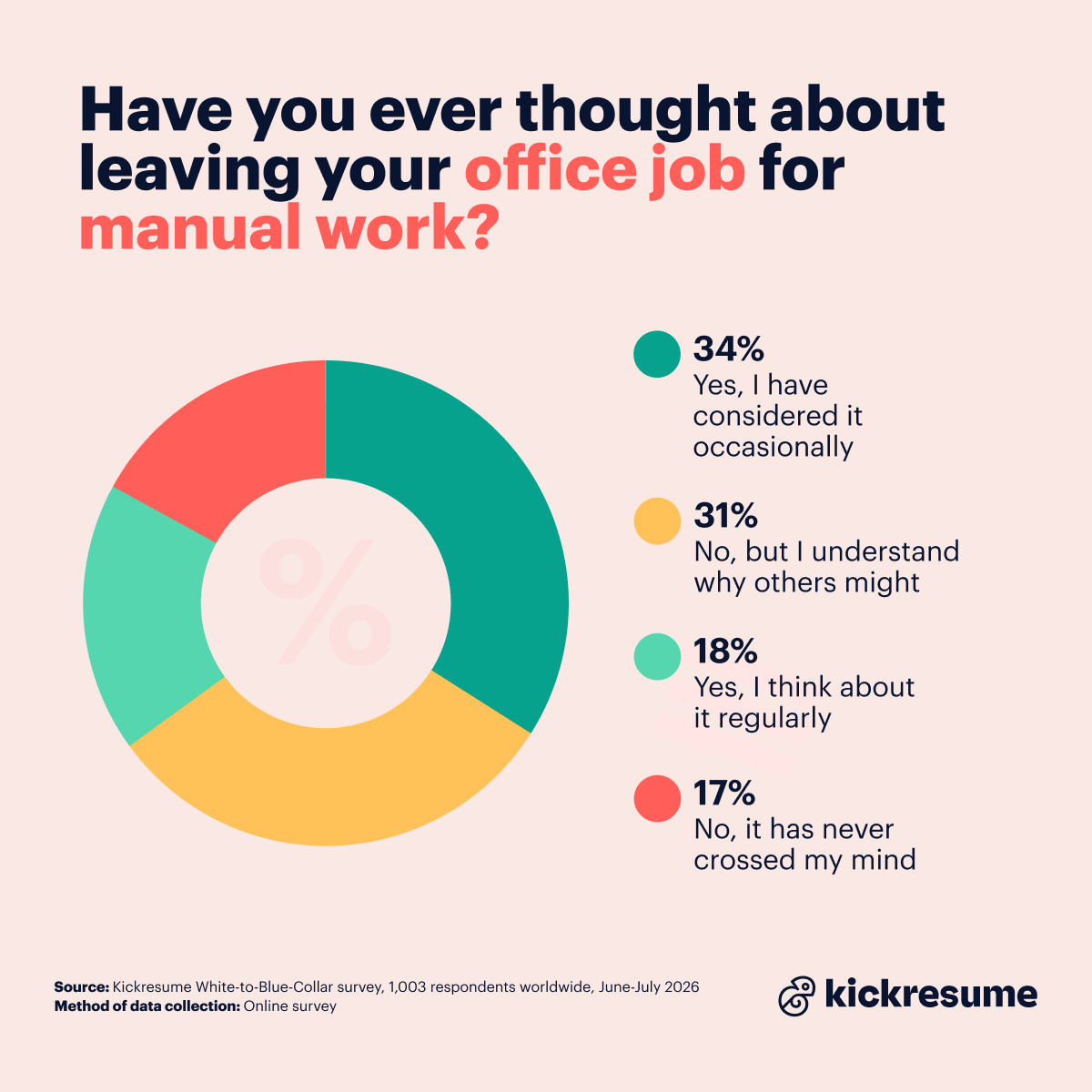
The instinct to leave an office job isn't a niche frustration—it's mainstream. Among the 517 office workers we surveyed, 52% have considered leaving for manual work—34% occasionally, and another 18% who say they think about it regularly. Only 17% say the idea has never crossed their mind.
The itch isn't spread evenly, though, and the clearest divide is age. Among office workers, 58% of Gen Z have considered leaving, against 53% of Millennials and 48% of Gen X—and the youngest are the most likely to think about it regularly, at one in five versus one in eight of Gen X.
The sharper divide is geographic. Asian office workers were far and away the most likely to be eyeing the exit—64% have considered leaving, against 48% in Europe and 46% in the US—and the most likely to think about it regularly (22%, versus 13% of Americans).
The desire runs hottest in Asia and coolest in the West, which means our "half of office workers" headline is really an average stretched across a wide spread.
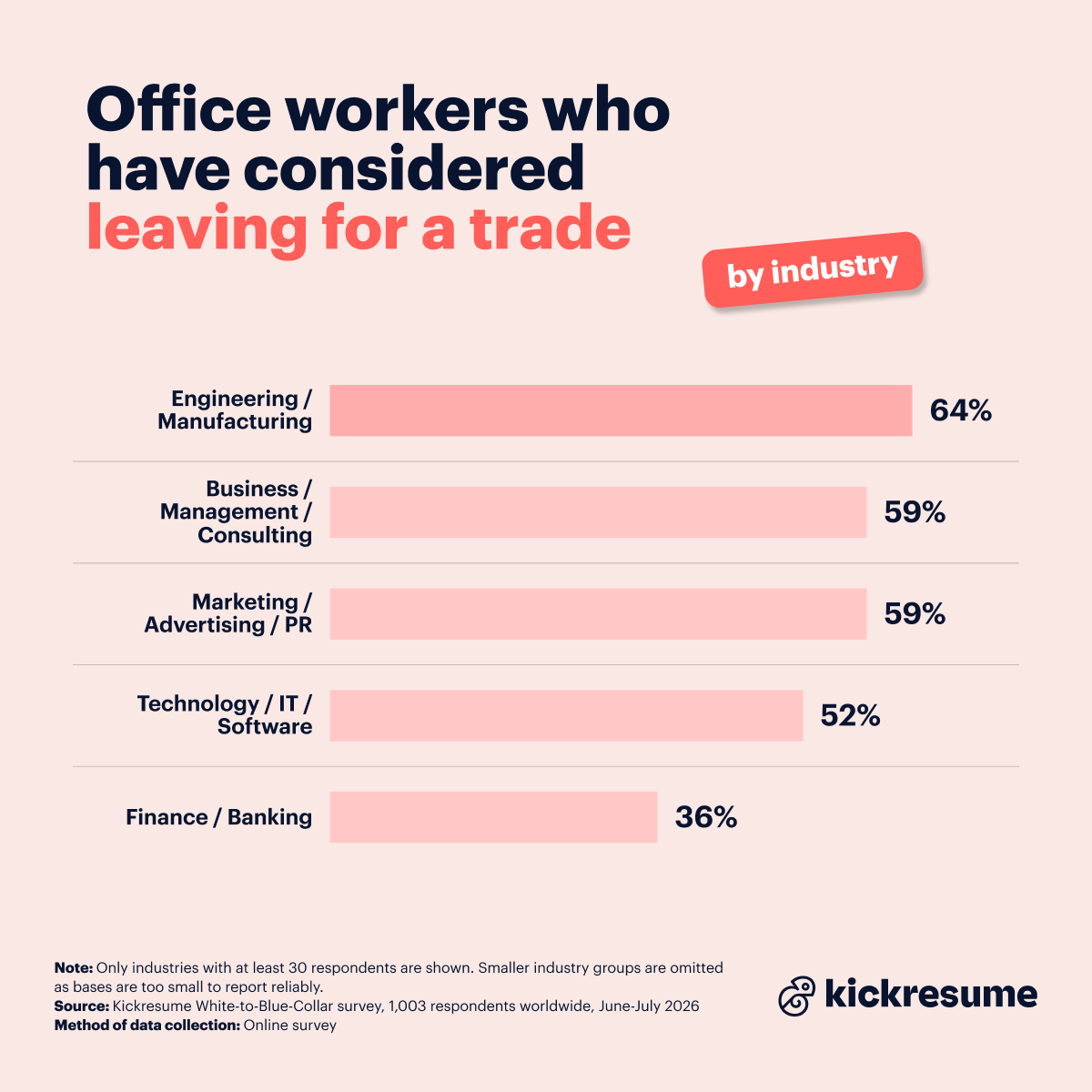
It splits by industry, too. Among office workers, the urge to leave runs deepest in the roles you would least expect: 52% of those in tech and IT have considered leaving for manual work, rising to around 59% in business and consulting.
Finance and banking were the notable holdouts, the only group where a clear majority hadn't thought about it (only 36% had). Ironically, the pull toward manual work is strongest among those whose jobs are furthest removed from anything you can actually touch.
Much of this is plain fatigue: 87% of the office workers open to leaving said stress or burnout had made them question their career at some point. And for many it set in early—28% say they started questioning office work within their first two years, and more than half within five, with no real spike at any later stage.
The doubt isn't a mid-career crisis that builds over decades; it shows up fast and simply never fully goes away. The desire to leave, in other words, is widespread and largely emotional in origin—a response to how the desk job feels, before it's about anything a trade might offer.
It's not about the pay—it's about meaningful work
Ask them why, and the answers aren't what you'd expect from a story about pay. When we asked the office workers open to leaving what their main reason would be, the top answer was meaning, not money: 23% pointed to wanting more meaningful or rewarding work, followed by physical or mental health (13%) and better work-life balance (12%).
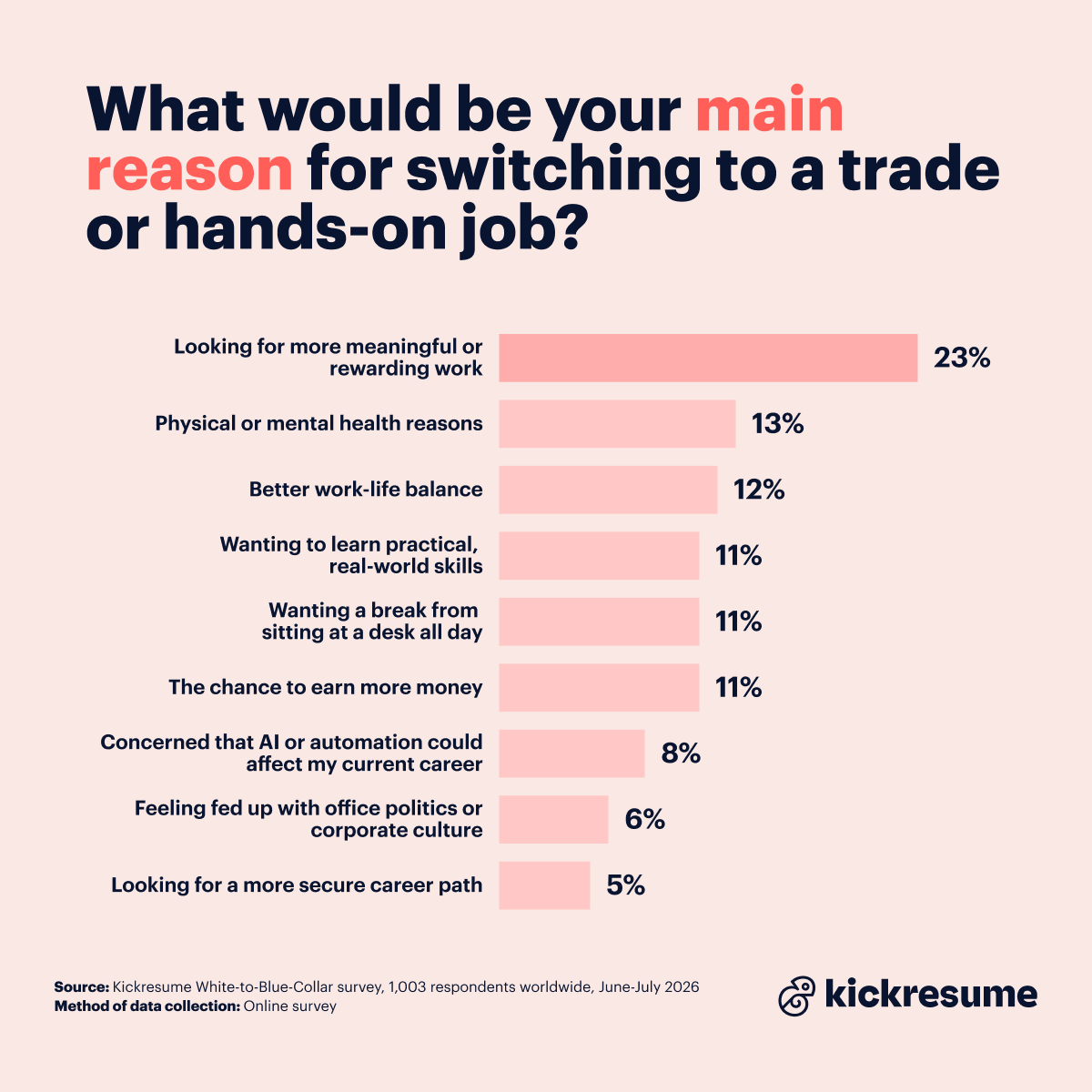
The chance to earn more came in at just 11%—tied with wanting a break from sitting at a desk all day.
And that ordering barely budges when you cut the data by who's answering. Meaningful work topped the list for men (22%) and women (25%), for every generation we measured, and on both sides of the Atlantic—named first by 27% of American office workers and 27% of European ones.
Wanting to earn more never climbed higher than fourth in any group, peaking at 17% among Gen X. Whatever the demographic, the pull toward a trade is about the work, not the wage.
Money is the wall—and the fantasy behind it
Money doesn't pull people toward a trade. But it's the main thing keeping them from actually making the move.
That's the real tension here. It's not that people are torn between meaning and money—they've already decided meaning wins. What holds them back is more practical: they can't afford the pay cut it would take to get there.
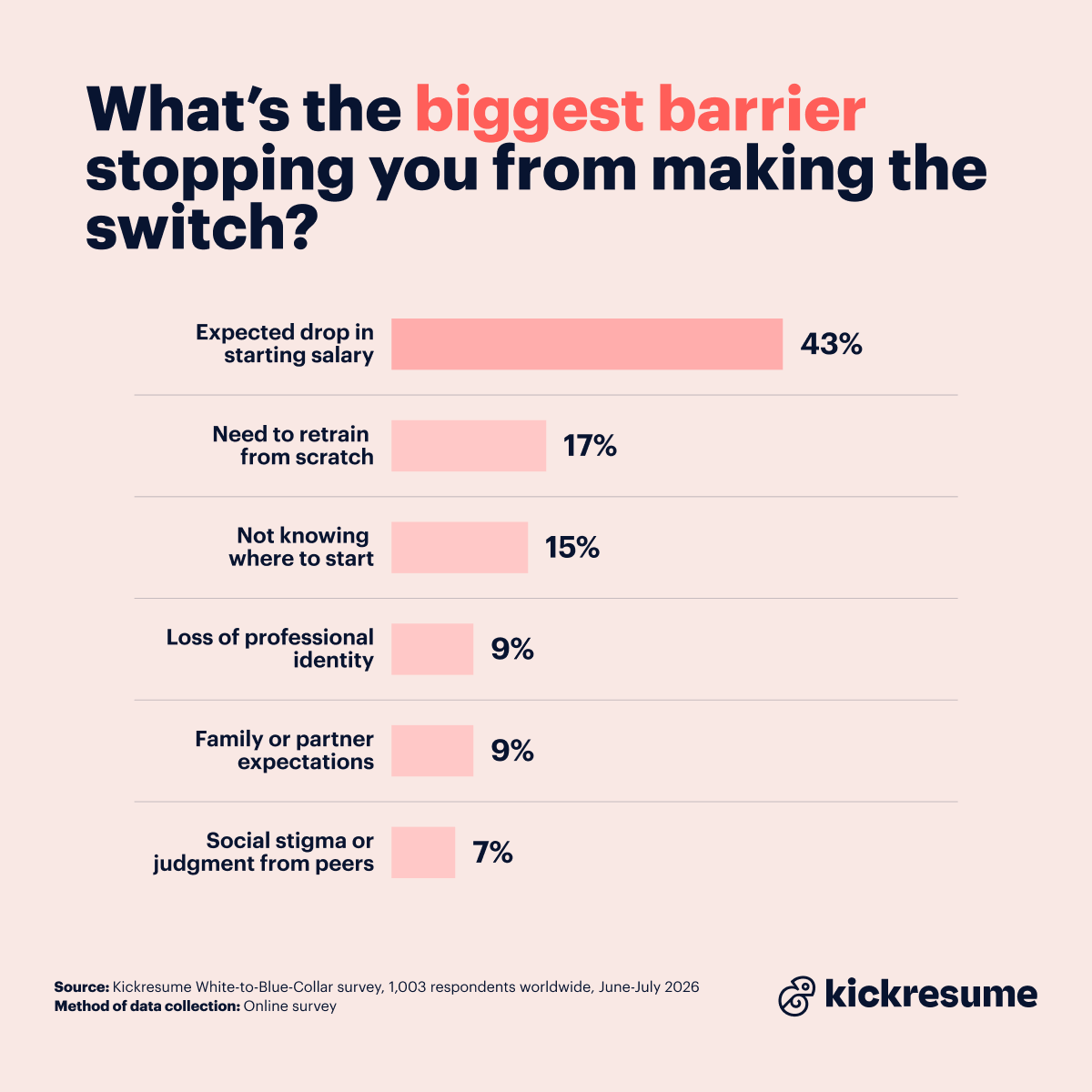
When we asked what's actually stopping workers from the desired switch, 43% named the expected drop in starting salary—more than the next three barriers combined. Retraining from scratch (17%) and simply not knowing where to start (15%) followed.
The softer barriers you might expect to dominate—loss of professional identity, family expectations, social stigma—trailed at 9%, 9%, and 7%.
So we asked the obvious follow-up: what if that wall came down? If retraining and lost income were fully covered, 96% of the office workers open to leaving said they'd switch—54% immediately, 42% after serious consideration. Only 4% said they'd probably stay put.
That's the finding that reframes everything. It's not that people are unsure about the trades—they just can't afford to give them a try.
And here's what makes that wall even stranger: many of these people don't even believe trades pay less. Among the office workers open to leaving, 37% think tradespeople earn more than they do, and another 24% think earnings are roughly comparable.
The real barrier isn't the career itself—it's getting there. It's the pay cut on the way in, the years of retraining, and the gap before the new career starts paying off.
Ask a desk worker their dream job—the answer is farming
If money were no object, where would office workers actually go? We asked them to pick a hands-on career they'd switch to tomorrow if it cost them no pay—and the answers were more pastoral than practical.
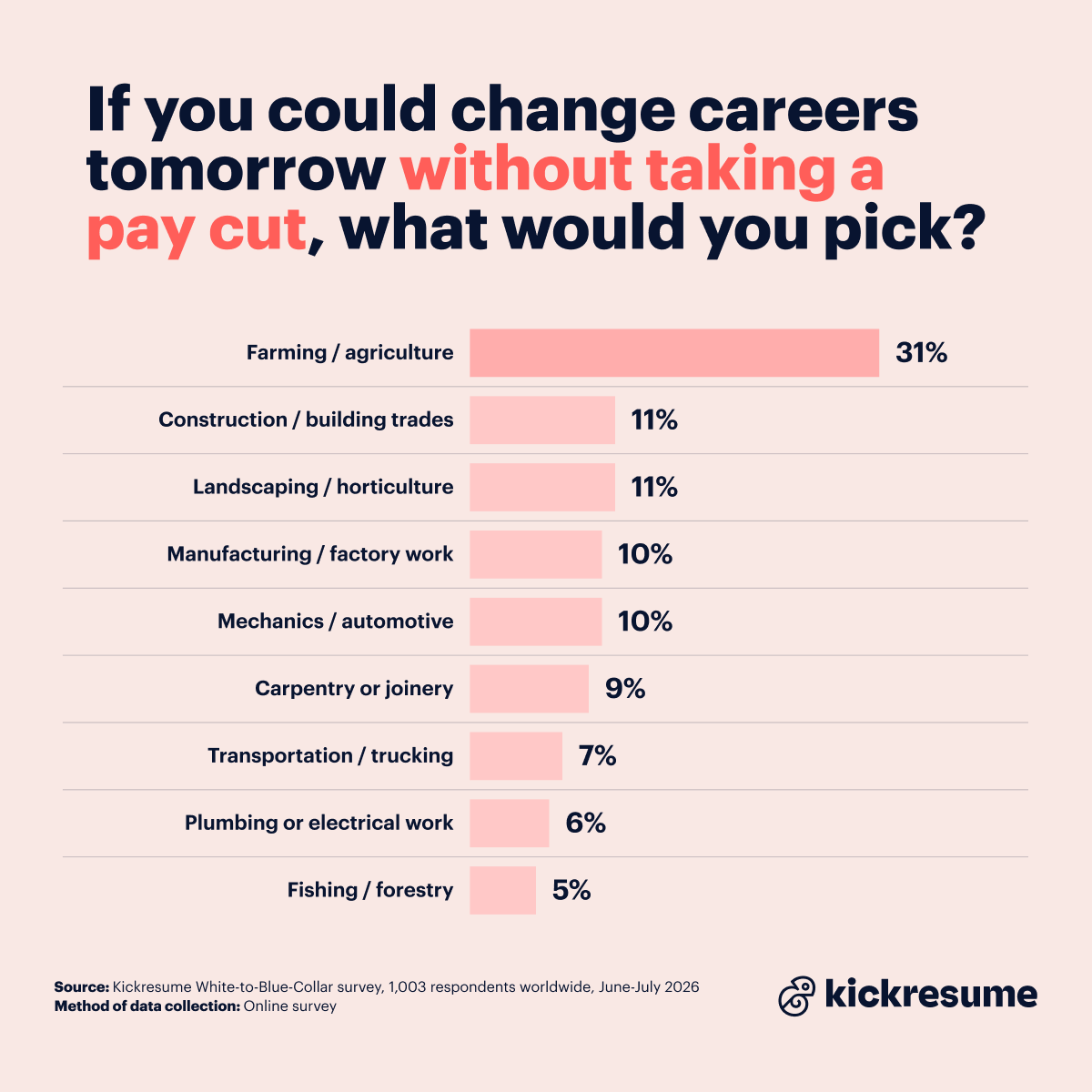
Farming and agriculture led at 31%, well ahead of construction (11%), landscaping (11%), manufacturing (10%), and mechanics (10%). The office escape fantasy, it turns out, looks less like a job site and more like a field.
And the dream skews young. Nearly half of Gen Z office workers (45%) picked farming, against 28% of Millennials and just 22% of Gen X—so the workers most likely to be eyeing the exit are also the ones romanticizing the land the hardest.
It shows up geographically too: farming topped every region but spiked to 43% in Asia, the same place the urge to leave ran hottest. Whatever farming represents here—space, autonomy, working with your hands, distance from a screen—it's pulling strongest on exactly the people most eager to go.
Students still want the office their parents are fleeing
Now the twist. If half of office workers are eyeing the exit, you'd expect the people about to enter the workforce to have gotten the message. They haven't.
When we asked students which path felt most appealing, 84% chose an office-based professional career. Every trade combined—mechanics, plumbing and electrical, construction, farming, transport, landscaping—accounted for the remaining 16%.
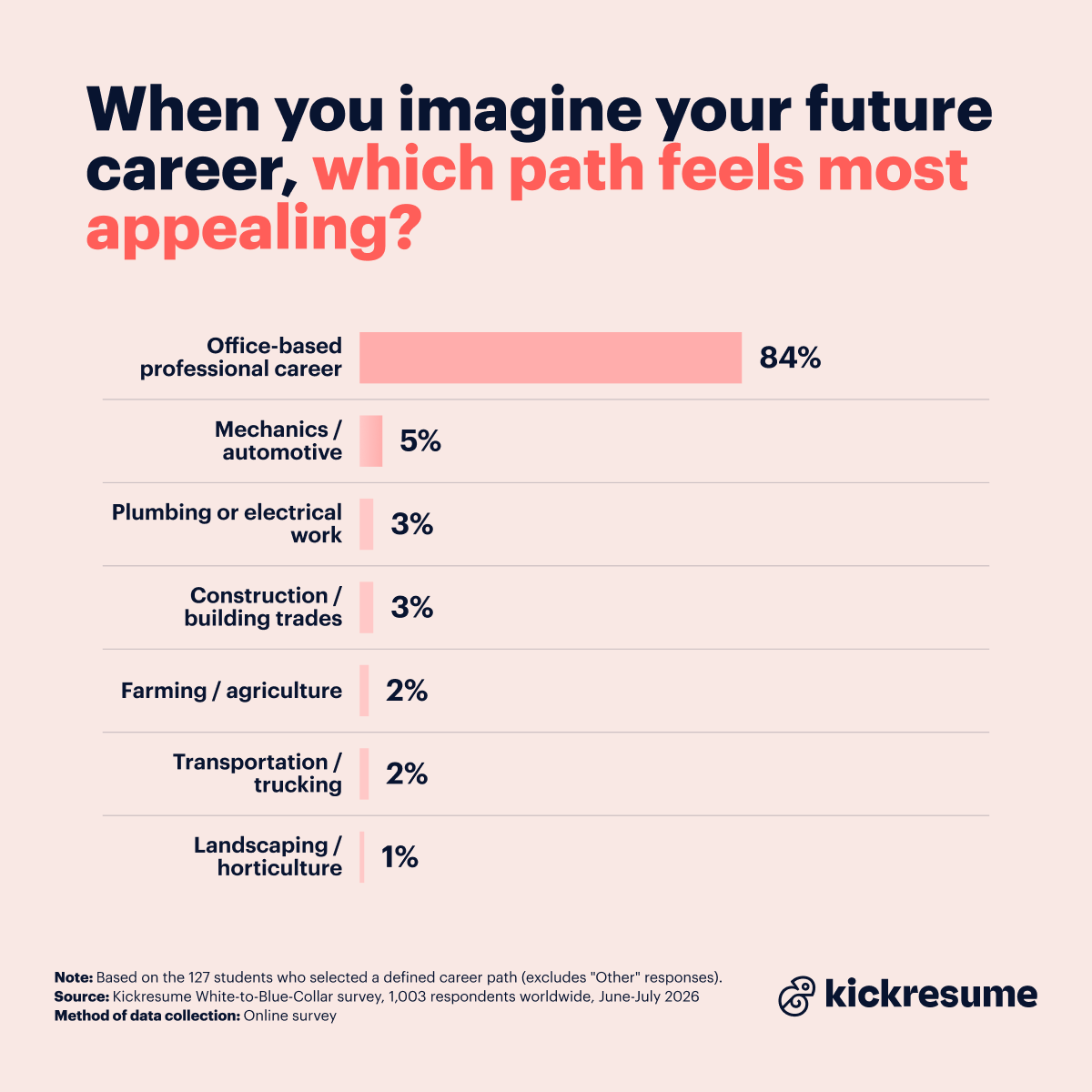
So the next generation is walking toward the exact desk that half the current one wants to leave. It's not that students think trades pay badly, either: 55% believe tradespeople earn as much as or more than university-educated professionals. They know the money can be there. They're choosing the office anyway.
Nor is it fear of judgment. Asked whether they'd be embarrassed to tell people they'd picked a trade over a degree, 45% said they wouldn't care what anyone thought, and only 11% said they'd feel embarrassed. Whatever's steering them toward the desk, it isn't a stigma they'd admit to.
What may be steering them is what they were shown—or weren't. Among students, 42% say trades were never seriously discussed at their school, and another 28% say trades came up but academic careers were clearly the favored path.
Only one in five say the two were presented as genuine equals. So the generation defaulting to the office is also the one that was quietly pointed there: a full career category filtered out before most of them were old enough to weigh it.
That's the loop worth sitting with. Current office workers are looking for the door. The students behind them are walking in—not because they've judged the trades and found them wanting, but because, for most, the trades were never really put on the table.
Nobody told them trades were an option
The students aren't unusual. That same filtering—never having the trades put on the table as an option—shows up across almost every group we surveyed.
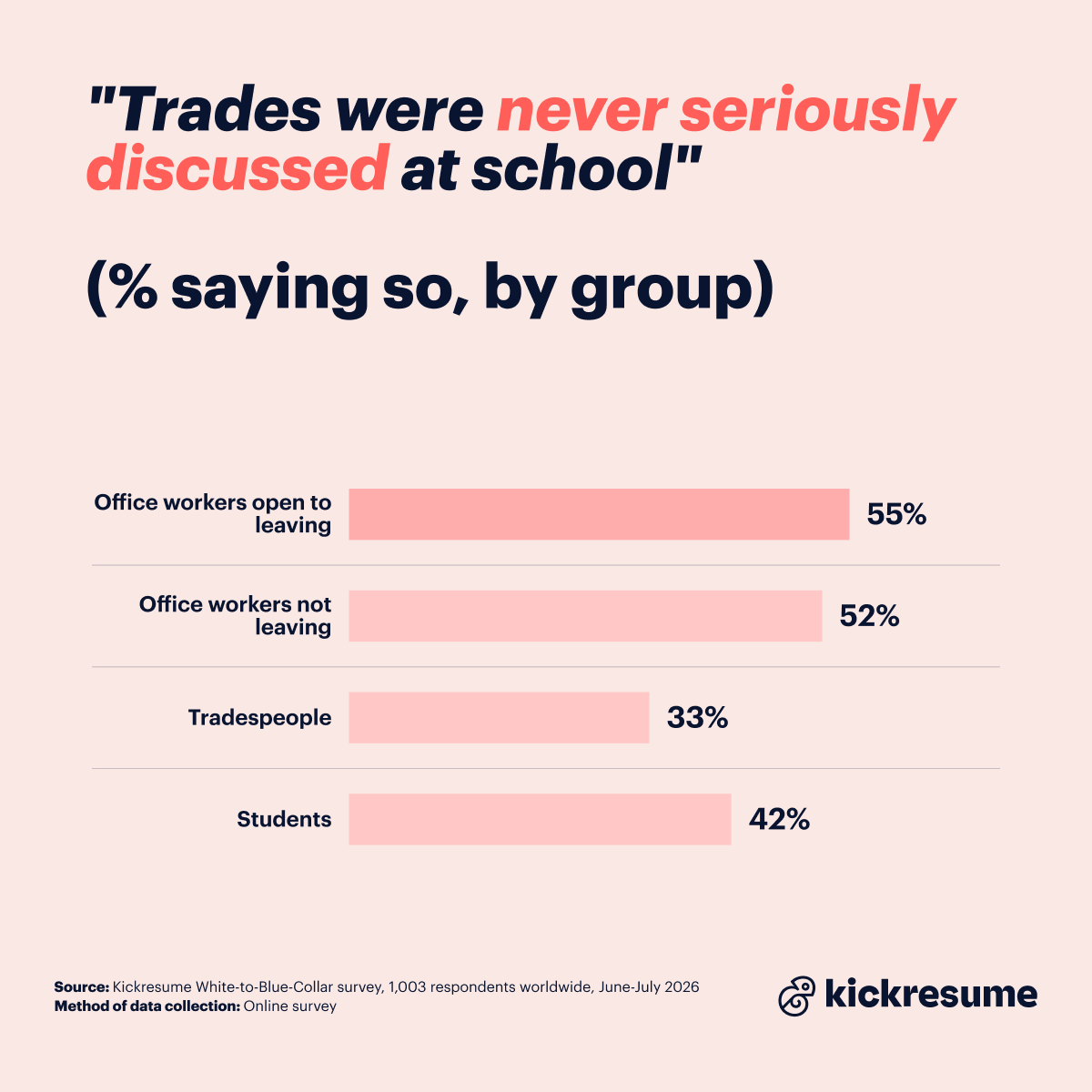
Among office workers open to leaving, 55% say trades were never seriously discussed at school. Among those not looking to leave, it's 52%. Tradespeople themselves report this least often—just 33%—though even that means one in three had trades screened out of their own schooling.
Whatever your age, situation, or how you feel about your job today, the pattern holds across every group, even if unevenly: for a meaningful share of everyone we asked—from a third of tradespeople to more than half of office workers—a whole category of work was screened out early.
That early filtering may echo further down the line. Even among office workers who aren't looking to leave, only 31% said they'd steer their own kids toward an office career—23% would lean toward a trade, and a full 46% had no preference either way. Even people content to stay at their desks don't treat it as the obvious win anymore.
People think trades get less respect—but wouldn't be ashamed to switch
Ask everyone, not just the would-be switchers, and an attitude gap shows up. Across all 1,003 respondents, 47% think skilled tradespeople get less respect than office workers. Only 7% think they get more; 29% see it as about equal.
But here's the part that complicates the familiar "trades are looked down on" narrative: the stigma seems to weigh far less on the individuals than the topline suggests. Among the office workers open to leaving, 67% said they wouldn't care what their colleagues thought if they switched to a trade.
Only 11% said they'd feel embarrassed. The students told us much the same—45% wouldn't care, and just 11% would feel embarrassed to pick a trade over a degree.
So there's a real perceived respect gap—people believe society values trades less—but when it comes to their own decision, most say the judgment of others wouldn't stop them. The shame, in other words, is smaller than the stereotype.
The grass is greener both ways: most tradespeople have eyed an office job
It would be easy to turn all this into a tidy grass-is-greener story: unhappy office workers dreaming of honest, hands-on work. The people already doing that work complicate it.
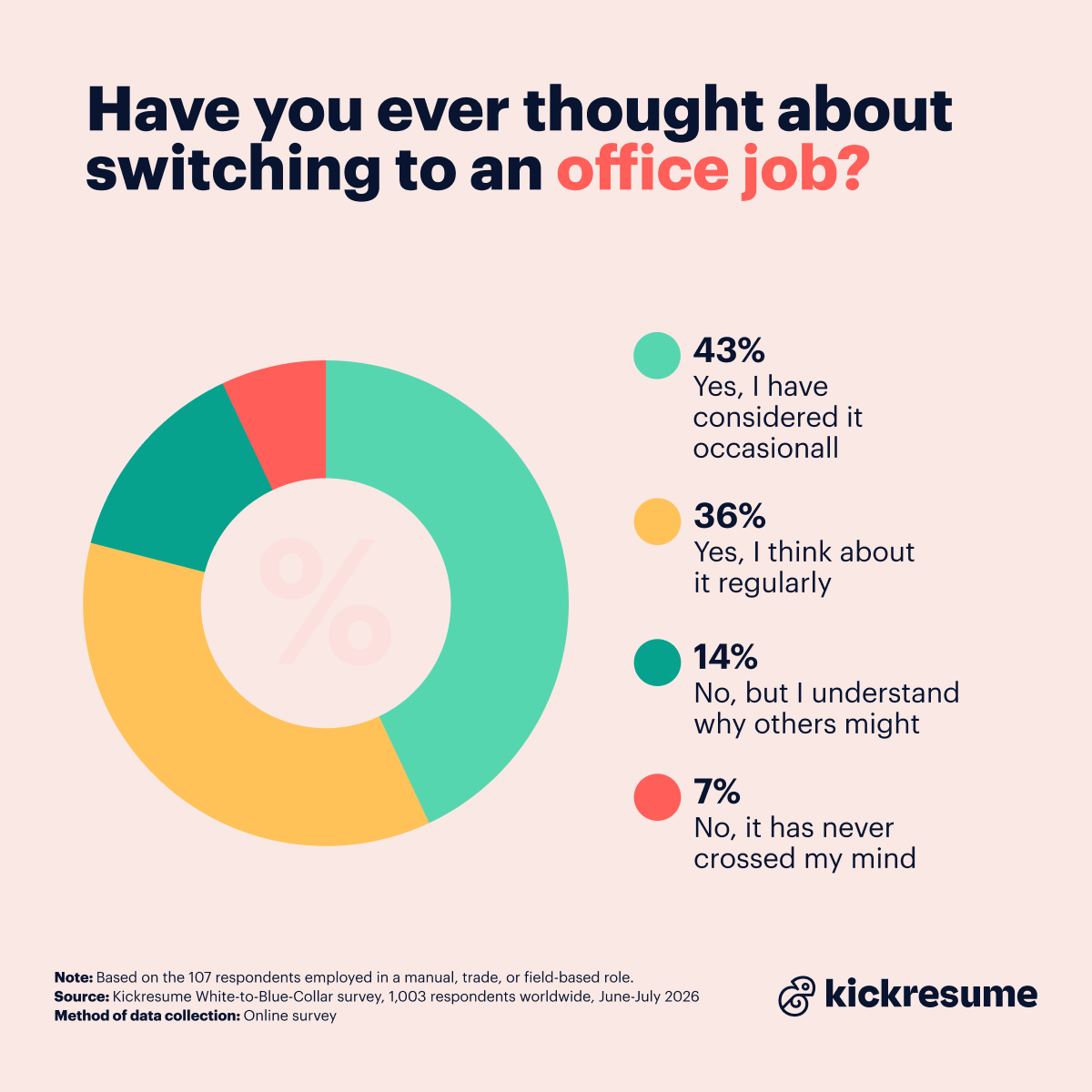
Among the 107 tradespeople we surveyed, 79% have thought about switching to an office job—36% of them regularly. That's a higher rate of "considering the other side" than the office workers showed.
The unemployed tell a more open-ended story. Of those who came from an office or mixed background, 46% now wish they'd pursued a trade—16% strongly.
And three in four are open to retraining into one as part of their current job search: 51% say they're open to it, and another 24% are already actively exploring it. For people between jobs, the trade path isn't a fantasy so much as a live option they're weighing right now.
But that daydreaming doesn't mean regret. Asked what they'd encourage their own child to do, nearly half of tradespeople (49%) leaned toward a trade—36% fully so—against just 26% who'd point a child toward an office.
Whatever pull the desk job has for them personally, they'd still steer the next generation into the work they know. It's the mirror image of the office workers a few sections up, who mostly wouldn't push their own kids toward a desk.
Final thoughts
The desire to leave is mainstream (52% of office workers have considered it), driven more by meaning and burnout than by money. The thing stopping people is money—specifically the cost of the transition, not the pay at the destination, which many believe is already competitive.
People think society looks down on trades, but most say they wouldn't actually care if it were their own choice. And a lot of this traces back to school: about half the people we asked say trades were never seriously presented as an option. That's probably why 84% of students are still choosing an office career today.
For job seekers, the practical read is that the barrier to a career change is usually the transition cost, not the ceiling—worth checking what a trade actually pays before ruling it out on assumption.
For employers and schools, the gap between "half have considered it" and "almost none have done it" is a lot of motivated talent sitting on the wrong side of a wall that's mostly financial.
Demographics
Age
- 18–29 (Gen Z): 31%
- 30–45 (Millennials / Gen Y): 45%
- 46–61 (Gen X): 21%
- 62–80 (Baby Boomers): 1%
- Under 18: 2%
Gender
- Man: 67%
- Woman: 33%
- Non-binary or other: 1%
Location
- Asia: 30%
- USA: 24%
- Europe: 22%
- Latin America: 11%
- Africa: 8%
- Canada: 4%
- Australia / Oceania: 1%
Industry (Top 5)
- Technology / IT / Software: 20%
- Business / Management / Consulting: 13%
- Engineering / Manufacturing: 10%
- Education / Academia: 6%
- Finance / Banking / Creative / Media: 5% (tied)
Note
This anonymous online survey by Kickresume, conducted in June-July 2026, gathered insights from 1,003 respondents from around the world. All participants were reached via Kickresume's internal database.
About Kickresume
Kickresume is an AI-based career tool that helps candidates source jobs and raise salary with powerful resume and cover letter tools, skills analytics, and automated job search assistance. It has already helped more than 8 million job seekers worldwide.