


Resume writers around the world are noticing the same thing in their inboxes: applications that read smoothly, hit all the right buzzwords, and sound suspiciously like every other resume that landed yesterday.
To find out how AI is reshaping resume writing, the Professional Association of Resume Writers & Career Coaches (PARWCC), in collaboration with Kickresume, surveyed resume professionals about what they're seeing in client submissions, what's working, what's broken, and how their own jobs are changing in real time.
Here's what we found:
- 67% of resume writers now see AI-generated content in client resumes—the single most common trend in the industry today.
- Generic, boilerplate content has overtaken typos as the #1 resume issue (63% vs. just 8%).
- 57% of resume writers see AI-generated resumes "always" or "often"—and not a single respondent said "never."
- 86% say AI has improved their workflow—and 69% see AI as a tool or opportunity, not a threat.
- Longer resumes are making a comeback: nearly 1 in 3 writers report seeing more two-page-plus applications.
- 24% of resume writers are seeing more resumes built around personal branding and storytelling.
Most resume writers spot AI in client resumes, 1 in 3 see longer resumes
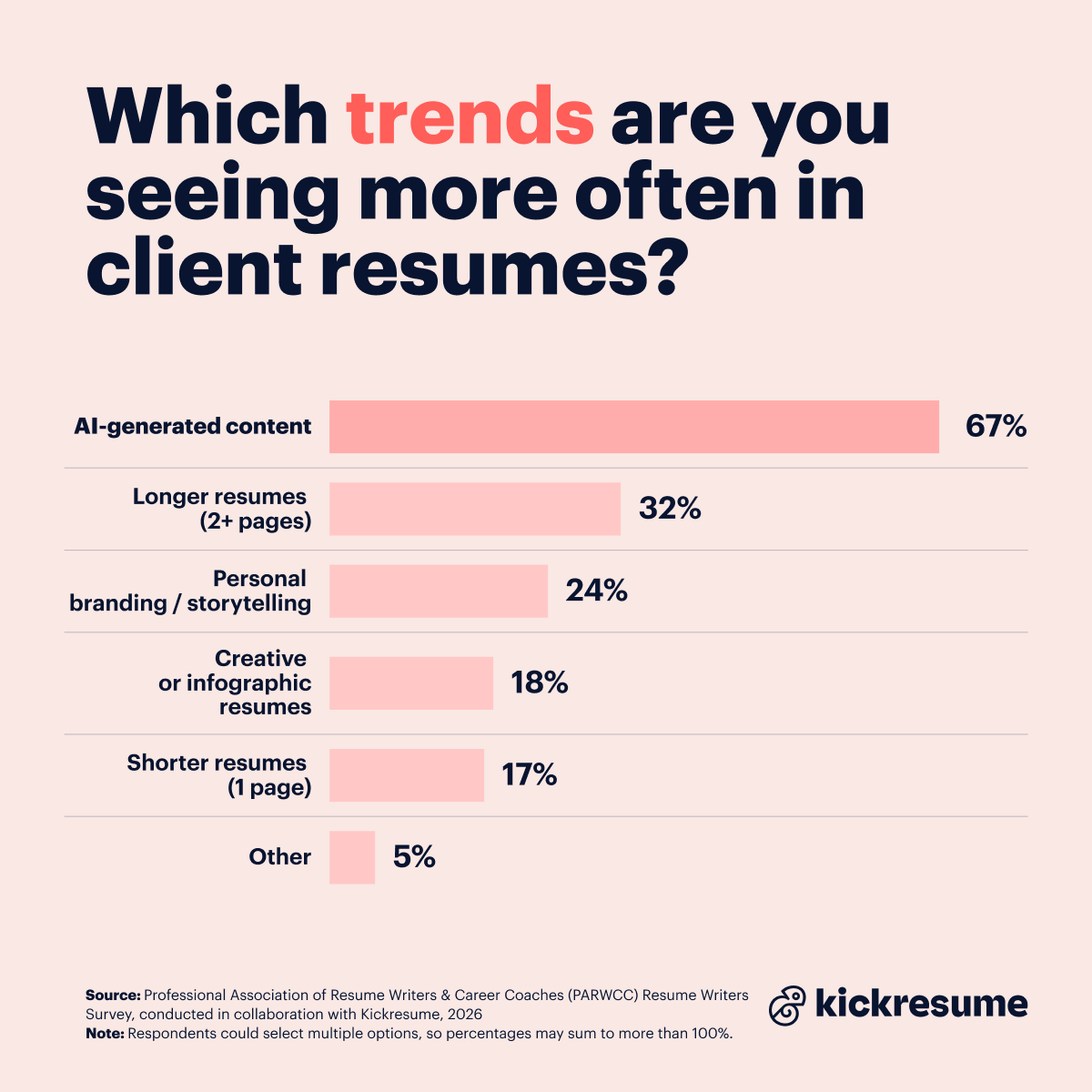
Ask any resume professional what they're seeing most in client submissions these days, and the answer comes back loud and clear: AI-generated content. 67% of respondents flagged it among the trends they see most often.
And it's not just resume writers picking up on it. In an earlier Kickresume survey of 1,004 job seekers and HR professionals, 44% of HR respondents said they can spot AI use in a CV easily, and another 45% said they can tell at least sometimes. In other words, both sides of the desk are noticing the same thing.
But AI isn't the only thing changing. Resumes are also getting longer, more personal, and in some cases, more visually creative:
- 32% of writers say they're seeing more two-page-plus resumes—pushing back against the old "one page or bust" rule.
- 24% report a rise in applications built around personal branding or storytelling.
- 18% are seeing more creative or infographic-style resumes.
- 17% still see shorter, one-page resumes leading the pack.
What's the through-line here? Candidates are experimenting. With AI handling the heavy lifting on wording and structure, job seekers are free to play with length, voice, and design in ways they wouldn't have dared a few years ago.
But there's a catch.
Generic content tops the list: 63% of writers say resumes all sound the same
For years, the bane of every resume writer's existence was the humble typo—that rogue comma, that misspelled job title, that "manger" instead of "manager." Not anymore.
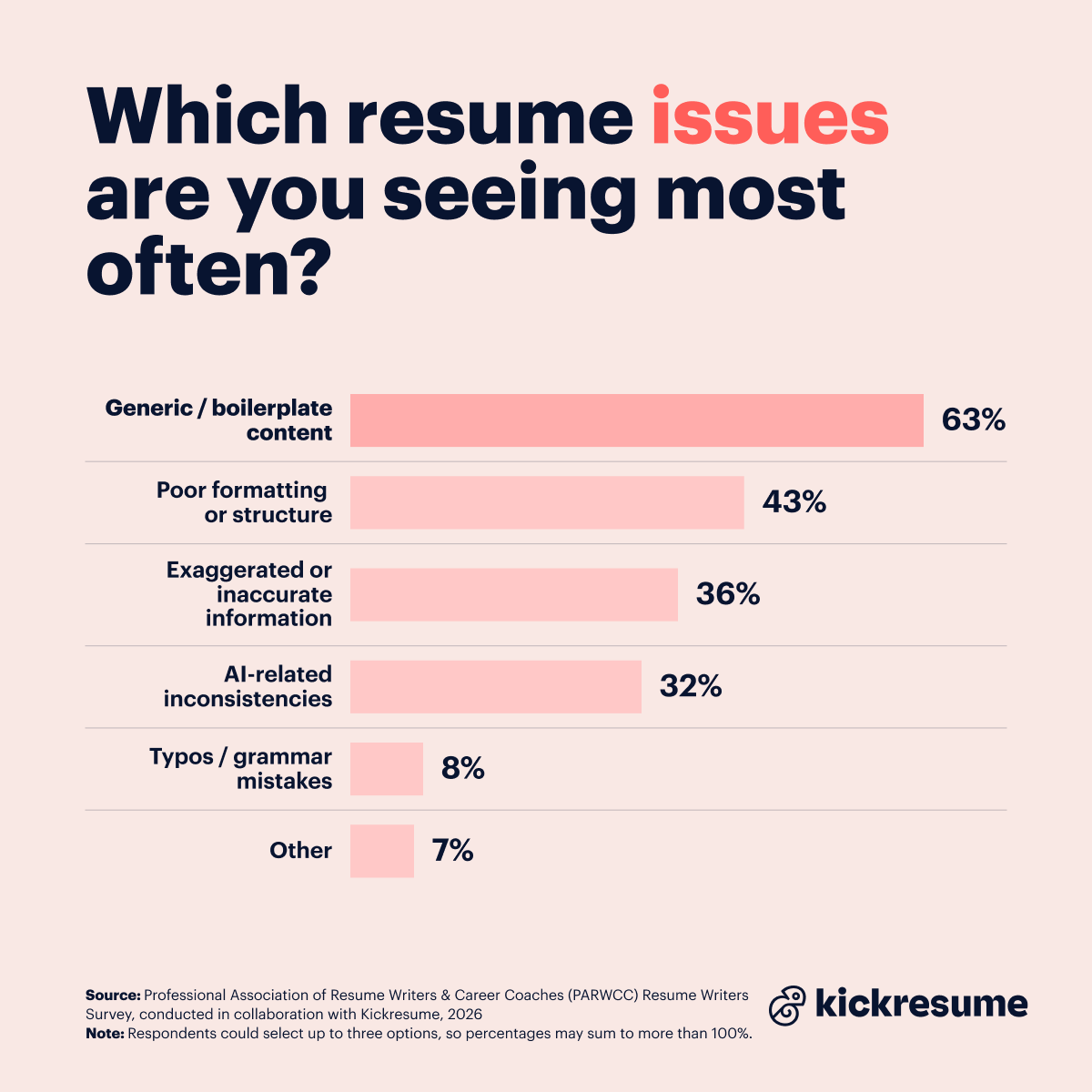
Today, only 8% of resume professionals say typos and grammar mistakes are the most common issue they see. AI has all but killed the spelling error.
The new villain? Generic, boilerplate content.
- 63% of writers say generic or boilerplate phrasing is now the most common problem in client resumes.
- 43% point to poor formatting and structure.
- 36% flag exaggerated or inaccurate information.
- 32% spot AI-related inconsistencies—like tense shifts, mismatched tones, or achievements that don't quite add up.
In other words: resumes read more polished than ever, but they're starting to blur together. The same power verbs. The same "results-driven professional with a proven track record."
This may explain why personal branding and storytelling are on the rise. Candidates (and the resume professionals who help them) are realizing that even with AI’s efficiency, human insight still matters. Adding context, unique achievements, and your own voice is what makes a resume stand out.
1 in 5 resumes are now much more likely to exaggerate achievements
Boilerplate content isn't the only thing resume writers are catching more of these days. As AI makes it easier than ever to write impressive-sounding bullet points, writers are also noticing a more delicate trend—exaggeration.
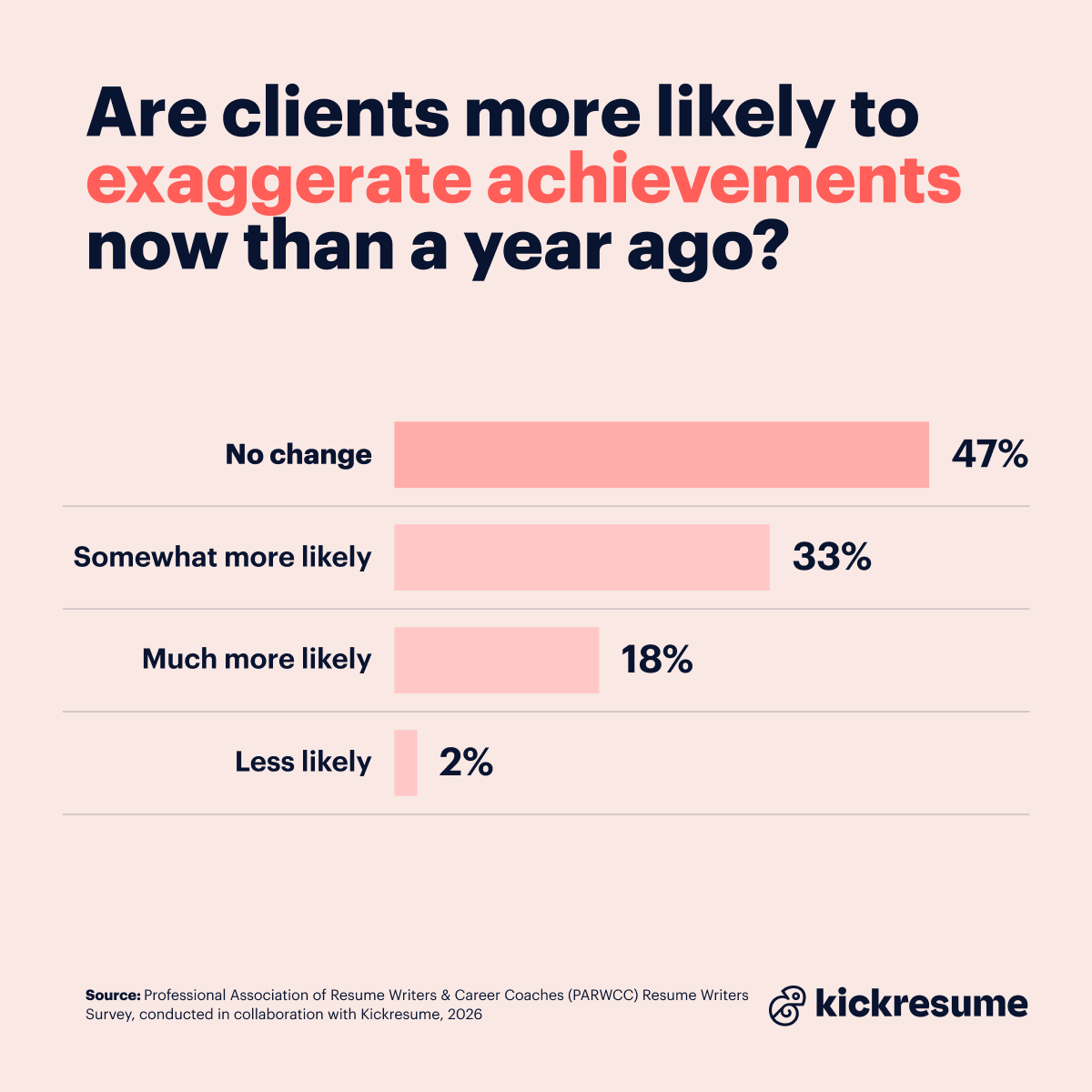
We asked them whether clients are more likely to exaggerate their achievements now than they were a year ago. The answer is a clear yes for half the industry:
- 18% say clients are much more likely to exaggerate.
- 33% say they're somewhat more likely.
- 47% see no change.
- Just 2% say clients are less likely to exaggerate.
More than half of resume writers (51%) say client exaggeration is on the rise.
This lines up neatly with what Kickresume found earlier in its Resume Trends Survey: 39% of job seekers said they'd use an AI-suggested "tiny lie" on their CV if they could justify it.
On the HR side, 39% of recruiters estimate that exaggeration shows up in 26–50% of the CVs they read, and another 31% put the number even higher.
Why is this happening? When strong wording is easier than ever to access, the line between confidently presenting a real achievement and quietly inflating it gets thinner. A bolder verb here, a more impressive-sounding phrase there—and a routine task can start to read like a strategic initiative if no one's keeping the story honest.
This is exactly where resume professionals add real value alongside AI tools. Polished language is easy to come by. But verifiable, accurate, and believable achievements still take a human eye—someone who can tell when a bullet point has drifted from confident to questionable, and pull it back before a recruiter does.
For job seekers, the lesson is worth taking seriously. Recruiters are getting just as comfortable with AI tools as candidates are. And the screening doesn't take long. A separate Kickresume survey found that 62% of recruiters admit to rejecting candidates without fully reading their CV—usually because key requirements (or inconsistencies) jump out within the first 30 seconds.
For more than half of resume writers, reviewing AI-generated client drafts is now a regular part of the job
The reason these shifts are showing up at all is simple: AI-assisted resumes aren't a fringe trend anymore—they're the new default.
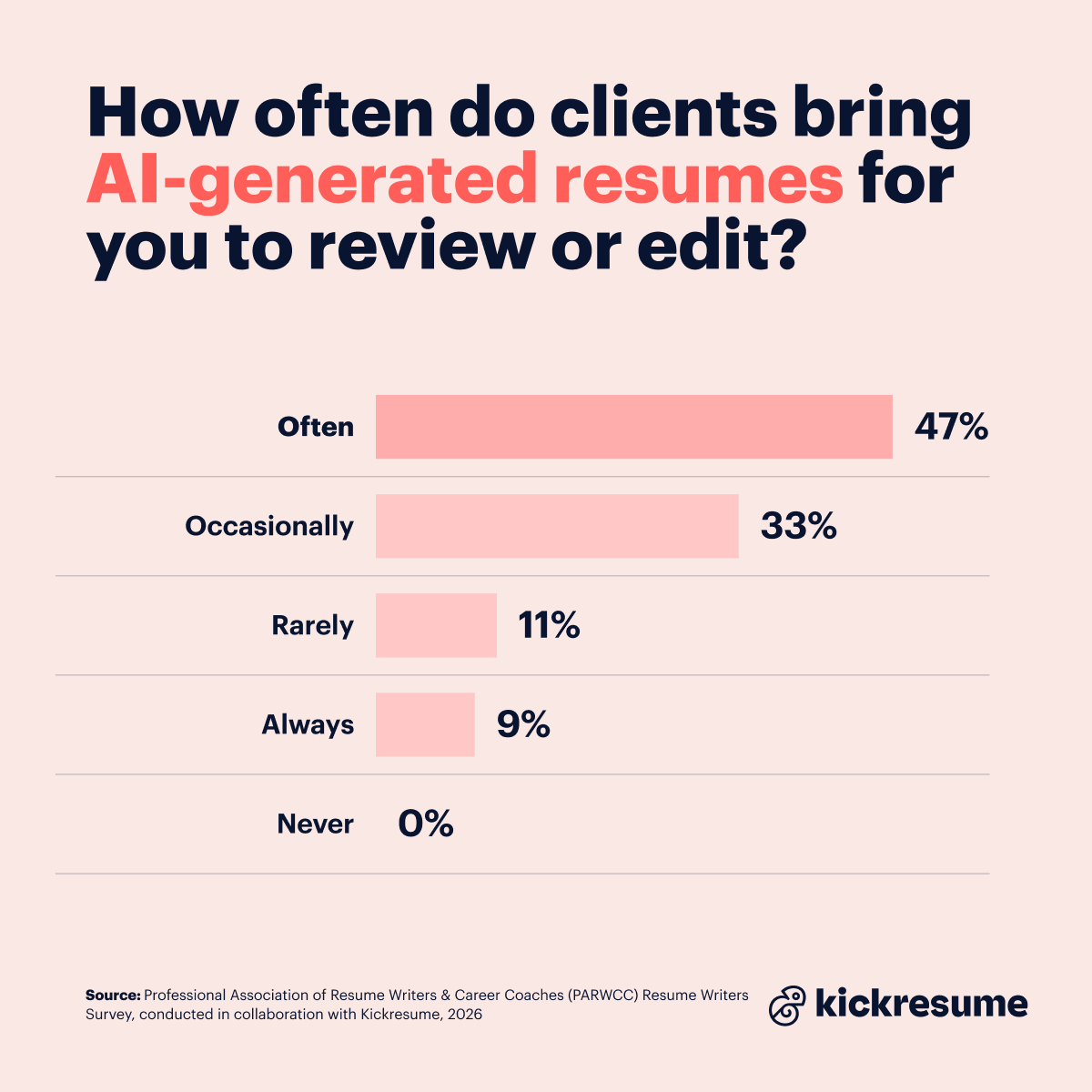
Just how common are AI-generated resumes in day-to-day client work? Very. More than half of resume writers (57%) see them always or often, while not a single respondent reported never seeing them.
- 47% say they see AI-generated resumes often.
- 33% see them occasionally.
- 11% see them rarely.
- 9% see them always.
- 0% say they never see them.
For resume professionals, this means the job itself is shifting. Instead of building resumes from scratch, they're increasingly acting as editors and translators—taking AI-generated drafts and shaping them into something that actually reflects the candidate behind the words. Tightening structure, sharpening the wording, adding real achievements, and making sure the final product sounds like the candidate, not just the tool that helped them write it.
86% of resume writers say AI improved their workflow—and only 16% see it as a threat
Here's where the story gets interesting. You might expect resume professionals (whose livelihoods depend on writing) to be cautious about AI. But the data tells a very different story, starting with how it's already changed the way they work.
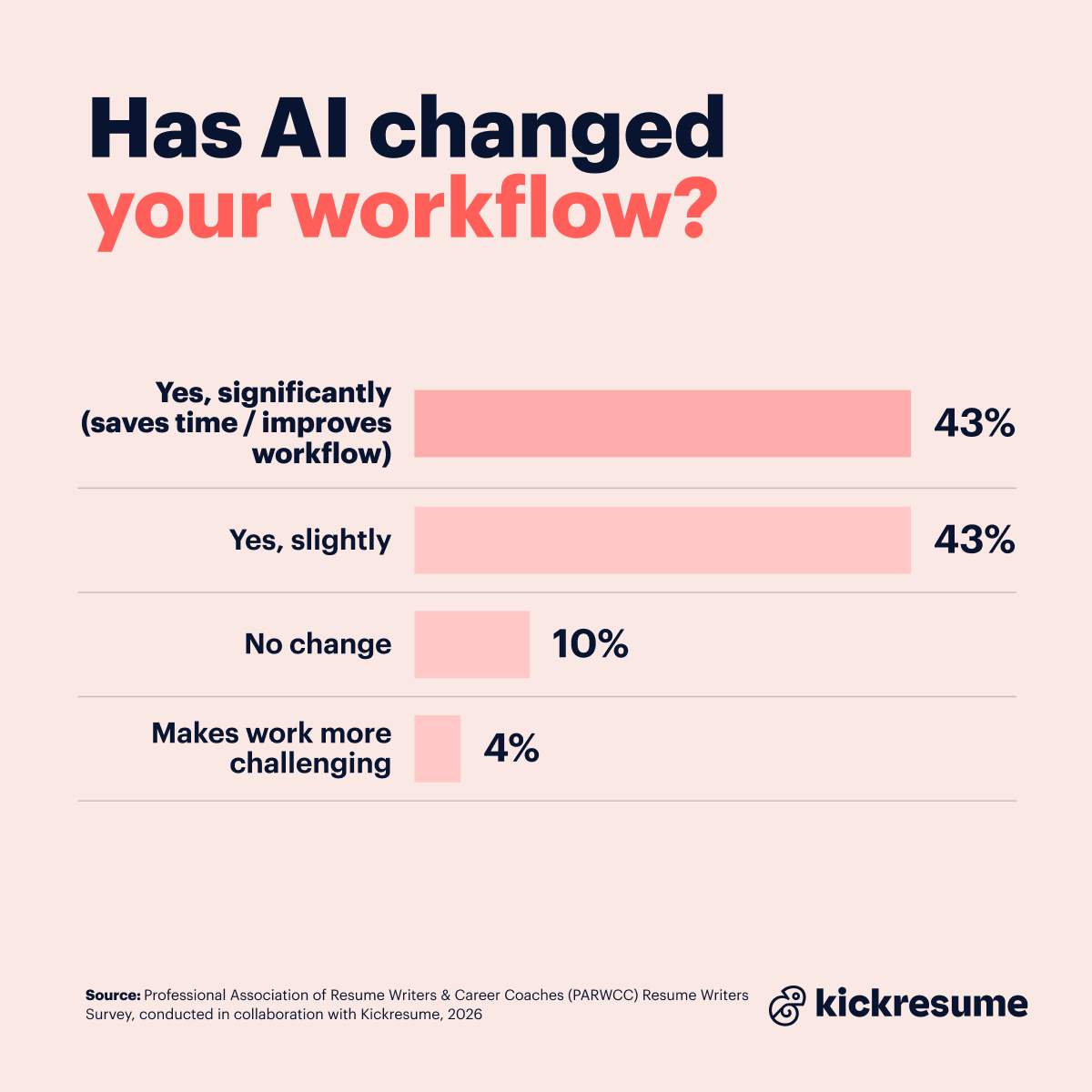
A combined 86% of resume writers say AI has improved their workflow, with 43% calling the improvement significant and another 43% reporting a slight improvement. Only 4% say AI has made their work more challenging.
- 43% say AI has significantly improved their workflow (saves time, smoother process).
- 43% report a slight improvement.
- 10% see no change.
- Just 4% say AI has made their work more challenging.
Resume writers aren't the only ones sold on AI. In our Resume Trends Survey, 78% of job seekers rated AI as at least moderately helpful for CV writing, and 52% called it very helpful or essential.
It turns out AI isn't just changing what resumes look like—it's giving the resume professionals behind them a serious productivity boost, too. AI handles the grunt work—drafting, wording, brainstorming—freeing up writers to focus on the craft side of the job: strategy, storytelling, and helping candidates find their authentic voice.
And it's not just the workflow benefits that have won resume writers over—when asked directly how they see AI, most of the industry takes a clearly positive view.
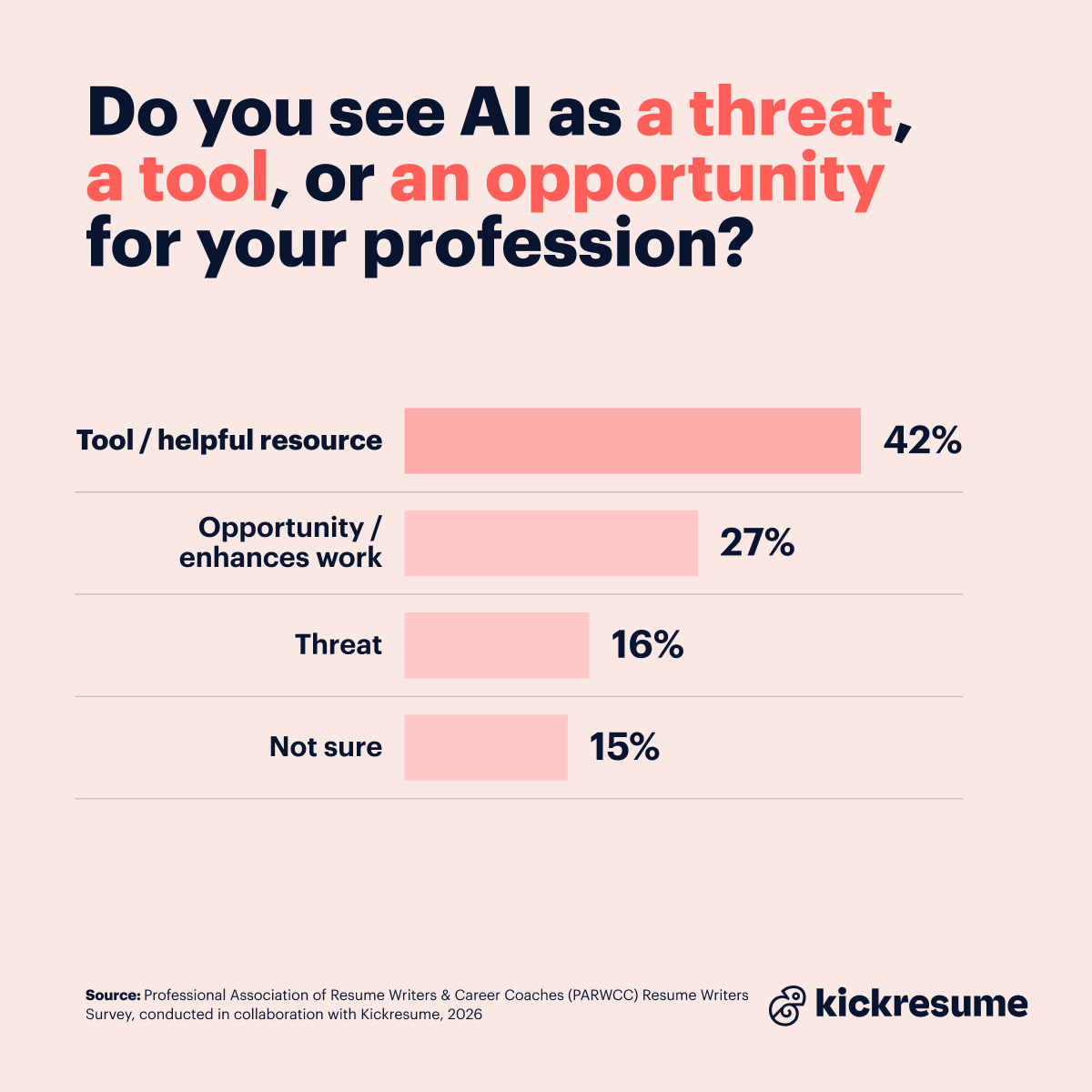
We asked resume writers whether they see AI as a threat, a tool, or an opportunity for their profession:
- 42% describe AI as a tool / helpful resource.
- 27% see it as an opportunity that enhances their work.
- 16% view it as a threat.
- 15% aren't sure yet.
Combined, 69% of resume writers see AI as a net positive—either as a tool that supports their work or an opportunity that improves it.
Still, 16% view it as a threat. Writing has long been one of the professions most exposed to AI, and for some professionals, the fear that clients will eventually skip the human step altogether is real.
The fact that this group still sits below 1 in 5, though, says a lot about how the industry sees its own future: not as something being replaced, but as something being reshaped—with the human still firmly in the loop.
Final thoughts
The findings across this survey point in the same direction. AI is now part of the resume writing process for nearly everyone. And the resume writers reviewing client drafts every day aren't worried about it—they're working with it.
But the resumes themselves are changing too. They sound smoother and read more confidently, while at the same time starting to blur together. Exaggeration is creeping in. And candidates are experimenting more with length, branding, and storytelling, looking for ways to stand out from a stack that's quickly losing its rough edges.
For job seekers, the message is consistent across every Kickresume study we've run this year: AI works best when it's working with you. Lean on it for stronger wording, clearer structure, and a more polished delivery—then bring the real specifics only you can provide.
When everyone's resume sounds good, the things that set a candidate apart are the ones AI alone can't generate on autopilot: specific achievements, honest numbers, and a story that holds up under a recruiter's eye.
Note
This anonymous online survey was conducted by PARWCC in collaboration with Kickresume in April 2026. A total of 152 resume writing professionals from around the world participated, recruited via PARWCC's membership database. As respondents represent an engaged professional community rather than a randomized sample, findings reflect the views of active resume industry practitioners.
About Kickresume
Kickresume is an AI-based career tool that helps candidates source jobs and raise salary with powerful resume and cover letter tools, skills analytics, and automated job search assistance. It has already helped more than 8 million job seekers worldwide.