


A side hustle used to mean something scrappy — a weekend market stall, a bit of tutoring, odd jobs for extra cash. Today, it's a parallel economy. More than six in ten workers earn income outside their main job, and the reasons range from financial survival to career ambition to a quiet vote of no confidence in their employer.
But how many people are actually building something meaningful from them — and how many are quietly putting in the hours for very little in return?
To find out, Kickresume surveyed 1,070 workers worldwide. We asked about earnings, hours worked, motivations, workplace secrecy, and more — revealing which side hustles pay the most for the least effort, and the ones that quietly drain your time for almost nothing in return.
Key findings at a glance:
- 61% of workers have a side hustle — but 20% earn irregular or no consistent income
- 24% say side hustle income is essential to their survival — rising to 27% in Asia and dropping to just 14% in Europe
- 48% started out of financial pressure — and in the USA, that figure jumps to 60%
- The highest-earning category is renting property or assets (48% earn $500+/month), yet only 5% of respondents do it
- Delivery and ride-sharing pay well (47% earn $500+/month), but 1 in 5 doing it work 20+ hours a week
- 66% have worked on their side hustle during regular working hours — 16% in the USA do it often
- 36% keep their side hustle secret from their employer — women are more likely to fear it looks unprofessional (11% vs. 6% of men)
- 46% would quit their main job if their side hustle matched their salary — rising to 63% among Creative and Media workers
61% have a side hustle — and most are doing it out of financial pressure
Nearly two-thirds of respondents (61%) earn some form of extra income outside their main job — 29% regularly, 32% occasionally.
The most common reason people start a side hustle is simple: they need the money. 48% started their side hustle because of extra income needs or financial pressure. Passion (12%), career-building (11%), and skill development (10%) trail well behind.
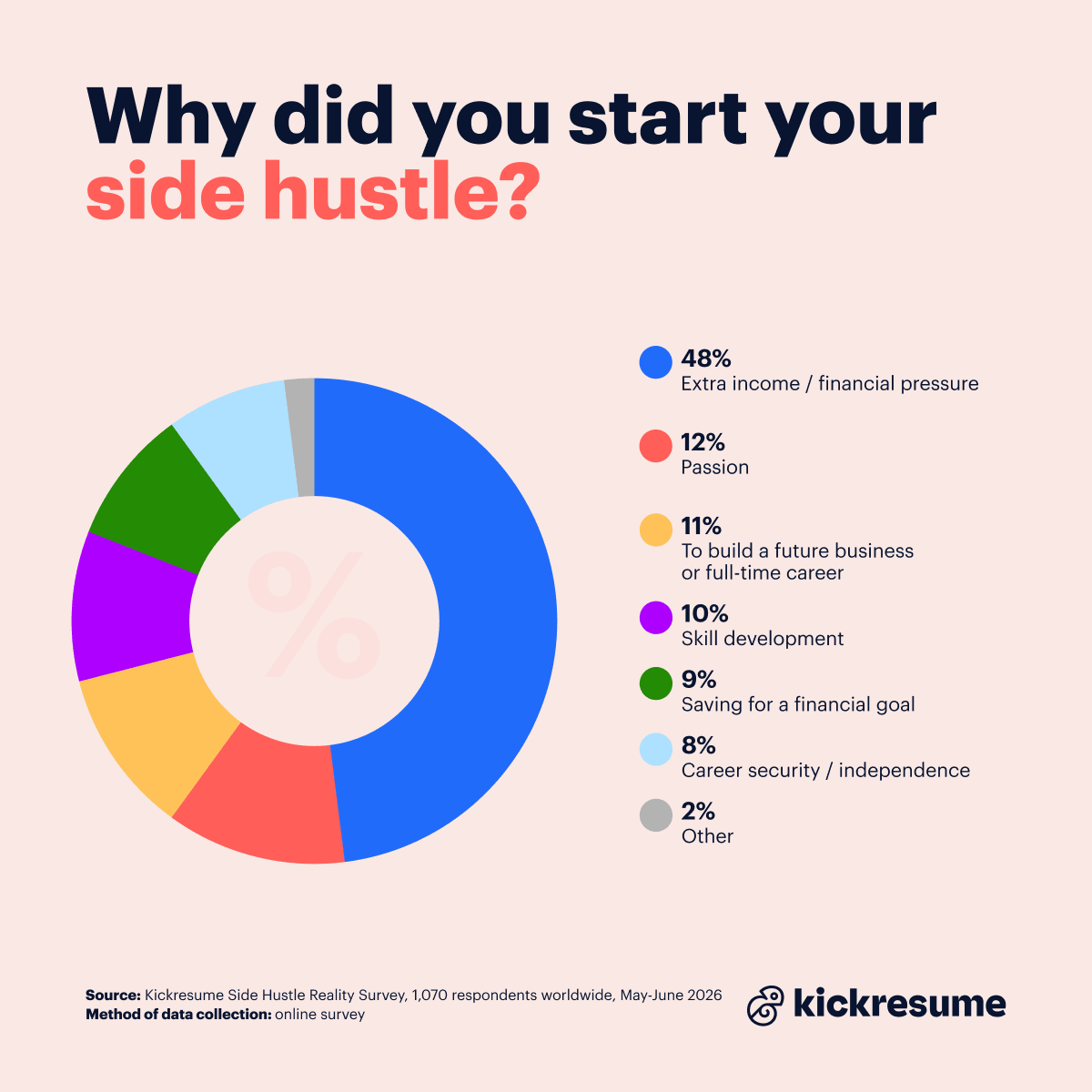
But while financial pressure is the dominant engine, it runs very differently across the world:
- In the USA, 60% of side hustlers started out of financial need — the highest of any region — compared to just 40% in both Europe and Asia.
- Europeans are more likely to cite passion (16%), while Asians place greater emphasis on career-building (15%) and skill development (11%).
- Europeans appear more likely to hustle by choice; Americans, more likely by necessity.
.png)
Gen X is the most financially driven generation in the survey at 55% (Gen Z: 45%, Millennials: 48%), suggesting that the older you get, the more a side hustle becomes about plugging gaps rather than exploring possibilities.
Gender shapes motivations, too. Women are noticeably more financially driven (54% vs. 46% of men), while men lean more toward building a future business (13% vs. 8% of women). One possible reading: men treat side hustles as ambition projects more often; women use them to cover real financial shortfalls.
The spread also varies by industry. Creative/Media and Healthcare workers are among the most likely to have a side hustle (75% and 74% respectively), while Finance/Banking is nearly an even split at 49% yes, 51% no. Students are the least likely group — 56% have no extra income source at all.
Most side hustlers earn modestly — but for 55%, that income genuinely matters
Six in ten workers have a side hustle. But the earnings picture is far more uneven than that headline suggests.
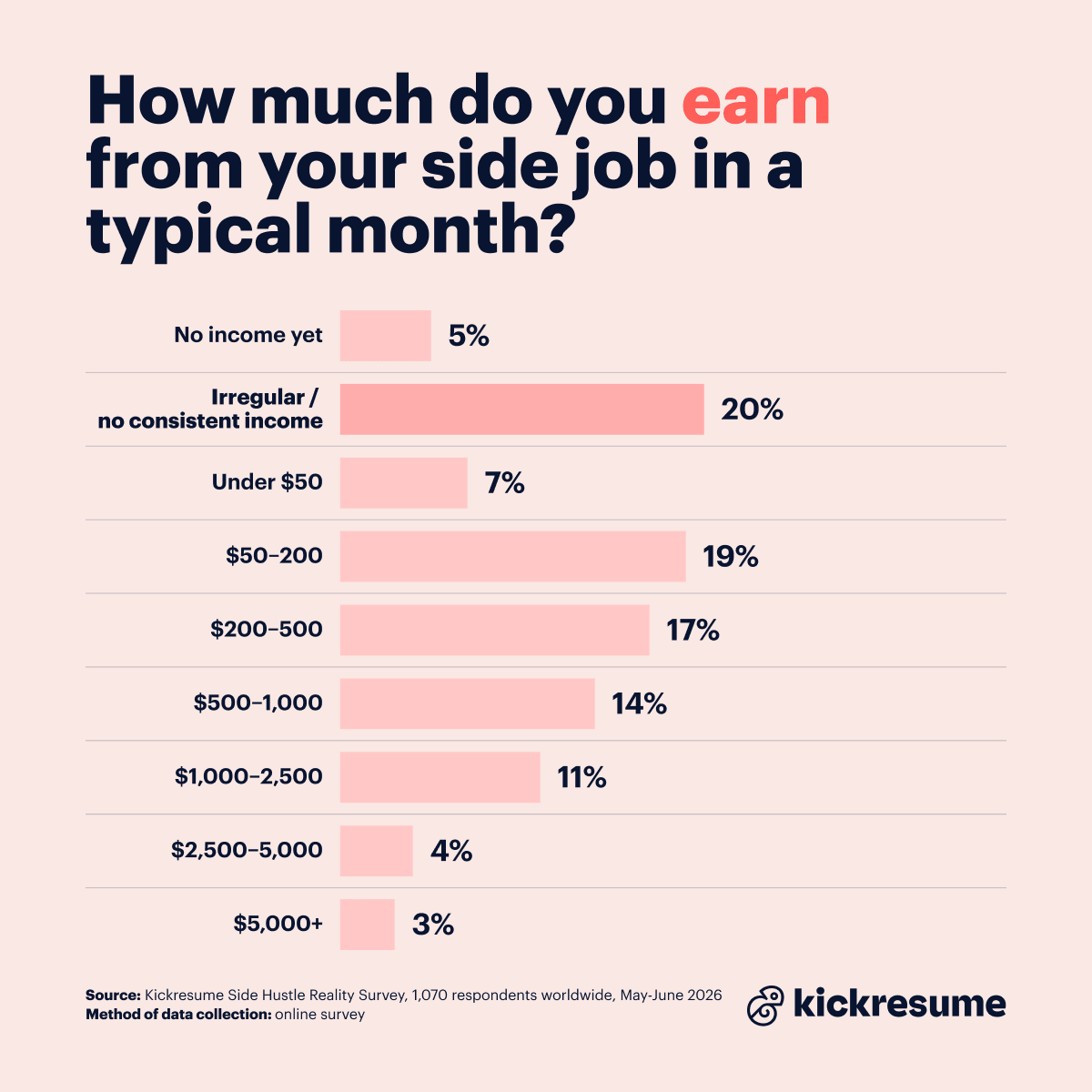
The most common outcome is instability — one in five side hustlers (20%) don't earn consistently. Another 19% earn between $50 and $200 per month. Only around a third regularly cross $500 per month.
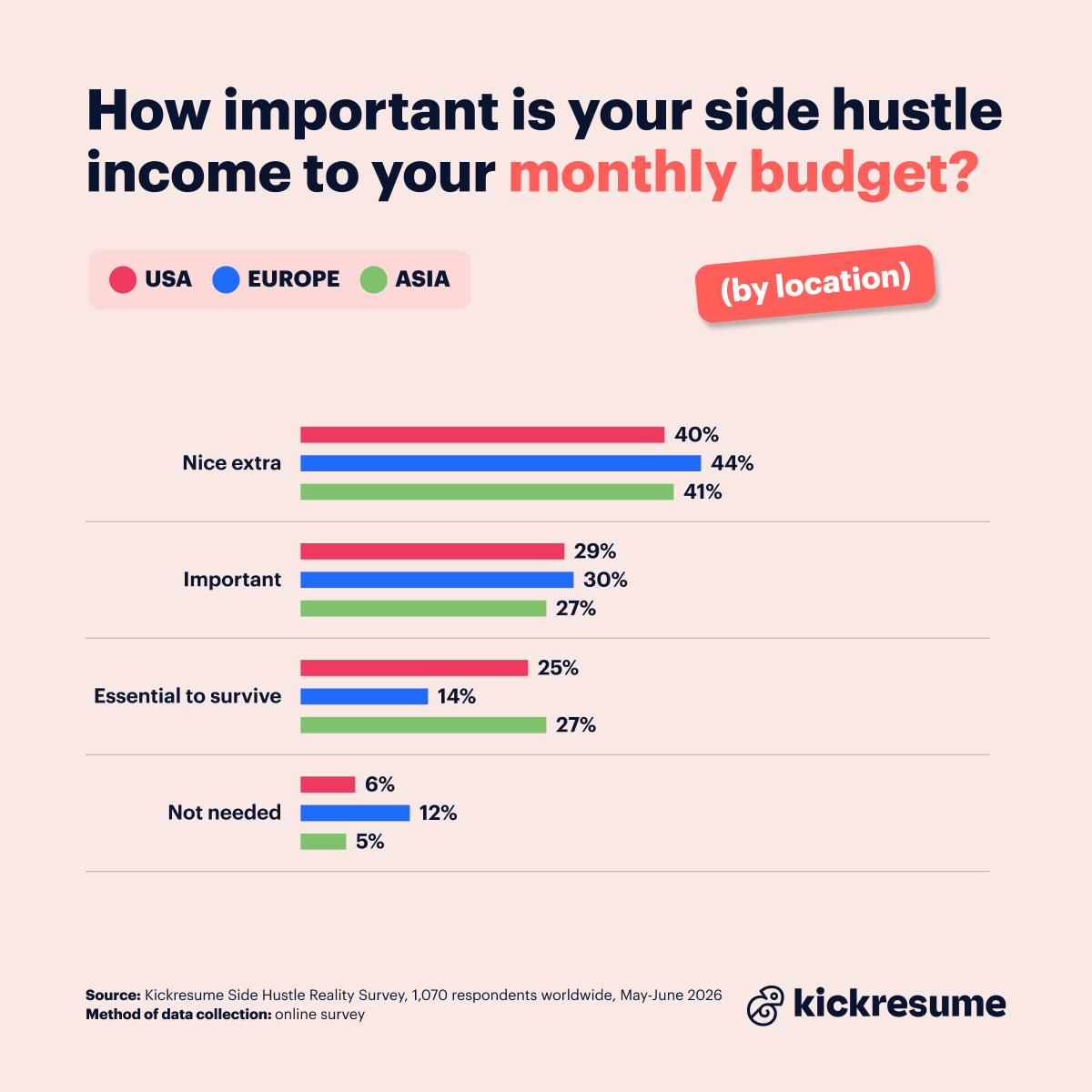
However, when asked how important their side hustle income is to their monthly budget, more than half say it matters — 31% describe it as important and 24% say it's essential to their survival. Only 6% don't need it at all:
- Nice extra: 39%
- Important: 31%
- Essential to survive: 24%
- Not needed: 6%
The "essential to survive" figure rises to 25% in the USA, 27% in Asia, while dropping to 14% in Europe, again suggesting that Europeans tend to hustle more by choice than necessity. It's also worth noting that earnings mean different things in different markets: for example, $500 a month is a meaningful supplement in many European markets, while in the USA it barely covers a car payment.
The gender gap in earnings is one of the more notable findings. Men are more likely to earn above $500/month (28% of men earn between $500 and $2,500, compared to 16% of women), while women cluster more heavily in the $50–200 bracket (23% vs. 17% of men). However, hours committed are almost identical (71% of men and 70% of women spend under 10 hours a week), so time investment isn't the explanation.
Side hustle choice plays a partial role — men are four times more likely to do Tech/IT (31% vs. 7% of women), while women are more likely to gravitate toward lower-earning categories like online microtasks (18% vs. 10%).
What are people actually doing — tech and knowledge work dominate
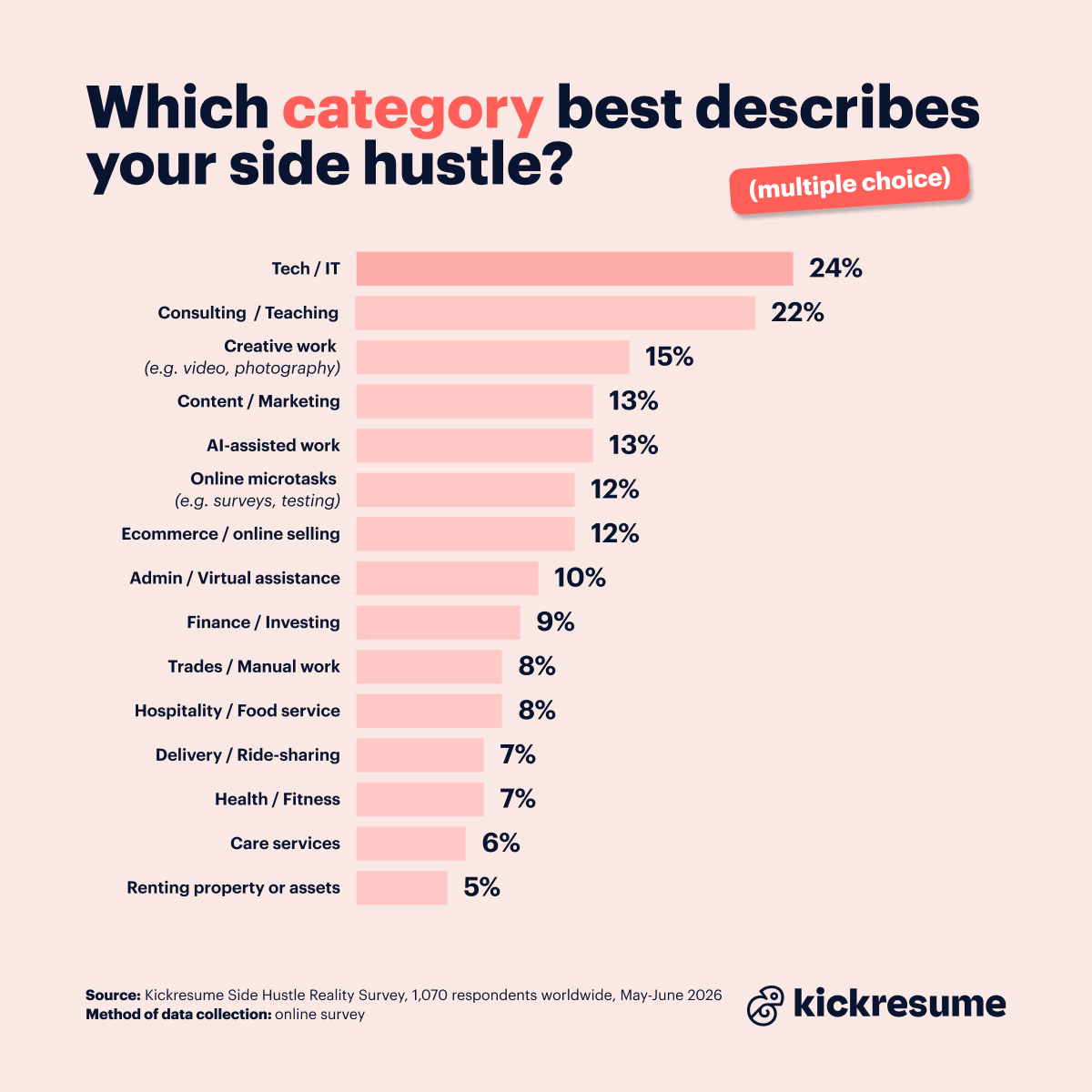
Side hustles aren't one thing. Kickresume asked respondents to select all the categories that described their side hustle — since many people do more than one — and the spread reveals where people are putting their time.
The two most common categories — Tech/IT (24%) and Consulting/Coaching/Teaching (22%) — together account for nearly half of all side hustlers.
Below them, Creative work (15%), Content / Marketing (13%), and AI-assisted work (13%) round out a top five that is almost entirely knowledge-based. Physical and service categories — like delivery, hospitality, care services, trades — are at the bottom of the list, chosen by 6–8% each.
This reflects a broader pattern: knowledge workers are the most likely to have a side hustle, and the most naturally positioned to monetise their existing skills without significant upfront investment. A software developer can freelance. A manager can consult. A teacher can tutor. The knowledge economy translates cleanly into extra income in a way that not all sectors do.
AI-assisted work (13%) is the most striking entry given how recently it emerged as a category. It now rivals content creation in popularity, suggesting workers have been quick to experiment with AI tools as an income source.
At the bottom, renting property or assets (5%) is the least common category in the survey — but, as the next section reveals, by far the most efficient earner.
Renting beats riding: which side hustles actually pay off
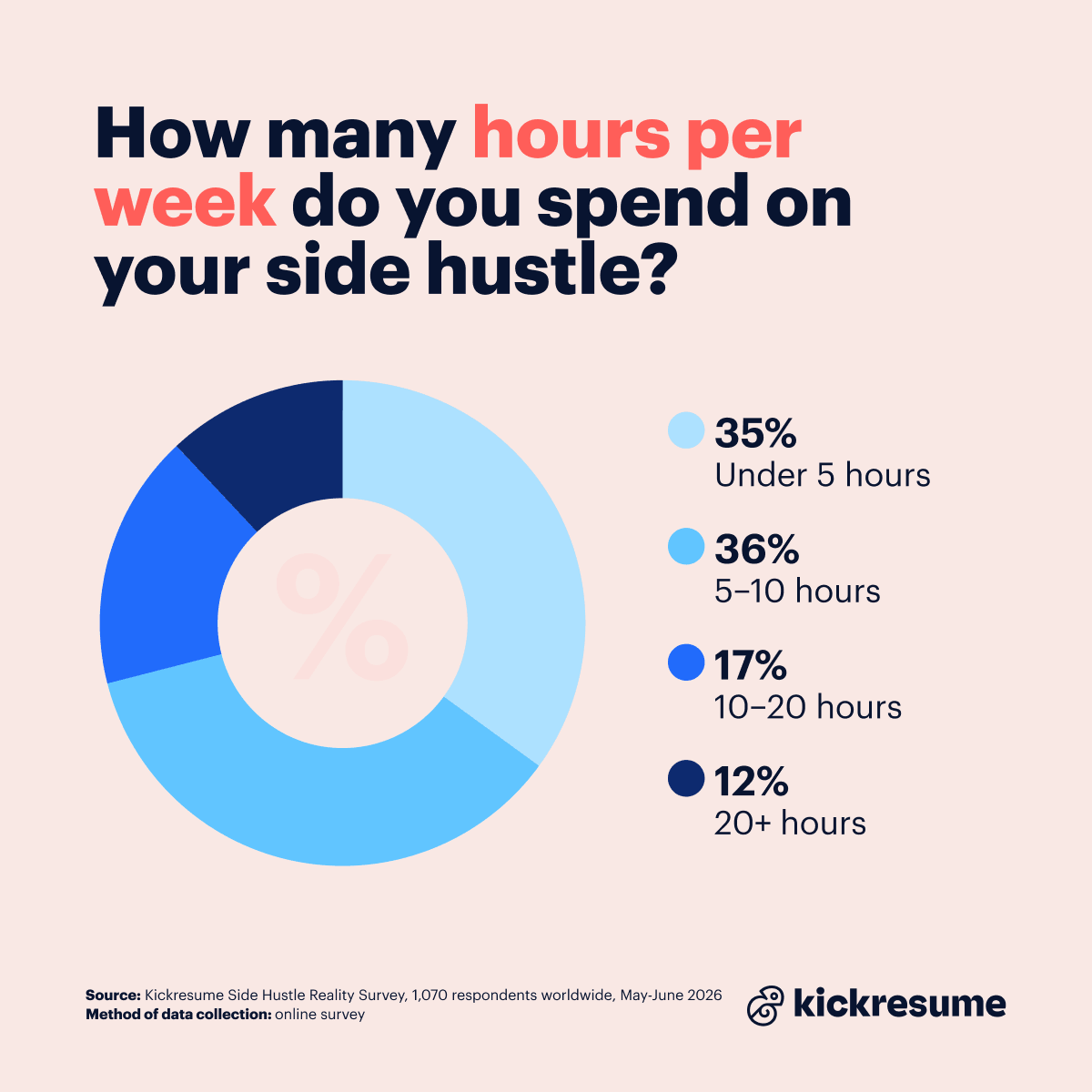
How much time do side hustlers actually invest? The majority keep it manageable — 35% spend under 5 hours a week, and 36% spend 5–10 hours.
But 17% spend 10–20 hours and 12% work 20 or more hours a week on their side hustle — at which point the line between side hustle and a second job starts to blur.
Here are the side hustle categories where time commitment is lowest:
Lowest effort (% of people spending under 10h/week)
- Renting property or assets — 79%
- Finance / Investing — 78%
- Online microtasks (e.g. surveys, testing) — 76%
- Consulting / Coaching / Teaching — 75%
- E-commerce / online selling — 73%
- Content / Marketing — 72%
- Trades / Manual work — 72%
- Health / Fitness — 70%
- Admin / Virtual assistance — 68%
But low effort doesn't automatically mean high reward. When you rank the same categories by earnings, the order shifts considerably:
Highest earners (% of people earning $500+/month)
- Renting property or assets — 48%
- Delivery / Ride-sharing — 47%
- Consulting / Coaching / Teaching — 43%
- Finance / Investing — 41%
- AI-assisted work — 38%
- Tech / IT — 38%
- Health / Fitness — 34%
- Care services — 33%
- Admin / Virtual assistance — 33%
- E-commerce / online selling — 32%
Online microtasks rank third for low effort, but don’t rank in the top earnings. Delivery and ride-sharing ranks second for earnings but doesn't appear in the top ten for effort — in fact, 43% spend 10 or more hours a week on it.
The categories that score well on both sides are the real winners. Kickresume cross-referenced earnings with time commitment across all side job categories. The graphic below highlights the five most actionable tiers.
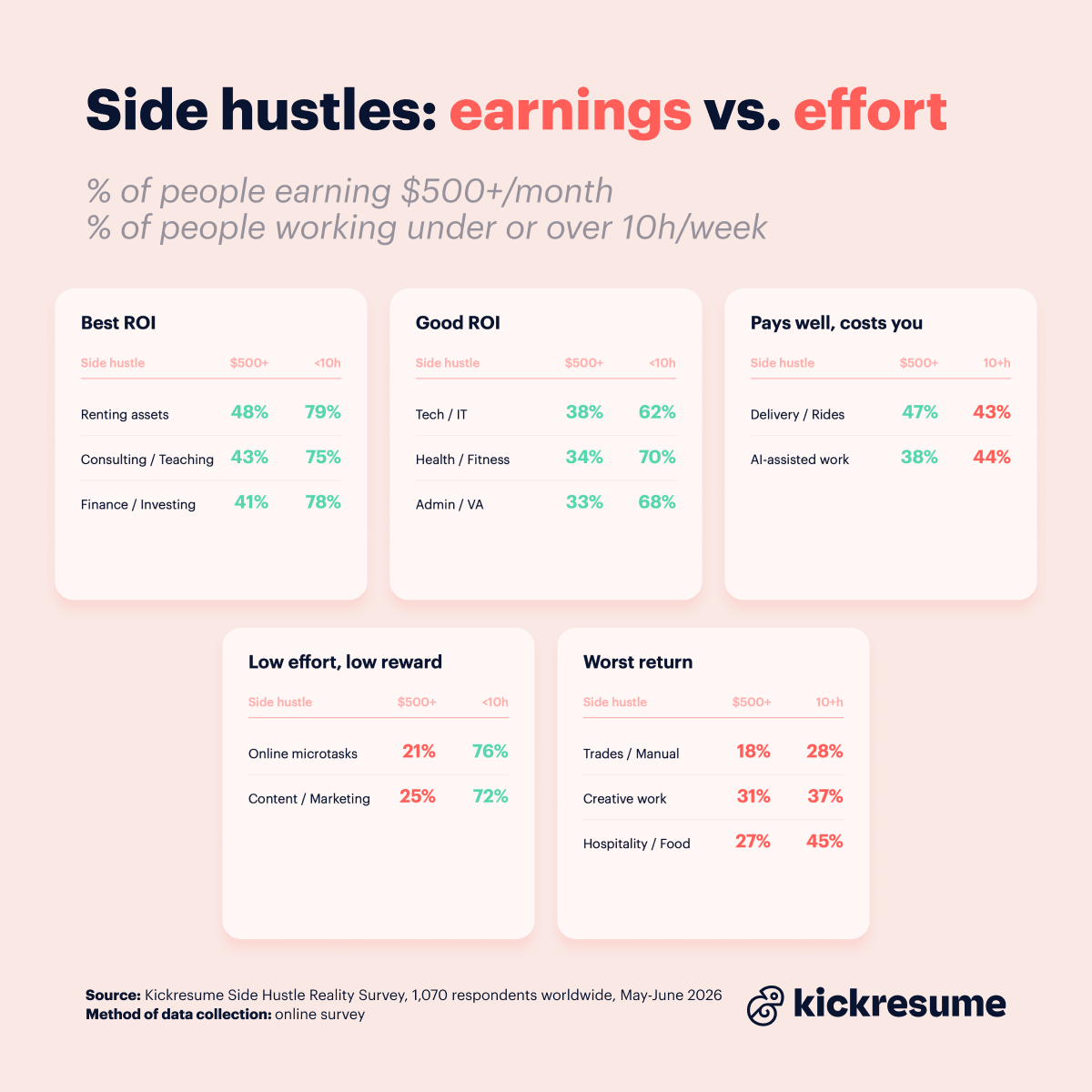
Best ROI hustles (high earnings + low effort)
Three categories stand out as genuine efficiency winners — high earning potential paired with low time commitment.
Renting property or assets is the standout. Nearly half of those doing it (48%) earn $500 or more per month, and 79% manage this in under 10 hours a week. It's the only category in the entire survey where not a single respondent reported "no income yet" or irregular income — everyone renting something is making money. The catch, of course, is the capital barrier: you need something to rent.
Finance and investing follow close behind: 41% earn $500+/month, and 78% do it in under 10 hours a week, with the highest share of any category earning over $5,000 per month (9%). This is the "works while you sleep" category — but one that requires knowledge and risk tolerance.
Consulting, coaching, or teaching is the most accessible of the top three. It's chosen by 22% of all side hustlers — the second most popular category in the survey — and 43% earn $500 or more per month, with 75% spending under 10 hours a week on it. For anyone with expertise to sell, this is the clearest path to meaningful income without significant time sacrifice.
Good ROI hustles (solid earnings + manageable effort)
Three categories don't quite reach the top tier but still offer a strong combination of earnings and reasonable time commitment.
Tech/IT earns well — 38% earn $500+/month — and 62% manage it in under 10 hours a week. It's the most popular side hustle category overall (24%), which suggests many people are already sitting on a valuable skill set.
Health / Fitness delivers 34% earning $500+/month with 70% under 10 hours a week — a strong ratio for a category that requires real expertise but scales well once established.
Admin / Virtual assistance offers similar returns: 33% earn $500+/month, and 68% keep it under 10 hours a week. It also has a lower barrier to entry than most knowledge-work categories, making it one of the more accessible routes to side income.
The hustle that pays well but costs you
Delivery / Ride-sharing is one of the highest-earning categories in the survey — 47% of those doing it earn $500+/month. But at the same time, it's also among the most time-intensive categories. 43% spend 10 or more hours a week on it, with 20% working 20+ hours a week. At that point, this isn't just a side hustle — it's more like a second job.
AI-assisted work also sits in this tier. While it delivers strong earnings (38% earn $500+/month), it demands a significant amount of time: 44% of those doing it work 10+ hours a week on it. Despite being associated with automation, AI-assisted work still appears to require substantial human input to generate meaningful income.
The effort trap: low effort, low reward
Online microtasks — surveys, testing, small digital tasks — are one of the most effortless side jobs in the survey. 76% of people doing them spend under 10 hours a week. But only 21% earn $500 or more per month, and 43% earn less than $200, with a further 22% earning irregularly.
Content / Marketing follows a similar pattern. 72% of content creators spend under 10 hours a week on it, but just 25% break the $500/month threshold, and 24% have irregular income.
The worst return on effort
Trades / Manual work has the worst earnings profile in the entire survey. While 72% spend less than 10 hours doing it, only 18% earn $500+/month — the lowest of any category — and 36% report either irregular income or no earnings at all. The data suggests that physically demanding side hustles deliver weaker financial returns than many knowledge-based alternatives.
Creative work — like video, photography, design — is chosen by 15% of all side hustlers, many of whom presumably love what they do. But only 31% earn $500+/month and 24% report only irregular income — while 37% spend 10 or more hours a week on it. Creative passion doesn't translate easily into consistent earnings.
Hospitality / Food service rounds out the worst performers: only 27% earn $500+/month, while 45% spend 10 or more hours a week on it. The $200–500/month range concentrates 30% of earners, suggesting a ceiling that's hard to break through.
The side hustle and the day job: two-thirds have crossed the line at least once
Side hustles don't exist in a vacuum separate from the main job. For most people, the two are entangled — and the data suggests that entanglement runs deeper than employers probably know.
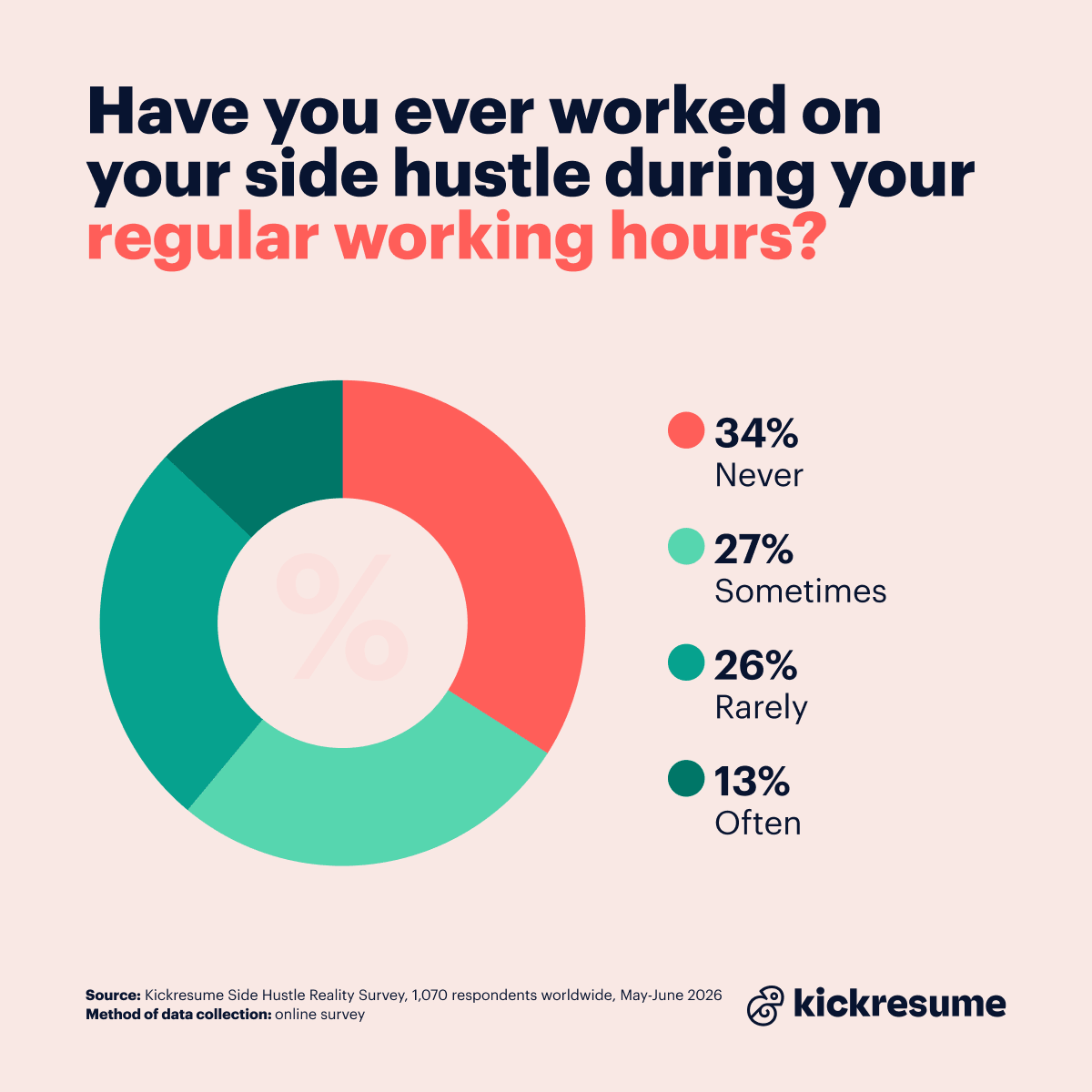
Two-thirds of side hustlers (66%) have worked on their side hustle during regular working hours — 27% sometimes, 26% rarely, 13% often. Only 34% say they've never done it.
The "often" group is most concentrated in the USA, where 16% work on their side hustle at work regularly, compared to 12% in Europe and 11% in Asia.
At the same time, most employers have no idea this is happening. 36% of side hustlers actively keep their hustle secret from their employer. Only 28% have told their employer about it, and 15% aren't even sure whether their employer knows.
The most common reasons for not telling an employer are:
- It's nobody's business: 47%
- I don't want extra attention/questions: 30%
- Fear of conflict with employer: 9%
- Fear it looks unprofessional: 7%
- My contract restricts it: 7%
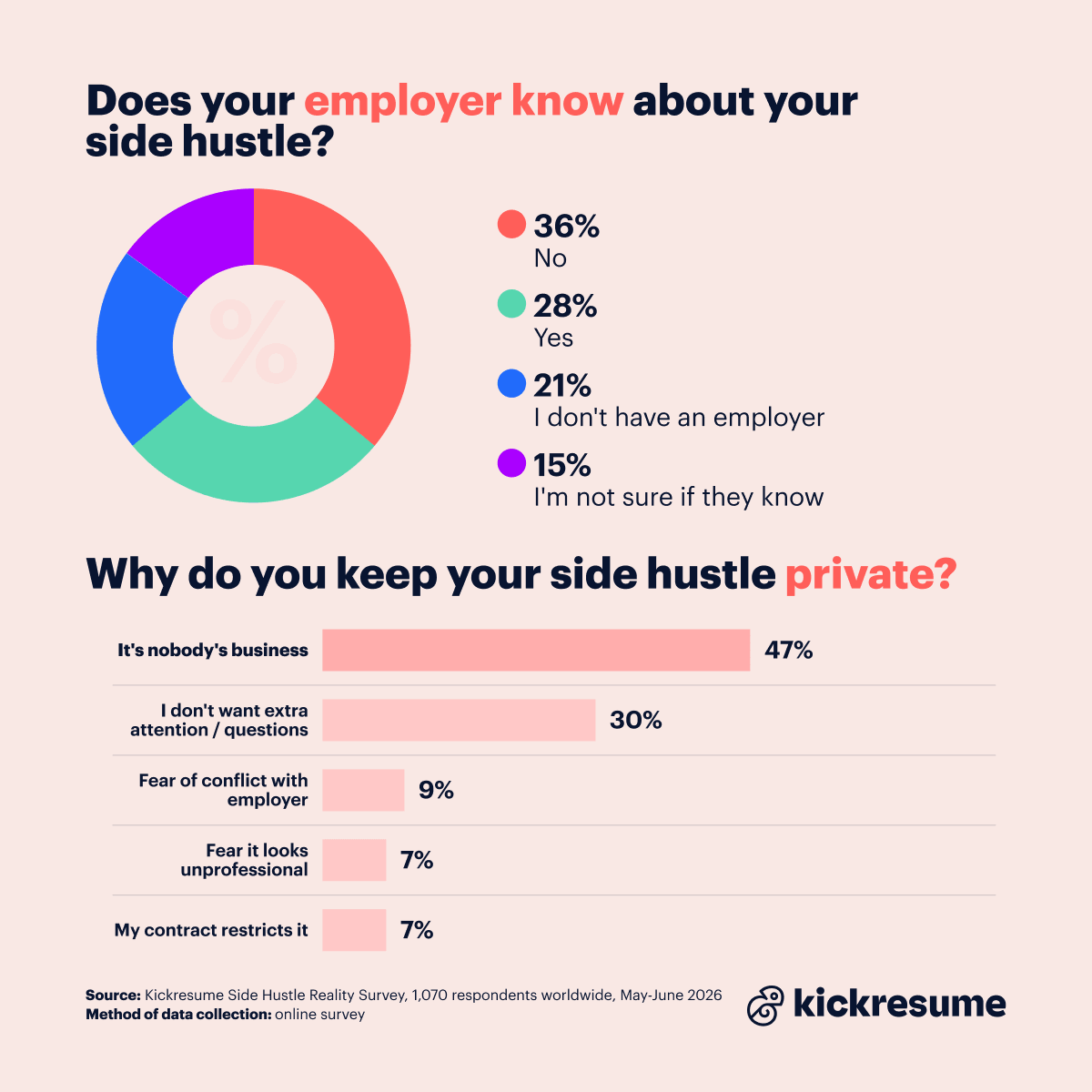
However, the reasons for secrecy differ by gender. Both cite privacy as their main reason — "it's nobody's business" — but the professional anxiety gap between genders is meaningful. Women are more likely to fear conflict with their employer (12% vs. 8% of men) or to worry that it looks unprofessional (11% vs. 6%).
Geography also shapes attitudes around disclosure:
- In the USA, 60% of those keeping it private cite personal autonomy — it's nobody's business — compared to 47% in Europe and 45% in Asia.
- In Europe, not wanting extra attention is a stronger secondary driver (32% vs. 23% in the USA).
- In Asia, contractual concerns feature more prominently — 9% cite their contract as the reason, compared to 5% in the USA and just 3% in Europe.
Millennials are the most open about their side hustle (35% say their employer knows), while Gen Z is the most secretive (41% say their employer doesn't know). Whether this reflects generational values around transparency or simply a more cautious start to working life is hard to say — but the direction is clear.
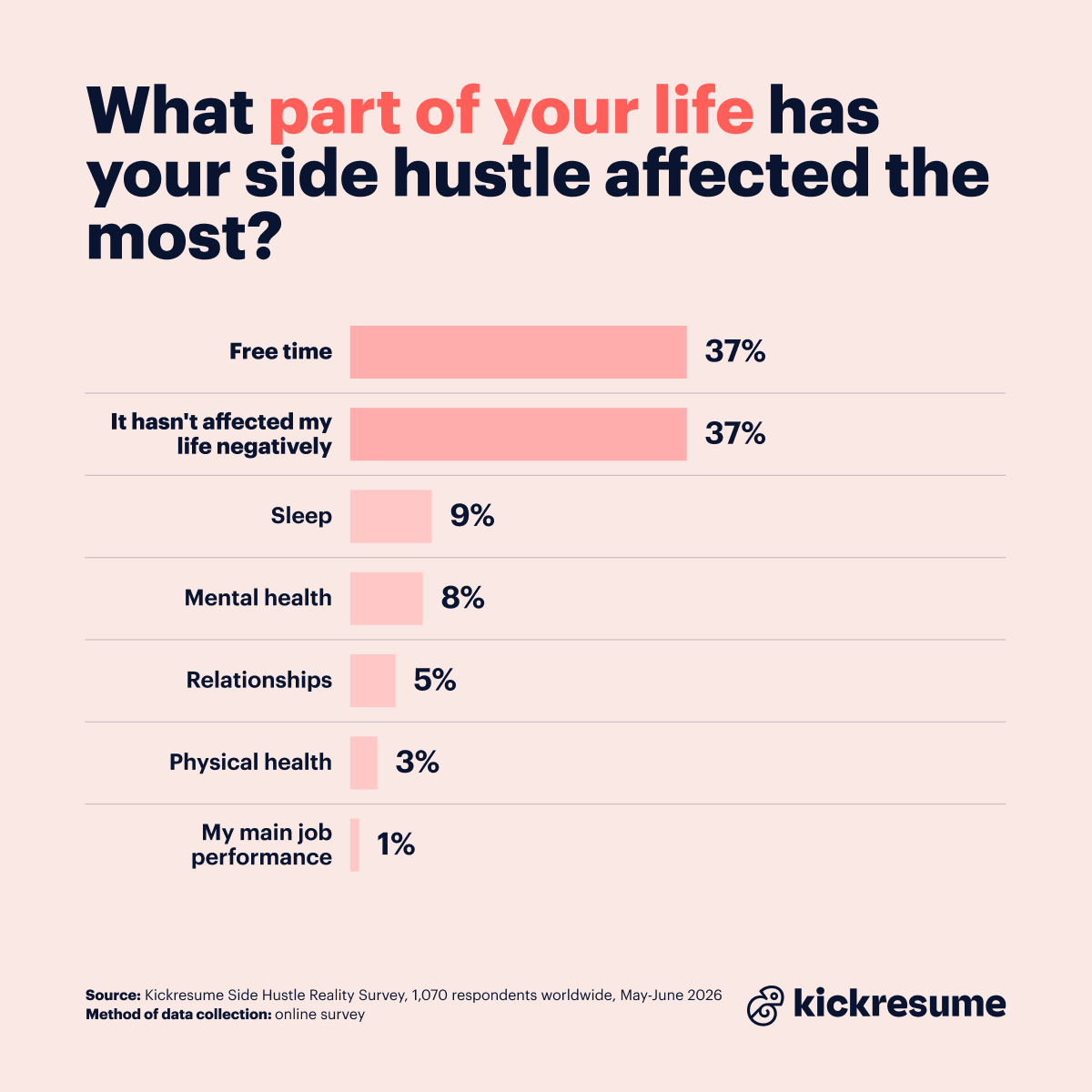
Beyond the workplace, the personal impact of side hustles is real — but more contained than you might expect. Free time is the most common casualty (37%), followed by sleep (9%) and mental health (8%). But an equal 37% say their side hustle hasn't affected their life negatively at all.
46% would quit tomorrow — if the numbers added up
Beneath the secrecy lies something more pointed — the appetite to leave. And it makes more sense when you consider how side hustlers feel about their work. 40% say they enjoy their side hustle and their main job equally — but 39% enjoy their side hustle more, either somewhat (18%) or much more (21%). Only 21% say they prefer their main job:
- I enjoy both equally: 40%
- I enjoy it much more: 21%
- I prefer my main job: 21%
- I somewhat enjoy it more: 18%
Against that backdrop, the willingness to leave is less surprising. If their side hustle matched their salary, 46% of respondents say they would leave their main job — either immediately (21%) or probably (25%).
Only 36% would probably not or definitely not leave.
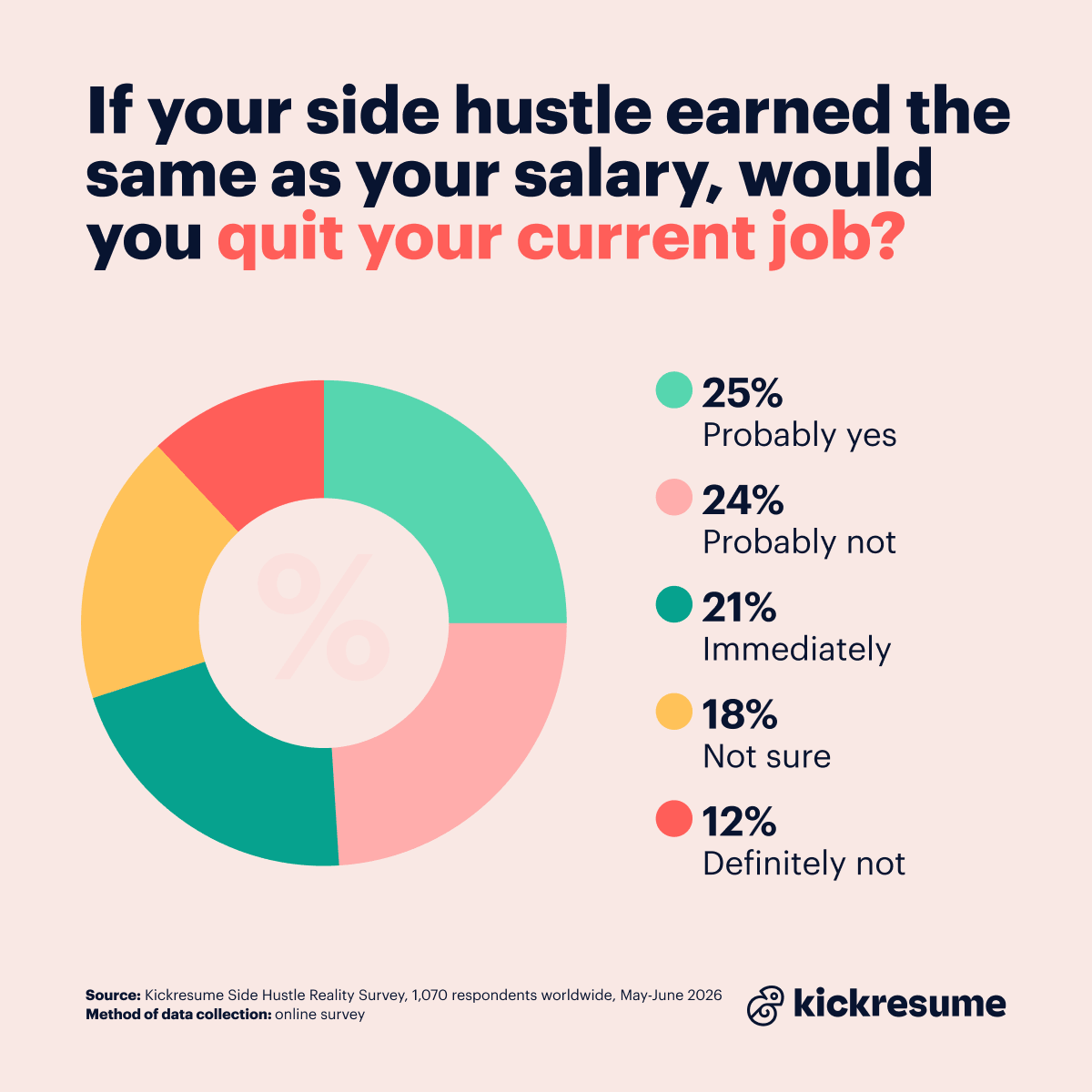
Millennials are the most ready to walk — 52% would quit immediately or probably, compared to 42% among Gen Z and 39% among Gen X, who are the most committed to their current careers (48% would probably not or definitely not leave).
By region, both Europe (53%) and Asia (51%) lean toward quitting, while the USA is the most divided — 47% would quit, but the top answer is "immediately" (24%), closely followed by "probably not" (23%), suggesting Americans are more polarised on the question.
Among industries, Creative and Media workers are the most ready to walk (63% would quit), while Healthcare workers are the most committed to their main careers (only 30% would quit). Technology workers sit in the middle at 41%.
Taken together — working on a side job during office hours, keeping it from the employer, being ready to leave if it paid enough — these findings point to a workforce that is, quietly and in large numbers, already reconsidering its relationship with the main job.
The 39% who don't have a side hustle — and why
Among those without a side hustle, the most common barrier isn't time, burnout, or contractual restrictions — it's simply not knowing where to begin, cited by 50%.
Other most common reasons for not having a side hustle are:
- I don't have time: 20%
- I'm already burned out: 9%
- I value free time: 8%
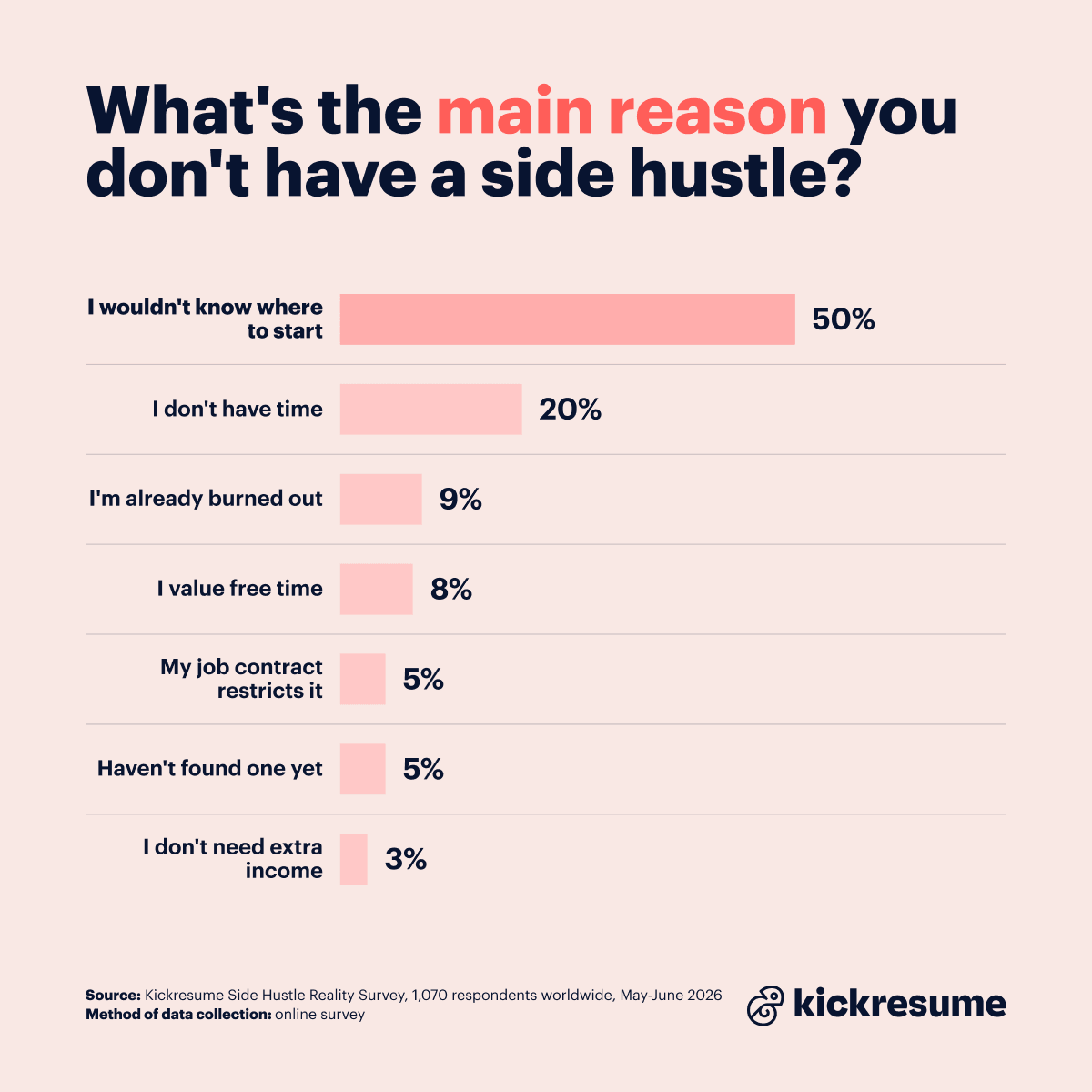
The barrier looks very different by region. In Asia, 62% say they wouldn’t know where to start, with the next highest being "don't have time" at just 15%. In Europe, the barriers split more evenly: not knowing where to start and not having time are tied at 33% each. In the USA, not knowing where to start is still the top answer at 45%, but burnout stands out as the highest of any region at 19%, compared to 9% in Europe and 5% in Asia.
The gender gap on burnout is striking: 14% of women cite burnout vs. 7% of men. Men are more likely to say they value their free time (9% vs. 4% of women). These aren't just different barriers — they reflect different relationships with work and rest.
When asked what would motivate them to start, 34% say extra income and 32% say financial independence — nearly identical responses, suggesting that the appeal is financial freedom broadly rather than a quick cash fix:
- Extra income: 34%
- Financial independence: 32%
- Turning a hobby into money: 18%
- AI tools making it easier: 8%
- Social media inspiration: 3%
- Absolutely nothing: 3%
- Fear of layoffs: 2%
Motivations are split clearly by generation. Millennials are most straightforwardly financially driven — 46% cite extra income as their top motivator. Gen X is almost evenly split between extra income (33%) and financial independence (34%). Gen Z stands apart: financial independence (36%), extra income (23%), and turning a hobby into money (23%) — the only generation for whom passion-driven motivation arrives at equal weight with financial need.
By region, the USA is the most income-focused (41% extra income), Asia is the most independence-driven (40% financial independence), and Europe is the only region where fear of layoffs ranks as a meaningful motivator (7% vs. 1% in the USA and 2% in Asia).
Final thoughts
What emerges from this survey isn't a picture of workers quietly building empires on the side. It's something more complicated: 61% of workers now earn extra income outside their main job, yet one in five don't earn consistently, and nearly half started out of financial pressure rather than ambition.
The data reveals a clear divide between those who hustle strategically and those who default to the most visible options. Renting property, consulting, and finance deliver strong returns with manageable time investment — while categories like creative work, hospitality, and delivery often require significantly more time for less predictable outcomes. And the easiest entry points, like online microtasks, rarely translate into meaningful income: 76% spend under 10 hours a week on them, but only 21% break the $500/month threshold.
Perhaps the most telling number in the survey is 46% — the share who say they'd quit their main job tomorrow if their side hustle matched their salary. That's not a fringe view. It's nearly half of the workforce, working in secret (36% keep it from their employer), often during office hours (66% have done it at least once), quietly building something they'd rather be doing full time.
The 50% who say they wouldn't know where to start aren't disengaged — they're waiting for a clearer signal. And the employers of the 46% who'd leave? They may want to pay attention.
Demographics
Gender
- Man: 69%
- Woman: 30%
- Non-binary or other: 1%
Age
- 18–29: 33%
- 30–45: 40%
- 46–61: 22%
- 62 and older: 2%
- Under 18: 3%
Location
- North America (USA): 24%
- Europe: 23%
- Asia: 23%
- Latin America: 12%
- Africa: 11%
- North America / Canada: 5%
- Australia / Oceania: 2%
Top industries
- Technology / IT / Software: 22%
- Business / Management / Consulting: 12%
- Creative / Design / Media: 7%
- Engineering / Manufacturing: 7%
- Healthcare / Medicine: 6%
- Education / Academia: 6%
- Other industries: 40%
Note
The Side Hustle Reality Survey was conducted by Kickresume in May-June 2026. A total of 1,070 respondents participated globally. All participants were reached via Kickresume's internal database. The survey was anonymous.
About Kickresume
Kickresume is an AI-based career tool that helps candidates source jobs and raise salary with powerful resume and cover letter tools, skills analytics, and automated job search assistance. It has already helped more than 8 million job seekers worldwide.