AI tools, resume influencers, LinkedIn advice — modern job seekers have never had more opinions telling them how a resume should look.
But what do resumes actually look like today?
To find out, Kickresume analyzed more than 2 million resumes created on the platform in 2025. In this part of the analysis, we took a closer look at how candidates structure their resumes, what sections they include, how long modern CVs really are, and what they look like.
Here are some of the key findings:
- The median resume length is 365 words, which typically fits on a single-page resume. Nearly 7 in 10 resumes contain between 200 and 500 words.
- The most-used resume templates are simple, with one-column layouts, and nearly 62% of downloaded resumes use ATS-friendly templates.
- Resume summaries appear in 84% of resumes — up from just 37% in Kickresume’s 2022 resume analysis.
- Traditional resume sections are still traditional: 97% of resumes include work experience, 86% include skills, and 76% include education.
- The typical resume lists 5 skills and 3 previous work roles.
- Most resumes use recognizable section names, although non-standard naming still appears in 28% of education sections and 17% of skills sections.
- The most common “extra” resume sections are publications (32%), hobbies/interests (31%), keywords/highlighted skills (31%), custom text sections (16%), and projects (15%).
- Technical and digital skills dominate. The most commonly listed skills include Python, SQL, JavaScript, Git, HTML, and data analysis.
Resume length: Nearly 7 in 10 resumes contain between 200 and 500 words
Despite years of debate around one-page versus two-page resumes, most candidates still strongly favor concise resumes.
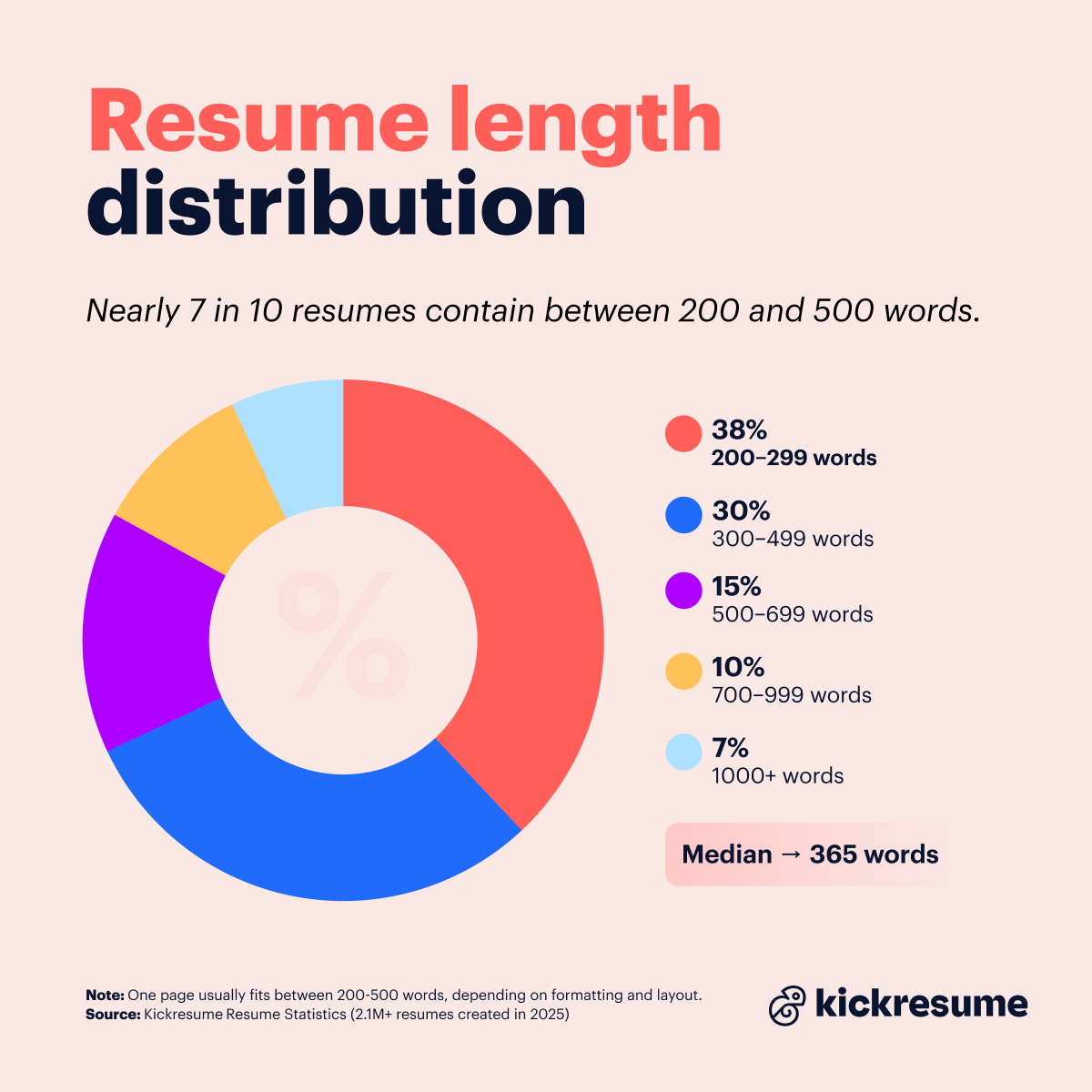
The analysis found that nearly 38% of resumes contain between 200 and 299 words, while another 30% fall between 300 and 499 words.
Overall, nearly 7 in 10 resumes contain between 200 and 500 words — a range that often fits within a one-page resume, depending on formatting and resume layout.
The median resume length was 365 words.
Still, the dataset revealed some extreme outliers. The longest resume analyzed contained 89,530 words — longer than many novels.
Here’s a closer look at the resume length distribution:
- 200–299 words: 38%
- 300–499 words: 30%
- 500–699 words: 15%
- 700–999 words: 10%
- 1000+ words: 7%
The data suggests that even as career advice increasingly accepts longer than one-page resumes for experienced professionals, most candidates still prioritize brevity and readability — likely reflecting the reality that recruiters often scan resumes very quickly before deciding whether to continue reading.
Interestingly, resumes in this broader dataset were noticeably shorter than resumes previously analyzed among successfully hired candidates. Earlier analysis of successful resumes found a median resume length of 443 words, compared to 365 words in the current dataset.
Also, according to Julia Belak, Certified Professional Resume Writer (CPRW) at Kickresume, candidates should avoid treating one page as a strict rule:
“The ‘one-page resume rule’ is largely a myth, and job seekers should stop stressing over it. Many candidates still try to compress their entire career into a single page, even when they already have substantial relevant experience. A concise resume is generally easier to scan, but experienced professionals often benefit more from clarity and context than from aggressively cutting information just to stay within a one-page limit.”
The preference for concise resumes is also reflected in the growing popularity of simpler resume layouts.
ATS-friendliness: Candidates prefer simple, structured resumes
To analyze resume design preferences, we looked at approximately 420K resumes downloaded from Kickresume in 2025.
The results show that many candidates increasingly prioritize ATS (Applicant Tracking System) compatibility, readability, and clear structure over highly visual resume designs.
Nearly 62% of downloaded resumes used templates classified as ATS-friendly. (Note: Templates were categorized by Kickresume as ATS-friendly based on how accurately three ATS systems (Sovren, CVlizer, RChilli) were able to extract and process resume content.)
The most commonly downloaded templates also shared strikingly similar characteristics: single-column layouts, clear section hierarchy, restrained use of color, and minimal decorative elements.
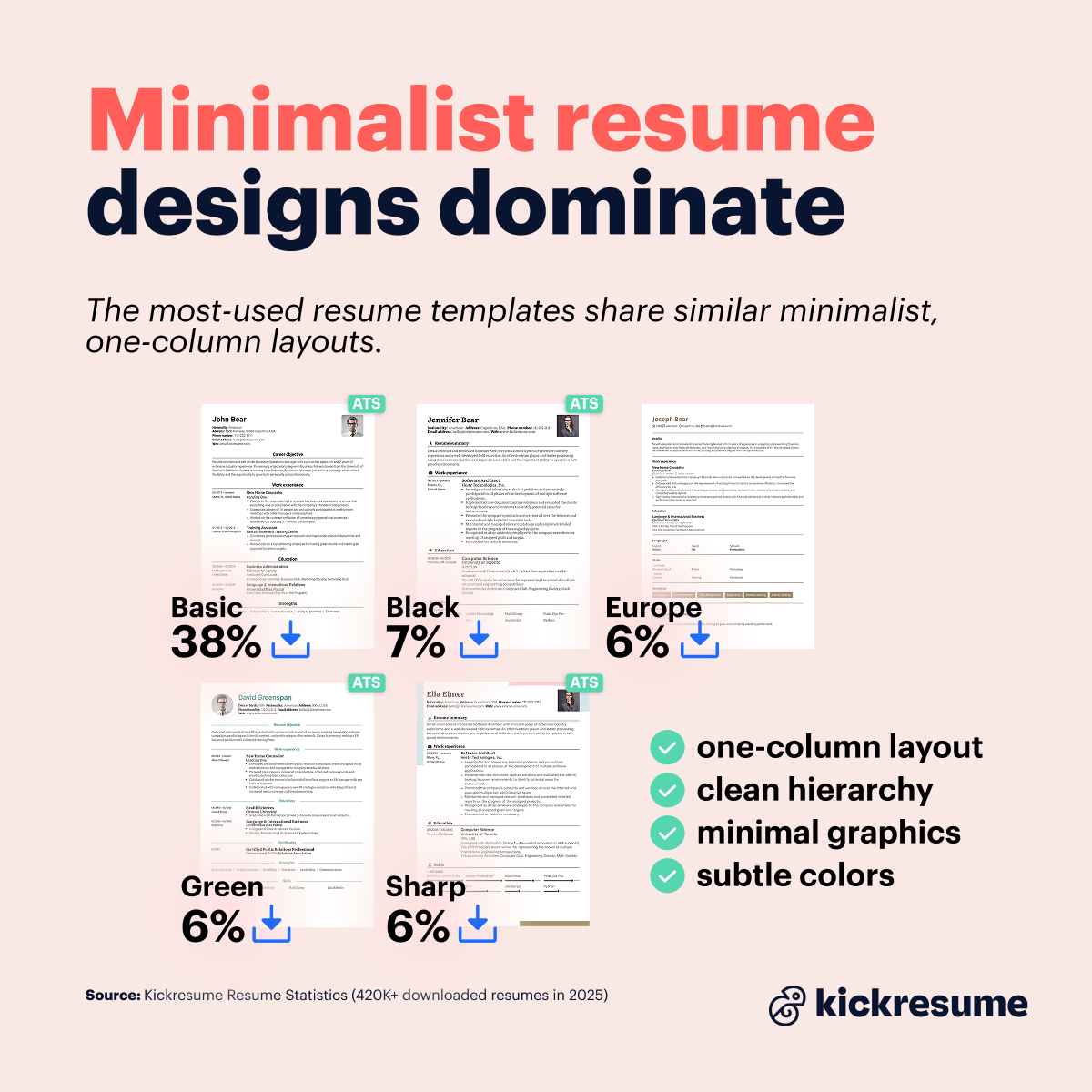
“The strongest pattern in the data is how heavily candidates favor clean, one-column resume layouts,” says Julia Belak, Certified Professional Resume Writer (CPRW). “Despite the huge variety of resume designs available, the resumes most commonly used in real applications consistently prioritized readability, structure, and ATS compatibility over visual complexity.”
Of course, that doesn’t mean creative resume templates are ineffective. “More visually distinctive resumes can work very well in creative industries, startup environments, or situations where candidates apply directly and know their resume is unlikely to go through an ATS system first,” says Belak.
Still, for most online job applications, candidates seem to prefer layouts that feel safer, easier to scan, and more structured.
At the same time, resumes remained far less standardized when it came to section naming for three core categories: work experience, skills, and education.
In fact, only 57% of the 1.8M English-language resumes analyzed used recognizable standardized naming across all three core resume categories simultaneously.
Another 23% used standardized naming only for work experience and skills, while 12% only for work experience and education.
Still, most candidates relied on broadly recognizable naming conventions overall:
- Work experience: 93%
- Skills: 83%
- Education: 72%
At the same time, non-standard or customized naming still appeared in a significant share of resumes — particularly in education sections:
- Work experience: 7%
- Skills: 17%
- Education: 28%
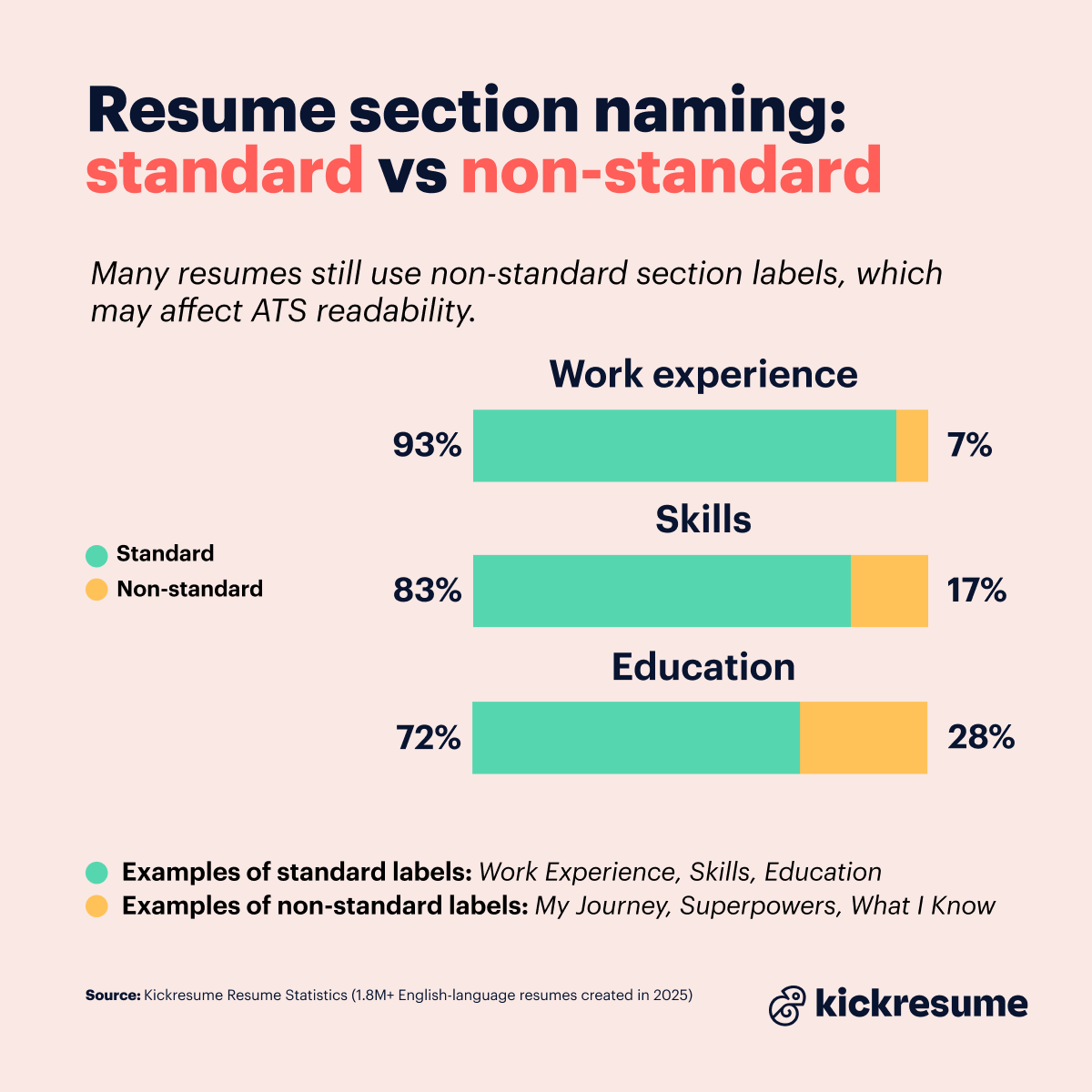
Examples of non-standard section names can include labels like “My Journey,” “Superpowers,” or “What I Know.” Such unconventional or highly creative section titles can create readability and parsing issues for both recruiters and ATS software.
What counted as “standard” section names
The analysis considered commonly recognized section labels and close variations that included relevant keywords.
Work experience section: Work Experience, Experience, Employment, Career History, Professional Background, Internship
Skills section: Skills, Competencies, Expertise, Languages
Education section: Education, Training, Academic Qualifications
Resume sections: Modern resumes are becoming more personalized
Most candidates still rely on a relatively traditional resume structure centered around work experience, skills, and education. At the same time, modern resumes increasingly include summaries, projects, publications, and other sections designed to communicate value more quickly and personally.
Here’s a closer look at the presence of traditional and additional resume sections in analyzed resumes:
Traditional resume sections
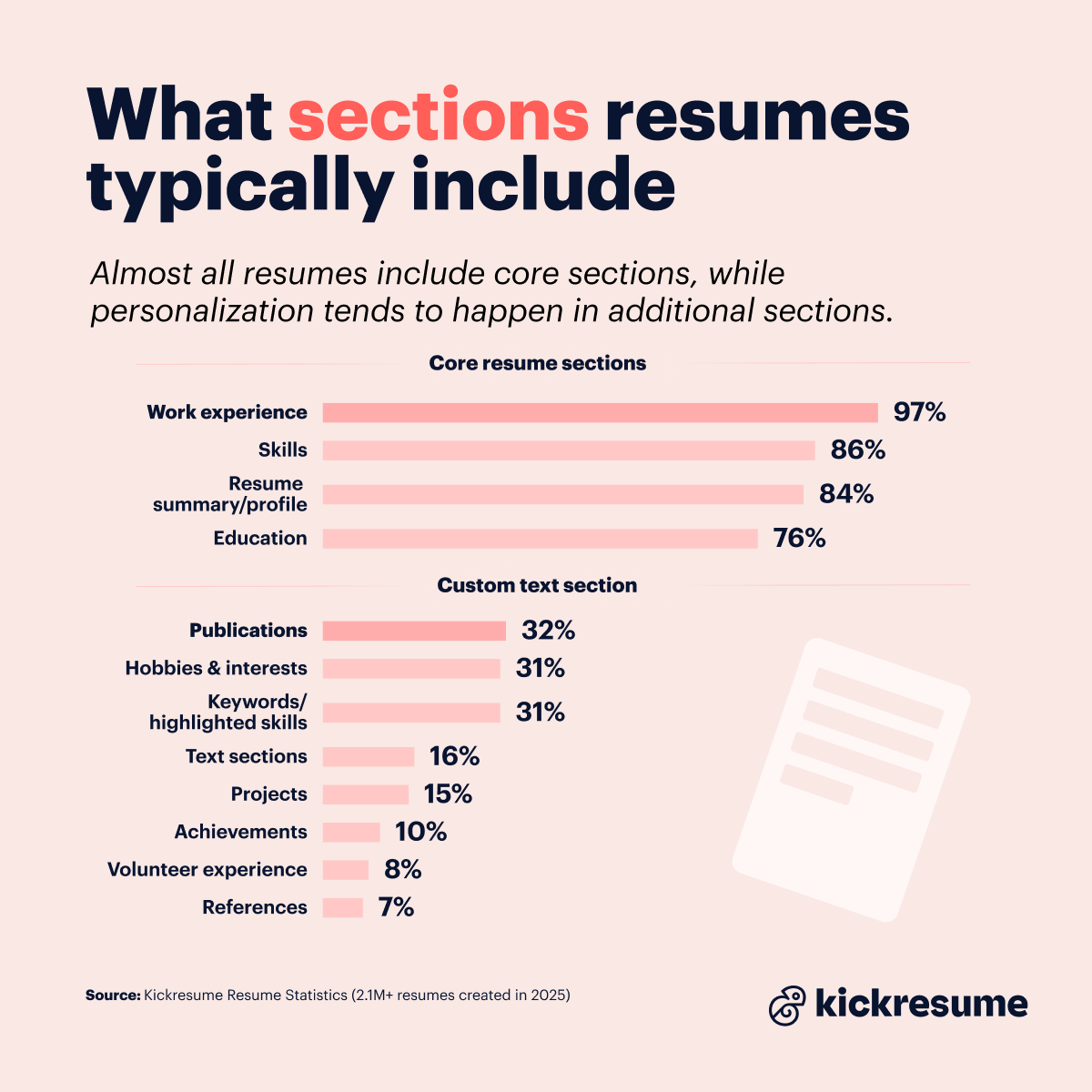
- Work experience: 97%
- Skills: 86%
- Resume summary/profile: 84%
- Education: 76%
Most common additional resume sections
- Publications: 32%
- Hobbies & interests: 31%
- Keywords/highlighted skills: 31%
- Text sections: 16%
- Projects: 15%
- Achievements: 10%
- Volunteer experience: 8%
- References: 7%
- Social links: 1%
- Goals/objectives: 1%
- Graphs/charts: 1%
Resume summaries became a standard — while objectives are disappearing
A resume summary — a short introductory paragraph at the top of a resume that highlights a candidate’s experience, skills, or key qualifications — has become one of the key resume sections.
The analysis found that resume summaries now appear in 84% of resumes. In a previous resume analysis from 2022, summary or objective sections appeared in just 37% of resumes combined, representing an increase of roughly 127% over the past few years.
At the same time, resume objectives have nearly disappeared entirely. Less than 1% of resumes included an objective section.
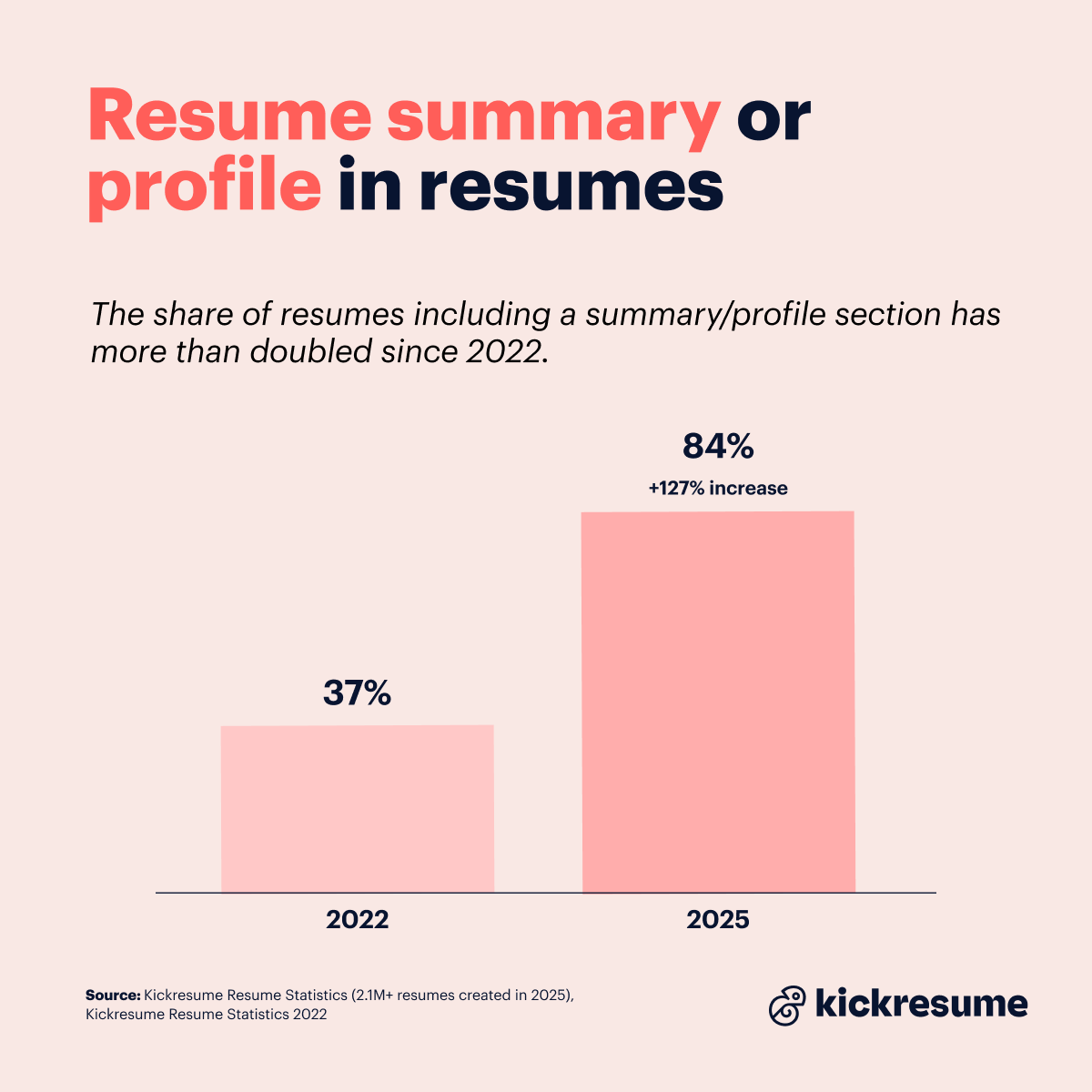
The shift reflects a broader change in resume writing. Candidates increasingly use the top of the resume to immediately communicate their experience, specialization, and value to employers.
“The top of the resume has become much more strategic than it used to be,” says Julia Belak, Certified Professional Resume Writer (CPRW). “Candidates increasingly use the resume summary as their opening pitch — a few lines to communicate who they are, what they specialize in, and why they’re relevant for the role before recruiters even reach the work experience section.”
Most resumes list 1 to 3 previous roles
Work experience remains the foundation of nearly every resume overall. Around 97% of resumes included a work experience section, making it the single most common major resume category.
However, most resumes remain relatively compact when it comes to work history.
The analysis found that resumes contain an average of 4 work experience entries, with a median of 3 previous roles listed per resume.
In fact, more than half of resumes list between 1 and 3 previous work experiences. Only around 5% of resumes include 10 or more work experience entries.
Here’s a closer look at work experience distribution:
- 0 roles: 3%
- 1 role: 28%
- 2 roles: 17%
- 3 roles: 13%
- 4 roles: 11%
- 5 roles: 9%
- 6 roles: 6%
- 7 roles: 4%
- 8 roles: 3%
- 9 roles: 2%
- 10+ roles: 5%
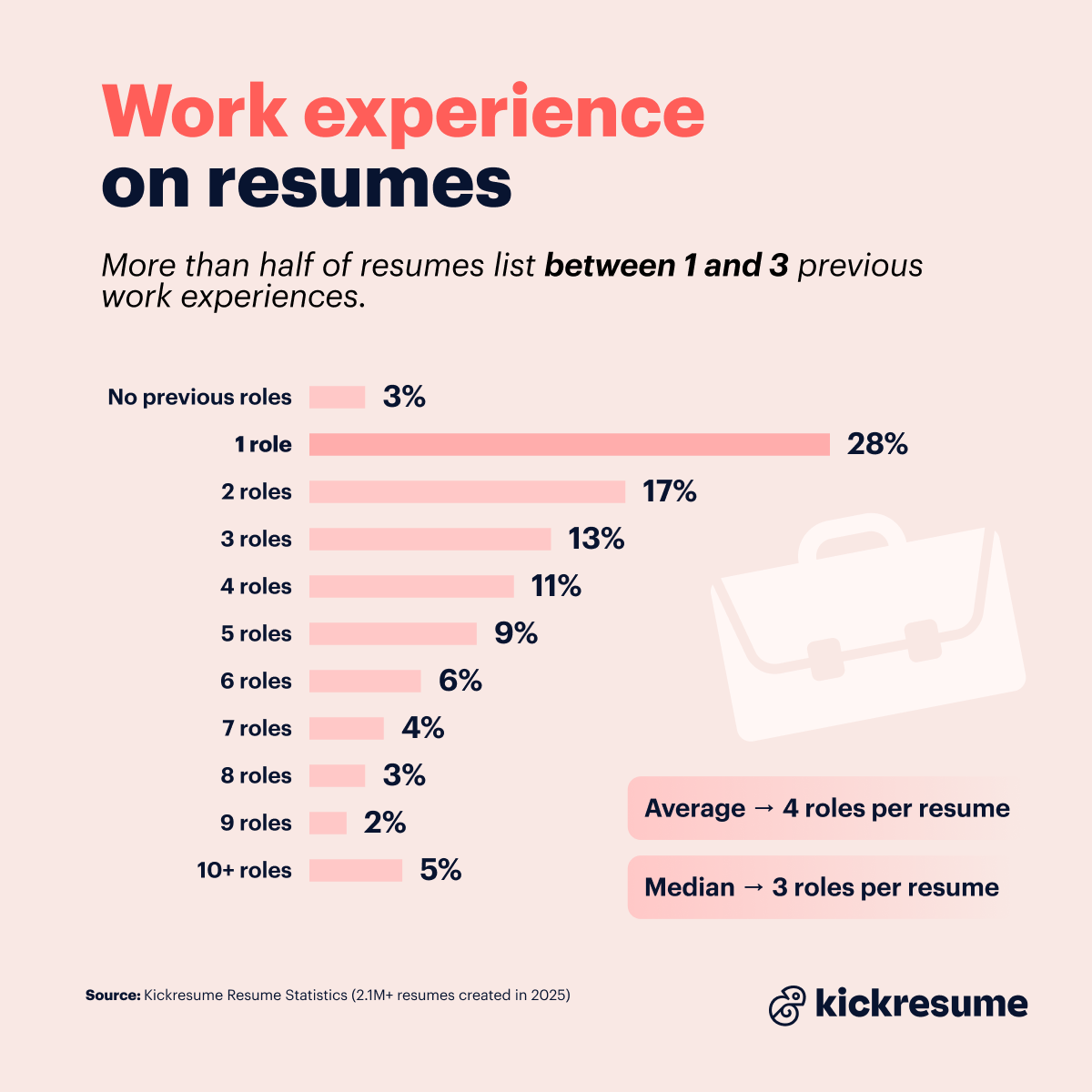
The findings suggest that even candidates with longer careers may increasingly prioritize relevance and readability over documenting every position they have ever held. Rather than functioning as complete career records, modern resumes appear to be becoming more selective and curated.
24% of resumes miss an education section
Education remains one of the core sections of most resumes, appearing in 76% of resumes analyzed.
Still, 24% of resumes don't have an education section. Overall, education appears less consistently than work experience, skills, or resume summaries — making it the least common of the four major core resume sections.
The data suggests that while education still plays an important role in resumes overall, a significant share of candidates now choose to prioritize experience, skills, or other sections instead.
More than 1 in 4 resumes list over 10 skills
Some resumes are increasingly packed with skills — likely reflecting how important keyword matching and searchability have become in online hiring.
The analysis found that 86% of resumes included a dedicated skills section.
Most candidates keep their skills sections relatively concise: 39% of resumes listed between 1 and 5 skills, while another 19% included 6 to 10 skills.
At the same time, longer and more keyword-heavy skills sections are becoming increasingly common. More than 1 in 4 resumes listed over 10 skills, including nearly 9% that contained more than 20. The average resume included 9 listed skills, with a median of 5.
Here’s a closer look at the skills distribution:
- No listed skills: 14%
- 1–5 skills: 39%
- 6–10 skills: 19%
- 11–15 skills: 12%
- 16–20 skills: 7%
- 21–30 skills: 6%
- 31+ skills: 3%
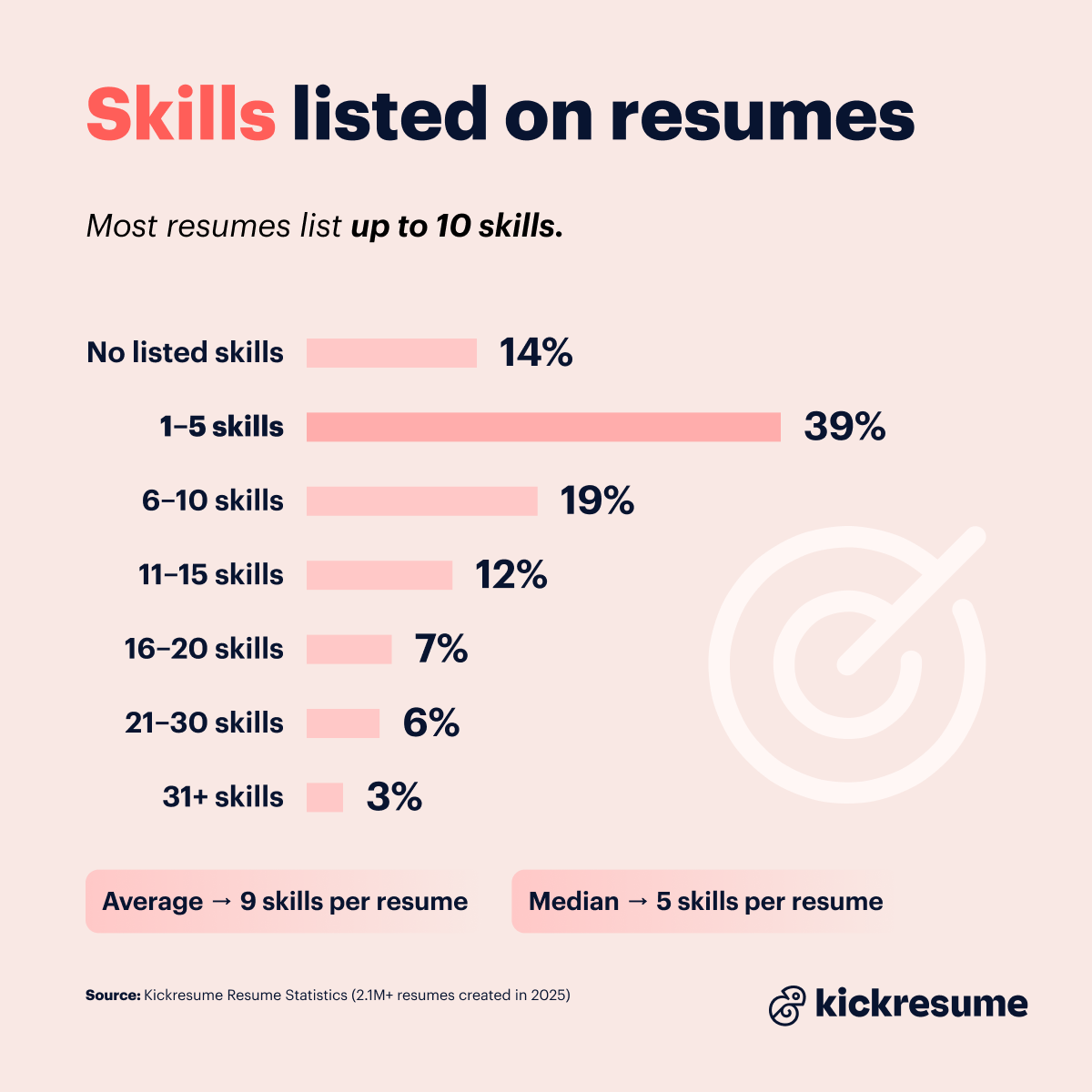
The most commonly listed resume skills were heavily dominated by technical and digital competencies like Python, SQL, JavaScript, Git, and Power BI. At the same time, workplace soft skills like communication, leadership, project management, and problem solving also remained highly common.
Interestingly, “English” ranked as the single most frequently listed skill overall — highlighting the importance of language proficiency in international hiring markets.
Most commonly listed resume skills
- English
- Python
- SQL
- JavaScript
- Java
- Data analysis
- Git
- HTML
- MySQL
- Time management
- CSS
- Project management
- Microsoft Office
- Communication
- Hindi
- Problem solving
- Power BI
- C++
- Leadership
- Jira
Thanks to additional sections, resumes are becoming more personal
Work experience, skills, and education still form the backbone of most resumes. But many candidates now supplement traditional sections with additional content designed to showcase expertise, personality, side projects, or searchable keywords beyond formal job history.
The most common additional resume sections were:
- publications (32% of resumes)
- hobbies and interests (31%)
- keyword-focused sections highlighting skills or expertise (31%)
Project sections appeared in 15% of resumes, while another 16% included custom text sections that did not fit traditional resume categories.
The data suggests that when it comes to content, resumes are increasingly evolving beyond standardized formats. Many candidates now appear to treat resumes not only as career summaries, but also as partially customizable personal branding documents tailored to specific industries, roles, or hiring systems.
“Candidates are increasingly moving beyond strictly standardized resumes,” says Julia Belak, Certified Professional Resume Writer (CPRW). “Additional sections allow people to emphasize projects, expertise, interests, or keywords that may not fit neatly into traditional work experience — especially in digital and creative careers.”
Altogether, the findings point toward resumes becoming both more standardized in structure and more personalized in content.
Conclusion: The modern resume is becoming simpler and more strategic
Despite endless online advice about “perfect” resumes, the data suggests most candidates are moving toward a surprisingly similar formula: concise, highly readable resumes optimized for fast scanning — both by recruiters and software systems.
At the same time, resumes are also becoming more personalized. Projects, publications, and keyword-focused sections increasingly supplement traditional work history and education.
The result is a resume that functions less like a static career document and more like a hybrid between a professional profile, a searchable keyword document, and a personal branding tool.
Methodology
For this report, Kickresume analyzed 2,133,734 resumes created on the platform in 2025.
To improve relevance and exclude partially completed or nearly empty resumes, the analysis focused only on resumes containing more than 200 words.
Some parts of the analysis were also conducted on smaller filtered datasets:
- Resume section naming analysis was limited to 1,784,323 English-language resumes.
- Resume template analysis was based on approximately 420,300 downloaded resumes.
The data was collected and analyzed anonymously and excluded personally identifiable user information.
About Kickresume
Kickresume is an AI-based career tool that helps candidates source jobs and raise salary with powerful resume and cover letter tools, skills analytics, and automated job search assistance. It has already helped more than 8 million job seekers worldwide.