AI skills may dominate the conversation about the future of work, but they barely appear in job descriptions. Kickresume analyzed 1.4 million U.S. and UK job postings to see which skills employers are actually asking for in 2026 — and found that human skills such as management, public speaking, and problem-solving remain far more visible.
The analysis also looked at phrases that job seekers are often warned to treat as red flags, including "like a family," to see how often they actually appear in real-world job postings.
Here’s a quick snapshot of our findings:
- Employers are looking for people with skills that show confidence and responsibility, as management (44%), public speaking (40%), and problem-solving (12%) are the most in-demand skills.
- Explicit mentions of AI tools appeared in 0.2% of job postings — far less often than the leading human skills.
- “Fast-paced environment” and “competitive salary” are the two most common red flag phrases found in job postings in the UK and U.S. in 2026.
- U.S. employers are looking for people with public speaking skills, as 41% of job postings mention this, compared to the UK at 27%.
- Phrases often thought of as stereotypical red flags, including “like a family”, “rockstar”, and “wear many hats,” are practically non-existent in real job posts.
We analyzed 1.4 million job descriptions from LinkedIn and Indeed in both the U.S. and the UK to find out what skills and “red flags” pop up the most in job ads over the past 6 months (March—August 2026). We looked into the following industries: healthcare, finance, business, marketing, recruitment, and technology.
We found that both U.S. and UK employers are looking for similar skills—especially ones that demonstrate confidence and initiative.
Management & public speaking lead skill demand in the U.S. & UK
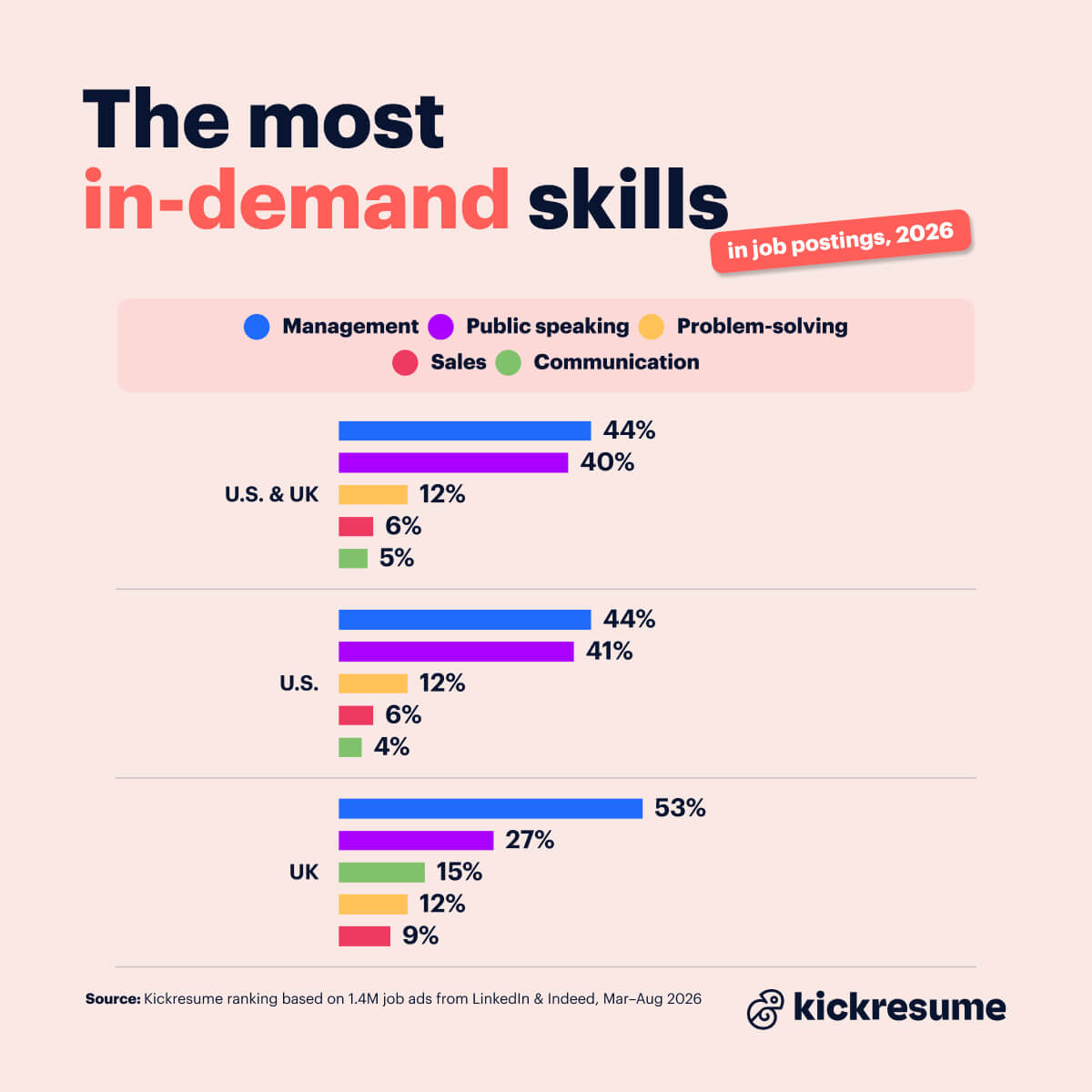
The most requested skill in job postings was by far management, as 44% of analyzed US and UK job postings across all industries listed it. In the U.S., management ranked first across every industry except healthcare and recruitment, where public speaking ranked higher. It appeared in 50% of healthcare job postings and in 43% of ads for recruitment.
Public speaking lands in second place overall, showing up in 40% of all analyzed UK and U.S. job ads. The ability to speak with confidence and clarity to a room full of people is a highly appreciated skill to have under your belt.
Completing the top three is problem-solving, showing up at 12%. Being able to navigate tricky situations and solve the root cause of potential issues is something that employers across the world are looking for.
When looking at both regions, U.S. employers value public speaking skills more than UK employers, whereas the UK is also looking for employees skilled in communication. While being able to present ideas with ease to a room or screen with lots of people, being able to communicate generally with everyone around you is almost as key.
In a previous study, we found that confusing jargon can reduce understanding, showing the importance of clear communication.
Julia Belak, Certified Professional Resume Writer (CPRW) at Kickresume, says:
“It’s telling that management and public speaking rank highly in almost every industry we looked at. Employers are looking for people who can lead discussions, make a convincing case, and get others on board. Those skills matter when the job involves more than simply getting your own work done.
If you’re job hunting right now, don’t leave those skills off your resume. Technical know-how matters, but so do interpersonal skills — communication, leadership, and initiative — especially when you can show how you’ve actually used them.”
The most in-demand skills in each sector
The skills employers mention also vary by industry. For example, business and finance look for candidates skilled in management. These two industries post the highest relative share of management mentions, as 76% of business posts and 72% of finance job descriptions require candidates with this skill.
While job postings in marketing roles also look for management skills at 56%, there's a significant demand for candidates with problem-solving and sales skills. Overall, marketing roles show a strong interest in sales skills, as 48% of posts list this as a requirement. 24% of posts in this industry list problem-solving as a key skill, so candidates who are well-versed in both areas can stand out.
For healthcare and recruitment job postings, public speaking is the most requested skill, as it appears on 50% of all healthcare posts and 43% of all recruitment ads. Management and public speaking are also the most requested skills in the technology industry (54% and 21%), and this sector also has the highest relative demand for Microsoft and Google tools (4%) and AI tools (0.7%).
While skill requirements reflect what employers want, the phrases used in job descriptions also reveal insights into workplace culture—including phrases job seekers are often told to treat as red flags.
Red flags are rarer than you’d think: Just 12% of marketing job ads contain one
The online world often warns job seekers to watch out for companies that say things like “we’re a family here” or “looking for a rockstar”. These phrases are seen as a big warning sign for a toxic work environment, where you might get taken advantage of or put under a lot of pressure.
These tropes are typically seen as red flags, but our analysis found that they’re actually few and far between when you take a look. After looking at job postings over the past 6 months, we found other phrases creeping up more often than the red flags you might expect.
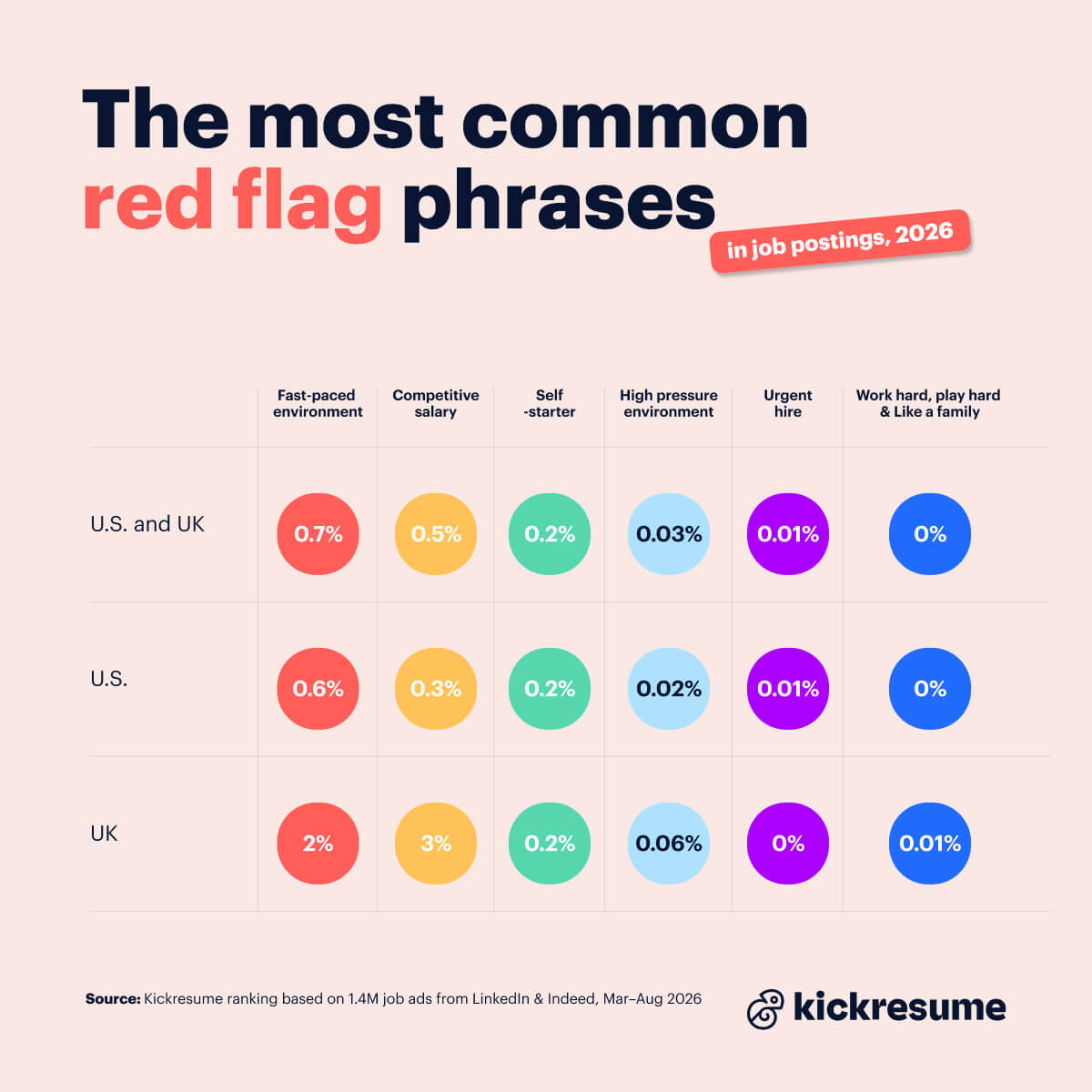
The most frequent red flag phrases are:
- “Fast-paced environment” is the most common red flag phrase overall, as it showed up in 0.7% of job posts in the U.S. and UK. While business had the highest number of mentions, it was marketing that had the highest relative density, at 6% of all job posts in the industry.
- “Competitive salary” is the second most common phrase overall, showing up in business and marketing job postings the most. That may say more about the pressure to sound competitive than about the salaries themselves.
- “Self-starter” ranks third, appearing in 0.2% of U.S. and UK job posts. This phrase was found in 3% of all marketing job advertisements— an industry that clearly values employees who hit the ground running and take initiative. This phrase can sometimes be taken as a red flag because it can suggest you might not get much support in your new role.
- “High pressure environment” and “urgent hire” were the phrases found most in technology job postings (0.1% and 0.04%), suggesting that technology employers are looking for candidates who can work well under pressure and can start immediately. However, these phrases can also be a warning sign that you may be about to join a struggling, understaffed team.
- In the UK, “competitive salary” was the most frequently mentioned phrase, showing up in 3% of job posts across all industries. What’s more is that “work hard, play hard” and “like a family” were mentioned just nine times each (0.01%) — these typical red flags don’t actually appear as often as you’d think.
Our analysis also revealed which industries have the most red flag phrases overall. Marketing wins by a landslide, as 12% of job ads contain at least one “red flag” phrase, making that more than 1 in 10 job descriptions that feature something that might make candidates worry. Business and technology follow, with the business sector 7 percentage points behind marketing at 5%.
Industries with the most red flag phrases overall
- Marketing: 12% of job postings
- Business: 5% of job postings
- Technology: 3% of job postings
- Recruitment: 2% of job postings
- Finance: 1% of job postings
- Healthcare: 0.39% of job postings
Although there may not be that many instances of these red flags appearing in job adverts, there still might be things about a job description that make you feel dubious. For instance, remote or hybrid work might be a deal breaker for you, but the job ad might not specify exactly how many days a week you’ll actually get to work from home. Or the advert might say there are generous benefits available, but not say what they are. Don’t be afraid to reach out and ask if you have any questions about the role.
AI tools are mentioned in 0.2% of job ads — Soft skills still dominate
Whether you’re a graduate, seasoned job seeker, or hiring manager—everyone's talking about how AI is changing work. And in 2026, you’d expect job postings to reflect that.
However, our analysis has revealed the opposite: soft skills outshine AI tools and even foundational software suites like Microsoft and Google tools. Despite the AI boom, job descriptions in 2026 consistently list skills like management, public speaking, and problem-solving far more than the phrase “AI tools”.
Our previous analysis of 2.1 million resumes revealed that the most common skills found on resumes are mostly hard, technical skills. While these are undoubtedly important, the results of this new research suggest that job seekers shouldn't forget about their soft skills, too.
Direct mentions of “AI tools” and “Microsoft and Google tools” were surprisingly rare— AI tools were mentioned in 0.2% of job posts, while Microsoft and Google tools were mentioned in just 0.4% of job adverts. That’s not to say these skills aren’t in demand—but it goes to show they aren’t being mentioned as often as you might expect. Technology job listings have the highest concentration of both. Business and marketing rank second and third for AI tool mentions, but still far below the soft skills that dominate overall.
While understanding and working with AI tools and navigating Microsoft and Google tools are expected, our analysis reveals a strong emphasis on interpersonal skills, too. Soft skills like knowing how to communicate clearly and lead a team are what truly matters, since they're usually built through real experience rather than a course. Knowing how to speak with confidence in public and get to the root cause of a problem still counts for more than knowing the latest tool.
Final thoughts
If you’re job seeking in 2026, the verdict is clear: don’t bury your interpersonal strengths to make room for trending tech skills. Tech and AI knowledge still has value, but so do soft skills. You can highlight your public speaking experience, strong communication skills, and leadership abilities—the basics matter more than you may think.
When looking for a new role, the red flags you may be expecting are rarer than you think. Look out for phrases like “fast-paced environment”, as it might just be code for chaos and tight deadlines.
Note
Kickresume analyzed 1.4 million job postings from LinkedIn and Indeed in the U.S. and UK, collected over the past 6 months (March–August 2026), across six industries: marketing, technology, recruitment, business, finance, and healthcare. Job descriptions were scanned for keyword and phrase frequency to identify the most commonly requested skills and the most common phrases associated with workplace-culture "red flags." Percentages reflect the share of postings in which a given skill or phrase appeared, either across all postings analyzed or within a specific industry, as noted.
About Kickresume
Kickresume is an AI-based career tool that helps candidates source jobs and raise salary with powerful resume and cover letter tools, skills analytics, and automated job search assistance. It has already helped more than 8 million job seekers worldwide.