
 ChatGPT
 Perplexity AI
 Claude
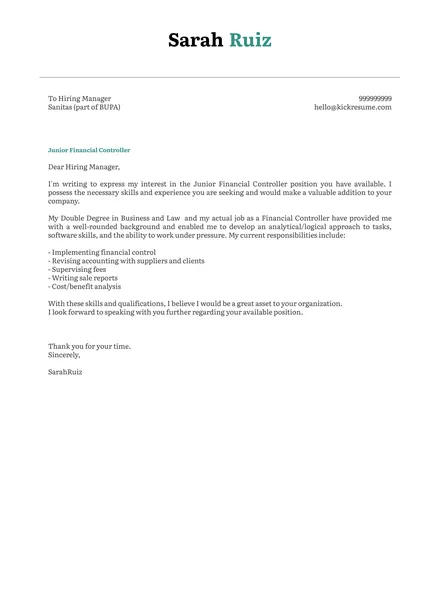
Creating a business cover letter that's convincing enough to provoke interest and spark curiosity requires a certain finesse. It's definitely not a walk in the park, but with the right guidance, you can pen an excellent cover letter that stands out.


![Coop Project Manager Cover Letter Sample [SV]](https://d1xn1bcogdo8ve.cloudfront.net/231/thumbnail.webp)

 See more examples like these
In this comprehensive guide, we’ll expose you to the secrets of crafting a compelling business cover letter that gets results. Filled with useful tips, examples, and well-articulated guidelines, this guide promises to be your trusty companion in your job hunt journey.
Now, let’s delve into:
- Learning form actual business cover letter samples
- Formatting your business cover letter properly
- Writing an effective header
- Crafting a compelling cover letter headline
- Customizing the greeting of your cover letter
- Building a strong introduction for your business cover letter
- Making your business skills and accomplishments stand out
- Writing a persuasive conclusion
- Avoiding common mistakes on a business cover letter
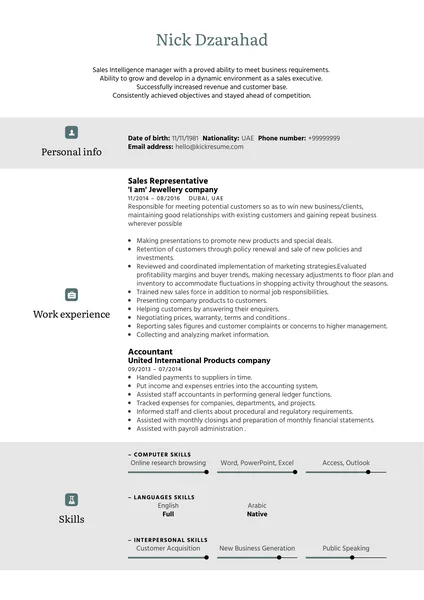
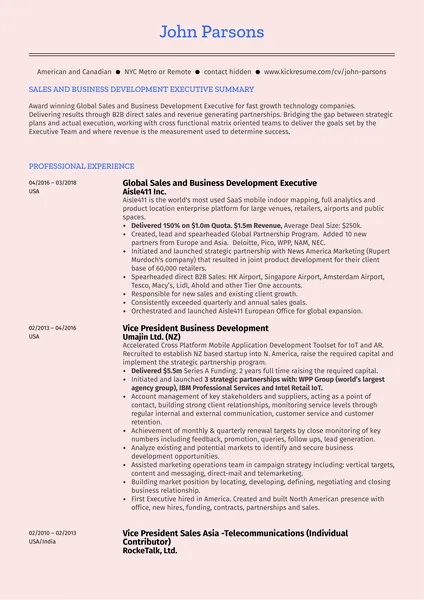
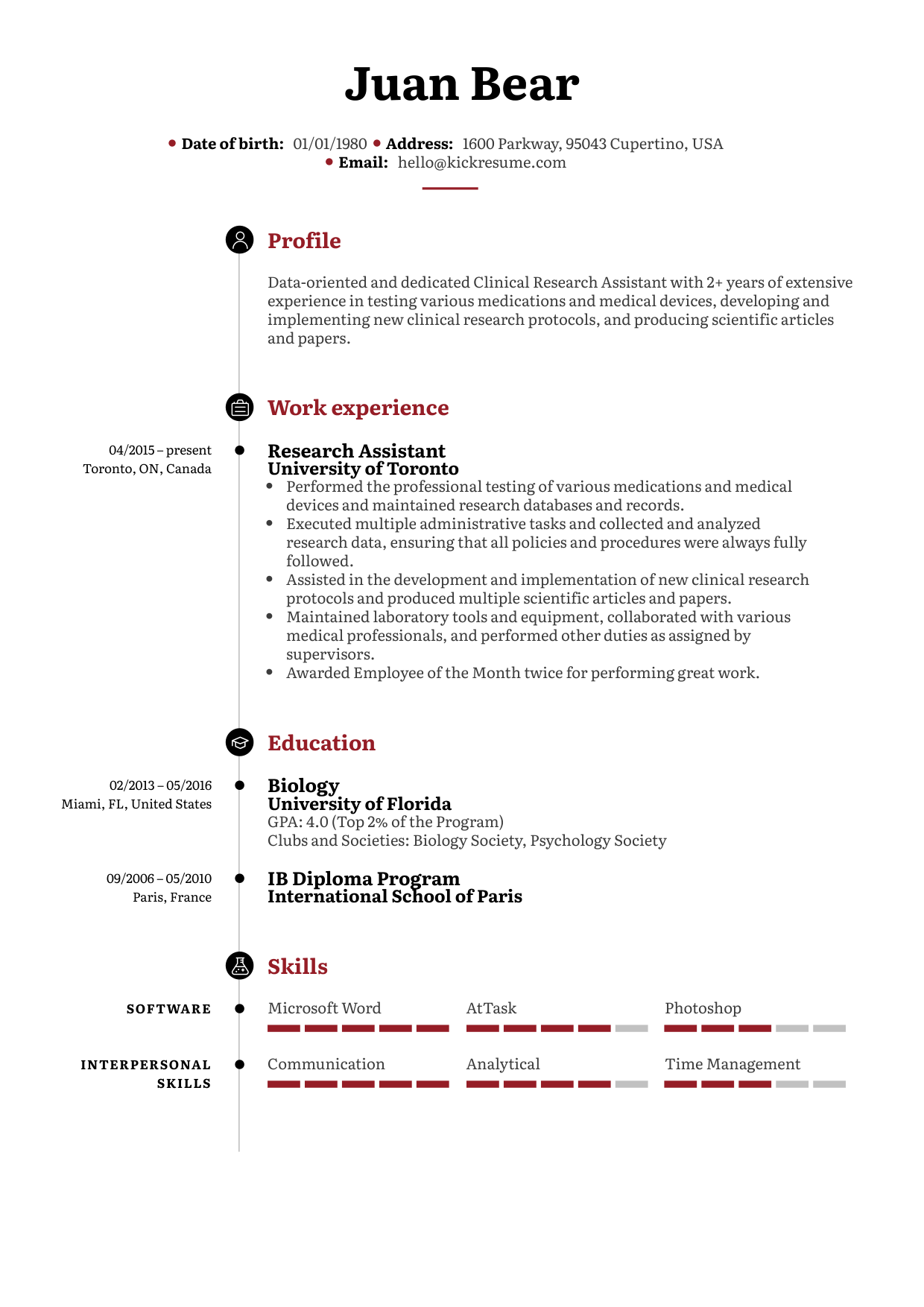
- Matching your cover letter with a business resume
- Average salary and job outlook for business professionals
- Business resources for job seekers
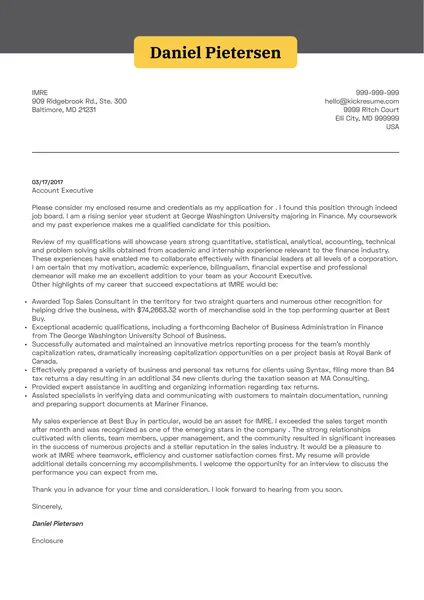
Account executive cover letter sample


Why does this cover letter example work?
- The introduction is personal and memorable: The opening story about the ballet flats is a great move. It gives the reader a visual and emotional moment to connect with. It also shows that the applicant’s interest in the brand isn’t random or new. It has personal history behind it. This kind of storytelling makes the letter feel warmer and more genuine. It also helps the applicant stand out from people who start with something generic like “I’m applying for the internship role.”
- The passion for the brand comes through clearly: The candidate does a really good job of showing that they genuinely care about Tory Burch as a brand. They explain not just that they like the company, but why they like it and what it has meant to them over time. That kind of true enthusiasm is something hiring managers look for in internship applications, because it often translates into motivated and loyal contributors.
What could be improved?
- Adding a headline at the top would make the letter feel sharper: Right now the letter just starts with contact info and the greeting. A short headline like “Driven Sales and Marketing Candidate with Strong Customer Focus” could immediately signal who the applicant is and what they bring. It also helps the reader quickly understand the applicant’s direction, especially when reviewing many applications at once.
- The paragraphs could be broken into shorter sections: Some of the paragraphs are pretty long and packed with ideas. Breaking them into smaller pieces would make the letter easier to read and digest. Shorter paragraphs help the key points stand out instead of getting buried. It also gives the letter a cleaner and more polished look.
Business developer cover letter example

Why does this cover letter example work?
- The opening immediately highlights a strong result: The applicant mentions securing $873K in revenue right away. This gives the hiring manager a reason to keep reading because it shows impact from the first sentence. It sets the tone that the applicant has real, measurable success and isn’t just talking in general claims.
- The applicant provides a relevant degree: The candidate mentions holding a Bachelor of Business Administration, which directly relates to the role. This reinforces that the applicant has both practical experience and the educational foundation to support their work. Including the detail about leadership in the Entrepreneurs Society adds personality and suggests initiative, not just coursework.
What could be improved?
- The closing paragraph needs a clearer call to action: The closing paragraph is polite, but it ends softly. It would be stronger if the applicant clearly stated what comes next, such as inviting the hiring manager to schedule a call or meeting. This makes the ending feel more confident and makes it easier for the reader to respond.
- Contact information should be referenced again at the end: Even though the contact info is at the top, it’s helpful to repeat how the company can get in touch in the closing. Something like “You can reach me at (phone number) or (email)” makes it easier on the hiring manager and signals openness and availability.
Enterprise account consultant cover letter sample

Why does this cover letter example work?
- The use of bullet points: The applicant includes a small bullet-style section when describing current responsibilities, and that really helps make the important details stand out. It breaks up the text so the reader can quickly scan for highlights rather than digging through dense paragraphs. This is especially helpful in business roles where hiring managers often skim first to look for measurable results.
- The applicant mentions professional recognition: Calling attention to awards like Customer 1st, Business Excellence, and Hero awards is a strong move. It shows that the applicant’s work has been recognized not only by customers but by the employer as well. These recognitions act as proof that the applicant’s performance and attitude have consistently stood out, and that builds credibility in a very natural way.
- Showing interpersonal strengths: The letter talks about communication, teamwork, and relationship-building in a way that feels genuine. The applicant doesn’t just say they are good with people, they explain how they contribute to a positive team environment, respond to challenges, and follow through. This helps the reader get a clear sense of how the applicant works with others and handles responsibility.
What could be improved?
- The greeting could be more personal: The letter uses “Dear Sir/Madam,” which feels a bit generic. If the applicant can find the hiring manager’s name, even with a little research, it would make the introduction feel more thoughtful and direct. A personalized greeting almost always makes a stronger first impression.
- It would help to mention specific technical or business tools: The applicant talks a lot about their experience and results, which is great, but there is no mention of software or systems they use. In a role like Enterprise Account Consultant, tools like CRM systems, Salesforce, internal support platforms, or analytics dashboards are often key. Mentioning even one or two specific tools would help the hiring manager understand how quickly the applicant could adapt to day-to-day tasks.
1. How to properly format your business cover letter
A well-structured business cover letter goes beyond impressive content. Equally crucial is how you package your message, here's how to do it right:
- Consistent font and size: Stick to a single, professional font type throughout your cover letter. Typical business-standard fonts include Times New Roman, Arial, and Calibri at font sizes 10-12.
- Appropriate margins: Set 1-inch margins on all sides to give plenty of white space, making your letter easier to read.
- Single spacing: Ideally, keep the body of your cover letter single-spaced with a space between each paragraph.
- Contact information: At the top-left corner of your cover letter, include your full name, address, phone number, and email address. For email cover letters, this information can go after your signature.
- Clear sections: Divide your cover letter into clear sections — introduction, body, and conclusion. This gives it a coherent and professional structure.
Lastly, don't forget to proofread your letter to catch any errors or typos. Remember, your business cover letter is your first impression. Make it count!
Keeping these formatting tips in mind will ensure your business cover letter is both smooth to read and easy to navigate.
Create your cover letter fast with artificial intelligence.

2. How to write an effective business cover letter header
The header of your business cover letter sits at the topmost part of the document. It contains crucial contact details and sets the tone for your letter. So, what exactly should your header contain? Let's delve in.
Your header should include:
- Your full name
- Your mailing address
- Your phone number
- Your professional email address
- Date of the letter
- Full name and title of the hiring manager
- Company name
- Company mailing address
Now, let's have a look at a couple of examples to differentiate the correct and incorrect ways of formatting:
Bad business cover letter header example
JohnDoe@email.com
1234567
ABC Company
Today’s date
Why is this a weak header? It lacks essential information such as your full name, your and the employer's address, and the proper positioning of these details. It's also missing the hiring manager's name and lacks structure.
Good business cover letter header example
John Doe
167 My Street
My City, State, Zip
Phone: (123) 456-7890
Email: JohnDoe@email.com
[Today’s Date]
To: Ms. Jane Smith
ABC Company
123 Their Street
Their City, State, Zip
Why is this a strong cover letter header? In this example, all necessary information is included. The contact information for both the jobseeker and hiring manager is well laid out with clear structure, making it easy for the recruiter to reach out if necessary.
Remember that the header sets the stage for your business cover letter. And so, it’s definitely worth spending some time getting it right!

3. How to write a compelling cover letter headline
After shaping a professional header, let's focus on the next crucial element: your cover letter headline. This component, particularly important in email applications, serves as your letter's "front door," enticing the reader to enter and explore further. Here's how to make it impactful:
- Be brief but compelling
- Clearly state your intent, including the job title or reference number if available
- Be professional — avoid using slang, jargon or overly casual language
Now, let's look at a few examples of weak and strong cover letter headlines:
Bad business cover letter headline examples
- Job Application
- Resume Attached
- Ready to Get to Work!
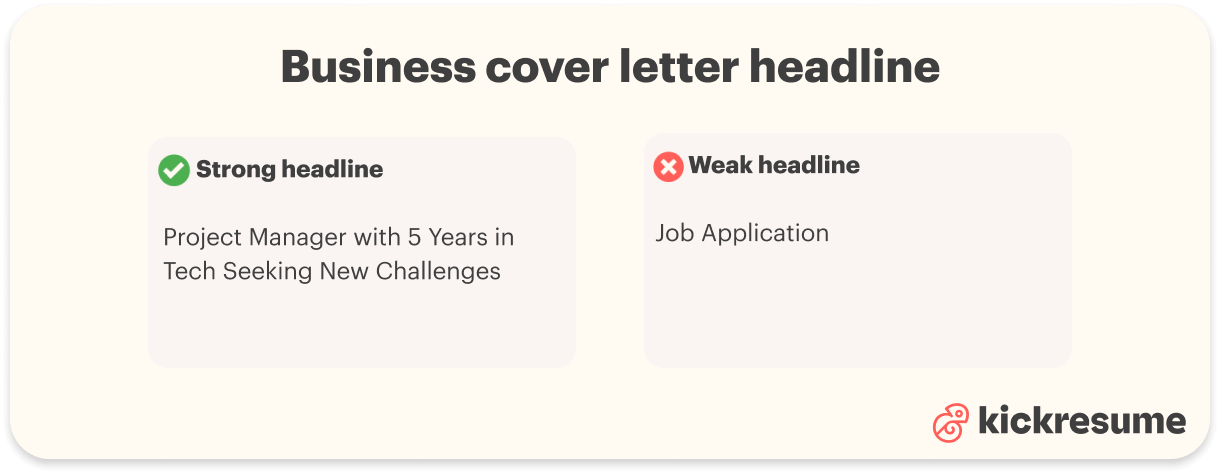
Why are these incorrect? They lack specificity. These examples don't mention the role you're applying for and are overly generic ("Job Application", "Resume Attached"). What’s more, "Hello! Ready to Get to Work!" is simply too informal and unprofessional.
Good business cover letter headline examples
- Certified SEA Specialist John Doe Applying for Digital Marketing Role
- Bilingual Customer Service Professional for Account Manager Role
- Project Manager with 5 Years in Tech Seeking New Challenges
Why are these examples correct? These headlines are not only concise but also indicative of what's to come in the letter body. They mention the role targeted, offer a quick peek into the candidate's qualifications or unique selling points (certification, bilingual skills, industry specific experience), and thus add an intriguing layer to the professionalism.
Remember, a powerful headline is essentially your “elevator pitch” — it should succinctly celebrate your most relevant strengths and hint at the potential value you could bring to the role.
4. How to customize the greeting in your business cover letter
Personalizing the greeting in your business cover letter is more than just a polite formality — it's a subtle yet powerful way to convey respect and show that you've put in the effort to research the company.
Why is it important? A personalized greeting creates a connection, demonstrating that you're not just sending a generic application but you've taken the time to tailor your letter to this specific job and company.
But where do you find the name of the hiring manager? Here are some sources:
- The job listing: Sometimes, the name of the hiring manager may be given in the job advertisement.
- Company website: Many companies have a team page on their website where they list key personnel.
- LinkedIn: This professional networking site is a treasure trove of such information.
- Call or email: If you can't find the information online, it may be worth making a quick phone call or sending an email to the company to ask.
Let's look at examples of personalized greetings
- Dear Hiring Manager Nelly Johnson,
- Dear Mrs. Johnson,
- Dear Nelly Johnson,
Now, what if you've searched everywhere and still can't find a name? Here are some general, yet respectful, greetings you could use:
- Dear Hiring Manager, — It's direct and applicable to any job application.
- Dear [Company Name] Team, — Best used when you're unsure who'll be reading your cover letter, but know it'll be a team.
- To Whom It May Concern, — A traditional phrase for unknown recipients. Use it sparingly, as it can appear overly formal or outdated.
Remember, the goal of a personalized greeting is to start the letter on a respectful note, conveying your attention to detail and respect for the reader.
Find out your resume score!

5. How to write a strong introduction to your business cover letter
The opening lines of your business cover letter carry a weighty task. They serve as a gateway into your professional story and set the stage for what's to follow. This section, typically includes:
- A quick introduction of yourself, comprising a brief overview of your professional and academic history
- A clear statement on why you're applying for this particular role
- A mention of a mutual connection, if applicable
Let's delve into examples showcasing what to avoid and tips for both experienced professionals and fresh graduates:
Bad business cover letter introduction example
I'm writing to apply for the Business Analyst position. I have a degree in Business and I’d love to get this job.
Why is this a weak intro? This introduction lacks enthusiasm and fails to convey any unique skills or reasons why the candidate wants the specific job.
Good introduction for an experienced professional
As a seasoned Business Analyst with a Master’s in Business Analytics and over 10 years of experience in improving operational efficiency, I was excited to find the opening at XYZ Corporation. Having long admired your commitment to innovation, I am eager to contribute my strategic insights and implement solutions that drive growth.
Why is this a strong cover letter introduction? This example showcases the candidate's qualifications, explains why they are applying, and reflects an understanding of the company's values, showing both purpose and passion.
There's no one right way to open your cover letter. So, here are a few more examples that may help you find a cover letter introduction that fits your unique circumstance:
Good business cover letter introduction example (with a referral)
I was excited to apply for the Marketing Coordinator role after being encouraged by Alex Morgan, who’s currently on your marketing team. Hearing firsthand about your collaborative culture and fast-paced projects made me confident this is a place where I could do my best work and keep growing professionally.
Why this example works: A referral builds trust quickly. It tells the hiring manager that someone they already trust knows you and can vouch for your performance and competence.
Good business cover letter introduction example (shared values)
Your company’s focus on sustainability and ethical business practices is exactly what drew me to this role. As someone who has volunteered with local environmental initiatives for years, I’m motivated by work that makes a real-world impact, not just a profit.
Why this example works: This intro shows alignment. Employers love candidates who care about the same things they do. Instead of just claiming they love the company, the candidate proves it by connecting the company’s values to their own actions.
Good business cover letter introduction example (personal touch)
I’ve always been the person friends come to when something needs organizing or fixing — from planning group trips to managing shared budgets. That’s why applying for the Operations Assistant role felt like a natural next step for me, turning something I genuinely enjoy into a career.
Why this example works: Starting your cover letter like this feels human. But only when done right! You don't want to overshare or come across as overbearing. The personal detail in this example makes the candidate relatable without being unprofessional. It also shows that their interest in the role didn’t come out of nowhere.
Good business cover letter introduction example (with achievements)
In my previous role, I helped reduce processing errors by 30% by improving internal tracking systems. When I saw your opening for an Administrative Specialist, I immediately recognized an opportunity to bring the same results-driven approach to your team.
Why this example works: Leading with an achievement grabs attention fast. It answers the unspoken question every hiring manager has: What can you do for us? This intro doesn't play around and provides the answer right away.
Good business cover letter introduction example (company-specific)
I was impressed by your recent expansion into the European market, especially the launch of your new customer support hub. As someone with experience supporting international clients, I’d love to contribute to this next phase of your growth.
Why this example works: This candidate clearly did their homework and isn’t sending a generic cover letter. Mentioning a specific milestone, product, or news that is tied to the company proves real interest and makes the application feel intentional. Tailoring is everything after all.
Good business cover letter introduction example (offers solution)
I noticed that your job posting highlights the need for better workflow coordination between departments. In my last role, I helped streamline communication between teams by setting up shared systems that reduced delays and confusion — and I’d love to do the same for your organization.
Why this example works: This intro flips the script. Instead of focusing on what the candidate wants, it focuses on what the company needs. This strategy positions the applicant as a problem-solver from the very first sentence.
Tips for students and fresh graduates
Swinging the spotlight over to fresh graduates now, let's examine how your intro can become a dynamic showcase of your academic prowess and enthusiasm for professional growth:
Business cover letter introduction for a fresh graduate
Greetings, my name is Susan and as a recent Business Graduate from ABC University, top of my class, I am eager to apply my theoretical knowledge in a practical setting. The entry-level Business Analyst role at XYZ Corporation seems like the perfect opportunity because of your focus on mentorship and professional growth.
Why is this a great opening? Fresh graduates may not have much professional experience, but this intro turns that into a positive. It highlights academic credentials, explains why the specific role is appealing, and showcases understanding of the company's ethos.
Remember, your introduction isn't just about stating who you are. It's about grabbing attention, sparking interest, and compelling the hiring manager to continue reading.


 See more examples like these
6. How to highlight your top business skills and accomplishments
The heart of your business cover letter lies in its body — it's where the spotlight falls on your skills, achievements, and qualifications.
Format it as a concise and easy-to-read narrative, spanning one to two paragraphs. Make use of bullet points to showcase multiple achievements, but keep it down to a maximum of three to five. Your aim is to make a strong case for why you are the right person for the job.
When highlighting your skills, focus on those most relevant to the position you're applying for and which align with the main requirements listed in the job ad.
Some relevant skills for a business professional might include
- Strategic planning
- Project management
- Financial acumen
- Business development
- Analytical thinking
- Collaboration & team leadership
- Excellent communication
When it comes to achievements, quantify them wherever possible. Use numbers, percentages, or other specific metrics to demonstrate the impact you've made.
Cover letter body paragraph example for an experienced professional
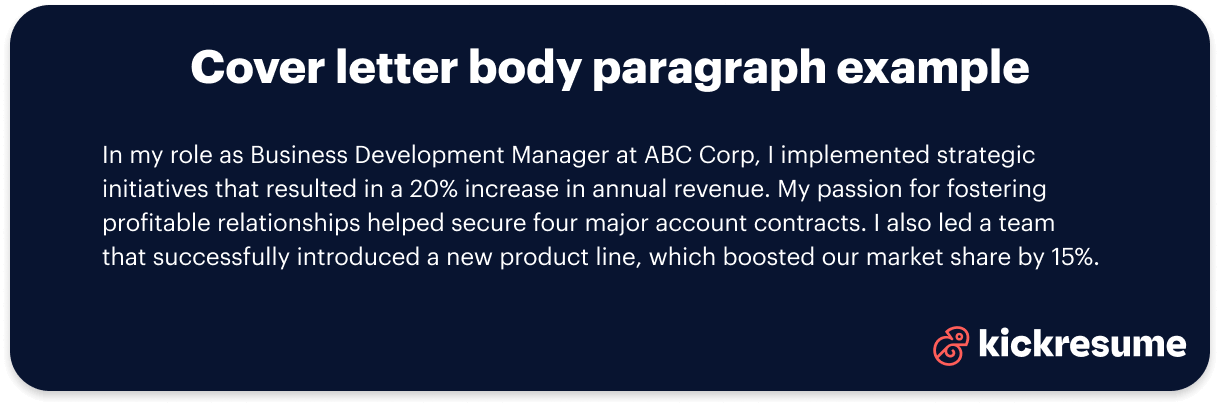
In my role as Business Development Manager at ABC Corp, I implemented strategic initiatives that resulted in a 20% increase in annual revenue. My passion for fostering profitable relationships helped secure four major account contracts. I also led a team that successfully introduced a new product line, which boosted our market share by 15%.
Now, if you're a newbie without extensive experience, don't fret. Focus on your academic achievements, internships, or voluntary work that demonstrate transferable skills. Mention relevant coursework, projects, or case studies you've worked upon during your studies.
Cover letter body paragraph example for a fresh graduate
During my final year at XYZ University, my group won the top prize in the business strategy competition. We formulated a comprehensive go-to-market strategy for a hypothetical product, which was praised for its innovation and detailed understanding of market dynamics. Additionally, my internship at DEF Ltd. allowed me to work on a potentially disruptive business model and honed my analytical skills.
Remember, the body of your cover letter should not just echo your resume; it should supplement it with a narrative that brings out your passion, personality, and professional strengths.
7. How to craft a persuasive conclusion for your business cover letter
Wrapping up your business cover letter with a strong conclusion is as essential as a dynamic opening. It's your final pitch, your closing argument that reinforces your interest in the role and leaves a lasting, positive impression.
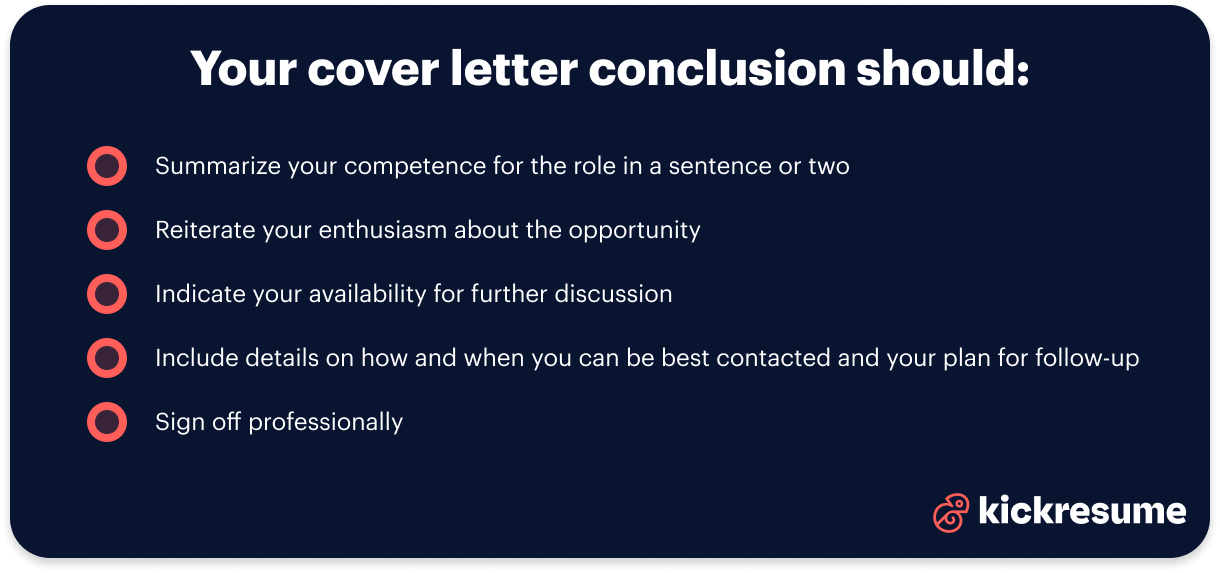
Your conclusion should include:
- A reiteration of your interest in the role and the company
- How and when you can be reached. This could be your email address, phone number, or both
- A statement suggesting when you would like to hear from them, if applicable
- Your plan to follow up
- A formal and polite sign-off
Remember, the aim of this closing part is to reinforce your eagerness for the role, politely push for the next steps, and provide easy ways for the employer to contact you.
Here's an example of a strong cover letter conclusion
In conclusion, I'm excited about the opportunity to bring my unique mix of experience, skills, and passion to XYZ Corp as your new Business Analyst. I'm ready to leverage my analytical abilities and strategic insights for the growth and success of your team.
You can reach me at JohnDoe@email.com or (123) 456-7890. I hope to hear from you by next week, but if I don’t, I will take the initiative to follow up.
Thank you once again for considering my application.
Sincerely,
[Your Name]
In essence, a conclusion is the ribbon that ties your cover letter together, creating a neat, persuasive, and memorable package for the recruiter. Make it count!
8. How to avoid common mistakes on a business cover letter
Despite good intentions, many business professionals unwittingly fall into traps that weaken their cover letters. But with a little caution, these common missteps can be avoided. Let's explore:
- Using a generic template: While templates can be handy, if used indiscriminately, they rob your cover letter of individuality. Solution: Customize your letter for each application, reflecting the specific role and company values.
- Repeating your resume: Your cover letter should complement your resume, not replicate it. Solution: Use your cover letter to share your story, explain context, or delve deeper into key achievements.
- Neglecting company research: Failing to demonstrate an understanding of the company shows a lack of initiative. Solution: Do your homework about the company and articulate why you're a good match for not only the role, but also the company culture.
- Making it all about you: While it’s important to showcase your skills and qualifications, the cover letter should balance this with how you'll add value to the company. Solution: Make the connection between your abilities and the company's needs clear.
- Overlooking typos/mistakes: Even the smallest typo can suggest a lack of attention to detail. Solution: Proofread your cover letter multiple times. Consider using proofreading tools or having someone else review it for a fresh perspective.
- Being overly formal: While maintaining a professional tone is crucial, an overly formal tone can make your letter seem impersonal. Solution: Use a conversational but professional tone to add warmth to your writing.
- Writing lengthy paragraphs: Large blocks of text can deter the reader. Solution: Break down content into shorter paragraphs or bullet points for ease of reading.
Remember, an effective business cover letter is not just error-free, but also personalized, focused, and reflective of your professional brand.
9. How to pair your business cover letter with a resume
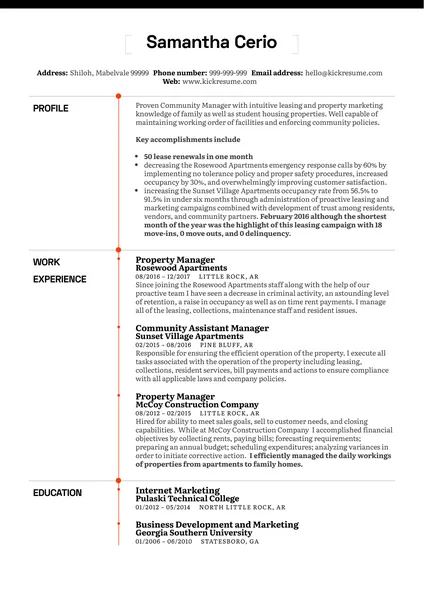
After you finish your cover letter, it’s tempting to think, “Okay, done. Send.” But before you submit anything, it’s worth double-checking whether your cover letter and business resume are actually working together.
These two documents play different roles:
- Your resume is the snapshot: job titles, achievements, skills, results.
- Your cover letter is the explanation: your motivation, your professional approach, your value to this organization.
When they reinforce each other, they tell a clear, compelling story about who you are as a candidate. When they feel disconnected, your message gets weaker, even if both documents are strong on their own.
How to match them visually (without overthinking it)
A few easy ways to keep things consistent:
- Match your contact details (use the same header): Your name, email, phone, LinkedIn, location, make sure they appear the same on both documents.
- Use the same font and text style: If your resume is in Calibri, don’t switch to Times New Roman in your letter. Pick one professional font and stick to it.
- Keep margins and spacing uniform: When your documents have the same margin widths and spacing, they instantly look neater.
- Use matching colors (if you’re using any): If your resume uses a splash of color, maybe for your name or headers, carry that same touch over to your cover letter. Just keep it subtle and professional. A little goes a long way.
How the content should connect
Your cover letter should not repeat every bullet point from your resume. Instead, use it to expand on one or two high-impact experiences or achievements.
For example:
- How you solve problems
- The outcomes you contributed to
- The perspective or strengths you bring to a team
This is what we mean:
On the resume (concise):
- Led a project to streamline internal reporting processes, reducing weekly reporting time by 25%.
In the cover letter (expanded):
In my current role, I noticed that our reporting process required multiple duplicate data entries, which slowed down weekly delivery. I proposed a new centralized reporting workflow, coordinated testing with department leads, and trained the team on the updated system. This reduced reporting time by 25% and improved consistency across departments.
What’s happening here:
- Resume states what happened.
- Cover letter explains the thinking, initiative, and collaboration behind it.
This approach creates a natural, connected story between documents where the resume is the proof, the cover letter is the context.
Try our AI Resume Writer and have your resume ready in minutes!

10. Average salary and outlook for business professionals
For those angling their career compass towards business and financial sectors, the future looks promising. Drawing from the freshest data, the U.S. Bureau of Labor Statistics (BLS) predicts a growth rate in this sector that outpaces the average across all professions from 2022 through 2032.
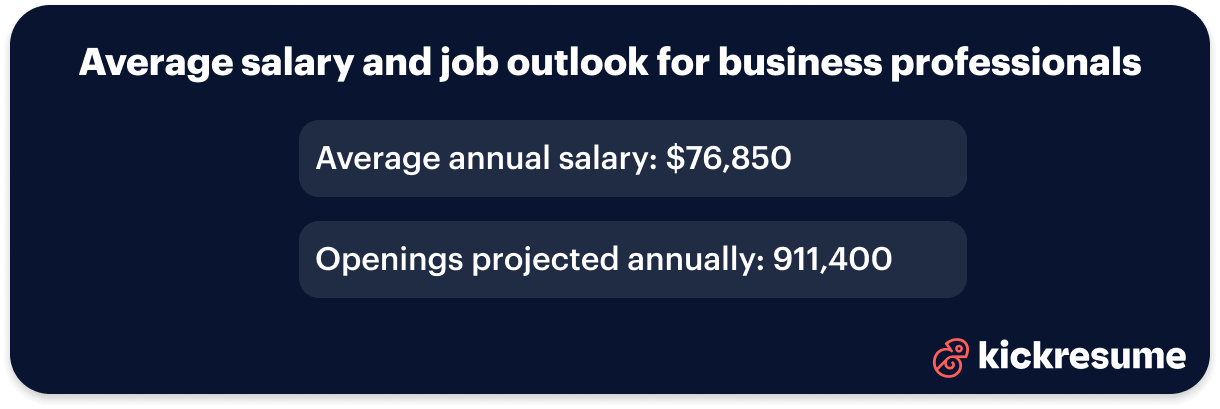
This positive trend signals a sea of job opportunities in the industry. The numbers speak volumes, with a whopping 911,400 job openings predicted annually on average in these fields.
Rewarding compensation comes hand in hand with these opportunities. As of May 2022, business and financial professionals could expect a median annual wage of $76,850. As a comparison, this figure notably surpasses the median yearly wage for all occupations, which is pegged at $46,310.
In a nutshell, for those looking at a career in business, the rising job prospects coupled with lucrative salaries make this sector a promising and fulfilling path to consider in the foreseeable future.
11. Essential business resources for job seekers
In the competitive landscape of business, having a stellar resume and cover letter is just the starting point. To stay ahead, you need to tap into resources that can help you not only land your dream job but also pioneer your ongoing professional journey. Here are a few resources you should be considering:
- LinkedIn: This professional networking platform is a treasure trove for job seekers, from connecting with potential employers to exploring job postings. What’s more, you can now turn your LinkedIn profile into a polished resume within a few seconds.
- Job boards: Job boards such as Indeed or Glassdoor allow you to search for vacancies across industries and locations, offer company reviews, and even provide estimates on salary expectations.
- Industry-related groups and forums: Joining groups and forums related to business and finance can give you insights into what's new in your field and who's hiring — for instance, groups on Facebook, Reddit, or LinkedIn.
- Professional associations: Being a part of associations such as the American Business Women’s Association or Business Professionals of America can offer networking opportunities, job listings, and professional development resources.
- Local chamber of commerce: Your local Chamber of Commerce can provide valuable networking opportunities, workshops, and information about local businesses.
- Career fairs: Attending career fairs puts you in direct contact with potential employers. Be prepared with your "elevator pitch" about who you are and your qualifications.
- Online webinars and workshops: E-learning platforms such as Coursera, Udemy, or SkillShare offer various business and finance related webinars and workshops. These platforms not only help you hone your skills but also often feature job opportunities, allowing industry professionals to connect directly with potential employers.
Remember, it’s vital to stay agile and open to opportunities in today’s dynamic business world. These resources can provide you with the edge you need to navigate the business career landscape successfully, keeping you informed, connected, and ready to seize opportunities with both hands.
Business Career Outlook in 2026
Business and Financial occupations are projected to expand faster than the nationwide average between now and 2034 (Source: U.S. Bureau of Labor Statistics).
Each year, roughly 942,500 openings in Business roles will become available, fueled by a combination of industry expansion and workers retiring or changing career paths.
Venture capital is flowing heavily into AI, climate tech, fintech, and healthtech sectors. (Sources: The Successful Founder & Forbes)
For business professionals, this means opportunities are concentrating in companies building AI-powered solutions, renewable energy storage, blockchain platforms, and digital health tools
Average US base salaries across popular Business roles:
- Account Manager: $77,109/year (excl. Commission)
- Business Development Manager: $87,290/year (excl. Profit sharing)
- Business Analyst: $67,294year (excl. Cash bonus)
- Consultant: $92,502/year
- Procurement Specialist: $71,764/year
- Procurement Manager: $98,639/year
- Procurement Engineer: $95,583/year
These salary estimates come from Indeed (as of January 2026), and are based on anonymous submissions from workers, along with salary data from job postings on the platform over the last 36 months. Exact figures vary by location, company size, and experience level.
If you’re thinking about starting a career in business or advancing within the field, the outlook remains strong, with steady demand and a wide range of opportunities across growing industries.
Business Cover Letter FAQ
How long should my business cover letter be?
Keep your business cover letter concise and impactful; ideally, it should be no more than one page long and contain three to four short paragraphs.
Should I include a photo on my business cover letter?
No, it's typically not recommended to include a photo on your cover letter. Stay professional by focusing on your skills and qualifications.
What if the job advertisement does not ask for a business cover letter?
Even if not explicitly requested, it's a good idea to include a cover letter. A well-written cover letter provides an opportunity to showcase your motivation, skills and qualifications in a personalized narrative.
Should I use business jargon in my cover letter?
While it's good to demonstrate your knowledge of the industry, avoid using excessive jargon. Keep your language clear, professional, and accessible — remember, the person reading your letter might not be familiar with industry-specific terminologies.
Should I use the same cover letter for every job application?
No, it's important to tailor each cover letter to the specific job you are applying for. Highlight skills and experiences that are most relevant to the job at hand, and take the opportunity to show your knowledge of and interest in the specific company.





![Representante de ventas en Adidas currículum ejemplo [ES]](https://d1xn1bcogdo8ve.cloudfront.net/472/thumbnail.webp)