Finding a new job isn’t a walk in the park. There’s a lot to consider, and there’s some serious competition out there. Whether you’re a recent graduate trying to get your foot in the door or an experienced candidate looking for something new, it can be daunting.
What can you do to increase your chances of landing a job in 2026? We’ve put together some expert tips and research-backed advice to help make finding your next job easier.
Here are some key points from our findings:
- Automation can help simplify the process
- Alumni groups may unlock access to unadvertised job opportunities
- January, February, and May are generally the most active hiring months
- Healthcare is the most in-demand sector
- People are 55% more likely to start a job in January
A smarter job search starts with preparation
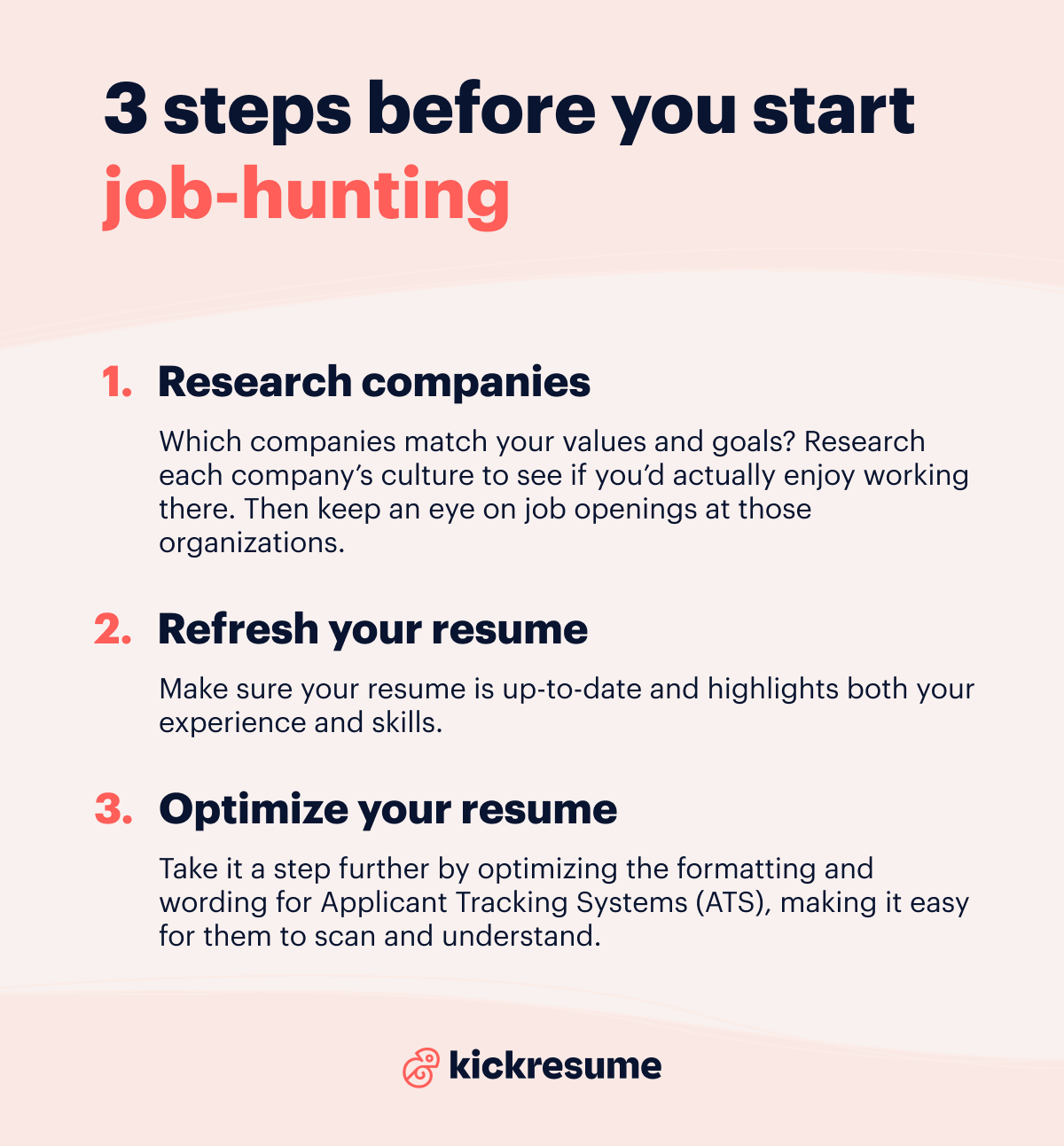
Before you start applying for jobs, there are a few things to get right first. Taking a little time to prepare can make every resume you submit more focused, polished, and effective. Here are the three key steps to tackle first:
- Draw up a shortlist of companies that genuinely match your values and goals
- Refresh and refine your resume so it clearly reflects your strengths
- Optimize your resume so it's easy for both ATS and humans to pick you out
Finding your target companies
Instead of applying to every job you come across in your field, it may be better to narrow down your approach. You can do this by curating a list of ‘best-fit’ companies, to put your time and energy into.
When creating a ‘best-fit’ list, thorough internet research is your best friend. Resources like Glassdoor are a great way to gain insight into companies that you’re interested in. You can find genuine employee reviews and scores to take into consideration. You may be able to learn more about the company culture and decide whether it’s a good fit for you.
Once you’ve made your list, set up job alerts on various job hunting websites and LinkedIn. This can help automate your job search by notifying you of relevant opportunities. You can take this a step further by using AI to tailor your resume towards each role you apply for, saving you time and energy.
Build a strong foundation—perfect your resume first
Before you begin your job search, you should re-work and update your existing resume to reflect your most recent and relevant skills and experiences.
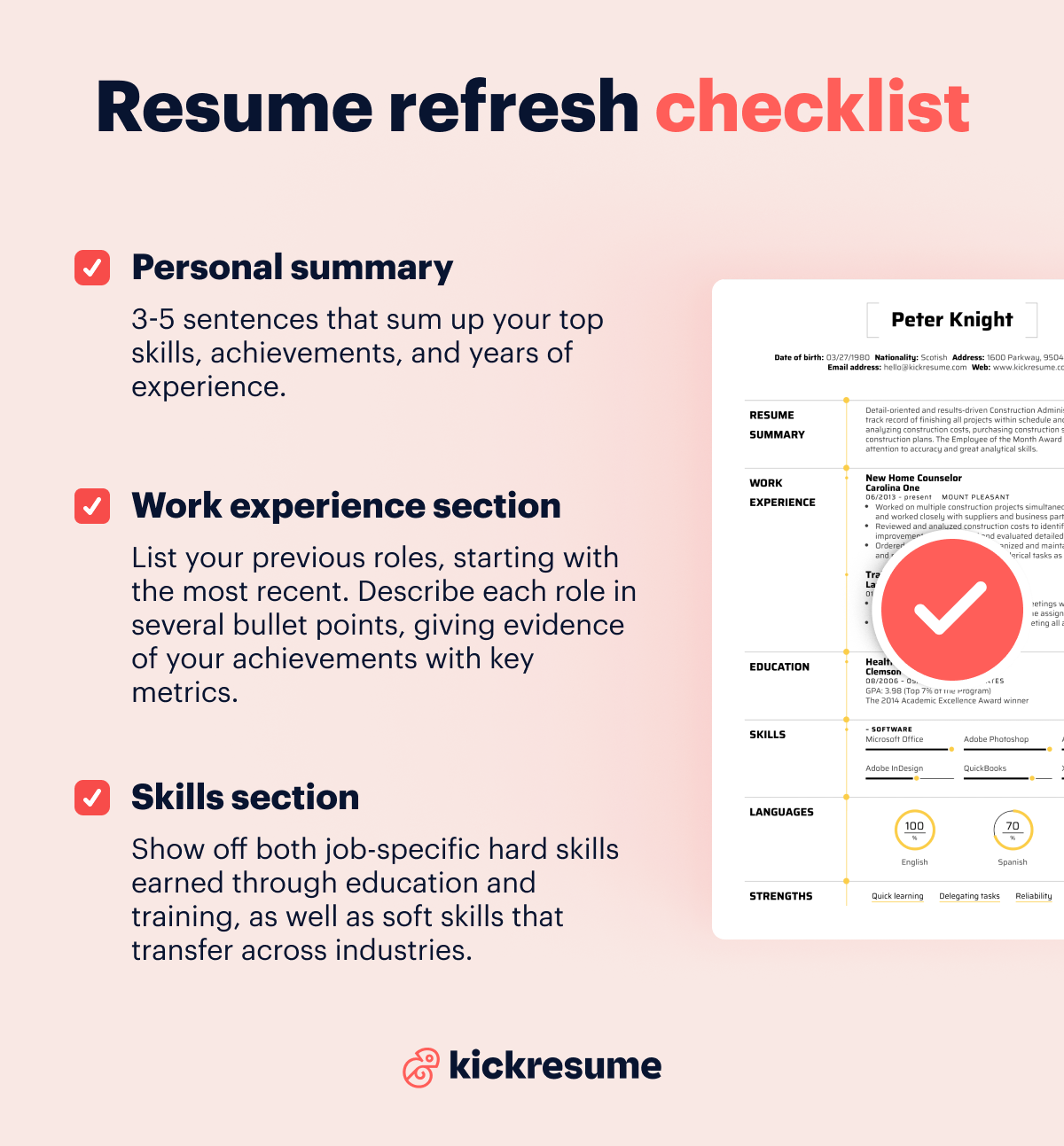
A strong resume should open with a personal summary section. This is a small section at the top of your resume that concisely summarizes what you have to offer. This will act as a first impression for recruiters and hiring managers—making it key to get right. We have a handy article where you can learn how to craft a compelling resume summary.
You can revise your work experience section, making sure your most recent role appears first. List the rest of your positions in reverse-chronological order. Keep your responsibilities as clear, concise bullet points under each job title, and whenever possible, back up your experience in each role with metrics that show off your abilities. For instance, if your work led to an increase in profits or decrease in customer complaints, try to quantify it.
What’s more, your resume should also include a clear skills section, making it easier for hiring managers to quickly spot your key qualities. List your top hard and soft skills so they can immediately see both what you can do and how you work with others.
- Soft skills are interpersonal abilities you develop over time, like problem-solving, communication, and time management. They demonstrate how you collaborate, handle challenges, and adapt to different situations.
- Hard skills, on the other hand, are what you’ve studied or trained in, such as data analysis, coding, and SEO. They show employers that you have the specific knowledge needed to do the job.
Don’t get caught out by ATS scanners
When it comes to strengthening your resume for 2026, optimizing it for Applicant Tracking Systems (ATS) is crucial. These tools filter out applications before a real person sees them. You can also use online ATS tools to check your resume and help it get past the software and into the right (human) hands.
Including relevant keywords is a key part of optimization. Look through the skills section of the job description for a role you’re interested in and add any skills you have into your resume.
Another key step when optimizing your resume for ATS is carefully checking the formatting. Clean, simple layouts are safest because ATS systems can struggle with graphics, columns, or decorative elements. If you choose to add color or design touches, keep them minimal so the ATS can still easily read and extract your information. Make sure that all the sections are laid out clearly, with dates listed for your previous roles and studies.
Networking and alumni groups can unlock hidden opportunities
Once your resume is updated and ready to go—you might face another challenge. Where can you find the right roles? Job listing sites and LinkedIn definitely work, but there are other, lesser-known routes to consider too.
One of the best ways to secure an interview is through networking. This can mean attending in-person events in your field or reaching out to professionals online. Networking is a direct approach to job hunting, and may lead to unexpected opportunities.
Intimidated by networking? You don’t have to be perfectly confident—focus on being curious and asking a few genuine questions, whether it’s at an event or online. That alone can take you surprisingly far.
We recommend attending networking groups and conferences in your field. If you went to college, you may have a chance to join an alumni group. They may be able to point you in the direction of job opportunities that might not be advertised.
Timing is everything for job search success
The job market can feel especially difficult right now—and data from Eurostat points to similar trends across Europe. The total job vacancy rate in the EU dropped to 2.1% in the second quarter of the year, compared to 2.2% in the first quarter. In the second quarter of 2024, the rate was higher at 2.4%. In the US, the Bureau of Labor Statistics recently reported that unemployment rates in August this year were higher than in 2024 in 62% of metropolitan areas.
One factor you may not think about immediately when looking for a job is your timing. Choosing the right moment to apply for jobs in 2026 may increase your chances of landing one sooner—especially when there are fewer jobs to go around, with higher competition.
Job listings surge in November and May
According to data from the US Department of Labor Statistics, the number of job postings surged to 8 million in November 2024. In 2025, the month of May had the highest number of job listings, coming in at 7.7 million.
In July and August 2025, the number of job listings went down to 7.2 million, which compared to the 7.8 million postings in the year prior (August 2024), shows a slight decrease in the number of opportunities available.
However, these are just overall figures—the stats change when you look at different industries. For some areas there’s a hiring freeze, whereas others like tech and healthcare, there’s growing demand.
Healthcare remains the most in-demand sector
In Europe alone, LinkedIn data shows that over one million jobs were posted in November 2025. More than 55,000 jobs in healthcare were listed, as well as 38,000 in finance and 16,600 in education. That makes healthcare one of the most in-demand industries across the U.S. and Europe.
In our article drawing on data from the U.S. Bureau of Labor statistics we noted that nurse practitioners are predicted to be the fastest growing job vacancy between 2021-2031. Which makes sense as there is a high demand for healthcare workers.
So when is the right time to apply? Research has found different sectors can have slightly different peak hiring times in both the U.S. and UK. However, we found that the start of the year and springtime may give you the best chance.
Seasonal demand: New Year & spring may be the best times to apply in 2026
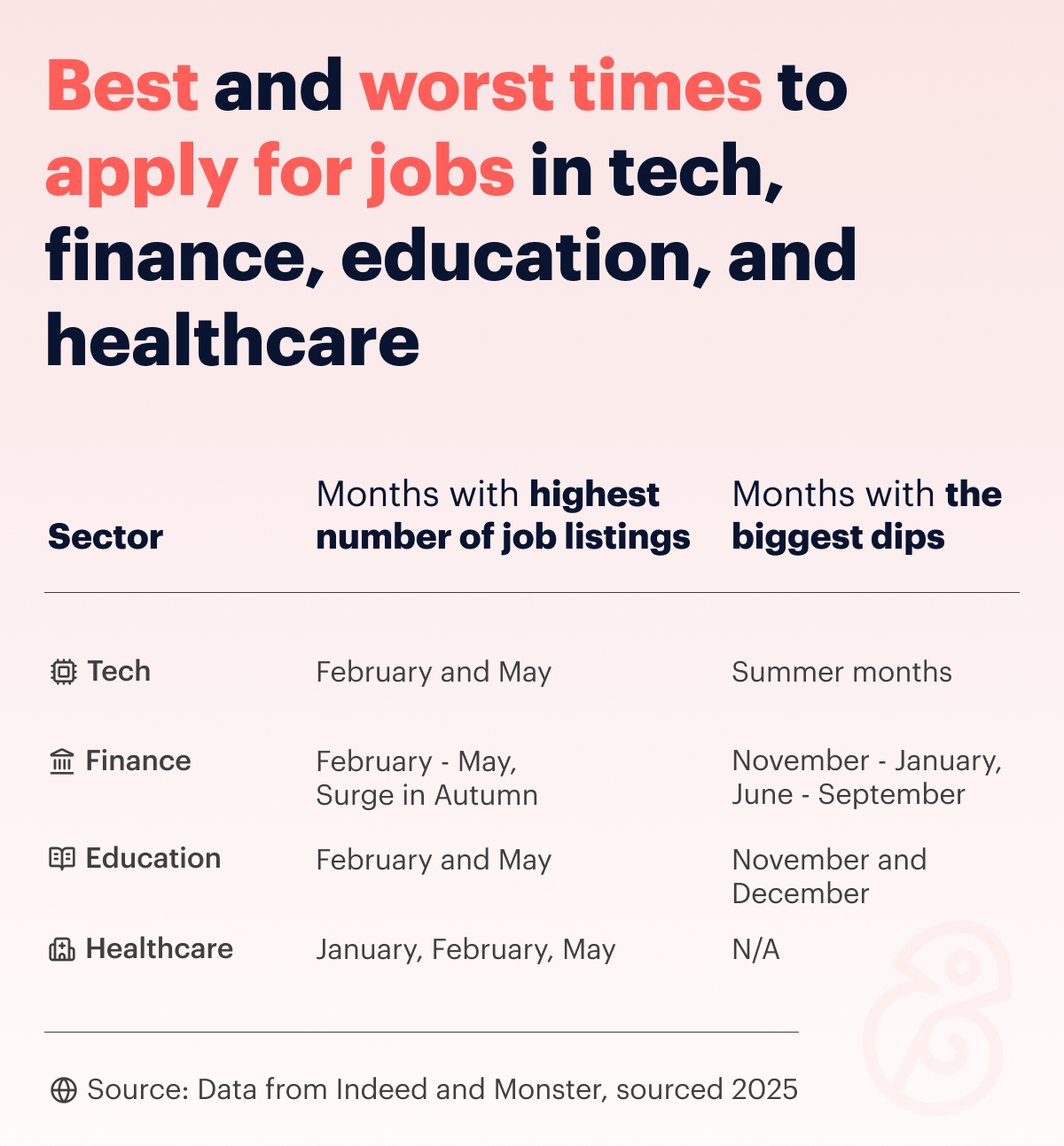
If you’re searching for roles in any of the above sectors, historically speaking the months listed may be the best times to apply.
According to data from Indeed, the highest number of job listings recorded in the Tech industry was in February 2022, February 2024, May 2023, and May 2024. The first three months of the year are when firms make use of a new budget to support staffing, which means you may have better chances applying around this time.
It’s a similar story if you’re planning to look for a finance job in 2026. The finance sector is typically most active in hiring at the end of winter in February and into the spring as new budgets are introduced. Things tend to pick up again in fall, and the biggest dip typically happens in the festive season from November to January.
It’s the same for the education sector, as there was a surge in job listings in February 2025 and May 2025. Job listings also declined in the period from November to December in 2022 and 2024.
Healthcare’s peak months for hiring are January, February and May. According to Monster USA, recruitment for healthcare roles surged earlier this year in May.
Why early in the year is a great time to find a new job
According to a Linkedin report, January, February, and November all show an increase in hiring across industries. This may be due to companies reassessing their staffing needs at the end of the year and planning budgets to support any changes.
The new year also brings a fresh mindset to many applicants, with a blank slate ahead. After some time off and space to reflect, many people feel ready for a change—which aligns perfectly with renewed hiring budgets.
LinkedIn data also shows that, over the last three years, people are 55% more likely to start a new role in January. That means you’re more likely to see new job ads appear in late fall and winter, with a January start date.
Overall, it seems like the start of the year and spring are the best times in both the U.S. and Europe to look for new job opportunities. If you time it right, automate your job search, update your resume, and network to find hidden opportunities, you may have the most success in 2026.
Key takeaways
- Research your target companies—use tools like Glassdoor to create a ‘best-fit’ list that matches your goals and values.
- Update and optimize your resume—include a strong personal summary, relevant skills, and quantifiable achievements.
- Leverage automation—set up job alerts and use tools to tailor applications efficiently.
- Time your applications strategically—aim for fall, January, or spring when hiring activity peaks.
- Tap your network—reach out to alumni, attend networking events, or organize informational chats with people at your target companies.
Note
Kickresume used data from the U.S. Department of Labor Statistics, LinkedIn, and Monster USA to examine seasonal hiring trends in the U.S. and Europe. They also provided practical tips for job seekers looking to find a new role in 2026, and explained why January is a key time to look.
About Kickresume
Kickresume is an AI-based career tool that helps candidates land jobs and raise their salary with powerful resume and cover letter tools, skills analytics, and automated job search assistance. It already helped more than 8 million job seekers worldwide.