




At Kickresume, we set out to answer a practical question: what actually gets a job application a response in 2026? So instead of theorizing, we ran a real-world test of the hiring process—sending genuine applications to live postings and tracking the responses, the same way researchers have studied hiring for years.
This wasn't a sterile lab study, and we won't pretend it was. It was a field test, with all the mess real job-hunting involves: postings that disappear, forms that fight you, and long stretches of silence.
We tested four resume versions, 51 applications each. Two were human-written—one in a clean single-column layout, one in a two-column layout. The other two were AI-generated: one left as the raw generic draft, one tailored to each specific posting.
We rotated them across all 204 applications in phases over two months, which matters—each version met a different slice of the job market rather than competing head-to-head on the same jobs.
Out of 204 applications, 36 came back positive—about 18%, or roughly one in six—and these weren't polite auto-replies: 22 were direct interview requests, the rest a mix of phone and video screens, positive emails, and assessments.
We expected to come away with lessons about resumes, and we did. But we discovered that one of the biggest challenges came before the application was even written: finding enough genuinely suitable jobs to apply for.
Here are our key findings:
- We exhausted well-matched local openings in about a week.
- 30 of 36 positive responses came from genuinely well-matched roles.
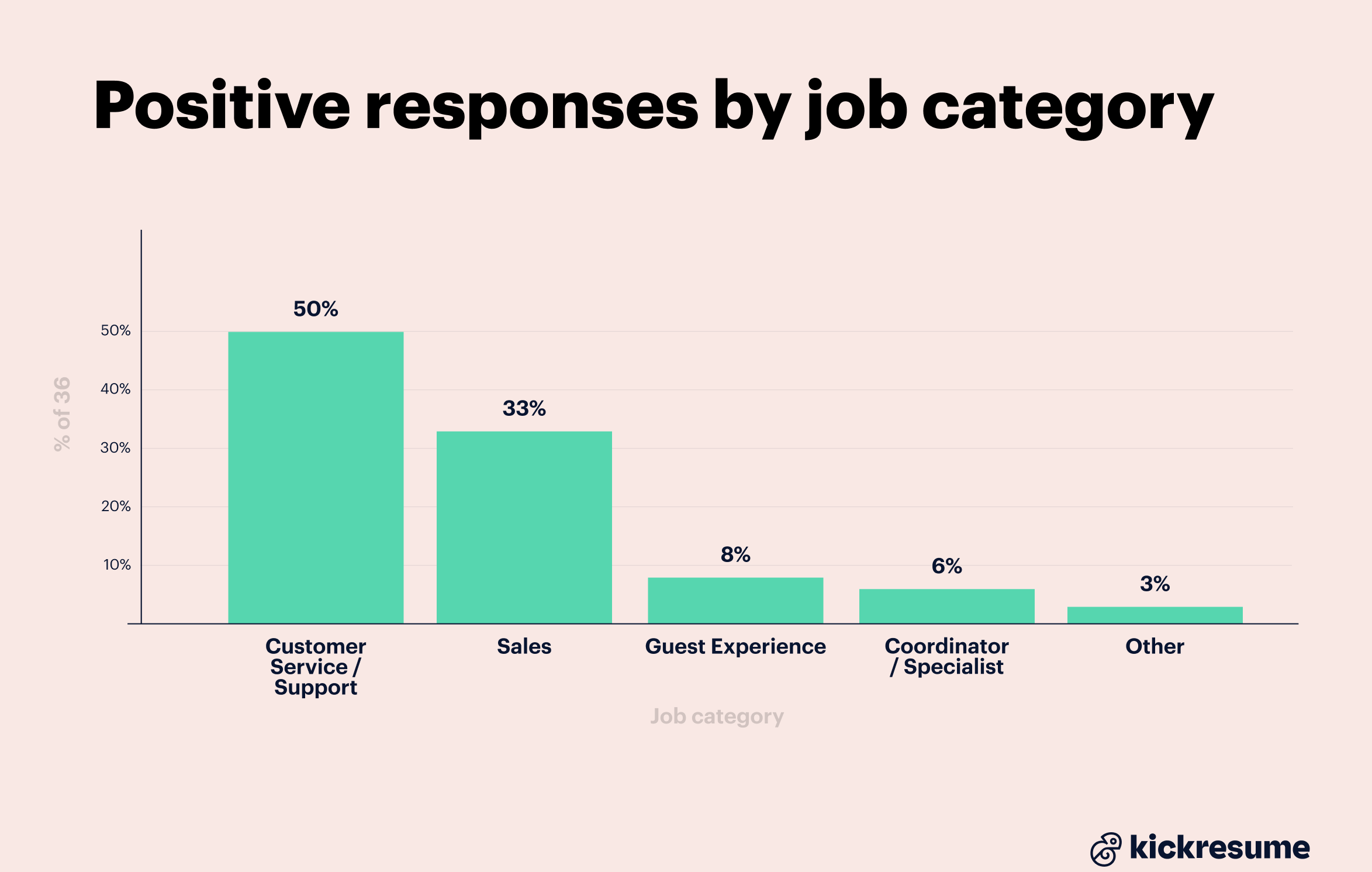
- Customer service and support accounted for half of all positive responses.
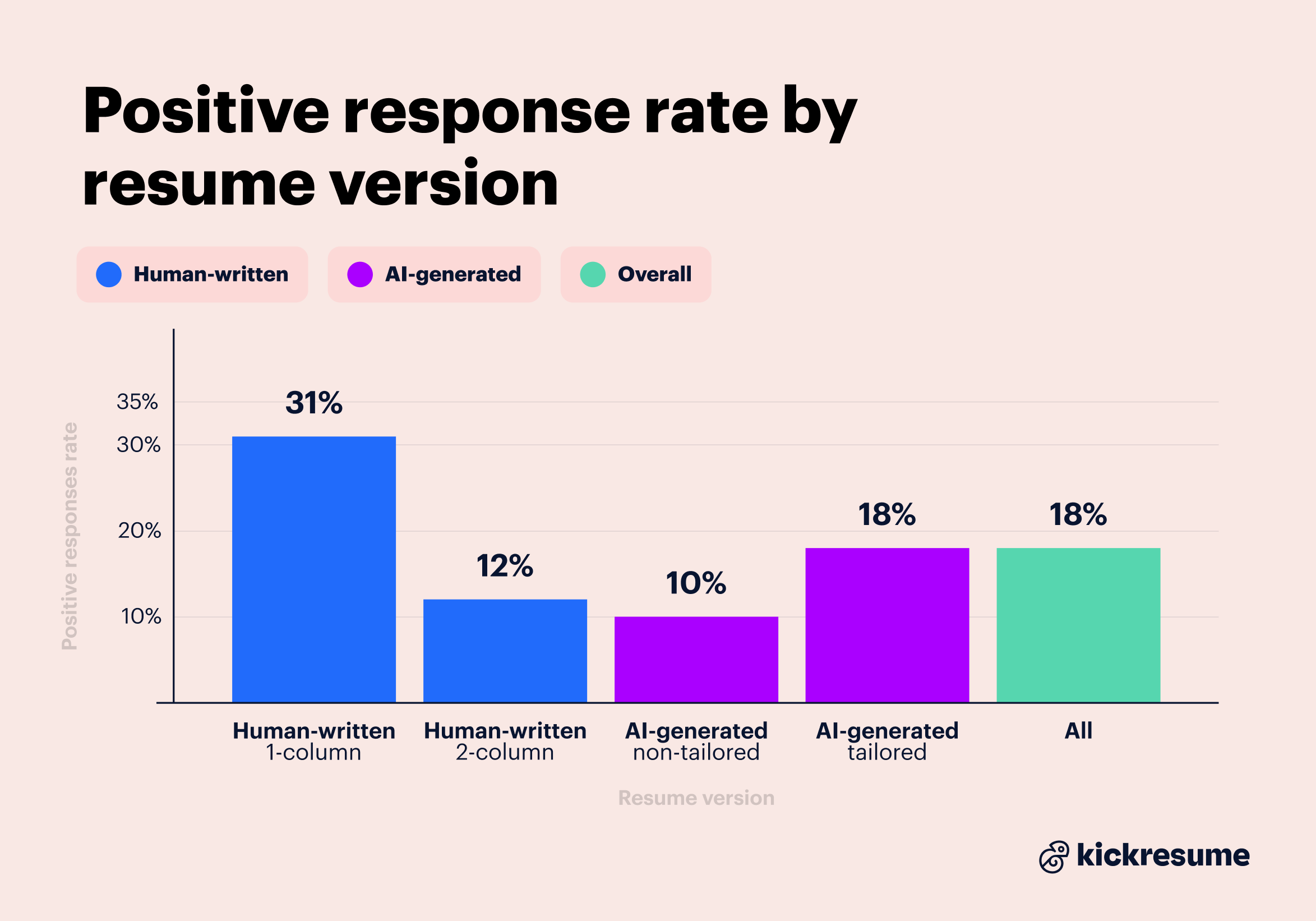
- Human-written resumes led the run—our single best batch drew responses on 31% of applications.
- Raw AI resumes were the weakest at 10%—but tailoring them to the job nearly doubled the response rate, to 18%.
- When replies came, they came fast—most within three days.
The well-matched jobs ran out in about a week
We started where any focused job seeker would: one city—New York—and roles that lined up well with our candidates' backgrounds. That pool emptied fast.
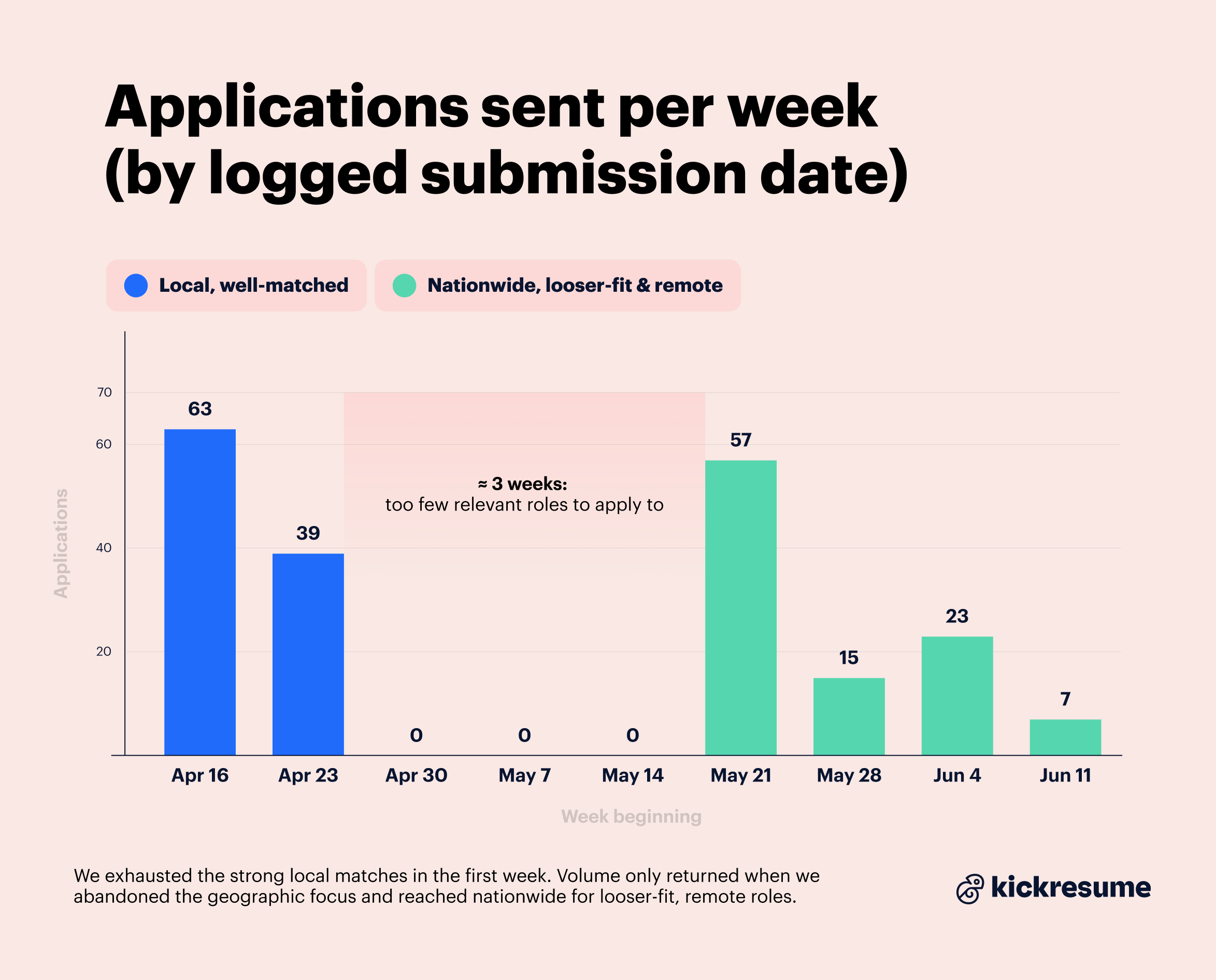
That flat stretch in the middle is the finding. We didn't pause because we ran out of effort; we paused because we ran out of jobs worth applying to. And when applications picked up again, it wasn't a recovery—it was us lowering the bar on fit and casting a far wider net to find anything at all.
Even the most in-demand jobs were hard to source
Here's the part that surprised us most. We deliberately targeted customer service and sales-representative roles—consistently among the highest-volume, most in-demand job categories in the country. If there's anywhere you'd expect a deep, easy-to-fill pipeline of relevant openings, it's here.
And even in one of the highest-volume job categories, we found that genuinely well-matched openings were more limited than we expected.
It also shaped our results: roughly half of all our positive responses came from customer service and support roles, simply because that's where the market gave us the most to work with.
Our experience also echoes what the national data shows—part of a broader shift some have dubbed "The Great Hunkering Down": workers staying put, fewer roles opening up, more competition for each one.
The Bureau of Labor Statistics put the quits rate at just 1.9% in May 2026—roughly where it's sat for nearly a year, well below its pre-pandemic level and far off the 3% peak of the 2022 "Great Resignation."
What’s more, analysts at Indeed's Hiring Lab describe a market that isn't broken so much as frozen: there are plenty of openings on paper, but few people are moving between jobs—and, as they note, headline opening counts don't automatically translate into real opportunities for job seekers.
That gap between "openings exist" and "openings you can actually land" is exactly what we ran into.
"The headline numbers make the market look healthier than it feels from a job seeker's chair," says Marta Říhová, an HR expert at Kickresume. "When almost nobody's quitting, very little churns loose—so even in high-volume categories like customer service, the pool of genuinely relevant, genuinely open roles is thinner than the topline suggests."
While our experiment wasn't designed to measure the market itself, it reflects what many job seekers describe today: finding a genuinely relevant opportunity can be as hard as writing the application.
What still got responses
None of this means applications are futile—far from it. The 36 positive responses we got were real hiring interest, not polite auto-acknowledgements: most were direct interview requests, with the rest a mix of phone and video screens, positive emails, and assessments.
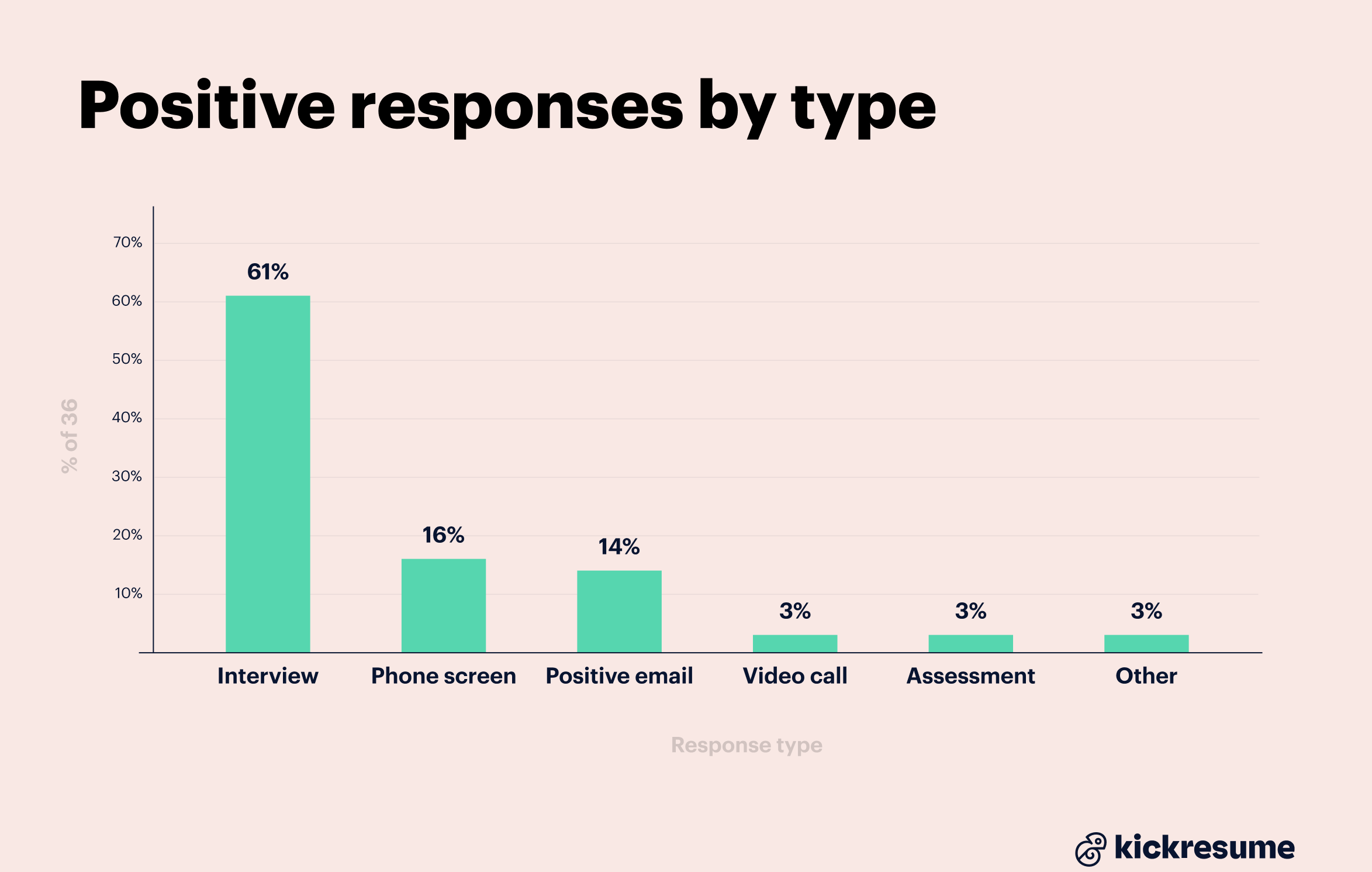
More useful than the count is the pattern behind it—which applications drew those responses, and why.
We looked at what job seekers are usually told matters: fit, the resume itself (who wrote it, whether it was tailored, and how it was laid out), and timing. Here's how each held up against what we actually saw.
1. Five of six responses came from genuine-fit roles
30 of our 36 positive responses—about five in six—came from genuinely well-matched roles, not the loose long tail we sent later to keep the numbers up.
And within those matches, responses concentrated hard in the lane our profiles fit best: customer service and support alone drew half of them (18 of 36). Casting wider didn't help. What worked was applying where you genuinely fit—in the right roles, in the right category.
Fit decided which doors opened. But we also varied the resume itself—four versions, from human-written to raw AI—and those differences told their own story.
2. Our best resume was human-written
The strongest resume we sent was written by a person. Our clean one-column human CV drew responses on 31% of applications—nearly one in three, the best of the entire run. And the weakest? The raw AI draft we sent exactly as generated, at 10%.
That's not a knock on AI—it’s built to get you a strong first draft in seconds, but it’s the human who supplies the substance—concrete achievements, real figures, the specifics that make a resume yours.
And how often are those specifics actually missing? Our analysis of 1.8 million resumes found nearly 1 in 5 contained no numbers at all—no figure, percentage, or headcount anywhere.
Concrete numbers are the clearest marker of substance, and they're exactly what a raw draft can't supply: an AI doesn't know you managed a $2M budget or lifted retention 12 points. Only the person does.
So a raw, unedited draft landing at the bottom isn't surprising. The human-written resume on top and the untouched AI draft at the bottom sit exactly where you'd guess.
We'll stop short of "humans beat AI," though—and the first reason is timing. The human resumes went out first, to the best-matched local roles, before that pool ran dry. Some of that 31% is the quality of the jobs those resumes happened to meet, not the CV itself—an advantage the AI versions never got.
What’s more, the middle of the table earns some honesty too. Our tailored AI resume matched the overall average—proof that a well-personalized AI resume competes with anything.
So what we'll stand behind is simple: a person's judgment sets the ceiling, raw AI the floor. AI is a powerful head start—a starting point, not the finished resume. And the clearest evidence for that sits in the gap between our two AI resumes.
3. AI gets you a draft, tailoring gets you replies
That raw-AI floor is worth a second look, because setting it beside the tailored AI resume isolates a variable nothing else in the run can: not who wrote the resume, but whether it was adapted to the job. Both came from the same tool; only one was fitted to each posting.
The result was the widest spread of any pairing we tested. The generic draft drew responses on just 10% of applications, while the tailored version reached 18%—same tool, same late-phase roles, nearly double the rate. With the author held constant, that gap is a tailoring effect and little else.
The usual caveat applies: the versions went out in phases, not side by side on identical jobs, so treat it as a strong signal rather than proof. But it's the closest natural comparison the run offers, and it points the same way as everything else—adapting each application to the specific role is what held the response rate up exactly when fit was working against us.
That extra effort per application is why most people skip it. It's also the part that's gotten dramatically easier—matching a resume to a posting is now a task tools handle in minutes rather than the hour it used to take.
4. A clean layout is the safe default
The two human resumes tell a parallel story—this time about layout. They differ in only one obvious way: one was single-column, one two-column. The single-column version drew responses on 31% of applications; the two-column one, 12%.
We won't claim that as proof the layout wins, though—in a real job search, layout never travels alone. The single-column resume also went out first, so the same fit-and-timing advantage that flatters its 31% is doing part of the work here too. We can't cleanly separate the column count from the quality of the jobs it happened to meet.
This is where our own analysis of 2.1 million resumes does the heavy lifting our 51-application sample can't. Across millions of real resumes, the most-downloaded templates overwhelmingly share the same traits—single-column layouts, clear section hierarchy, minimal decoration—and nearly 62% use templates classified as ATS-friendly.
The median resume now runs just 365 words. In other words, when candidates vote with their downloads, they land on exactly the clean, simple layout our run happened to favor.
A clean, single-column layout is the low-risk choice to set once and stop worrying about. Modern applicant tracking systems parse far better than they used to, but simpler designs still reduce the risk of a parsing error—and nothing in our run gave us a reason to steer away from them.
5. Timing mattered—but not the way we expected
We assumed speed would be everything: apply early, beat the crowd, win the response. The data only half-agreed. Two timing questions matter to a job seeker—how fresh the posting needs to be when you apply, and once you've applied, how long until you know. The answers pointed in opposite directions.
How fresh the posting was barely mattered
We expected applications to brand-new postings to clearly beat ones sent to older listings. In our experiment, they didn't. Sorting every application by how old the posting was on the day we applied, the response rate stayed inside a narrow band no matter what:
- Postings 0–2 days old: 19%
- 3–7 days old: 18%
- 8–14 days old: 16%
- 15+ days old: 17%
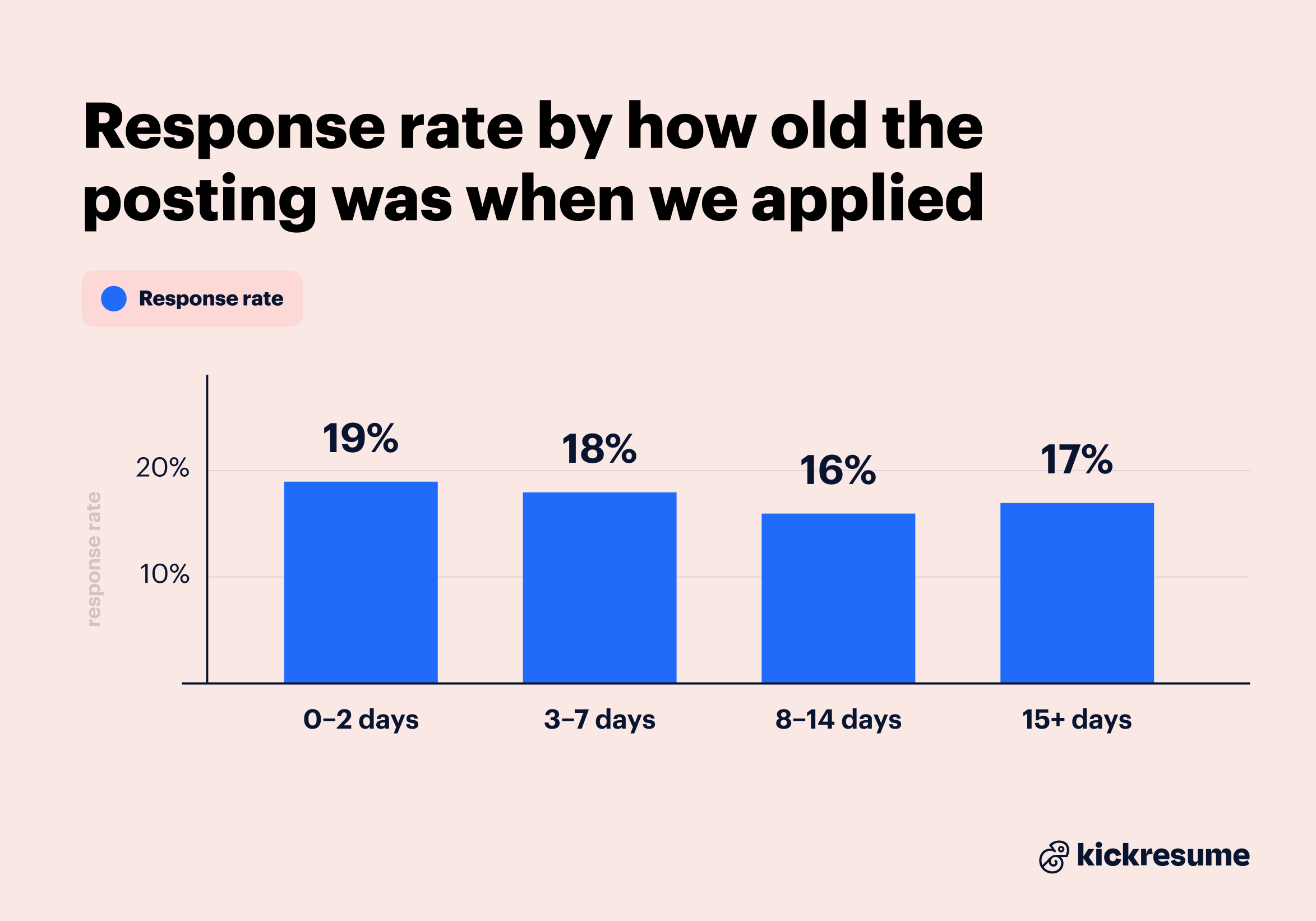
The postings that drew a response had been live for a median of about six days when we applied—exactly the same as the ones that didn't. And several of our strongest responses came from listings that were already weeks old: 28, 43, even 52 days after they'd first been posted.
That doesn't make timing irrelevant—it means the "early advantage" we thought we saw was mostly a fit advantage in disguise. Our earliest applications went to the best-matched local roles, and those are what responded. Once the strong matches ran out and we reached for looser-fit postings, the response rate fell—not because those listings were older, but because we fit them less well. Freshness wasn't the lever. Fit was.
When replies came, they came fast
The clearer timing signal was on the other side: how quickly employers moved once we'd applied. When a response came, it came fast. More than four in ten arrived within a single day of applying—often same-day callbacks from high-volume sales and support roles.
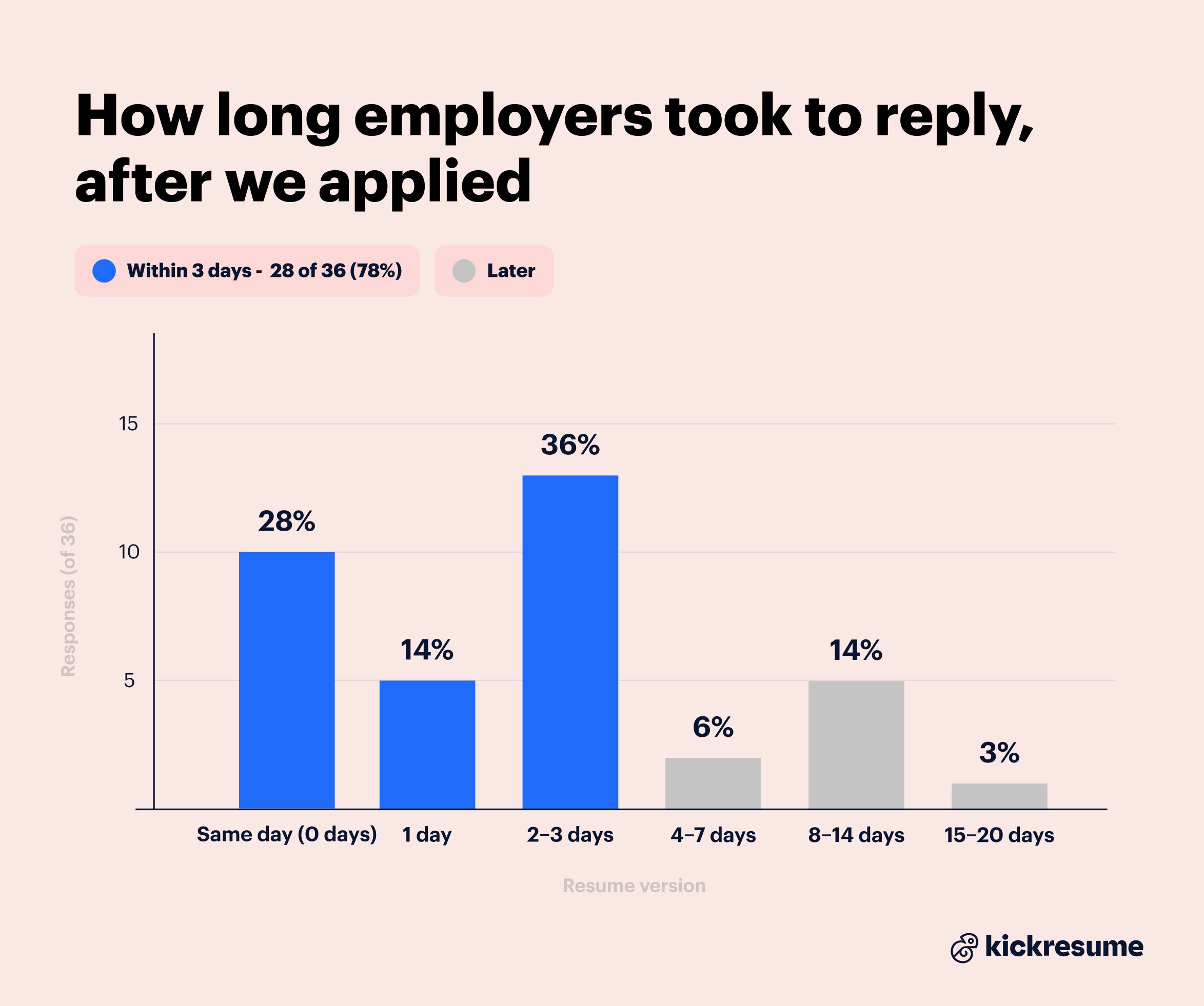
About eight in ten landed within three days. The median wait was three days, and even the slowest genuine response took just 20.
The practical takeaway is blunt: silence is an answer. If a week goes by with nothing, that application has almost certainly gone cold, and waiting won't revive it. Spend your follow-up energy in the first few days after applying, then move on to the next role rather than refreshing your inbox for one that's already gone quiet.
What job seekers can learn from the experiment
We started this experiment expecting the resume to be the biggest variable. Instead, finding the right opportunity was often the harder challenge. Once we found relevant roles, the fundamentals still mattered—fit and tailoring above all, with a clean, well-structured resume as the sensible baseline:
- Finding jobs is the hard part. The strong local matches ran out in about a week, and relevant new openings were slow to replace them. Budget your energy for the search itself, not just the applications.
- Fit beats volume. Five of every six positive responses came from well-matched roles, not the loose long tail sent later to pad the numbers.
- Let AI draft, not decide. Our strongest batch was a human-written resume; our weakest was a raw, unedited AI draft. AI is a fast, powerful starting point—but the resumes that landed had a person's hand on them.
- Tailor every application. On the same loose-fit roles, tailored resumes drew responses at nearly double the rate of a generic one. It's the highest-leverage habit we saw—and the one most people skip.
- Keep the layout simple. A clean, single-column resume is the safest way to get read the way you intended.
- Expect fast replies or none. Fit drove whether we heard back; when we did, most replies landed within three days, so long silences usually meant no.
None of this requires a secret trick. The applications that got responses got them for reasons you can copy—the right roles, tailored well, with a resume built to be read.
Methodology note
Findings are based on 204 real applications submitted over two months in 2026 using a set of realistic candidate profiles, primarily targeting customer service and sales-representative roles.
We rotated four resume versions—two human-written (one single-column, one two-column) and two AI-generated (one generic, one tailored to each posting)—51 applications each, sent in phases rather than head-to-head. Applications went to live postings across multiple US locations and were tracked for positive responses (interview requests, phone or video screens, positive replies, and occasional assessment or screening steps).
Application volume by date comes directly from logged submission dates; the match-quality phases on the timeline describe our sourcing process and are not a measured fit score. Because versions were sent at different times and to different roles rather than side by side on identical postings, this is an observational field test, not a controlled experiment—we treat differences between versions as signals, not proof.
About Kickresume
Kickresume is an AI-based career tool that helps candidates source jobs and raise salary with powerful resume and cover letter tools, skills analytics, and automated job search assistance. It has already helped more than 8 million job seekers worldwide.