

After studying for years and graduating, the next hurdle is landing a decent grad job. But with salaries, living costs, and tax rates varying between regions, where is actually the most affordable place for 2026 grads to relocate?
This is why Kickresume analyzed graduate earnings, income tax rates, and unemployment metrics across UK regions and U.S. states to find where 2026 graduates can get the best overall value when starting their careers.
Here’s a snapshot of our findings:
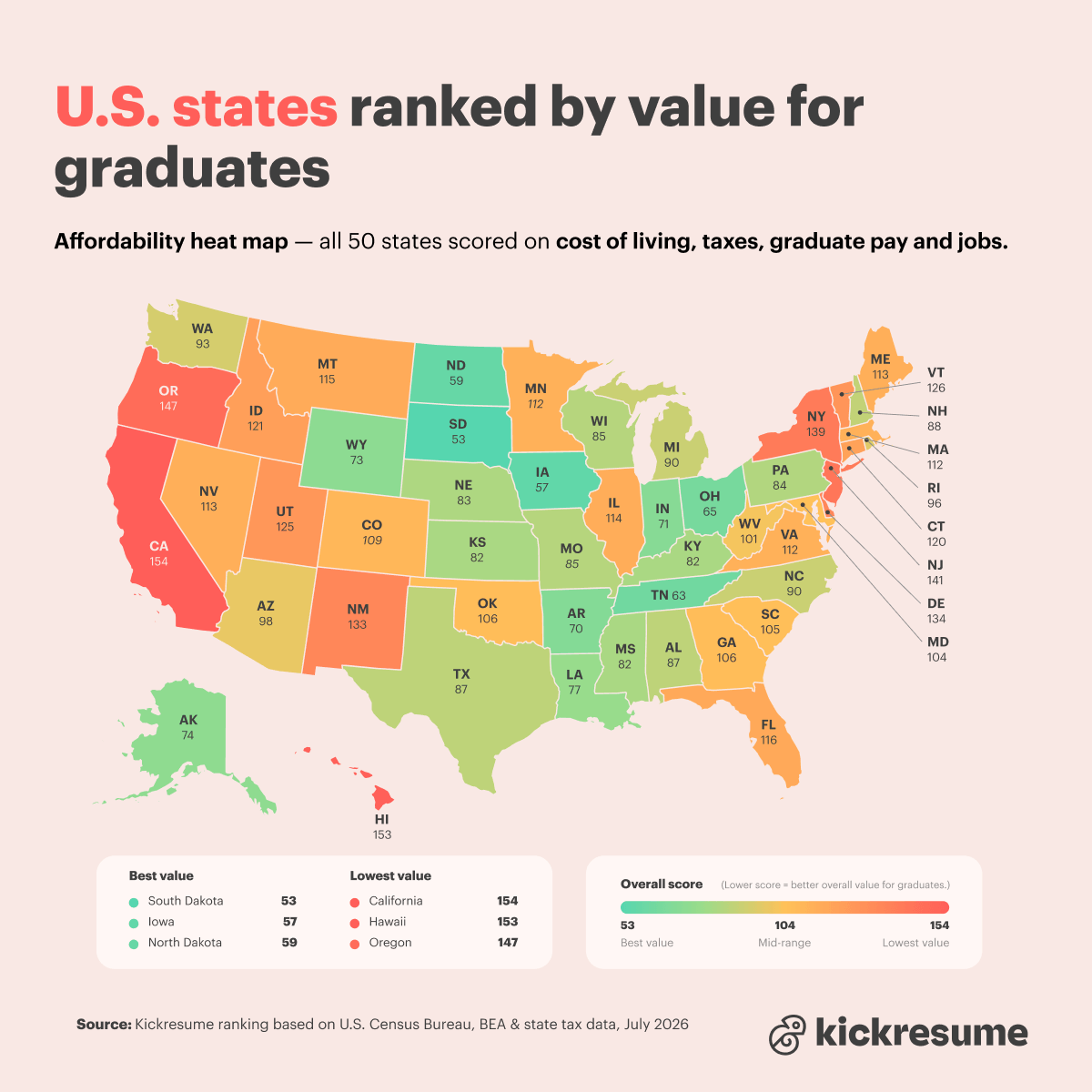
- Midwestern states offer the most financial value for graduates, as South Dakota, Iowa, and North Dakota rank highly for low living costs, low graduate unemployment rates, and decent tax rates.
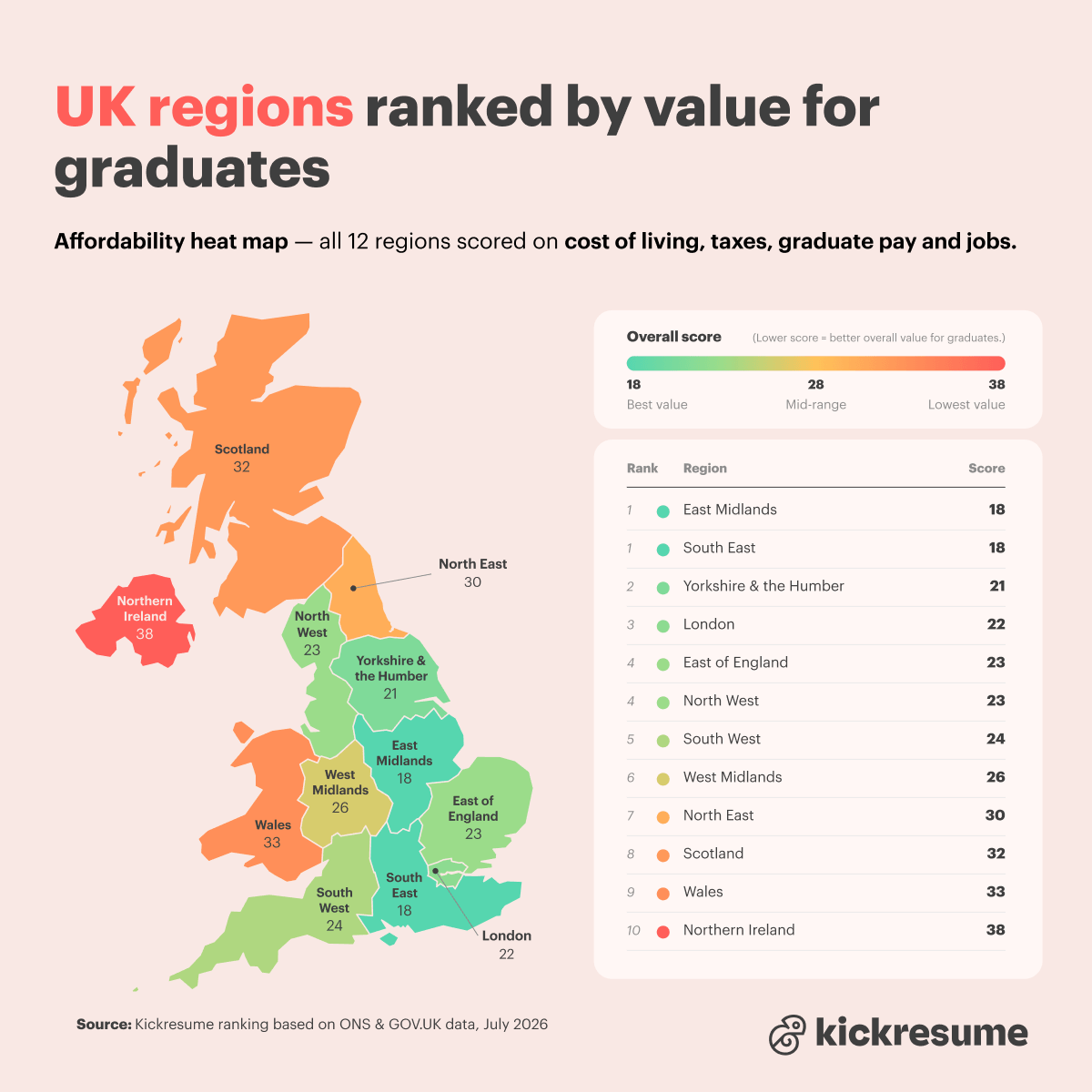
- The East Midlands and South East tie for first place in the UK. The East Midlands boasts affordable rent and one of the highest graduate employment rates whereas the South East offers high salaries and job availability.
- High living costs and steep taxes push powerhouses like California and New York to the bottom despite offering high salaries.
- High salaries and job availability aren’t enough for first place, as astronomical rent prices knock London down to third place despite having the highest salaries and job availability.
To create our U.S. ranking, we found the cost of living index, graduate unemployment rates, graduate salaries, and marginal state income tax for each state. We ranked these individual statistics by assigning numbers to each. For example, the state with the highest graduate salary would earn one point and so on, so the state with the fewest number of points would rank the highest.
We followed suit with our UK ranking. We found out the job availability per 10,000 residents, graduate employment rates, the average graduate earnings, and the average rent for a one-bedroom apartment for each region. We then ranked these areas by assigning points to each category and adding up the points to create an overall score. The regions with the fewest points scored the highest.
To find each national benchmark, we averaged the individual regional and state figures. For the UK, salary figures are median earnings five years after graduation (GOV.UK); for the US, they're median earnings for bachelor's-degree holders aged 25–64 (U.S. Census Bureau).
Graduates are better off living in affordable areas than chasing high salaries
It's no secret that salary matters when it comes to looking for a job. But our research reveals that graduates are better off financially in areas that might not have the highest salaries, but better living costs.
South Dakota ranked first for offering young professionals the most value as we found this state has one of the lowest graduate unemployment rates at just 0.9%, and 0% state income tax. However, this state has a below average salary of $58,207, which is one of the lowest overall.
We found that South Dakota has a low cost of living number at 88.59. We used the Regional Price Parity (RPP) index values from the U.S. Bureau of Economic Analysis to work out average living costs. 100 is the national average, so 115 means living costs are 15% higher and 85 means that prices are 15% lower.
Other midwestern states followed closely behind: we found Iowa and North Dakota came in second and third place—each having low unemployment rates and favorable tax rates despite below-average salaries.
While having a below-average salary of $62,654, residents of Tennessee also benefit from not having to pay a cent in state income tax. This state also has a low graduate unemployment rate of 1.8%, and has a low cost of living number of 91.81, which is below the national average of 100. In both the U.S. and the UK, factoring in living expenses and available job opportunities makes more financial sense than chasing immediate high earnings.
It’s a similar story in the UK. The average annual graduate salary in the East Midlands is £31,500—just below the national average of £32,083. But this location has one of the highest graduate employment rates at 78.3% and affordable rent (£644 per month for a one-bedroom apartment), putting it on top as one of the best places for graduates to start their careers.
Meanwhile, the South East offers the best of both worlds. The graduate salary in this region is above the national average and the second-highest behind London at £34,400, and this area has a high employment rate (78%) and job availability, landing it in joint first place for best place to move to after graduation for those prioritizing job security and a great salary.
Yorkshire and the Humber is ranked the second best place to live for new degree holders, but has one of the lowest average salary bands in the research at £30,400. However, at £608 per month, this region has the second cheapest rent and the highest graduate employment rates at 78.4%. This shows that high salaries aren't everything—it’s about where graduates can actually afford to live and have a good shot at finding a job.
London, New York, California: Why these major regions aren’t the best starting point
In both the UK and the U.S., the pattern is largely the same, as major areas are held back by high living costs despite offering high salaries. In the U.S., major hubs that are full of opportunity and buzzing with life fall all the way to the bottom of the ranking.
California ranks dead last for best place to move to after graduation, as its cost of living number of 110.72 is much higher than the national average. This state also has the highest income tax rate at 9.30%, and the highest graduate unemployment rate at 3.7%. This may be because of fierce competition and oversaturated markets. However, California has one of the best salaries for graduates at $80,874.
Young professionals in Hawaii have similar problems. With a cost of living number of 109.95 and high income tax at 8.25%, this state is one of the most costly to live in for those starting out. Compared to California, Hawaii has a lower graduate unemployment rate, indicating opportunities exist; however, the average salary is considerably lower than average at $62,969.
Oregon lands in third place as another state with high tax rates and expensive living costs. New York and New Jersey follow closely behind, as these states offer high salaries of $76,760 and $81,107, but both have very high living expenses at 107.92 and 108.81, as well as higher tax rates.
In a previous study, we found that due to the rising cost of living, 24% of workers with a side hustle are dependent on the extra income for their survival. This indicates a need for more affordable living costs so workers don’t have to rely on an extra source of income.
In the UK, there’s a similar narrative for its capital city. We found that London has the highest job availability in the UK by a large margin at 122.16, but its graduate employment rate is 76.4%, which is on the lower end. To make up for the high expenditures, the average graduate salary is as high as £39,200, beating the second highest by almost £5,000.
These stats look promising, until you factor in London's astronomical rent prices. A one-bedroom apartment in this city costs £1,733 per month—which pretty much wipes out any salary advantage graduates get from living there. This can be combatted by finding flatmates and renting on the outskirts of the city to keep the costs down while benefitting from the opportunities and lifestyle available in London.
Overall, across the states and the UK, there seem to be hidden penalties for starting out on a high salary in a major location. The cost of living in these markets is pricing young professionals out of their dreams of starting their careers in a big city. High tax rates in the U.S. and skyrocketing rent prices in the UK are making the transition from student to post-grad more and more difficult.
The middle ground: Overlooked areas are actually the best place for a grad to be
Our research shines a light on areas that may not offer the highest earnings, but are sustainable and affordable places to live post-graduation. In the U.S. midwestern states like South Dakota, Iowa, North Dakota, and Ohio are some of the most affordable places to live as well as having low unemployment rates.
These states may be overlooked by graduates looking to move to the hustle and bustle of a huge metropolis. But those who are looking to kickstart their career may be better off finding balance in an affordable heartland state over an expensive coastal region.
The same can be said for UK professionals. The North West and the South West fall in the middle of the ranking, offering grads a balance between affordability and earnings. In these locations, rent is more affordable, there are available job opportunities, and graduate salaries are just below the national average.
Northern cities like Manchester, Leeds, and Sheffield offer young workers more affordable housing and a vibrant cultural scene. This positions these cities as strong options for professionals to explore. In the U.S., cities like Pittsburgh in Pennsylvania and Dallas in Texas are two examples of lucrative yet affordable destinations for college grads to start their careers in.
Pittsburgh has many opportunities in IT, robotics, and healthcare, while Pennsylvania offers graduates a decent average salary of $70,261 and low income tax rate of 3.07%. Dallas in Texas, is known for its opportunities in finance, and Texas residents benefit from 0% state income tax.
For graduates looking for their first job, we put together this guide full of expert tips and advice on how you can land a job this year. We understand the market’s tough right now, and want to help you get your foot in the door.
High income tax, monthly rent, and limited jobs—UK locations that fall short
While coastal regions in the U.S., like New Jersey and California, present higher living costs and income tax, several UK locations also scored lower in our ranking.
Northern Ireland, Wales, and Scotland fall into the bottom three, as sparse job availability and low employment rates brought these areas down in the ranking. Northern Ireland was the area with the lowest job availability at 63.46, and the lowest average salary at £28,500. The graduate employment rate is the second lowest at 70.4%, behind Scotland's rate of 68.9%.
Final thoughts
Finding the right place to start your career is a tricky choice, and there are plenty of factors to weigh up before you make your decision. We found that while a high salary in a big city is an attractive opportunity for some, it may not necessarily be the best decision for everyone.
Rising living costs and rent increases impact all professionals, especially graduates. This is something to take into consideration when choosing a place to live as a young professional. Overlooked locations may offer the best bang for your buck as they offer average salaries, but affordable living costs and better chances of finding a job make up for it.
The bottom line is to find somewhere that suits your preferences and budget. Some people may feel more comfortable spending more money on rent if it means they get the chance to fulfill their dream of living in a vibrant big city. Others may prioritize living comfortably in a more affordable area. There’s no right or wrong place to live, it’s a matter of your needs and wants.
Note
For our U.S. ranking, we used the Regional Price Parity (RPP) index values from the U.S. Bureau of Economic Analysis: An index of 100 represents the U.S. average cost of living, with values above 100 indicating a higher cost of living and values below 100 indicating a lower cost of living. To find the state unemployment rates, we used data from the U.S. Census Bureau American Community Survey (ACS) Table S2301 to determine the state unemployment rate for individuals aged 25-64 with a bachelor's degree or higher. We found the marginal state income tax for a single filer, and we found the median earnings for bachelor's-degree holders (aged 25–64) in every state using data from the U.S. Census Bureau’s American Community Survey (ACS). After finding the information for each category, we assigned points to each one, giving the fewest points to the states with the best statistics. For example, the state with the lowest graduate unemployment rate would receive one point, and so on. We then added up the number of points to create an overall score, with the least amount of points being ranked the highest and so forth.
For our UK ranking, we used data from ONS Textkernel New Online Job Adverts from May 2026 to work out the number of available jobs in each UK region, and we also used data from the ONS to find population estimates from mid 2024. To work out the job availability, we calculated the number of job adverts by the population and multiplied by 10,000 to find the amount of jobs available per 10,000 residents. We used new online job adverts because graduate/entry-level job counts were not available in the official dataset. We used information from GOV.UK to find the graduate employment rates, and the median graduate earnings five years after graduation for each region.
Like we did for the U.S. ranking, we then assigned each category a number of points corresponding to the most favorable statistics. We added up the number of points for each area to create an overall score, ranking the regions with the lowest score the highest.
About Kickresume
Kickresume is an AI-based career tool that helps candidates source jobs and raise salary with powerful resume and cover letter tools, skills analytics, and automated job search assistance. It has already helped more than 8 million job seekers worldwide.