Can being “too nice” or “too polite” actually hold you back in your career? We spoke to Lisa Wong, a workplace communications specialist with over 10 years of experience to get her insights into the topic of politeness at work and all the different ways we communicate.
Spoiler: no communication style’s inherently better or worse for career success, as long as you’re respectful to your colleagues and good to work with. Lisa also explained how numerous factors influence the way we communicate—as well as the way we’re perceived by others.
Here’s a quick rundown of what we found:
- Politeness can be a strength, but it can also hold you back. Being respectful is great—but if it stops you from speaking up, it can hurt your career.
- Men are given more permission to be direct than women.
- More hierarchical work environments might expect more politeness and deference from junior employees.
- Expectations of politeness at work vary around the world, from the outspoken US to the more indirect UK.
- Companies use personality tests like the DISC model to understand their staff’s different communication styles.
- New developments like remote working and AI tools affect how we communicate and what it means to be polite at work today.
Politeness can help you succeed—or hold you back
We asked Lisa Wong to share thoughts on what impact being very polite could have on your career. The expert explained that first, we have to explore what politeness means—it has both potentially positive and negative connotations.
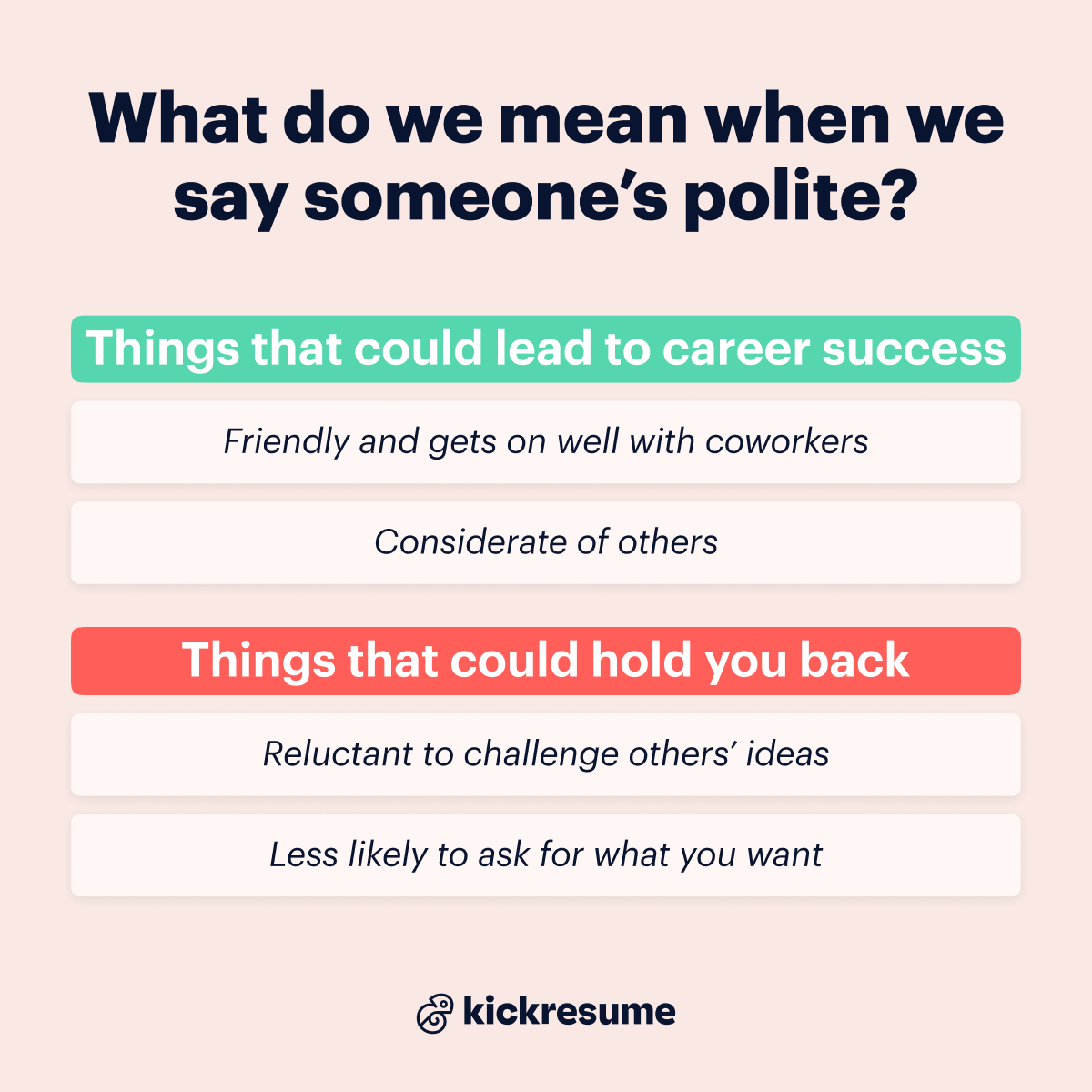
Being polite could mean being a friendly person who’s great to be around, or someone who's always considerate to their coworkers and mindful of their workload.
On the other hand, people who try too hard to be polite and not rock the boat at work could be doing themselves a disservice. They might also be less likely to advocate for themselves to receive a promotion, a raise, or the opportunity to work on exciting projects. It might even stop you collaborating with others as well as you could. In Lisa’s words, if you’re not comfortable with challenging people’s ideas, you might find yourself always “choosing the path of least resistance”.
If you’re worried that being too polite and reluctant to blow your own trumpet is holding you back in your career, our helpful guide to negotiating what you want at work is full of great advice. It breaks down these potentially difficult conversations into manageable steps.
We asked Lisa Wong whether people who are less polite and more direct are more likely to advance faster. The expert acknowledged that “if you take risks, you move faster”, something that assertive people might find easier.
However, there’s a balance between pushing forward your point of view and getting others on board. The workplace communications specialist urged readers to understand that often it comes down to “people over projects in the long run, if you plan to stay around”. For instance, if you’re very forceful in meetings you might tend to get your way, but at what cost to your relationships with coworkers?
Overall, Lisa advised that even in “ruthless environments”, either more or less polite professionals could have an advantage—as long as they're well-liked and respected by their colleagues. Someone who's always polite might work together with others “in harmony”, but someone who’s very bold might be great at “visibly mobilizing people”. The expert further suggested that it partly comes down to the unique interpersonal dynamics at your organization—as well as any office politics at play.
Directness is often praised in men, but criticized in women
Despite the benefits that being direct and assertive can bring in the workplace, not everyone who communicates in this way will necessarily be treated equally. For instance, men and women might have different experiences. We asked Lisa Wong to discuss this phenomenon. The expert shared that confident, direct women are more likely to be perceived as bossy or demanding at work—even when they’re just communicating in the same way as their male peers.
A 2020 psychology study from the University of Stanford and the University of North Carolina at Chapel Hill investigated real performance reviews from a Fortune 500 technology company. The researchers found that female employees were more likely to be described as too aggressive and male employees more likely to be called too soft. 10% of women’s evaluations suggested their communication style was aggressive, compared to 3.9% of men.
Lisa warned that these expectations around behavior affect both men and women. How can organizations tackle this to become a fairer place to work? The expert advised that companies looking to change their culture shouldn’t be disheartened as mindset shifts and learning aren’t “something that happens overnight.” Lisa recommended that companies have open conversations about this tricky subject, as well as introducing DEI initiatives, and working to build an environment that treats all genders equally.
Junior employees might be expected to be extra polite
As well as different expectations for men and women, internal company hierarchies might affect who’s allowed to be blunt. We asked Lisa Wong whether in this expert’s experience, junior employees are expected to soften their language, especially when talking to their higher-ups.
The communications specialist shared that this depends a great deal on the workplace culture. Some organizations are very hierarchical and traditional, and new starters in entry level positions have to earn their credibility and their voice. According to Lisa, at these companies, “the more years of experience you have, the more respected you are”.
However, some organizations are very different. The expert gave the example of tech companies and start-ups, where she described a common belief that “politeness will impede progress”. In these workplaces where things move quickly, everyone’s expected to challenge conventional thinking and iterate on each other’s ideas in ways that might seem dismissive in other environments.
Lisa warned readers to be mindful of the dynamics created by different situations. Big group settings and one-to-one meetings might require different levels of formality—the expert compared politeness to humor, as you have to “know your audience”. Even if you’re normally quite casual with your boss, you may want to be more formal when senior management is present.
Managers should set an example when it comes to treating others with respect
When it comes to building the company culture and setting the tone for how people talk to each other at work, managers play a major role. A great boss boosts the team’s morale and creates the kind of environment where people support each other. But it goes beyond being a positive influence—Lisa Wong told us managers are also in a position of authority to call people out, if the way they’re communicating might hurt or offend a team member.
This isn’t just about politeness or tone. A team member might unintentionally commit a microaggression—a subtle, stereotype-based discriminatory comment or action. The communications professional added that junior employees may not feel comfortable speaking up because they worry they’ll be seen as “abrasive,” so they often “look towards someone of authority to call such behavior out”.
Unfortunately, not all managers stick up for their teams—and in fact, they can sometimes be the ones making staff feel uncomfortable. Our survey into people’s experiences with bad managers found that 85% of workers have had a “horrible boss” at some point. Within this group, 51% said their manager was disrespectful or rude. If the way your boss talks to you makes you feel miserable, try setting a boundary in a calm, private conversation. And if it doesn’t improve, document it and raise it with HR or a senior leader.
Cultural norms around politeness vary around the world
What does it mean to be polite at work in different cultures? We asked Lisa Wong to describe what she’s noticed in her career working with different organizations based around the world.
The communications specialist told us that American companies encourage their employees to be “more outspoken and expressive”. In fact, in US organizations, if you’re after a promotion, it can be extremely important to make yourself visible and share your ideas—not just perform the tasks in your job description well.
On the other hand, Lisa shared that organizations in some Asian countries may have a more hierarchical culture, although of course this varies. The expert gave the example of Japanese companies in particular expecting junior employees to “soften their messages while they learn the ropes”.
In Lisa’s experience, politeness expectations varied across Europe too. The Netherlands is one example of a country where it’s typical to be forthright in the workplace, because culturally there’s “a higher level of acceptance for directness”.
This stands in contrast to countries like the UK. Indirectness and politeness are so ingrained here that jokes about Brits saying the opposite of what they mean to their coworkers are a workplace staple.
All this means that those who move to a new country might at first find the cultural differences in the workplace quite difficult! Someone who comes from a place where people are quite blunt might find it frustrating adjusting to an office culture where people hint at things rather than say them outright. On the other hand, people used to these workplaces might initially interpret more direct communication styles as rudeness.
Chatty Yellow or reserved Blue? How companies use the DISC test
While workplace culture and national norms influence communication styles, individual factors also play a big role. Lisa Wong told us that “how you perceive others and how you're perceived can vary considerably depending on personality type and management styles.” Personality tests are often used by companies to learn how their current team works together, as well as helping them select new hires.
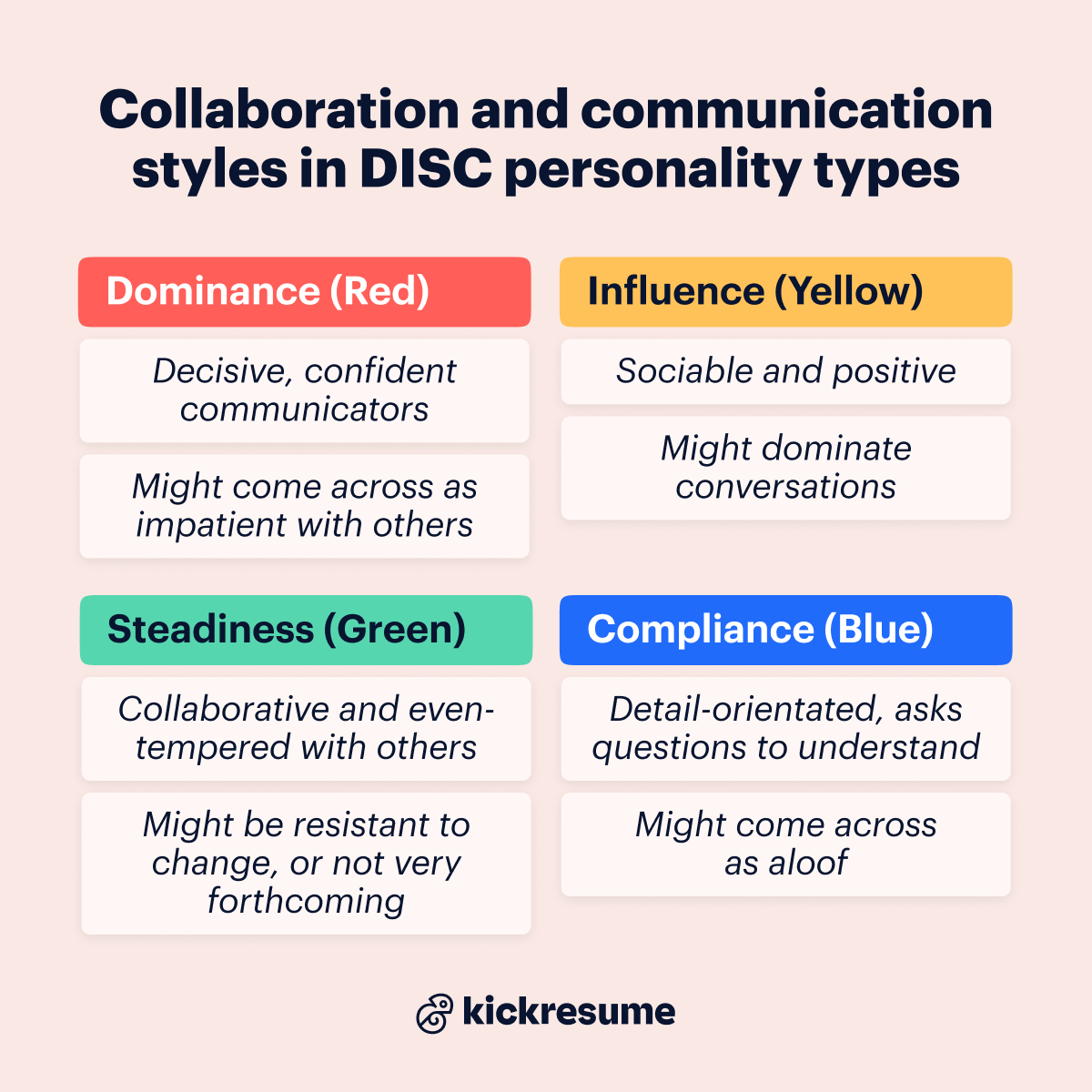
And one of the most popular personality tests used in workplaces is the DISC model, based on the work of psychologist William Moulton Marston nearly a hundred years ago. It stands for Dominance, Influence, Steadiness, and Compliance—four personality types with their own strengths and weaknesses. Each of these personality types tend to have a different way of communicating:
- Dominance is represented by the color Red. This personality type tends to be purposeful and decisive, so they’re great at getting things done and advocating for their point of view. However, they can sometimes be impatient with others, and might be perceived as rude in moments of disagreement.
- Influence (Yellow) is a personality type known for being sociable, outgoing, and imaginative. People who fall into this category can be very easy to get along with, but their chatter can leave quieter coworkers feeling shut out.
- Steadiness (Green) people tend to collaborate well with others and look for compromises, so they often come across as polite and friendly. However, they can be resistant to change and not very forthcoming with their ideas.
- Lastly, Compliance (Blue) is a category for people who are analytical and detail-orientated, meaning they often ask a lot of careful questions to make sure everyone understands what’s going on. They can come across as sticklers for the rules or sometimes as rather aloof.
While your results on a personality test might give a broad overview of some of your qualities, it doesn’t sum you up entirely. As Lisa shared on the subject, “at the end of the day we're human and we're not one-dimensional”. How we feel, act, and present ourselves can vary in different situations—whether you get on well with your coworkers and feel stimulated by the work you’re doing has a major impact.
For instance, someone who’s a “Red” might find themselves feeling irritable and snapping at people if they’re not in a work environment they enjoy. But in a workplace where they feel happy and fulfilled, they might be an energetic leader who inspires others. Lisa told us it’s critical “to identify if a company’s purpose and culture resonates with you—and whether it’s a place where you can at least function, and ideally excel, depending on your career goals.”
Remote working has made communication more deliberate—and often slower
When we talk about communication, we don’t just mean face-to-face. We asked Lisa Wong to share her expert thoughts on how remote working in the digital age could have affected people’s politeness at work. She explained that virtual meetings often require more deliberate effort to include everyone—for example, waiting your turn, inviting quieter team members to speak, and avoiding interruptions. That extra focus on politeness can slow down decision-making.
Lisa, who has a great deal of experience facilitating online sessions for remote teams, shared that technical factors can have a big impact on how people communicate. Audio lag and camera issues make it harder to emotionally connect, or even in some cases understand each other. Body language is also more difficult to read on a video call.
Some people are less comfortable expressing themselves than they would be in person, so they come across as more reserved than usual during these virtual meetings. They might also be feeling camera-shy, or tired after a long day of calls without a chance to stretch their legs.
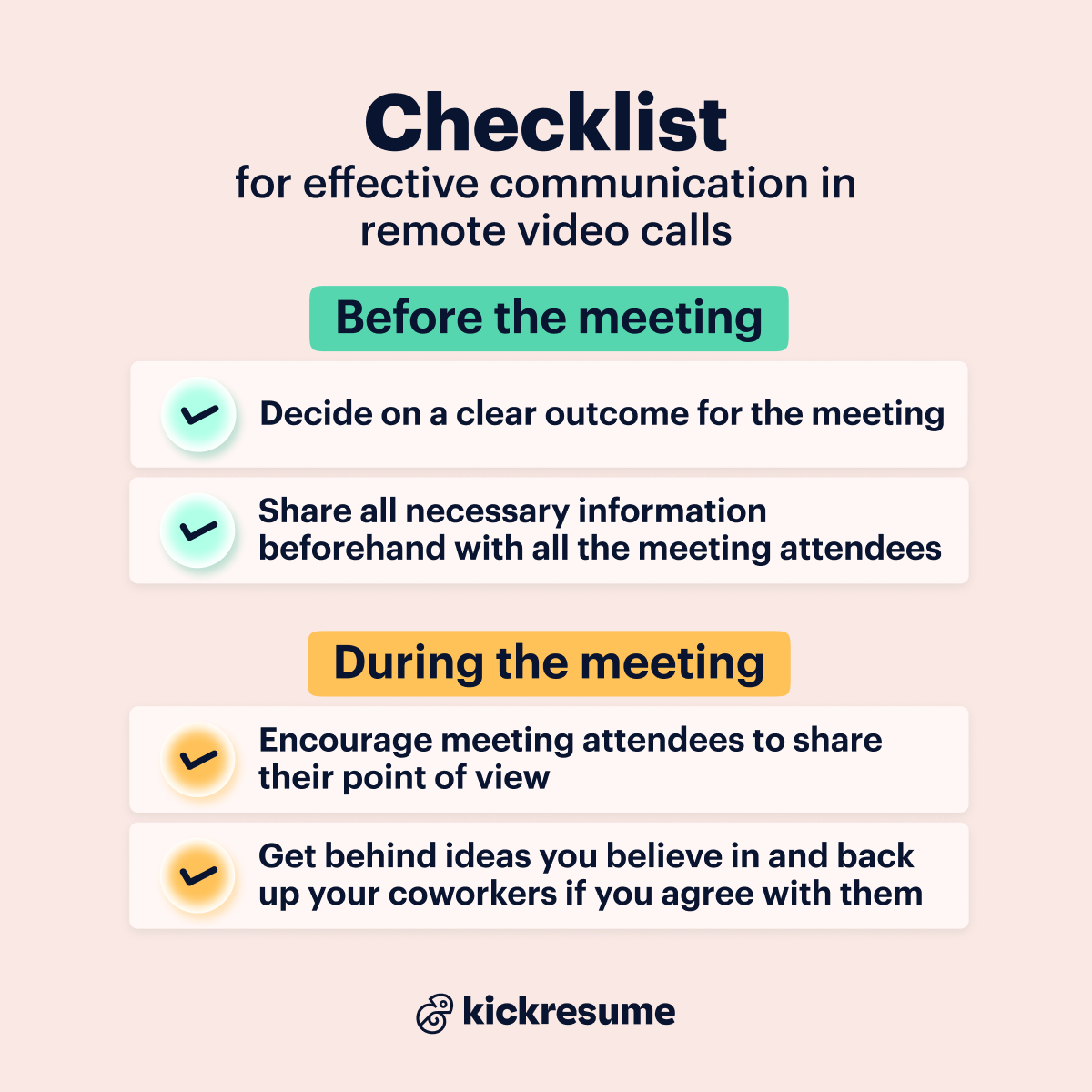
Lisa provided some tips for employees and managers on how to improve communication in online meetings:
- If you’re the one who’s called the meeting, make sure everyone comes prepared.
- Give the meeting a clear outcome to aim for.
- Encourage your coworkers to speak up and participate in conversations.
- Endorse ideas you agree with, supporting your coworkers.
AI is speeding up work talk—but cooling the tone
In recent years, AI has become a normal part of work—and it’s not just changing tasks. It’s changing how we communicate, from emails and messages to meetings and collaboration.
Our 2025 survey into AI found that chatbots like ChatGPT and Gemini were the most popular tools, with 78% of AI users relying on them. Beyond finding or summarising information, coworkers now commonly use these tools to write messages to one another.
Depending on how well these messages are received, this could affect how well people collaborate. For instance, imagine you’ve spent some time putting together a helpful email to your coworker, only to get a reply that sounds completely AI generated. For some people, it could seem disingenuous, dismissive, or as though the sender didn’t take the time to properly engage. Others, however, might not see an issue with it at all.
Lisa Wong emphasized that people’s responses to emails, reports, and memos created using AI might depend on how it’s been used—ideally it should be an assistant, not take over the work completely. The expert advised that “consistency, quality, judgement, and accountability are key”.
AI tools are also affecting how meetings are run. Until recently, there usually needed to be at least one person taking notes, but now AI notetakers can handle the task. That said, they don’t always capture who said what—especially when multiple people are joining from the same device. As a result, someone who comes up with a strong idea might not get proper credit. One simple way to be a more considerate teammate is to say something like, “Lisa, that was a great suggestion!”, so it’s clearly recorded in the meeting notes.
All in all, as AI becomes a normal part of how we work, the tone and quality of our communication will increasingly depend on how we use it. AI can speed things up, but it can also make interactions feel impersonal or dismissive if we rely on it too heavily. Ultimately, politeness and collaboration still come down to people—not the tool.
Final thoughts
As our deep dive into politeness at work shows, there are so many different dimensions that affect how we talk to each other in the workplace. From our personalities and how we fit into the company culture to societal factors such as who’s allowed to be direct, this issue goes much deeper than saying “please” and “thank you”. There are also new developments in AI to think about, with coworkers sending each other messages and work that’s been created using these tools.
We’d like to thank Lisa Wong for sharing her insights with us. As the workplace communications specialist emphasized, whatever your communication style, there are multiple ways to find success in your career. Whether you’re a direct and upfront changemaker or the best at bringing teams together and finding compromises, you just need to work well with others without putting yourself last.
Note
Kickresume spoke to Lisa Wong, a workplace communications specialist with over 10 years of experience. The HR expert shared her insights into the topic of politeness in the workplace, including how behaviour that’s typically considered polite might either help advance your career or hold you back. Lisa also discussed how today’s employees now use AI tools to communicate with their coworkers.
About Kickresume
Kickresume is an AI-based career tool that helps candidates source jobs and raise salary with powerful resume and cover letter tools, skills analytics, and automated job search assistance. It has already helped more than 8 million job seekers worldwide.