This year we’ve seen plenty of workplace terms floating around—and some of them are surprisingly colorful. From “office frogs” leaping from role to role to “ghost vacationers” who take time off without letting anyone know, these phrases have been cropping up all year.
Created to describe emerging workplace trends, these words bring attention to deeper problems going on at work. We’ve rounded up some of these buzzwords which highlight 2025 workplace trends—do you relate to any of them?
Here’s what we found:
- While AI can be very helpful, some people have been misusing it to send out ‘spamplications’ or create ‘workslop’
- Workers want to keep flexibility which has brought on trends like ‘coffee badging’ and ‘microshifting’
- Gen Z are being called ‘office frogs’ as they aren’t afraid to jump from job to job to explore their options and upskill
- Some workers feel the need to ghost vacation (take time off without telling their employer) due to burnout
AI at work: How misuse leads to ‘workslop’ and ‘spamplications’
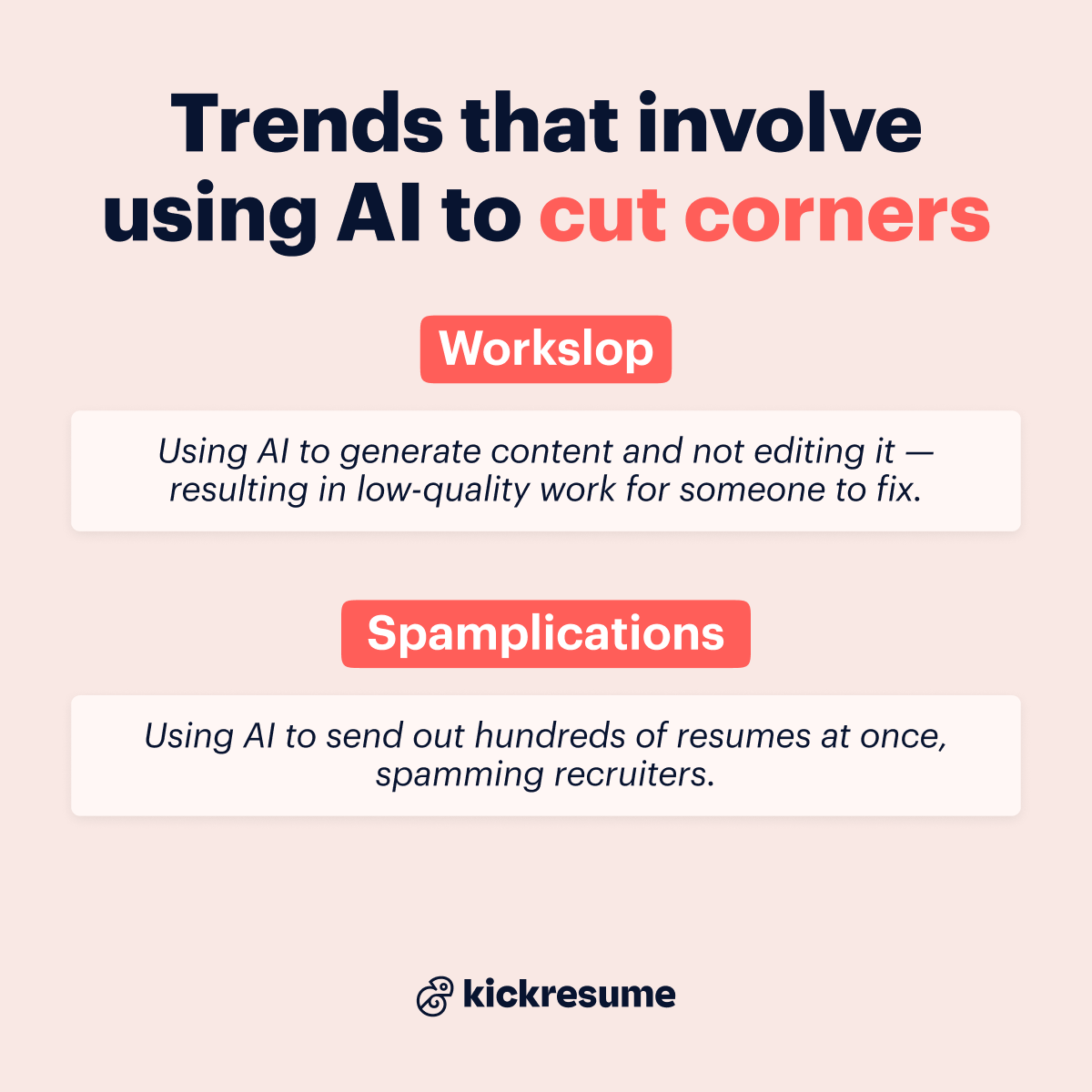
AI has swept through workplaces this year, sparking a wave of new buzzwords to describe how people are using—and misusing—it. From firing off hundreds of job applications at once to generating low-quality content that someone else has to fix, these trends have inspired some striking new terms.
In a previous piece of research, we found that 89% of people consider AI useful at work. But in 2025, we’re also seeing a growing number of workers using this evolving technology to cut corners—giving rise to buzzwords like the ones below.
Workslop
A prime example is ‘workslop’. This term refers to low-quality AI-generated work that just leads to more work for the rest of the team. If content created by AI isn’t edited properly, the quality usually doesn’t measure up.
How to avoid workslop:
- Learn to prompt: A detailed prompt can make a world of difference when it comes to creating content. A carefully thought-out prompt that includes every detail can be a great foundation for your work.
- Review AI output carefully: After you’ve crafted your prompt and you’re happy with the response, you should review it carefully before submitting any work. Make sure the facts are correct, as AI can sometimes ‘hallucinate’ by making things up.
Spamplications
Also known as ‘resume-spamming,’ spamplications is another workplace trend on the rise this year. It refers to using AI to send out hundreds of resumes at once, in the hopes of receiving more job interviews. It might sound like a good idea to get your resume out to as many recruiters as possible—but this could backfire. You might just end up with rejection emails if you’ve not put any thought into your resume.
You may yield better results by carefully selecting roles that are right for you and tailoring every application. AI can still speed the process up—you can use it to tailor your cover letter and resume, as long as you review, edit, and add in your own personal touch.
How to look for jobs using AI:
- Curate a list of roles to apply for: You could use AI to search for companies that align with your values, so you can look for roles that suit you best. Once you’ve created a list, keep an eye out for roles relevant to you within these companies.
- Tailor your resume and cover letter: AI can help you personalize your resume and supporting documents to match the role you’re applying for.
Return-to-office vs remote working—flexibility wins
There’s been changes in how we use technology, but one thing that has stayed the same this year is the desire to work from home.
We’ve seen some more trends involving how workers are reacting to being asked to come into the office. The general consensus seems to be that workers value flexibility—which they will try to keep hold of!
Coffee badging
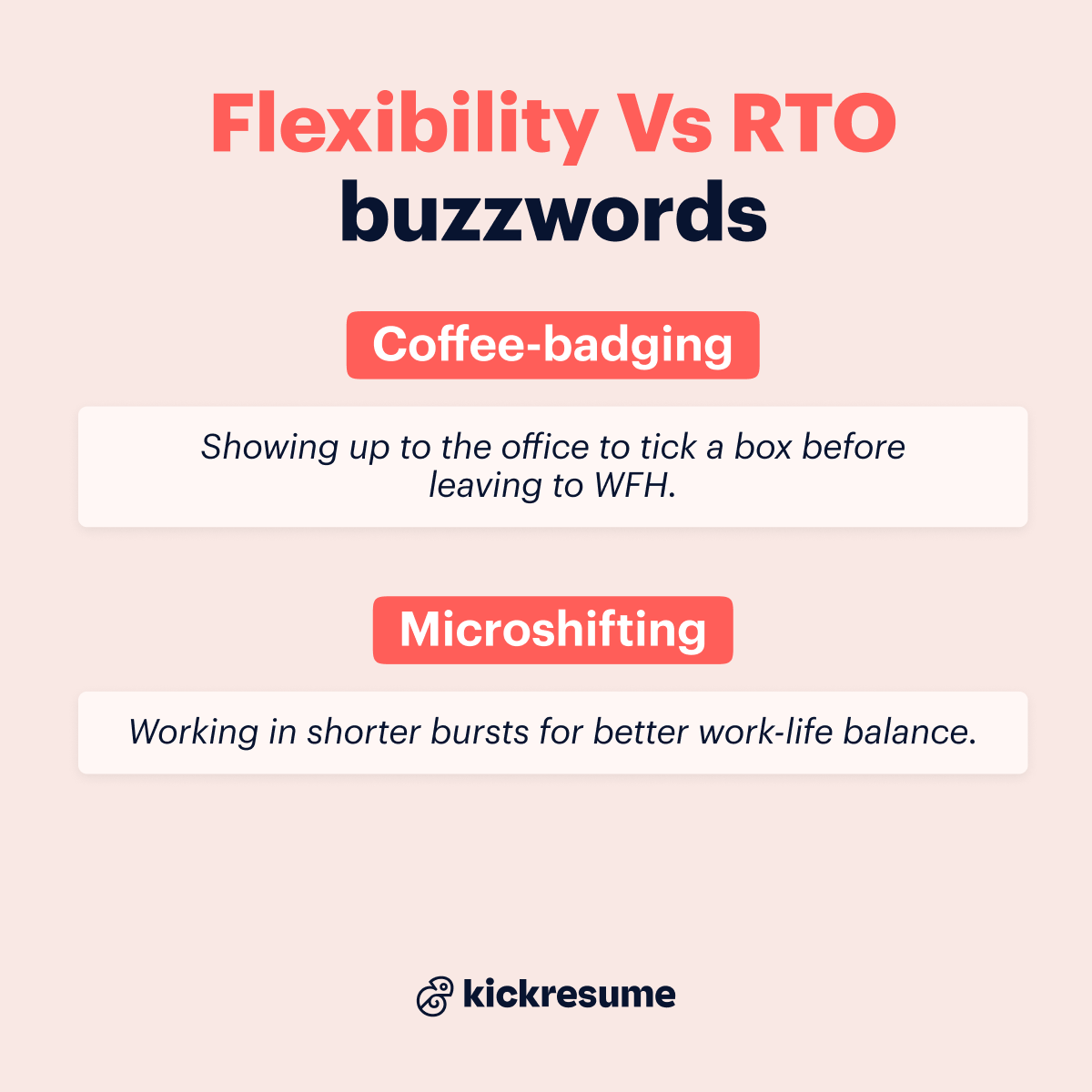
Have you ever seen a colleague clock in, make small talk over a coffee, and then seemingly disappear at some point throughout the day? That’s called ‘coffee-badging’ and is a sneaky way to evade a return to office mandate.
Clocking in to show face and then immediately heading home might land you in trouble if you’re caught. Instead of coffee-badging, there are a couple of things you can do to gain some flexibility.
- Discuss flexibility options: To avoid coffee-badging, you can talk to your manager about potentially coming to a compromise. Many people find that working from home for at least part of the week boosts their well-being and helps them save time.
- Make your office days meaningful: Instead of coming into the office just to fulfill a mandate, why not commit to the full day and make it more productive? Schedule meetings with your team to brainstorm and discuss ideas, or use this time to socialize and network with your colleagues and wider team.
Microshifting
In one of our recent studies, we found that work-life balance and flexibility are among the most sought-after work perks. And it’s no surprise that trends like ‘microshifting’ were created to describe emerging work styles.
Microshifting refers to working shorter and concise shifts throughout the day, an example being four hours in the morning and four hours in the evening. The break in the middle can help you keep on top of family and life responsibilities—allowing for more flexibility in the work week than a standard 9-5 offers.
The office frogs and poly-employed—Gen Z workplace trends explained
Something we’ve picked up on in 2025 are the rising terms used to capture Gen Z’s experience at work. Gen Z (born in years 1997-2012) make up the youngest demographic in the office, and can sometimes bring a different perspective to the workplace.
The office frogs
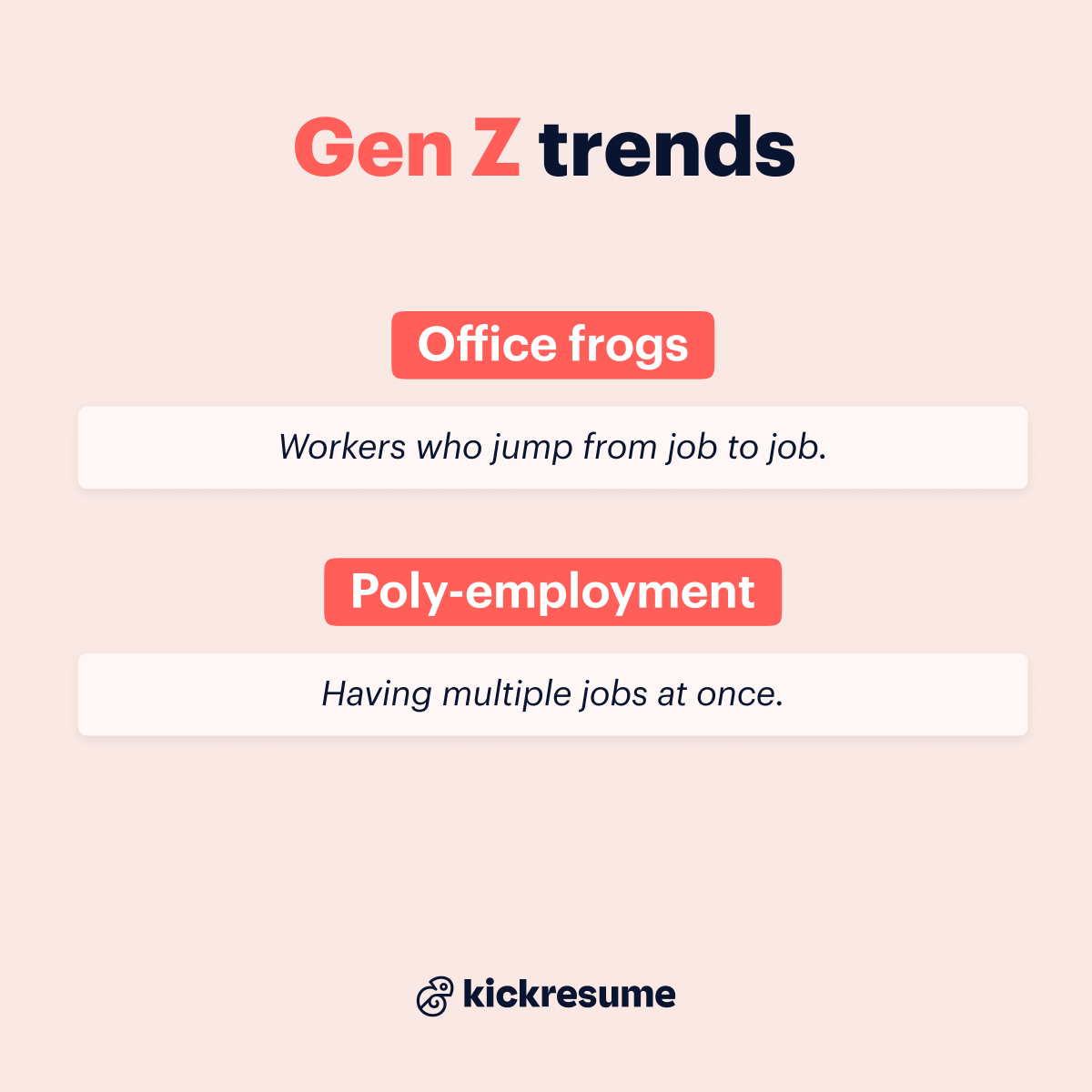
This year Gen Z have been dubbed as ‘office frogs’ as this generation may leap from job to job like a frog. But changing jobs frequently isn’t necessarily a bad thing, it can just mean that this generation is less likely to stay in a role that doesn’t serve them anymore.
As young people are right at the start of their careers, it makes sense for them to hop around a bit to find the right path for them. Although, too much job hopping might be a red flag to recruiters, as it could indicate a lack of commitment.
Poly-employment
A workplace trend rife among Gen Z is having multiple jobs at once. Known as poly-employment, this is young people’s answer to the rising cost of living. Instead of having one job, some workers are taking on multiple jobs for variety and additional income. This trend may be more common with younger workers who are unsure on what career they’d like to pursue yet.
Having multiple jobs, especially in different industries allows you to build up a diverse skillet that looks amazing on your resume. However, it’s important to let your employers know about your other jobs, so there’s no clashing.
Quietly disappearing: workplace ghosting trends
Going ghost on someone means to quietly disappear without a trace. While this may be more acknowledged in social settings, it’s definitely something you shouldn’t do at work! We’ve noticed a couple of trends involving people slipping away from the office without telling anyone.
Ghost vacationing
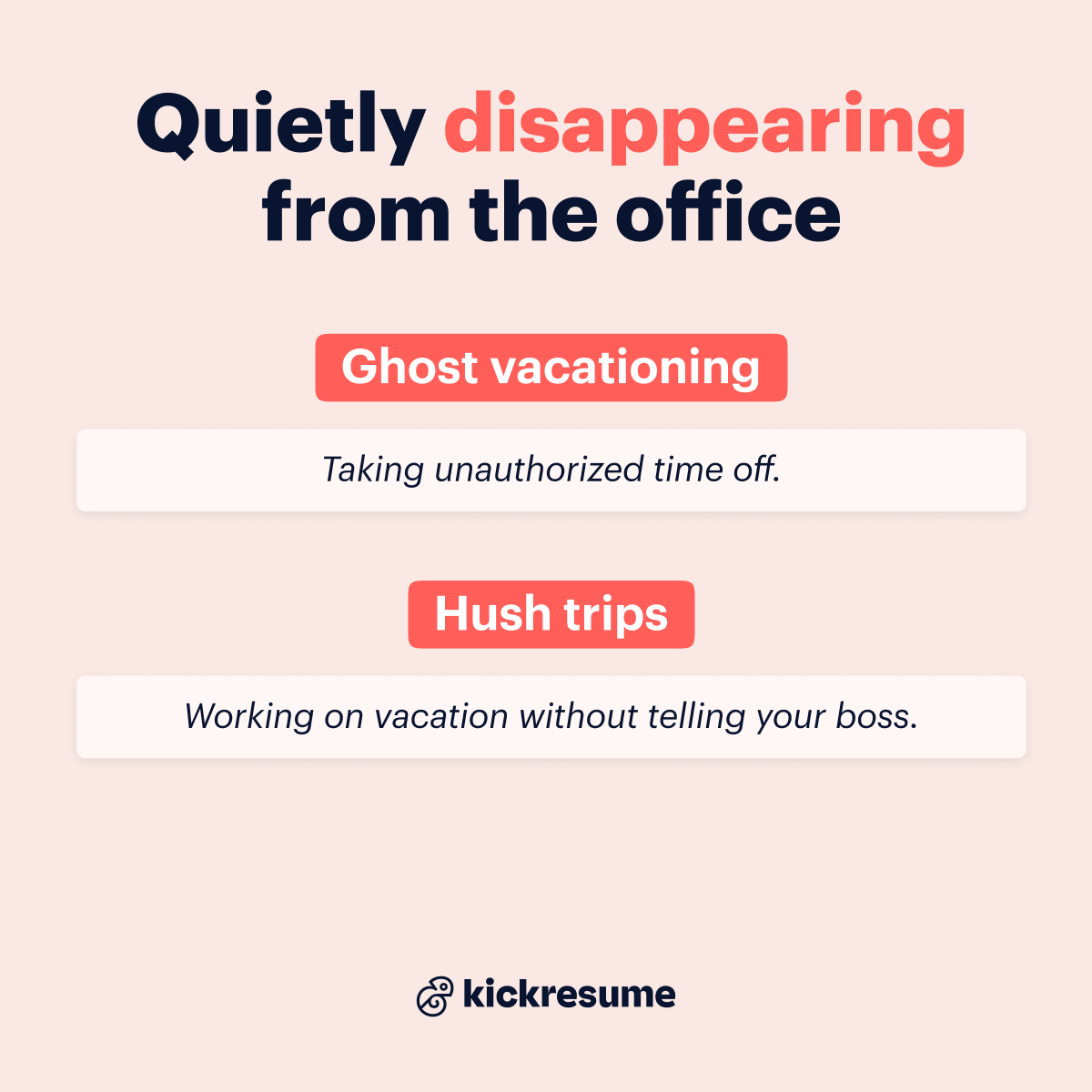
Ghost vacationing or ‘quiet vacationing’ as you can guess, means to take some time off work without letting anyone know. This can be because employees don’t feel like they can take time off, so they silently slip away when nobody's looking. In one of our 2025 surveys, we found out that around 1 in 3 workers in both of the U.S. and Europe have ghost vacationed at least once.
This can be down to a cultural problem at work. In some workplaces, using PTO might be frowned upon, creating a stigma around taking a break. This might push some employees to resort to taking quick and unofficial time off.
If you feel the need to ghost vacation from time to time, it can be worth talking to your manager about your concerns. They may reduce your workload if that’s the problem, or encourage you to use your PTO allowance.
Hush trips
Similarly, hush trips are another trend that involves not letting your employer know where you are. The difference is that those on ‘hush trips’ are still working—just on a vacation!
It can be worth letting your employer know if you’re away on vacation, even if you’re still working. You never know when you’ll be asked to come into the office, and timezones might impact your working hours.
This trend likely came about from employees making the most of remote work and flexible hours. As long as deadlines are met, some employers don’t mind where you work.
The effects of stress and burnout in 2025
Something else we noticed a lot of in 2025 are trends pertaining to employees either not being challenged enough or completely overworked. It’s important to address this early to prevent stress and burnout.
Boreout
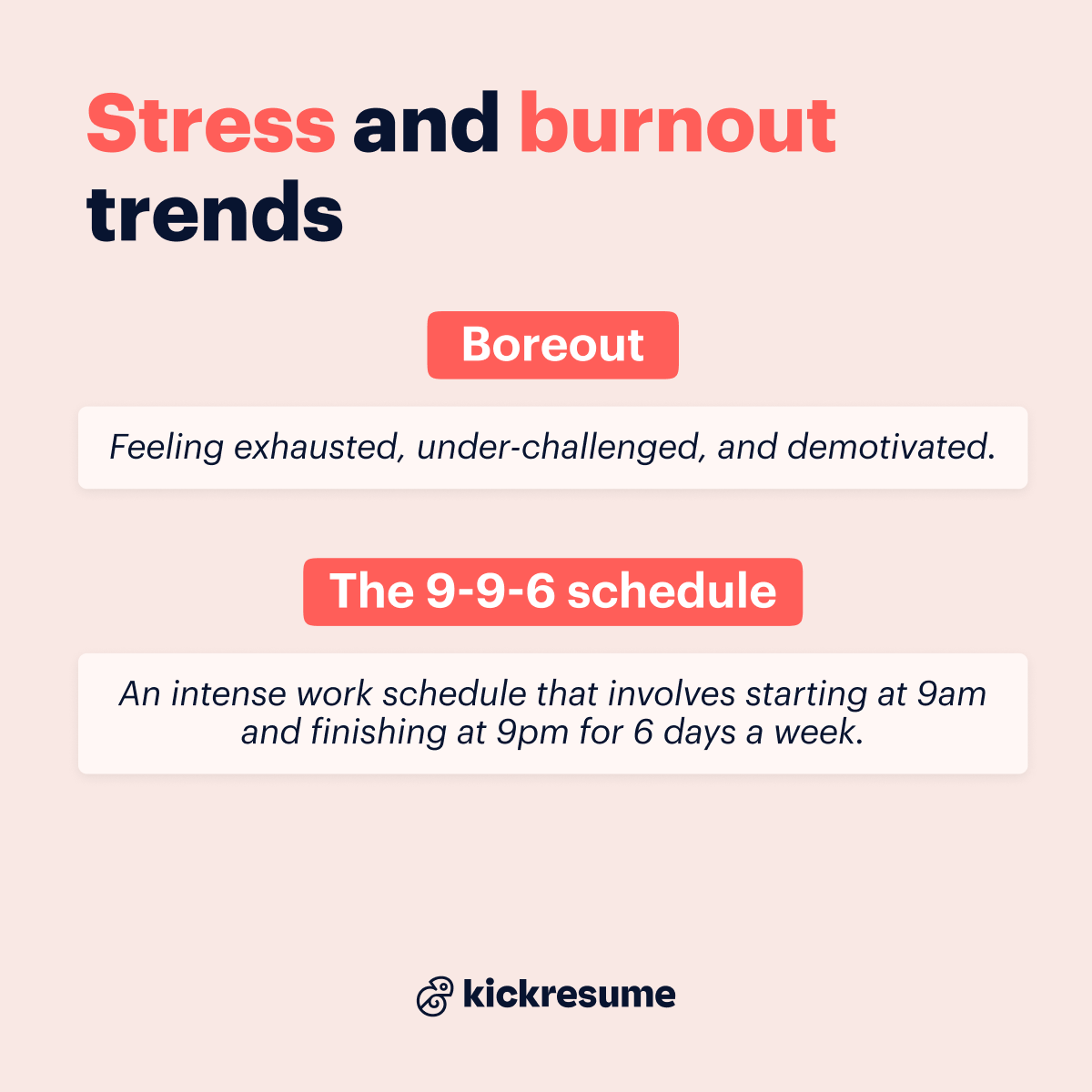
‘Boreout’ is another kind of burnout, but instead of being totally overwhelmed, it’s the opposite. Have you ever felt totally demotivated and under-challenged with work? If so, you might have experienced boreout.
This can lead employees to feeling ‘useless’ and disinterested in their roles. If you feel like this, it’s worth talking to HR or your manager to discuss possible solutions. You might need a fresh challenge or the opportunity to learn a new skill.
The 9-9-6 schedule
A rather concerning trend that’s emerged this year involves a pretty intense work schedule. The 9-9-6 schedule means working from 9am to 9pm, 6 days a week. This not only cuts into the weekend, but leaves you little time to do anything else during the week.
It’s safe to say this schedule can quickly lead to a lot of stress—72-hour weeks are not sustainable. Below are some of the key symptoms of burnout to watch out for if you’re on a particularly demanding schedule.
- Feeling drained
- Feeling detached from your job
- Lack of motivation
- Increased irritability
- Feeling helpless or overwhelmed
- Fatigue
- Headaches
If you’re experiencing some of the above symptoms, you may be on your way (if not already) to stress and burnout. For your well-being it’s important to talk to HR or your manager about how you’re feeling. Together, you can come up with solutions to feeling better about work, which may involve reducing your workload.
Final thoughts
The 2025 workplace buzzwords highlight deeper issues: AI shortcuts that create more work, rigid schedules that fuel burnout, and a generation of workers reshaping careers through job-hopping and multiple roles. Used well, AI and flexible work can boost productivity and well‑being; used badly, they lead to “workslop,” “spamplications,” and ghosting.
For employers, the message is clear: people want meaningful work, realistic workloads, and real flexibility. For employees, it’s about using AI as a tool rather than a crutch, setting boundaries to protect your energy, and being intentional about each career move—even in a tough job market.
Note
Kickresume has compiled a list of some workplace related trends and buzzwords that became popular in 2025, and provided some analysis into why they may have taken off this year.
About Kickresume
Kickresume is an AI-based career tool that helps candidates land jobs and raise their salary with powerful resume and cover letter tools, skills analytics, and automated job search assistance. It already helped more than 8 million job seekers worldwide.