

How honest are we really in these reviews, and what holds us back? And are they even helpful, or just another thing to tick off the list?
It’s not always easy to write honestly about your own work, especially when you know someone else will be reading between the lines. Yet performance self-reviews remain a popular yearly ritual in many workplaces.
To understand how employees really approach self-reviews, Kickresume surveyed 1,365 people from around the world.
Here’s what they told us:
- 71% of employees admit to bending the truth in self-reviews.
- 18% don't think they can be honest about their struggles or requests for support.
- More than a quarter of employees (26%) believe their performance is only average or even below expectations.
- 32% of workers feel they deserve more credit and money.
- 26% think that self-reviews are only meant to “make employees feel involved even if decisions are already made.”
- Older generations are more skeptical about self-reviews.
- 72% of our respondents suspect their managers use AI to write their performance reviews.
71% airbrush their self-reviews one way or another
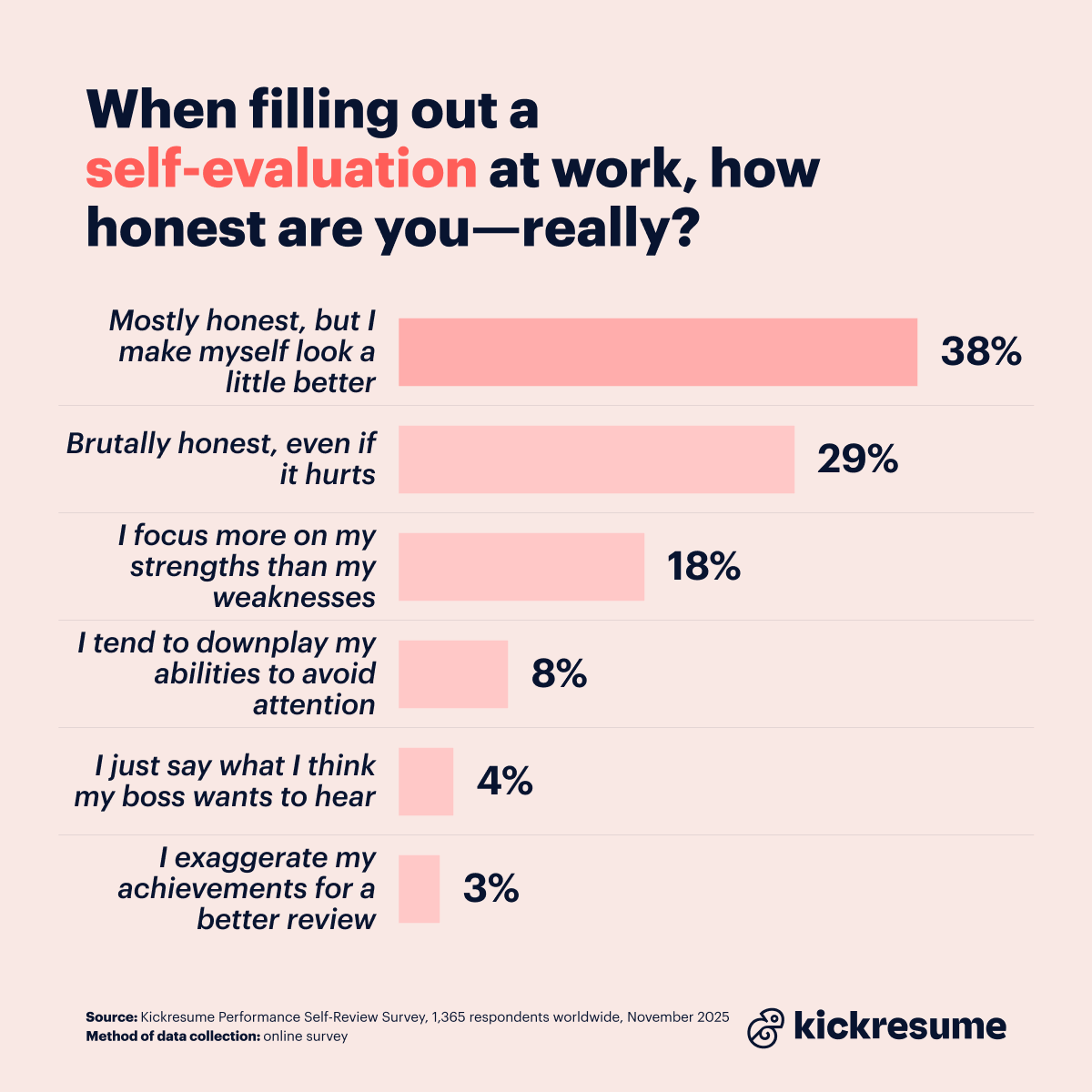
Most respondents admit they bend the truth a little when filling out performance self-reviews.
Only 29% say they portray themselves as they truly are, warts and all. The rest admit to making small cosmetic changes to smooth the rough edges:
- 38% are mostly honest but make themselves look a little better.
- 18% focus more on their strengths than their weaknesses, which is a good strategy.
- 8% tend to downplay their abilities because they don’t want extra attention.
- 4% simply write what they think their boss wants to hear.
- 3% admit to exaggerating their achievements to make themselves look better.
People tweak their self-reviews, but they rarely rewrite reality. They emphasize a little here and hide a little there, yet most stay within the bounds of what still feels true.
If there’s one thing that stands out in these results, it’s just how consistent they are across different generations, genders, and regions. Answers from Gen Z, Millennials, and Gen X differ by only 1-3 percentage points. The same tiny gap shows up between men and women, and between respondents from the US, Europe, and Asia.
The only steady trend appears in the generational breakdown. The older the workers, the less they want attention turned their way. Here’s how often each age group says they downplay their abilities:
- Gen Z: 6%
- Millennials: 8%
- Gen X: 11%
And beyond that one trend, everything else lines up almost perfectly. Awkwardness of self-reviews seems to be truly universal. No matter where people live or how old they are, most approach these forms with the same mix of honesty, hesitation, and gentle self-editing.
The things people never dare write in their self‑reviews
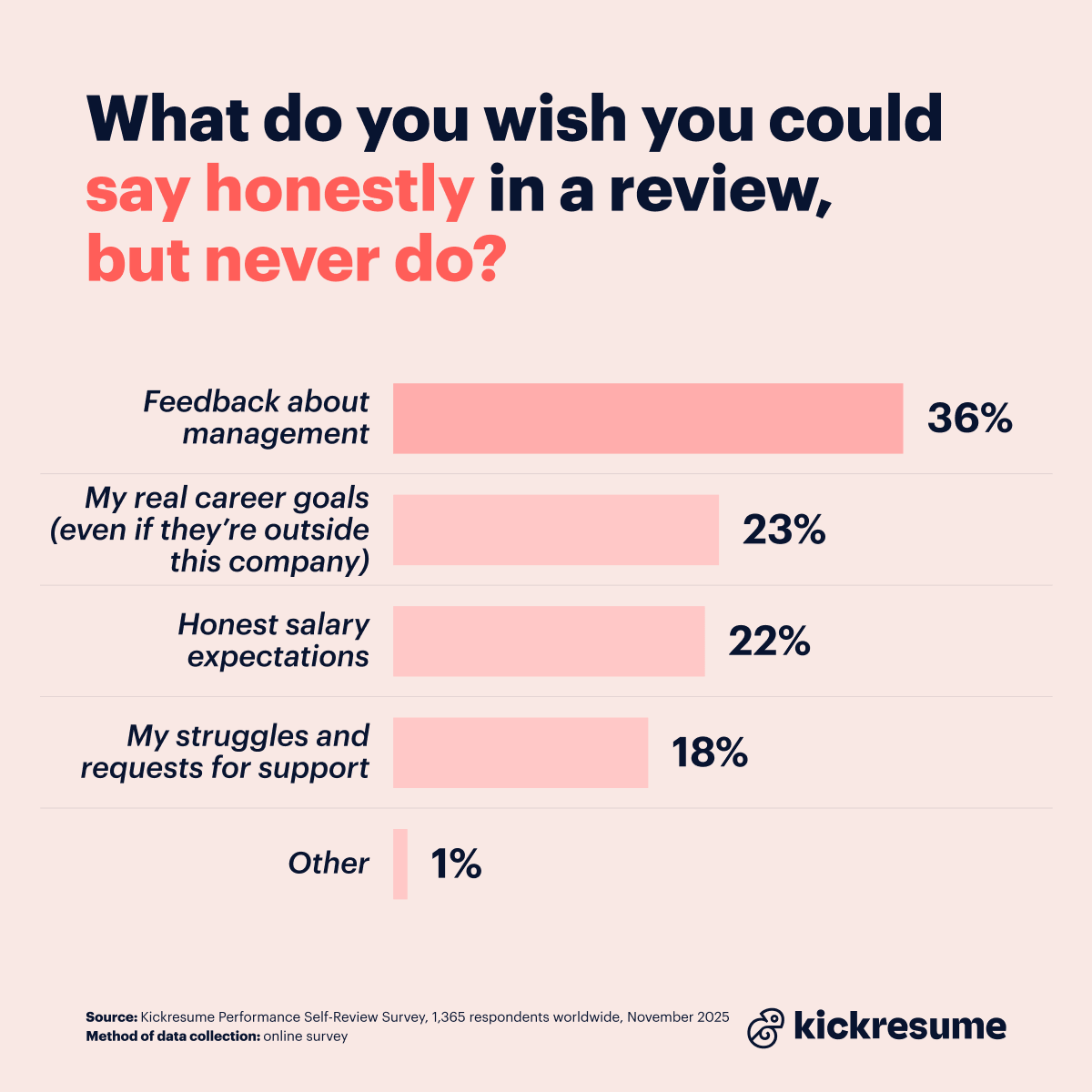
Regarding those 71% who admit to not being totally honest about their self-reviews, we were curious to find out what they censured themselves about. So we gave them a list of common “unsaid” topics and asked which ones they usually hold back.
- 36% chose feedback about management. Many people clearly want to speak up about this, but don’t see the self-review as a safe place to do it.
- 23% hide their real career goals, especially if those goals lead them outside the company.
- 22% selected honest salary expectations, even when the review process could be a natural moment to bring it up.
- 18% said their struggles or requests for support (perhaps the most alarming statistics).
- And 1% said their reasons didn’t fit any category.
These choices show that the major taboos in self-reviews line up with broader workplace tensions: talking about managers, talking about money, admitting you might leave one day, or admitting you need help. Even when the form allows it, many workers feel there are unwritten rules about what shouldn’t be said and they tailor their honesty around those boundaries.
Gen Z workers most hesitant to share their true salary expectations
The older the workers, the more likely they are to wish they could give honest feedback about their managers:
- Gen Z: 30%
- Millennials: 37%
- Gen X: 42%
This could reflect experience. Older workers have spent more time in workplaces, which gives them a better sense of how management actually operates. It may also make them bolder in pointing out issues, or simply more confident in their perspective and aware of certain behaviors that younger employees might miss.
Salary talk shows a gentler curve.
- Gen Z: 24%
- Millennials: 22%
- Gen X: 21%
In general, younger workers seem more hesitant to bring up their real salary expectations. They might feel more shy or cautious about discussing money. Older workers, on the other hand, tend to have a better sense of their value, more bargaining power, and see talking about pay as a normal, necessary part of employment rather than a risky topic.
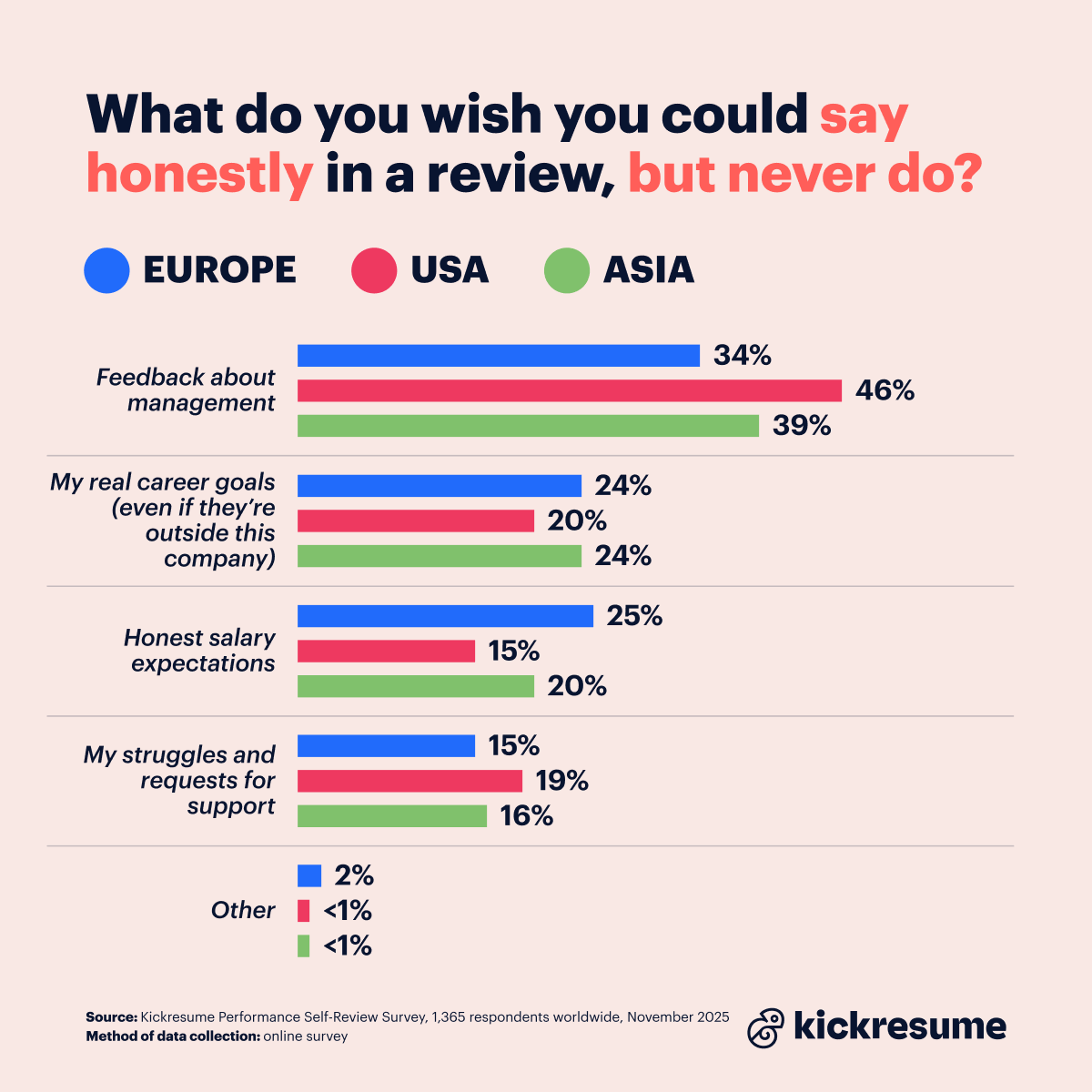
46% of Americans hold back criticism of their bosses
Feedback about management
- Workers in the U.S. are the most likely to hold back criticism of their managers, with 46% saying they cannot be fully honest.
- In Asia, it’s slightly lower at 39%, and in Europe, 34%.
This suggests that in the U.S., there may be stronger concerns about workplace hierarchy or fear of repercussions when critiquing management.
Honest salary expectations
- Talking about money is most uncomfortable for European employees, with 25% admitting they avoid it in their self.reviews.
- In Asia, 20% hold back, while in the U.S., only 15% say they feel restricted.
In the U.S., discussing pay is seen as a routine part of employment, while in Europe and Asia, workers are more cautious about bringing it up (likely reflecting social norms and workplace culture around money).
1 in 3 believe they deserve more credit—but won’t say it out loud
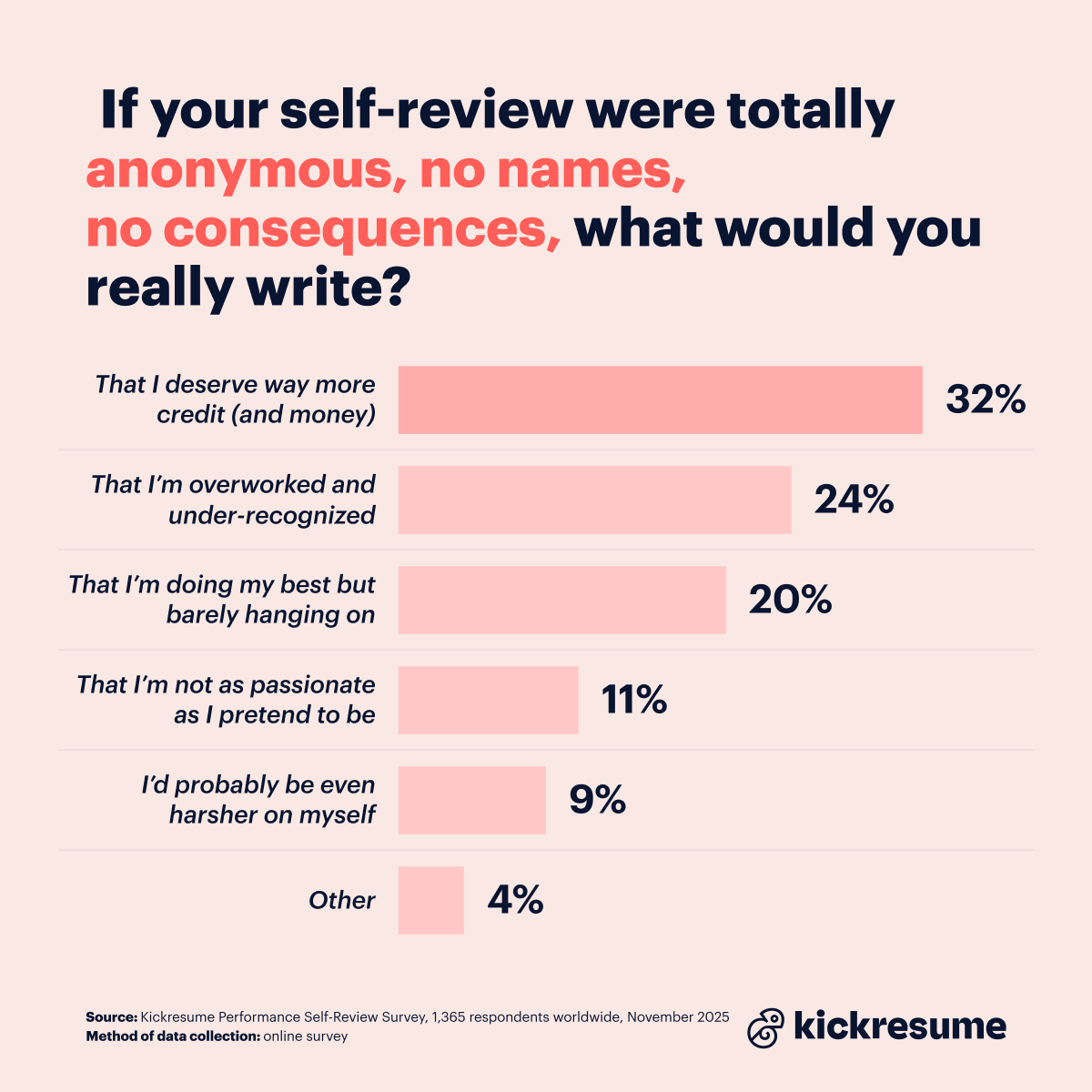
So, if the self-reviews were completely anonymous. No name. No consequences. Absolute freedom. What would our respondents really admit to?
- A full 32% said they’d finally say out loud that they deserve more. More credit, more recognition, and yes, more money.
- Another 24% would use that anonymity to confess that they’re overworked and under-recognized.
This means more than half of employees feel some level of underappreciation when you combine these two groups.
- Then there’s the 20% who say they’re doing their best but barely hanging on.
That means one in five workers is secretly struggling, which should prompt managers and HR teams to take a closer look at workload, support systems, and overall well-being. These are the people who might be smiling on video calls while moving dangerously close to a burnout.
- Another 11% admit they’re not as passionate as they pretend to be, hinting at the emotional labor of staying upbeat and “engaged” even when the spark is fading.
And 9% go in the opposite direction entirely: if their self-review were anonymous, they’d actually be harsher on themselves.
The squeezed middle: Millennials are overworked, Gen Z is overstressed
Sort everything by who answered what, and a few trends practically wave for your attention:
- 28% of Millennials say they’re overworked and under-recognized, noticeably higher than Gen Z (19%) and Gen X (25%). This positions Millennials as the squeezed middle: experienced enough to carry heavy workloads, but not always rewarded for it.
- 26% of Gen Z respondents say they’re “barely hanging on,” compared with 18% of Millennials and 15% of Gen X.
- Respondents in Asia recorded the highest levels of “I deserve more” at 34% (compared with 33% in the U.S. and 30% in Europe), the highest feeling of being overworked at 27% (22% Europe, 24% U.S.), and the highest “barely hanging on” at 20% (19% Europe, 16% U.S.).
- Men were more likely to say they deserve more money (33% versus 29% of women). Women, meanwhile, were more likely to feel overworked and under-recognized (27% versus 23% of men).
These responses reveal several different pain points. For men, it’s about pay. For women, it’s about being seen and valued. Together, they show that the challenges people face at work aren’t uniform and that recognition and fairness mean different things depending on who you ask.
Who’s bringing their A-game? Apparently almost everyone
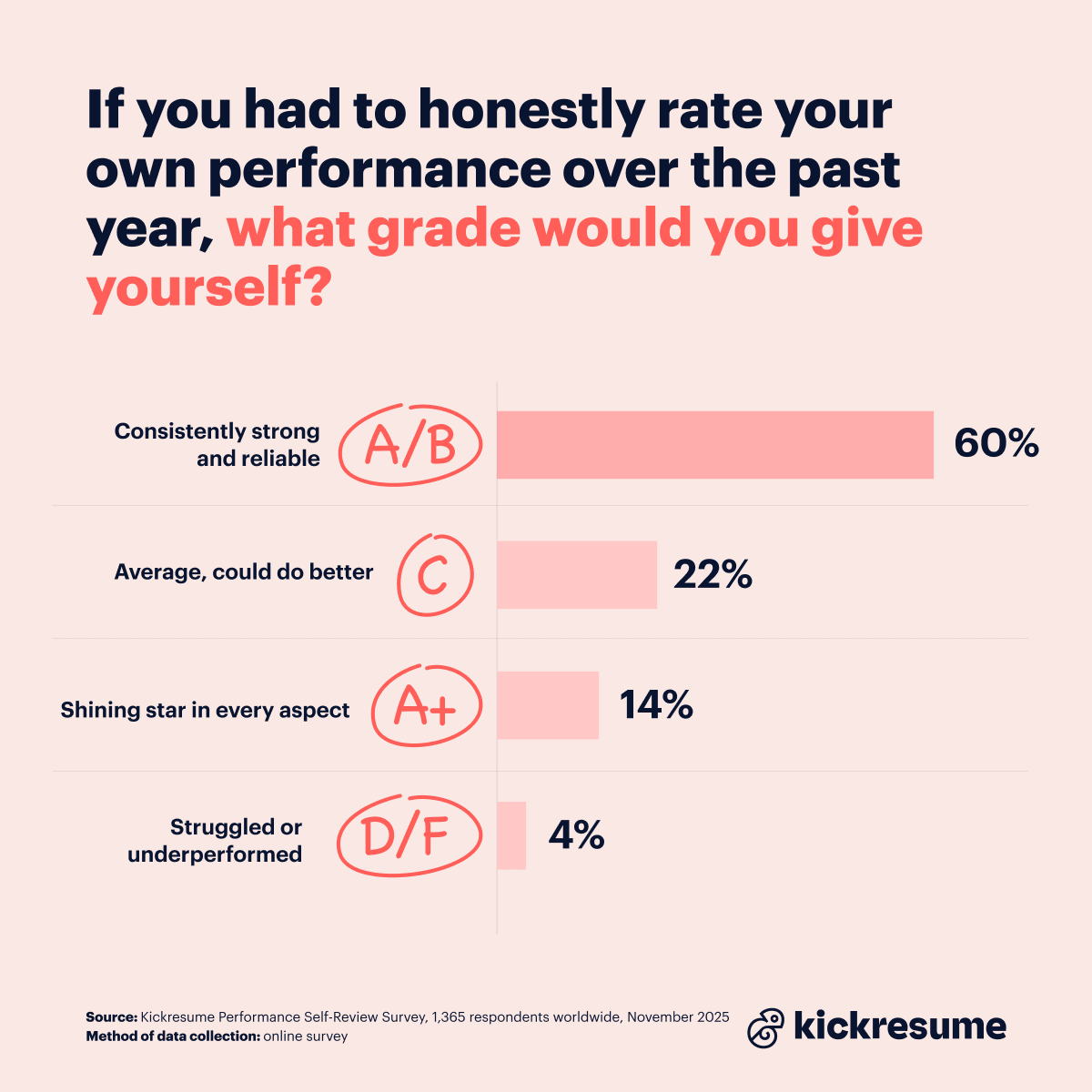
Hand on heart, and in the privacy that you have right now, how would you grade your own performance over the past year? For most of our respondents, the answer was positive:
- A solid 60% gave themselves an A or B, saying their work has been consistently strong and reliable.
- Another 14% went even further, rating themselves an A+ (a shining star in every aspect).
- That leaves 22% giving themselves a C, admitting they could have done better.
- Only a small 4% rated their performance as D or F, acknowledging struggles or underperformance.
At first glance, the numbers make it seem like we have a confident and capable workforce. But when you look a little closer, things get more interesting.
More than a quarter of employees (26%) believe their performance is only average or even below expectations. For managers and HR teams, that’s something worth noticing. If that self-awareness is ignored, it can lead to disengagement or missed opportunities for growth.
On the other hand, most employees rate themselves highly, which suggests they see themselves as reliable and skilled. That confidence can turn into initiative, leadership potential, and a willingness to take on bigger challenges, as long as organizations recognize it and give it space to grow.
And once you start slicing the data a bit, a few interesting patterns pop up. Here are some of the stand-out ones:
- Gen Z is the most self-critical generation. 26% of them went with a C (“could do better”), compared with 21% of Millennials and 19% of Gen X.
- Gen X, on the other hand, reported the highest D/F ratings at 5% (compared with 3% for Millennials and just 2% for Gen Z), suggesting they’re a bit more willing to call a tough year what it was.
- Men and women were almost mirror images of each other. Men landed at 60% A/B, 22% C, and 15% A+, while women came in at 62% A/B, 21% C, and 13% A+. Even the lowest scores are close (3% vs. 4%).
- Asia really stands out for confidence at the top: 20% of respondents there gave themselves an A+, compared with 12% in Europe and 11% in the U.S.
- Meanwhile, the U.S. leads the pack on solid A/B ratings (66%, compared with 60% in Europe and 55% in Asia).
Only 40% think their boss sees them as they really are
Most of us carry a bit of a “work persona” around the office. The polished, professional version of ourselves that feels safe and competent. So, if people dropped that filter and wrote exactly what they think about their own performance into their self-review, how would their bosses react? Would the person on the page match the person they see every day?
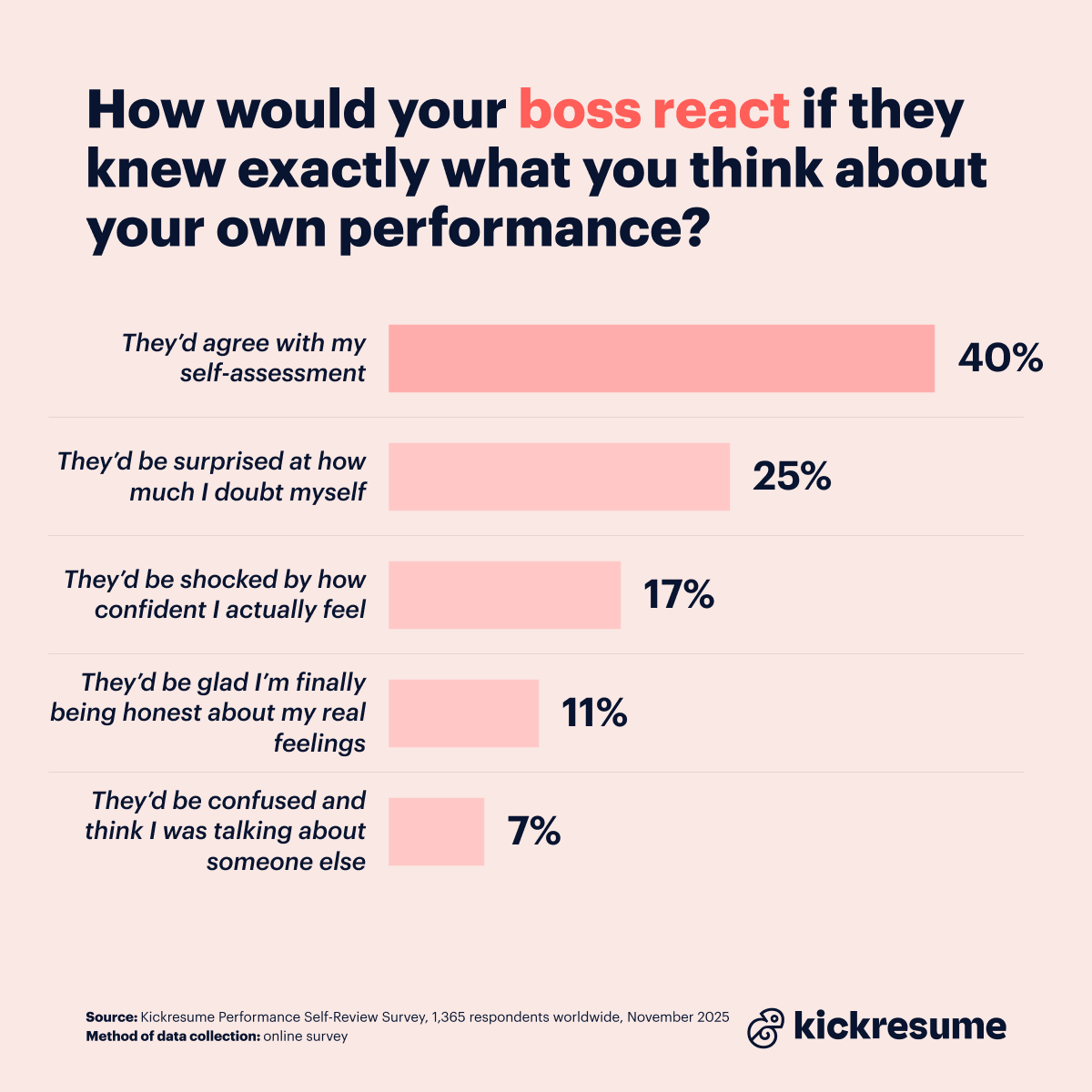
Here’s how respondents think their boss would react:
- 40% believe their boss would agree with their self-assessment. For many workers, there’s no big disconnect. What they think of themselves is more or less what their boss sees too.
- 25% say their boss would be surprised by how much they doubt themselves. This is a big one. A quarter of people are carrying self-doubt that never shows on the surface.
- 17% think their boss would be shocked by how confident they actually feel.
- 11% believe their boss would just be glad they’re finally being honest.
- And 7% think their boss would be confused and assume the review was about someone else entirely.
What really jumps out is the 25% hiding doubts their boss never sees. Self-doubt like that makes workers avoid risks, stay silent, or underestimate their own contributions.
And on the other side, the 17% with hidden confidence might be missing out too. Because when confidence doesn't show outward, it rarely translates into recognition, advancement, or leadership opportunities.
Managers often evaluate the version of someone they can observe. But the more accurate version may be the one employees keep to themselves.
A quarter say self‑reviews are just for show
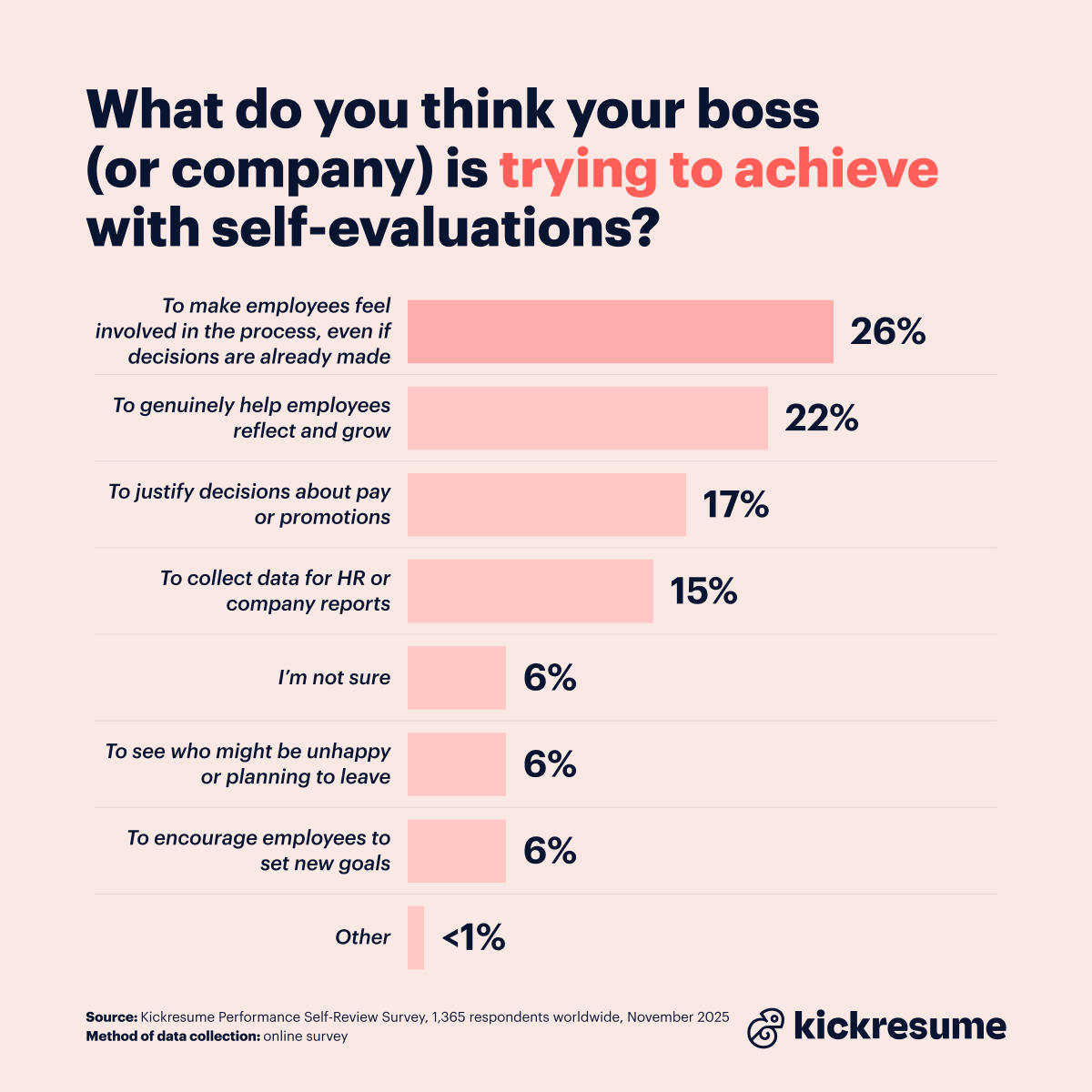
Which brings us to the question of what exactly employees think is the point of self-evaluations. Do they see them as a genuine tool for reflection, or something else entirely?
- 26% said self-reviews mainly exist to make employees feel involved, even when the big decisions are already made. In other words, the process can feel more symbolic than influential.
- 22% genuinely see them as a tool for growth.
- 17% believe the purpose is to justify pay or promotion decisions. They connect the exercise directly to rewards and advancement, not necessarily personal development.
- 15% think companies use self-reviews mostly to gather data for HR or internal reporting. To them, it’s more of a checkbox than a chance to improve.
Smaller groups cited other reasons: 6% think self-reviews help flag people who might be unhappy or thinking about leaving, another 6% say they help with goal-setting, and 6% aren’t sure what the point is at all.
There isn't a clear consensus on what self-reviews are actually meant to accomplish. Employees are split across reflection, recognition, data collection, and decision-making, with no single explanation rising to the top. The result is a process that feels purposeful to some, performative to others, and confusing to many.
Our data makes it clear that while companies may have their own intentions for self-reviews, employees don’t have a unified sense of what those intentions are. That disconnect can ultimately shape how seriously the process is taken.
7% call self-reviews pointless, skepticism grows with age
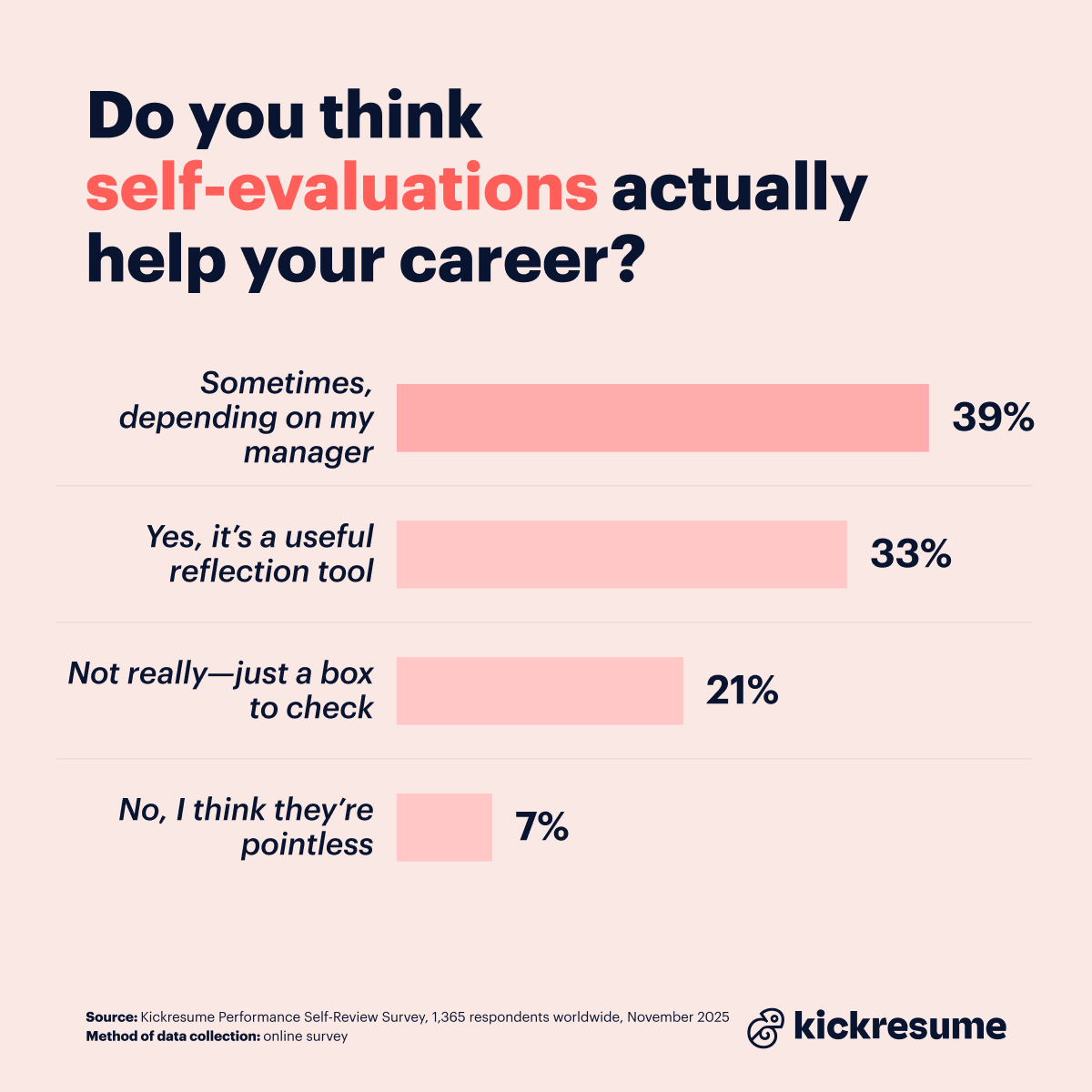
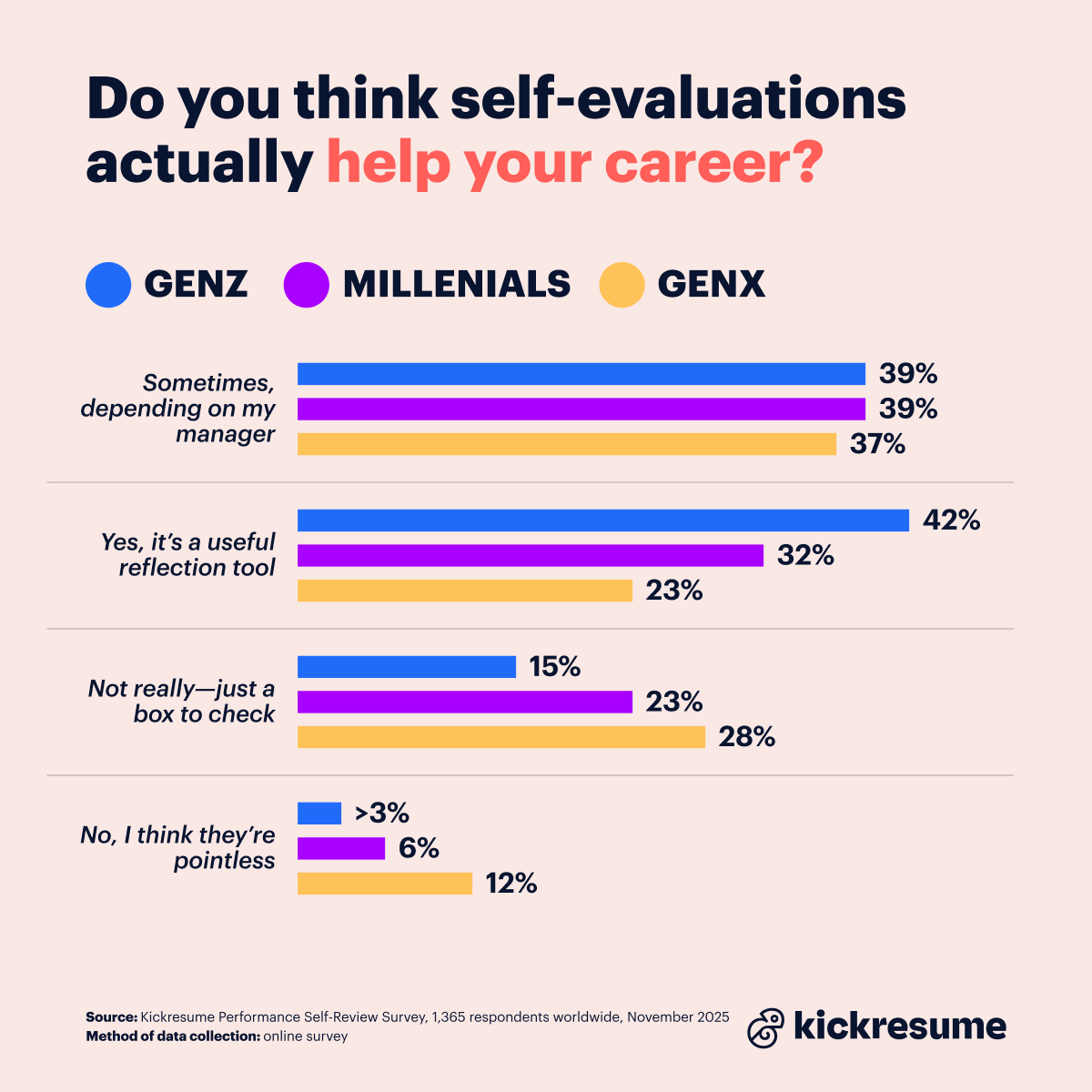
Company intentions aside, employees do think that self-reviews have the potential to improve their careers. Up to 33% of our respondents stand on that point firmly and consider self-reviews a truly useful reflection tool.
On the other end of the spectrum, 21% are far more skeptical and believe that self-reviews are just procedures without any real positive effect on their careers. And another 7% go as far as to call them pointless.
But the biggest group (39%) believes that the success doesn’t necessarily lie in the self-reviews themselves, but in what their managers actually do with them. In other words, the value of the whole process hinges less on the form and more on the follow-through.
Our data suggest that many employees genuinely want self-reviews to matter. They’re open to reflection, growth, and honest conversations about performance. But they’ve also seen enough processes, meetings, and “development cycles” to know that not everything labeled as feedback actually leads to something meaningful.
This point is nicely illustrated by observing how much different generations trust the process:
- Gen Z clearly has the most faith in the system: A full 81% (42% for “useful reflection tool” + 39% for "depending on the manager”) believe self-reviews can be useful. Only 18% (15% for “not really” + less than 3% for “pointless”) fall into the dismissive camp. For the youngest workers, the process still feels like it could do something.
- Millennials land in the middle: About 71% (32% or “useful reflection tool” + 39% for "depending on the manager”) maintain at least some degree of trust. But we can also see the skepticism grow with nearly 29% saying the whole thing ranges from procedural to pointless.
- Gen X is by far the most disillusioned: Only 60% (23% or “useful reflection tool” + 37% for "depending on the manager”) believe self-reviews hold any value, while 40% dismiss them outright. With more years of performance cycles behind them, they’re also the most likely to question whether the process actually changes anything.
The younger the employee, the more they believe self-reviews can genuinely help. The older the employee, the more the process feels like corporate theater.
AI thought to play a role in 72% of performance reviews
If the value of self-reviews depends on how managers use them, then we have to ask if managers are even writing the feedback anymore. A review only feels genuine when the person behind it is, too. And, as we're about to see, that’s becoming less certain.
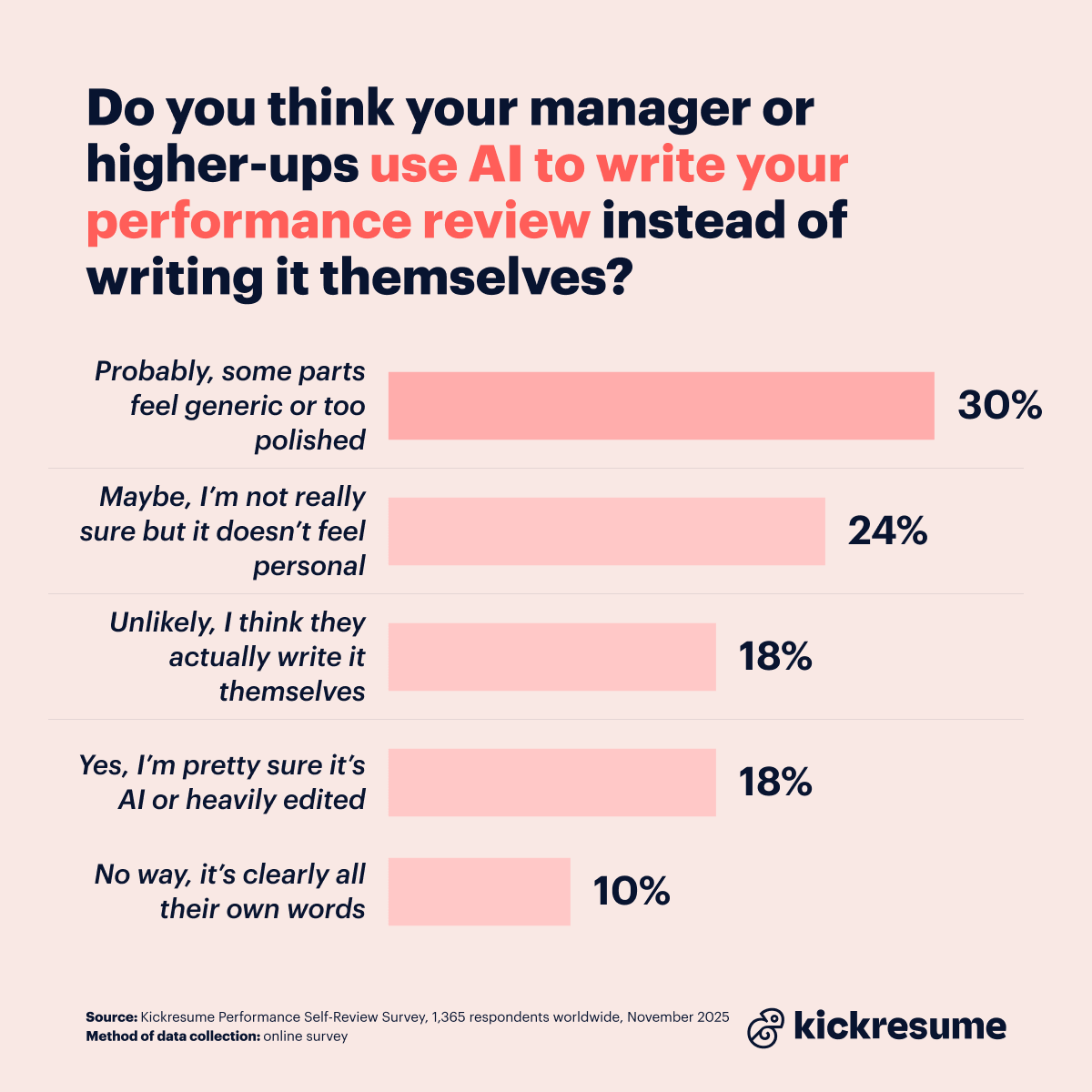
A decisive majority (72%) of our respondents suspect their managers use AI to write their performance reviews:
- “Probably, some parts feel generic or too polished”: 30%
- “Maybe, I’m not really sure but it doesn’t feel personal”: 24%
- “Yes, I’m pretty sure it’s AI or heavily edited”: 18%
Only 28% believe their manager writes their feedback entirely on their own:
- “Unlikely, I think they actually write it themselves”: 18%
- “No way, it’s clearly all their own words”: 10%
Our data shows that employees sense that performance reviews are drifting toward automation. And while AI-assisted writing isn’t inherently a problem, it becomes one when employees are waiting to see whether their manager actually knows their work, sees their effort, and cares enough to say something specific.
During a review season when people are already unsure how much their self-evaluations matter, discovering (or suspecting) that their manager didn’t even write their feedback can create even more distance.
In other words, if trust in self-reviews depends on managers demonstrating care, attention, and personal insight, then AI-flavored performance summaries risk sending the opposite signal.
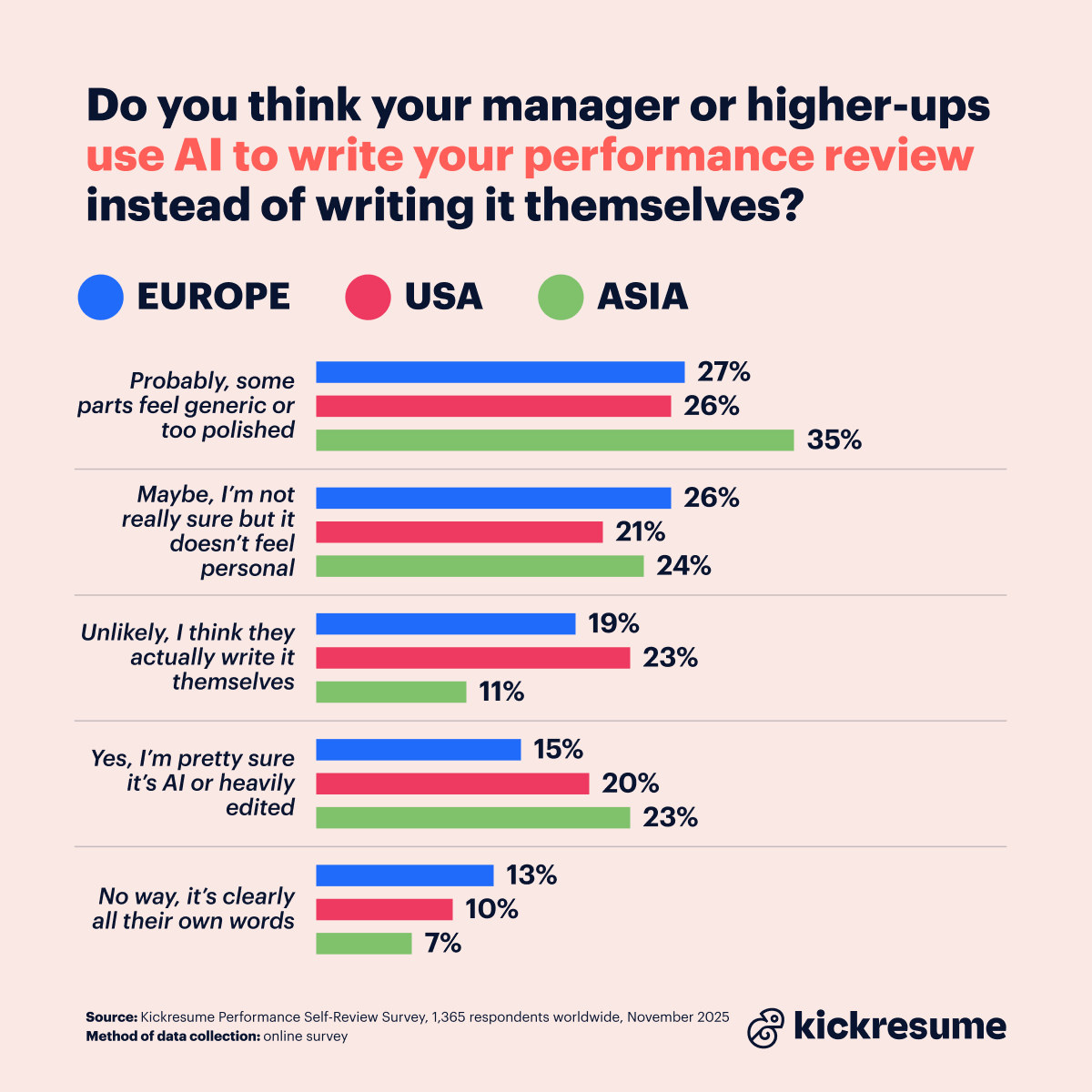
And when we look at where in the world employees feel AI creeping into their performance reviews the most, we will find Asia sitting on the top peg.
Below, we grouped respondents by whether they suspect AI is involved versus those who believe their manager writes everything themselves:
Asia
- Suspect AI is involved: “Probably” (35%) + “Maybe” (24%) + “Yes” (23%) = 82%
- Believe it’s written by their manager: “Unlikely” (11%) + “No way” (7%) = 18%
Europe
- Suspect AI: “Probably” (27%) + “Maybe” (26%) + “Yes” (15%) = 68%
- Believe it’s their manager: “Unlikely” (19%) + “No way” (13%) = 32%
USA
- Suspect AI: “Probably” (26%) + “Maybe” (21%) + “Yes” (20%) = 67%
- Believe it’s their manager: “Unlikely” (23%) + “No way” (10%) = 33%
So while doubt exists everywhere, Asia is in a league of its own, with more than four out of five employees assuming their reviews aren’t fully human-made.
Final thoughts
Performance self-reviews were meant to spark reflection, clarity, and better conversations. What our data suggests, however, is a workplace caught between wanting that ideal to be real and doubting whether the process delivers.
Employees are trying to be honest, but not too honest. They are willing to reflect, but unsure who is actually listening. They want feedback, but many now suspect that even the feedback might not come from a person anymore.
Still, the overall message is more hopeful than cynical. People genuinely want this process to matter. They want real conversations, specific guidance, and managers who read what they write and respond with something personal. If companies want self-reviews to truly work, they need to treat them as a way to build relationships rather than just a routine task.
Demographics
Gender
- Male: 69%
- Female: 30%
- Non-binary or other: 1%
Age
- Under 18: 2%
- 18–28: 28%
- 29–43: 44%
- 45–60: 23%
- 61–79: 2%
- 79 or older: <1%
Location
- Africa: 12%
- Asia: 24%
- Australia/Oceania: 2%
- Europe: 27%
- Latin America: 10%
- North America: 25% (90% based in the USA)
Note
This anonymous online survey by Kickresume, conducted in November 2025, gathered insights from 1,365 respondents globally. All participants were reached via Kickresume's internal database.
About Kickresume
Kickresume is an AI-based career tool that helps candidates source jobs and raise salary with powerful resume and cover letter tools, skills analytics, and automated job search assistance. It has already helped more than 8 million job seekers worldwide.