ChatGPT
 Perplexity AI
 Claude
Writing your professor resume shouldn't feel like preparing a tenure review packet. You need to showcase your teaching excellence, research contributions, and publications in a way that hiring committees can quickly grasp—without the 50-page CV.
In this guide, we'll show you some pragmatic resume tips, real-life professor examples, and compelling templates. Prepare to become the candidate that every university wants on their staff. Advanced academics, meet advanced resume writing.


 See more examples like these
Keep reading to learn all about:
- Reviewing actual resume samples for professors
- Giving your resume the right look (or format)
- Including the right contact information in your professor resume
- Crafting an informative resume summary (or objective)
- Choosing which skills to present on your resume
- Framing your work history for maximum impact
- Using action verbs to make your resume more dynamic
- Flashing out your education
- Adding optional sections to your professor resume
- The many small mistakes that can hurt your application
- Making your cover letter match your resume
- Accessing helpful resources for job-seeking professors
- The average salary and job outlook for professors
Still looking for a job? These 100+ resources will tell you everything you need to get hired fast.
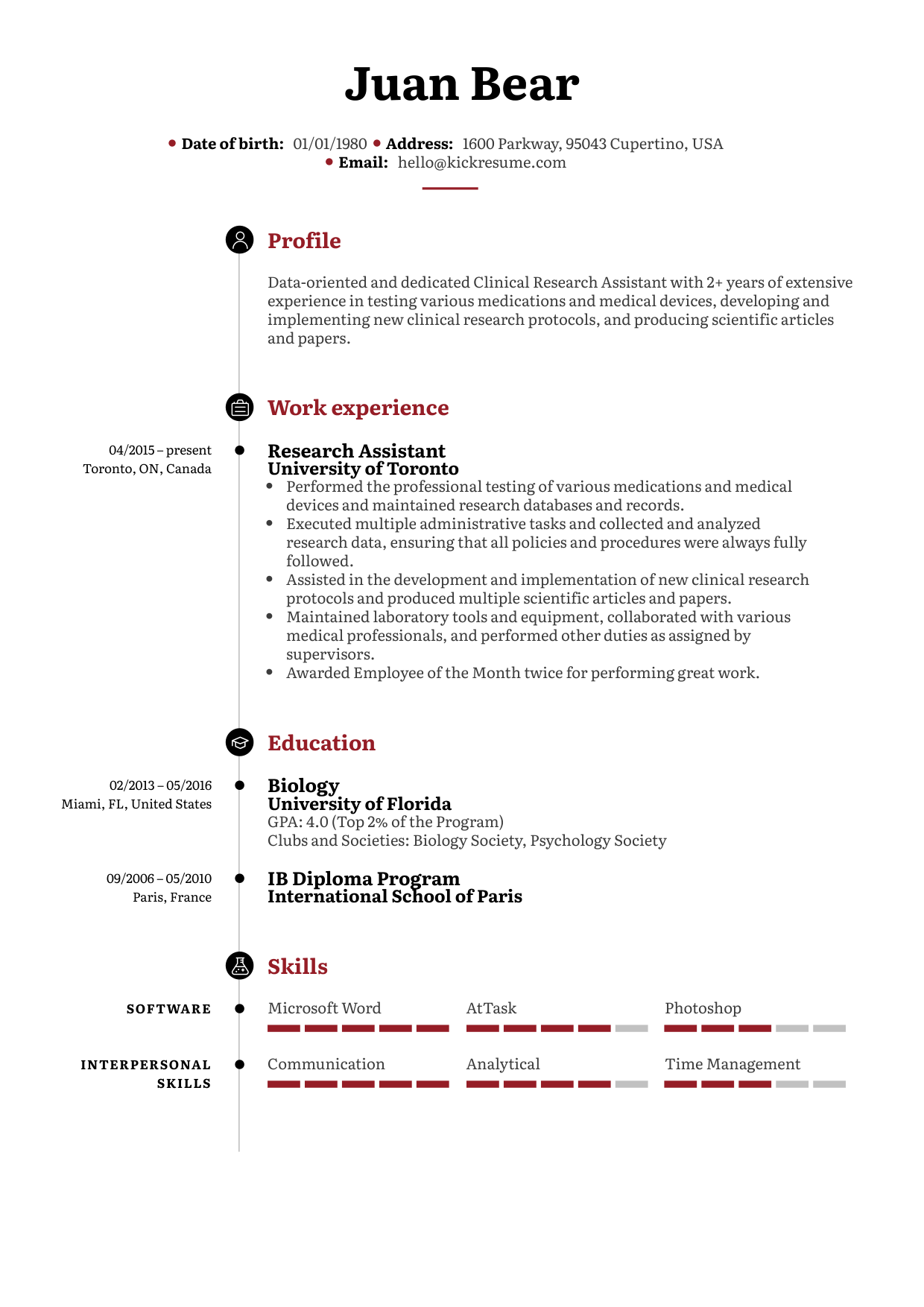
Adjunct professor resume sample


Why does this resume example work?
- It includes a separate “Publications” section: This resume carves out a dedicated space for publications, which instantly signals research credibility. Even though the list is short, the section helps round out the candidate’s academic profile and reinforces their role not just as an educator, but also as a contributor to the field.
- The work experience emphasizes impact on students: Since teaching is central to most professor roles, it’s helpful when the resume shows more than just what courses were taught. This one includes specific outcomes — like increased student participation or successful research mentorship — which clearly shows the candidate’s involvement in students’ academic progress.
What could be improved?
- Mentioning more quantifiable data: We get a few data points (a 15% bump in participation, for instance) but most of the experience is still written in broad strokes. How many students did they teach? How many published papers came from student projects? Even rough figures can help give scale and clarity. The more specific you are, the easier it is for a hiring committee to picture the impact.
- Moving work history before the education section: The resume currently leads with education, which makes sense for a recent graduate, but this isn’t that. With two decades of teaching at top institutions, the professional experience is clearly the headline here. Flipping the order would put the most relevant, impressive content front and center, where it belongs.
Assistant professor resume sample

Why does this resume example work?
- It highlights both language and technical skills: The skills section is short but effective. It covers both language fluency and technical tools commonly used in microbiology research. Especially in academia, being able to navigate research software like SPSS or SnapGene, while also communicating in more than one language, can be a real asset; whether for teaching diverse student cohorts or collaborating internationally.
- Bullet points start with storing action verbs: Each line under the work experience opens with a clear verb. This makes the descriptions feel more direct and readable. It also helps the reader quickly grasp what the applicant actually did in each role, rather than just listing general responsibilities.
What could be improved?
- Crafting a short resume summary: This resume jumps straight into education and experience. That’s not necessarily wrong, but a brief summary at the top could help tie it all together. Something that outlines the applicant’s focus, what kind of institution they’re looking to work at, and what they bring to the table. It’s especially useful for giving search committees a quick context before they dive into the details.
- Adding relevant optional sections: The basics are covered, but this resume could benefit from one or two well-chosen optional sections. For example: awards, publications, or professional affiliations. Given that the applicant has already published studies and received an academic award, highlighting that in a separate section would make it easier to spot.
Math teacher resume sample

Why does this resume example work?
- It shows a detailed education section: What helps this education section stand out is the extra context. Instead of stopping at the degree title and institution, the applicant includes their GPA, class rank, and specific academic awards. Those details can be easy to overlook when writing a resume, but they’re often what makes a candidate’s academic background feel tangible.
- It highlights awards and achievements: It’s good to see that the resume also highlights recognitions, such as the Gold Award for Innovative Teaching and a strong record of student performance. These additions go a long way in setting the candidate apart, especially when awards are linked to concrete outcomes like student engagement or success rates.
What could be improved?
- Sharing less personal information: Details like date of birth and nationality aren’t needed, and in many places, they’re best left out. They don’t add anything that helps the candidate’s case. On the contrary, in some settings, they can even raise concerns about bias.
1. Formatting tips for your professor resume
A resume is not the same thing as a CV.
Still, a lot of people (and job listings) use the two terms as if they were interchangeable. In most cases, especially in academia, this difference matters a lot.
CV vs resume: What’s the difference?
Essentially, CV (Curriculum Vitae) as a full record of your academic life. It includes everything: your education, teaching experience, research, publications, presentations, grants, service work, and any other academic contributions you’ve made over the years. A CV doesn’t have a page limit. It grows with your career.
A resume, on the other hand, is typically one or two pages long and tailored to a specific job. Resumes highlight only the most relevant skills, experience, and achievements. They cut out anything that doesn’t directly support your job application for that specific role.
When does a resume make sense for a professor?
If you're applying for traditional academic roles (like tenure-track jobs, research positions, or lectureships), you’ll need a CV. No exceptions.
However, there are situations where professors, especially those transitioning into non-academic careers or applying for roles in administration, policy, consulting, or private sector education, might be asked for a resume instead.
Some examples include:
- Moving into a higher education administrative role (e.g., Dean, Program Director)
- Applying for a policy or research position in government or think tanks
- Seeking work at educational nonprofits or foundations
- Transitioning into corporate training, curriculum design, or edtech
- Applying for a visiting scholar position abroad where the format expectations differ
In these cases, the people reviewing your application may not be academics. They may not have time to read a 10-page CV (or know what to do with it). That’s when a well-structured resume becomes the better choice.
A few formatting tips
If you're putting together a professor resume (not a CV), the format should help readers quickly see why you're a great fit for the role. That means clarity, brevity, and organization. Here's how to format your resume:
- Choose a clean, easy-to-read font like Calibri, Georgia, or Arial
- Set your font size between 10 and 12 points
- Keep it to one page if you can; two max if your experience really calls for it
- Break your resume into clear sections with headings like “Experience” or “Education”
- Use bullet points instead of long paragraphs (they’re faster to scan)
- Keep your margins consistent, around 0.75 to 1 inch on all sides
- Make sure there’s enough white space (crowded text is hard to read)
- Always save and send your resume as a PDF, unless the job posting specifically asks for another format
And if formatting isn’t your favorite part of the job search, feel free to check out our professionally designed resume templates. The less time you spend on formatting, the more you can focus on perfecting your content.
Try our AI Resume Writer and have your resume ready in minutes!

2. Include the right contact information in your professor resume
Your resume header establishes your professional identity. For academic positions, it needs to be clear, complete, and include discipline-specific information that helps hiring committees find and verify your work.
What to include in your professor resume header?
- Full name with credentials: Include your highest degree and any relevant titles: "Dr. Michael Chen" or "Sarah Johnson, PhD." Use the name format that matches your publications.
- Contact information: Phone number and professional email address. If you're currently at an institution, include both your university email and a permanent personal email.
- Current position and institution: "Associate Professor of Biology, State University" gives immediate context about your career level.
- Location: City and state are sufficient. Full addresses aren't necessary and take up valuable space.
Academia-specific additions
- ORCID iD: Essential for professors with publications. This unique identifier helps committees verify your research record.
- Google Scholar profile: Link your profile so committees can immediately see your citation metrics and h-index.
- Department website or personal academic page: If your institution hosts your faculty page with teaching portfolio, research interests, and publications, include the link.
- ResearchGate or Academia.edu: Optional, but useful if you maintain an active profile with accessible publications.
Good professor resume header example
Dr. Elena Martinez, PhD
Associate Professor of Chemistry | University of California, Berkeley
Berkeley, CA | (510) 555-1234 | e.martinez@berkeley.edu
ORCID: 0000-0001-2345-6789 | Google Scholar: scholar.google.com/martinez
Bad professor resume header example
Elena Martinez
123 Campus Drive, Berkeley, CA 94720
Home: (510) 555-1234 | Office: (510) 555-5678 | Cell: (510) 555-9012
elena.martinez1975@email.com | Age: 49
The first is professional and includes academic identifiers. The second clutters the page with unnecessary details. Keep your header clean so hiring committees can easily contact you and review your scholarly work.
3. Crafting an informative resume summary (or objective)
Right at the top of your resume comes a short paragraph that sets the tone for everything that follows. This is your resume summary or your resume objective.
These two options serve slightly different purposes, and choosing the right one depends on where you are in your career.
But first: why does this section even matter?
Because the person reading your resume probably has a lot of them to get through. Whether they’re in HR, a hiring committee, or an academic office, they need to decide whether you’re worth a closer look. A strong opening gives them a clear idea of who you are and why you're a good match for the role.
When to use a resume summary
If you’re an experienced professor or academic professional go with a resume summary. It’s the better fit when you have a track record to talk about.
Your summary should mentions things like:
- Your title or current role
- Years of experience
- Your area of expertise or academic discipline
- Key strengths relevant to the job
- A notable achievement or two
This is your chance to lead with what you’ve already done.
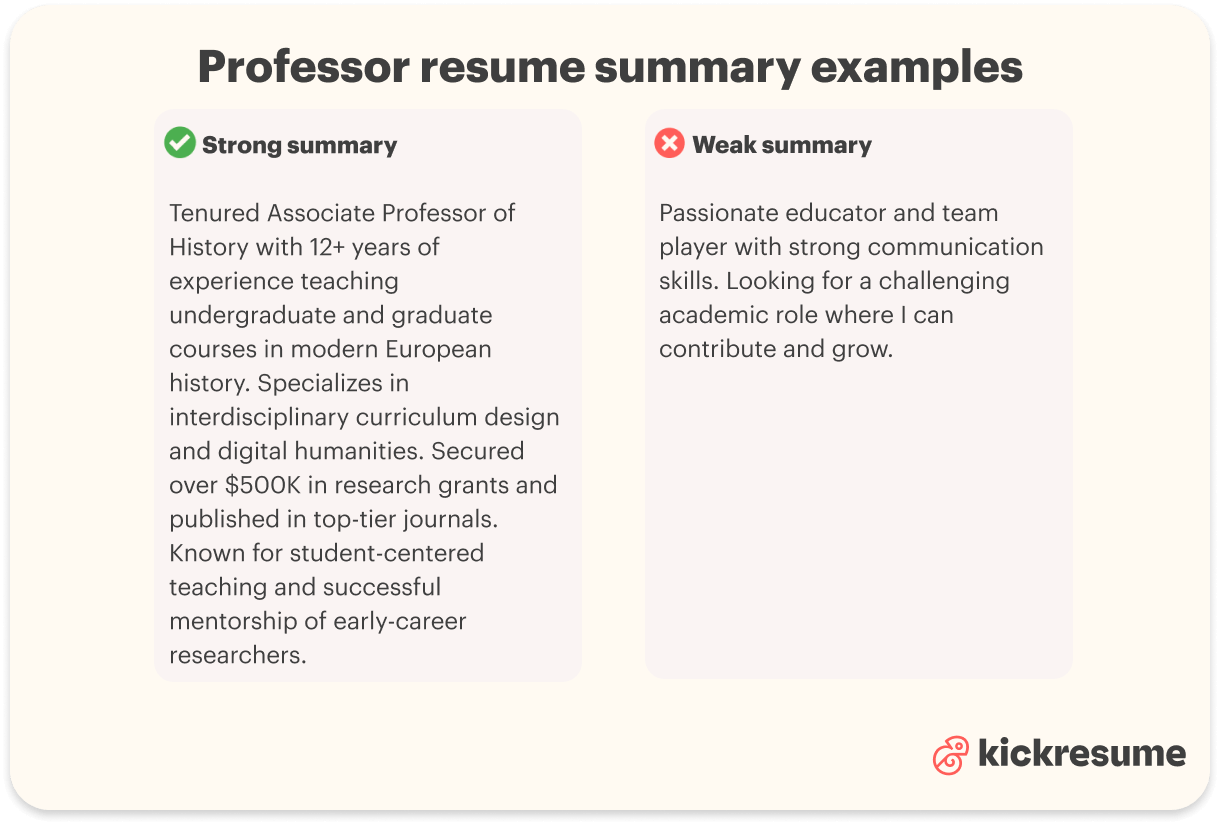
Bad professor resume summary example
Passionate educator and team player with strong communication skills. Looking for a challenging academic role where I can contribute and grow.
Why doesn't this work? It says nothing specific. It could be written by someone in any field, at any level. There’s no subject area, no experience, no unique strengths — just vague buzzwords.
Good professor resume summary example
Tenured Associate Professor of History with 12+ years of experience teaching undergraduate and graduate courses in modern European history. Specializes in interdisciplinary curriculum design and digital humanities. Secured over $500K in research grants and published in top-tier journals. Known for student-centered teaching and successful mentorship of early-career researchers.
What makes this example so much better? It shows depth of experience, mentions areas of focus, and touches on measurable achievements. Anyone reading it can immediately see the value this person brings.
When to use a resume objective
If you're newer to academia or if you’re switching from academia to another field, a resume objective might be a better fit.
Objectives are about potential. They’re forward-looking. Instead of listing past accomplishments, they highlight what you're aiming for, what you bring to the table, and how you hope to grow into the role.
Use an objective if:
- You’re early in your academic career
- You’re changing careers (e.g., into educational consulting or policy)
- You’re returning to work after a break
A good objective still needs to be specific. It should focus on your direction, relevant qualifications, and the value you bring.
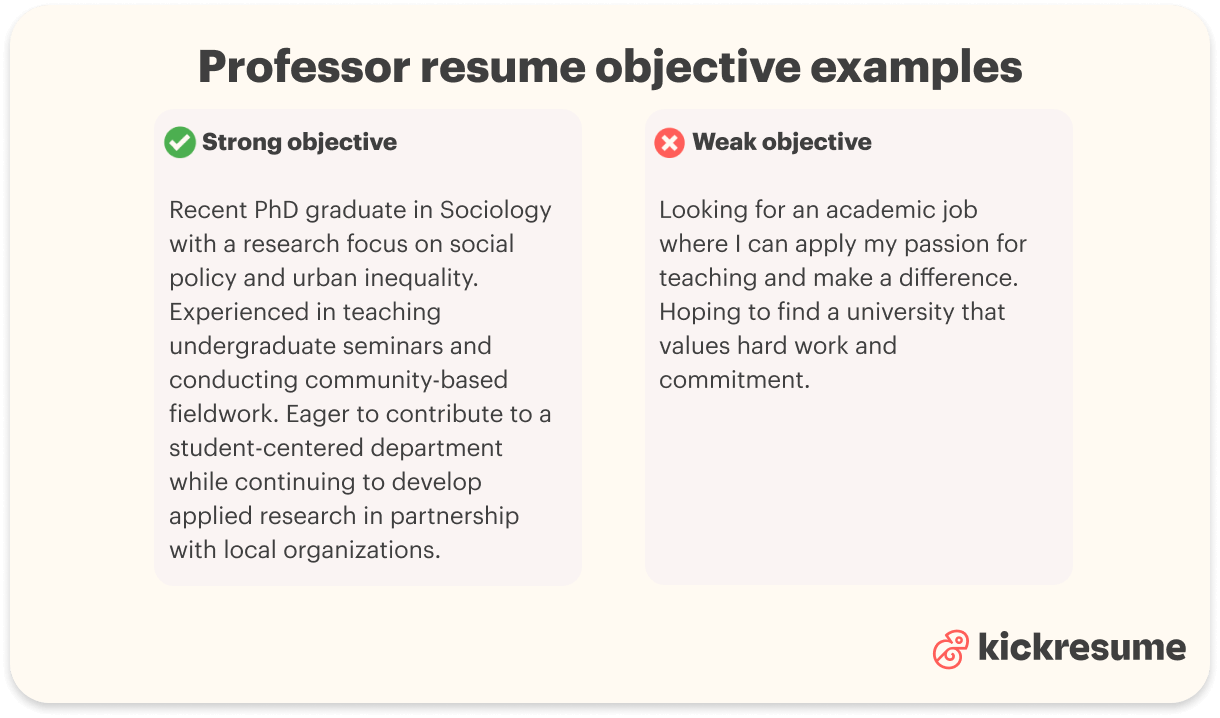
Bad professor resume objective example
Looking for an academic job where I can apply my passion for teaching and make a difference. Hoping to find a university that values hard work and commitment.
Why does this objective fall flat? Because it's vague and generic. There’s no subject area, no qualifications, no clear sense of direction.
Good professor resume objective example
Recent PhD graduate in Sociology with a research focus on social policy and urban inequality. Experienced in teaching undergraduate seminars and conducting community-based fieldwork. Eager to contribute to a student-centered department while continuing to develop applied research in partnership with local organizations.
Why does this sound more convincing? Unlike the previous example, this one is clear, grounded in real experience (even if it’s early-stage), and shows where the candidate wants to go.
Whatever you choose (summary or objective) skip personal pronouns like “I” or “my,” and avoid vague language or overused buzzwords. Say what you do, not how passionate or hardworking you are. Most importantly, mention your field or discipline right away, so the reader knows exactly who they’re dealing with from the first line.
4. Choosing which skills to present on your professor resume
It’s easy to assume your qualifications speak for themselves. But your skills deserve just as much attention.
Why? Because no two academic jobs are exactly alike.
A professor at a research-heavy institution will be evaluated differently than one applying to a teaching-focused college. Some schools want cutting-edge lab skills. Others are looking for classroom leaders who can mentor undergraduates and redesign core curricula. If you try to cover everything you’ve ever done, your resume will end up feeling scattered and unfocused.
That’s why you always need to tailor your resume to each opportunity! Here's how:
- Read the job description.
Many postings list desired skills under sections like “Qualifications”, “Preferred Experience”, or “Duties & Responsibilities.” If something is mentioned more than once (e.g., “undergraduate instruction,” “course development,” or “grant writing”), that’s a clear signal it matters. - Focus on overlap.
Once you’ve pulled out the keywords from the posting, look at your own skill set. What lines up with what the job is asking for? - Pen a dedicated skills section.
Don’t bury your strengths. Create a clearly labeled section called “Skills”, and list the most relevant, job-specific skills near the top.
Of course, demand will vary depending on your specialization and expertise, but some skills are universally relevant across (nearly) all academic fields.
Top 10 in-demand hard skills for professors
- Curriculum design and course development
- Learning management systems (Canvas, Moodle, Blackboard)
- Academic writing and publishing
- Research methodology (quantitative and/or qualitative)
- Grant writing and funding acquisition
- Data analysis tools (SPSS, R, Python, NVivo, etc.)
- Student advising and academic mentoring
- Conference presentation and public speaking
- Assessment and accreditation processes
- Online and hybrid instruction techniques
But being a professor isn’t just about technical knowledge and hard skills. You teach, guide, encourage, challenge, and support your students. You work with colleagues across departments. You help shape the academic culture of your institution. None of that shows up in a list of tools or certifications. That’s why soft skills are just as essentia!
Top 10 in-demand soft skills for professors
- Clear and engaging communication
- Empathy and approachability
- Collaboration and cross-disciplinary teamwork
- Adaptability in teaching methods
- Cultural awareness and inclusivity
- Conflict resolution
- Time and workload management
- Leadership and committee participation
- Mentorship (for students or junior faculty)
- Constructive feedback and student support
Remember that these don’t just belong in your skills section. In fact, the most convincing resumes are the ones where skills are backed up by real examples throughout the document. But we’ll talk more about how to do that in the next chapter.
Find out your resume score!

5. Framing your work history for maximum impact
Between teaching, research, publications, committee work, and administrative duties, there’s a lot you can include in the work experience section.
But here’s the thing: this section shouldn’t just be a chronological list of everything you’ve ever done. It should be a strategically framed narrative that speaks directly to the job you’re applying for.
Consider what to include based on the impact and relevance of your experience:
- Are you applying to a teaching-intensive college? Put your classroom experience and student outcomes up front.
- Is it a research-heavy university? Focus on publications, grants, collaborations, and conference activity.
- Looking at a hybrid role? Balance your bullets between instruction, research, and service.
So what exactly makes a strong work experience entry? Follow this formula:
- Start with your job title and organization
- Add your dates of employment (month + year format is standard)
- Use bullet points to describe your key responsibilities and accomplishments
- Focus on outcomes, not just duties
- Back it up with numbers or metrics whenever possible
- Lead with action verbs (we’ll cover those in an upcoming chapter)
Let’s compare take a look at two examples and see which one works better:
Bad example of a professor resume work history
Assistant Professor of Sociology
Lakeside College, MN
August 2019 – Present
- Taught undergraduate and graduate sociology courses
- Advised students
- Published articles
- Served on committees
- Wrote grant proposals
What’s wrong here? This example doesn’t tell us anything specific about the professor’s teaching style, research focus, or professional contributions. There's no scale, no context, and no results.
Good example of a professor resume work history
Assistant Professor of Sociology
Lakeside College, MN
August 2019 – Present
- Designed and taught 10+ undergraduate and graduate-level courses, including a new capstone seminar on Race and Media
- Supervised 15+ student research projects, with two resulting in co-authored publications in peer-reviewed journals
- Secured a $50K external grant to support community-based participatory research with local advocacy organizations
- Served as department DEI liaison, helping implement inclusive syllabus policies across all core classes
- Co-chaired the curriculum committee that led a successful general education revision in 2022
What makes this example pop? Each bullet is specific, outcome-focused, and aligned with key priorities in higher education — student mentorship, innovative teaching, external funding, and service contributions. It paints a clear picture of a professor who makes an impact across multiple dimensions.
Julia Belak, Certified Professional Résumé Writer, comments:
“When you list your teaching experience, include one bullet per role that quantifies student-outcomes or course innovation — for example: ‘Designed a blended-learning module that increased student pass-rates from 78 % to 90 % in 2023.’ These kinds of specific, measurable statements turn a generic teaching history into evidence of impact.”
Tips for students and newcomers to the profession
If you’re an early-career academic your experience might look a bit lighter. That’s totally fine. Focus on what you have done, and frame it with confidence.
Here’s an example of how to do that:
Good work experience entry example for new professors
Adjunct Instructor, English Department
Mason Valley University (Remote)
January 2023 – Present
- Taught two fully online sections of Academic Writing II, incorporating asynchronous modules and peer-reviewed writing workshops
- Developed scaffolded assignments to improve student critical thinking, reflected in a 20% increase in average essay scores
- Held weekly virtual office hours and maintained a 96% course satisfaction rating from student evaluations
- Collaborated with department lead to revise assessment rubrics for writing-intensive courses
It always pays to read the job description closely and shape your work history around what the employer is actually looking for. The more directly your experience lines up with their needs, the easier it is for them to picture you in the role. That’s what gets you to the next stage.
6. Using action verbs to make your resume more dynamic
There’s one small change that can make a big difference on your resume: starting your bullet points with strong action verbs.
Why?
Because instead of sounding passive or vague, action verbs make you sound as someone who takes initiative, solves problems, and makes things happen.
Just take a look at this before-and-after:
Before:
Was part of a committee that helped improve the first-year student experience.
After:
Co-led a faculty-student committee that introduced a new orientation program, increasing first-year student retention by 12%.
Same experience but the second version gives you a much stronger sense of the person behind it.
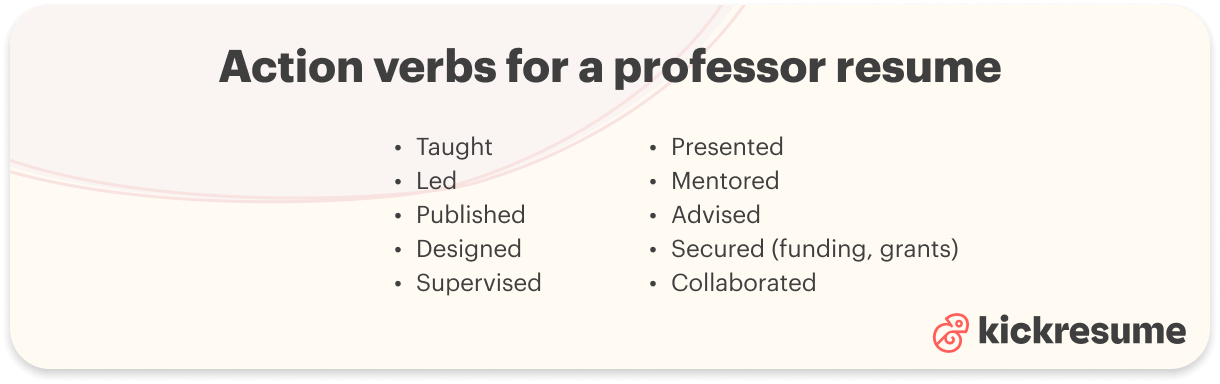
Here are some action verbs that tend to work especially well for academic roles:
Examples of action verbs to use in a professor resume
- Taught
- Led
- Published
- Designed
- Supervised
- Presented
- Mentored
- Advised
- Secured (funding, grants)
- Collaborated
Just be sure to keep things varied. If every bullet starts with “Conducted” or “Assisted,” it gets repetitive fast. Mix it up, and keep the language specific to what you actually achieved.
7. Flashing out your education section as a professor
If you're applying for a role in academia, no one needs convincing that your education section matters. But when it comes to your resume, the question isn’t whether to include your degrees, it’s how much detail they really need.
The answer? It depends on where you are in your career, and how directly your academic background connects to the role in front of you.
Option 1: The succinct version
If you’re an experienced professor applying for a lateral or senior role, there’s no need to unpack your degree in detail. Because your work history and research vouch for your knowledge. In this case, your education section just needs to cover the essentials.
Include:
- Degree name (and academic level)
- Field or discipline
- Institution
- Graduation year (optional but helpful)
Succinct education section example for professors
PhD in English Literature
University of Edinburgh
2014–2018
MPhil in Comparative Literature
University of Oxford
2012–2014
Option 2: The more detailed version
If you're early in your academic career, applying to your first full-time role, or transitioning from a postdoc, your education section may carry more weight.
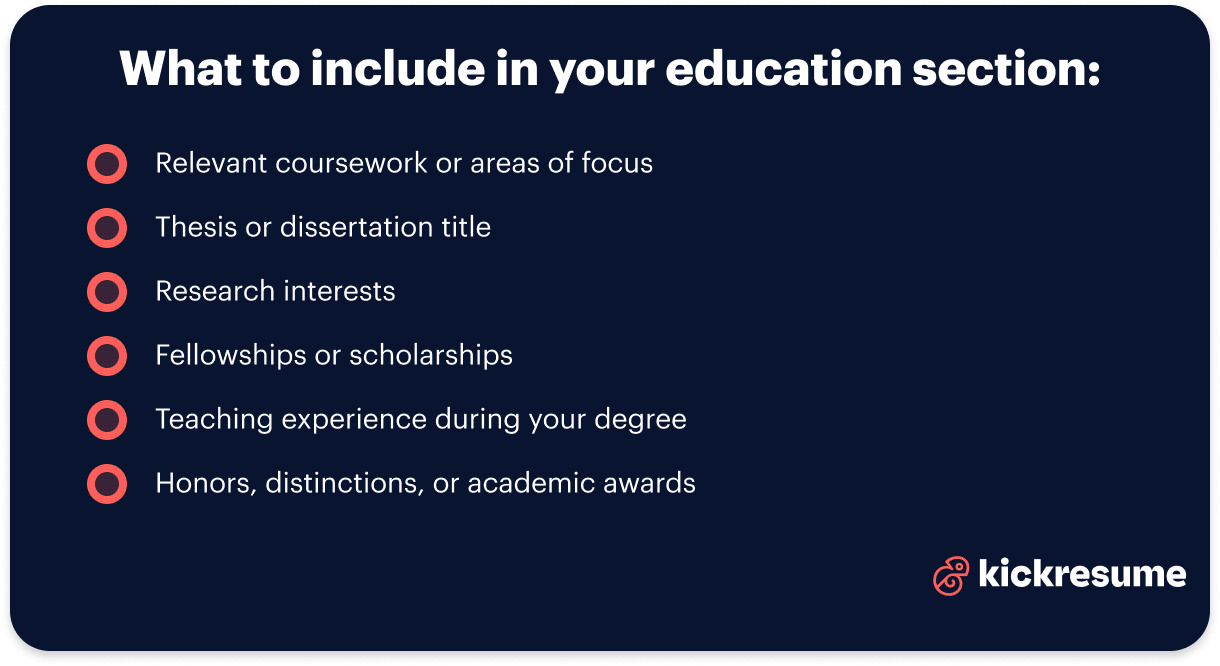
You might include:
- Relevant coursework or areas of focus
- Thesis or dissertation title
- Research interests
- Fellowships or scholarships
- Teaching experience during your degree
- Honors, distinctions, or academic awards
Detailed education section example for professors
PhD in Political Science
University of Michigan
2018–2023
- Dissertation: “Populism and Democratic Backsliding in Central Europe: A Comparative Study”
- Research Focus: Electoral systems, democratic institutions, and EU governance
- Teaching Assistant: Introduction to Political Theory, Comparative Government
- Recipient of the Rackham Predoctoral Fellowship (2022)
- Member, American Political Science Association (APSA)
Your education section showcases the backbone of your expertise. Whether you're just starting out or still in school, this part of your resume shows that you have the knowledge and skills to support your career goals. Make it count!
8. Adding optional sections to your professor resume
Once you’ve got these core sections in place, your resume is technically “done.” But that doesn’t mean it’s finished.
If there’s more you can say that deepens your case as a strong candidate, optional sections are where you do it. These are your chance to highlight accomplishments or credentials that don’t quite fit under the usual headings.
That said, not everything needs to make it onto the page.
When to include optional sections
Add one (or more) when:
- You have relevant experience that doesn’t fall neatly under work history
- There’s still room on the page without making it feel cluttered
- The section adds clear value or reinforces your suitability for the role
Skip them when:
- You’re adding something just to make the resume feel longer
- The content doesn’t clearly tie back to the role or institution
- You’re forcing relevance that isn’t there
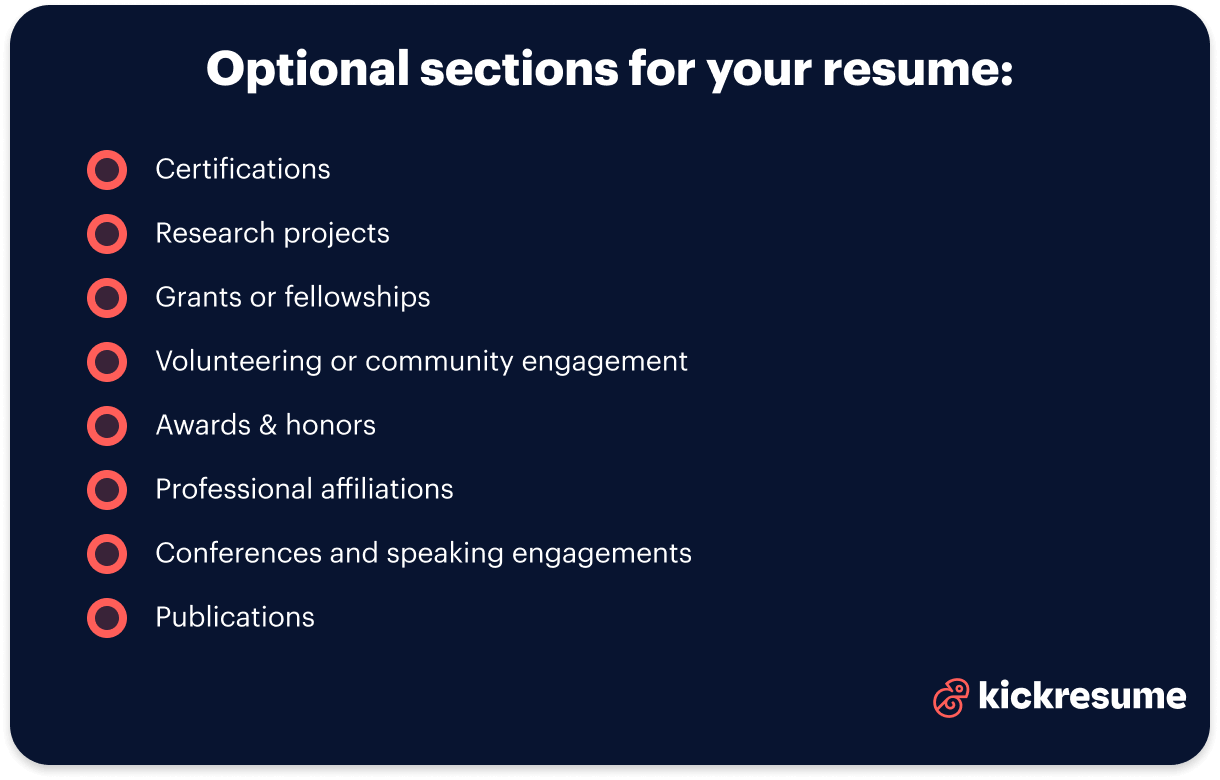
If you're unsure what additional sections to include, here are some possibilities to consider:
- Certifications (especially in pedagogy, technology, or DEI)
- Research projects (outside your main employment or doctoral work)
- Awards and honors
- Grants or fellowships
- Professional affiliations
- Conferences and speaking engagements
- Publications
- Volunteering or community engagement (especially if it’s education-related)
Example of optional sections in a professor resume
Certifications
- Teaching and Learning in Higher Education – Coursera (2023)
- Inclusive Teaching Strategies – edX, University of Michigan (2022)
Awards & Honors
- Excellence in Undergraduate Teaching, College of Arts & Sciences (2021)
- Dean’s Research Fellowship, University of Washington (2018)
Professional Affiliations
- Member, American Philosophical Association
- Member, Society for the Teaching of Psychology
Optional sections aren’t about cramming your resume with every last thing you’ve ever done. If something strengthens your story or rounds out your academic profile, give it a place. If it doesn’t, leave it off. Less can absolutely be more.
9. Steering clear of mistakes that can hurt your application
You’ve put time and thought into your resume, but before you send it off, it’s worth pausing for one last check. Even the most qualified candidates get passed over because of things like awkward formatting, vague language, or details that don’t quite line up with the job.
Let’s go over a few common mistakes so you can catch them early and keep your application as strong as it deserves to be.
- Typos, grammar slips, and unclear writing: Your work as a scholar depends on clarity and your resume should reflect that. Even one typo can raise eyebrows. Proofread out loud. Ask a trusted colleague to give it a once-over.
- Overcrowded layout or confusing formatting: Hiring committees skim first. If your resume is visually overwhelming, dense, or inconsistent, it makes their job harder (and yours, less successful). Stick to a clean layout: clear headings, bullet points over paragraphs, and consistent formatting from top to bottom.
- Treating every application the same: Each role has its own focus (teaching-heavy, research-intensive, interdisciplinary) and your resume should shift accordingly. Use the job ad as a guide to emphasize what matters most for that institution.
- Listing tasks without showing their significance: “Supervised graduate theses” is fine, but what did that mean in practice? How many students? What kind of projects? What outcomes? Focus on the value and results of your work, not just the activity.
- Missing or outdated contact info: It’s surprisingly common! An old email address, a broken link, a missing phone number can creep into your resume unnoticed. Triple-check your contact details and make sure everything is current, professional, and easy to find.
- Leaving out keywords from the job posting: Many institutions use Applicant Tracking Systems (ATS). If your resume doesn’t include keywords from the job ad (like “curriculum development,” “qualitative research,” or “interdisciplinary teaching”), your materials might not even reach human eyes.
- Padding the page with outdated or irrelevant info: That summer internship from 2009? Probably not helping your case anymore. Focus on what’s relevant now — work that connects to the kind of professor they’re looking for today. Less is more when every line has purpose.
Julia Belak, Certified Professional Résumé Writer, comments:
“Even academic institutions now use applicant tracking systems (ATS). To make it through, don't make the mistake of not tailoring your resume to each posting: mirror the exact terminology in the job description — for example, ‘curriculum development’ instead of ‘course design’ if that’s the phrase they use. This ensures your application is not filtered out before a human ever sees it.”
Before you submit, take one more look. Trim the excess, tighten up the details, and make sure everything you’ve included strengthens your case as capable and reliable. That extra five minutes of editing could be what gets you the interview.
10. Making your cover letter match your resume
A well-crafted resume is essential. But if you really want to show who you are as a scholar, a teacher, or a colleague, a professor cover letter is where you get to speak in your own voice.
Yes, some job ads say that a cover letter is optional. But especially in academia, it’s often one of the first things committees read. And when it’s done well, it can do a lot of heavy lifting: adding context, filling in the gaps, and showing a genuine interest in the role and institution.
What a good cover letter should answer:
- Who are you as a scholar or educator?
- Why this department, at this institution?
- How does your background align with the role?
- What do you bring to the table and why does it matter?
And no, your cover letter doesn’t need to be long. A few focused paragraphs will do the trick, especially if they’re thoughtful, tailored, and free of jargon.
Resume vs. cover letter: what are the differences?
While your resume is structured, bullet-based, and factual, your cover letter is narrative, flowing, and contextual.
Let’s say your resume states:
- Supervised five MA students and co-organized an interdisciplinary research workshop with international speakers.
Your cover letter might expand:
Beyond my teaching and research, I’ve found real fulfillment in mentoring emerging scholars. Supervising MA theses has given me insight into how students shape, and are shaped by, collaborative research environments. That’s also what inspired me to co-organize a cross-departmental workshop last spring, focused on building intellectual bridges across disciplines.
That’s the kind of nuance a cover letter gives you room to explore!
Keep things visually consistent
Your cover letter and resume don’t have to be identical twins, but they should at least look like they’re part of the same family. Here’s how to keep things consistent:
- Same header: Use the same layout for your name and contact info.
- Same fonts: Stick with one typeface throughout both documents.
- Matching layout and spacing: Align your margins, line spacing, and paragraph breaks.
- Same design style: If you’ve used bold colors or section dividers in your resume, lightly echo them in your cover letter.
The truth is, most people won’t bother sending a cover letter. So when you do, it immediately sets you apart. It doesn’t have to be long or formal. Just pen something relevant, tailored, and full of personality. Sometimes, that little extra effort is exactly what gets you in the door.
Let your cover letter write itself — with AI!

11. Top resources for job-seeking professors
Entering the academic job market can be as challenging as unraveling quantum physics. But don't worry, just as in your ever-elusive search for answers, there are resources to aid you on your job-seeking journey. Here are our top picks:
- Academic job boards: Stretch your job hunt beyond generic job sites. Target specific academic job boards like HigherEdJobs and Academic Positions. Who knows which university is keen to absorb your expertise right now?
- LinkedIn networking: Ever heard of networking? Of course, you have. And, LinkedIn is your digital conduit to it. Engage with colleagues, join groups, reach out to universities.
- Office of career development: Your current institution's career development office can be a gold mine. Reach out and explore their resources for academics looking to expand or transition.
- Resume templates and samples: A well-crafted professor resume can open doors. Hunt for top-notch examples and templates to guide you. Don’t be surprised when they’re less mystical than you might think.
- Professional associations: Associations like Modern Language Association and American Historical Association provide plenty of resources, job listings, and networking opportunities. Getting involved has never been so rewarding.
Remember to portray not just what you've done, but how you've made an impact. Now that's some career advice you can bank on. Will your class discuss it tomorrow? Maybe not. Will it help you land that dream job? Absolutely.
Education Career Outlook in 2026
Jobs in Education are expected to grow at a slower rate compared to the average for all occupations between now and 2034.
Nevertheless, an estimated 890,300 openings in Education are projected annually over this decade, largely driven by the need to replace individuals who change careers or leave the workforce, including those retiring. (Source: U.S. Bureau of Labor Statistics)
According to a report by the Center for Democracy & Technology, a large number of students already use AI, and teachers are starting to adopt it too.
Even so, AI is still far from replacing educators and mostly supports admin work, leaving teaching, mentoring, and critical thinking firmly human.
Average US base salaries across popular Education roles:
- Instructor: $37,012/year
- Associate Professor: $100,696/year
- School Counsellor: $64,191/year
- Special Education Teacher: $100,697/year
- Teacher: $43,281/year
- Teaching Assistant: $39,247/year
- Tutor: $55,139/year
- Youth Advisor: $41,756/year
These salary estimates come from Indeed (as of January 2026), and are based on anonymous submissions from workers, along with salary data from job postings on the platform over the last 36 months. Exact figures vary by location, company size, and experience level.
While the growth of education roles is expected to be slower than average, the steady demand for replacement workers ensures there will still be plenty of opportunities within the field.
Professor Resume FAQ
What should be included in a professor resume?
Your professor resume should include your contact information, a focused summary statement, areas of expertise, education credentials, positions held, published works, awards and honors, and professional associations. Also consider including any relevant courses taught, research interests, or community service.
Can I include non-academic work experience in my professor resume?
If the non-academic work experience contributes to your skills as a professor or is relevant to the position you're targeting, it's worth mentioning. Showcase how these skills can be transferred to an academic setting.
How long should a professor resume be?
Given the depth of experience most professors have, a two-page resume is acceptable. For those with extensive publications, a separate CV may be used to detail them, with a brief mention and reference on the resume.
Should I tailor my resume for each job application?
Absolutely. Every job description is different and tailoring your resume to each role shows you're genuinely interested. Customizing your resume allows you to highlight the most relevant skills and experiences for each specific post.
How can I make my professor resume stand out?
Highlight your achievements, not just responsibilities. Use quantifying figures when possible, to show your success in teaching, mentoring, or conducting research. Also, a well-formatted, neat, and error-free resume always stands out.


![How to Write a Professional Resume Summary? [+Examples]](https://d2xe0iugdha6pz.cloudfront.net/article-small-images/How_to_Write_a_Professional_Resume_Summary_.png)
![How to List Your Education on a Resume? [+Examples]](https://d2xe0iugdha6pz.cloudfront.net/article-small-images/How_to_Put_Education_on_a_Resume_.png)
![How to Describe Your Work Experience on a Resume? [+Examples]](https://d2xe0iugdha6pz.cloudfront.net/article-small-images/How_to_Describe_Your_Work_Experience_on_a_Resume_.png)