ChatGPT
 Perplexity AI
 Claude
A strong pharmacy resume sample can show you exactly how to turn your day-to-day work in a pharmacy setting into a job-winning application. Whether you’re an intern, pharmacy technician, or experienced pharmacist, this guide is packed with practical tips, examples, samples, and templates to help you write a resume that highlights both your technical accuracy and patient care skills.
Just like ensuring each prescription is filled correctly, building a great pharmacy resume is all about precision and attention to detail. Throughout this guide, you’ll learn how to showcase your clinical knowledge, workflow experience, pharmacy software skills, and how to format everything so hiring managers and Applicant Tracking Systems (ATS) understand your value in seconds.


 See more examples like these
In this guide, you’ll find:
- Resume dos and don’ts based on real pharmacy resume samples
- How to choose the right resume format for a pharmacy or healthcare environment
- How to write a professional pharmacy resume summary
- How to format your pharmacy resume and keep it ATS-friendly
- Which pharmacy-specific technical and soft skills to highlight
- How to present your work experience
- How to format your education section properly
- Which optional sections are useful for a pharmacy resume
- Which action verbs work best for pharmacy roles
- Common resume mistakes for pharmacy roles (and how to avoid them)
- How to create a complementary cover letter for your pharmacy resume
- Salary expectations and job outlook for pharmacy professionals
- Where to find useful resources, job boards, and templates for pharmacy job-seeking
Still job searching? Kickresume can help you build a professional pharmacy resume and find everything you need to get hired faster.
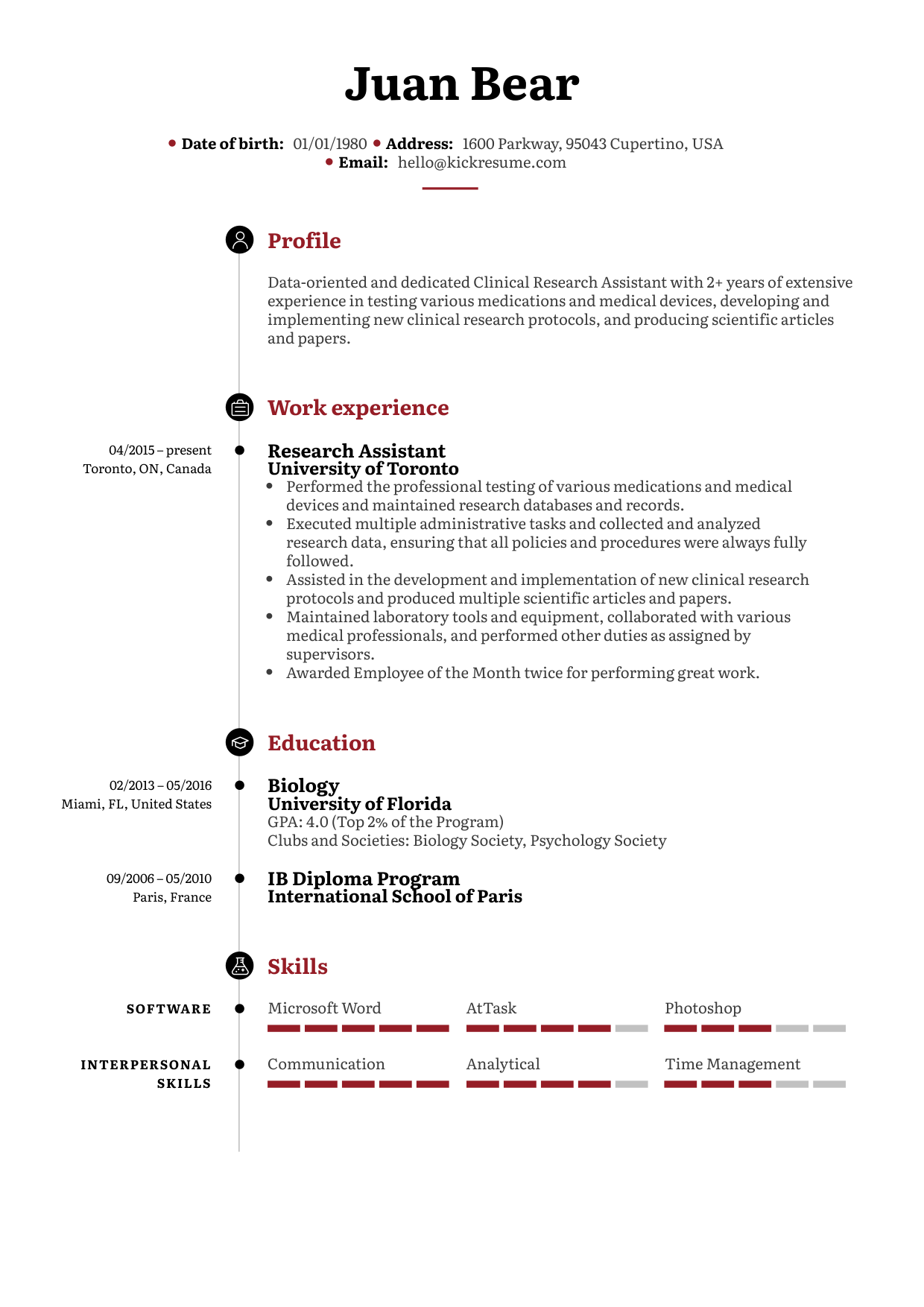
Pharmacy intern resume sample


Why does this resume example work?
- Strong early exposure to real pharmacy work: Even at the internship level, this resume highlights hands-on responsibilities relevant to a pharmacy environment, such as assisting with prescriptions, supporting pharmacists during dispensing, and interacting with patients. That signals practical readiness rather than just academic interest.
- Good alignment between education and work experience: The candidate makes a clear connection between pharmacy coursework and on-the-job learning. For junior roles, employers are looking for potential, and this resume conveys that the candidate is actively applying theory in a real setting.
- Clean, beginner-friendly structure: Short bullet points, orderly sections, and clear labeling (Education, Skills, Experience) make this resume easy to skim. Intern resumes benefit from simplicity, especially when screening volume is high.
What could be improved?
- Lack of measurable outcomes: Even as an intern, it’s possible to quantify impact — e.g. prescriptions processed per shift, wait times assisted with, inventory accuracy, or data-entry turnaround. Small numbers can make a junior candidate stand out more.
- Soft skills could be more explicit: Pharmacies rely heavily on communication, attention to detail, empathy, and customer interaction. Highlighting these more clearly, especially in a Skills section, would round out the profile.
Pharmacist resume sample

Why does this resume example work?
- Clear demonstration of professional accountability: Unlike the intern sample, this resume reflects full-scope pharmacist duties, such as verifying prescriptions, counseling patients, coordinating with healthcare providers, and ensuring compliance. Employers want proof that the candidate can operate independently and safely, and that’s shown here.
- Balanced technical + patient-facing competencies: The resume successfully blends pharmacological knowledge (medication interactions, dosing, treatment plans) with clinical communication (patient education, counseling). That balance is essential in modern pharmacy roles, which are often highly customer-facing.
- Shows maturity in pharmacy work: This resume communicates confidence and professional identity. The candidate isn’t presenting themselves as “learning the field,” but as someone already operating in it.
What could be improved?
- Could show more business and operational impact: Contemporary pharmacists often influence pharmacy performance metrics, such as medication adherence, counseling interventions, insurance claim resolution, or MTM (Medication Therapy Management). Adding even one or two KPIs would give employers clearer insight into performance.
- More emphasis on cross-functional collaboration: Many pharmacies work alongside physicians, nurses, insurers, and specialty providers. A bullet point illustrating collaboration could signal a broader professional scope.
Specialty pharmacy technician resume sample

Why does this resume example work?
- Specialization is communicated immediately: The resume makes it obvious this isn’t a generic retail pharmacy technician role. Specialty areas (insurance coordination, complex therapies, authorization processes, patient follow-ups) differentiate the candidate and position them for higher-level technician jobs.
- Highlights process-based responsibilities, not just tasks: Instead of simply listing duties, the resume shows workflows — approvals, documentation, refill coordination, or specialty therapy support. This demonstrates ownership and understanding of pharmacy operations at scale.
- Senior-level clarity and independence: The resume reads like someone who manages their workload autonomously rather than waiting for direction. Hiring managers rely on this heavily for advanced technician roles.
What could be improved?
- More specificity in specialty terminology: Senior techs often work with biologics, injectables, oncology drugs, immunotherapy, or limited-distribution medications. Calling out even one therapeutic area would strengthen positioning.
- Room for measurable indicators: Metrics like authorization turnaround times, compliance rates, patient adherence improvements, or refill coordination efficiency would reinforce the “specialty” aspect with concrete results.
1. Picking the right resume format as a pharmacy professional
Before you start writing your resume, you’ll need to decide which format best highlights your background. Each resume format emphasizes different strengths, and the right choice depends on your level of experience, your specialty, and the type of pharmacy environment you’re targeting.
Here are the three most common formats and how they work in pharmacy:
Reverse-chronological resume (traditional resume)
This format puts your most recent role first and showcases your career progression over time. Reverse-chronological format is the most common resume format in healthcare and is especially strong if you’ve held roles such as:
- Pharmacy Intern -> Pharmacy Technician -> Pharmacist
- Retail Pharmacist -> Staff Pharmacist -> Clinical Pharmacist
- Pharmacist -> Senior Pharmacist -> Pharmacy Supervisor
Use this format if you want hiring managers to immediately see your clinical or operational growth, certifications, and responsibilities.
Functional resume (skills-based resume)
The functional format focuses on skills, certifications, and clinical competencies rather than job titles. It can work well if:
- You’re transitioning from retail to hospital or specialty pharmacy
- Your work history includes gaps or short-term roles
- You’re changing careers into pharmacy with relevant training or education
This format highlights abilities such as medication dispensing, sterile compounding, patient counseling, immunization, insurance processing, or regulatory compliance, even if your job titles don’t tell the full story yet.
Hybrid resume (combination resume)
The hybrid format blends both approaches: skills at the top, followed by clear work history. It’s often ideal for pharmacy professionals who want to emphasize a mix of:
- Certifications (CPhT, CSPT, immunization, sterile compounding)
- Clinical experience or specialized rotations
- Technical systems (Pyxis, Epic, ScriptPro, PioneerRx, insurance billing)
- Operational accomplishments (inventory, workflow, accuracy, patient satisfaction)
Hiring managers in healthcare settings often favor this format because it’s both ATS-friendly and easy to scan.
Matching resume format to pharmacy experience levels
Here’s how to choose the right format depending on where you're in your pharmacy career:
- Pharmacy interns / entry-level pharmacy techs: Functional or hybrid formats help spotlight coursework, clinical rotations, certifications (CPhT), and technical skills when work history is minimal.
- Pharmacy technicians (mid-level): Hybrid or reverse-chronological formats work well to emphasize medication preparation, distribution accuracy, system workflows, insurance billing, and patient-facing tasks.
- Pharmacists (staff / clinical / retail): Reverse-chronological is usually strongest, especially if you want to highlight achievements such as immunization volume, medication therapy management (MTM), accuracy metrics, formulary compliance, or interdisciplinary collaboration.
- Senior pharmacists / supervisors / specialty roles: Reverse-chronological or hybrid formats are best for showcasing leadership, cross-department collaboration, specialty expertise (oncology, infusion, compounding, ambulatory care), and clinical outcomes.
Pro tip
If a company requests a reverse-chronological resume, you should submit it in this format even if you're a student or intern. The reverse-chronological formatting is also typically the most ATS-friendly option, which makes it a safe choice in cases where the posting doesn’t specify a preferred structure.
Try our AI Resume Writer and have your resume ready in minutes!

2. Writing an engaging resume summary as a pharmacy technician
Your resume summary is the first impression and introduction of you that an employer gets. As such, your resume summary needs to highlight your strengths and experience as a pharmacy technician.
Bad pharmacy technician resume summary example
Pharmacy Technician who recently completed an accredited training program. Worked in an internship position for 6 months working directly with pharmacists and learning the daily tasks within the pharmacy.
What's wrong with this example? This resume summary is too passive and non-specific. The applicant clearly lacks experience, and is trying to work around this by talking about completing training and an internship. However, this would be far more effective if they provided more specific examples and qualifications.
Good pharmacy technician resume summary example
Recently certified Pharmacy Technician seeking an entry-level opportunity to expand skills and grow a professional network. Interned for six months at Meadowview Pharmacy alongside experienced pharmacists to help dispense medications, prepare labels, and communicate with customers.
Why is this better?
This example is much more active and introductory, letting the employer know right off the bat that the candidate is only recently certified, but is driven and ready to learn. The more specific details about the internship show that the applicant has experience working within a pharmacy environment and alongside other pharmacists.
3. Formatting your pharmacy resume (and keeping it ATS-friendly)
Picking the right resume format is only half of the work. Even a highly qualified pharmacist or pharmacy technician can lose interviews if the resume is difficult to scan or incompatible with Applicant Tracking Systems (ATS).
Most hospitals, specialty pharmacies, retail chains, and PBM organizations use ATS tools to filter applicants before a recruiter even opens the file. That’s why your document needs to look clean to both humans and software.
Basic formatting rules for pharmacy resumes
To keep your resume professional, readable, and ATS-safe, stick to the following guidelines:
- Use a simple one-column layout: Multi-column templates, tables, text boxes, images, and graphics often break when parsed by ATS software.
- Pick a clean and readable font: Good options include Calibri, Arial, Helvetica, or Times New Roman. Decorative fonts may look stylish but hurt clarity.
- Keep font sizes consistent: Use 10.5–12 pt for body text and 14–16 pt for section headings so pharmacists and HR teams can skim quickly.
- Use standard section titles ATS can recognize: Avoid creative labels. Stick to familiar ones such as: Work Experience, Skills, Education, Certifications, Additional Information
- Use bullet points, not large paragraphs: Bullets make it easier for ATS tools to parse responsibilities and achievements.
- Submit PDF or DOCX files: These formats tend to parse best. If a job posting requires one specifically, always follow instructions.
How to optimize a pharmacy resume for ATS scanners
ATS systems scan for keywords, job titles, and specialized terminology that appear in the posting.
To improve your match rate:
- Mirror keywords from the job description naturally: If the role mentions “sterile compounding,” “prior authorization,” or “patient counseling,” use those same terms (only if accurate to your experience).
- Include pharmacy-specific terminology and systems: Depending on the setting (hospital, retail, specialty, long-term care), useful keywords may include:
Useful pharmacy-specific keywords
- Dispensing
- Medication verification
- Compounding (sterile / non-sterile)
- EMR / EHR systems
- Patient counseling
- Prior authorization
- Insurance & billing
- Inventory management
- Controlled substances
- Cold chain handling
- Medication therapy management (MTM)
- Immunization
- Pyxis / Omnicell
- Avoid graphics, icons, rating bars, or skill sliders: ATS software often misreads or ignores them entirely.
- Don’t hide keywords or “stuff” them: Tricks like white text or keyword dumps can flag the resume as low quality and get it filtered out.
A pharmacy-specific ATS tip applicants often overlook
Many ATS databases allow recruiters to search by job title.
If your official title is uncommon or internal (e.g., “Medication Liaison Associate”), consider adding a standardized equivalent in parentheses:
Standardized pharmacy job title examples
- Medication Liaison Associate -> Pharmacy Technician
- Clinical Support Coordinator -> Pharmacy Technician / Billing & Authorization
But remember - Always use the same job title as the job posting states.
This helps ATS tools categorize your experience and makes it easier for hiring managers to see your level immediately.
Use ATS-friendly templates to save time
Formatting a pharmacy resume manually can be tedious, especially when juggling EMR systems, technical skills, certifications, and pharmacy acronyms. ATS-friendly resume templates solve that problem by offering clean structure, proper headings, and smart spacing out of the box.
Kickresume’s resume templates are optimized for ATS parsing while still looking polished to pharmacy hiring teams in retail, hospital, specialty, and clinical environments.
4. Choosing skills that are highly relevant to pharmacy tech
Pharmacy technicians must possess a wide range of skills, as the job involves both very technical aspects as well as highly interpersonal interactions. Dealing with medications and potentially ill or upset patients requires pharmacy techs to keep a level head and clear focus to keep everything calm and organized.
With this in mind, it's essential to include both technical and interpersonal skills on your resume when applying for a job as a pharmacy technician.
Best hard skills to include on your pharmacy technician resume
- Mathematics
- Computer skills
- Dispensing medications
- Preparing labels
- Processing prescription requests
- Managing patient records
- Inventory management
- Prescription data entry
- Proper storage of medications
- Brand vs. Generic knowledge
Effective soft skills for your pharmacy technician resume
- Active listening
- Reading comprehension
- Organization
- Attention to detail
- Verbal communication
- Conflict management
- Patient education
- Teamwork
- Task prioritization
- Time management
Find out your resume score!

5. Writing a compelling pharmacy technician work experience section
Your work experience is the place to let your qualification and accomplishments shine.
In the descriptions of your work experience entries, it's important to include highly specific information and quantifiable facts or data when possible. This makes your work experience more compelling, as well as allowing you to highlight your strengths and capabilities.
Pharmacy technician work experience resume example
Pharmacy Technician | CVS
Boston, MA | June 2017 to October 2021
- Prepared prescription labels and filled prescriptions accordingly.
- Implemented a new pre-packaging process for commonly distributed medications that resulted in a 35% increase in order completion speed.
- Directly assisted and communicated with 100 customers per day on average, including handling customer conflicts, inquiries, and complaints.


 See more examples like these
6. Including the correct education information
As a pharmacy technician, you're not required to attend a formal four-year university to earn your credentials. In most places, the main requirement is the completion of a certification training program in order to qualify for employment.
No matter what route you took to become a pharmacy technician, you should include information about your highest level of training or education. In many cases, this may result best if you separate your licenses and certifications from your education. Here's how to properly list your education:
Education section for a pharmacy technician resume example
Licenses & Certifications
Massachusetts Pharmacy Technician License – Expires 2022
Education
East View High School | Boston, MA
Graduated 2018 | GPA: 3.9
7. Picking relevant optional sections for a pharmacy resume
Once you’ve nailed the essentials (summary, skills, work experience, education, and licenses), you can decide whether to add optional sections to strengthen your application.
These sections can help you stand out, but only if they add meaningful context to your pharmacy background.
Add optional sections if:
- You have certifications, clinical training, or continuing education relevant to pharmacy practice.
- You’ve completed specialized rotations, residencies, or internships.
- You’ve worked with pharmacy software, dispensing systems, or patient care tools worth highlighting.
- You’ve earned awards or recognitions for performance, accuracy, or patient service.
Skip optional sections if:
- They exist only to fill space.
- They’re outdated or unrelated to pharmacy or healthcare.
- They distract from your strongest qualifications.
Useful optional sections for a pharmacy resume
1. Certifications & licenses
Certifications can be a major differentiator in pharmacy roles, especially when tied to safety, regulatory compliance, and medication handling.
Examples worth listing:
- PTCB Certified Pharmacy Technician (CPhT)
- NHA Certified Pharmacy Technician (ExCPT)
- Registered Pharmacy Technician (State-Level)
- Pharmacy Intern License
- Immunization Certification
- Sterile Compounding / USP <797> Training
- Controlled Substances Handling Certification
- Medication Therapy Management (MTM) Training
- CPR / Basic Life Support (BLS)
For pharmacists, this can also include:
- PharmD
- PGY-1 / PGY-2 Residency
- Board Certifications (BCPS, BCACP, BCOP, etc.)
2. Clinical rotations / internships
Appropriate especially for pharmacy students, interns, or recent graduates.
Examples:
- Hospital rotation (oncology, emergency, ICU)
- Community pharmacy rotation
- Ambulatory care rotation
- Specialty pharmacy rotation
These sections show real-world exposure beyond coursework.
3. Awards & achievements
Pharmacy environments value precision, patient service, and teamwork. Therefore, recognition matters. So feel free to include your awards and achievements.
Examples:
- “Technician of the Month” or performance-based awards
- Accuracy awards or recognition for error-free dispensing
- Customer service or patient satisfaction awards
- Academic distinction or dean’s list (for students or new grads)
4. Tools & systems
Pharmacy roles rely heavily on dispensing software, inventory systems, and patient record platforms.
Common tools include:
- Pyxis / Omnicell dispensing systems
- PioneerRx
- McKesson EnterpriseRX
- ScriptPro
- Cerner / Epic (EHR/EMR)
- Mediware
- CVS RxConnect
- Walgreens Intercom Plus
- Insurance verification & billing systems (e.g., NCPDP workflows)
Listing these increases your credibility immediately, especially in fast-paced settings.
5. Professional affiliations
Especially relevant for pharmacists and career-minded technicians.
Examples:
- American Pharmacists Association (APhA)
- American Society of Health-System Pharmacists (ASHP)
- National Pharmacy Technician Association (NPTA)
- State pharmacy associations
- Student organizations (e.g. APhA-ASP)
6. Volunteer or community service
This section can support soft skills and patient-care orientation.
Examples:
- Health fairs
- Medication take-back events
- Vaccination clinics
- Community education programs
Example of optional sections on a pharmacy resume
Certifications
Examples of certifications for pharmacy roles
- PTCB Certified Pharmacy Technician (CPhT), 2024
- Sterile Compounding / USP <797> Training, 2023
- CPR & Basic Life Support (BLS), 2023
Tools & systems
Examples of tools and systems for pharmacy roles
- PioneerRx
- Pyxis
- RxConnect
- Epic EMR
- ScriptPro
Professional affiliations
Examples of professional affiliations for pharmacy roles
- National Pharmacy Technician Association (NPTA)
- American Pharmacists Association (APhA)
Use optional sections strategically. A few well-chosen additions can make your pharmacy resume stronger, without cluttering it or distracting from core qualifications.
.png)
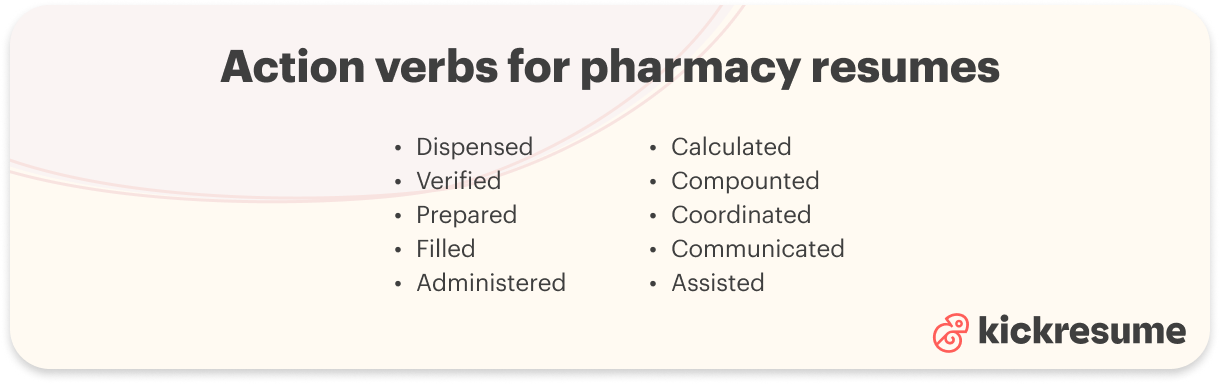
8. Choosing pharmacy-focused action verbs for stronger bullet points
Action verbs are small words with a surprisingly big impact. They turn passive job duties into clear achievements, marking the difference between sounding like you “were present” at work and sounding like you actually made things happen.
Compare:
Responsible for dispensing medications
vs.
Dispensed and verified prescriptions with 99% accuracy, ensuring patient safety and regulatory compliance
Same job. Very different level of confidence and professionalism.
Action verbs that work especially well in pharmacy resumes
- Dispensed
- Verified
- Prepared
- Filled
- Administered
- Calculated
- Compounded
- Coordinated
- Communicated
- Assisted
- Documented
- Processed
- Educated
- Collaborated
- Calibrated
- Stocked
- Resolved
- Implemented
- Updated
- Supported
Pharmacy roles (technician or pharmacist) often require precision, regulatory awareness, patient communication, and workflow support...and the best verbs reflect that.
Before → After improvements
Before including action verbs
- Was in charge of filling prescriptions
- Helped maintain pharmacy inventory
- Talked to customers about medications
After including pharmacy-specific action verbs
- Dispensed and verified 150+ daily prescriptions with high accuracy and adherence to safety regulations
- Managed inventory reconciliation and automated ordering, reducing stock discrepancies by 12%
- Educated patients on proper medication usage, dosing, and contraindications in collaboration with the pharmacist
Why this matters
Even though the tasks didn’t change, the second version sounds more proactive, more measurable, and more aligned with healthcare expectations. Before finalizing your resume, scan for weak phrases such as:
- “Responsible for…”
- “Helped with…”
- “Was in charge of…”
Replacing them with pharmacy-specific action verbs instantly makes your resume sharper, more credible, and more competitive, especially in settings where accuracy and communication are essential (hospital, retail, specialty, clinical, or long-term care).
9. Avoiding pharmacy resume mistakes
You’ve put in the hard work by completing coursework, clinical rotations, certifications, and gaining real pharmacy experience. It would be shame if you let preventable resume mistakes undermine all of that now.
Here are the most common pitfalls pharmacy applicants run into (and how to avoid them):
- Typos & accuracy issues: In a pharmacy setting, accuracy is everything. Even small spelling or grammar mistakes can raise doubts about attention to detail, which is a major red flag in a field that deals with patient safety, dosage calculations, and regulatory compliance. If you want to be extra sure, consider using professional proofreading or editing services.
- Messy or complicated formatting: Dense paragraphs, unusual fonts, inconsistent spacing, or decorative layouts make your resume harder to read. Use clear headings, bullet points, and a clean structure so hiring managers can spot your qualifications, certifications, and skills instantly.
- One generic resume for every job posting: Retail, hospital, specialty, long-term care, and outpatient settings all look for slightly different skills. Tailoring your resume to the posting by reflecting relevant terminology and responsibilities. This increases your chances of making it past both ATS screening and human review.
- Listing duties without demonstrating impact: “Filled prescriptions” or “Assisted patients” sounds generic. Instead, highlight outcomes, accuracy, workflows, or patient satisfaction when possible.
- Not quantifying when you could: Pharmacy work is full of measurable data points — prescription volume, error reduction, inventory reconciliation, turnaround time, prior auth approvals, billing accuracy, etc. Numbers strengthen credibility and give context.
- Ignoring soft skills that matter in healthcare: Communication, empathy, conflict resolution, teamwork, and patient education are all vital in pharmacy roles, especially patient-facing positions. Don’t focus solely on technical skills.
- Outdated or unprofessional contact information: Make sure your phone, email, and LinkedIn are current and professional. A single typo can block a recruiter from contacting you.
- Keyword gaps for ATS systems: If the job description mentions “sterile compounding,” “prior authorization,” “Pyxis/Omnicell,” or “patient counseling,” and your resume doesn’t, ATS may filter you out.
- Crowding the resume with irrelevant information: Unrelated hobbies, decades-old part-time jobs, or non-transferable experience can dilute your key strengths. Stick to information that supports pharmacy or healthcare competencies.
Before submitting, do one final scan with these pitfalls in mind. A few quick edits can make your pharmacy resume look far more polished, credible, and aligned with the expectations of modern healthcare employers.
10. Creating a complementary pharmacy cover letter that matches your resume
Your resume shows what you’ve done.
Your cover letter shows how you did it and why that matters in a healthcare environment.
While a pharmacy resume leans on bullet points, workflows, and accuracy, the cover letter gives you space to:
- Explain your approach to patient care
- Highlight your communication style with patients and providers
- Show your motivation for this particular pharmacy, hospital, or healthcare system
- Clarify your clinical interests or specializations (retail, clinical, specialty, long-term care, etc.)
What should your pharmacy cover letter accomplish?
A strong pharmacy cover letter should answer:
- Who are you as a pharmacy professional?
- Why are you interested in this specific employer or healthcare setting?
- What clinical or workflow results have you achieved before (with 1–2 specific examples)?
- How will you support patient safety, efficiency, and teamwork on their pharmacy team?
Instead of repeating your resume bullet points, use the cover letter to provide context and narrative.
Example upgrade:
Good example of a pharmacy cover letter paragraph
At my current retail pharmacy, I counsel an average of 40–60 patients per shift on medication usage and contraindications, helping decrease repeat clarification calls and improve refill adherence. I’d welcome the opportunity to apply this patient-centered approach within your hospital setting, where interdisciplinary collaboration plays an even greater role.
How a cover letter differs from a resume (especially in healthcare)
A resume is structured, concise, built around bullet points, metrics, and regulatory responsibilities.
A cover letter usually consists of 4–6 short paragraphs that explain your motivation, values, communication style, and fit for the role.
Your resume proves you can do the job.
Your cover letter proves you want this job, at this specific pharmacy, hospital, or healthcare organization.
Make your resume and cover letter look like a cohesive set
Visual consistency may seem like a superficial thing, but in healthcare environments it signals professionalism and attention to detail, which are two traits pharmacy directors never overlook.
To match your documents:
- Use the same contact header on both
- Keep fonts and formatting consistent
- Align spacing and section layout
- Mirror any subtle accent colors
- Use paired templates when available
Kickresume’s resume templates also come with matching cover letter templates, making it easy to submit an application that looks polished and intentional.
Create your cover letter fast with artificial intelligence.

11. What to expect in terms of salary and job outlook in pharmacy
Pharmacy roles remain essential in healthcare, from community pharmacies to hospitals, long-term care, and specialty settings. While automation and digital tools influence many industries, pharmacists and pharmacy technicians continue to be in demand because of their critical role in medication safety, patient counseling, and clinical coordination.
Salary expectations
In the U.S., pharmacists generally earn a strong salary compared to many healthcare support roles. According to the latest U.S. Bureau of Labor Statistics data, the median annual wage for pharmacists was about $137,480 in May 2024. This means half of all pharmacists earned more and half earned less than this amount, and this figure includes professionals in retail, hospital, clinical, and specialty pharmacy settings.
By contrast, pharmacy technicians are the professionals who support pharmacists with dispensing, inventory, and technical tasks and earn a lower median salary, which is typical for technical support roles in healthcare. The median annual wage for pharmacy technicians was around $43,460 in 2024 (about $20.90 per hour), according to BLS estimates.
Of course, your actual pay can vary depending on factors such as:
- The type of setting you work in (hospital vs. retail vs. specialty)
- Your location and regional cost of living
- Your level of experience and certifications (e.g., PharmD, CPhT)
- Whether you supervise others or take on advanced clinical tasks
Specialized pharmacist roles, such as clinical pharmacy specialists, pharmacy directors, or roles in oncology or ambulatory care, often command even higher compensation than general retail or hospital pharmacy roles.
Job outlook
The job outlook for pharmacy-related occupations varies by role:
Pharmacists: Employment of pharmacists is expected to grow by about 5 % from 2024 to 2034, roughly in line with the average growth for all occupations, according to BLS projections. This growth reflects ongoing needs for medication management, patient education, and integration of pharmacists into broader healthcare teams.
Pharmacy technicians: These roles are projected to grow slightly faster than many other occupations, with employment of pharmacy technicians expected to increase about 6 % from 2024 to 2034 — faster than the average for all jobs. This growth will be driven by demand for prescription medications, an aging population, and the expansion of pharmacy services in clinical and community settings.
Annual openings in pharmacy technician roles are also expected to be robust, largely due to the need to replace workers who retire or transition to other positions within healthcare.
What this means for you
- Pharmacists can expect competitive salaries with opportunities for advancement into clinical, administrative, or leadership positions. Roles that involve direct patient care, clinical decision-making, or specialized medication management tend to be especially sought after.
- Pharmacy technicians should anticipate stable demand with room for career growth, especially with additional certifications like CPhT (Certified Pharmacy Technician). Technical expertise, accuracy, and experience with pharmacy systems can also improve earning potential.
If you enjoy supporting patient care, helping solve medication-related questions, and working as part of a healthcare team, pharmacy careers can offer both solid income and long-term stability.
.png)
12. Where to find the best resources for job-seeking in pharmacy
Whether you’re applying for your first pharmacy technician role, transitioning from retail to hospital settings, or moving into a more specialized clinical or supervisory pharmacist position, knowing where to look can make your job search significantly faster and more strategic.
Below are some of the best resources to explore:
General job boards
Large job boards cover thousands of openings and are a great place to start, especially if you want to compare roles across states, industries, and salary bands:
- Indeed: Search filters for pharmacist, clinical pharmacist, pharmacy technician, specialty pharmacy, hospital pharmacy, and more.
- ZipRecruiter: Helpful salary insights and quick-apply functions for both retail and clinical pharmacy positions.
- Glassdoor: Provides job listings along with salary transparency and company reviews.
- LinkedIn Jobs: Excellent for networking-based hiring and direct recruiter outreach.
Pharmacy-specific job boards & platforms
If you want to skip irrelevant listings and view mostly pharmacy-related roles, these platforms are worth bookmarking:
- Pharmacist.com Job Board (American Pharmacists Association — APhA):
- ASHP CareerPharm (hospital & clinical roles)
- NPTA (National Pharmacy Technician Association)
- RxCareer Center (U.S. pharmacy marketplace)
- RxRecruiter (pharmacist + tech positions)
Hospital systems also frequently post openings directly before they reach general boards, especially for clinical pharmacy and specialist roles.
Company & healthcare system career pages
If you already have target employers in mind, go straight to their career portals. This works particularly well for:
- Hospital systems & academic medical centers
- Oncology, infusion & specialty pharmacies
- Retail chains (CVS, Walgreens, Rite Aid, etc.)
- PBMs and mail-order pharmacies (Optum, Express Scripts, CarelonRx, etc.)
- Long-term care & senior services
- Military & VA health systems
Many high-value roles (especially clinical and specialty pharmacy) never appear on mass job boards before being filled internally or through networking.
Professional associations & certifications
Professional organizations are underrated job-search tools, as they often host networking events, job boards, and continuing education:
- APhA — American Pharmacists Association
- ASHP — American Society of Health-System Pharmacists
- NPTA — National Pharmacy Technician Association
- PTCB — Pharmacy Technician Certification Board
- NABP — National Association of Boards of Pharmacy
Joining local or state chapters also helps uncover regional hiring trends and smaller employers that don’t advertise broadly.
Networking & online communities
Pharmacy hiring is surprisingly relationship-driven. Networking can unlock roles before they’re publicly listed:
- LinkedIn pharmacy groups
- Hospital & clinical pharmacy communities
- State board networking events
- Alumni groups
- Continuing education workshops & conferences
A short message to a clinical pharmacist or pharmacy manager can go much further than sending another application into an ATS void.
Continuing education & specialization
Upskilling can improve both job prospects and salary potential, especially for pharmacists moving into specialized niches:
Consider exploring:
- Board certifications (BCPS, BCOP, BCACP, etc.)
- Compounding certifications
- Immunization & vaccination certification
- Sterile & non-sterile compounding courses (USP <797>/<800>)
- Oncology, geriatrics, ambulatory care, or managed care training
- Technician certifications (CPhT, CSPT, billing & reimbursement)
Specialization is one of the clearest differentiators in pharmacy hiring today.
Final note
Job searching is rarely instant, but with the right career tools, networking strategy, and a polished pharmacy resume, you can dramatically accelerate the process. Pair one (or more) of these resources with a tailored resume and cover letter, and you’ll be one step closer to your next role in pharmacy.
Healthcare Career Outlook in 2026
Employment in Healthcare is expected to grow much faster than the average for all occupations from now to 2033. (Source: U.S. Bureau of Labor Statistics)
On average, about 1.9 million openings are projected each year, driven by employment growth and the need to replace workers who leave the occupations permanently.
AI is also becoming part of everyday healthcare work. According to an AMA survey, 66% of physicians reported using AI in their practice, with admin automation among the most common use cases.
Average US base salaries across popular Healthcare roles:
- Dentist: $238,239/year
- Medical Assistant: $48,475/year
- Physician: $216,858/year
- Mental Health Therapist: $73,462/year
- Nurse: $96,354/year
- Pharmacy Technician: $40,393/year
- Physical Therapist Aide: $42,232/year
- Veterinarian: $136,583/year
- Chiropractor: $88,666/year
- Sonographer: $126,890/year
- Paramedic: $51,758/year
- Occupational Therapist: $94,666/year
Salary estimates are based on data from Indeed as of January 2026, combining anonymized salary submissions and job posting data. Actual salaries may vary depending on location, company size, and experience level.
As you can see, salaries can vary a lot across healthcare roles—so if you’re considering a career in this field, it’s worth comparing paths based on both training requirements and long-term opportunities.
Pharmacy Technician Resume FAQ
Should I include quantifiable results on a pharmacy resume?
Yes, even though pharmacy isn’t sales-driven, measurable outcomes matter because numbers help hiring managers see your real-world impact rather than just your duties.
Relevant pharmacy metrics include:
- dispensing accuracy
- reduced wait times
- improved workflow efficiency
- insurance claim resolution rates
- inventory shrink reduction
- patient counseling volume
- immunization success rates
Are certain pharmacy settings more competitive than others?
Yes. Hospital, clinical, and specialty pharmacy roles tend to be more competitive than retail environments.
Residency experience, board certifications, sterile compounding skills, and familiarity with EMR systems can increase your chances for hospital or clinical openings.
Retail settings prioritize customer-facing skills, insurance billing, immunizations, and workflow speed.
Tailor your resume toward the setting you’re targeting instead of trying to sound generic.
Do pharmacy resumes need to be ATS-friendly?
Most large healthcare systems, hospital networks, retail chains, and specialty pharmacies use Applicant Tracking Systems (ATS) to pre-filter resumes.
Use standard section headings (Work Experience, Skills, Education, Certifications), avoid tables and graphics, mirror job description keywords, and export to PDF or DOCX. This ensures both ATS and human reviewers can scan your resume easily.
What’s the difference between a pharmacy technician resume and a pharmacist resume?
A pharmacy technician resume focuses on operational support, medication dispensing, inventory management, insurance claims, and workflow efficiency.
A pharmacist resume highlights clinical decision-making, patient counseling, medication therapy management (MTM), immunizations, and regulatory responsibilities.
Technicians show how they support pharmacy operations; pharmacists show how they oversee, verify, and optimize patient care.
Do I need a cover letter for pharmacy roles?
While not always required, a cover letter is strongly recommended, especially for clinical, hospital, residency, specialty, or research environments. A good cover letter explains your motivation, clinical or operational strengths, and alignment with the pharmacy setting in a way a resume cannot. It can make the difference between an interview and a pass.
Should I tailor my pharmacy resume for each job application?
Yes. Tailoring helps both with ATS screening and with human hiring decisions.
Match keywords from the job description (e.g., “sterile compounding,” “insurance billing,” “patient counseling,” “workflow optimization”) and highlight the experiences most relevant to the specific setting (hospital, retail, specialty, long-term care). Even small adjustments can boost interview rates significantly.
Do I need certifications to get a pharmacy job?
Certifications aren’t always mandatory, but they significantly improve your competitiveness.
Technicians benefit from CPhT (PTCB), ExCPT (NHA), and sterile compounding certificates.
Pharmacists should list PharmD, residency training (PGY-1/PGY-2), and any board certifications (BCPS, BCACP, BCCCP). If you’re still working toward certification, include the expected completion date.
Should I list pharmacy software and tools on my resume?
Yes. Pharmacy software proficiency is a major hiring filter. List systems such as PioneerRx, ScriptPro, Pyxis, Omnicell, Intercom Plus, Epic, or Cerner if applicable. This signals that you can integrate into the pharmacy workflow quickly and reduces training time for employers.
What skills should I include on a pharmacy resume?
A strong pharmacy resume balances both hard and soft skills, in this case - technical and patient-facing competencies.
Technical skills may include medication preparation, dispensing, insurance billing, sterile compounding (USP <797>), EMR/pharmacy software, and inventory control.
Soft skills such as communication, accuracy, empathy, and teamwork are equally important, especially in patient counseling and customer-facing settings.
How long should a pharmacy resume be?
For most pharmacy technicians, interns, and early-career pharmacists, a one-page resume is ideal.
Two pages are acceptable for clinical pharmacists, hospital pharmacists, residency-trained PharmD candidates, or professionals with advanced certifications and rotations. The goal is clarity and relevance, not listing every role you’ve ever had.




![How to Write a Professional Resume Summary? [+Examples]](https://d2xe0iugdha6pz.cloudfront.net/article-small-images/How_to_Write_a_Professional_Resume_Summary_.png)
![How to List Your Education on a Resume? [+Examples]](https://d2xe0iugdha6pz.cloudfront.net/article-small-images/How_to_Put_Education_on_a_Resume_.png)
![How to Describe Your Work Experience on a Resume? [+Examples]](https://d2xe0iugdha6pz.cloudfront.net/article-small-images/How_to_Describe_Your_Work_Experience_on_a_Resume_.png)