ChatGPT
 Perplexity AI
 Claude
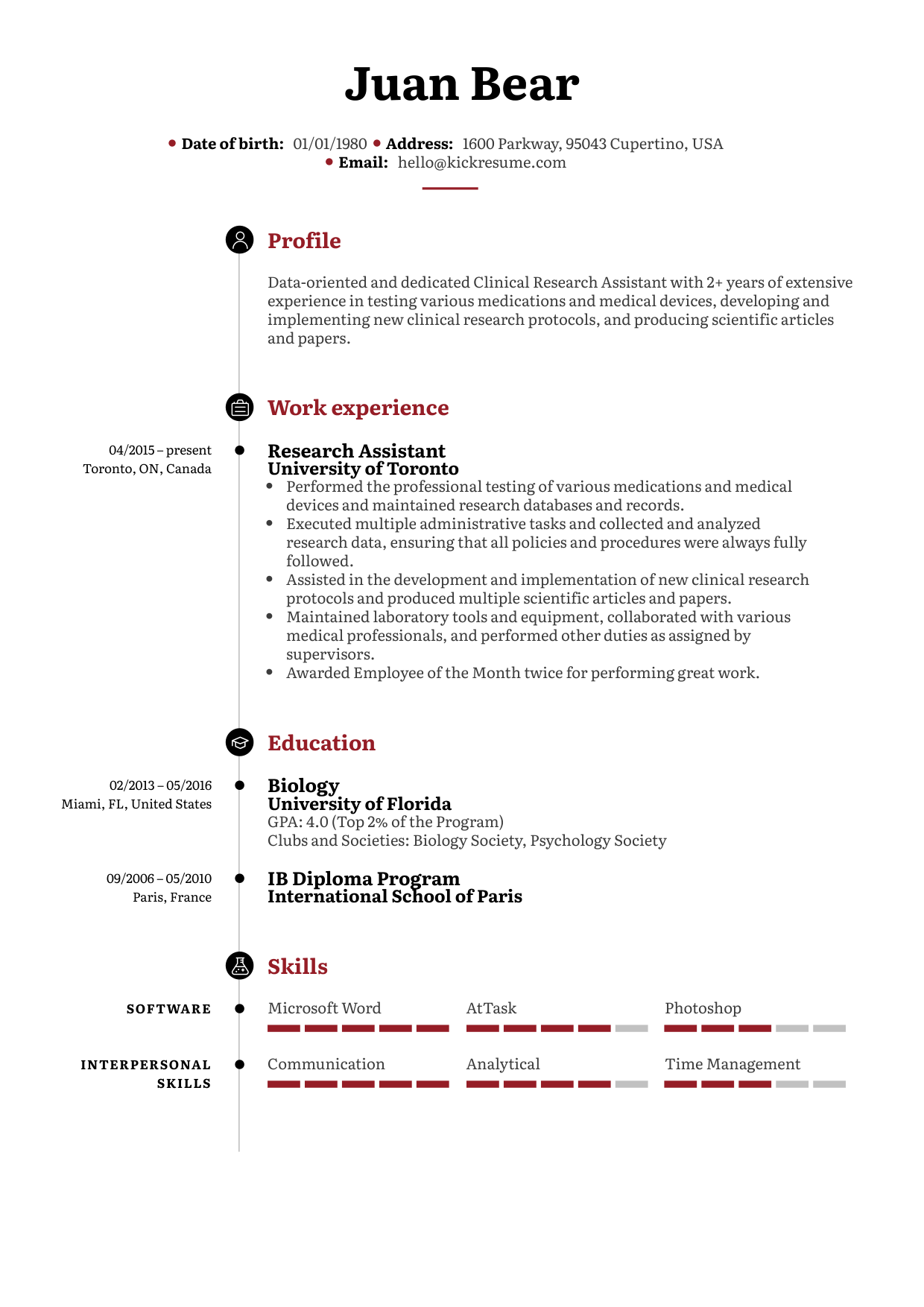
From meteorologists who predict and track the weather to geologists who uncover our planet’s history, there is a whole world of unique specializations and jobs waiting in the realm of nature science. But landing a job in this exciting field wouldn't be possible without an outstanding nature scientist resume.
Follow our comprehensive guide and discover valuable writing tips, customizable templates, plenty of examples, and resume samples submitted by industry professionals.


 See more examples like these
Keep reading to learn all about:
- The dos and don'ts of resume writing from real-life resume samples
- Picking the right resume format for a nature scientist
- Choosing between resume summary and resume objective
- Presenting the right skills on your nature scientist resume
- Making the most out of your achievements and experience
- Elevating your resume through the use of action verbs
- Dealing with the education section effectively
- Selecting relevant optional sections for your nature scientist resume
- Steering clear of mistakes that can sabotage your resume
- Accompanying your resume with a matching cover letter
- Finding the best resources for job-seeking nature scientists
- Exploring average salary and job outlook in nature science careers
Still looking for a job? These 100+ resources will tell you everything you need to get hired fast.
GIS specialist resume sample


Why does this resume example work?
- Including a separate publications section: Having a Publications section is a great move, especially for someone in a technical or academic field like GIS. It shows the candidate is not just working in the field but also contributing knowledge. This helps them stand out from others who may not have published anything.
- Clean, easy-to-read layout: The sections are broken down logically: Profile, Education, Work Experience, Skills, Strengths, and Publications. That kind of layout helps employers quickly find what they’re looking for without having to dig through a wall of text.
What could be improved?
- Placing work experience before education: The sections are broken down logically: Profile, Education, Work Experience, Skills, Strengths, and Publications. That kind of layout helps employers quickly find what they’re looking for without having to dig through a wall of text.
- Fixing typos and language consistency: There are a few spelling mistakes like "Expierence" instead of "Experience", and some language switching like "súčasnosť" (which is Slovak, not English). Fixing these errors would make the resume look more polished and professional.
Environmental engineer resume example

Why does this resume example work?
- Comprehensive skills section: This resume does a nice job laying out both technical know-how and soft skills. Things like systems evaluation and quality control show the candidate’s technical side, while teamwork, communication, and time management tell us they work well with others and can juggle multiple tasks.
- Detailed education section: It’s great to see more than just schools and degrees here. The resume shares real accomplishments like ranking in the top 5% of a Master’s program and earning First Class Honours in undergrad. There’s also mention of clubs and societies, which shows the candidate stayed active and involved.
What could be improved?
- Resume summary could be more effective: The summary talks about the candidate’s strengths, but it stays pretty high-level. That’s not wrong, but it feels a bit generic and formal, almost like it could apply to a lot of people. It also doesn’t show off the specific wins that are mentioned in the resume later (like the waste reduction or academic awards).
Geologist resume sample

Why does this resume example work?
- Including a separate awards section: Including a dedicated awards section helps highlight standout achievements. In this case, the “Best Senior Thesis Award” gives an extra layer of credibility to the candidate’s academic work. It’s easy to spot and adds value at a glance.
- Use of action verbs: The resume uses clear, active verbs like conducted, managed, developed, collaborated. These help each point sound dynamic and confident. It gives the impression the candidate was hands-on and made real contributions, not just tagging along.
What could be improved?
- Sharing less personal information: Details like nationality and date of birth don’t need to be on a resume and can actually open the door to bias (whether intentional or not). Most employers don’t want to see that info, especially in the U.S. and many European countries.
- Including quantifiable data: The second job entry has some great data (like the 30% increase in success rate), but the first job description doesn’t include much measurable impact. Adding numbers, like how much productivity increased, how many projects were managed, or how much money was saved, would make those bullet points even stronger.
1. Which resume format is best for a nature scientist
Before you sit down to type your job application, we need to briefly discuss the differences between a resume and a CV (Curriculum Vitae). And yes, these are two separate documents.
Resume
In most non-academic job applications (like roles in conservation, environmental consulting, field research, or lab-based analysis) a resume is the right choice. It’s concise, tailored, and highlights what’s most relevant to the job at hand.
That's why all the information it presents should always be custom tailored to align with the requirements outlined in the specific job posting as closely as possible.
The ideal resume length is between 1-2 pages, depending on your years of work experience. Generally, one page should suffice for those with less than 10 years of experience, while more senior professionals (10+ years) are expected to present their work history across two pages.
Resumes can be further divided into three types based on which information they emphasize and which is pushed to the background:
- Reverse-chronological format: The most prominent section is your work experience, listed in reverse order (starting with your most recent job). The outline typically includes: a summary/objective, work experience section, education, skills, and optional sections. This format is best suited for those with a solid work history and a clear career progression.
- Functional format: This format shifts the spotlight to your skills. The outline typically includes: a skills section, a smaller work history, education, and optional sections. It’s ideal for career changers, recent graduates, or those with employment gaps.
- Hybrid (combination) format: A hybrid resume blends both skills and experience. It starts with a skills section but still includes a reverse-chronological work experience section. This format is highly flexible, making it a great option for people with a mix of strong skills and solid work history.
CV (Curriculum Vitae)
If you’re applying for an academic, research, or university-affiliated position, a CV is what you’ll need. Apart from your professional history, it also dives deep into your full academic background:
- Publications
- Research projects
- Grants
- Conference talks, and more.
Naturally, the sheer amount of information CVs usually contain is also reflected in its length. Unlike a resume, a CV can be as long as it needs to be. This means that there’s no strict page limit — some academic CVs can easily span five or even ten pages.
Remember that not every job requires a CV — in fact, most outside of formal science and academia won’t. Therefore, it’s always important to read job postings carefully and identify what application materials they specifically ask for.
Formatting your resume also includes details like margin settings, font choices, and spacing, which can be time-consuming to perfect. Fortunately, using a professionally designed resume template can solve all of these headaches for you. Plus, our templates are also highly customizable, which makes them suitable for writing a CV as well.
Try our AI Resume Writer and have your resume ready in minutes!

2. How to choose between resume summary and resume objective
The first thing your resume needs is a strong opener — and that’s where either a resume summary or a resume objective comes in.
But before we get to that part … Why does this section even matter?
Hiring managers don’t have time to read every word on every resume that lands in their inbox. When a single job posting pulls in dozens, sometimes hundreds, of applications, they need a fast way to spot the strongest candidates.
That’s where your resume summary or objective comes in. In just 3–5 sentences, it gives them a quick “taste” of what’s to come — and helps them decide whether to keep reading.
When to use a resume summary
If you already have a few years of experience under your belt, a resume summary is the way to go. This version focuses on your work history and everything you've achieved so far. The point is to use your experience to prove you can do the job.
A great summary should include:
- Job title (of the position you're applying for)
- Years of experience in the field
- The industry or sector you specialize in (e.g. conservation, environmental research, lab science)
- A few key skills relevant to the role you’re applying for
- Notable accomplishments (ideally backed by numbers or results)
- Any special certifications, awards, or recognitions
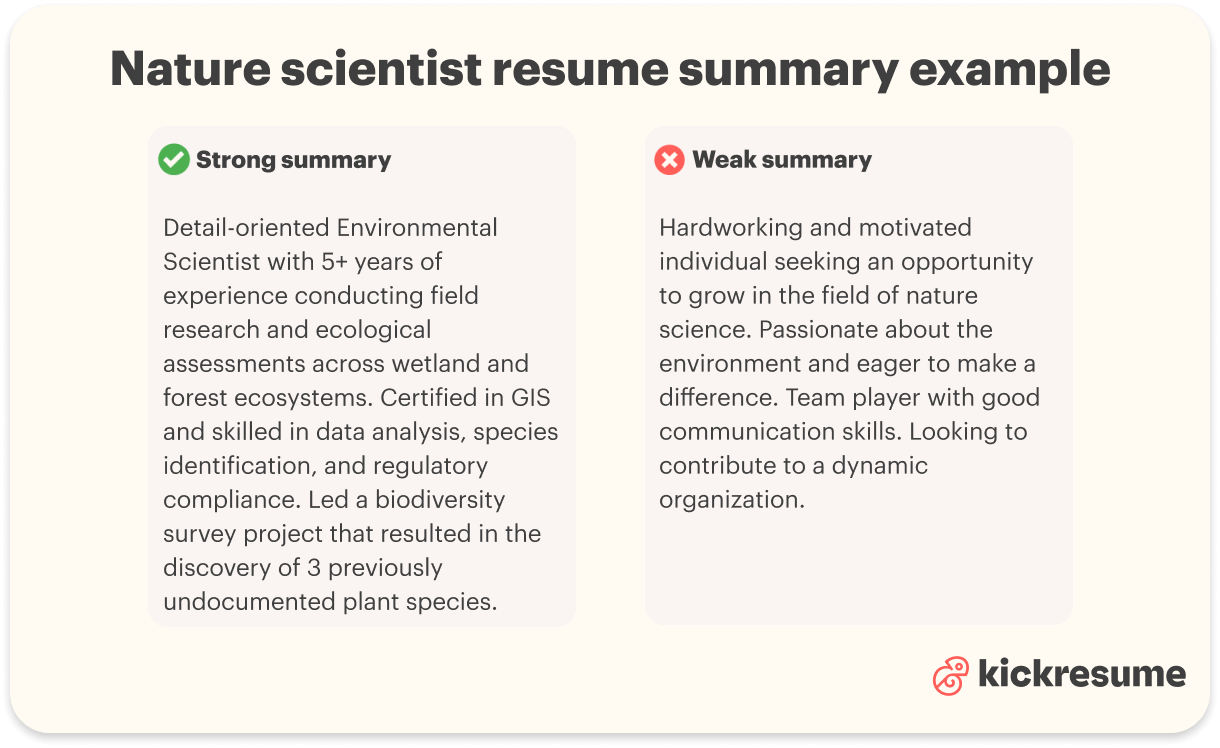
Bad example of a nature scientist resume summary
Hardworking and motivated individual seeking an opportunity to grow in the field of nature science. Passionate about the environment and eager to make a difference. Team player with good communication skills. Looking to contribute to a dynamic organization.
What makes this so unconvincing? This summary is full of vague buzzwords and says very little about the actual applicant. It doesn’t tell us what they’ve done, what they’re good at, or what makes them stand out from the crowd. Anyone could write this, and that’s the problem.
Good example of a nature scientist resume summary
Detail-oriented Environmental Scientist with 5+ years of experience conducting field research and ecological assessments across wetland and forest ecosystems. Certified in GIS and skilled in data analysis, species identification, and regulatory compliance. Led a biodiversity survey project that resulted in the discovery of 3 previously undocumented plant species.
Why does this example work so well? Because it's specific, shows off real accomplishments, and gives us a clear idea of who the candidate is and what they can do. You can picture this person in action. They’re experienced, skilled, and they’ve already made a measurable impact. That’s the kind of summary that makes a hiring manager want to keep reading.
When to use a resume objective
If you’re just starting out in your career and don't have that much professional experience, a resume objective is probably the better choice. This section is perfect for students and fresh grads, career changers, or people returning to work after a gap.
Unlike resume summary, objective aims to show the hiring manager your potential.
A great objective should include:
- The type of position or field you’re targeting
- Any relevant education, certifications, or training
- Transferable skills (from school, internships, volunteering, or other jobs)
- A short statement about your goals and what you hope to contribute
- A tone that’s enthusiastic and professional
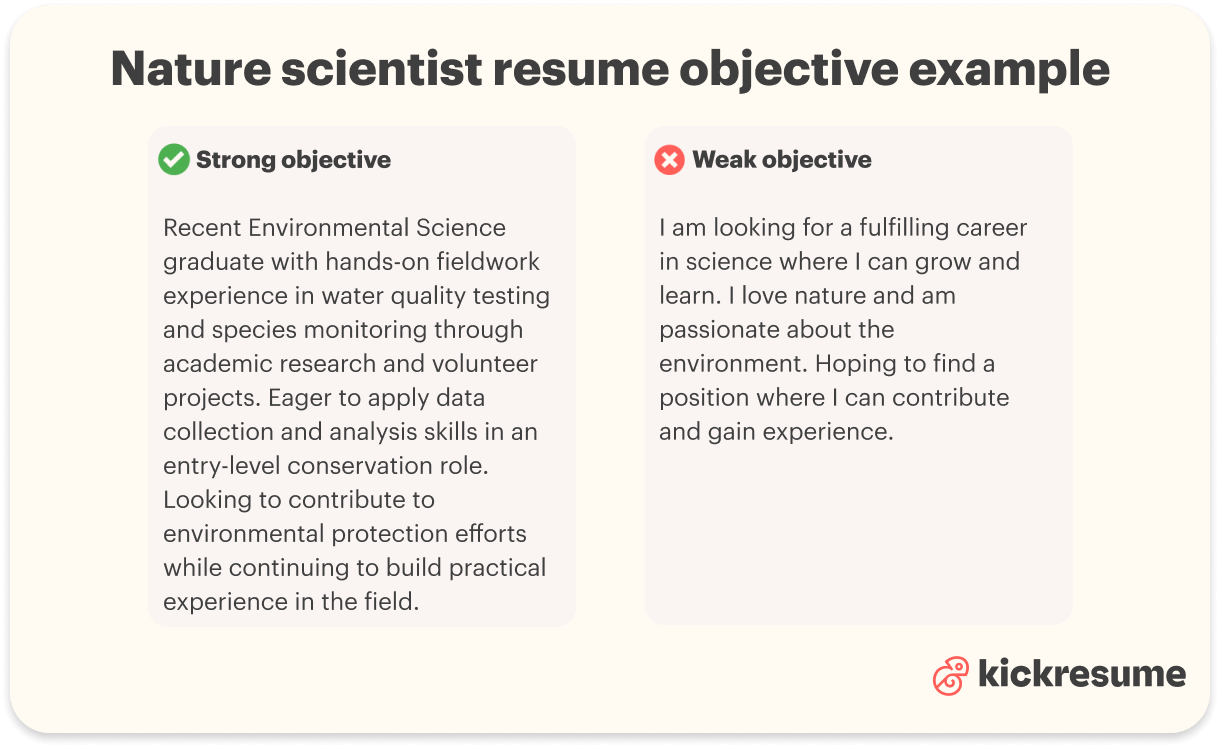
Bad example of a nature scientist resume objective
I am looking for a fulfilling career in science where I can grow and learn. I love nature and am passionate about the environment. Hoping to find a position where I can contribute and gain experience.
Why doesn't this example work? It doesn’t tell the employer what the applicant brings to the table or what specific skills they have. Passion is great, but without something concrete to back it up, it’s not very convincing. Plus, the wording sounds like the candidate is hoping the job will do all the heavy lifting.
Good example of a nature scientist resume objective
Recent Environmental Science graduate with hands-on fieldwork experience in water quality testing and species monitoring through academic research and volunteer projects. Eager to apply data collection and analysis skills in an entry-level conservation role. Looking to contribute to environmental protection efforts while continuing to build practical experience in the field.
Why is this so much better? This example shows focus and direction. It highlights relevant education, hands-on experience (even if it’s not from a full-time job), and a clear goal. The applicant sounds motivated and prepared, even if they’re still early in their career. That’s exactly what a good objective should do.
Just like choosing the right resume format, deciding between a resume summary and a resume objective comes down to what works best for you. There’s no one-size-fits-all answer. It all depends on where you are in your career and what you want your resume to highlight first.
3. How to highlight your most relevant nature scientist skills
Nature science is a broad umbrella that covers everything from ecology, botany, and geology to environmental consulting, wildlife biology, and field research. So naturally, not every skill will matter equally for every job.
So how do you decide which ones to list?
1. Read the job posting carefully
Start with the job ad. Look at the responsibilities and qualifications sections and underline anything that sounds like a skill or tool (for example, “soil sampling,” “ArcGIS,” “data analysis,” or “public outreach”).
2. Match the job’s needs to your own experience
Now, go through your own toolkit. Which of the skills from the job ad do you already have? Focus on overlap — the more your resume reflects what the employer is looking for, the better your chances.
3. Tailor your skills section for every single application
Yes, every single one. For example, if you're applying for a conservationist position, emphasize fieldwork, species identification, or stakeholder communication. If it’s a lab-based research role, highlight data modeling, lab techniques, or statistical software. Customizing your resume makes all the difference.
Top 10 most in-demand hard skills for nature scientists
- Geospatial technologies (e.g., GIS, ArcGIS, QGIS)
- Field data collection and sampling techniques
- Statistical analysis (e.g., R, SPSS, Excel)
- Environmental impact assessment (EIA)
- Species identification and taxonomy
- Remote sensing (e.g., satellite imagery, LiDAR)
- Report writing and documentation
- Laboratory techniques (microscopy, chemical testing, or genetic sampling)
- Regulatory compliance and environmental legislation knowledge
- Database management and data visualization (like Excel or Tableau)
Nature scientists often work across disciplines and teams, so technical skills alone aren't enough. Soft skills can help set you apart from other applicants with similar qualifications.
Top 10 most in-demand soft skills for nature scientists
- Critical thinking and problem-solving
- Attention to detail
- Teamwork and collaboration
- Communication skills
- Adaptability and flexibility
- Project management
- Initiative and self-direction
- Time management
- Ethical judgment and environmental responsibility
- Public speaking and presentation skills
Where should you list your skills on your resume?
The most obvious place is a dedicated skills section. It should be skimmable and to the point. You can also indicate your level of proficiency using graphics — but if you’re submitting your resume through an ATS, it’s best to skip the visuals and stick to plain text instead.
However, the most effective resumes show these skills in action. Use the work experience section to back up your claims with real-world examples. But that is a topic for another chapter.
Find out your resume score!

4. Making the most out of your achievements and experience
Your work experience section is the heart and soul of your resume. Whether you’ve spent your time knee-deep in wetlands, crunching lab data, or working with local communities on sustainability efforts, this is where you show how you’ve put your skills to work and what kind of difference you’ve made along the way.
So what makes a strong work experience entry? Follow this formula:
- Start with your job title, organization, and location
- Add your dates of employment (month + year format is standard)
- Use bullet points to describe your key responsibilities and accomplishments
- Focus on outcomes, not just duties
- Back it up with numbers or metrics whenever possible
- Lead with action verbs (we’ll cover those in an upcoming chapter)
Take a look at these two examples and see which one work better:
Bad example of a nature scientist resume work history
Environmental Scientist
Green Earth Research Lab, Boston, MA
March 2020 – Present
- Conducted fieldwork and collected samples
- Analyzed data and wrote reports
- Worked with local communities on conservation projects
- Attended meetings and gave presentations
- Monitored environmental changes in the area
Why doesn’t this example work? This one’s just too vague. Anyone in the same role could’ve written it. It sounds more like a job description than a story about what the candidate actually achieved. There are no numbers, no unique contributions, and nothing that makes this person stand out.
Good example of a nature scientist resume work history
Environmental Scientist
Green Earth Research Lab, Boston, MA
March 2020 – Present
- Designed and executed a coastal habitat restoration study, resulting in a 23% increase in native plant regrowth within one year.
- Analyzed water quality data from 150+ sampling points using R and ArcGIS, identifying contamination trends that led to updated local policy on stormwater runoff.
- Co-authored three peer-reviewed publications and presented findings at the 2023 Northeast Ecology Conference.
- Led outreach workshops for over 500 local residents, boosting community engagement in invasive species management programs.
- Collaborated with a multidisciplinary team to secure $200K in federal funding for climate resilience research.
What makes this example effective? Now this paints a picture. It’s clear what the person did, how well they did it, and what kind of results they delivered. There are numbers, action verbs, and specifics that show they were actively driving impact. Even if someone isn’t a scientist, they can quickly understand the value here.
Tips for students and fresh graduates
Don’t worry if you’re a student, a recent grad, or switching into nature science from another field. You can still craft a solid experience section. It's all about showing initiative and value, no matter the setting.
Consider including:
- Internships (lab, fieldwork, nonprofit, or government)
- Capstone or research projects
- Volunteer experience related to conservation or science outreach
- Lab assistant or teaching roles
- Field courses with hands-on experience
Good work experience entry example for fresh graduates
Conservation Intern
WildRoots NGO, Asheville, NC
June 2023 – Sept 2023
- Assisted with daily monitoring of wildlife camera traps and recorded 400+ data points over 12 weeks.
- Created GIS maps to track the spread of invasive plant species in protected areas.
- Helped design and lead educational nature walks for school groups, reaching over 300 students.
- Contributed to the writing of a community grant proposal that secured $25K in funding for a reforestation project.
Your experience section should tell a story — not just where you’ve been, but how you’ve made things better. Use numbers, action verbs, and specifics. Make it easy for recruiters to see your value, fast.
5. How to elevate your nature scientist resume through the use of action verbs
Want to give your resume that extra spark of clarity and confidence? Here's a trick that works every time: action verbs.
These simple but powerful words help you sound like someone who takes initiative, solves problems, and makes real things happen. They grab the reader's attention and make you look like a candidate with a proactive approach and results-oriented mindset.
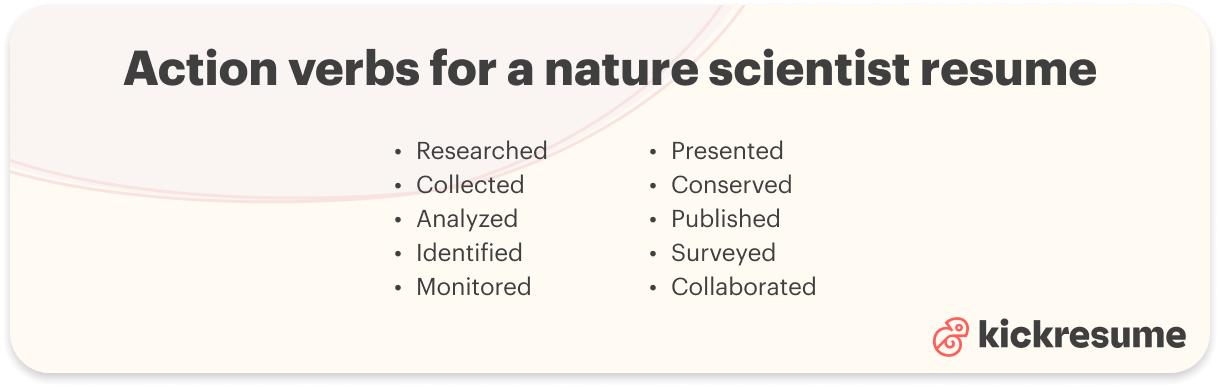
Examples of action verbs to use in a nature scientist resume
- Researched
- Collected
- Analyzed
- Identified
- Monitored
- Presented
- Conserved
- Published
- Surveyed
- Collaborated
Want a clearer picture of how this works in practice? Let’s do a quick before-and-after:
Before:
- I was part of a team that worked on a project about invasive species and helped write some of the report.
After:
- Researched the ecological impact of invasive species across 12 wetland sites and co-authored a 40-page environmental assessment submitted to local conservation authorities.
See the difference? The second version feels clear, professional, and proactive.
One last tip: variety matters. Avoid starting every bullet point with “Conducted” or “Assisted.” Try to rotate your verbs to keep your resume fresh and easy to read. It may seem like a small detail, but it makes a big impact.
6. How to list your academic credentials in as a nature scientist
In the field of nature science, your academic background is part of your credibility. So yes, the education section belongs on your resume. But how much detail should you go into?
That depends on your level of experience and how much your academic journey connects to the job you're applying for.
Option 1: The succinct version
This is a great choice if you already have several years of professional experience and don’t need your education to do the heavy lifting. You don’t need to over-explain your degree, just hit the key facts and keep it moving.
Include:
- Degree name
- Field of study
- University name
- Location (optional)
- Graduation year
Succinct education section example for nature scientist
MSc in Environmental Science
University of British Columbia
2013-2016
Option 2: The detailed version
If you’re earlier in your career, just graduated, or your education plays a big part in why you’re qualified for the role, then this is the way to go. Adding more context here helps fill in the bigger picture.
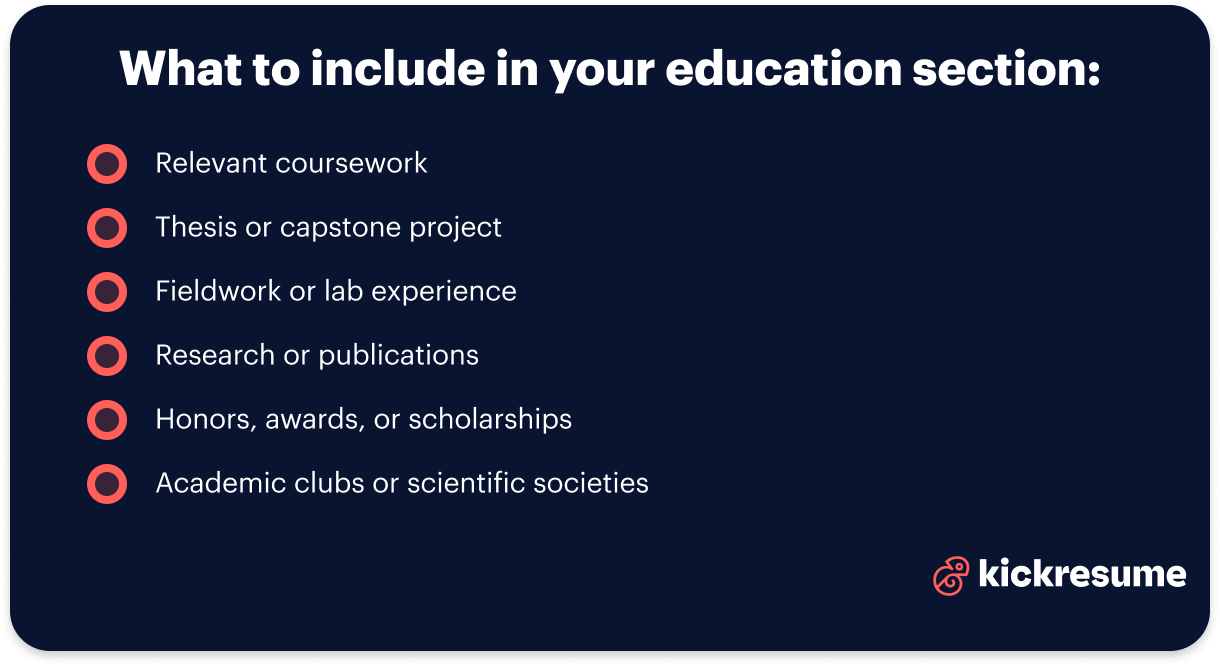
You can include:
- Relevant coursework
- Thesis or capstone project
- Fieldwork or lab experience
- Research or publications
- Honors, awards, or scholarships
- Academic clubs or scientific societies
Detailed education section example for nature scientist
BSc in Ecology and Evolutionary Biology
University of Toronto
2019-2022
- Coursework: Conservation Biology, GIS Mapping, Invertebrate Zoology
- Thesis: “Pollinator Behavior in Fragmented Urban Ecosystems”
- Conducted summer fieldwork in Algonquin Park for three consecutive seasons
- Recipient of the Natural Sciences and Engineering Research Council (NSERC) Undergraduate Student Research Award
- Member, Canadian Society for Ecology and Evolution
Your education section showcases the backbone of your expertise in the nature sciences. Whether you're just starting out or still in school, this part of your resume shows that you have the knowledge and skills to support your career goals. Make it count!
7. How to select relevant optional sections for your nature scientist resume
By now, you’ve covered all the core elements of your resume — your summary or objective, skills, experience, and education. But what if there’s more to your background that deserves the spotlight? That’s where optional sections come in.
These extra sections give you the space to show off accomplishments and experiences that don’t quite fit into the standard categories, but still say something meaningful about your value as a nature scientist.
Just one thing to keep in mind: optional doesn’t mean random! Only add sections that strengthen your application and align with the role you're aiming for.
When should you include more sections?
Go for it if:
- You have something noteworthy that adds depth to your qualifications.
- It helps paint a clearer picture of your expertise, interests, or achievements.
- You still have room on the page without overcrowding.
Maybe skip it if:
- The content isn’t relevant to the job or field.
- You’re including it just to take up space.
- It doesn’t enhance your credibility or uniqueness in any real way.
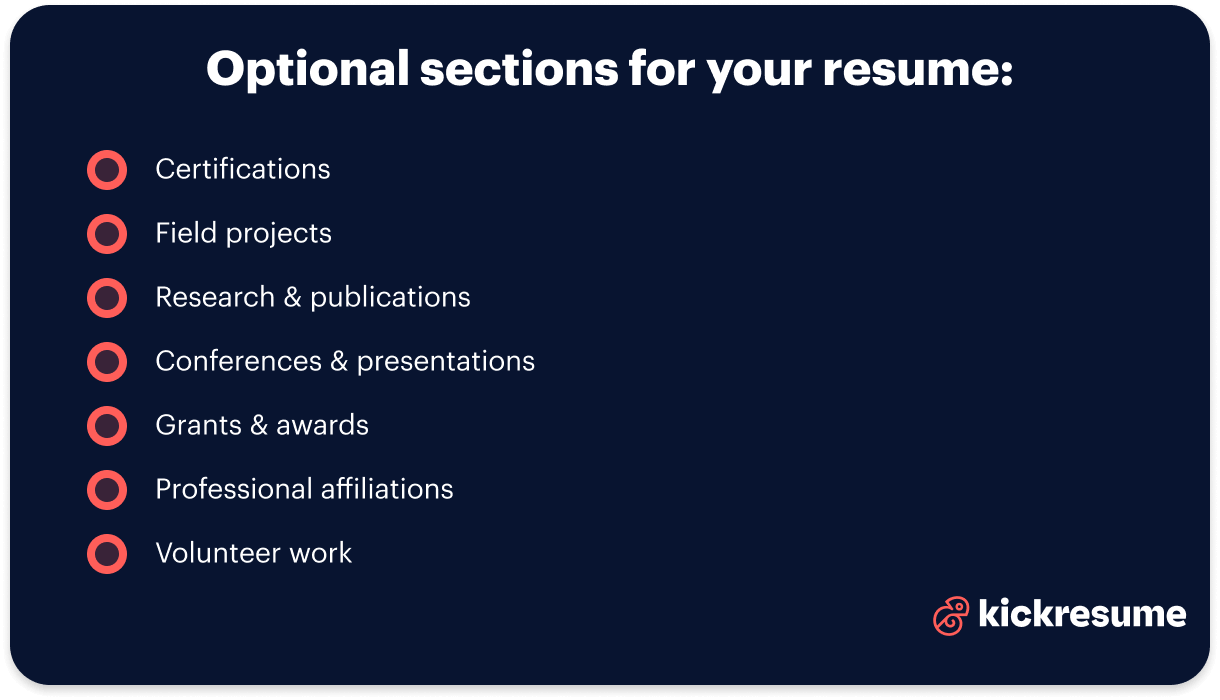
Here are some extra sections that often make sense for someone working in nature sciences — especially if you’ve been involved in research, community projects, or cross-disciplinary work:
- Certifications
- Field projects
- Research & publications
- Conferences & presentations
- Grants & awards
- Professional affiliations
- Volunteer work
Example of optional resume sections for a nature scientist
Certifications
- Wilderness First Responder (WFR), NOLS — 2023
- Certified Ecological Restoration Practitioner (CERP) — 2022
Field Projects
Wetland Restoration Monitoring | Statewide Project (2021–2023)
- Monitored vegetation recovery and amphibian biodiversity across 12 wetland sites post-restoration.
- Collected and analyzed bi-weekly field data using standardized ecological assessment protocols.
Awards & Recognitions
- Recipient, “Emerging Scientist in Conservation” – Midwest Eco Conference, 2023
- Dean’s Research Fellowship for Undergraduate Environmental Research – 2022
In short, optional sections are your resume’s bonus round. If they make your story clearer, stronger, or more memorable, include them. But if they don’t add anything meaningful, leave them out. An informative, relevant resume always outshines one that’s packed just for the sake of it.
8. How to avoid mistakes that can sabotage your resume
So, you’ve pulled together your resume and you’re ready to start applying. But before you send it off to potential employers or research institutions, it’s worth pausing for one last, crucial step: making sure it’s free of errors that could silently weaken your chances.
Let’s walk through the most common resume mistakes and how to avoid them:
- Spelling, grammar, and unclear writing: A scientific background doesn’t mean much if your resume is riddled with typos or clunky wording. Proofread carefully. Use tools like spell checkers, but don’t rely on them alone — human review is key.
- Formatting that makes your resume hard to read: No matter how impressive your experience, poor layout can make it hard to see. Stick to a clean structure: consistent fonts, legible text sizes, and well-spaced sections. Use bullet points for clarity, and avoid dense blocks of text.
- One-size-fits-all resumes: Different roles emphasize different aspects of nature science. If you’re using the same resume for every job, you’re missing out. Tailor your resume to reflect the responsibilities, tools, and qualifications listed in each posting.
- Listing tasks without showing impact: Saying “conducted biodiversity surveys” is a start, but what came out of it? Did the data inform a conservation initiative? Did you help reduce invasive species? Employers want to know how your work mattered.
- No numbers, no context: Quantifying your achievements helps give your experience weight. For example, instead of saying “monitored water quality,” try “monitored chemical and biological indicators across 15 freshwater sites.” Whether it’s percentages, timeframes, species counts, or project scopes — numbers make your experience and accomplishments tangible.
- Outdated or incorrect contact info: It seems obvious, but it's often overlooked. Double-check your phone number and email. Use a professional email address (ideally with your name). If you include a personal website, online portfolio, or LinkedIn profile, make sure the links work and reflect the same information you’re listing.
- Ignoring key terms from the job ad: Many institutions and employers use applicant tracking systems (ATS) to scan resumes before a human ever sees them. If your resume doesn’t reflect keywords from the job description (terms like “habitat restoration,” “GIS mapping,” “environmental impact assessment,” or “biodiversity monitoring”) you might not make the cut.
- Irrelevant or outdated content: Everything on your resume should support your candidacy for this specific role. If a position doesn't benefit from your unrelated summer job or your high school biology club, it’s okay to leave it out.
Don’t let small oversights hold you back. A few final edits can make all the difference between getting passed over and landing an interview. Review your resume with a critical eye, polish the weak spots, and make sure every line adds value to your application.
9. How to pair your resume with a matching cover letter
Even the strongest resume benefits from backup. If you want your application to feel complete don’t forget to pen a compelling cover letter.
What’s the role of a cover letter?
Your cover letter connects the dots (or bullet points) from your resume. It explains why this job, why this organization, and why you.
A well-written cover letter answers questions like:
- What experience or perspective sets you apart?
- How does your background align with the employer’s mission?
- Why do you want this specific job?
- Why this company?
- What value do you bring to them?
Resume vs. cover letter: What are the differences?
While they’re part of the same application, resumes and cover letters do different things:
- Resumes are skimmable (bullet points, dates, facts)
- Cover letters are conversational (full sentences, complete thoughts, a bit of personality)
- Resumes show what you’ve done.
- Cover letters show why it matters — and why you care.
Let the cover letter do what the resume can’t: show personality, demonstrate your values, and highlight your understanding of the field.
How to make your cover letter and resume visually consistent
Visually and tonally, your cover letter should feel like it belongs alongside your resume. Here’s how to achieve that:
- Use the same header: Your name and contact details should appear at the top of both, styled the same way.
- Stick to one font family: Avoid mixing typefaces.
- Keep formatting clean and consistent: Line spacing, margins, and alignment should match across both documents.
- Carry over subtle design elements: If your resume uses a specific color for section headers, echo that choice in your cover letter's header or name block.
- Use templates to achieve a unified look: For example, each of Kickresume’s professionally designed resume templates is paired with a matching cover letter template. The only problem you'll face is the dilemma of choosing which design you like the most!
Sometimes a job ad will say a cover letter is optional — should you still send one? Unless the job ad explicitly says “no cover letter,” yes, you absolutely should! It’s your chance to speak in your own voice, show your motivation, and add a layer of meaning that your resume alone can’t fully capture.
Let your cover letter write itself — with AI!

10. Valuable job search resources for nature scientists
So, now you're more than well-equipped to handle your resume, but do you know where to look for work opportunities? If you're unsure of where to start, you can draw inspiration from our list of resources:
- Job boards for nature scientists: For positions in scientific and academic institutions, search through websites like Earthworks-Jobs, Nature Careers, ChronicleVitae, or jobs.ac.uk.
- General job search boards: But platforms that don't cater to your professional area only, such as Indeed, Glassdoor, or Monster, can also yield compelling results.
- Research projects: If you're looking for grants or support for your research projects, try exploring websites of the European Research Council (ERC), the National Science Foundation (NSF), or the United Nations Environment Programme (UNEP).
- Professional associations: These organizations offer a wealth of resources for nature scientists like yourself. For example, check out the International Union of Biological Sciences (IUBS), the Australian Society for Fish Biology (ASFB), or the British Ecological Society (BES).
- Consulting firms and environmental consulting companies: Consulting firms specializing in environmental science, ecology, and biodiversity assessment, such as ERM or SLR Consulting, may hire nature scientists for project-based work.
- Continuous learning: Do you need further knowledge of data analysis and visualization? Or work on your presentation skills? With courses offered by Coursera, Udemy, and edX, you'll expand your skill set with ease.
Job searching in the field of nature science often involves navigating through a competitive landscape with limited job openings. However, with persistence, networking, and showcasing relevant experience and qualifications with your nature scientist resume, the right opportunities can be found.
Science Career Outlook in 2025
Employment in Science is expected to grow faster than the average for all occupations from 2023 to 2033. (Source: U.S. Bureau of Labor Statistics)
Every year, about 148,400 science jobs are expected to open, primarily due to employment growth and the need to replace workers who retire.
Average US base salaries across popular Science roles:
- Chemist: $82,208/year
- Scientist: $97,828/year
- Historian: $70,272/year
- Research Scientist: $99,932/year
- Research Assistant: $44,970/year
- Meteorologist: $66,862/year
- Biologist: $83,527/year
- Physicist: $165,461/year
- Mathematician: $108,979/year
- Microbiologist: $75,976year
- Environmental Scientist: $68,140/year
- Data Scientist: $124,841/year
Salary estimates are based on data submitted anonymously to Indeed by individuals working in these roles, as well as information from past and present job postings on the platform over the last 36 months.
These numbers may vary based on location, company size, employment type, and experience level.
Overall, if you’re thinking about starting a career in Science—or you want to grow within the field—now is a great time to explore the opportunities the industry provides.
Nature Scientist Resume FAQ
How can I best showcase my skills and experience as a nature scientist on my resume?
Always tailor your resume to highlight your relevant skills and experience in the field of nature science. Focus on technical skills such as field research, data analysis, and laboratory techniques, as well as soft skills like critical thinking, problem-solving, and communication. To give more weight to your achievements, use concrete examples and quantifiable data to demonstrate your proficiency and impact in previous roles.
What can I do to stand out from other candidates in the competitive field of nature science?
The best thing you can do is emphasize any specialized training, certifications, or unique experiences that set you apart from other candidates. For example, you can highlight your contributions to research projects, publications, presentations, and collaborations within the field. Additionally, showcase your passion for nature science through relevant volunteer work, extracurricular activities, or professional affiliations.
How can I effectively use keywords to optimize my nature scientist resume for ATS?
First of all, you need to research keywords relevant to your field of nature science and incorporate them strategically throughout your resume. Use terms commonly found in job descriptions, industry publications, and professional profiles to increase your chances of passing through ATS scans. However, prioritize readability and relevance over keyword stuffing, and ensure your resume remains tailored to human readers as well.
How can I format my nature scientist resume to make it visually appealing and easy to read?
Opt for a clean and professional resume format with clear headings, bullet points, and appropriate amount of white space. Also, use a legible font and consistent formatting throughout the document. If you want to save yourself some time and energy, feel free to pick one of our very own resume templates.
What about my fieldwork experience? How can I write about it on my nature scientist resume?
Write about your fieldwork experience by including specific details such as the location, duration, objectives, and outcomes of your fieldwork projects. Emphasize your role in planning, executing, and analyzing field studies, as well as any relevant skills or techniques utilized in the field. Additionally, you can mention any publications, presentations, or reports resulting from your fieldwork.


![How to Write a Professional Resume Summary? [+Examples]](https://d2xe0iugdha6pz.cloudfront.net/article-small-images/How_to_Write_a_Professional_Resume_Summary_.png)
![How to List Your Education on a Resume? [+Examples]](https://d2xe0iugdha6pz.cloudfront.net/article-small-images/How_to_Put_Education_on_a_Resume_.png)
![How to Describe Your Work Experience on a Resume? [+Examples]](https://d2xe0iugdha6pz.cloudfront.net/article-small-images/How_to_Describe_Your_Work_Experience_on_a_Resume_.png)