



While AI is often associated with writing resumes, the data suggests a different reality: more job seekers use it to check and optimize their resumes than to create them.
To better understand how AI is used in practice, Kickresume analyzed anonymized internal usage data from over 1.2 million people who used AI-powered features in 2025.
The results reveal a clear pattern: AI is most widely used for structured, task-based activities — particularly resume writing and optimization — while other parts of the job search, such as cover letters or interview preparation, remain far less common.
Here are some of the key findings:
- Over 1.2 million people used AI-powered job search features in 2025.
- More than 773K (around 64%) used AI to check and analyze their resumes for ATS compatibility — making it the most common AI use case overall.
- 586K (roughly half of users) used AI to write or improve resume content.
- AI is used across the entire resume writing process, from generating full resumes (433K) to refining specific sections (185K) and rewriting content (155K).
- Around 43K (about 3.5%) used AI to tailor their resumes to a specific job description.
- Around 50K (about 4%) used AI to write cover letters, while 18K (around 2%) used it to prepare for job interviews.
- Only around 3K (well under 1%) relied on AI for career guidance.
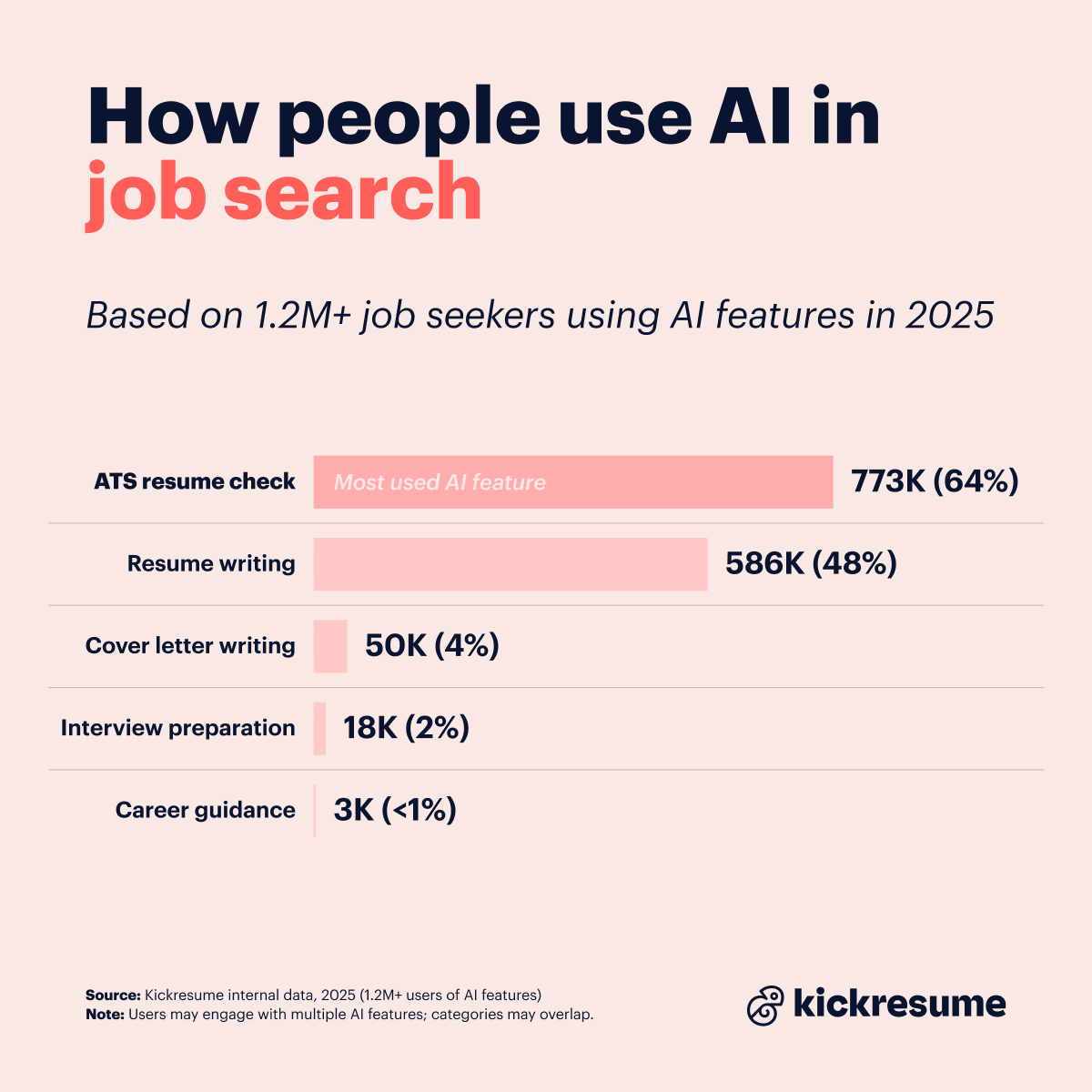
While resume writing remains the strongest content-related use case, resume checking highlights another important behavior: job seekers increasingly rely on AI as a second layer of validation before submitting applications.
Methodology note
This analysis is based on Kickresume’s internal product usage data from 2025. It includes 1.22 million unique users who interacted with AI-powered features related to resumes, cover letters, ATS resume checking, career guidance, and job interview preparation.
Because users may use multiple AI features during their job search, categories can overlap. For example, one user may generate a resume, rewrite a section, and later use ATS resume checking. For this reason, the figures represent how many people used each type of AI feature, rather than separate groups that add up to a total.
Over 580K job seekers used AI to write or improve their resumes — not just generate them
Resume writing remains the most common content-related use of AI — but it’s rarely limited to generating a full CV.
In 2025, more than 580K people (roughly half of users) used AI to write or improve their resumes. Job seekers use AI across the entire writing process, from creating the first draft to refining individual sections.
Here’s a closer look at how AI is used among the 586K users who rely on it for resume writing:
- 433K (about three-quarters) created a full resume with AI
- 185K (around one-third) generated specific sections, such as summaries, skills, or work experience descriptions
- 155K (around one-quarter) used AI to rewrite or refine existing content
Some job seekers also use AI to further improve their resumes:
- 18K (around 3%) used AI to get recruiter-style feedback
- 11K (around 2%) used AI to translate their resume into another language
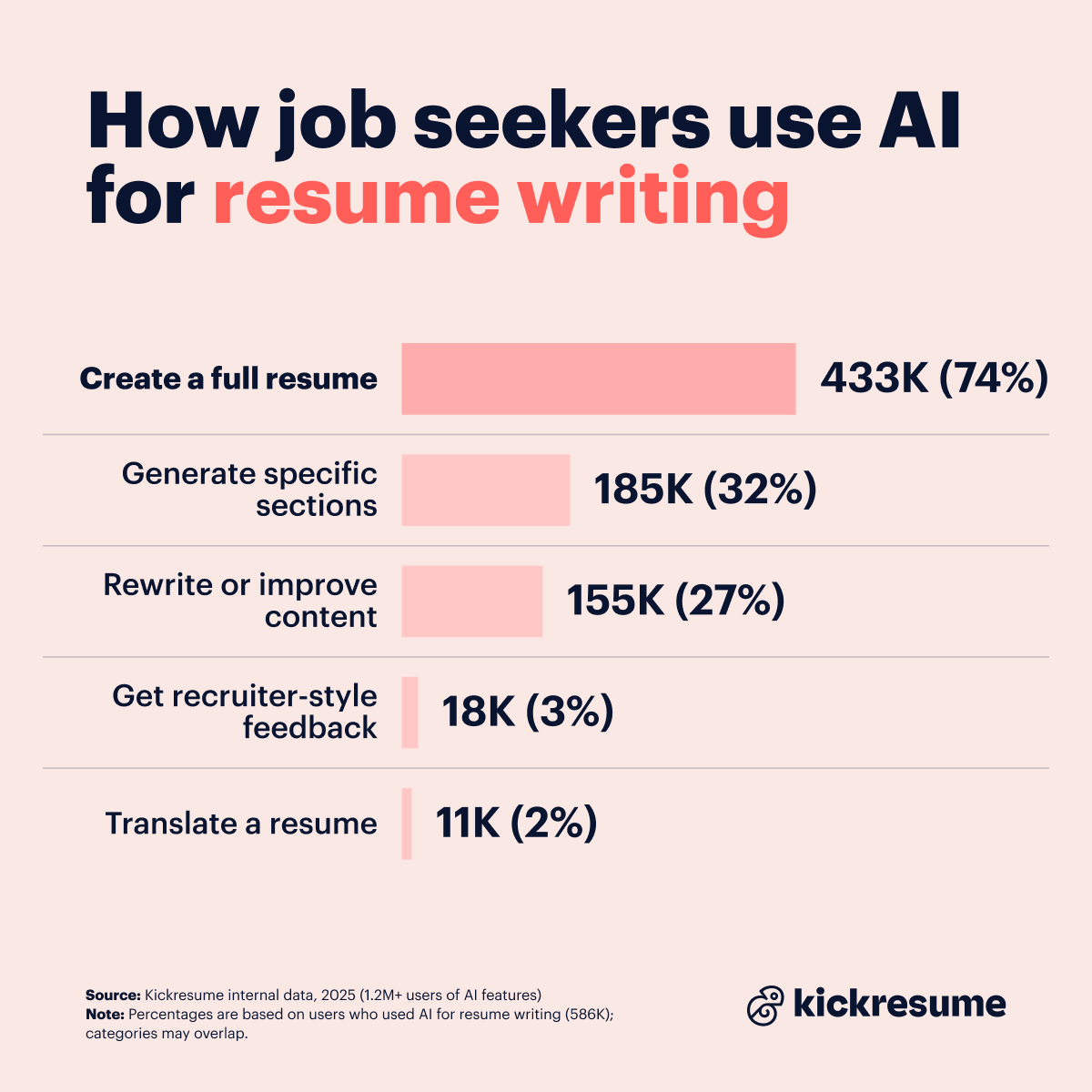
In other words, AI is not just a starting point — it has become a practical assistant helping throughout the entire resume creation process, from first draft to final polish.
This aligns with previous survey findings, where 78% of job seekers said AI is at least moderately helpful when writing resumes. Most often, they use it to sound more professional (55%) or to save time (24%).
Even more job seekers use AI to check their resumes than to write them
AI is most often associated with writing resumes — but the data tells a slightly different story.
In 2025, 773K job seekers (around 64%) used AI to check and analyze their resumes for ATS compatibility — roughly one-third more than those who used AI to write or improve their resumes (586K).
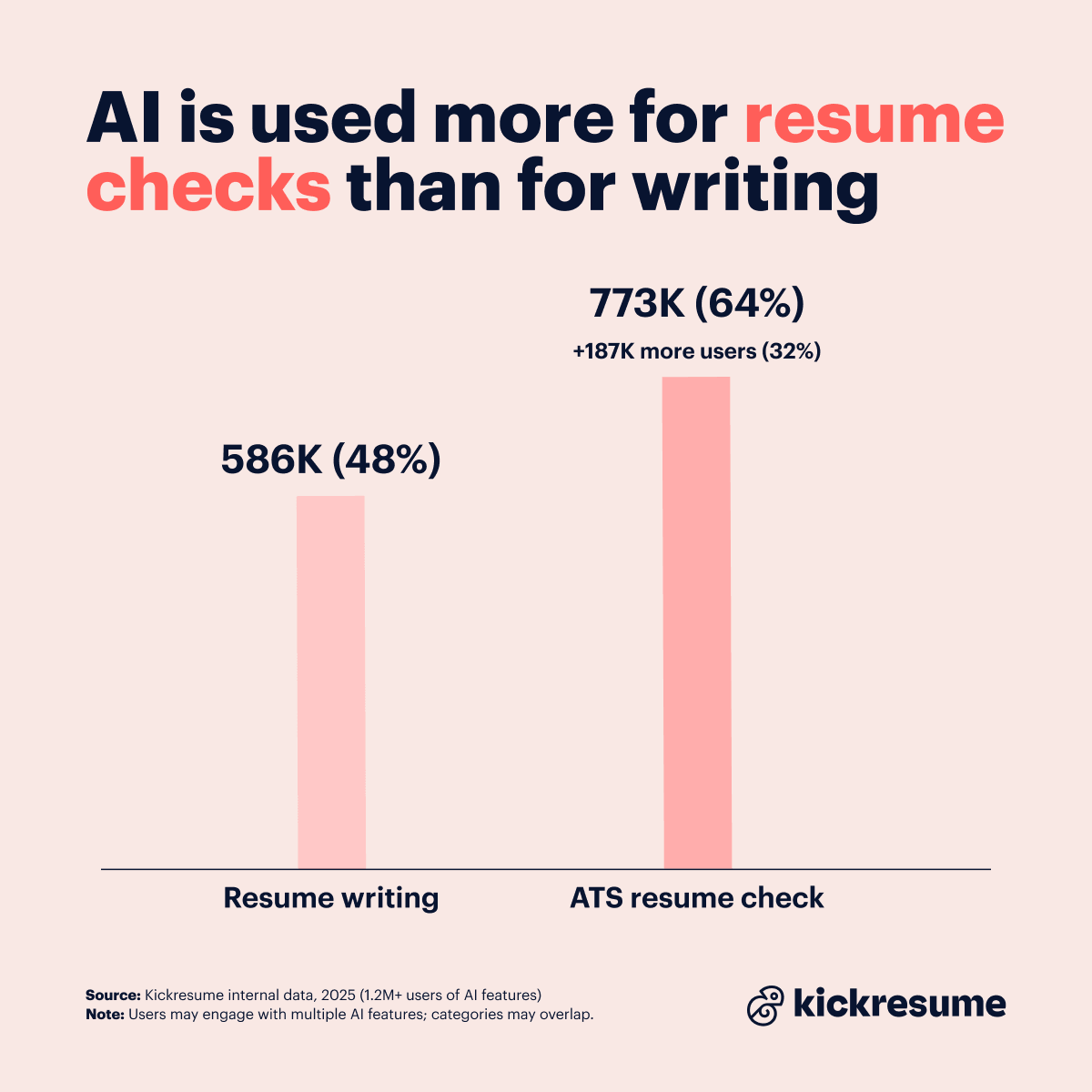
Applicant tracking systems are widely used to filter candidates, and even strong resumes can be rejected if they are not properly formatted, structured, or aligned with common screening criteria.
This helps explain why resume checks are the most common use case: for many candidates, the biggest concern is no longer just “Is my resume good?” but also “Will it even get seen?”
In practice, these checks often focus on how a resume is structured and written — for example, whether key sections are present, how clearly information is organized, or whether the content is easy to scan and understand.
Rather than tailoring a resume for a specific role, they help candidates identify potential issues and improve the overall quality of their CV before applying.
At the same time, some job seekers use AI for more targeted changes, too. In 2025, around 43K job seekers (about 3.5%) used AI to tailor their resumes to a specific job description.
This reflects a broader challenge job seekers face: in a previous survey, 29% of job seekers said tailoring their resume for each role is the hardest part — closely linked to meeting ATS requirements and improving visibility.
Cover letters remain a second priority — even with AI
While resumes dominate AI usage, cover letters are used far less frequently.
According to the data, around 50K people (roughly 4%) used AI to write cover letters in 2025 — less than 10% of those who used AI for resume writing.
One likely explanation is simple: many candidates don’t prioritize them as much as resumes — especially when they are optional. According to HR expert Marta Říhová, recruiters often rely primarily on resumes when assessing candidates:
This helps explain why candidates may choose to spend less time on cover letters — and why their usage remains relatively low, even with AI support.
At the same time, cover letters can still play a role in certain situations — for example, when candidates want to explain a career change, highlight motivation, or provide additional context that isn’t immediately clear from their resume.
When AI is used for cover letters, it is typically used for full generation rather than refinement:
- 47K (95%) used AI to generate a complete cover letter
- around 10K (20%) used it to rewrite or improve existing content
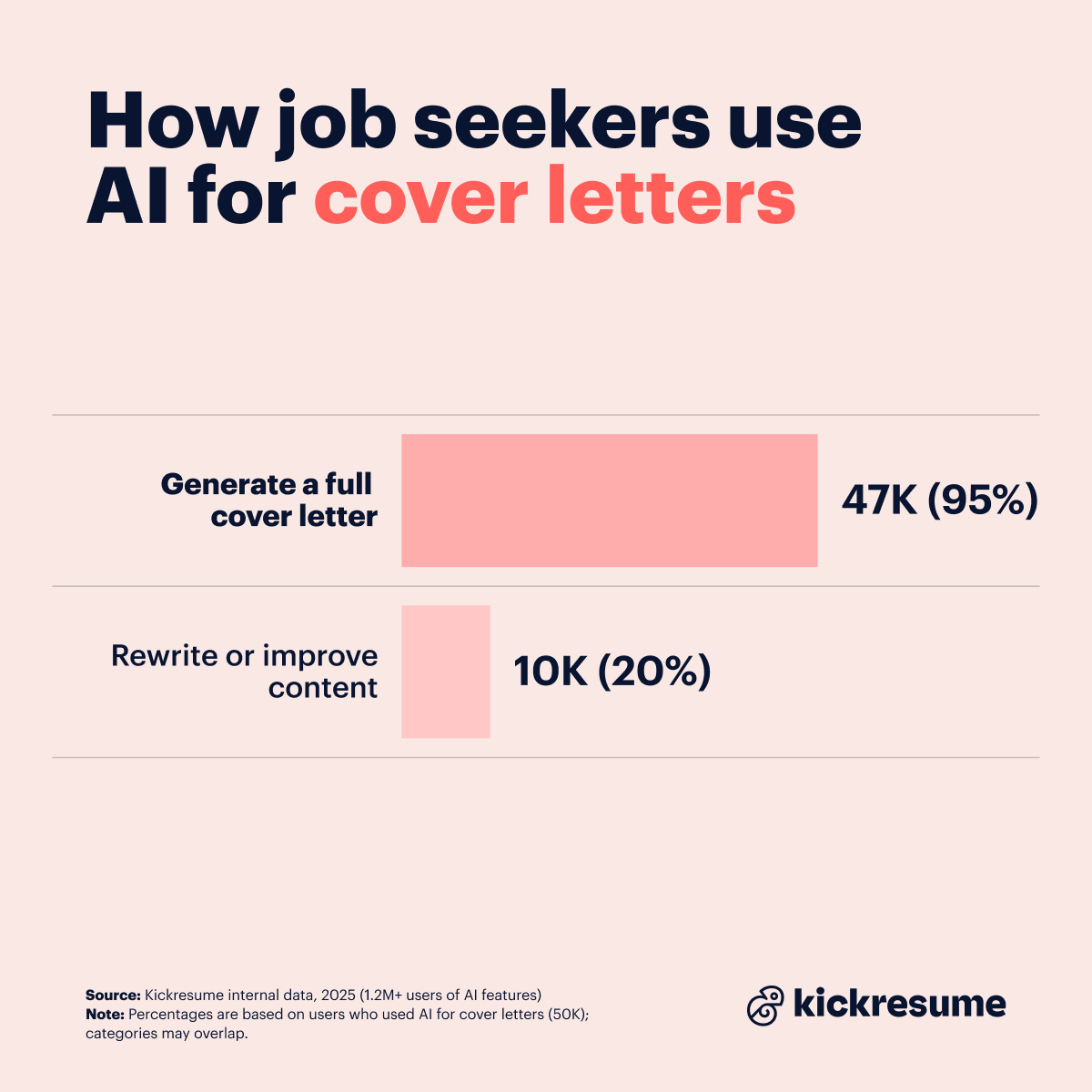
This suggests that, unlike resumes, cover letters are more often treated as a one-off task rather than something to iteratively refine.
AI use drops beyond applications — but shows different potential
While AI is widely used to create and optimize applications, its use becomes less common in later stages of the job search.
In 2025, around 18K people (around 2%) used AI to prepare for interviews, while only about 3K (well under 1%) used it for career guidance — making these the least common use cases overall.
These are smaller groups — but they represent a different type of usage.
Part of this difference may also come down to how these tools are structured. Resume-related features often cover multiple steps of the process, while interview preparation or career guidance are typically used as single, more focused features.
At the same time, according to HR expert Marta Říhová, candidates often underestimate how useful AI can be beyond just writing applications — especially when it comes to preparation and understanding what employers are actually looking for:
At the same time, how candidates approach preparation varies significantly — and often mirrors the overall quality of their applications.
Říhová also sees AI as a useful tool when it comes to broader career thinking — but mainly as a support, not the final decision-maker.
This suggests that AI can support not just execution, but also how candidates reflect on their experience and position themselves — even if these use cases are still less widely adopted.
Expert perspective: The biggest mistake is using AI without thinking
The data shows that AI is already widely used across the job search — especially for writing and optimizing applications. But how candidates use it matters just as much.
According to Marta Říhová, one of the biggest mistakes is over-reliance on AI in situations where individual thinking matters most:
Instead of replacing effort, AI should be used to improve it.
Here are some of the most effective ways to use AI in the job search, according to Říhová:
- Compare your CV with a specific job description: Put the two side by side and use AI to see what’s missing, what should stand out more, and where your experience doesn’t fully match the role.
- Use AI to better understand what the role and company require: It can help you understand what matters in the position or at the company — and what you should focus on when preparing for interviews.
- Use AI to support your preparation, not just to create content: It can help you think through how to present your experience and what to highlight in the hiring process.
- Be cautious when using AI in assignments or case studies: This can lead to very similar or generic outputs, making it harder to stand out.
- Use AI as a tool for reflection, not decision-making: It can be useful when thinking about career direction, but it shouldn’t replace your own judgment.
As Říhová puts it:
Final thoughts: AI is becoming part of every stage of the job search
AI is no longer just a tool for writing resumes — it’s increasingly used to review, improve, and optimize them before applying.
The data shows that more than 1.2 million people used AI-powered tools in 2025, with over 580K using them to write or improve resumes and more than 770K relying on AI to check their resumes for ATS compatibility — the most common use case overall.
At the same time, adoption varies significantly depending on the task.
While resume writing and ATS optimization dominate, other areas — such as cover letters (50K), interview preparation (18K), or career guidance (3K) — remain far less common. Although some job seekers are already using AI in these parts of the process as well.
As more people become familiar with these possibilities, AI could become a more natural part of the entire job search — not just application writing, but also preparation and career planning.
Methodology
This analysis is based on anonymized internal data from Kickresume, collected in 2025.
The dataset includes 1.22 million users who interacted with AI-powered features across resume writing, cover letter creation, interview preparation, and resume analysis tools.
Because users may use multiple AI features, categories in this report may overlap.
About Kickresume
Kickresume is an AI-based career tool that helps candidates source jobs and raise salary with powerful resume and cover letter tools, skills analytics, and automated job search assistance. It has already helped more than 8 million job seekers worldwide.