ChatGPT
 Perplexity AI
 Claude
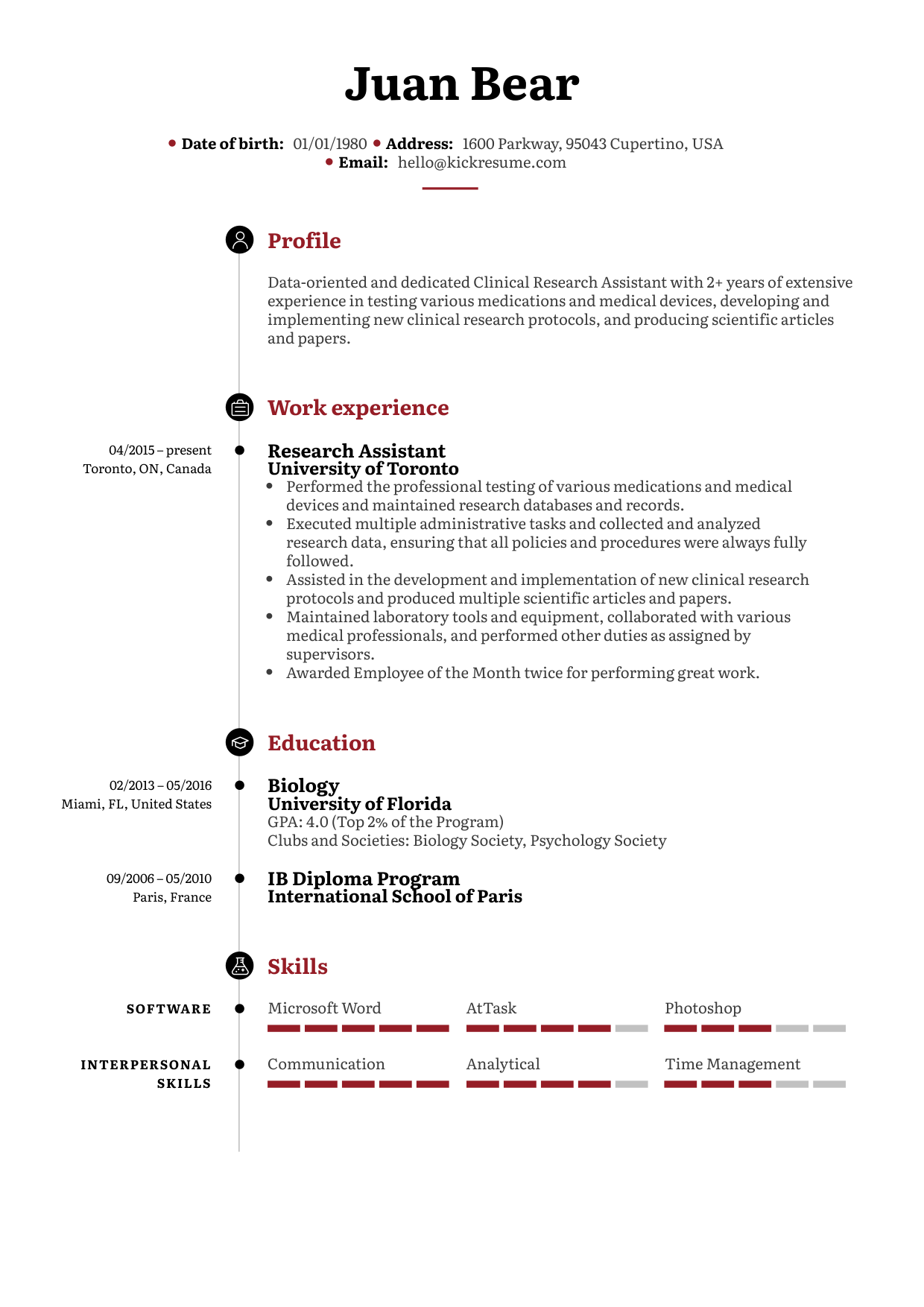
Are you having trouble crafting your natural sciences student resume? Don't worry, we've got you covered!
As a natural sciences student, it's essential to have a resume that not only showcases your understanding of the scientific field but also your abilities and talents within it. And don't worry in case you lack work experience, we'll show you how to create a great resume even without it.
That's why we've prepared this easy-to-follow guide, brimming with the best resume writing tips, plenty of detailed examples, inspiring resume samples, and functional templates.


 See more examples like these
Keep reading to learn all about:
- Resume dos and don’ts based on real-life natural sciences student resume samples
- How to pick the right resume format as a natural sciences student (with and without experience)
- How to format your natural sciences student resume (and keep it ATS-friendly)
- How to choose between a resume summary and a resume objective as a student
- Which technical and soft skills matter most on a natural sciences student resume
- How to write a work & relevant experience section when you have limited professional history
- How to make your education section stand out as a natural sciences student
- How to use optional sections (projects, coursework, publications, tools) to strengthen your resume
- Which action verbs work best for natural sciences resumes
- How to create a complementary cover letter that matches your natural sciences student resume
- Where to find the best resources when job-seeking as a natural science student
Still looking for a job? These 100+ resources will tell you everything you need to get hired fast.
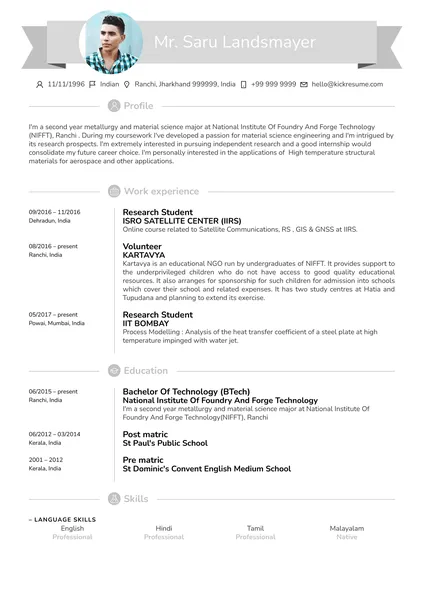
Research intern resume sample


Why this resume example works
- Real internship context with reputable organization: This resume shows a clear link to Carbon Trust, a known research-oriented institution, that signals credibility and purpose to employers looking for research-oriented candidates.
- Multiple relevant academic & volunteer research entries: The candidate includes several research student roles (e.g., at ISRO Satellite Center and IIT Bombay) even though they are still early in their academic journey. This communicates commitment to scientific work.
- Shows breadth of activities beyond coursework: The resume highlights involvement in an educational NGO and ongoing research modelling projects, which helps convey initiative, teamwork, and real contributions to project goals, not just classroom learning.
What could be improved
- Lack of quantified impact: There are strong experience entries, but they largely describe roles without emphasizing measurable outcomes (e.g., data collected, results analyzed, experiments completed). Adding numbers or concrete deliverables would boost impact.
- Skills section is generic/not tailored to science: The skills listed include general software (Adobe, Word) and broad programming languages, but scientific resumes should spotlight lab techniques, data analysis tools, statistical software, instruments, or scientific methodologies that are relevant to research positions.
- Profile could be more concise and targeted: The opening statement is narrative but could focus more on the candidate’s research strengths, technical competencies, and a clear objective (e.g., “seeking research intern role focusing on thermal materials testing and data analysis”). This would align it better with recruiter expectations for scientific resumes.
PhD student resume sample

Why this resume example works
- Clear research orientation with real projects: The resume highlights multiple internship experiences at a research center (e.g., Cancer Research Centre Lyon), showing the candidate’s long-term engagement in scientific inquiry, and that is exactly what academic or research-lab roles seek.
- Shows progression and breadth of experience: This candidate includes roles beyond internships (teaching, pharmacy), which demonstrates adaptability and a broad scientific foundation, which is valuable for multidisciplinary research positions and academic settings.
- Includes technical skills relevant to natural sciences: Skills such as Western Blotting, RT-PCR, CRISPR/Cas9 techniques, flow cytometry, and related laboratory competencies immediately convey domain-specific expertise that can set the resume apart.
What could be improved
- Focus on impact and outcome: While the experience section lists many roles and projects, the resume would benefit from more quantified contributions (e.g., key findings, experiment results, efficiencies gained, data volumes processed) to make achievements more concrete.
- Skill section includes generic descriptors: Alongside strong technical lab techniques, the resume lists soft traits like “Punctual” or “Hard Working”. These are subjective and less impactful compared to measurable competencies or tools (e.g., software, instruments, analytical methods).
- Ordering could better reflect current goals: For a PhD student, placing research experience and publications/presentations higher in the layout, ahead of older roles such as teaching or pharmacy work, would align the resume more effectively with research-focused objectives (e.g., academic or lab careers).
University student resume sample

Why this resume example works
- Clean, beginner-friendly structure: The layout is easy to scan with clearly labeled sections (Education, Experience, Skills), which is ideal for hiring managers reviewing student resumes with limited experience.
- Highlights academic experience and leadership: Including a Student Network Manager role and leadership activities helps show initiative, teamwork, and responsibility, which are the traits employers value even when technical experience is limited.
- Includes measurable accomplishments: The resume includes quantifiable results (e.g., “oversaw 15 project teams,” “managed events with 100+ attendees”) which strengthens credibility and gives context to the student’s contributions.
What could be improved
- More domain-specific skills needed: For a natural sciences focus, the skills section could better highlight scientific competencies, lab tools, analytical methods, or coursework relevant to STEM fields, rather than general tasks like event organization or customer engagement.
- Work/volunteer experience lacks research context: Current non-science entries (e.g., network manager) are useful for transferable skills, but adding science-related projects or internships would make the resume more targeted to research and lab-based roles.
- Education section could include coursework or labs: Listing major courses, lab modules, GPA, thesis topic, or academic projects under the Education section would make academic preparation more visible and relevant to science-focused opportunities.
1. How to choose the correct resume format as a natural sciences student
The first big decision to make when writing a resume is what format to use. As a current student, you may have a varying level of formal work experience, which can affect which format is best for you.
Here is a breakdown of the 3 main types of resume formats:
- The Reverse-Chronological Resume: The reverse-chronological format is focused almost entirely on work experience, listing your most recent job first and working backward from there. While this format is often the standard expected by most employers, it is only effective when you have an adequate amount of relevant work experience to describe.
- The Functional Resume: The functional resume format removes the focus from work experience and places it instead on education, skills, and unpaid experience. This is often the best format for current students, as it allows you to focus more heavily on your academic experience and achievements.
- The Hybrid Resume: The hybrid resume is a combination of the reverse-chronological and functional formats, spreading out the focus of the document between all sections. This resume is a good choice for applicants who have a mix of both academic and professional experience.
As you progress further into your scientific career, you may find yourself in need of a longer-form resume that details your entire academic and professional history. This is known as a Curriculum Vitae, or CV, and is used when applying for high-level positions in science or academia.
Pro tip
If you’re applying for a job through an Applicant Tracking System (ATS), go with the reverse-chronological format whenever possible. Many ATS programs struggle with purely functional resumes, which can cause your application to get filtered out even before a human recruiter. But remember: Always read the job ad carefully! If the employer asks for a traditional resume, stick with reverse-chronological, even if you’re early in your management journey.
Try our AI Resume Writer and have your resume ready in minutes!

2. How to optimize your natural sciences resume for ATS scanners
Applicant Tracking Systems (ATS) don’t read resumes like humans do. They scan for keywords, job titles, skills, and terminology pulled directly from the job posting. Research labs, biotech companies, environmental organizations, universities, and even internship programs often use ATS filters long before a recruiter or professor sees your resume.
To increase your chances of passing ATS screening:
- Mirror keywords from the job posting: If a posting mentions “PCR techniques,” “data analysis,” or “lab safety,” use these terms naturally (and honestly) in your resume if they apply to you.
- Include field-specific terminology: STEM resumes perform better when they include technical language such as:
- Lab techniques (PCR, spectroscopy, microscopy, cell culture)
- Software (R, Python, MATLAB, SPSS, Prism, GIS tools)
- Research skills (experimental design, data collection, literature review)
- Avoid graphics, icons, tables, and skill bars: Many ATS tools can’t read them correctly and may skip key information like skills or education.
- Don’t stuff keywords or hide them: “White text” tricks or dumping buzzwords can trigger rejection instead of helping.
- Use recognizable job titles: If your internship or research role had a unique internal title, consider adding a more standard equivalent in parentheses (e.g., “Undergraduate Research Assistant (Biology Department)”).
- Save in PDF or DOCX format: These parse best unless the job posting requests a specific file type.
Use ATS-friendly templates to save time
Kickresume’s templates are optimized for both academic and internship applications, so your resume remains clean, structured, and easy for both ATS tools and human reviewers to scan.
Find out your resume score!

3. How to choose between a resume summary and a resume objective as a natural sciences student?
As a student or early-career applicant, you can start your resume either with a resume summary or a resume objective. Both work, but they serve slightly different purposes depending on how much experience you already have.
A resume summary is a brief introductory statement at the beginning of a resume. In this statement, applicants should strive to include compelling details that catch the eye of potential employers and help them to stand out from the competition.
To better illustrate how to write an effective resume summary as a natural sciences student, here is an example of a weak summary, followed by a correction and explanation:
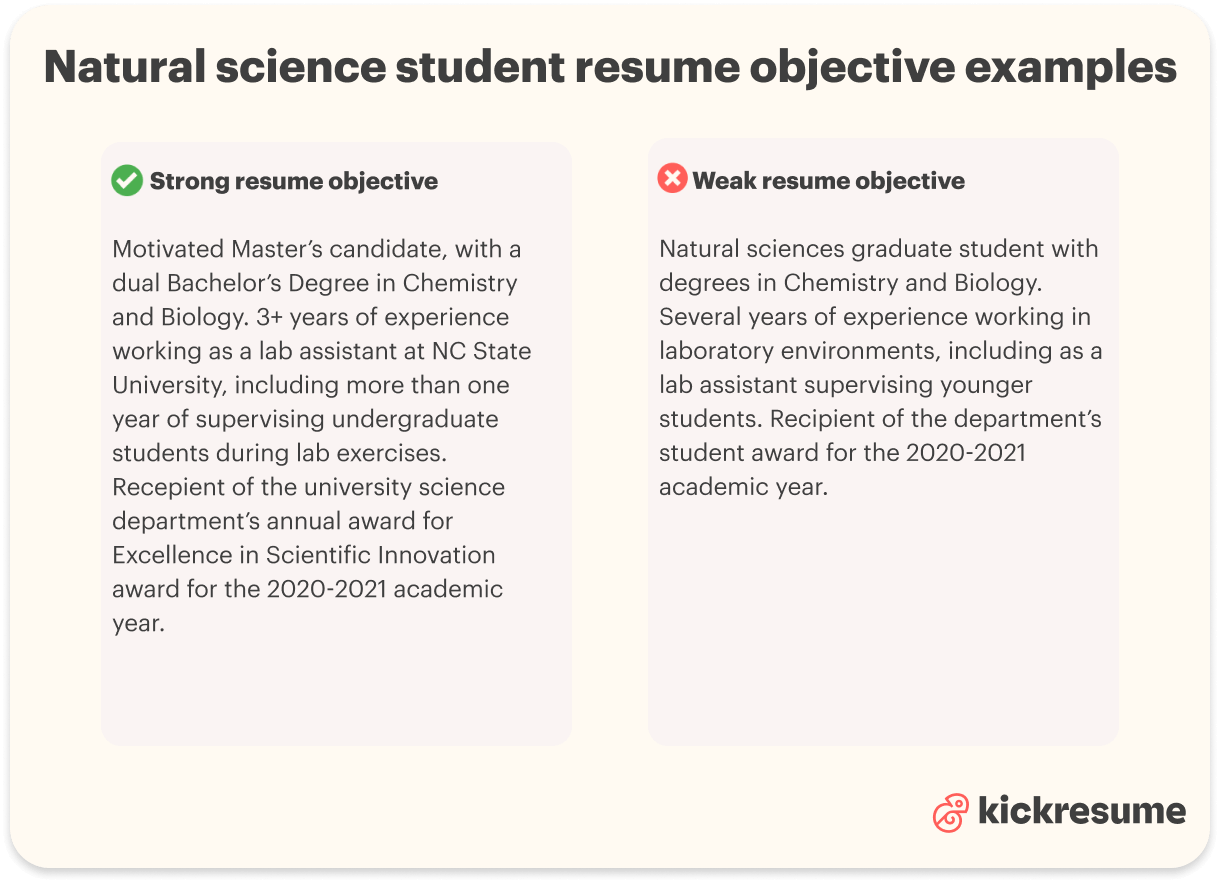
Bad natural sciences student resume summary example
Natural sciences graduate student with degrees in Chemistry and Biology. Several years of experience working in laboratory environments, including as a lab assistant supervising younger students. Recipient of the department’s student award for the 2020-2021 academic year.
Why is this resume summary bad? Whenever you write a resume summary, you want it to be as specific and attention-grabbing as possible. Think of it as a narrative hook – your summary should be a compelling statement that encourages employers to read on. This example could be significantly improved with better and more quantifiable details, such as the applicant’s university name and the specific name of the award they won.
Good natural sciences student resume summary example
Motivated Master’s candidate, with a dual Bachelor’s Degree in Chemistry and Biology. 3+ years of experience working as a lab assistant at NC State University, including more than one year of supervising undergraduate students during lab exercises. Recepient of the university science department’s annual award for Excellence in Scientific Innovation award for the 2020-2021 academic year.
Why is this resume summary good? In this example, the applicant is far more precise with the details they provide. Not only do they name the university they attend, but they also give more formal titles for their degrees and the exact name of the award they received. Additionally, they are more specific when discussing their experience as a lab assistant and supervisor.
Use a resume summary if you already have some experience
A summary works best when you can refer to things you’ve already done, such as:
- Research assistantships
- Lab internships
- Student projects or thesis research
- Tutoring or teaching support roles
- Relevant volunteer or academic work
In that case, your summary should briefly highlight:
- Your degree program + specialization
- Relevant tools or technical skills (e.g., microscopy, MATLAB, PCR)
- Notable academic achievements (awards, publications, conferences)
- What type of role you’re targeting (lab, research, analytical, etc.)
Use a resume objective if you’re still early in your program
An objective makes more sense if you:
- Don’t yet have research or lab experience
- Are applying to internships or entry-level roles
- Are transitioning between scientific subfields
- Want to explain your academic focus or research interests
Objectives often describe your goals and direction, rather than past experience. This helps give hiring managers context, especially when applying to competitive labs or internship programs.
Pro tip: Simple rule of thumb
- Summary = what you’ve already done
- Objective = what you aim to do
Quick examples of natural science student resume summaries
Bad example
Looking for a job in science. Hard-working and motivated. Want to gain experience.
Why this doesn’t work: It’s vague, doesn’t say what kind of science, and doesn’t tell the reader anything useful about skills, goals, or academic focus.
Good resume objective (early student)
Second-year Biology student interested in molecular biology and wet lab techniques, seeking an internship to build skills in PCR, DNA extraction, and microscopy. Motivated to contribute to ongoing lab research while developing hands-on experience in experimental design.
Good resume objective (more experienced student)
Master’s candidate in Geoscience with 1+ year of research experience analyzing sediment core samples using R and ArcGIS. Completed a funded thesis project on coastal erosion mapping and presented findings at the GSA regional conference. Seeking a research internship in environmental data analysis or field-based geomorphology.
4. Which key natural science skills to include on your student resume
No matter what discipline you study, whether it's chemistry, biology, physics, geology, or environmental sciences, your resume should highlight a mix of technical and interpersonal skills (hard skills vs. soft skills).
Technical skills (often called hard skills) reflect what you’ve learned through coursework, labs, and research: experimentation, analysis, documentation, tools, or software.
Interpersonal skills (soft skills) reflect how you collaborate, communicate, and approach scientific problem-solving, all of which matter in lab settings, group projects, and research environments.
Below are examples of skills that work well for natural sciences students:
Best technical skills for a natural science student resume
- Research methods & experimental design
- Data collection & data analysis
- Laboratory techniques & instrumentation
- Quality control & sample preparation
- Laboratory safety & compliance standards
- Report writing & scientific communication
- Product testing & validation
- Sample collection & preservation
- Measurement & calibration
- Administrative & documentation skills
Effective interpersonal skills for natural science students
- Problem-solving & critical thinking
- Collaboration & teamwork
- Curiosity & scientific inquiry
- Creativity & experimentation mindset
- Time management & prioritization
- Adaptability & flexibility in lab settings
- Persistence & perseverance
- Strong verbal and written communication
- Leadership (especially in group projects)
- Mathematics & quantitative reasoning
Note: It's always important to mention the skills listed in the job posting. You can always use Kickresume's Resume Tailoring tool to do it for you, effortlessly.
5. How to write the work experience section as a natural sciences student
The work experience section looks different for students than for mid-career professionals. Many science students apply to internships, lab assistant roles, or fieldwork before they’ve had a “real job”, and that’s completely normal.
If you already have hands-on experience from labs, research projects, or internships, list it the same way you would list a job:
- Role title (e.g., Laboratory Intern, Research Assistant, Tutor)
- Organization / lab / university
- Dates
- Bullet points showing what you did + what you achieved
Example of a natural sciences student internship entry
Example of a natural sciences student internship entry
Chemical Laboratory Intern — McCall Cosmetics Lab, Birmingham, AL
June 2020 – December 2020
- Assisted scientists with mixing and testing formulas according to precise measurements.
- Followed laboratory safety standards and co-created updated safety diagrams, contributing to a 10% reduction in lab-related incidents.
- Managed inventory of non-toxic chemicals and handled daily reporting for replenishment.
Why does this work? Because it shows tools, techniques, safety, precision, documentation, and impact, which are all attractive for scientific roles.
What if you have no work experience yet?
In that case, we have got some good news for you! Science resumes don’t rely solely on formal jobs. Students can fill this section with equivalent experience that still proves their scientific skills and discipline.
You can include:
- Lab coursework (especially wet-lab or computational)
- Capstone projects or thesis work
- Research projects (solo or group)
- Fieldwork or field courses
- University clubs or academic societies
- Volunteer roles
- Tutoring or peer mentoring
- Graduate teaching/assistant work
- Conference participation or poster presentations
Example (no traditional job experience)
Undergraduate Research Project — Molecular Biology, UNC Chapel Hill
2023 – Present
- Conducting PCR and gel electrophoresis experiments to analyze plant DNA samples.
- Recorded observations and documented results using standardized lab notebooks and digital spreadsheets.
- Collaborated with a 4-member team to present findings at the campus research fair.
Another example (non-science job -> scientific value)
Barista — Starbucks, Raleigh, NC
2022 – 2023
- Maintained quality control standards and precise preparation protocols during fast-paced shifts.
- Improved order accuracy by implementing a labeling system adopted by the shift lead.
- Balanced cash handling and customer communication while meeting tight time constraints.
Why include this? Because it shows attention to detail, protocol compliance, teamwork, time management, accuracy, and customer-facing skills, all of which translate well into labs, research, and academia.
What recruiters look for in early science resumes
Even without a formal job, they want to see signs of:
- Curiosity + initiative
- Ability to learn lab or analytical techniques
- Scientific communication skills
- Persistence + experimental mindset
- Precision + documentation
- Accountability + teamwork
These are extremely valuable in research environments.
Pro tip (very important)
If you’re writing your first-ever resume or applying with zero professional experience, check out our full guide on how to build a strong resume without work history.
6. How to make your education section stand out (especially if you’re still a student)
For most natural sciences students, the education section is the main showcase of your academic foundation, lab exposure, and research potential. Unlike in many business or retail careers, science employers fully expect students to be “in progress”, so the key is to present your academic work clearly and professionally.
If you’re still studying, make sure to include:
- Degree level + major(s)
- Institution name
- Expected graduation date
- Concentrations or tracks (if relevant)
- Honors, awards, or academic achievements
- Relevant coursework (only if it adds value)
- Lab training, research experience, or projects (optional but powerful)
Here’s what a science-focused education section might include:
- Degree level: B.S., B.A., M.S., Ph.D., or dual major
- Specialization or concentration: Molecular Biology, Environmental Chemistry, Geoscience, etc.
- Academic honors: Dean’s List, honors program, scholarships, awards
- Research-intensive electives: Helps compensate for limited job experience
- Capstone, thesis, or dissertation: Especially important for Master’s and Ph.D. students
- Lab training or safety certifications: e.g. BSL-2 training, animal handling, radiation safety, chemical waste procedures
- Relevant STEM coursework: Particularly useful for internships or entry roles
Education section example (undergraduate in progress)
B.S. in Biology
University of Hawai’i at Hilo
Expected Graduation: May 2024
Honors: Dean’s List (2021–2023)
Relevant Coursework: Molecular Genetics, Cell Biology, Organic Chemistry II, Biochemistry, Ecology
Education section example (graduate-level)
M.S. in Environmental Science
University of Michigan — Ann Arbor
2022–Present
Thesis: Modeling heavy metal distribution in freshwater sediment ecosystems
Research Focus: Geochemical analysis, field sampling, environmental data modeling
Awards: NSF Graduate Research Fellowship (2023)
If you have minimal work experience, use education to compensate
A student without past jobs can still signal strong academic value through:
- Research labs
- Capstone projects
- Cass projects with real datasets
- Summer programs
- Coursework with fieldwork or lab components
- Academic competitions
- Poster presentations or conferences
These are absolutely valid substitutes for “experience” in a science resume.
Pro tip
If you’re applying to internships, labs, or research assistantships, mentioning specific techniques or instruments under your education or coursework section can instantly make you more competitive. For example:
- PCR amplification
- Spectrophotometry
- GIS mapping
- Histology preparation
- Chromatography
- MATLAB or R data analysis
These also serve as “keywords” that recruiters, professors, and ATS systems actively look for.
What if you’re switching science fields?
If you’re transitioning (e.g. chemistry -> biomedical), emphasize coursework and transferable lab/analysis skills. Fields in natural sciences often overlap more than students assume.
7. Which action verbs to use to strengthen your natural sciences student resume
The verbs you choose matter more than most students realize. In scientific resumes, the difference between “helped in the lab” and “performed spectrometry analysis” is huge, as one sounds vague and junior, the other shows real technical skill.
Action verbs make your experience sound:
- Precise
- Proactive
- Technical (when needed)
- Research-oriented
- Result-driven
Compare:
Before including action verbs
Helped with experiments in the biology lab.
After including action verbs
Conducted PCR-based experiments and documented results to track gene expression changes.
Same experience, but including action verbs leaves a much stronger impression.
Best action verbs for natural sciences resumes
Lab work & experimentation action verbs
- Conducted
- Performed
- Prepared
- Mixed
- Cultured
- Tested
- Measured
- Synthesized
- Isolated
- Assembled
Data & analysis action verbs
- Analyzed
- Interpreted
- Modeled
- Quantified
- Evaluated
- Calculated
- Tracked
- Compared
- Predicted
- Reported
Research & scientific inquiry action verbs
- Investigated
- Researched
- Observed
- Identified
- Hypothesized
- Validated
- Verified
- Implemented
- Experimented
- Assessed
Documentation & compliance action verbs
- Recorded
- Documented
- Organized
- Catalogued
- Standardized
- Logged
- Filed
- Updated
- Maintained
- Ensured compliance
Collaboration & academic teamwork action verbs
- Collaborated
- Coordinated
- Assisted
- Mentored
- Supported
- Presented
- Communicated
- Contributed
- Facilitated
- Partnered
Impact & results action verbs
- Improved
- Reduced
- Increased
- Optimized
- Enhanced
- Streamlined
- Accelerated
- Refined
Examples of before/after including action verbs for natural science students resumes
Example 1:
Before
Helped with lab prep and equipment setup.
After
Prepared laboratory equipment and calibrated devices to ensure accurate experimental measurements.
Example 2:
Before
Worked with data from experiments.
After
Analyzed experimental datasets using statistical methods to identify patterns in material degradation.
Example 3:
Before
Did fieldwork with classmates.
After
Collected and catalogued geological samples across multiple field sites for environmental impact analysis.
Pro tip - A quick reminder on balance
Don’t force technical verbs everywhere. A resume that reads like a dense lab manual can make communication skills disappear. Mix technical verbs with collaboration-oriented verbs to show range.
Science is about curiosity + rigor + teamwork, therefore, your resume should reflect all three.
8. Which optional sections to add to your natural science student resume
Once you’ve covered the core sections (summary, skills, experience, and education), consider adding optional sections, but only if they genuinely strengthen your application.
In science resumes, optional sections can be a huge advantage because they let you highlight academic achievements, research involvement, or technical exposure that doesn’t fit neatly into work experience.
Add optional sections if:
- You have academic achievements worth showcasing
- You’ve participated in research, lab work, or fieldwork
- You’ve completed technical or scientific certifications
- You’ve presented, published, or competed in academic settings
- You’ve worked on capstone or independent projects
Skip optional sections if:
- You’re adding unrelated hobbies to fill space
- Achievements are outdated or from early high school
- Certifications don’t relate to science, research, or lab environments
- Information repeats what you already listed elsewhere
Useful optional sections for natural sciences student resumes
Below are the optional categories that typically add the most value for science students:
Research experience
Especially useful if you’re applying for:
- Lab internships
- Research assistant roles
- Graduate programs
- Academic fellowships
Examples of what to include:
- Name of lab or department
- Research focus or topic
- Methods or tools used
- Datasets or organisms studied
- Brief outcomes or results (if possible)
Projects & capstones
Projects can stand in for “experience” when you’re early in your academic path.
Strong project bullets often include:
- Scientific question/problem
- Techniques or methods used
- Results or findings (even small ones)
- Collaboration or presentation aspects
Certifications & lab training
These matter a lot in natural sciences because they signal lab-readiness and safety compliance.
Examples include:
- Laboratory Safety (BSL-1 / BSL-2)
- Hazardous Waste Management (RCRA)
- Radiation or Chemical Safety
- Animal Handling (IACUC)
- GIS certification
- CPR/First Aid (for field-based research)
Awards & academic achievements
Adding your awards and achievements is great for highlighting academic strength, curiosity, or initiative.
Examples include:
- Dean’s List
- Scholarships & fellowships
- Science fair awards
- Honors societies
- Academic competition placements
Technical tools & instrumentation
Labs love seeing familiarity with specific tools/software, even if you weren’t the primary operator.
Examples include:
- PCR / Gel Electrophoresis
- Chromatography instruments
- Microscopy
- MATLAB, R, Python
- GIS tools
- SPSS / STATA / JMP
Publications & presentations
More relevant for Master’s and PhD students, but even poster sessions count.
Examples include:
- Conference posters
- Symposium presentations
- Undergraduate research showcases
- Preprints or journal submissions (if applicable)
Professional affiliations & student societies
Shows interest, initiative, and community engagement.
Relevant examples:
- American Chemical Society (ACS)
- Society for Physics Students (SPS)
- Geological Society of America (GSA)
- Environmental Science Student Association
- Biology Club
Volunteering
Volunteering work is especially impactful if science-related (museum, outreach, tutoring) or field-relevant.
Examples:
- Science outreach programs
- STEM tutoring or mentoring
- environmental cleanups
- Museum or nature center volunteering
Example of optional sections in a science student resume
Certifications & training
- BSL-2 Laboratory Safety Certification, 2023
- Chemical Waste Handling (RCRA), 2022
Research projects
- Capstone project on heavy metal contamination in freshwater ecosystems using ICP-MS analysis
Awards
- Dean’s List, Fall 2021 – Spring 2023
- Undergraduate Research Scholarship, 2023
Technical tools
- PCR, Gel Electrophoresis, Spectrophotometry, MATLAB, R, GIS
But remember: The goal isn’t to list everything you’ve ever touched in a science lab. The goal is to highlight what aligns with the internships, labs, or programs you’re applying for.
.png)
9. Common mistakes natural sciences students should avoid
You’ve put in the work. You’re earning your degree, building research skills, and gaining exposure to labs, coursework, or fieldwork. The last thing you want is for avoidable resume mistakes to undermine all of that.
Below are the most common pitfalls to watch out for when creating a natural sciences student resume, and how to avoid them:
- Typos, formatting issues, and unclear writing: Science environments rely heavily on precision and clarity. Small mistakes can signal carelessness or poor attention to detail, which are both red flags in lab settings.
How to fix it: Proofread, use consistent formatting, and read your resume aloud. If you want an extra layer of polish, consider professional proofreading. - Making the resume purely task-based: Listing duties like “Completed lab exercises” or “Assisted professor” doesn’t show impact.
How to fix it: Add context or outcomes: methods used, tools or instruments involved, procedures learned, skills developed, improvements or results (even small ones) - Ignoring transferable experience: Students often skip part-time work because it isn’t “scientific”, but roles with customer interaction, teamwork, communication, or responsibility can be extremely valuable.
How to fix it: Highlight transferable traits such as: problem-solving, organization, reliability, time management, communication - Not tailoring the resume to the goal: A resume for a lab internship will differ from one for an environmental field project or graduate program.
How to fix it: Reflect keywords, tools, and themes from the job posting or program description. - Omitting technical tools, methods, or coursework: In science roles, knowing the right techniques can matter as much as having experience.
How to fix it: Add sections for relevant: coursework, lab skills, tools & software, certifications, safety training - Using vague, generic language: Phrases like “worked in lab,” “did research,” or “helped with experiments” don’t tell the reader much.
How to fix it: Be specific about what you worked on, even if it feels small or academic. - Forgetting about ATS keywords: Many university labs, companies, and research institutions use Applicant Tracking Systems to filter candidates.
How to fix it: Echo keywords from the posting naturally, e.g.: PCR, chromatography, microscopy, spectroscopy, GIS, MATLAB, environmental sampling - Adding irrelevant details: Unrelated hobbies, very early high-school achievements, or long personal statements can distract from your strongest points.
How to fix it: Keep the resume focused and concise, ideally one page for students. - Weak or outdated contact information: A non-professional email address or incorrect phone number can cost you interviews.
How to fix it: Use a clean academic or personal email (e.g. firstname.lastname@domain.com) and make sure everything works. - Skipping optional sections that matter: For students, optional sections like projects, certifications, research, awards, or technical tools often carry more weight than work experience
Take one final pass with these mistakes in mind. A few quick adjustments can make your resume feel more polished, more scientific, and more competitive, even if you’re still early in your academic journey.
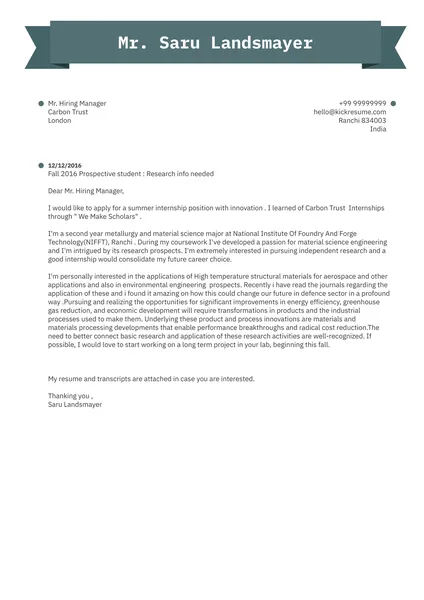
10. How to create a complementary and matching cover letter for your resume
Your resume shows what you’ve done so far: coursework, projects, research exposure, lab skills, and relevant experience.
Your cover letter explains how you think, how you approach science, and why you’re interested in this particular lab, program, or organization.
While a resume leans heavily on bullet points, tools, and methods, the cover letter is your chance to:
- Give context to your academic interests
- Explain what motivates you in a specific scientific field
- Highlight relevant projects or research exposure
- Show enthusiasm for the role, lab, or research area
- Connect your skills to the opportunity you’re applying for
What should a natural sciences student cover letter accomplish?
A strong cover letter should answer:
- Who are you as a student researcher or emerging scientist?
- What scientific interests or disciplines are you drawn to (and why)?
- What relevant coursework, tools, or research experience have you gained (with 1–2 examples)?
- Why are you interested in this specific internship, lab, or organization?
- What do you hope to contribute or learn?
Instead of repeating your resume bullet points, use the cover letter to add narrative and direction:
Narrative example for your natural science student cover letter
During my Molecular Biology coursework, I became particularly interested in gene regulation and CRISPR mechanisms. This interest led me to a semester-long project where I assisted with gel electrophoresis-based assays and data documentation. I would welcome the opportunity to further develop these skills within your research team, particularly in a setting that blends molecular techniques with applied clinical outcomes.
This gives hiring managers, researchers, or program coordinators a sense of curiosity, initiative, and fit, which are qualities that matter just as much as GPA or lab skills.
How is a cover letter different from a resume (especially for students)?
Resume:
Structured, concise, built around bullet points, coursework, tools, software, and achievements.
Cover letter:
4–6 short paragraphs that communicate motivation, scientific interest, and academic direction.
Your resume shows you’re qualified.
Your cover letter shows why you want this opportunity, at this place, and at this moment in your academic journey.
How to make your cover letter and resume look like a set
Even for students, visual consistency signals professionalism and attention to detail. Those are the traits that matter in both research and lab environments.
To align your documents:
- Use the same header (name, email, phone, location, LinkedIn/website)
- Match fonts and spacing
- Keep layout simple and readable
- Use the same accent color (if any) for headings or subheadings
- Avoid overly stylized designs, because clarity is valued in scientific fields
Kickresume offers resume templates with matching cover letter templates, so you can submit a cohesive application without extra formatting work.
A consistent set of documents makes your application feel intentional, polished, and easier to evaluate, especially when applying to competitive labs, research internships, or academic programs.
Create your cover letter fast with artificial intelligence.

11. Top resources for job-seeking natural sciences students
Let's be honest, trying to secure a job as a student is not an easy task! That's why you should know where to look for opportunities that fit your current career stage. For example, you can start by checking what these resources have to offer:
- Job boards for freshers: If you're looking for an internship or your very first job, make sure to visit websites like WayUp, Handshake, Prospects.ac.uk, or JobTeaser.
- General job search platforms: You can also find compelling job postings on platforms that don't cater to freshers specifically. For instance, engines like Indeed, SimplyHired, Glassdoor, or LinkedIn publish an impressive amount of new opportunities daily.
- Professional associations: Based on your specialization, you can turn to organizations such as the American Chemical Society (ACS), the Geological Society of America (GSA), the Society of Physics Students (SPS) for job listings, internship programs, or the latest industry insights.
- Research institutions: Instead of using third parties, you can contact institutions like the Natural History Museum, the Smithsonian Institution, and the Scripps Research Institute directly. There's no harm in speculative job applications!
- Specialized publications: If you want to impress recruiters during job interviews, keeping up with the latest industry insights, developments, and findings is a must! That's why you should pay attention to media like “Cell,” “Journal of Experimental Biology,” and “Physics Today.”
- Continuous learning: Lastly, you shouldn’t rest on your laurels when it comes to your education. Gaining new skills through learning platforms like Coursera, edX, Udemy, or Khan Academy can bring you closer to getting hired.
Don't be afraid to reach out to potential employers with a friendly email or apply even if you feel a bit underqualified! After all, every application is a step forward and a chance to improve. Remember, each connection you make is a door that could lead to exciting possibilities. Stay curious, stay positive, and enjoy the journey!
Student Career Outlook in 2026
Choosing the right university in 2026 isn’t just about prestige. It’s about employability. As AI tools and automation takes over more entry-level tasks, getting hired straight out of school is tougher, and universities that focus on real-world experience and industry links give graduates an edge.
For the 15th year, the Global University Employability Ranking 2026 by Times Higher Education highlights the universities worldwide that employers believe produce the most employable graduates.
It’s based entirely on votes from international employers and hiring managers, with insights from more than 13,000 recruiters worldwide.
Here are the top 10 universities for employability in 2026:
- Massachusetts Institute of Technology (MIT), US
- Stanford University, US
- Stanford University, USCalifornia Institute of Technology (Caltech), US
- University of Cambridge, UK
- University of Oxford, UK
- University of California, Berkeley, US
- Harvard University, US
- National University of Singapore, Singapore
- Imperial College London, UK
- ETH Zurich, Switzerland
You can find the full ranking including all 250 universities here.
Natural Sciences Student Resume FAQ
How can I make my involvement in student organizations or clubs benefit my resume?
Participation in relevant student organizations, clubs, or societies can make your resume stand out! Describe your role and any particular achievements, such as organizing events, leading projects, or increasing club membership. Always convey how these experiences have helped you develop valuable skills such as leadership, teamwork, and project management.
What can I include in my resume if I have limited work experience?
Take advantage of any internships, volunteer work, or part-time jobs that demonstrate your skills and work ethic. Go into detail describing your responsibilities and achievements in these roles that are relevant to the job you're trying to secure. Also, mentioning academic and personal projects on your first resume can show your initiative and passion for the field.
How can I use quantifiable data to enhance my natural scientist resume?
Whenever possible, quantify your achievements with data and statistics to provide concrete evidence of your abilities and impact. For example, you might include details such as the number of experiments you conducted, the percentage improvement of a process you developed, or the amount of funding you secured for a project.
What are common mistakes to avoid when writing a natural scientist resume?
First and foremost, don’t overcrowd your resume with too much information; instead, focus on relevance and clarity. Always proofread your resume multiple times to avoid any typos or grammatical errors, as these can make you look careless. And, of course, always tailor each resume to align as closely as possible to the job posting you're currently responding to.
Which skills should I include on my natural scientist student resume?
Focus on skills that are most relevant to the job you're applying for. You can include technical skills such as laboratory techniques, field research methods, and proficiency with scientific software or instruments. But don't forget to showcase your soft skills like problem-solving, critical thinking, and communication too! These are all essential in research and teamwork.






![How to Write a Professional Resume Summary? [+Examples]](https://d2xe0iugdha6pz.cloudfront.net/article-small-images/How_to_Write_a_Professional_Resume_Summary_.png)
![How to List Your Education on a Resume? [+Examples]](https://d2xe0iugdha6pz.cloudfront.net/article-small-images/How_to_Put_Education_on_a_Resume_.png)
![How to Describe Your Work Experience on a Resume? [+Examples]](https://d2xe0iugdha6pz.cloudfront.net/article-small-images/How_to_Describe_Your_Work_Experience_on_a_Resume_.png)