ChatGPT
 Perplexity AI
 Claude
A well-written insurance agent cover letter sample can quickly show you what actually resonates with hiring managers, and what helps an application stand out instead of blending in with dozens of others.
This guide walks you through real insurance agent cover letter samples, practical writing advice, and clear examples that demonstrate how to communicate your sales abilities, client-first approach, and understanding of the insurance industry in a professional and credible way. Whether you’re preparing your first insurance cover letter or refining one after years of working with clients and policies, you’ll find guidance with expert tips tailored to your level of experience.


 See more examples like these
Keep reading to learn:
- How to analyze real insurance agent cover letter samples and apply what works
- Which formatting choices make insurance cover letters easier to scan and more professional
- How to write a clear, credible cover letter header for insurance roles
- Why a strong headline can instantly improve your first impression
- How to choose the right greeting (and what to use when no name is listed)
- How to introduce yourself without sounding generic or overly salesy
- Which insurance-related skills and strengths to highlight first
- How to use action verbs to sound confident, not robotic
- How to close your cover letter in a persuasive, professional way
- The most common insurance agent cover letter mistakes (and how to avoid them)
- Why your cover letter and resume should work together visually
- Where to find the best resources for insurance agent job seekers
- Average salary expectations and job outlook for insurance professionals
Still looking for a job? Our in-depth cover letter and resume guides, along with practical career tools, can help you move from application to interview faster and with more confidence.
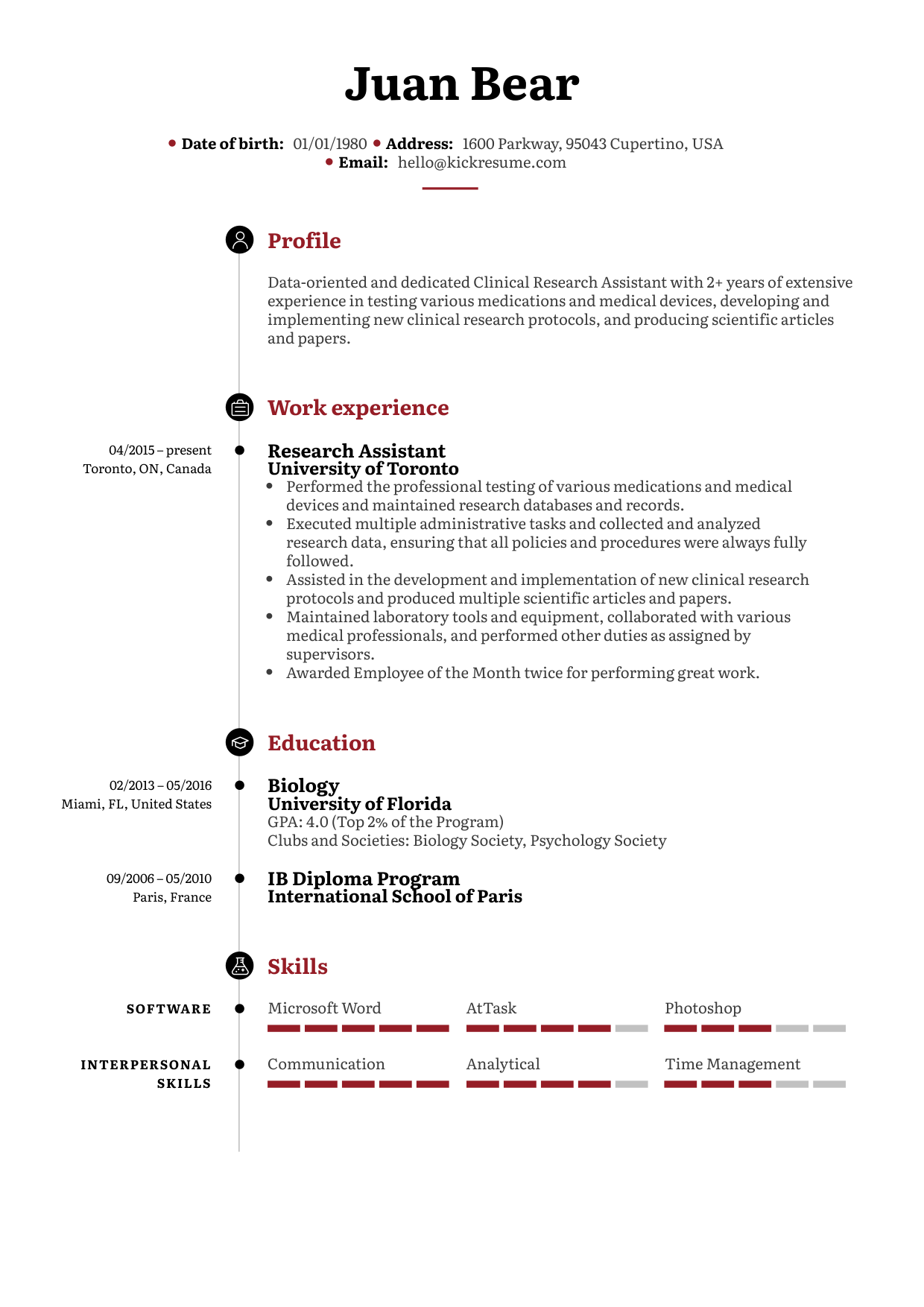
Loan officer assistant cover letter sample
What works
- Clear opening with relevant experience: The letter begins by stating the candidate’s interest and immediately touches on experience related to loan operations/assistant duties. This helps recruiters quickly understand the applicant’s background and context.
- Client-focused language: The applicant emphasizes interaction with clients and responsiveness, which is a core skill in loan assistance roles. This shows an understanding of the relational nature of the job and helps align with the expectations of hiring managers in finance.
- Professional and polite tone: The overall tone strikes a good balance between confident and courteous. It reads professionally without being overly formal, which suits client-facing financial roles where trust and communication are key.
What could be improved
- Lacks strong, specific achievements: The letter mentions responsibilities but doesn’t include concrete accomplishments or measurable results (e.g., number of loan applications processed, improvement in turnaround time, success rate). Quantifying impact would make the case stronger.
- Generic details about the company: The cover letter references the employer’s reputation in a vague way. Instead, it could show that the candidate researched the specific organization (e.g., mentioning their loan products, client segments, company values) to demonstrate tailored interest.
- Limited use of action verbs and impact language: Many sentences describe duties in passive or standard language. Using stronger action verbs (e.g., streamlined, facilitated, improved, accelerated, advised) and tying them to client outcomes would make the writing more dynamic and compelling.
Insurance underwriter cover letter sample
What works
- Professional tone and structure: The letter follows a clear, professional format, with an opening, a body, and a confident closing. It reads like a well-organized narrative rather than a generic note, which suits underwriting roles that value precision and clarity.
- Focus on relevant qualifications: The candidate mentions specific industry-related knowledge and skills (e.g., risk assessment, policy evaluation). This shows they understand the core aspects of underwriting and are prepared to discuss how they apply their expertise.
- Credibility through experience and context: The letter references experience in risk analysis, evaluation of financial data, and collaboration with underwriting teams. These details help position the applicant as someone already familiar with key responsibilities of an insurance underwriter.
What could be improved
- Lacks measurable achievements: While responsibilities are mentioned, there are no concrete results or metrics (e.g., reduced processing time, improved accuracy rates, percentage of risk assessments approved). Adding quantifiable outcomes would make the applicant’s impact more compelling.
- Could be more tailored to the company/role: The letter stays quite general and could benefit from referencing specific attributes of the target company (e.g., particular product lines, underwriting philosophy, market segments). That would show deeper interest and research.
- More dynamic language needed: Some phrasing is passive or repetitive. Using stronger action verbs (e.g., evaluated, optimized, implemented, improved, collaborated, streamlined) and pairing them with outcomes would make the wording more engaging and persuasive.
Insurance agent cover letter sample
What works
- Clear and professional tone: The cover letter uses a professional yet approachable voice, which fits well with client-facing insurance roles. It strikes the right balance between confidence and respect, helping build trust, which is a key quality for an insurance agent.
- Relevant skills and experience highlighted early: The opening paragraph quickly mentions experience in customer service and sales — core competencies in insurance roles. This helps the hiring manager immediately see that the candidate has a background aligned with the job.
- Focus on client relationships: The candidate emphasizes building trust, understanding client needs, and delivering personalized solutions. This aligns well with what insurance agencies value most, making the letter feel more relevant and targeted than if it were purely transactional.
What could be improved
- Lacks specific accomplishments or metrics: Most of the examples are duty-based rather than outcome-focused. Adding measurable achievements — like “increased policy renewals by X%” or “grew client portfolio by Y accounts” — would make the candidate’s impact much stronger and tangible.
- Could be more tailored to the target company: While the letter mentions enthusiasm for the employer, it doesn’t show evidence of research (e.g., agency specialty, market focus, unique products). Including a specific reason why the candidate wants to work at this company would help differentiate the application.
- Action verbs and dynamic phrasing are under-utilized: Some of the wording is neutral or passive (e.g., “I have experience in…”). Replacing weak phrases with stronger verbs (e.g., advised, negotiated, retained, expanded, generated, secured) would make the writing more impactful and help both ATS and human readers see key strengths faster.
1. Formatting your insurance agent cover letter for a professional first impression
If you want your insurance agent cover letter to get noticed, that means not only your presentation has to be on point, but the content as well.
Insurance is a people-facing, credibility-driven profession. If your cover letter looks messy, cluttered, or hard to scan, hiring managers may question your attention to detail before they even get to your experience.
Here’s how to format your insurance agent cover letter so it looks polished, professional, and easy to read:
- Use a clean, readable font: Stick with proven choices like Arial, Calibri, or Times New Roman. A font size between 10 and 12 points keeps your letter readable without feeling cramped or oversized.
- Keep spacing clear and intentional: Avoid dense blocks of text. Short paragraphs with enough white space make your letter easier to scan, which matters when recruiters review dozens of applications.
- Left-align your text: Left alignment looks professional and is the easiest to read. Skip centered or justified text, which can feel awkward and uneven.
- Follow a simple structure: Your cover letter doesn’t need to be creative in layout. A clear structure works best:
- Header
- Opening paragraph
- 1–2 body paragraphs
- Closing paragraph
- Limit it to one page: Insurance recruiters are looking for clarity and relevance, not long explanations. One focused page is more than enough to show your value.
- Use bullet points sparingly (but smartly): If you want to highlight key achievements such as sales results, client retention, or certifications, bullet points can help those stand out quickly.
- Match the tone to the industry: Professional, confident, and personable works best. You’re building trust, not writing a legal document or a sales pitch overloaded with buzzwords.
Pro tip
If formatting isn’t your strong suit, using a professional cover letter template can save you time and help you avoid common layout mistakes, so you can focus fully on your message.
Formatting may not be the most exciting part of writing a cover letter, but in insurance roles, first impressions matter. Once your layout is clean and professional, you can move on to what really counts: showing that clients and employers can trust you.
You can also read our in-depth guide on how to build a perfect cover letter that gets you results you want.
Create your cover letter fast with artificial intelligence.

2. Writing an effective cover letter header for insurance agent roles
Let’s talk headers. It may feel like a small detail, but in insurance roles, it carries more weight than most applicants realize.
If you’re emailing your cover letter, the header is the first thing a recruiter sees. It instantly signals whether you’re professional, organized, and easy to contact. These are all traits employers expect from someone who works directly with clients and handles sensitive information.
Your goal here is simple: make it effortless for a hiring manager to reach you. If they want to schedule an interview, your contact details should be impossible to miss.
What a strong insurance agent cover letter header should include
Your contact details:
- Your full name
- Your professional title (optional, but helpful if it matches the role — e.g. Licensed Insurance Agent)
- Phone number (always include the area code)
- Professional email address
- LinkedIn profile (if it’s up to date and relevant)
- Personal website (optional)
The recipient’s information:
- Hiring manager’s name (if available)
- Their job title
- Company name
- Company address
Let’s look at an example of what not to do:
Bad example of an insurance agent cover letter header
From: Alex R.
555-9876 | alex@email
To: Hiring Team
Why this doesn't work: The phone number is incomplete, which can cause issues if the company is outside your local area. The email address looks rushed and informal, which isn’t ideal in an industry built on trust and professionalism. Finally, addressing the letter vaguely to “Hiring Team” misses an opportunity to personalize your application.
Now compare it with a stronger version:
Good example of an insurance agent cover letter header
From: Alex Reynolds
(415) 555-9876
alex.reynolds@email.com | linkedin.com/in/alexreynolds
To: Michelle Carter, Senior Hiring Manager
EverTrust Insurance Group
245 Market Street
San Francisco, CA 94105
Why this works: Everything is clear, complete, and professional. The contact details are easy to find, the email address looks trustworthy, and the LinkedIn profile adds credibility. Addressing a specific person shows initiative and signals that you’ve taken the time to research the company.
In insurance roles, details matter. A clean, well-structured header shows that you take communication seriously, which is exactly the kind of impression you want to make before a recruiter even reads your first paragraph.
Once your header is in place, you’re ready to move on to writing a cover letter headline that actually grabs attention.
.png)
3. Crafting a strong headline that reflects your insurance agent expertise
Why does your headline matter so much?
Because it’s the first thing a hiring manager sees, and in many cases, it decides whether they keep reading or move on to the next application.
Insurance recruiters often go through dozens (sometimes hundreds) of cover letters. They don’t read every word carefully at first. Instead, they scan. A clear, compelling headline helps your application stand out instantly and sets the tone for the rest of your cover letter.
Let’s look at two examples and see the difference.
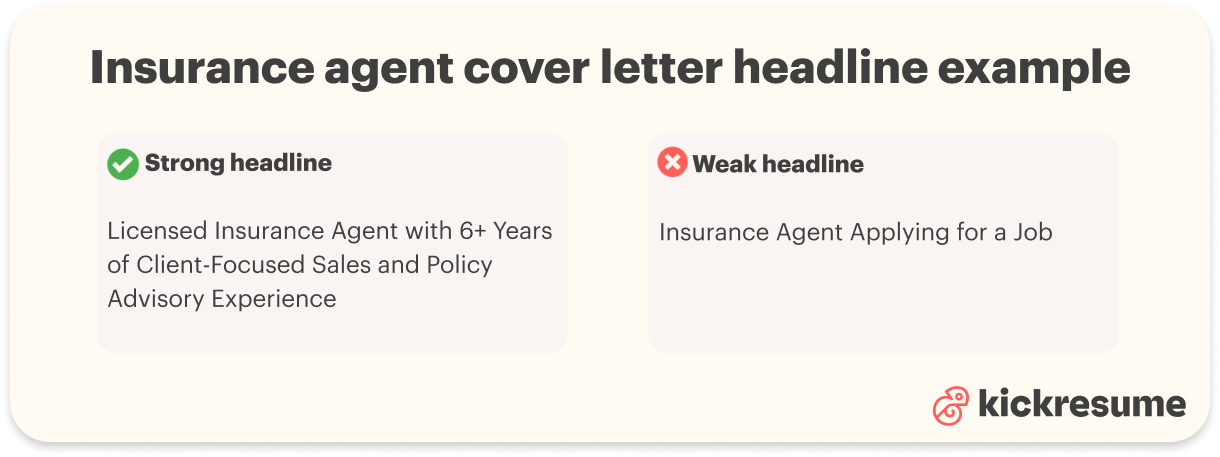
Bad example of an insurance agent cover letter headline
Insurance Agent Applying for a Job
Why this doesn't work: This headline is vague and adds no real value. It simply repeats what the recruiter already knows and doesn’t communicate your experience, specialization, or strengths. It also sounds passive and generic, which isn’t ideal for a role that values confidence, initiative, and client-facing skills.
Now compare it to a stronger option:
Good example of an insurance agent cover letter headline
Licensed Insurance Agent with 6+ Years of Client-Focused Sales and Policy Advisory Experience
Why this headline works better:
- It’s specific: It clearly states the candidate’s licensing status, years of experience, and core strengths.
- It highlights relevance: Client advisory and policy guidance are key parts of most insurance agent roles.
- It grabs attention: If a recruiter is looking for an experienced, customer-oriented agent, this headline immediately signals a strong match.
Crafting a headline as a junior insurance agent or career starter
If you’re new to the insurance industry or transitioning from another field, you probably don’t have that much experience in this field, but that doesn’t mean you can’t write a strong headline. In such case, you just need to shift the focus.
Instead of years of experience, highlight:
- Relevant skills (sales, customer service, communication, needs analysis)
- Licensing or exam progress
- Training programs, internships, or entry-level exposure
- Motivation to grow in the insurance field
Entry-level insurance agent cover letter headline example
Entry-Level Insurance Agent with Strong Sales Skills and State Licensing in Progress
This works because it’s honest, forward-looking, and focused on potential. It tells the recruiter what you already bring to the table and where you’re headed, which is often exactly what they want to see in junior candidates.
Your headline is your first chance to position yourself as a serious insurance professional. Keep it clear, confident, and tailored to the role, and it’ll do a lot of the heavy lifting before the recruiter even reads your opening paragraph.
4. Creating a personalized greeting that connects with insurance hiring managers
Starting your cover letter with a generic line like “To Whom It May Concern” instantly makes your application feel impersonal. And in a relationship-driven field like insurance, that’s a missed opportunity right at the start.
Insurance agencies and brokerages look for professionals who can build trust, communicate clearly, and pay attention to details. A personalized greeting quietly signals all three, before the recruiter even reads your first paragraph.
So how do you find the right name?
Here are a few practical places to look:
- The job posting: Sometimes the hiring manager or agency owner is mentioned directly.
- The company website: Check the “About,” “Team,” or “Leadership” sections, especially for agencies and brokerages.
- LinkedIn: Search for roles like Sales Manager, Agency Manager, Branch Manager, or HR Manager at the company.
- Call or email the agency: This is perfectly acceptable in insurance. A quick, polite inquiry can leave a surprisingly positive impression.
Once you’ve found a name, use it like this:
Examples of personalized greetings
- Dear Ms. Thompson,
- Dear Mr. Daniel Thompson,
- Dear Hiring Manager Ms. Thompson,
Stick to professional titles such as Mr., Ms., or Dr., unless you’re absolutely certain the company culture prefers otherwise. And double-check spelling, because accuracy matters in insurance, and small mistakes can undermine trust.
What if you can’t find a name?
Don’t worry if you can’t find a name, that happens, especially with larger insurers or online postings. If you’ve made a reasonable effort and still come up empty, these are safe, professional alternatives:
Examples of greeting if you can't find a name
- Dear Hiring Manager,
- Dear Insurance Sales Team,
- Dear [Company Name] Recruitment Team,
These options are neutral, respectful, and far better than outdated or overly formal openings.
Taking the time to personalize your greeting shows initiative and professionalism, as these are the two qualities insurance employers value highly. It’s a small detail, but it sets the right tone for a cover letter built on trust, clarity, and client-focused thinking.
.png)
5. Writing an introduction that grabs attention as an insurance agent
If you want your insurance agent cover letter to stand out, your opening paragraph needs to do more than just say “I’m applying for the role.”
The introduction is where you right away prove that you understand the business, the clients, and the role itself. A strong opening shows that you’re not just looking for any sales job, but that you’re genuinely interested in insurance and confident in the value you can bring.
You don’t need to overcomplicate it. Focus on clarity, relevance, and intent.
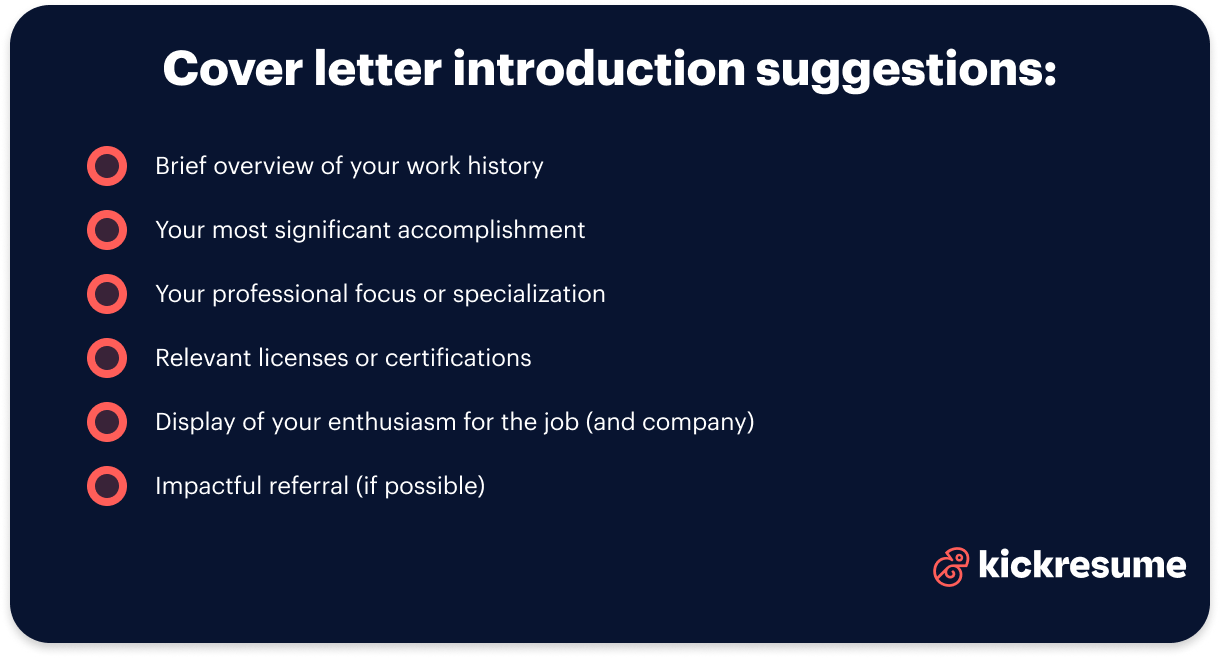
Here are a few things you can naturally include in your opening lines:
- A brief overview of your insurance or sales background
- One standout achievement (sales results, retention rate, client portfolio, etc.)
- Your professional focus or specialization (life, health, property & casualty, commercial, etc.)
- Relevant licenses or certifications
- A clear reason why this company or agency caught your attention
- A referral or recommendation (if you have one)
Pro tip
If you’re transitioning into insurance from another sales or client-facing role, this is the perfect place to explain why. Framing your career shift with transferable skills (relationship-building, negotiation, customer trust) helps hiring managers immediately see the fit.
Bad example of an insurance agent cover letter introduction
I’m writing to apply for the insurance agent position at your company. I believe I would be a good fit and am interested in learning more about the role.
Why this doesn't work: This introduction is vague and generic. It doesn’t mention insurance, sales, clients, or any relevant experience. There’s nothing here that would convince a hiring manager to keep reading or remember this candidate later.
Good example of an insurance agent cover letter introduction
I am a licensed insurance agent with over 5 years of experience helping individual and small business clients protect their assets through tailored life and property insurance solutions. In my current role, I manage a portfolio of 200+ active clients and consistently exceed quarterly sales targets by an average of 18%. Your agency stood out to me for its strong client-first approach, and after speaking with Mr. Daniel Thompson from your sales team, I was encouraged to apply based on my background and results.
Why this version works so well: This introduction immediately establishes credibility. It clearly states the candidate’s role, experience level, specialization, and measurable results. It also shows genuine interest in the company and includes a personal referral, which adds trust and context. In just a few lines, the hiring manager learns who this person is, what they do well, and why they’re applying.
Tips for recent graduates and new insurance agents
If you’re new to the insurance industry, don’t worry, you still have plenty to work with. Employers aren’t just hiring experience; they’re hiring potential, attitude, and communication skills.
In your introduction, you can highlight:
- Your education and any insurance-related coursework
- Internships, traineeships, or shadowing experience
- Sales, customer service, or advisory experience
- Licenses you’ve earned (or are currently pursuing)
- Your motivation to build long-term client relationships
Cover letter opening example for an entry-level insurance agent
I’m excited to apply for the insurance agent position at Horizon Mutual. As a recent graduate with a background in business administration and a newly obtained Property & Casualty insurance license, I’ve developed a strong foundation in client communication, needs analysis, and consultative sales. Through my internship at a local brokerage, I assisted with policy reviews and client onboarding, and I’m eager to continue building my career in insurance with a team that values trust and long-term relationships.
Why this example works: Even without years of experience, this introduction feels confident and focused. It highlights relevant education, licensing progress, and hands-on exposure to insurance work while clearly expressing motivation and direction.
A well-crafted introduction sets the tone for your entire cover letter. Get this part right, and you make it easy for hiring managers to keep reading and picture you as their next insurance agent.
6. Highlighting your professional value as an insurance agent
This section, which is the body of your cover letter, is where you connect the dots between what you’ve done and what the employer actually needs.
Your goal here isn’t to repeat your resume. It’s to explain how your experience, skills, and results translate into real value for their clients and their business.
How to format the body
Before jumping into the content, let’s talk structure. The body of your cover letter should be:
- 2–4 short, focused paragraphs
- Easy to scan and straight to the point
- Packed with relevant examples and no filler
Each paragraph should answer one simple question:
Why does my background make me a strong insurance agent for this role?
Key skills employers look for in insurance agents
Not sure which skills to highlight? These are some of the most in-demand skills for insurance agent roles:
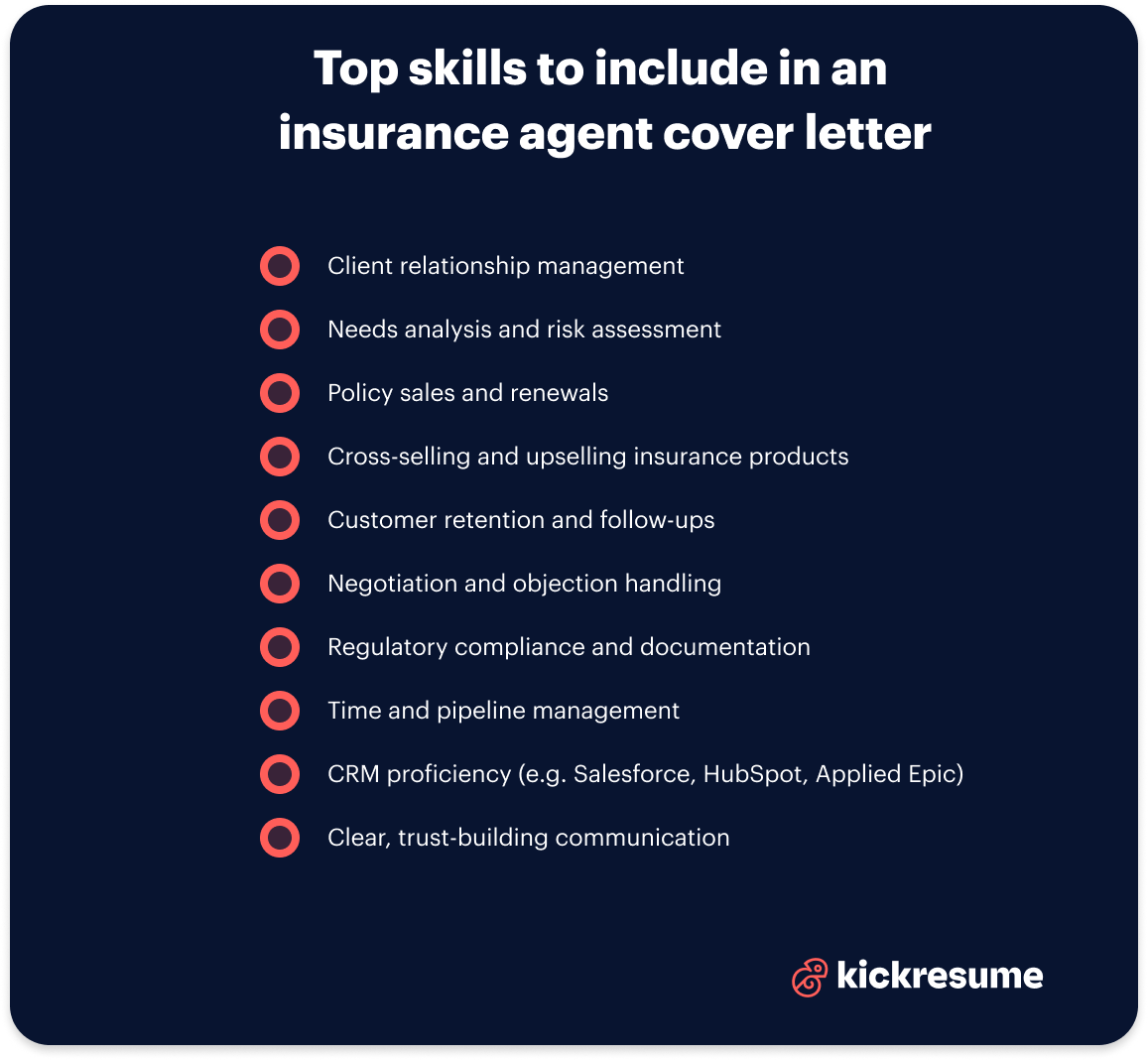
Top skills to mention in your insurance agent cover letter
- Client relationship management
- Needs analysis and risk assessment
- Policy sales and renewals
- Cross-selling and upselling insurance products
- Customer retention and follow-ups
- Negotiation and objection handling
- Regulatory compliance and documentation
- Time and pipeline management
- CRM proficiency (e.g. Salesforce, HubSpot, Applied Epic)
- Clear, trust-building communication
How to showcase your value with impact
Here’s the formula that works every time:
Context + numbers = credibility
Instead of listing duties, show outcomes. Tie everything back to the job posting and the type of clients the agency serves.
How to do that effectively:
- Quantify your results: Sales growth, retention rates, portfolio size, because numbers matter.
- Mirror the job description: If they emphasize client retention, show how you’ve kept clients long-term.
- Use bullet points strategically: A short list of achievements can make your strongest results impossible to miss.
Examples for experienced insurance agents
At NorthBridge Insurance, I managed a portfolio of 300+ personal and small business clients, maintaining a client retention rate above 92% through proactive policy reviews and follow-ups.
I consistently exceeded quarterly sales targets by 15–20% by identifying cross-sell opportunities in life and property coverage and tailoring policies to client needs.
By improving onboarding and documentation workflows, I reduced policy processing time by 30%, resulting in faster policy issuance and higher client satisfaction.
I served as the primary point of contact for claims coordination, guiding clients through the process and helping reduce escalation cases by 25%.
Tips for candidates with limited insurance experience
If you’re early in your insurance career or transitioning from another sales or customer-facing role, focus on transferable skills and real-world exposure.
Hiring managers know you won’t have a massive book of business yet. What they want to see is:
- Strong communication skills
- Comfort working with clients and explaining complex information
- Motivation to build trust and long-term relationships
Example of accomplishments for entry-level or junior insurance agents
During my internship at RiverStone Insurance Group, I assisted senior agents with client needs analysis, policy comparisons, and renewal follow-ups, contributing to a 10% increase in renewal conversion rates.
In a previous customer service role, I handled 40+ client interactions per day, resolving inquiries and building rapport — skills I now apply when explaining insurance coverage options.
While completing my insurance licensing coursework, I conducted mock consultations and risk assessments, strengthening my ability to clearly explain policy details and benefits to non-technical clients.
The body of your cover letter is where you prove your value, not in theory, but in practice. Be specific, back up your claims with results, and focus on how your skills help clients feel protected and confident.
Do that well, and it becomes much easier for a hiring manager to picture you as a trusted insurance agent on their team.
7. Enhancing your cover letter with dynamic and relevant action verbs
Once your cover letter has a clear structure and strong examples, there’s one more thing that can instantly level it up: action verbs.
Action verbs turn plain statements into confident, results-driven claims. Compare these two sentences:
No action verb included
I was responsible for handling client policies.
Aftere including action verbs
I managed client insurance portfolios and proactively optimized coverage based on changing needs.
Same responsibility, but very different impact.
The second version sounds active, professional, and trustworthy. And that’s exactly what you want as an insurance agent.
Strong action verbs for an insurance agent cover letter
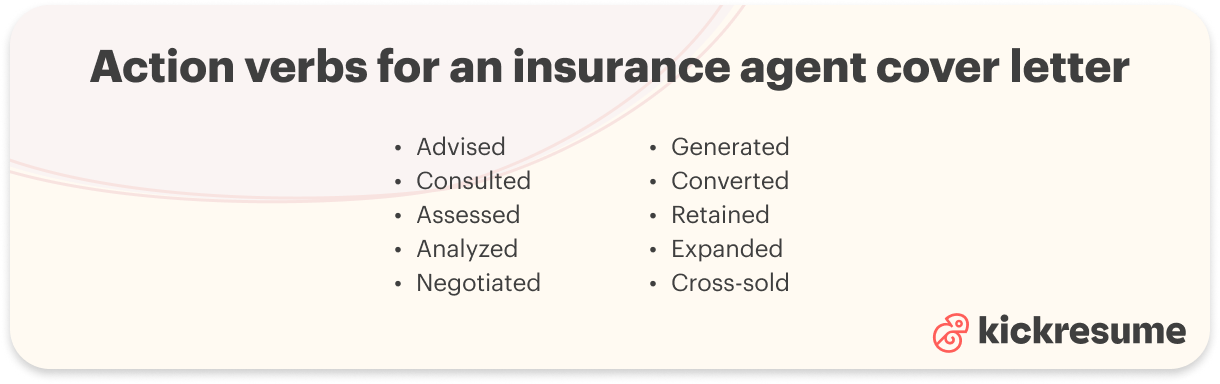
Here are action verbs that work especially well for insurance, sales, and client-facing roles:
Effective action verbs for insurance agents
- Advised
- Consulted
- Assessed
- Analyzed
- Negotiated
- Generated
- Converted
- Retained
- Expanded
- Cross-sold
- Renewed
- Closed
- Educated
- Coordinated
- Resolved
These verbs help you move away from task-based descriptions and toward value-based storytelling, showing how your actions led to better outcomes for clients and the business.
How to use action verbs the right way
The goal isn’t to sound fancy. It’s to sound clear and credible.
Here’s how to get it right:
- Be specific: Don’t just say you “assisted clients.” Say how you helped them and what changed as a result.
- Tie verbs to outcomes: Whenever possible, follow your action verb with a result (sales growth, retention rate, faster processing, etc.).
- Mix them up: Repeating the same verb over and over (“managed,” “managed,” “managed”) weakens your writing. Variety keeps things sharp and readable.
Example:
Instead of
Handled policy renewals
Try to use
Renewed and upsold existing policies, increasing annual premium volume by 18%.
Action verbs and ATS: a hidden advantage
Action verbs don’t just make your cover letter more engaging, because they also help with ATS compatibility.
Applicant Tracking Systems often scan applications for verbs and phrases pulled directly from job descriptions. Insurance job ads commonly include terms like assessed, advised, generated, retained, or negotiated. Using these verbs naturally in your cover letter increases the chances that your application gets flagged as a strong match.
Pro tip
Look closely at the job posting and reuse their wording where it makes sense. If they say “client retention” or “needs analysis,” reflect that language in your action verbs and examples.
Strong action verbs make your cover letter sound confident, professional, and results-oriented. Those are exactly the qualities employers look for in a successful insurance agent.
8. Writing a persuasive and confident closing statement for your insurance agent cover letter
Your closing paragraph might be short, but it carries a lot of weight.
Think of it as the confident wrap-up to a sales conversation. The kind of wrap-up that reinforces trust, reminds the reader why you’re a strong fit, and clearly invites the next step.
A strong insurance agent cover letter closing should include:
- A professional thank-you for the reader’s time
- A brief reminder of the value you bring (client focus, sales results, advisory skills)
- Genuine enthusiasm for the role and the company
- A clear call to action (your openness to an interview or discussion)
- Your preferred contact details and availability
- A polished, professional sign-off
Let’s start with an example of what not to do.
Bad example of an insurance agent cover letter conclusion
I hope you like my application. Thank you for your time and consideration. Looking forward to hearing from you.
Best,
Alex
Why this doesn't work: This closing feels rushed and forgettable. It doesn’t reinforce the candidate’s strengths, doesn’t express real enthusiasm, and doesn’t encourage the hiring manager to take action. For a role built on communication and persuasion, this ending misses the mark.
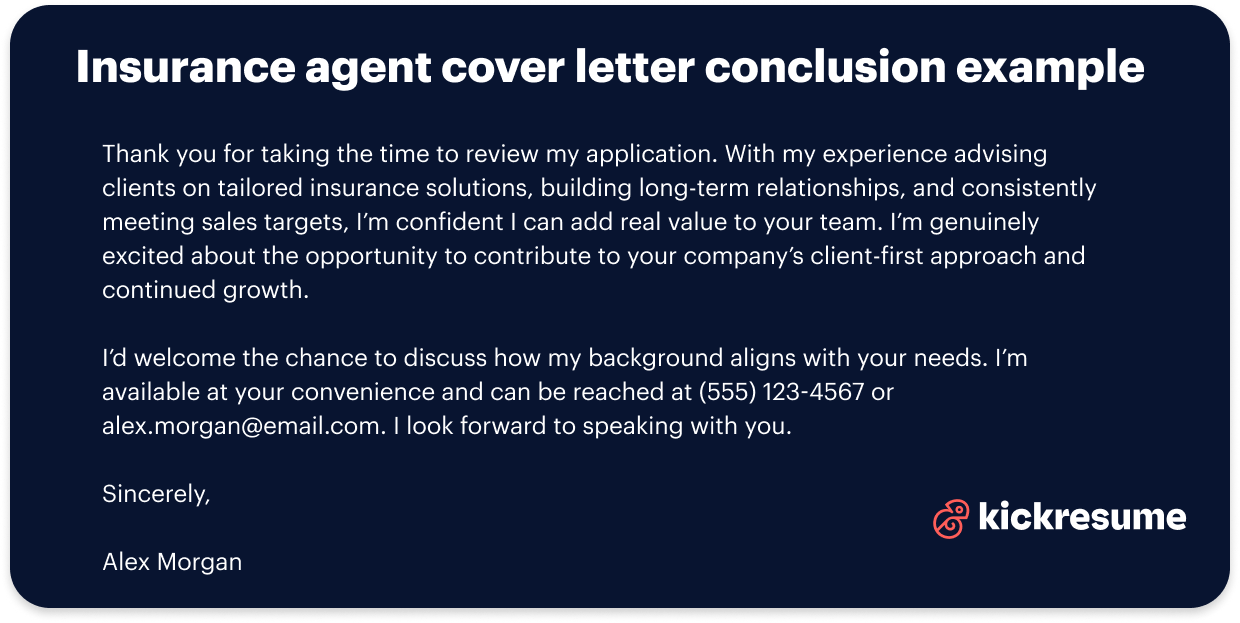
Good example of an insurance agent cover letter conclusion
Thank you for taking the time to review my application. With my experience advising clients on tailored insurance solutions, building long-term relationships, and consistently meeting sales targets, I’m confident I can add real value to your team. I’m genuinely excited about the opportunity to contribute to your company’s client-first approach and continued growth.
I’d welcome the chance to discuss how my background aligns with your needs. I’m available at your convenience and can be reached at (555) 123-4567 or alex.morgan@email.com. I look forward to speaking with you.
Sincerely,
Alex Morgan
Why this version works better: It does everything a strong closing should. It starts with appreciation, reinforces relevant strengths, expresses enthusiasm for the company, and makes the next step crystal clear. The tone is confident, professional, and reassuring, because that is exactly what employers look for in an insurance agent.
Your closing statement doesn’t need to be long or dramatic. It just needs to feel intentional.
Reaffirm your value, show that you’re genuinely interested in the role, and make it easy for the hiring manager to reach out. A strong ending leaves a lasting impression, and that can be the difference between a polite rejection and an interview invite.
9. Avoiding common mistakes in insurance agent cover letters
Even a strong insurance agent cover letter can lose its impact if it’s filled with avoidable mistakes. And in a role built on trust, communication, and attention to detail, those “small” slips can raise big doubts.
Here are the most common pitfalls insurance applicants run into, and how to avoid them:
- Sending the same letter to every company: A generic cover letter feels like a copy-paste sales pitch, and nobody wants to buy from someone who doesn’t understand their needs. A captive insurer, an independent agency, and a broker-focused firm all hire for slightly different priorities. Your letter should reflect that.
- Being vague about your results: “I’m good with clients” is nice, but it’s not convincing. Insurance is performance-driven. If you can, mention measurable proof — policy volume, renewal rates, lead conversion, cross-sell results, or retention improvements.
- Talking only about what you want: It’s fine to be ambitious, but your cover letter shouldn’t read like a personal goal list. Instead, focus on what the employer needs: client retention, strong communication, ethical selling, accurate documentation, and the ability to explain coverage clearly.
- Repeating your resume word for word: Your resume lists what you did. Your cover letter should explain how you did it and why it mattered. Add context: how you handled objections, built long-term relationships, turned cold leads into clients, or helped customers navigate complex coverage decisions.
- Ignoring the job posting (especially licensing requirements): Insurance job ads often include must-haves like licensing, product focus (P&C, life, health, commercial), CRM tools, or cold-calling expectations. If the posting asks for something specific, address it directly, or you risk looking like you didn’t read the role carefully.
- Sounding too “salesy” or too pushy: Confidence is great. Aggressive vibes aren’t. A good insurance agent comes across as trustworthy and consultative, not like someone trying to close a deal in two minutes. Keep your tone professional, helpful, and client-focused.
- Letting typos and compliance mistakes slip through: In insurance, details matter. Wrong company names, sloppy formatting, or errors in basic wording can signal carelessness, which is the last thing employers want in someone handling policies and client information. Proofread and double-check names, numbers, and titles.
- Forgetting the client perspective: Insurance isn’t just about selling policies, but it’s also about advising people. If your letter focuses only on hitting targets and ignores customer needs, it can feel one-dimensional. Mention how you educate clients, simplify complex terms, and recommend coverage responsibly.
Catching these mistakes isn’t about being “perfect.” It’s about showing care, and in insurance, care is part of the job. Take a few minutes to tailor, proofread, and tighten your message. It can make your application feel instantly more credible, professional, and hire-ready.
10. Pairing your insurance agent cover letter with a standout resume
Before you hit “send” on your application, make sure your insurance agent cover letter is backed up by a strong, well-aligned insurance agent resume. These two documents shouldn’t feel like separate pieces; they should rather work together to tell one clear, convincing story.
They serve different purposes, but the goal is the same: showing the employer you’re the right person for the role.
Here’s how they complement each other:
- Your resume focuses on structure and speed. It highlights your experience, licenses, skills, and results in a clean, scannable format using bullet points and clear sections.
- Your cover letter adds context and personality. It explains how you achieved those results, why you enjoy working in insurance, and what motivates you to join this specific agency or company.
Together, they create a complete picture, displaying both credibility and character.
How to make your resume and cover letter work as a set
To look professional and polished, your documents should match visually as well as content-wise:
- Use the same header on both documents: Your name, phone number, email address, and LinkedIn profile should appear in the same style and order on your resume and cover letter. Consistency makes your application easier to recognize and review.
- Stick to one font family: Choose a clean, professional font like Calibri, Arial, or Georgia and use it across both documents. Keep font sizes, spacing, and heading styles aligned.
- Match margins and spacing: Uniform margins and line spacing give your application a tidy, intentional look, which is something insurance employers appreciate in roles that require accuracy and organization.
- Keep colors subtle and consistent: If your resume uses a light accent color for section headings or dividers, mirror that same color in your cover letter. Avoid bold or flashy designs, because clarity and trustworthiness matter more than visual flair.
If you’d like to skip the hassle, using professionally designed resume and cover letter templates can save time and ensure everything looks cohesive. All of Kickresume’s templates come as matching pairs, so your insurance agent resume and cover letter automatically look like they belong together.
When your resume and cover letter feel aligned, your application feels more credible, professional, and easy to trust. And that is exactly the impression you want to leave in the insurance world.
Try our AI Resume Writer and have your resume ready in minutes!

11. Job-search resources for insurance agents
Armed with the perfect cover letter and your insurance agent resume, it's time to get to the grand finale — the actual job hunt! But this is easier said than done. Don't worry, we thought about this too. So, we've prepared a list of helpful resources for you to use:
- Industry-specific job boards: The most straightforward option is to look at websites that cater specifically to your profession. For example: InsuranceJobs.co.uk, iHireInsurance, or InsuranceJobs.com.
- Online job search engine: By filtering your search through location and keywords, you can find plenty of suitable opportunities with platforms like Indeed, Glassdoor, ZipRecruiter, and SimplyHired.
- Insurance associations: Organizations such as the Chartered Insurance Institute (CII), the National Association of Insurance and Financial Advisors (NAIFA), or the Independent Insurance Agents & Brokers of America (IIABA) offer unique opportunities for networking, further training, as well as job listings and so much more.
- Networking: Networking is king! And with a powerhouse of a platform like LinkedIn, you'll be able to connect with industry experts and potential employers from the comfort of your home.
- Specialized publications: Apart from occasional job postings, media like “Insurance Journal,” “PropertyCasualty360,” or “Insurance Networking News (INN),” can help you stay up-to-date with latest industry trends, news, and strategies.
- Courses & certificates: Online learning platforms like Coursera, Udemy, edX, or even LinkedIn Learning offer a wide selection of courses and certificates that can help you stay sharp and keep developing.
It doesn't matter how many job postings you end up responding to, remember to always custom tailor every single cover letter to align as closely as possible to whatever the job description calls for.
Accounting / Finance Career Outlook in 2026
Between now and 2034, the accounting field is projected to see 5% growth while finance occupations are expected to grow by 6%. Both rates outpace the national average for all occupations. (Source: U.S. Bureau of Labor Statistics).
On top of that, employers are expected to post about 124,200 accounting openings and 29,900 finance openings each year, largely due to business growth and normal turnover (like retirements and role changes).
According to The World Economic Forum’s report, some traditional accounting roles may decline as automation spreads, but the upside is clear: demand will stay strong for accountants and finance professionals who can use AI and tech tools to work faster, deliver better insights, and support decisions.
Average US base salaries across popular Accounting / Finance roles:
- Accountant: $67,624/year
- Auditor: $93,976/year
- Bookkeeper: $65,719/year
- Financial Analyst: $81,598/year
- Insurance Agent: $74,701/year
- Investment Advisor: $86,320/year
- Tax Services: $73,546/year
These salary estimates come from Indeed (as of January 2026), and are based on anonymous submissions from workers, along with salary data from job postings on the platform over the last 36 months. Exact figures vary by location, company size, and experience level.
Still, if you’re entering accounting or finance, or looking to grow, the field is opening up, especially for people who can pair finance skills with modern tools.
Insurance Agent Cover Letter FAQ
What's the most effective way to showcase my skills in an insurance agent cover letter?
Write about your skills in a real-life context. Don't just say you're great at customer service; give specific examples of how your outstanding service led to increased client satisfaction or retention. Start by describing the situation, which skills you utilized to solve it, and mention what results you achieved.Ideally you'll also support your words with quantifiable results.
Should I use a specific structure for my cover letter?
When it comes to cover letter writing, nothing is set in stone. But we recommend following the structure outlined in our article. It's simple, professional, and it stood the test of time for a reason. Just make sure to always include: a greeting, introduction, main body, conclusion, and sign off.
Should I include my salary requirements in the cover letter?
Unless specifically requested in the job posting, it's usually best to avoid the salary discussion at this stage. You want the focus to be on your skills, experiences and fit for the role. Any further discussions about salary expectations should be left to later stages of job interviews.
How long should my cover letter be?
In this case, less is definitely more. Your cover letter should not exceed one page. Anything longer than that, and your job application goes straight in the bin. Aim for three to four well-crafted paragraphs. The idea behind a cover letter is to pique the hiring manager's interest, not give them your life story. Stay succinct, engaging, and relevant!
Do cover letter formats even matter?
Of course they do! Every single detail of your job application speaks volumes about your professionalism. For example, consistent formatting shows attention to detail. So, stick to a simple, clean font, keep margins even, and use a logical order - your contact details, the date, the recipient's details, then your letter content. But our cover letter templates will take care of any such details.