ChatGPT
 Perplexity AI
 Claude
It's true that crafting the perfect humanities student resume can be a real challenge. But rest assured, we've got the tools you need. Our guide will show you actionable tips, practical examples, and professional templates to take you through the writing process step by step.


 See more examples like these
In this guide, we will teach you some key steps to writing a resume as a humanities student. Keep reading to learn how to:
- Learn the dos and don'ts of resume writing from real-life samples
- Choose a resume format that matches your experience level
- Write a resume summary that showcases your best professional attributes
- Select key humanities skills to include on your resume
- Describe your relevant work experience on a resume
- List your educational credentials as a humanities student correctly
- Pick the best optional sections for your resume
- Avoid common humanities student resume mistakes
- Access the best job search resources for humanitites students out there
Still looking for a job? These 100+ resources will tell you everything you need to get hired fast.
Fresher resume sample


Why does this resume example work?
- Including a volunteering section: The volunteering experience as Student Government President is a strong point. Since the applicant is a student with limited work history, showing leadership and involvement in school activities really helps fill in the blanks. It tells the reader that the candidate is responsible, engaged, and has experience organizing people and events. That kind of experience is valuable in lots of roles.
- The layout is clear and easy to read: The resume is structured in a clean and logical way. The sections are easy to spot, the bullet points are simple to follow, and there isn’t any unnecessary filler. A hiring manager can quickly scan and understand the candidate’s background, which is exactly what you want. For a student resume, clarity is essential, and this one does that well.
What could be improved?
- The education section could do more heavy lifting: Since the candidate is still early in their academic and professional journey, the education section is one of the biggest strengths they have. Right now, it lists schools and some clubs, but it could go further. For example, mentioning relevant coursework, research interests, academic projects, or even a short line about what draws the candidate to humanities and politics would help show a clearer academic identity.
- The resume could benefit from adding references: Because this is a student resume, having someone who can vouch for character and reliability can make a big difference. A teacher, advisor, coach, or internship supervisor could serve as a reference. Even just adding “References available upon request” gives the employer confidence that others can speak to the candidate’s strengths.
Congressional intern resume example

Why does this resume example work?
- The skills section is varied and well-rounded: The resume includes language abilities, computer software knowledge, and interpersonal skills. This gives a fuller picture of the applicant and shows that they bring both technical competence and soft skills. For a humanities student, this balance is really helpful because it shows versatility and the ability to fit into different environments.
- Mentioning a recognition for a past internship: The “Intern of the Month” recognition during the congressional internship is a strong detail. It shows that the applicant not only completed the internship, but actually stood out and impressed supervisors. That kind of acknowledgment increases credibility and gives the hiring manager confidence in the applicant’s work ethic.
What could be improved?
- The profile section could be more concise: The profile is trying to say a lot at once, which can make it feel dense. Shortening it and focusing on one main message would make it easier for the reader to take in. Something like a single clear sentence about what the applicant studies, what they accomplished, and their past experience would have a stronger impact.
- Including more quantifiable data: The resume lists responsibilities during the internship, but some numbers could make the impact clearer. For example, mentioning how many reports were prepared, how many events were supported, or how many constituents or visitors were assisted. Even approximate numbers help the hiring manager imagine the scale of the work.
Social work intern resume example

Why does this resume example work?
- The resume includes an awards section: Adding an awards section is a strong choice, especially for a humanities student. It gives the applicant a chance to show recognition from outside sources, which boosts credibility. The awards listed also show leadership, academic achievement, and community involvement. This helps paint a fuller picture of the applicant’s character and work ethic.
- Work experience is placed before the education section: This order makes sense here because the applicant has several years of hands-on work experience. By putting the work experience first, the resume highlights practical skills and real-life responsibilities right away. This can make a stronger impression on a hiring manager, especially when the applicant is applying to roles where experience with people and communication is valuable.
What could be improved?
- Some descriptions rely on weaker phrasing and could use stronger action verbs: Many bullet points use phrases like “responsible for” or “duties included,” which can sound passive. Switching to verbs like “trained,” “supervised,” “coordinated,” or “implemented” would make the applicant’s contributions clearer and more direct. Strong verbs help the resume feel more confident and impactful.
- The work experience section focuses mostly on duties rather than results: The resume lists what the applicant did day-to-day, but doesn’t show the difference they made. For example, did trainees show improvement? Did customers have consistently positive feedback? Did the applicant introduce any new activity or training techniques? Even small accomplishments help show growth and impact.
1. Choose the best format for your humanities student resume
As a student, it can be difficult to figure out what the best formatting option is for your resume
Generally speaking, a reverse-chronological resume is the standard format expected by employers. This resume focuses on work experience, listing your most recent job first and working backward from there. Along with formal paid jobs, you can also list academic assistantships and internships as part of this work experience.
However, if you lack any formal work experience, you will likely need to use one of the following resume formats instead:
- The Functional Resume: Functional resumes do not focus on work experience and instead prioritize the other sections like education, skills, and unpaid experience. This format is well-suited for students with an extensive academic background but limited work history.
- The Hybrid Resume: Hybrid resumes do not focus on any one section in particular. Instead, these resumes spread out the focus of the document evenly between all sections. This makes this format a good option for applicants who have a mix of both academic and professional experience.
Use artificial intelligence to create your resume — FAST!

2. Write a convincing resume summary (or objective)
The small section right at the top of your resume is called a resume summary or resume objective. Which one you go for depends on your experience.
Why this section matters
Hiring managers and admissions committees often skim through dozens of resumes daily. A strong opening helps them quickly understand what kind of candidate you are, what you’ve studied, and how your skills or experience connect to the opportunity they offer. That's how they decide whether they should keep reading your job application or move on to someone else's.
It doesn’t need to be long, just 3 to 4 concise lines that make it clear why you’re a good fit.
If you have some experience: use a resume summary
A resume summary works best if you’ve already built a bit of experience through internships, part-time jobs, research projects, or volunteering. It focuses on what you’ve done and how that connects to the role or program you’re applying for.
Your summary should include:
- Your current level or title (e.g., “History major,” “Liberal Arts graduate,” “English student with internship experience”)
- Your area of focus or key interests
- 1–2 relevant skills or accomplishments
- What kind of opportunity you’re looking for next
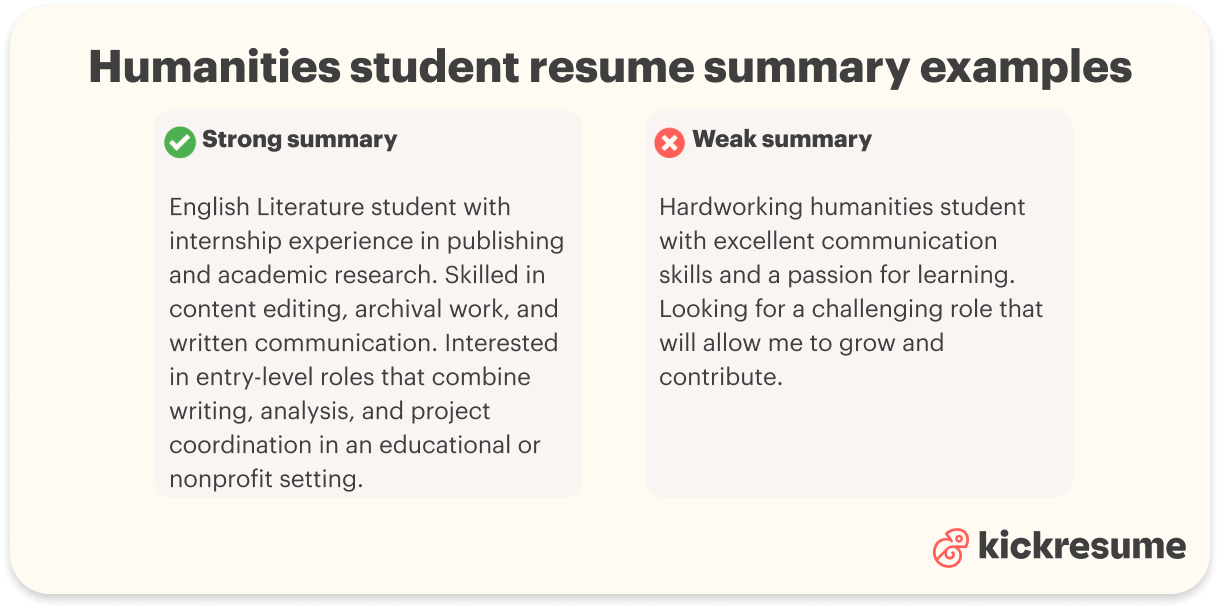
Bad humanities student resume summary example
Hardworking humanities student with excellent communication skills and a passion for learning. Looking for a challenging role that will allow me to grow and contribute.
Why doesn't it work? This example is way too vague. You could drop this same summary into almost any resume, for any field. It doesn’t tell the reader what you’ve studied, what you can actually do, or what direction you’re headed in.
Good humanities student resume summary example
English Literature student with internship experience in publishing and academic research. Skilled in content editing, archival work, and written communication. Interested in entry-level roles that combine writing, analysis, and project coordination in an educational or nonprofit setting.
Why does this one work? It gives specifics like the field, the experience, the skills, and the direction. Anyone reading this knows right away what this student offers and where they’re aiming.
If you have no experience yet: use a resume objective
If you’re earlier in your studies or haven’t had the chance to gain formal work experience, that’s completely fine. In that case, a resume objective is the better choice. It focuses on your goals, transferable skills, and enthusiasm for contributing to the organization or field.
Your objective should include:
- Your degree or major
- Key skills or qualities that fit the role
- What kind of position or experience you’re seeking
- How you can add value, even as a beginner
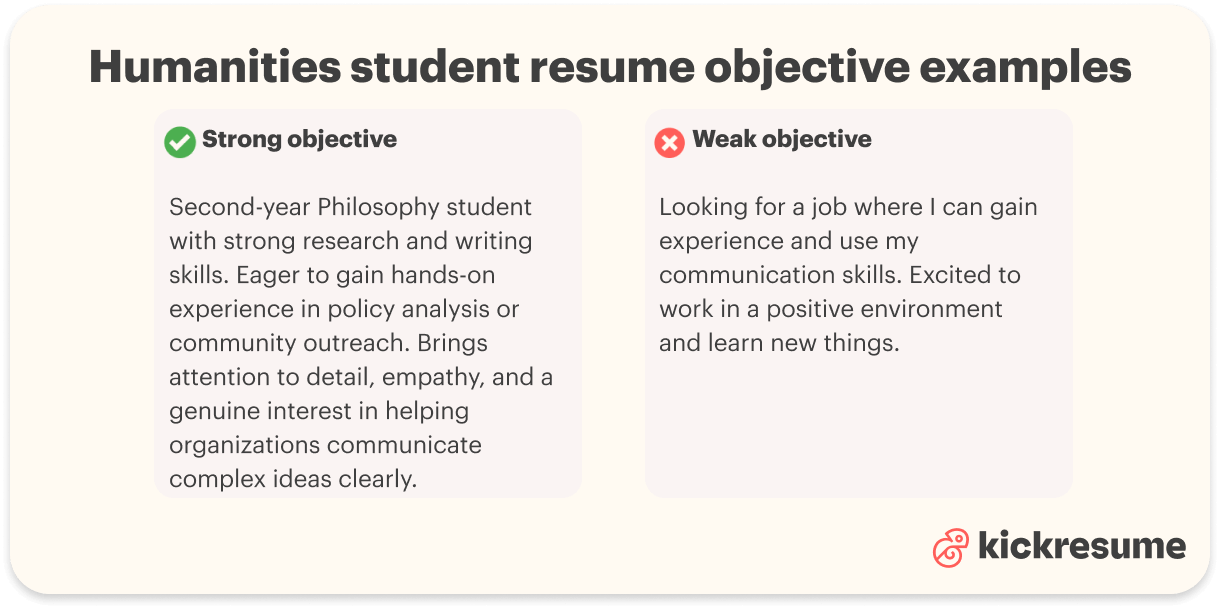
Bad humanities student resume objective example
Looking for a job where I can gain experience and use my communication skills. Excited to work in a positive environment and learn new things.
Why does this fall flat? This objective doesn’t show what kind of role you’re after, what you’re studying, or what makes you useful to the organization.
Good humanities student resume objective example
Second-year Philosophy student with strong research and writing skills. Eager to gain hands-on experience in policy analysis or community outreach. Brings attention to detail, empathy, and a genuine interest in helping organizations communicate complex ideas clearly.
What makes this one better? Firstly, it’s grounded in what the student does have, like strong academic skills, curiosity, and relevant interests. And secondly, it’s specific without being overconfident.
A few quick tips
- Keep it short — 3 to 4 sentences at most.
- Drop the personal pronouns (“I,” “my,” “me”) to keep it clean and professional.
- Use clear, direct language. Skip filler words like “motivated” or “passionate” unless they’re backed up with detail.
- Mention your field right away — don’t make the reader guess what you study or specialize in.
Whether you’re building your first resume or adding to one you already have, this short section at the top can set the tone for everything that follows. Be clear, be specific, and make it easy for someone to see what you’re about in just a few lines.
3. Select the most effective humanities skills to include on your resume
It is always crucially important to include key skills on your resume – but what skills are the best to include for a Humanities Student?
First and foremost, it is essential to include both technical and interpersonal skills on your resume. Technical skills refer to your learned abilities gained through education and training, while interpersonal skills refer to how you work with people and the world around you. Interpersonal skills can be both inherent and learned.
The best technical skills to put on your humanities student resume
- Research methods
- Knowledge of human behavior
- Sociology
- Foreign languages
- Literary analysis
- Data collection and analysis
- Art history
- Political science
- Interviewing and Journalism Techniques
- Archaeology
Interpersonal skills for your humanities student CV
- Creativity
- Adaptability
- Critical thinking
- Communication
- Collaboration
- Leadership
- Motivation
- Willingness to learn
- Problem-solving
- Empathy
Find out your resume score!

4. Craft a relevant work experience section for your humanities student resume
Describing your work experience on a resume requires you to go above and beyond simply listing out the responsibilities you held within the position.
While describing your responsibilities is important, you must also strive to include quantifiable and specific accomplishments that make you stand out as an applicant. This can include awards, key achievements, or major projects you worked on.
Here is an example of a work experience entry from a humanities student’s resume
UNC Charlotte Department of Humanities, Charlotte, NC
Research Assistant
August 2021 to Present
- Assisted the Head of Department in conducting a study of the effects of cultural events on the overall mental health of students on campus.
- Co-authored 4 papers published in major scientific and academic journals, including the American Journal of Sociology.
- Collected and analyzed data for 8 different studies over the course of 2 years.
5. List your educational credentials as a humanities student correctly
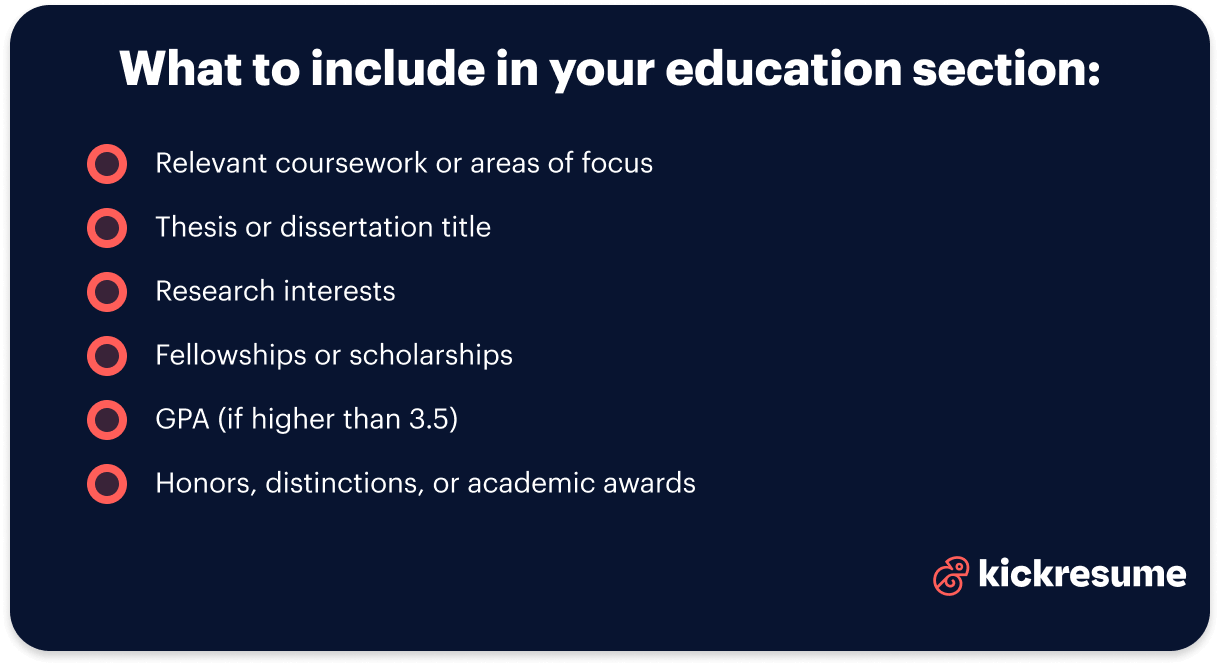
When writing your resume while still a student, it is important to indicate that your degree is still ongoing. Additionally, you should always include the correct information about when you expect to graduate and the institution or university you attend.
Here is an example of a well-crafted education section on a humanities student’s resume
West Virginia University, Morgantown, WV
B.A. in Humanities
- Ongoing, Expected Graduation: May 2023
- Major: Foreign Languages & International Literature
- Dean’s List, 2020-2022
6. Elevate your humanities student resume with optional sections
Once you’ve covered the basics (education, experience, and skills) your resume is in good shape. But if you want it to really stand out, adding a few optional sections can make a big difference.
When to include optional sections
Optional sections are great when they add something meaningful, a skill, an experience, or a bit of context that supports your goals.
Add them when:
- You’ve got extra space on your resume (but not so much that it looks empty).
- The information helps explain your strengths or direction.
- You’ve done something that connects to the opportunity, even if it’s outside of school or work.
Skip them when:
- You’re adding things just to fill space.
- They don’t relate to the role or field you’re targeting.
- They distract from your main achievements.
Optional sections to consider for humanities students
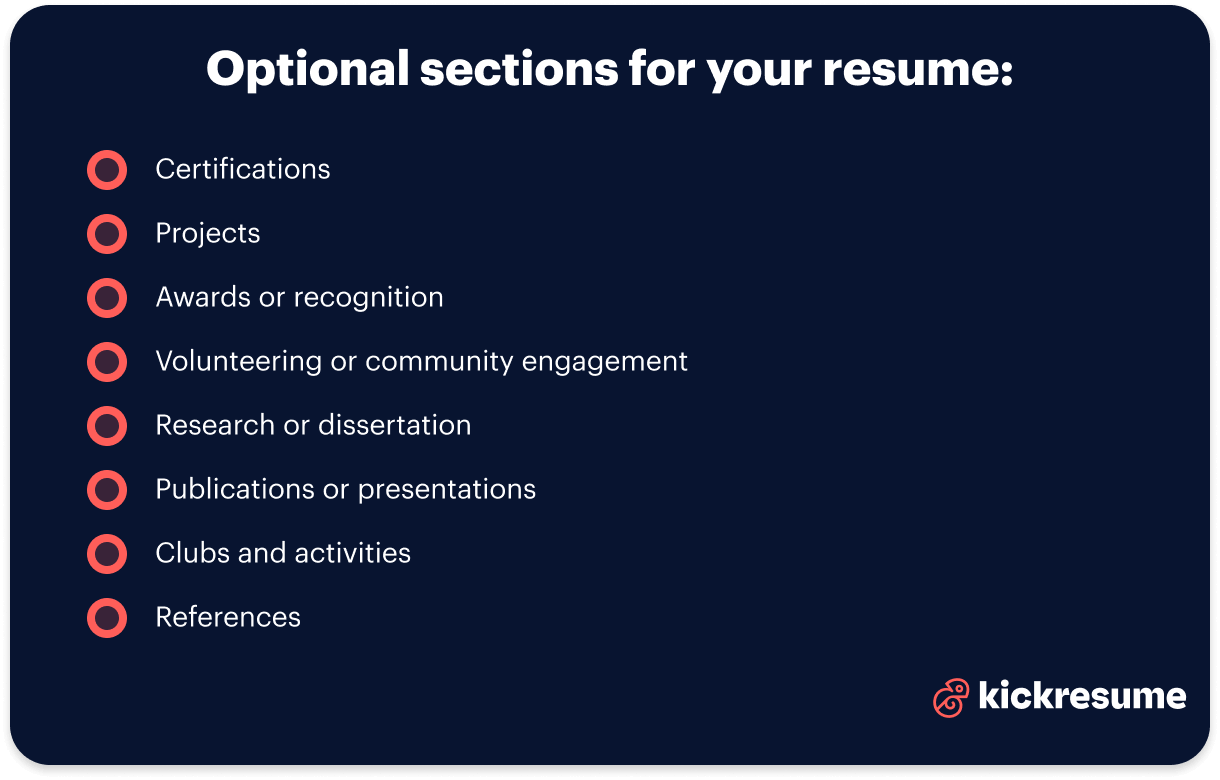
Depending on your background, here are some strong options to include:
- Certifications: These show that your interest in your field is genuine and doesn't just evaporate once you leave the classroom.
- Projects: Perfect for class projects, group assignments, or independent research that show analytical thinking or creativity.
- Research or dissertation: If you’ve completed a major research paper or dissertation, give it a short section. This works especially well for graduate students or those applying to academic or research roles.
- Volunteer work or community involvement: This can highlight your empathy, communication skills, and leadership. All of these qualities matter in humanities and service-oriented fields.
- Awards and honors: List any scholarships, fellowships, or academic recognitions. They show dedication and excellence in your field.
- Publications or presentations: If you’ve published a paper, blog post, or presented at a student conference, include it. It shows initiative and communication skills.
- Clubs and activities: If you’re involved in student organizations, journals, or debate societies, this is where you can highlight that engagement.
Example of optional sections in a humanities student resume
Projects
- Senior Seminar Project: Analyzed media coverage of postwar Europe using discourse analysis techniques; presented findings to a 30-person seminar group.
Dissertation
- Honors Thesis: “The Ethics of Memory in Postcolonial Literature” – Explored representations of cultural trauma through comparative literary analysis.
Awards
- Dean’s List, 2023–2025
- Humanities Undergraduate Essay Prize, Department of English, 2024
Cubs and activities
- Editor, Student Literary Review (2024–Present)
- Member, History Society (2023–Present)
How to fit them in
You don’t need all of these, just go with the ones that reinforce your main story. You can also group similar ones together (for example, “Projects and Research” or “Awards and Honors”) to keep things tidy and easy to read.
But please, remember that optional sections shouldn't be just a padding for your resume. Whatever you mention in this document, it needs to add depth and value to your application. Everything else needs to go!
7. Steer clear of common mistakes that can tank your chances
You’ve spent time fine-tuning your resume, but before you send it on its merry way, it’s worth doing one final read-through. Small mistakes can undermine all that effort.
Here are some of the most common resume missteps you should look out for:
1. Typos, grammar slips, and unclear phrasing
Even one small typo can give the impression that you’re careless. In the humanities, where writing and communication are core skills, that kind of slip stands out even more.
2. Overstuffed layout or inconsistent formatting
If your resume looks like a wall of text, people won’t read it. They'll just move on. And that's not what you want.
3. Sending the same version everywhere
A single, generic resume can’t work for every opportunity. A nonprofit internship and a research assistant role call for different emphases.
4. Listing duties instead of impact
“Wrote essays” or “assisted with research” doesn’t tell the reader much. Show what your work achieved.
5. Missing or outdated contact info
It happens more often than you’d think. Sneaky mistakes like an old email, a missing phone number, or a broken LinkedIn link are plaguing many otherwise great resumes!
6. Ignoring keywords from the description
If you’re submitting your resume through an online system, it might be screened by software before a human ever sees it. If your resume doesn’t include key terms from the listing (like “archival research,” “community engagement,” or “critical analysis”), it could get filtered out.
7. Including everything you’ve ever done
You don’t need to list every paper you’ve written, every club you’ve joined, or every part-time job you’ve had since high school.
Before you send your application, take a few quiet minutes to review it with fresh eyes. Trim what’s not adding value, double-check the details, and make sure every line earns its place. That last bit of polish can turn a good resume into one that actually opens doors.
8. Top job search resources for humanities students
As a humanities student, finding the right platforms for your job hunt is crucial. Listed below are some of the best job search resources to kickstart your career path:
- Handshake: A dedicated platform for college students and new graduates, providing networking opportunities, career advice and, of course, plenty of job listings.
- LinkedIn: With its vast network and ability to showcase your profile to potential employers, LinkedIn remains an essential resource. Make sure your profile is optimized to attract recruiters.
- Indeed: A comprehensive job search engine with a well-stocked section for humanities roles.
- Glassdoor: An excellent resource to research potential employers, their culture, and salaries, besides job listings.
- Your university's career center: Don't overlook this valuable resource. They often have job boards and provide resume and interview preparation.
Remember, patience and persistence are key. Use these resources wisely to tune into opportunities that align with your skills and interests.
Student Career Outlook in 2026
Choosing the right university in 2026 isn’t just about prestige. It’s about employability. As AI tools and automation takes over more entry-level tasks, getting hired straight out of school is tougher, and universities that focus on real-world experience and industry links give graduates an edge.
For the 15th year, the Global University Employability Ranking 2026 by Times Higher Education highlights the universities worldwide that employers believe produce the most employable graduates.
It’s based entirely on votes from international employers and hiring managers, with insights from more than 13,000 recruiters worldwide.
Here are the top 10 universities for employability in 2026:
- Massachusetts Institute of Technology (MIT), US
- Stanford University, US
- Stanford University, USCalifornia Institute of Technology (Caltech), US
- University of Cambridge, UK
- University of Oxford, UK
- University of California, Berkeley, US
- Harvard University, US
- National University of Singapore, Singapore
- Imperial College London, UK
- ETH Zurich, Switzerland
You can find the full ranking including all 250 universities here.
Humanities Student Resume FAQ
What major points should I include in my humanities student resume?
Your resume should highlight your education, skills, any past work or internship experience, and relevant academic projects or coursework.
How do I convey my humanities knowledge in my resume?
Leverage your skills section to highlight core competencies like critical thinking, communication, research skills, and cultural awareness. If possible, link these skills to concrete experiences or achievements.
What format should I use for a humanities student resume?
A reverse chronological format usually works best, starting with your most recent education or experience. However, if you have many relevant academic projects, a hybrid or combination resume could be a better fit.
How long should my humanities student resume be?
As a student, your resume should be succinct. Aim for one page, but if you have significant relevant experiences, a second page could be warranted.
What's a common mistake to avoid when writing a humanities student resume?
Beware of being too general. Recruiters want to see how your skills and experiences directly apply to the role you're targeting. Tailor your resume to the specific job and organization each time you apply.


![How to Write a Professional Resume Summary? [+Examples]](https://d2xe0iugdha6pz.cloudfront.net/article-small-images/How_to_Write_a_Professional_Resume_Summary_.png)
![How to List Your Education on a Resume? [+Examples]](https://d2xe0iugdha6pz.cloudfront.net/article-small-images/How_to_Put_Education_on_a_Resume_.png)
![How to Describe Your Work Experience on a Resume? [+Examples]](https://d2xe0iugdha6pz.cloudfront.net/article-small-images/How_to_Describe_Your_Work_Experience_on_a_Resume_.png)