ChatGPT
 Perplexity AI
 Claude
Maybe you're wondering, how do you put hobbies on a resume? And why should you even bother? Can they actually help your chances of getting the role? The thing is, they kind of can.
Your hobbies and interests make you, well, you. But that's not the only reason to put them on your resume.
Sure, they can say a lot about what makes you tick. But most importantly, they can help an employer decide whether they'd like you as a person or not — and have you on their team. What's more, your hobbies are a great indication of whether you fit a company culture or not.
In this how-to guide, we'll show you how to list your hobbies on a resume and leverage them to your advantage.
This guide will answer the following questions:
- What is the resume hobbies section?
- Why include hobbies on your resume?
- When to include hobbies in your resume?
- What's the difference between hobbies and interests, and why does it matter?
- What are some good hobbies and interests to put on your resume?
- How to list them on your resume?
Too long, don't wanna read? 60sec video guide
What is the resume hobbies section?
The hobbies section is an optional part of your resume where you can mention your interests and hobbies.
Many people leave it out because they think it ultimately won’t make any difference. But whether you’re a student, a fresh graduate, or a seasoned professional, it can be useful for both you and your future employer. Well, if you do it right.
It usually sits at the bottom of your resume and might include up to five interests or hobbies, briefly described in a few words or simply illustrated with icons.
Why include hobbies on your resume?
In general, the main purpose of a resume is to show that you have what it takes for a given job. Your hobbies and interests have little to contribute to this goal.
For this reason, it’s never a mistake NOT to include hobbies in your resume. But still, there are some benefits to including them.
- You show that you fit the company culture. Why would employers care about your love for reading dense novels? Because companies today don’t want corporate robots, but real people who align with their culture.
- It shows your personality. It’s always nice to let recruiters know you’re a human being, too. It makes them think of you in a different way. All of a sudden, you become an intriguing human being with your own hopes and dreams.
- It sets you apart from others. There is a chance the hiring manager will remember you as the person who has an interesting hobby, compared to other candidates who only list their work achievements.
- It can demonstrate personal growth and commitment. Sticking with a hobby over time signals dedication, adaptability,
- and a commitment to personal development , making you seem more dynamic and well-rounded.
- It can indicate transferable skills. Certain hobbies can showcase specific qualities or transferable skills that are applicable to many jobs.
All right, then. Where should you place your hobbies? At the bottom of your resume.
As we’ve already said, your hobbies are not the most important part of your resume. More important resume sections, like work experience or skills, should precede them.
Still, you can make this section look a bit fancier. The little icons can give it a nice artistic touch, but do everything in moderation. Sometimes less is more.
Of course, don’t make stuff up just to seem more interesting.
Do you feel like you don’t have any hobbies that are relevant to the job or the company? Or perhaps you feel they lack transferable value?
Then don’t mention them. After all, a resume should ideally be one page long. You’ll easily find better ways to use this space.
Oh, and whether you have job-related hobbies or not, you can now turn your LinkedIn profile into a polished resume with just one click.
When to include hobbies in your resume?
As mentioned, hobbies and interests aren’t the most important part of your resume.
But in some cases, they can give you a boost, show off transferable skills, or even give you something interesting to talk about in an interview.
This can be especially helpful if you don’t have much work experience or are struggling to fill up your resume.
Here are a few more reasons to include hobbies and interests on your resume:
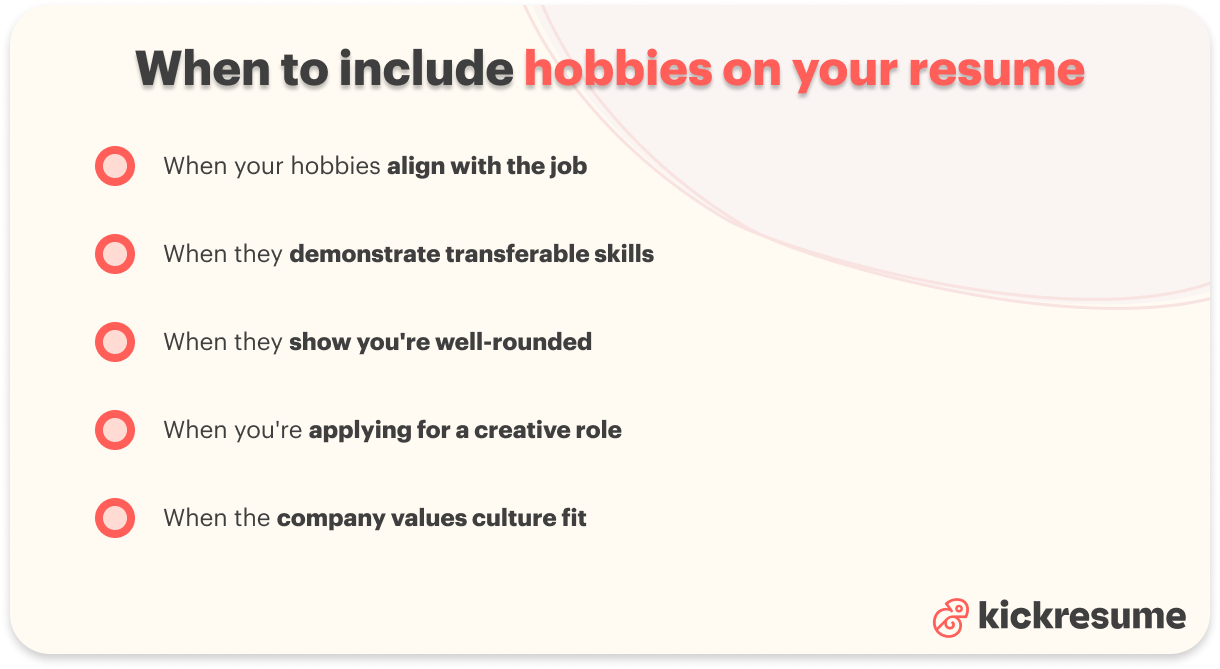
- When your hobbies align with the job. If your interests directly relate to the role you're applying for, it can show you’re passionate about the industry.
- When they demonstrate transferable skills. Hobbies like volunteering, team sports, or managing a blog can highlight valuable skills like leadership, teamwork, and time management.
- When they show you're well-rounded. If your hobbies demonstrate that you're active, creative, or committed to personal growth, it can give a more complete picture of you as a candidate.
- When you're applying for a creative role. Creative hobbies, like photography or graphic design, can serve as proof of your creative mindset, especially if your portfolio is light on projects.
- When the company values culture fit. If the company values work-life balance, community involvement, or creativity, mentioning relevant hobbies can help show you're a good cultural fit.
What’s the difference between hobbies and interests?
Hobbies and interests are related but are not the same.
An interest is something you enjoy, but it doesn't necessarily mean you actively do it. If yes, you enjoy doing it just from time to time.
A hobby is something you practice or do regularly. You usually do it during your free time for enjoyment. So, your interest can become a hobby if you do it every day and make it a part of your life.
You paint from time to time but don’t have sufficient time to practice it regularly. That’s an interest. Do you meditate and do yoga daily? Good! That means you have a hobby.
Finally, while interests alone aren’t especially impressive, regularly practicing a hobby is. That’s why your resume should (ideally) include your hobbies rather than simply listing things you find interesting.
But, If there's an interest you're truly passionate about and feel it could boost your resume, that's fine. Just list it clearly, making sure to focus on what you actually engage in or practice.

What hobbies should you include on a resume?
Avoid being vague. The point of listing hobbies on your resume is NOT to mention everything you like to do.
For example, saying that you like music isn’t going to help you make a stronger case for your candidacy. Everybody likes music. It’s vague. It doesn’t say anything about you.
Do you only listen to music or do you also write your own music? Do you like dancing to music? You get the idea.
Moreover, you especially want to mention those of your interests that are interesting or impressive. Do you enjoy running? Don’t forget to mention that you finished a marathon. Do you love traveling? Tell them how many countries you’ve visited.
Yet again, if you want your hobbies to work as icebreakers and conversation starters, be REALLY specific.
After all, a “fervent golf player” or “contemporary American documentary novel lover” sounds much more engaging than vague statements “playing every kind of sport” or “getting lost in a good book.”
Finally, always highlight any of your interests that relate to the desired position.
Start by scanning the job description to identify the qualities and skills they’re seeking. Write them down, reflect on them, and try to link them to a specific hobby.
Let’s say that you’re looking for a job that requires analytical thinking. What do you think will impress them more? Your passion for solving the Rubik’s cube or your love of good food?
Or let’s say you’re applying for a managerial position at a travel agency. Being an avid hitchhiker can help you a lot.
Or perhaps you’re applying for a job at a vinyl shop. Playing an instrument will help you look like you have a deep connection to the industry. See the point?
You can also research the company to find out about their company culture and tailor your hobbies section to it.
Find out your resume score!

General hobbies that look good on any resume
Although technically, there is no "good" or "bad" answer when it comes to hobbies, some hobbies are more resume-worthy than others.
Why? Hobbies can demonstrate skills or specific personality traits that make you appear more suitable for a role. For example, if you've managed to run a marathon, it shows that you have discipline, resilience, and a strong work ethic.
On the other hand, if you’re passionate about gardening, it could indicate that you have patience and attention to detail.
So, what are those “good” hobbies to put on a resume?
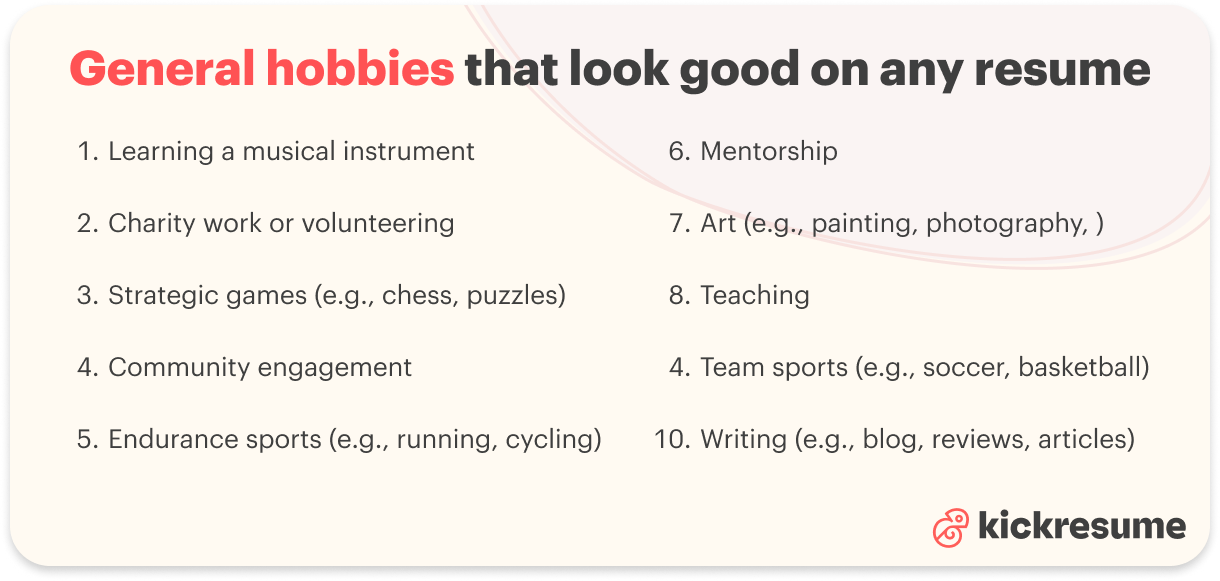
- Learning a musical instrument. Learning an instrument shows you’re patient, disciplined, and willing to put in the effort to improve, which are traits that make you a strong learner in any job.
- Charity work or volunteering. Volunteering highlights your people skills, empathy, and ability to work with different groups. That makes you easy to work with in any team.
- Strategic games (e.g., chess, logic puzzles). Enjoying games that require strategy shows you're a natural problem-solver who can think ahead. That’s useful no matter the role or industry.
- Community engagement (e.g., book clubs, community gardening). Being active in your community shows initiative, collaboration, and communication. These are all skills that translate well into any workplace.
- Endurance sports (e.g., running, cycling). Training for long distances isn’t easy, and it proves you’re goal-driven, resilient, and know how to push through tough situations.
- Mentorship. Mentoring others shows you’re a strong communicator and a team player who helps people grow. That’s valuable in leadership and collaboration across any job.
- Artistic hobbies (e.g., drawing, photography). Creative hobbies highlight your eye for detail, originality, and ability to express ideas visually, which is useful even outside creative roles.
- Teaching. Whether you’ve taught formally or informally, it shows you can explain complex ideas clearly. That’s a major asset in almost any role.
- Team sports (e.g., soccer, basketball). Playing team sports shows you know how to cooperate, communicate, and bring your best to group efforts.
- Writing (e.g., blogs, reviews, articles). Writing regularly shows you can think clearly, communicate well, and organize ideas. Those are essential skills in any workplace.
Good hobbies and interests for specific job roles
While some hobbies are great on any resume, others can highlight specific strengths that match certain jobs perfectly and can do a lot of quiet talking on your behalf. Here are some hobbies that pair especially well with different types of roles.
1. Creative hobbies
These hobbies show you can tackle challenges creatively and adapt to new ideas. These are great to mention for jobs in marketing, advertising, product development, content creation, or any role that values creativity.
- Drawing/Painting
- Making Music
- Photography
- Playing a Musical Instrument
- Writing
- Content creation
2. Critical thinking hobbies
These hobbies show you can think strategically and tackle complex problems, not to mention that they suggest you're actually having fun with it. Great for roles in analytics, research, data, or problem-solving.
- Crossword Puzzles
- Chess
- Quizzes
- Sudoku
- Brain Teasers
- Logic Puzzles
- Strategy Games
- Reading
3. Content-related hobbies
These hobbies show you’re a natural communicator, love collaborating, and know how to engage with people. They highlight your ability to transform ideas into content, which is valuable for marketing, social media, PR, or any role involving public speaking or community engagement.
- Creating Content
- Blogging
- Podcasting
- Video Making
- Social Media Management
- Writing Reviews
4. Community hobbies
These hobbies show you care about connecting with others and making a real impact in your community, plus you're not shy about taking the lead and getting people involved. They’re great for roles in event planning, community management, PR, nonprofit work, or any job that values teamwork and building relationships.
- Book Club
- Community Gardening
- Scouting
- Organizing Events
- Mentorship
- Charity Fundraising
- Traveling
5. Technological hobbies
Technological hobbies indicate that you are comfortable with new technologies, have an interest in digital platforms, and possess skills that can be applied to tech-focused roles.
- Designing Apps
- Building Websites
- Graphic Design
- Coding
- 3D Modeling
- Digital Photography
- Video Editing
6. Sport hobbies
Sport hobbies show you have strong discipline, a commitment to personal growth, and the ability to handle challenges. Plus, if it’s a team sport, it means you’re a team player too. All of these traits can be valuable for any role.
- Hiking
- Running
- Swimming
- Cycling
- Climbing
- Team Sports (e.g., Soccer, Basketball, Volleyball)
- Yoga
There are plenty of hobbies you can list on your resume, and we’re not here to put limits on your creativity. However, there are a few hobbies you should avoid mentioning when it comes to your resume.
Use artificial intelligence to create your resume — FAST!

Aligning hobbies & interests with company culture
Listing your hobbies and interests can help you catch a recruiter’s attention and show that you're naturally a good fit for the company culture. It can make you seem more interesting and position you as the right fit from the very beginning.
- Research the company’s core values & culture. Dive into the company’s “About Us” page, social media, and news articles. Are they competitive and fast-paced, or do they promote collaboration and community involvement?
- Find the subtle value match. If a tech firm emphasizes innovation, mentioning your interest in hackathons or building apps for fun makes great sense. On the other hand, for a company known for philanthropy, mentioning your volunteering interests might be a better fit than martial arts.
- Use language that resonates. If their site describes employees as “adventurous problem-solvers,” It might be worth mentioning activities like mountaineering, chess competitions, or escape rooms.
- Show how your hobby helps you at work. Talk about how your hobbies gave you in return. For example: “I run marathons—training for races taught me discipline and perseverance, which I now use when managing projects at work.”
Here are few examples of hobbies for a specific company cultures:
If the company values innovation and tech curiosity:
Pick hobbies that show you love experimenting, learning on your own, and staying ahead of the curve when it comes to technology.
"Organize quarterly hackathon meetups to experiment with new technologies."
"Built a mobile budgeting app as a side project to improve my Flutter skills."
If the company promotes community and social impact:
Choose hobbies that show you care about people, enjoy giving back, and thrive in collaborative, purpose-driven environments.
"Co-organize charity runs and fundraisers for local nonprofits."
If the company calls for adventurous, driven individuals:
Choose hobbies that show you embrace challenges, push your limits, and stay motivated even when things get tough.
"Completed the 800km Camino de Santiago pilgrimage on foot."
"Regularly participate in escape room challenges with a local logic puzzle group."
How to list hobbies on a resume
Your hobbies section should work for you. Don’t just list what you like to do—show how your hobbies align with the role and highlight any achievements or skills gained from them.
When listing your hobbies, mention something specific or cool you’ve done. Otherwise, they’ll just feel vague and sort of pointless.
This is your chance to show a bit of personality, so use it. Here's how to list your hobbies correctly on your resume:
- You can name the section simply as “Hobbies”.
- Instead of listing too many of your hobbies and interests on a resume, pick 4-5 based on the criteria described in the section “What hobbies and interests should you include”. Think about a skill or an achievement that best illustrates your passion for an activity and put it right next to it.
- Depending on a company, you can also follow up by simply listing some of the quirkier hobbies you have. The point is to give them a peek of your personality. At the same time, don’t go all out with companies that have a very formal company culture.
- Finally, keep your hobbies section short.
How to correctly list hobbies and interests on a resume
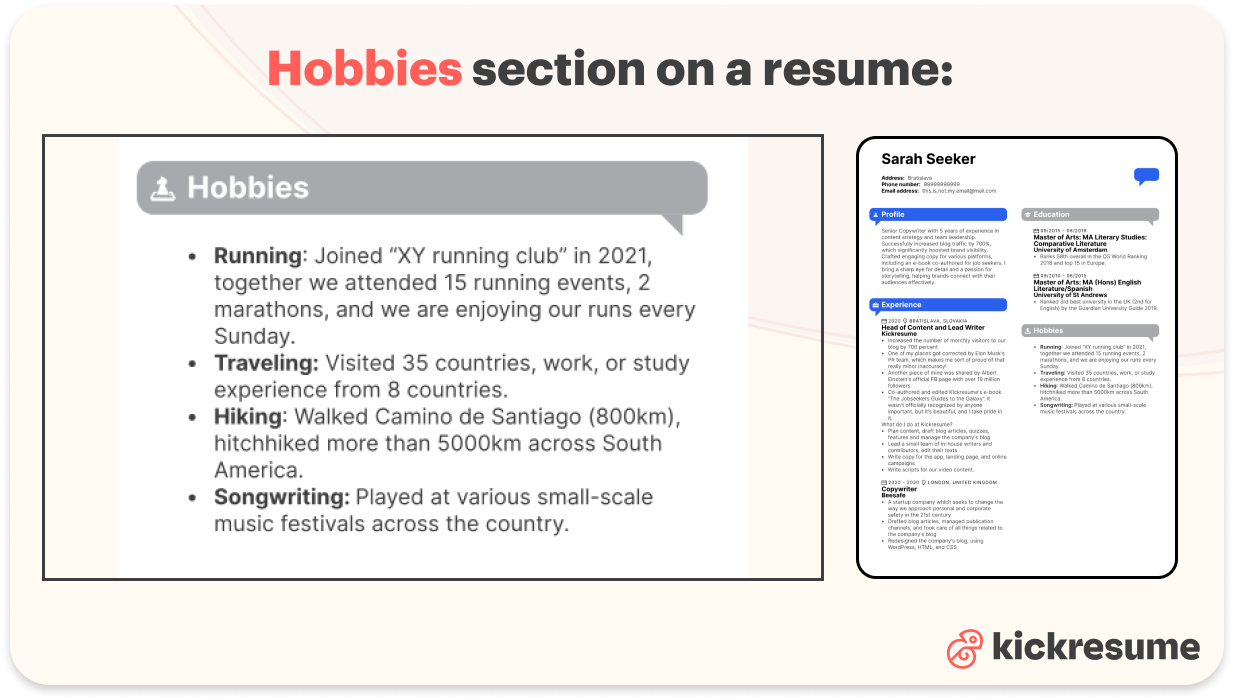
- Running club: Joined “XY running club” in 2021, together we attended 15 running events, 2 marathons, and we are enjoying our runs every Sunday.
- Traveling: Visited 35 countries, with work or study experience in 8 countries.
- Hiking: Walked Camino de Santiago (800km), hitchhiked more than 5000km across South America.
- Songwriting: Played my music at various small-scale music festivals across the country.
While it’s only a small part of your resume, if done right, it can help you stand out by giving the reader a positive, personal impression.
How NOT to list hobbies on a resume
There are plenty of hobbies and interests you can list on your resume, and we’re not here to put limits on your creativity. However, there are a few things you should avoid mentioning when it comes to your resume.
- Don’t include any sensitive subjects such as politics, any controversial issues, religion, or sex.
- Don’t mention risky and time-consuming activities. Your future employer wants to have you fit and able to work. Any activities that put your life at risk or are too time-consuming may scare them.
- Don’t use buzzwords. Football, reading, traveling, music, social media? Nope. If you really like reading so much that you want to mention it, at least be specific. Reading is not a unique interest. Reading 55 books a year is.
Don’t overdo it. Adding too many hobbies and interests to fill up more space isn’t a good idea. Keep it simple, list only the best ones and leave the valuable space on your resume for more important information.
Bad example of hobbies and interests on a resume
- Partying
- Social media
- Dangerous sports (e.g.,base jumping, cage fighting)
- Niche personal hobbies (e.g., collecting obscure items)
- Sensitive subject hobbies (e.g., kink groups, adult entertainment)
- Trash TV
- Being involved in political or religious movements
Key takeaways
Hobbies can be a great way to elevate your resume and give potential employers a glimpse of your personality.
When listed thoughtfully, they can help you:
- Show that you align with the company culture
- Set you apart from other candidates
- Demonstrate personal growth and commitment
- Highlight transferable skills
That said, to make your hobbies truly work in your favor, you need to follow a few simple rules:
- Avoid being vague
- Be specific when listing hobbies
- Focus on your achievements or progress
- Highlight hobbies relevant to your desired role
- Research the company’s values and align your hobbies with them
Following these simple rules will help you list your hobbies and interests in a way that actually adds value to your resume, rather than just taking up space.

![How to Write a Professional Resume Summary? [+Examples]](https://d2xe0iugdha6pz.cloudfront.net/article-small-images/How_to_Write_a_Professional_Resume_Summary_.png)
![How to List Your Education on a Resume? [+Examples]](https://d2xe0iugdha6pz.cloudfront.net/article-small-images/How_to_Put_Education_on_a_Resume_.png)
![How to Describe Your Work Experience on a Resume? [+Examples]](https://d2xe0iugdha6pz.cloudfront.net/article-small-images/How_to_Describe_Your_Work_Experience_on_a_Resume_.png)