ChatGPT
 Perplexity AI
 Claude
What does the best manual tester resume example for 2026 look like? If you’re updating your current QA resume or starting completely from scratch, that question comes up quickly.
We’ll walk you through multiple manual tester resume samples, explain why each one is effective (or where it falls short), and then give you practical writing tips and resume templates you can customize.
And if you want to build your own resume step by step, you’ll find a simple guide at the end to help you shape a version of a manual tester resume that fits your experience and the roles you’re targeting.
The best manual tester resume example for 2026


Note: The preview above shows only the first page of this resume. Click on the sample to view the full multi-page version with all sections or scroll down for a full text version.
What makes this manual tester resume work?
- Strong, focused profile summary: The profile immediately establishes the candidate as a Manual QA Tester with 2 years of experience, relevant skills, and also their familiarity with Agile methodology.
- Mentioning a professional recognition: The Employee of the Month recognition for catching a critical bug vouches for the applicant’s abilities.
- Comprehensive skills section: The resume lists widely used QA tools (Jira, Bugzilla), basics of SQL, some front-end knowledge (HTML, CSS, JavaScript), and also documentation tools like Trello and Basecamp.
- Strong academic background: Degree in Computer Science shows that the candidate has a strong technical foundation, which is valuable in all manual testing roles.
- Relevant certification included: The ISTQB Foundation Level credential is one of the most recognized certifications in manual testing.
- Inclusion of relevant keywords: The work experience covers key manual testing responsibilities (identifying bugs, reviewing specs, writing test plans, executing test cases, and documenting defects), which makes the resume ATS-friendly.
- Easy-to-spot header: The candidate’s name, contact information, and professional title are clearly displayed at the top, making it simple for hiring managers or ATS systems to identify who the resume belongs to.
How can this manual tester resume be improved?
- Including quantifiable data: Recruiters love specific numbers. Metrics like “reduced defect leakage by 15%” or “cut regression testing time by 20%” add credibility and help the resume stand out.
- Hobbies add little value: “Exploring distant lands” and “Getting lost in a good book” don’t strengthen a manual tester application.
- Some tools listed are less relevant to core QA work: Items like Basecamp, Trello, or Excel are useful but not core testing tools. If included, they should appear lower in the list so they don’t overshadow more technical skills.
- Experience bullets could be more impact-driven: Many bullet points simply describe tasks (“Identified and reported bugs,” “Created logs”) without showing outcomes.
Now, let's dissect 8 more manual tester resume samples.
If any of these designs catch your eye, just click on the image and start customizing the content to fit your needs.
QA tester resume example

Note: The preview above shows only the first page of this resume. Click on the sample to view the full multi-page version with all sections or scroll down for a full text version.
What makes this QA tester resume work?
- Neatly organized skills section: The skills section is broken into clear sub-sections (languages, computer skills, interpersonal skills), which makes it very easy for a recruiter or hiring manager to scan. Manual tester resumes often get reviewed quickly, so this kind of structure helps important information stand out.
- Strong emphasis on collaboration: Both QA roles highlight how the candidate worked closely with developers, managers, and other testing teams. Manual testers rarely work in isolation, so showing this repeatedly strengthens the resume.
How can this QA tester resume be improved?
- Education section goes into unnecessary detail: A more concise education entry (or one that highlights relevant coursework, QA-related projects, or even the dissertation topic) would make the section more aligned with what employers look for at this level.
- Profile leans on generic traits instead of specifics: Phrases like “exceptional analytical skills,” “attention to detail,” and “fast-paced environments” are positive qualities; but they're also very vague. Including more concrete information, like types of products tested, industries worked in, or particular strengths in the QA process, would work better here.
QA analyst resume example

Note: The preview above shows only the first page of this resume. Click on the sample to view the full multi-page version with all sections or scroll down for a full text version.
What makes this QA analyst resume work?
- Use of bullet points: The bullet-point formatting makes the work experience easy to skim and helps key contributions stand out.
- Quantifiable achievements: Including numbers like a 35% reduction in processing time and a 24% decrease in unnecessary costs instantly strengthens the resume. These results show measurable impact and help the candidate stand out from applicants who only describe duties.
How can this QA analyst resume be improved?
- Profile section is way too long: The profile tries to cover many traits and responsibilities at once, which makes it feel less punchy. A more hard-hitting summary would focus on one or two major achievements, specific domains (e.g., Windows/Linux apps), or unique testing expertise.
- Generic interpersonal skills: Skills like “good team player,” “communication skills,” and “time management” are very common and could apply to almost any job. Because they’re so broad, they don’t help the recruiter understand what the candidate is specifically strong at within QA.
Software tester resume example

What works here
- The award is a nice credibility boost: Awards help you stand out right away and show that other people have recognized your skills. It adds instant credibility.
- The job history shows progression: The path from IT support → QA → software testing makes sense and shows steady growth. It’s easy for a hiring manager to see how this candidate's skills have built over time.
What can be better
- More consistency with action verbs: Some bullets start strong, others feel more like unfinished phrases. Keeping every bullet action-oriented (“Created,” “Tested,” “Supported,” etc.) would make the whole thing read cleaner and more confident.
- The tasks don’t really show the impact: Right now most bullets describe what the candidate did, not what came out of it. Adding even small wins would make your experience feel more meaningful.
Quality assurance tester for video game resume sample

What makes this quality assurance resume work?
- Coverage of multiple QA responsibilities: The resume shows breadth of QA work: identifying bugs, documenting issues, creating test plans, and pre-launch testing. It shows both depth (technical knowledge) and process understanding.
- Clear professional focus: The profile immediately tells the reader that the candidate is a Video Game QA Tester and specifies key languages (English, Spanish) and tools. Hiring managers don’t have to guess what the candidate does.
What can be better
- Section order could be improved: Education is currently listed before work experience, but hiring managers care more about hands-on experience. Moving work experience to the top would make the resume more impactful and immediately relevant.
- Education section could highlight relevant projects: Even with a strong GPA, mentioning key projects or capstone work in game design could show hands-on experience and creativity in a QA context.
Application analyst resume sample

Note: The preview above shows only the first page of this resume. Click on the sample to view the full multi-page version with all sections or scroll down for a full text version.
What works here
- Multilingual skills: Listing proficiencies in several languages is a plus! Especially for international teams or companies dealing with global clients.
- Volunteer experience included: Even brief volunteer roles, like First Year Representative, show leadership and community involvement. Plus, it also shows initiative and willingness to take on responsibility.
What can be better
- Too heavy on interpersonal skills: Some interpersonal skills overlap with what’s already shown in work experience. Condensing or grouping them more efficiently would make this section cleaner.
- Hobbies are redundant: While “Exploring distant lands” or “Getting lost in a good book” shows personality, it doesn’t strengthen the professional profile and could be omitted to save space.
Software testing fresher resume sample

What makes this software testing resume work?
- Internship integrated into work experience: The internship at IBM is listed alongside the fresher role rather than separately under “Internships,” which shows continuous growth. This makes it easy for recruiters to follow the career timeline.
- Strong academic performance: High GPAs and awards (Top 1% of the program, Academic Excellence Award) underscore technical competence and dedication, which is especially valuable for a fresher-level applicant.
What can be better
- Section order could be better: Work experience currently comes after education. For a candidate with even a small amount of hands-on experience, it’s better to lead with work experience to show practical abilities first.
- Repetitive phrasing in work experience: Many bullet points use similar language like “collaborated with cross-functional teams” and “implemented automated testing frameworks.” Varying the wording or combining some points would make the section easier to read.
Quality assurance consultant resume sample

Note: The preview above shows only the first page of this resume. Click on the sample to view the full multi-page version with all sections or scroll down for a full text version.
What makes this QA resume work?
- Detailed project descriptions: Each project includes responsibilities, types of testing performed, tools used, and programming languages. This level of detail is great for recruiters who want to see exactly what the candidate has done, and it showcases technical competence across multiple domains.
- Extensive work experience: The resume demonstrates a strong history in QA testing with multiple companies and projects.
What can be better
- Less personal information: Including date of birth and full address is unnecessary and could lead to unconscious bias. Simply listing city, country, email, and phone is enough to contact the candidate.
- More customization and focus: The resume is very long and includes all past roles and projects, even ones that might not be relevant to the target job. Focusing on the most relevant experiences, tools, and testing types for the role being applied to would make the resume shorter, more targeted, and easier to read.
Junior QA tester resume sample

What makes this QA resume work?
- Impressive quantifiable achievement: The resume highlights a 13% reduction in testing expenses, which gives a clear example of the candidate’s impact.
- Awards and recognition included: Listing both the Employee of the Year Award and academic distinctions demonstrates excellence and motivation. This shows the candidate consistently performs well, both in school and at work.
What can be better
- Profile could be more achievement-focused: The profile is general and talks about being “results-oriented” and “analytical” without showing specific achievements.
- More specificity on testing tools and projects: The computer skills list includes tools like Selenium and Ranorex, but the work experience doesn’t explain how they were used. Adding context (e.g., “Created automated test scripts in Selenium to validate web app functionality”) would better demonstrate applied knowledge.
How to write the best manual tester resume for 2026 in 7 steps
If you aren’t a fan of modifying existing QA resumes, creating your own from the ground up can actually be the better choice. All you need to do is pick one of our professionally designed resume templates and follow these 7 simple steps:
- Make an easy-to spot resume header
- Create an attention-grabbing profile summary
- Pick the right skills to highlight
- Make your work experience the center of attention
- Flash out your education and certification
- Elevate your resume with relevant optional sections
- Format your resume with ATS in mind
1. Start with an informative manual tester resume header
Your resume header is the small block of information at the very top of your resume. Its only purpose is to make it easy for someone to contact you without hunting around the page.
These five things should always be there:
- Your full name
- Phone number (+ area code)
- Professional email address
- LinkedIn profile link (if updated)
- DIgital portfolio link (if you have one)
Anything that can create bias or raise questions that have nothing to do with your skills should stay off your resume.
What you should NOT put in your header:
- A photo
- Date of birth
- Nationality
- Marital status
- Gender
None of this helps you get the job, and in many places, recruiters prefer not to see it because it creates legal and ethical issues.
Julia Belak, Certified Professional Résumé Writer, comments:
“There’s no universal rule about including a photo on your resume. In some countries, like Spain or Italy, recruiters expect a professional headshot. But in many English-speaking countries, this practice is discouraged due to discrimination concerns. My advice is to always check the resume standards for the specific country you’re applying to.”
2. Create a concise profile summary
Your profile summary (also called a resume summary or resume objective) is the short paragraph that sits right under your header.
The goal here is to convince the hiring manager to keep reading the rest of your resume in just 4-5 lines, without wasting a single word.
A good manual tester summary includes these essentials:
- Years of experience
- Your job title (Manual Tester, QA Analyst, Junior Manual Tester, etc.)
- Quantified achievements (numbers help people trust what you say)
- Certifications (e.g., ISTQB)
- Specific hard skills (test case design, functional testing, API testing, etc.)
- A connection to the company (mention one thing that shows you actually looked them up, for example, their product, industry, tech stack, or values)
Now, let's take a look at two examples and see which one works better:
Bad manual tester resume summary example
I am a hardworking team player who is passionate about quality and always gives 110%. I am seeking a challenging role where I can use my skills to grow and contribute to a dynamic organization. I am detail-oriented and committed to excellence.
Why is this so bad? This example is too vague. It doesn't show any specific skills, achievement, nor any link to the company. It's pretty hollow and could apply to any job on Earth.
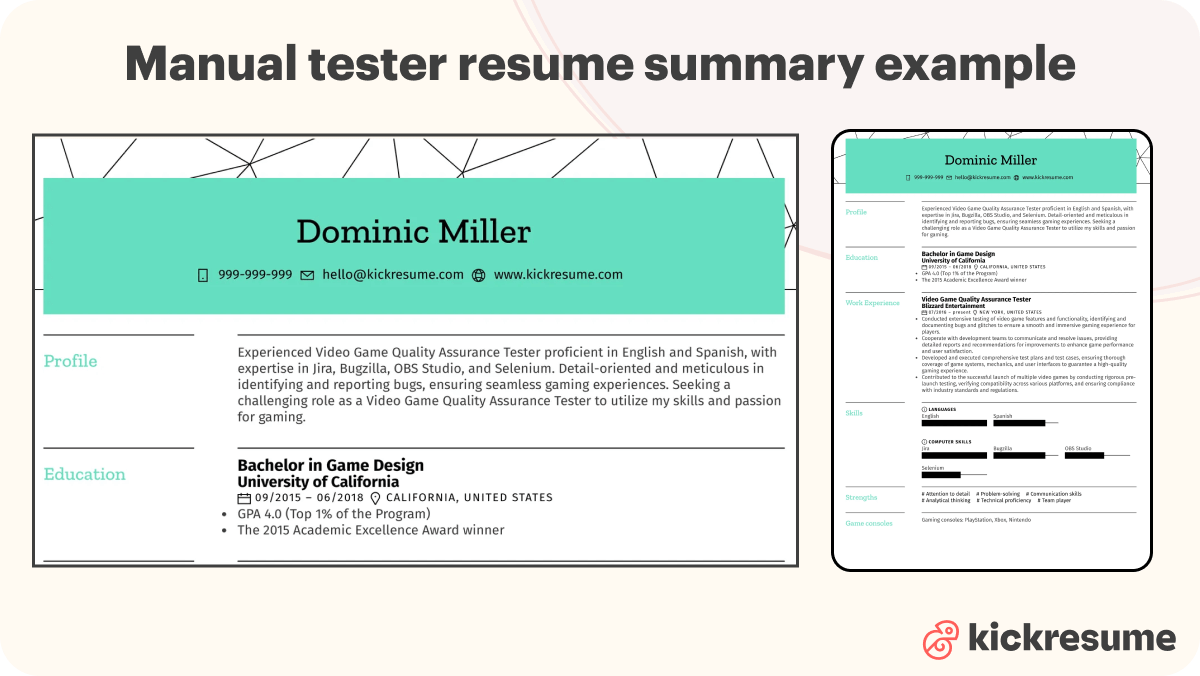
Good manual tester resume summary example
Manual Tester with 3+ years of experience in functional and regression testing for web and mobile apps. Skilled in identifying high-impact bugs and working with Jira and Postman. ISTQB-Certified, with a track record of reducing test cycle times by 18% in my last role.
Why does this work? This profile summary shows off the candidate's experience, lists relevant manual testing skills, and mentions specific achievement. This whole section stays focused and intentional.
3. Pick the right manual testing skills to highlight
The best manual tester resumes are customized!
And the first step towards a customized resume is knowing which skills to put in the forefront and which don't actually need to be explained in detail.
Before you write your skills section, do this:
- Read the job ad carefully.
- Highlight the skills the employer keeps repeating (tools, testing types, methodologies, domain knowledge, etc.).
- Match those requirements with your real skills.
- Those matched skills are the ones that absolutely need to appear on your resume.
Once you do that, you’ll know exactly what to include, and your resume will instantly feel more relevant to the hiring manager.
Top 10 in-demand technical skills for manual testers
- Functional Testing
- Regression Testing
- Writing Test Cases & Test Scenarios
- Bug Tracking (Jira, Bugzilla, etc.)
- API Testing (Postman)
- SQL for Data Validation
- Test Planning & Test Documentation
- Cross-Browser & Cross-Platform Testing
- Agile/Scrum Methods
- Exploratory Testing
After picking the right hard and soft skills, create a separate skills section and divide it into further sub-categories. This makes the reading experience more digestible and clear for hiring managers, which is exactly what you need.
Here are four example groups manual testers often use, with sample skills:
- Testing Skills (functional testing, regression testing, Smoke & Sanity testing)
- Tools & Platforms (Jira, TestRail, Postman)
- Automation Basics (Selenium WebDriver, TestNG, Basic Java)
- Database & API Skills (SQL Queries, API Testing, JSON/XML Validation)
Having a dedicated skills section is great, but the real power comes from showing those skills in your work experience section.
4. Make your QA work experience the center of attention
The work experience section is the part of your resume that really carries the most weight. And just like your skills section, it also needs to be customized to match what the employer says they need.
If the job ad highlights certain tools, testing types, or responsibilities, your bullet points should make it clear that you’ve handled those things before (and ideally done them well).
Here’s how to write work experience bullet points that actually help you:
- Stick to about 5 bullets per job: Enough space to show what you handled without turning the section into a wall of text.
- Give ample detail: Skip generic phrases like “helped with testing” and explain what you did and achieved in detail.
- Use action verbs to kick off each bullet: These verbs add a flavor of initiative and proactivity. For manual testers, verbs like tested, executed, identified, logged, collaborated, or validated can be especially useful.
- Talk about impact, not just daily tasks: Not every bullet should be “I did X.” Some should show why it mattered. For example, instead of “Executed test cases for new features” go with “Executed test cases for new features, reducing post-release bugs by 20% in the following sprint.”
- Add numbers when you can: How many test cases you handled, how often you ran regression tests, how many defects you logged, how quickly issues were resolved.
- Use keywords from the job ad: If the employer mentions “API testing,” “Agile,” “test documentation,” “Jira,” or anything else repeatedly, weave those terms into your bullets (as long as you’ve actually done them). It shows that your experience lines up with what they’re hiring for.
Take a look at these examples and see for yourself which one leaves a stronger impression:
Bad manual tester resume work entry example
Manual Tester — ABC Tech
2021–2023
- Helped with testing activities.
- Ran tests when needed.
- Worked with developers.
- Reported bugs.
- Did other tasks when asked.
Why this falls flat: It’s vague, doesn’t show any actual skill, has no context, no tools, no numbers, and gives zero sense of impact. A hiring manager learns nothing from this.
Good manual tester resume work entry example
Manual QA Tester — ABC Tech
2021–2023
- Executed 200+ detailed test cases for web and mobile features each release cycle.
- Performed functional, regression, and exploratory testing across multiple releases.
- Flagged a critical usability issue affecting onboarding; after the fix, customer support tickets dropped by 18%.
- Collaborated with product owners and QA leads during sprint planning to refine requirements, reducing last-minute rework by 30% over two quarters.
- Created detailed test cases for web and mobile features in an Agile environment.
5. Flash out your education and certification
When it comes to the education section, you have two ways to approach it.
Option 1: Keep it simple
This version only includes the basics:
- Degree name
- Institution
- Years of study
You should choose this version if:
- You already have 4+ years of work experience (at this point, your skills and professional results matter more than your coursework).
- Your degree isn’t related to the job you’re applying for.
- You don’t want the education section to take attention away from your actual experience.
Manual tester resume education example (short version)
B.Sc. in Physics, University of Delhi
2014–2017
Option 2: Add more detail
If you’re just starting out or your current job isn’t in the same field as the one you’re targeting (but your degree is), you can expand the section.
You can add things like:
- GPA (only if above 3.5)
- Relevant courses
- Projects
- Dissertations
- Academic achievements or recognitions (including the Dean’s list)
Manual tester resume education example (detailed version)
B.Sc. in Computer Science, University of Pune
2019–2022
- GPA: 3.8
- Relevant courses: Software Testing, Data Structures, QA Fundamentals
- Final-year project: Built a defect-tracking tool with automated reporting
- Awarded Best Capstone Project (2022)
Certifications can go in their own section, but they can also sit under education. Especially if they support your technical skills or prove that you’re qualified despite not having a related degree.
Recognized certifications for manual testers
- STQB Certified Tester Foundation Level (CTFL)
- ASTQB – CTFL (US-specific version of ISTQB)
- QA Analyst Certificate – IIST (International Institute for Software Testing)
- Software Quality Assurance and Testing Specialization by Board Infinity (via Coursera)
6. Elevate your QA resume with relevant optional sections
If you’ve got this far, your resume already has all the basics a strong manual tester resume needs. But there’s still room to go one step further with optional sections.
When to add optional sections:
- You have relevant experience that doesn’t fit neatly under your work history.
- There’s still room on the page without making it feel cluttered.
- The section adds clear value or reinforces your suitability for the role.
When to skip optional sections
- You’re only adding it to make the resume look longer.
- The content doesn’t clearly tie back to the role or company.
- You’re forcing relevance that isn’t there.
For inspiration, here are a few optional sections manual testers might find useful:
- Volunteering: If you’ve helped with QA or tech projects outside of work.
- Professional awards & recognitions: Any honors that show your testing or tech skills.
- Certifications (if not used previously): Extra QA or software testing certificates.
- Projects: Side projects or open-source contributions.
- Technical workshops or training: Courses, bootcamps, or seminars.
- Publications or blogs: If you write about testing, coding, or tech topics.
Example of optional sections on a manual tester resume
Volunteering
- QA Volunteer, Open-Source Game Project, 2022 – Tested new features, documented bugs, and suggested workflow improvements.
Awards & Recognitions
- Employee of the Month, Tech Solutions Inc., 2021 – Recognized for catching critical bugs before product release.
Certifications
- ISTQB Foundation Level Certified Tester, 2023, [Certificate ID: OO-2023-9200]
- Selenium WebDriver Basics, 2022, [Certificate ID: IA-2022-2436]
Projects
- Personal Bug Tracking Tool – Developed a simple tool to log, categorize, and prioritize bugs for small projects using Excel and Python.
7. Format your manual tester resume with ATS in mind
Before your resume even reaches a human, it often goes through an ATS (an Applicant Tracking System). These are software programs that scan resumes for keywords, skills, and experience relevant to the job posting.
ATS are now widely used by companies of all sizes.
And even the most tailored, impressive resume can get discarded if it’s not ATS-friendly.
7 Tips for making your manual tester resume ATS-friendly
- Use standard headings: Stick to common section titles like “Work Experience,” “Education,” “Skills,” and “Certifications.” Avoid creative alternatives like “My Journey” or “Learning Adventures.”
- Keep formatting simple: Avoid tables, text boxes, graphics, or columns that ATS might misread.
- Include keywords from the job ad: Use exact phrases the employer mentions, like “manual testing,” “bug tracking,” “test case execution.”
- Use standard fonts: Stick to fonts like Arial, Calibri, or Times New Roman. Fancy fonts may break ATS parsing.
- Save as a Word or PDF (depending on employer instructions): Word (.doc or .docx) is safest for most ATS; some systems also handle PDFs well, but check the posting.
- Spell out acronyms at least once: For example, write “Quality Assurance (QA)” instead of just “QA” to ensure ATS picks it up.
- Use a consistent, standard date format: Write dates as MM/YYYY (e.g., 04/2020 – 11/2022) or Month YYYY (e.g., April 2020 – November 2022).
Common mistakes to avoid when writing a manual tester resume
Even a strong resume can fall apart if it contains mistakes that hiring managers and recruiters see every day. Here's what you should watch out for:
- Typos, sloppy writing, or unclear descriptions: Read everything out loud. Run a spell-check. Ask someone else to take a quick look.
- Crowded layout or inconsistent formatting: If your resume feels cramped, uses tiny fonts, or switches styles halfway through, it becomes harder to read. Stick to a simple layout with clear headings, spacing, and bullet points instead of big paragraphs.
- Sending the same resume to every job: If you don’t tailor your resume to the job ad, you’ll look generic. Read the posting and make sure your bullets speak directly to those needs.
- Including irrelevant or outdated information: Old school projects, unrelated jobs, or skills you haven’t used in years can clutter your resume and push important details down the page. Stick to what actually supports your application today.
- Skipping keywords from the job posting: If your resume doesn’t include words the employer is looking for, it might never reach a human. You don’t need to “keyword stuff,” but your language should naturally match the terminology in the ad.
- Messy or unclear dates: You’d be surprised how many resumes use confusing dates like “2019–20” or “Fall 2021,” or accidentally leave gaps because the formatting jumps around.
Average salary and job outlook for manual testers
As more companies move their products and services online, the need for reliable software keeps growing. Every new app, website, or digital platform has to be tested before it reaches real users, which is why the demand for QA professionals, including manual testers, continues to rise.
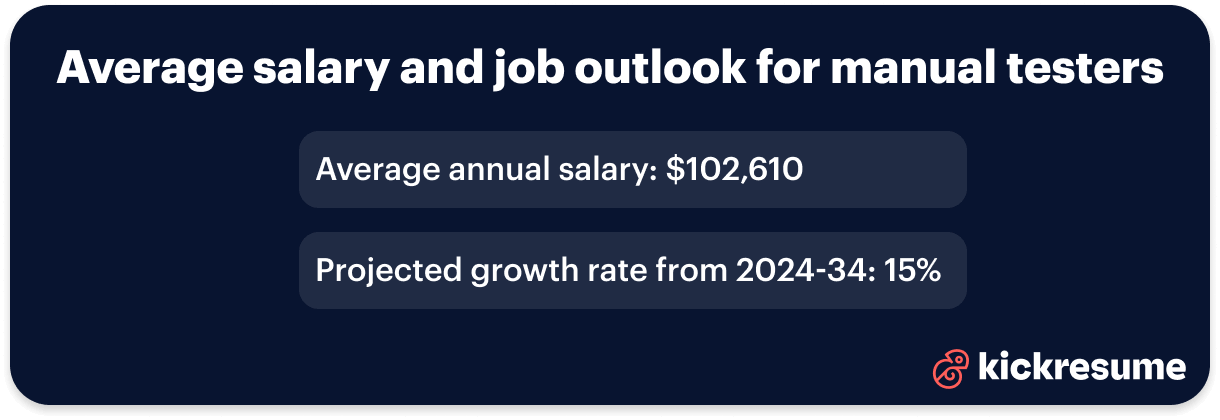
According to the U.S. Bureau of Labor Statistics, the average annual salary for software quality assurance analysts and testers in 2024 was $102,610. That’s significantly higher than the national median wage for all occupations.
And the job outlook is just as strong. The BLS projects employment for “software developers, quality assurance analysts, and testers” to grow by 15% from 2024 to 2034, which is much faster than the average for all occupations.
Based on their current data, about 129,200 openings for software developers, quality assurance analysts, and testers are projected each year, on average, over the decade.