ChatGPT
 Perplexity AI
 Claude
If you’re in need of writing a good police officer cover letter to land a job at your preferred district department, you’ve come to the right place.
This guide will give you everything you need to know to craft a standout cover letter. We’ll provide practical examples, real-life samples, ready-to-use templates, and plenty of writing tips to ensure every detail is spot on. Let’s get started.


 See more examples like these
Keep reading to learn:
- How to analyze real police officer cover letter samples and apply what works
- How to format a police officer cover letter so it’s professional, structured, and ATS-friendly
- How to write a clear and disciplined cover letter header
- How to craft a strong headline that reflects your law enforcement credentials
- How to choose the right greeting (even when no hiring contact is listed)
- How to introduce yourself with authority, clarity, and credibility
- Which law enforcement skills to highlight first
- How to use action verbs that convey confidence, responsibility, and command presence
- How to write a persuasive closing that reinforces professionalism and readiness
- Which common mistakes to avoid when writing a police officer cover letter
- Why your police officer cover letter and resume should work together as a cohesive set
- Where to find the best job-search resources for police officer roles
- What to expect in terms of salary and job outlook in law enforcement
Still looking for your next job? Our in-depth cover letter and resume guides, along with practical career tools, can help you turn applications into interviews and interviews into job offers.
Criminal justice instructor cover letter sample


What works
- Clear academic positioning from the start: The introduction immediately establishes the candidate’s current teaching role and subject expertise (Criminal Law and Ethics), which makes it easy for the reader to understand their specialization and relevance for a Criminal Justice Instructor position.
- Strong alignment with the role’s core responsibilities: The letter highlights lesson planning, delivering instruction in both physical and virtual formats, assessment design, and varied teaching methods. These details directly reflect what hiring committees look for in higher education roles.
- Logical structure with concise, readable paragraphs: The content is organized into short, focused sections that are easy to scan. The flow moves naturally from current role, to academic background, to teaching philosophy, and finally to career goals.
What could be improved
- The opening is too generic: The first sentence expresses “enthusiastic interest” but doesn’t reference the specific institution, department, or program. Adding a tailored reason for applying would make the introduction more compelling and less template-like.
- The closing lacks a confident call to action: The final paragraph is polite but passive. It would be stronger if it clearly invited an interview, reinforced key strengths, and included direct contact details to encourage next steps.
Superintendent cover letter sample

What works
- Strong leadership credibility is clearly established: The candidate immediately positions themselves as a seasoned educational leader with 30+ years of experience and relevant superintendent certification, which aligns well with the senior-level nature of the role.
- Demonstrates measurable and strategic impact: The letter references specific outcomes such as increased student completion rates, CTE pathway expansion, implementation of virtual learning software, and adoption of a restorative discipline model. These examples show high-level, district-wide influence rather than routine responsibilities.
- Clear career progression and scope of responsibility: By outlining prior roles such as Principal, Director of Curriculum, and Director of Human Resources, the cover letter effectively shows upward mobility and broad administrative expertise, reinforcing readiness for a superintendent position.
What could be improved
- Limited personalization to the specific district: The letter doesn’t reference the school district’s mission, demographics, strategic plan, or current challenges. Adding tailored alignment with the district’s priorities would strengthen its relevance.
- The closing could be more decisive and forward-looking: While polite, the ending is somewhat conventional and could be strengthened with a clearer invitation for discussion and a stronger emphasis on the candidate’s vision or leadership philosophy.
Police officer cover letter sample

What works
- Clear and easy-to-follow structure: The cover letter is well-organized, with short, focused paragraphs that make it easy to read and quickly digest — especially important for busy police hiring panels reviewing multiple applications.
- Relevant operational experience is highlighted: The candidate references concrete law enforcement duties such as patrol work, traffic control, responding to alarms, assisting in accidents, preparing warrants, and testifying in court. These examples demonstrate hands-on, real-world policing experience.
- Strong alignment with core police competencies: The letter emphasizes physical endurance, composure under pressure, academy training, and recognition for performance, all of which reinforce suitability for a frontline policing role.
What could be improved
- Greeting lacks personalization: The use of “Dear Hiring Managers” feels generic. Addressing a specific recruiting officer, superintendent, or HR representative would demonstrate greater initiative and attention to detail.
- Header and positioning could be strengthened: The header contains only basic contact details and lacks a clearly structured format. Additionally, there is no strong headline or positioning statement that immediately defines the candidate as a certified, experienced police officer tailored to the specific station’s needs.
1. How to format a police officer cover letter for clarity and professionalism
If your cover letter feels chaotic, overly long, or difficult to follow, it can betray a lack of organization. And in policing, attention to detail isn’t optional.
Police departments and public safety agencies often review many applications at once. A clean, organized layout makes it easier for recruiters and command staff to quickly identify your qualifications, certifications, and readiness for duty.
Here’s how to format your police officer cover letter so it appears professional, composed, and reliable:
- Use a standard, professional font: Choose dependable fonts such as Arial, Calibri, or Times New Roman. Keep the font size between 10 and 12 points to ensure readability and a formal appearance.
- Keep paragraphs concise and well-spaced: Avoid long blocks of text. Short, focused paragraphs with proper spacing make your letter easier to review, especially when hiring panels are screening multiple candidates.
- Left-align your text: Left alignment is clean and professional. Avoid centered formatting or decorative styling, which can distract from your message.
- Follow a straightforward structure: There is no need for creative layouts in law enforcement applications. Stick to a clear structure: Header -> Opening paragraph -> 1–2 body paragraphs -> Closing paragraph
- Keep it to one page: Police recruiters are looking for clarity, not lengthy narratives. One focused page that highlights your training, field experience, certifications, and community commitment is sufficient.
- Use bullet points only when helpful: If you want to emphasize specific achievements, such as reduced incident response times, successful conflict de-escalation, community engagement initiatives, or commendations, a brief bullet list can make those accomplishments easier to spot.
- Maintain a composed and professional tone: A police officer’s role requires calm judgment, integrity, and responsibility. Your language should reflect steady confidence, sound decision-making, and respect for the law and community.
Pro tip
If formatting isn’t your strong suit, using a professionally designed cover letter template can help you present your application in a structured and disciplined way, which are qualities valued in law enforcement.
In policing, credibility starts before the interview. A well-formatted cover letter shows that you understand professionalism, structure, and accountability from the very first page.
Create your cover letter fast with artificial intelligence.

2. How to write a professional cover letter header for a police officer role
Start with the header.
Your goal is straightforward: make your contact details complete, accurate, and easy to locate.
What to include in your police officer cover letter header
Your contact details:
- Full name
- Professional title (optional, e.g., Police Officer or Police Officer Applicant)
- Phone number with area code
- Professional email address
- LinkedIn profile (only if relevant and professional)
- Personal website (optional)
The recipient’s details:
- Hiring officer’s name (if available)
- Their rank or job title (e.g., Recruitment Officer, Chief of Police, HR Manager)
- Police department name
- Department address
Bad example of a police officer cover letter header
From: J. Martinez
555-8844 | jmart@email
To: Police Department
Why this doesn’t work: The phone number is incomplete, the email appears informal, and the department contact is vague. In law enforcement, missing or imprecise information can immediately raise concerns about attention to detail.
Good example of a police officer cover letter header
From: Jonathan Martinez
(312) 555-8844
jonathan.martinez@email.com
To: Captain Laura Bennett, Recruitment Division
Chicago Police Department
3510 South Michigan Avenue
Chicago, IL 60653
Why this works: The information is complete, professional, clearly structured, and properly formatted. Addressing a specific individual and department demonstrates preparation and genuine interest in joining that agency.
Once your header is structured properly, you can move forward with a headline that is tailored for the specific job.
.png)
3. How to create a strong headline that immediately captures attention
But why does your headline matter?
Because it’s a great opportunity to catch a recruiter’s eye! In a competitive police recruitment process, your headline should make the reader hooked from the very first moment. That’s why it needs to be both informative and attention-grabbing.
A strong police officer cover letter headline should quickly reflect:
- Your level of experience or training
- Academy graduation or certification status
- The type of law enforcement environment you’ve worked in (patrol, community policing, investigations, etc.)
- Core strengths such as public safety, crisis response, or community engagement
Let’s look at the difference.
Bad example of a police officer cover letter headline
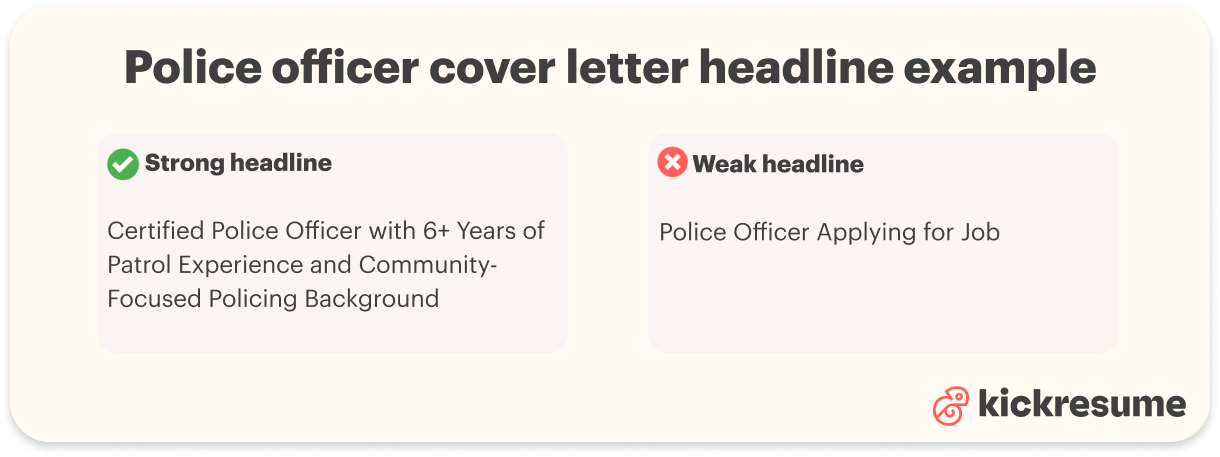
Police Officer Applying for Job
Why this doesn’t work: It is too general, and repeats the job title without adding meaningful information. It doesn’t mention training, specialization, or strengths. There’s no clear reason for a recruitment officer to keep reading.
Good example of a police officer cover letter headline
Certified Police Officer with 6+ Years of Patrol Experience and Community-Focused Policing Background
Why this works better:
- It highlights certification status, which is critical in law enforcement.
- It states years of experience.
- It specifies patrol work and community policing focus.
- It immediately presents the candidate as trained, experienced, and mission-ready.
For departments seeking officers who balance enforcement with community engagement, this headline signals alignment right away.
Crafting a headline as an entry-level police officer
If you’re a recent academy graduate with no prior work experience in the field or transitioning from military or related public safety roles, focus on preparation and transferable strengths.
Instead of emphasizing long-term field experience, highlight:
- Police academy graduation
- Field training completion
- Military or security background
- Crisis response or de-escalation training
- Commitment to public safety and community service
Entry-level police officer headline example
Police Academy Graduate with Strong Crisis Response Training and Community Service Background
This works because it demonstrates readiness and foundational training, even without years of on-duty experience.
Your headline sets the tone for your entire cover letter. Keep it specific, professional, and aligned with law enforcement values.
4. How to choose the right greeting for a police officer cover letter
Opening your cover letter with something vague like “To Whom It May Concern” can make your application feel impersonal.
Police officers are expected to pay attention to detail and follow proper protocol. So, taking the time to address your letter to the correct person is a nice touch that can only work in your favor.
How to find the right contact name
Here are several practical ways to identify the appropriate contact:
- Review the job posting: Many police departments list a Recruitment Officer, HR representative, or a command-level contact.
- Visit the department’s official website: Look under sections like “Careers,” “Recruitment,” or “Command Staff.”
- Search LinkedIn: Try titles such as Recruitment Officer, Human Resources Manager, Captain, or Chief of Police.
- Call the department’s non-emergency line: A brief and respectful inquiry about who handles recruitment can leave a positive first impression.
Once you have a name, use it in a professional format.
Examples of a personalized greeting
- Dear Captain Reynolds,
- Dear Chief Martinez,
- Dear Ms. Thompson,
Use formal titles such as Captain, Chief, Sergeant, Mr., or Ms., depending on the role. Always double-check spelling and rank. In law enforcement, accuracy reflects respect and discipline.
What if you can’t find a name?
In some cases, especially with large municipal departments or civil service hiring processes, a specific contact may not be listed. If you have made a reasonable effort and still cannot find a name, these alternatives are appropriate:
Examples if you can't find a recipient's name
- Dear Hiring Committee,
- Dear Recruitment Division,
- Dear [Department Name] Hiring Team,
These options remain respectful and professional while avoiding outdated phrasing.
Starting your letter correctly helps establish credibility before the first paragraph even begins.
5. How to introduce yourself without sounding generic or scripted
If you want your police officer cover letter to stand out, your opening paragraph must do more than announce that you are applying. Your introduction should immediately show that you understand the responsibility that comes with wearing the badge.
Here’s what you can naturally include in your opening:
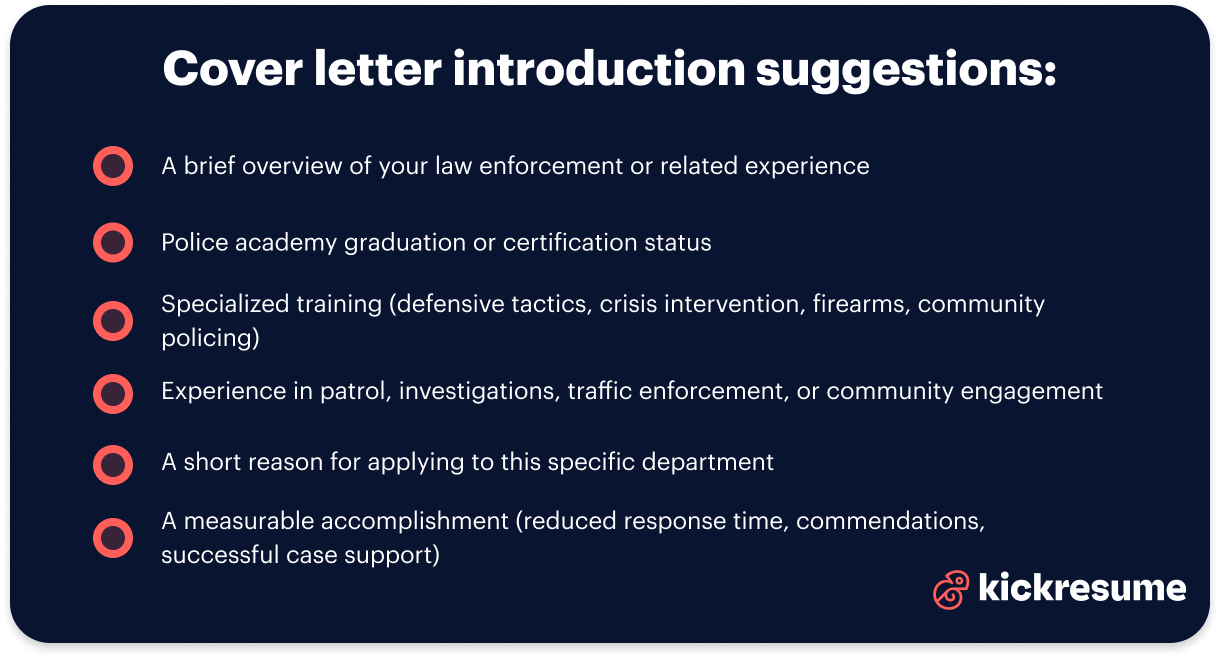
- A brief overview of your law enforcement or related experience
- Police academy graduation or certification status
- Specialized training (defensive tactics, crisis intervention, firearms, community policing)
- Experience in patrol, investigations, traffic enforcement, or community engagement
- A measurable accomplishment (reduced response time, commendations, successful case support)
- A short reason for applying to this specific department
If you're transitioning from military service, corrections, security, or another public-facing role, this is the ideal place to highlight transferable skills such as discipline, decision-making under stress, teamwork, and ethical responsibility.
Bad example of a police officer cover letter introduction
I am writing to apply for the police officer position. I believe I would be a strong candidate and look forward to discussing the opportunity.
Why this doesn’t work: It's vague and provides no information about training, readiness, or public safety experience. There is no clear indication of qualifications or motivation.
Good example of a police officer cover letter introduction
I am a certified police officer with three years of patrol experience in an urban district, where I responded to emergency calls, conducted traffic enforcement, and supported community policing initiatives. During my service, I maintained a consistent record of accurate reporting and contributed to a measurable decrease in repeat disturbance calls within my assigned sector. I am drawn to your department’s strong focus on community engagement and proactive crime prevention, and I am eager to contribute to that mission.
Why this works: This introduction clearly states certification, experience, measurable impact, and alignment with the department’s priorities. It presents professionalism, readiness, and commitment in just a few sentences.
Tips for entry-level police officer candidates
If you're a recent academy graduate or applying for your first sworn position, focus on training and preparation.
You can highlight:
- Police academy completion
- Field training experience
- Military or corrections background
- Crisis intervention training
- Strong ethical standards and accountability
- Community involvement or volunteer service
Entry-level police officer introduction example
I recently graduated from the State Police Academy, where I completed intensive training in criminal law, defensive tactics, and emergency response procedures. Through my field training assignments, I developed strong situational awareness, clear communication skills, and a disciplined approach to public safety. I am committed to serving the community with integrity and professionalism and am eager to begin my career with your department.
Why this works: Even without years of field experience, the candidate demonstrates preparation, discipline, and commitment to law enforcement values.
A strong introduction shows that you understand policing is not simply a job, but a responsibility. When your first paragraph reflects professionalism, readiness, and dedication to public safety, you immediately position yourself as a credible law enforcement candidate.
6. Which skills to highlight first in a police officer cover letter
The body of your cover letter is where you move from introduction to evidence.
This is your opportunity to show how your training, judgment, and professionalism directly contribute to public safety, crime prevention, and community trust.
Don't repeat your resume word for word. Instead, expand on it. Add context. Demonstrate how you apply your skills in real-world situations.
How to structure the body
Keep it focused and purposeful:
- String together 2–4 concise paragraphs
- Show clear and practical examples
- Avoid empty filler
- Make it easy to scan
- Use quantifiable data
Each paragraph should answer one central question: How do I protect the community, enforce the law responsibly, and contribute to effective policing?
Key skills police departments look for
If you're unsure what to emphasize, these are some of the most important competencies in law enforcement:
Top skills to highlight in your police officer cover letter
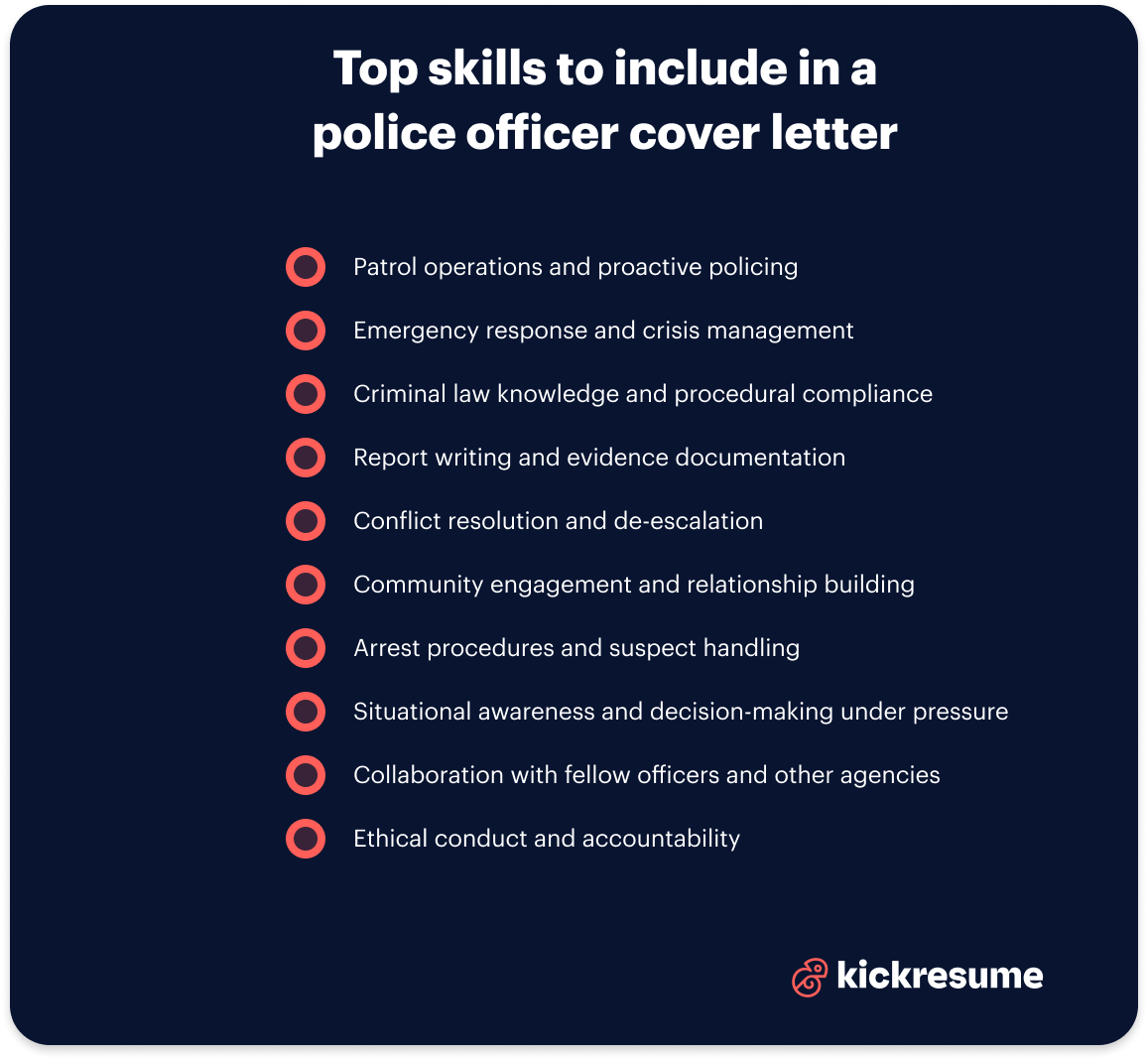
- Patrol operations and proactive policing
- Emergency response and crisis management
- Criminal law knowledge and procedural compliance
- Report writing and evidence documentation
- Conflict resolution and de-escalation
- Community engagement and relationship building
- Arrest procedures and suspect handling
- Situational awareness and decision-making under pressure
- Collaboration with fellow officers and other agencies
- Ethical conduct and accountability
How to demonstrate value instead of listing duties
A simple structure works well:
Situation + action + outcome = credibility
Rather than describing your assigned responsibilities, explain what improved because of your actions.
Here’s how:
- Include measurable improvements when possible (reduced repeat calls, faster response times, commendations)
- Reflect the department’s priorities (if they emphasize community policing, highlight your involvement in outreach or neighborhood programs)
- Provide outcome-driven examples
Examples for experienced police officers
- In my current patrol assignment, I respond to emergency calls, conduct traffic enforcement, and support proactive crime prevention initiatives. By increasing foot patrol visibility in high-incident areas and engaging with local business owners, I contributed to a noticeable reduction in repeat disturbance calls within my sector.
- I prioritize accurate and thorough reporting, understanding that documentation is essential for successful investigations and court proceedings. My supervisors have consistently commended my reports for clarity and attention to procedural detail.
- During high-pressure incidents, I focus on maintaining composure and using de-escalation techniques when appropriate. In a recent domestic disturbance call, I was able to calm both parties, ensure safety, and resolve the situation without physical escalation.
- Working rotating shifts has strengthened my resilience, discipline, and commitment to consistent performance regardless of time or conditions.
Tips for entry-level police officer candidates
If you’re newly certified or transitioning from a related background, focus on foundational strengths:
- Police academy training
- Military or corrections experience
- Crisis response training
- Strong ethical standards
- Clear communication skills
- Physical readiness and discipline
Departments value professionalism, accountability, and integrity just as much as years of service.
Examples for entry-level or academy-trained candidates
- During my academy training, I completed scenario-based exercises focused on traffic stops, conflict de-escalation, and arrest procedures. These simulations strengthened my decision-making skills and reinforced the importance of applying the law fairly and consistently.
- In my previous role in public service, I handled high-stress situations that required calm communication and responsible judgment, skills that directly translate to law enforcement duties.
The body of your cover letter should clearly show that you do more than enforce laws.
When hiring panels can clearly see the impact you bring, it becomes much easier for them to envision you serving effectively in uniform.
7. Using action verbs to present yourself as decisive and proactive
Once your structure is solid and your examples are clear, there is one easy way to strengthen your cover letter: upgrade your verbs.
Passive wording can make even serious duties sound routine. Strong action verbs, on the other hand, communicate initiative and control.
Compare the difference:
Police officer cover letter example without strong action verbs
I was responsible for responding to calls and writing reports.
vs.
Police officer cover letter example with strong action verbs
Responded to emergency calls, secured scenes, conducted preliminary investigations, and prepared detailed incident reports in accordance with departmental procedures.
The responsibility is the same. The impact is not.
The second version sounds accountable, confident, and operationally focused, which is exactly how a police officer should come across.
Action verbs that work well for police officer roles
Police departments look for evidence of sound judgment, enforcement ability, and community responsibility. Your verbs should reinforce those qualities.
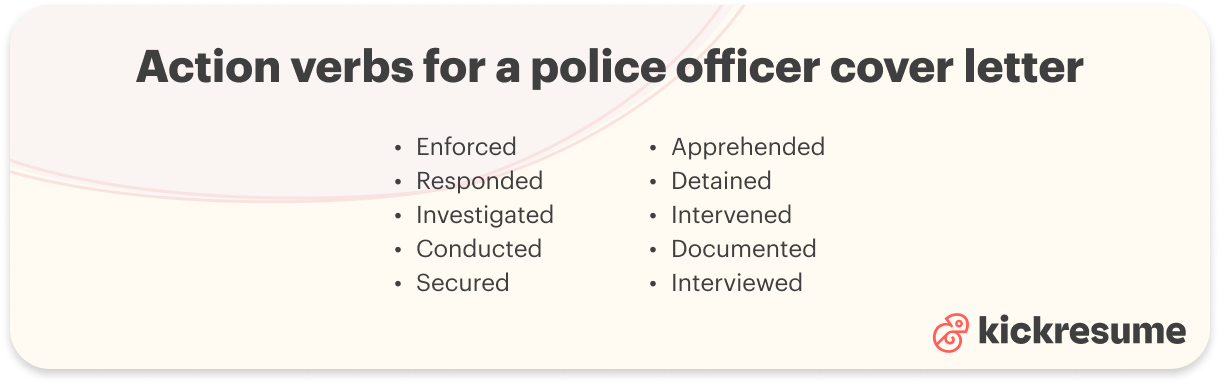
Action verbs for police officer cover letter
- Enforced
- Responded
- Investigated
- Conducted
- Secured
- Apprehended
- Detained
- Intervened
- Documented
- Interviewed
- Coordinated
- Patrolled
- De-escalated
- Assisted
- Testified
These verbs shift your language from “tasks assigned” to “actions taken.”
How to use action verbs effectively
The goal is clarity and authority, not exaggeration.
To use them well:
- Begin sentences with a clear, direct verb
- Connect the action to an outcome when possible
- Avoid repeating the same verb too frequently
- Match the verb to your level of responsibility
Examples before action verbs
- Handled traffic stops.
- Helped resolve disputes.
Examples after action verbs
- Conducted traffic stops in compliance with department policy and issued citations when appropriate to maintain roadway safety.
- De-escalated domestic disputes through calm communication and procedural intervention, ensuring the safety of all parties involved.
Action verbs and ATS compatibility
Strong verbs also support Applicant Tracking System alignment.
Police job postings commonly include terms such as:
- Investigated
- Enforced laws
- Conducted patrols
- Responded to emergencies
- Prepared reports
- Collected evidence
Using similar terminology in your cover letter helps ensure your application aligns with both automated screening systems and review panels.
8. How to write a persuasive closing that encourages an interview
Your final (closing) paragraph may be brief, but it carries weight.
In law enforcement, professionalism and clarity matter from beginning to end. Your closing should reinforce your readiness to contribute to the department.
A strong police officer cover letter closing should include:
- A professional thank-you for the reader’s time
- A short reminder of your core strengths (public safety, sound judgment, report accuracy, community engagement)
- Genuine interest in serving with that specific department
- Actionable nudge towards the next steps
- Your contact details and availability
- A formal sign-off
Bad example of a police officer cover letter conclusion
Thank you for reviewing my application. I hope to hear from you soon.
Best,
Daniel
Why this falls short: It is vague and forgettable. There is no reinforcement of qualifications, no mention of service or responsibility, and no confident statement about next steps. For a position centered on authority and accountability, the tone feels too passive.
Good example of a police officer cover letter conclusion
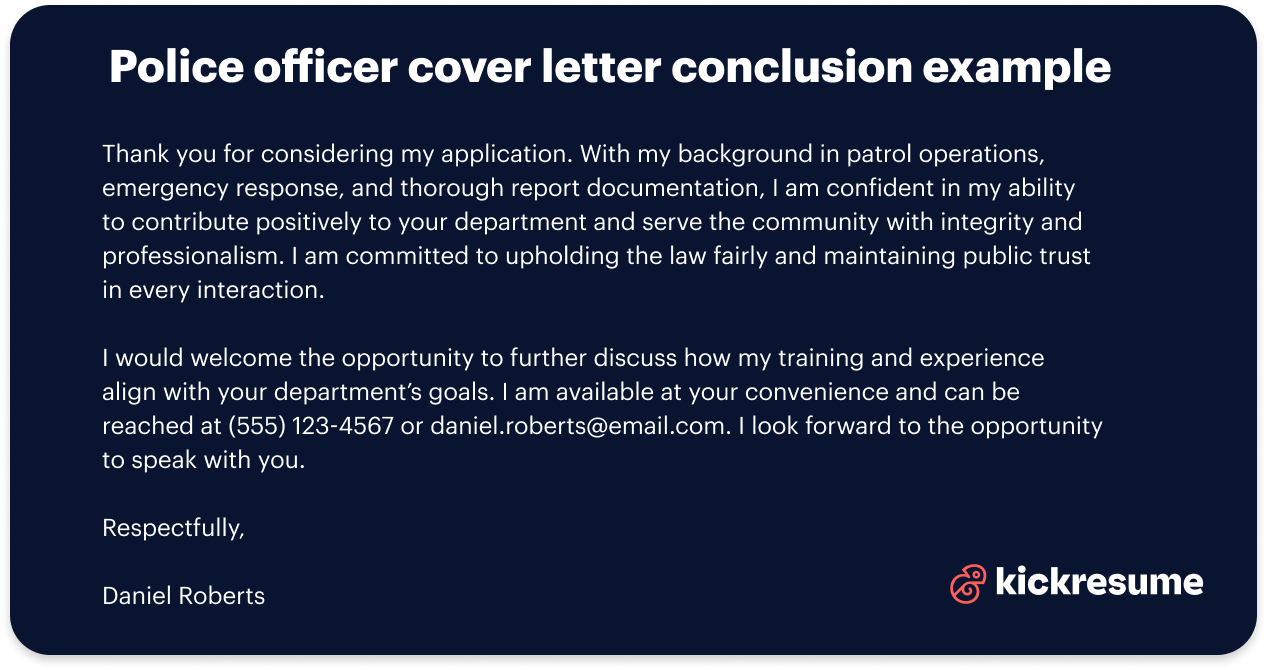
Thank you for considering my application. With my background in patrol operations, emergency response, and thorough report documentation, I am confident in my ability to contribute positively to your department and serve the community with integrity and professionalism. I am committed to upholding the law fairly and maintaining public trust in every interaction.
I would welcome the opportunity to further discuss how my training and experience align with your department’s goals. I am available at your convenience and can be reached at (555) 123-4567 or daniel.roberts@email.com. I look forward to the opportunity to speak with you.
Respectfully,
Daniel Roberts
Why this works: It reinforces key law enforcement qualities such as integrity, preparedness, and public service. The tone is steady and confident without sounding forceful. It clearly invites the next step while maintaining the professionalism expected in policing.
Reaffirm your commitment to service, express interest in the department, and make it easy for them to contact you. A confident ending leaves the impression that you dependable and ready to serve with integrity.
9. Which mistakes to avoid when writing a police officer cover letter
Even a well-written police officer cover letter can lose impact if it contains avoidable mistakes, as small errors can create unnecessary doubts about your professionalism.
Here are the most common pitfalls police officer candidates encounter and how to avoid them:
- Sending the same letter to every department: Every police department has different priorities. One may emphasize community policing, another traffic enforcement, narcotics, school resource work, or investigative units. Tailor your letter to reflect the department’s mission, community profile, and operational focus.
- Being vague about experience: Statements like “I maintained public safety” are too broad. Be specific. Mention patrol duties, report writing, arrest procedures, evidence handling, court testimony, traffic enforcement, or community outreach initiatives. Precision builds credibility.
- Focusing only on authority, not service: Policing is about both enforcement and community trust. If your letter highlights only arrests and control without mentioning communication, fairness, or de-escalation, it may feel one-dimensional. Departments value balanced officers who protect and serve.
- Repeating your resume word for word: Your resume outlines assignments and responsibilities. Your cover letter should explain how you handled high-pressure calls, resolved disputes, supported victims, worked within a team, or contributed to crime prevention efforts. Add context and judgment.
- Ignoring required qualifications: Police roles often require academy graduation, POST certification, firearms qualifications, background clearance, and sometimes specialized training. If the job posting specifies certain requirements, address them clearly so there is no doubt about your eligibility.
- Using an overly aggressive or defensive tone: Confidence is essential in law enforcement, but aggression is not. Avoid language that sounds confrontational or overly forceful. Departments look for officers who demonstrate control, professionalism, and measured decision-making.
- Overlooking formatting or making careless errors: Spelling mistakes, incorrect department names, or sloppy formatting suggest a lack of care. In policing, documentation accuracy is critical. Proofread thoroughly to reflect the same precision expected in official reports.
- Failing to demonstrate integrity and judgment: Law enforcement agencies prioritize ethics, accountability, and sound decision-making. If your letter focuses only on tasks and ignores character, integrity, or responsibility, it may feel incomplete.
Taking the time to tailor your cover letter and double-check it for any potential mishaps can save you a good amount of panic and stress. Plus, it costs you nothing. So, don't make all the time you've already spend working on your application go to waste.
10. Why your police officer cover letter and resume should work together
Before submitting your application, make sure your police officer cover letter is backed by a resume that supports the same narrative. These two documents should feel connected.
Although they serve different purposes, they share one objective: do everything the employers need and a little more.
Here’s how they complement each other:
- Your resume is structured and direct. It outlines your law enforcement experience, academy training, certifications, patrol assignments, investigative work, arrests, court testimony, and measurable contributions in a clean, easy-to-scan format.
- Your cover letter adds insight and judgment. It explains how you approach community interactions, handle high-pressure situations, exercise sound decision-making, and apply department policies in real-world scenarios.
Together, they show both competence and character, which are equally important in policing.
How to make your resume and cover letter feel cohesive
To keep both documents visually aligned:
- Use a consistent header: Your name, contact details, and certification information should appear in the same format on both documents.
- Stick to one professional font: Choose clean fonts such as Arial, Calibri, or Times New Roman and maintain consistent sizing and formatting.
- Keep margins and spacing uniform: Structured spacing reflects discipline and attention to detail.
- Avoid unnecessary design elements: Police departments value clarity over decoration. Keep the layout simple and professional.
If formatting feels overwhelming, using matching resume and cover letter templates can help ensure a polished and consistent presentation.
When your resume and cover letter reinforce each other in both content and appearance, your application feels organized, credible, and ready for law enforcement standards.
Try our AI Resume Writer and have your resume ready in minutes!

11. Top resources for job-seeking police officers
Whether you're looking for opportunities in law enforcement, transitioning to a civilian role, or advancing your career, a great cover letter is a must. But it’s not just the cover letter that helps you land the job you want — knowing where to look gives you the ultimate head start.
Here are some essential resources for police officers aiming to stay ahead:
- Law enforcement job boards: Explore industry-specific job boards like Go Law Enforcement and OfficerList for law enforcement openings nationwide. These platforms often feature specialized roles tailored to your expertise.
- General job boards: Check general job boards that allow you to filter for law enforcement positions and specific locations. Websites like Indeed, Glassdoor, and Monster are great places to start.
- State and federal agencies: Visit websites like USAJobs.gov if you’re interested in federal law enforcement positions. For local opportunities, check your state’s public safety or police commission websites.
- Networking: Networking is one of the best ways to find a job. Join LinkedIn groups to connect with law enforcement professionals or become a member of organizations like the International Association of Chiefs of Police, which offer events and other resources.
- Continuous education and certification programs: Ongoing education and certification are crucial for police officers, given the role's high level of responsibility and the need to handle stressful situations effectively. Completing courses and training through resources like PoliceOne Academy , NAPO, or FEMA will enhance your resume, making you a stronger candidate for specialized roles.
While navigating the job market isn’t easy and might sometimes feel intimidating, with a good cover letter and the right resources, you’ll ace your next job in no time.
Military / Law Enforcement Career Outlook in 2026
Law Enforcement roles (i.e. police and detectives) are projected to grow by 3% between now and 2034, which is as fast as the national average for all jobs. This means about 62,200 positions will open each year from both new jobs and workers retiring or changing careers. (Source: U.S. Bureau of Labor Statistics)
For military-specific roles, the U.S. Bureau of Labor Statistics doesn't provide employment projections, as these positions are not part of the civilian labor force data. That said, the armed forces will always need to hire and train new personnel to stay fully staffed.
Average US base salaries across popular Military / Law Enforcement roles:
- Guard: $63,678/year
- Law Enforcement Officer: $82,529/year
- Police Officer: $71,159/year
- Police Dispatcher: $60,799/year
- Security Officer: $66,918/year
Salary figures are based on Indeed's January 2026 data from anonymous submissions and job listings. What you actually earn will depend on location, company size, job type, and how much experience you have.
Police Officer Cover Letter FAQ
What is the best way to showcase my skills in a police officer cover letter?
The best way to show your abilities is by focusing on specific, measurable examples of your skills. For instance , instead of saying, "I have strong leadership skills," say, "I led a team of 12 officers in implementing a new community policing program, resulting in a 20% reduction in neighborhood crime rates." Be sure to include both hard skills (e.g., tactical training, law enforcement technologies) and soft skills (e.g., communication, conflict resolution) throughout your cover letter.
How can I make my cover letter stand out from the competition?
Tailor your cover letter to the department and role you're applying for. Research the agency’s mission and values, then try to align your achievements, skills, and aspirations with their goals. For instance, if the department prioritizes community involvement, mention your experience in organizing neighborhood watch programs or youth outreach initiatives. Personalization shows genuine interest and commitment.
How can I effectively use keywords in my police officer cover letter?
Look for keywords mentioned in the job posting such as "community policing," "crime prevention," or "incident reporting." Incorporate them naturally into your achievements and skills. For example, you might write, "I excel at community policing, fostering relationships with local residents to proactively address potential safety concerns."
Should I address my experience differently if I’m new to law enforcement?
Yes. If you're new to law enforcement, focus on transferable skills from previous roles, such as communication, teamwork, leadership, or problem-solving. If you have any relevant training, certifications, or volunteer work, don’t forget to mention it. This can include things like a police academy program or participating in a neighborhood safety initiative. Lastly, show your passion for public service and commitment to the values of law enforcement.
Can I include soft skills in my cover letter, or should I focus only on technical skills?
While technical skills like report writing, firearms proficiency, and knowing the ins and outs of law enforcement procedures are important for any police officer, your soft skills matter just as much. Don’t shy away from showing off things like communication, empathy, and conflict resolution in your cover letter, as they’re just as valued and can really set you apart.