ChatGPT
 Perplexity AI
 Claude
Your physical therapist cover letter is a testament to your role as a provider of vital care to patients who are recovering from or living with illnesses, injuries, disabilities, and more.
To do justice to your skills and experience, your cover letter must be top-notch! So, let's make it happen with our comprehensive guide, brimming with the best writing tips, customizable templates, cover letter samples, and plenty of examples.


 See more examples like these
In this guide, we teach you the key steps for writing an impressive physical therapist cover letter. Keep reading to learn how to:
- Learn the do’s and don'ts of cover letter writing from samples
- Format your physical therapist cover letter properly
- Put together an informative header
- Create a headline that grabs attention
- Personalize the cover letter greeting
- Make a great first impression with introduction
- Put your physical therapy skills in the spotlight
- Weave action verbs into your cover letter naturally
- Conclude your cover letter with style
- Dodge mistakes that can sabotage your cover letter
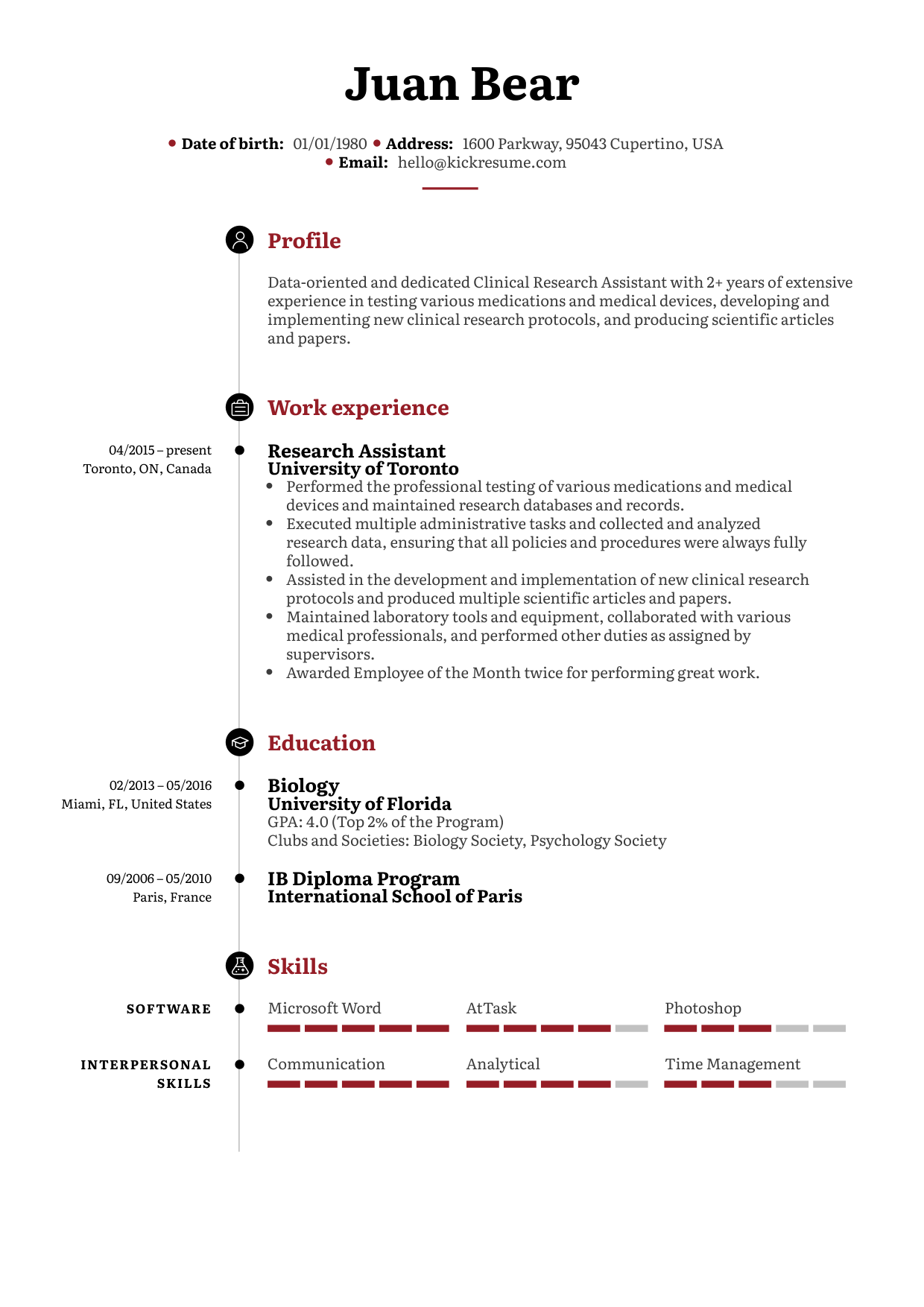
- Pair your cover letter with a matching resume
- Access resources for job-seeking physical therapists
- Learn about the average salary and job outlook for physical therapists
Still looking for a job? These 100+ resources will tell you everything you need to get hired fast.
Recreational therapist cover letter sample


Why does this cover letter example work?
- It's personalized: The applicant greets the hiring manager by name, mentions the company directly, and shows an understanding of its values. The reference to Select Medical’s mission and commitment to person-centered care helps ground the letter in something specific.
- It puts emphasis on working with people: The applicant goes beyond surface-level descriptions and talks about serving diverse populations, including children, adults, and seniors. They explain how they personalize treatment plans and use recreational activities in a way that supports emotional, physical, and cognitive goals. This shows they’re not just trained in therapy but understand how to connect with the people they serve and adapt care to each individual.
What could be improved?
- Accomplishments could be stronger if quantified: The applicant talks about implementing therapy programs and developing treatment plans, but there’s no mention of outcomes. Did these programs improve patient mobility? Did they increase participation or satisfaction rates? Adding even one or two specific achievements with numbers or outcomes would help the reader better understand the impact of their work.
Chiropractor cover letter example

Why does this cover letter example work?
- It mentions professional recognitions: The applicant mentions being named one of the top 10 chiropractors in Miami for two consecutive years. That kind of recognition adds credibility and helps the candidate stand out. It shows that their work has been acknowledged not just internally, but publicly.
- It has a clear, easy-to-read layout: The structure of the letter is neat and straightforward. Each paragraph covers a distinct area and nothing feels cluttered or hard to follow. This makes it easy for the reader to quickly understand the candidate’s background and strengths, which is essential when a hiring manager might be reading dozens of applications.
- It shows a steady career progression: The letter outlines a clear professional path, from co-running a practice to serving as a lead chiropractor, to working in a hospital. It reflects a well-rounded and experienced professional who has worked in different types of clinical settings. This shows that the applicant can adapt and thrive in various environments.
What could be improved?
- The headline could be more specific: “Application for the Position of Chiropractor” is technically correct, but it’s also very generic. A stronger headline could reference the clinic by name or highlight a specific value proposition. For instance, “Experienced Chiropractor with Team Leadership Background Seeking to Join John Smith Clinic” instantly feels more personalized and engaging.
- The closing paragraph could carry more weight: The last paragraph ends rather abruptly. It thanks the reader and expresses vague interest, but it misses a chance to leave a stronger impression. A more effective close might recap the candidate’s value, clearly express enthusiasm for the clinic’s mission or values, and include specific contact details or a note of availability for a meeting.
Physical therapy aide cover letter example

Why does this cover letter example work?
- It emphasizes relevant education and qualifications: The applicant mentions holding a Doctor of Physical Therapy (DPT) degree and actively pursuing additional certifications. This shows that they’re continuing to build their expertise. That kind of ongoing learning is always a positive signal to hiring managers, especially in a clinical setting where new methods and technologies are constantly evolving.
- It mentions language proficiencies: Being fluent in both Swedish and English, with additional proficiency in French and Dutch, is a major plus, especially in a setting, which serves a multilingual patient base. Mentioning this gives the applicant an edge, as it highlights their ability to communicate with a wider range of patients and families.
What could be improved?
- The candidate could focus more on achievements: While the applicant describes what they do, they don’t really show the impact of their work. For example, were patient satisfaction scores improved? Did they help streamline a treatment process or increase clinic efficiency? Specific examples can help the reader picture the value this candidate would bring to their team.
- Establishing a connection between the employer and candidate: The letter never actually says why the applicant wants to work at St. Stephan Hospital specifically. A line or two about what drew them to this hospital would help make the application feel more intentional and less like a template sent to multiple places.
1. Formatting your physical therapist cover letter the right way
People say, “Don’t judge a book by its cover.” But let’s be honest, we all do. And hiring managers are no different. If your cover letter looks like a cluttered mess, they may not even get to the part where you talk about your skills.
Good formatting doesn’t get you the job, but it does get your letter read! And that’s where everything starts. Here’s how to make sure your cover letter looks the part:
- Pick a clean, easy-to-read font: No fancy scripts or curly letters. Go with Calibri, Arial, or Times New Roman. They’re simple, professional, and always a safe bet.
- Keep the font size between 10 and 12: Go with 11 or 12 points. You want it big enough to read comfortably, but not so large it looks unprofessional.
- Use 1-inch margins all around: This gives your letter breathing room and keeps it from looking like you tried to cram in your entire resume.
- Space it out: Use single spacing in the body, but add a blank line between paragraphs. It makes everything easier to read.
- Left-align everything: Left alignment keeps things clean and neat. No need to center or justify text.
- Keep it to one page: Short and sweet wins the day. Aim for four to six paragraphs max.
- Avoid over-formatting: Don’t bold, underline, or italicize every other word. Let your content do the heavy lifting.
- Use white space wisely: Empty space isn’t wasted space. It gives your words room to breathe and helps key points stand out.
Fighting with formatting can feel like trying to fold a fitted sheet. It's frustrating and somehow never quite right. That’s why using a ready-made cover letter template makes all the difference! They’re clean, professional, and set up to make you look good. No stress, no formatting fails.
Create your cover letter fast with artificial intelligence.

2. Crafting an informative cover letter header
Do you really need a header if you're emailing your application and all your info is in the email anyway? Fair question, but the answer is still yes.
The header is simply a part of the tradition. Cover letters are formal documents, and in formal writing, certain things are just expected. A header is one of them.
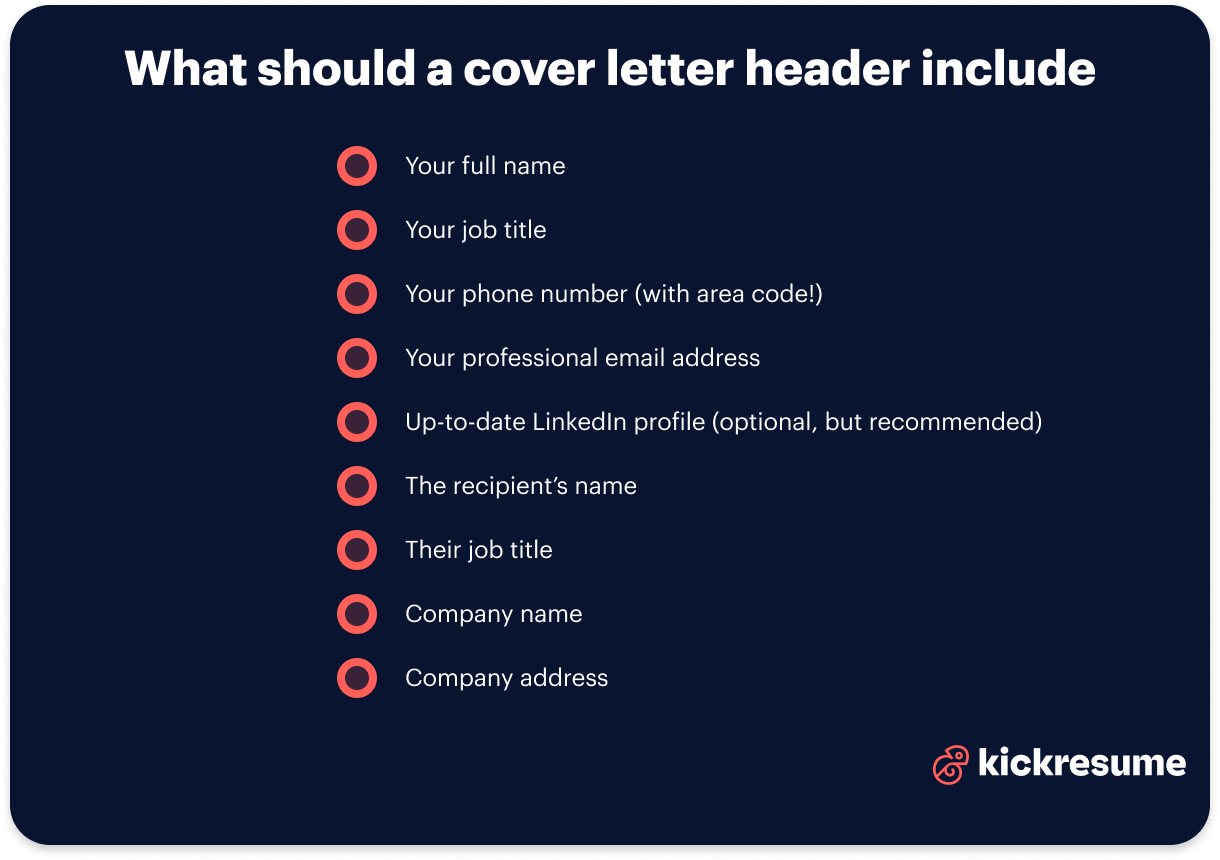
Here’s what a solid header should include:
1. Your contact information
Put this right at the top, and make sure it’s accurate:
- Full name
- Phone number (include the area code)
- Email address (use something professional, firstname.lastname is a safe bet)
- LinkedIn profile (if you have one and it’s up to date)
- Optional: You can also add your job title (like Licensed Physical Therapist), especially if it matches the position you’re applying for.
2. The employer’s information
Below your info, add the details for the person or company you’re writing to:
- Name of the hiring manager (if you can find it)
- Their job title
- Company name
- Company address
Let’s look at an example of how not to do it:
Bad example of a physical therapist letter header
Mike T.
555-123 | mikethedude123@email.com
To Whom It May Concern
What’s wrong here? A lot. The phone number is incomplete. The email address is unprofessional. The full name is missing. There’s no LinkedIn, no job title, and no address listed for the company. Also, “To Whom It May Concern” is impersonal and outdated (but we'll talk about that a bit later).
Now let’s clean it up:
Good example of a physical therapist letter header
Michael Thompson, DPT
(555) 123-4567
michael.thompson@email.com | linkedin.com/in/michaelthompsonpt
Jane Roberts, Hiring Manager
Healthy Motion Physical Therapy
123 Wellness Lane
Seattle, WA 98101
What makes this version better? It’s clean, complete, and easy to follow. The contact info is professional and polished. The recipient’s name and title are included, which makes it feel more personal and tailored. Everything is in the right place and nothing’s missing, nothing’s overdone.
Even though the header might feel like a formality, it’s one that matters. And once it’s done right, you won’t have to think about it again.
3. Creating an attention-grabbing headline
This might be the most underrated part of the whole cover letter.
Here’s why: most hiring managers won’t read your job application top to bottom, at least not right away. They skim. They glance. And unless something catches their eye fast, they move on.
That’s why a strong headline matters.
It’s one line, right below your header, that tells the person reading exactly what you can bring them.
A solid headline should check these boxes:
- Specific: What kind of PT are you? What’s your specialty?
- Relevant: Make sure it speaks directly to the job.
- Confident: Show them you know what you’re doing.
Let’s break down some examples.
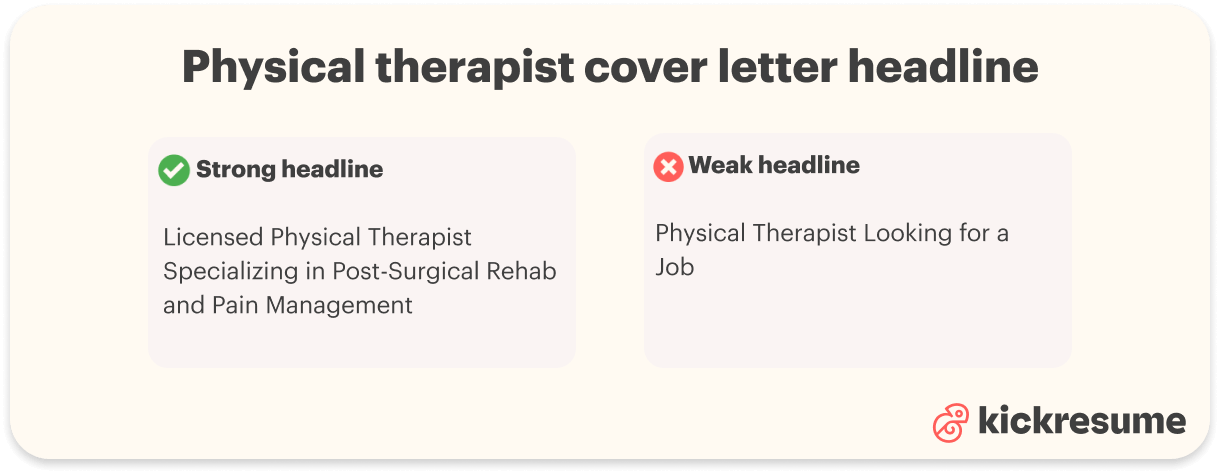
Bad example of a physical therapist cover letter headline
Physical Therapist Looking for a Job
Why doesn't this help you? Because it says the bare minimum. You’re a physical therapist — they already know that. You’re job hunting, also obvious. There’s nothing here that gives a sense of what you’re actually good at.
Good example of a physical therapist cover letter headline
Licensed Physical Therapist Specializing in Post-Surgical Rehab and Pain Management
Why does this example work? It tells us what kind of work you do, where your strengths are, and what you’re likely bringing to the team. It’s not flashy, but it’s clear. And clear beats clever every time.
Tips for students and fresh grads
You don’t need years of experience to write a strong headline. You just need to point to what you do have, whether that’s your clinical rotations, your degree, or your eagerness to grow.
Fresh graduate cover letter headline example
DPT Graduate with Clinical Training in Pediatric and Geriatric Physical Therapy Settings
A headline won’t land you the job, but it will buy you a few more seconds of attention. And in the world of job applications, that’s a win.
4. Personalizing the greeting of your physical therapist cover letter
Once the hiring manager is hooked by your headline, you’ve got their attention. Now’s the time to show them you’ve done your homework. One of the simplest, smartest ways to do that? Address them by name.
It’s a small move, but it shows respect. It shows effort. And in a stack of generic “To whom it may concern” letters, yours suddenly feels a lot more human.
So how do you actually find out who to address it to?
Here are a few quick places to check:
- The job posting: Sometimes the name is right there. Scroll to the bottom or look near the contact info.
- The company website: Check the “Team” or “About Us” page. If you’re applying to a clinic, the rehab director or practice manager is often listed.
- LinkedIn: Search the company and look through employees. Someone with a title like “Clinic Director,” “Lead Physical Therapist,” or “HR Manager” is a solid bet.
- Pick up the phone or send a quick email: Seriously. A short, polite message asking who’s handling applications for the physical therapist opening can save you a lot of guesswork.
Let’s say your detective work pays off and you find the name — Jane Roberts. How do you use it in your greeting?
Examples of personalized greetings
- Dear Ms. Roberts,
- Dear Jane Roberts,
- Dear Hiring Manager Jane Roberts,
Keep it professional and polite. If you're unsure about using “Mr.” or “Ms.,” just stick with their full name — no harm done.
But what if you can’t find a name?
It happens. Some companies keep things pretty tight-lipped, and even your best sleuthing comes up short. That’s okay, even without a name you can still write a greeting that feels thoughtful and not like it was copied and pasted.
Here are some good fallback options:
General but still personal-sounding greetings
- Dear Hiring Manager,
- Dear Healthy Motion Physical Therapy Team,
- Dear Recruitment Team at Healthy Motion,
These still sound human. They still show effort. And most importantly, they don’t feel like you just sent the same letter to every clinic in the state.
Taking the time to personalize your greeting, even just a little, makes a big difference. It shows that you’re serious, thoughtful, and genuinely interested in this job at this company.
5. Catching the hiring manager's eye with an original introduction
Now, your introduction doesn't have to start with something dramatic or over-the-top. You’re not auditioning for a TED Talk. But you do want to sound like a real person with a clear sense of purpose. Someone who knows what they’re good at and why this job actually matters to them.
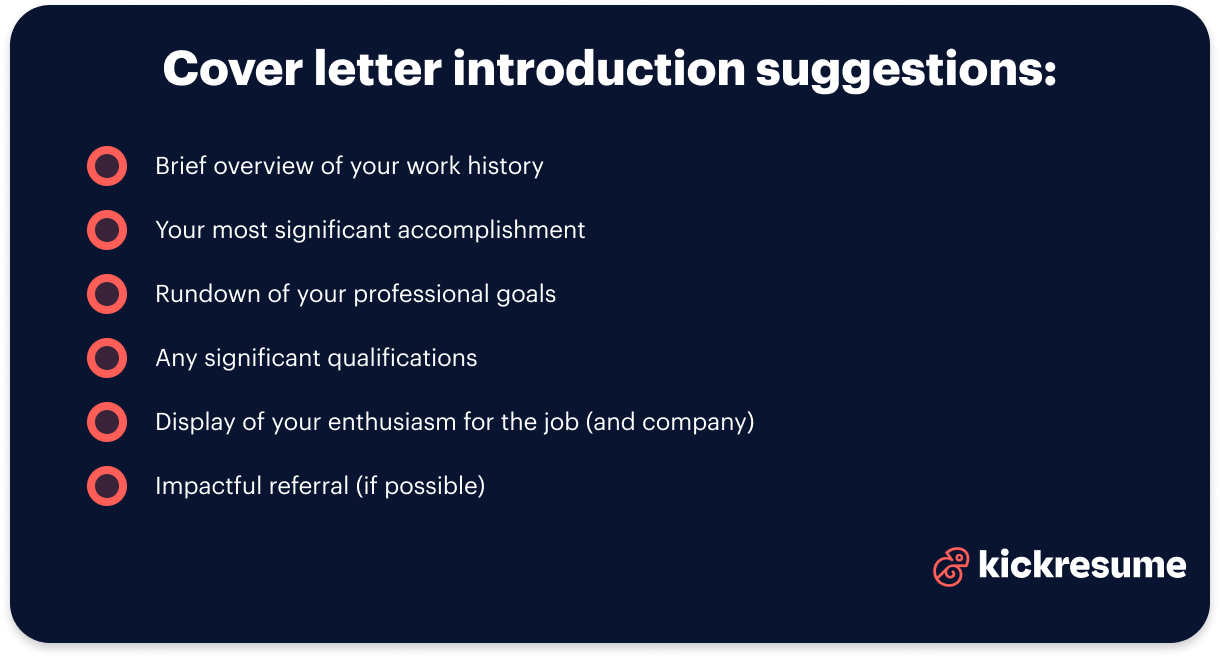
If your opening line could be copied and pasted into any other application, it’s probably not doing you any favors. Here are a few key things that can make your introduction specific:
- Brief overview of your work history
- Your most significant accomplishment
- Any relevant qualifications
- Display of your enthusiasm for the job (and company)
- Impactful referral (if possible)
Let’s look at some example introductions that do just that. And one that doesn’t:
Bad example of a physical therapist cover letter introduction
I’m writing to apply for the physical therapist position at your clinic. I have experience in patient care and believe I’d be a good fit for your team.
What makes this example so flat? It’s vague, forgettable, and tells us nothing about what kind of PT they are, what they care about, or why this role matters to them. There’s no energy, just box-checking.
Good example of a physical therapist cover letter introduction (referral)
Peter Perez recommended I reach out about the open Physical Therapist role at Active Motion Clinic. During our time working together at Riverbend Rehab, she saw firsthand my commitment to personalized care and post-surgical recovery outcomes. I’d be thrilled to bring that same level of care and energy to your team.
Why does this work? Because it leads with a name the hiring manager knows, shows a shared history, and communicates something meaningful about the candidate’s approach to care.
Good example of a physical therapist cover letter introduction (shared values)
When I read about your recent partnership with the local senior center to expand geriatric care, I knew I had to apply. As a physical therapist with a deep focus on balance training and fall prevention for older adults, I’m passionate about helping seniors stay safe, mobile, and independent — and I’d love to contribute to a team that shares that mission.
Why does this work? It shows the candidate has done their research and truly aligns with the clinic’s work. There’s a clear shared value, which makes the application feel personal and intentional.
Good example of a physical therapist cover letter introduction (qualifications)
With over 7 years of experience in outpatient orthopedic rehab, I’ve helped hundreds of patients recover mobility and rebuild confidence after surgery — including one case that earned our clinic a regional excellence award. I’m now looking to bring that same focus and energy to a team like yours at Core Wellness PT.
Why does this work? It’s confident, specific, and impactful. It communicates a clear specialty, a quantified success, and professional recognition. All this sounds natural and without bragging.
Tips for fresh PT graduates
If you’re just starting out in physical therapy, you might be wondering what you even have to write about. You’ve got more than you think.
Here’s what to focus on in your intro:
- Show enthusiasm and a willingness to learn
- Mention any clinical placements, internships, or volunteer work
- Highlight the skills or settings you trained in
- Let your personality and interest in the field shine through
Cover letter opening example for fresh PT graduates
I recently earned my Doctorate in Physical Therapy and completed clinical rotations in both acute care and pediatric rehab settings. At Riverside Hospital, I assisted with mobility plans for post-stroke patients and helped facilitate group therapy sessions. I’m excited to grow with a team that values hands-on learning, collaboration, and patient-centered care.
Whether you’re a seasoned PT or fresh out of your final clinical, your intro should sound like you. If it’s clear, thoughtful, and tailored to the role, it’ll do exactly what it’s meant to: get them to keep reading.
6. Spotlighting your physical therapist skills and achievements
This part of your cover letter is where you really start to show what you bring to the table. Not by listing everything you’ve ever done, but by focusing on what this employer is actually looking for.
That’s what customizing a cover letter really means.
Take a close look at the job ad. What skills are mentioned right away? What’s repeated more than once? Those are the things they care about most.
If “orthopedic rehab,” “manual therapy,” or “collaboration with medical staff” keeps coming up, don’t ignore it. Make sure you touch on those points in your letter.
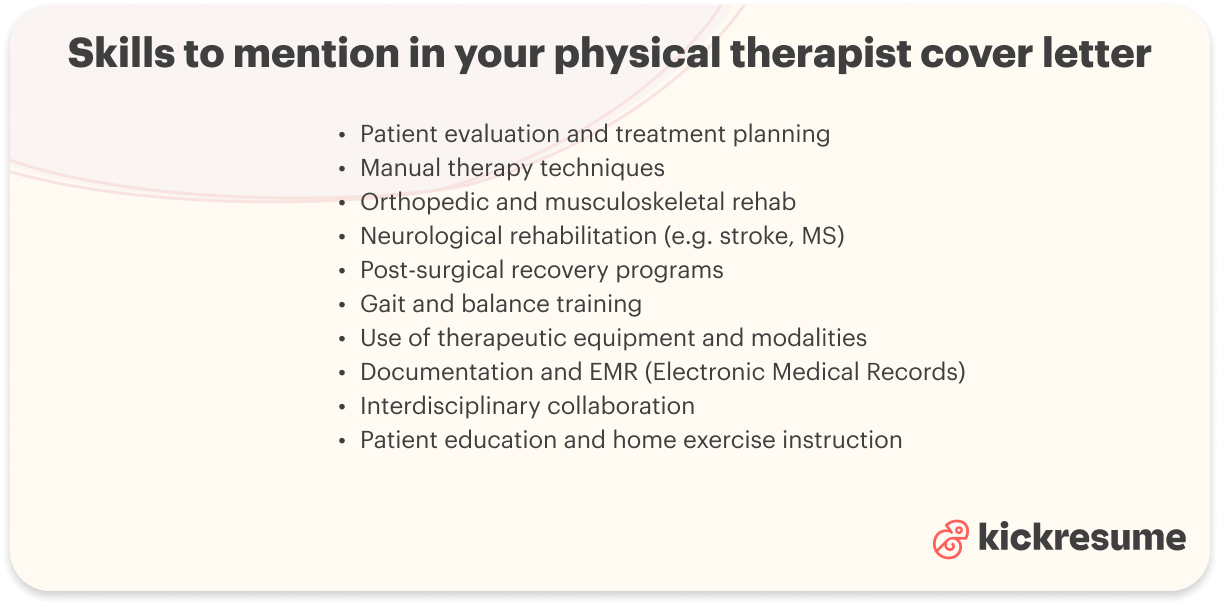
The 10 most in-demand physical therapist skills
- Patient evaluation and treatment planning
- Manual therapy techniques
- Orthopedic and musculoskeletal rehab
- Neurological rehabilitation (e.g. stroke, MS)
- Post-surgical recovery programs
- Gait and balance training
- Use of therapeutic equipment and modalities
- Documentation and EMR (Electronic Medical Records) systems
- Interdisciplinary collaboration
- Patient education and home exercise instruction
Physical therapy isn’t just about hard skills and technical knowledge. Since you work with people who are often in pain, scared, or discouraged, your soft skills (like empathy, patience, or communication) matter equally.
How to structure the body of your cover letter?
No need to overcomplicate it. Keep your body paragraphs focused and easy to scan.
- Aim for 2 to 4 short paragraphs
- Each should highlight a specific skill, achievement, or experience
- Use clear context and numbers when possible
- Stick to what’s most relevant for this job
Think of it like this: Context + Numbers = Impact
Presenting your skills in a physical therapist cover letter
- Neurological rehab: “At Central Neuro Clinic, I worked closely with post-stroke patients, building individualized plans that helped 80% of them regain independent mobility within six months. Seeing that kind of progress reinforced why I love this field.”
- Patient communication: “I’ve always believed that trust is the foundation of good therapy. At BrightCare, I made it a point to explain treatment plans in plain language, which led to a 95% patient follow-through rate on home exercises.”
- Documentation and EMRs: “I'm experienced with SOAP notes and EMR systems like WebPT and Epic. My documentation is always timely and thorough — I’ve even trained new hires on how to keep records both accurate and efficient.”
- Post-surgical rehab: “After ACL surgery, patients often feel overwhelmed. At MotionWorks PT, I developed a recovery protocol that combined education with early movement, reducing re-injury cases by 20% over 12 months.”
Tips for interns and fresh graduates
No long job history? No problem. You’ve still got value to share. Start by thinking about:
- What settings you trained in (hospital, sports clinic, rehab center)
- What types of patients you worked with
- What you learned or took initiative on
- Any feedback you received or responsibilities you were trusted with
Presenting your skills in a physical therapist cover letter an an intern
During my final DPT rotation at Brookline Rehab Center, I supported treatment for post-op orthopedic patients and led balance training sessions for seniors. I also co-created a patient education board with stretches and safety tips — something the staff chose to keep up even after my rotation ended. That experience taught me how small actions can have a lasting impact.
Your experience, whether it's 10 years deep or just getting started, is the heart of your cover letter. The more clearly you can show what you’ve done and how it connects to this role, the easier it is for the hiring manager to see you as the best fit.
7. Strengthening the impact of your words with action verbs
Bonus tip that makes a big difference
This one’s simple, but powerful. The verbs you use shape how your achievements come across. A flat verb makes your experience sound like a task. The right action verb makes it feel like an accomplishment.
Let’s compare:
- Before: I was responsible for developing treatment plans.
- After: I developed individualized treatment plans for patients recovering from orthopedic surgery.
See the difference? One sounds like something you were told to do. The other shows what you actually did.
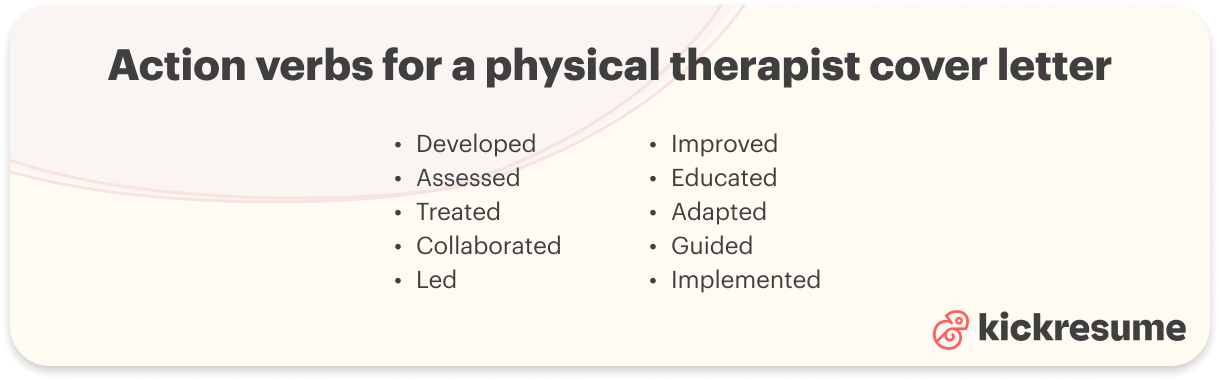
Here are some strong, clear action verbs that work well for physical therapists:
List of strong action verbs for a physical therapist cover letter
- Developed
- Assessed
- Treated
- Collaborated
- Led
- Improved
- Educated
- Adapted
- Guided
- Implemented
A few more quick examples:
- Before: I was involved in patient education.
After: I educated patients on injury prevention and home care exercises. - Before: I helped with post-surgical rehab.
After: I guided patients through post-surgical rehabilitation plans tailored to their mobility goals.
You don’t need to overuse them or sound like a thesaurus, just be mindful. Swapping in stronger verbs here and there can give your writing more clarity and confidence.
So when you're writing about your work, skip the generic “responsible for” language. Choose words that actually show what you did and what kind of plumber you are.
8. Concluding you physical therapist cover letter memorably
Endings matter.
You’ve made a strong first impression with your header and intro. You’ve backed it up with your skills and experience. Now it’s time to wrap it all up in a way that sticks with the hiring manager. The closing paragraph might seem like a small detail, but it plays a big part in how your application is remembered.
A good closing does a few simple things:
- Summary of competence: Highlight why you’re the best person for the role.
- Reiterate enthusiasm: Express genuine excitement about the opportunity.
- Contact information: Clearly state how and when you can be contacted.
- Follow-up plan: Indicate how and when you’ll follow up on your application.
- Formal sign-off: End with a professional closing.
Let’s start with what not to do:
Bad physical therapist cover letter closing example
I hope you will consider me for this role. Please let me know if you need anything else. Thank you.
Best regards,
MIKE
What’s missing here? It’s polite, sure. But it doesn’t reinforce anything important. There’s no confidence, no sense of who Mike is or why he’s worth a call back. It just ends.
Now let’s see a version that lands with more impact:
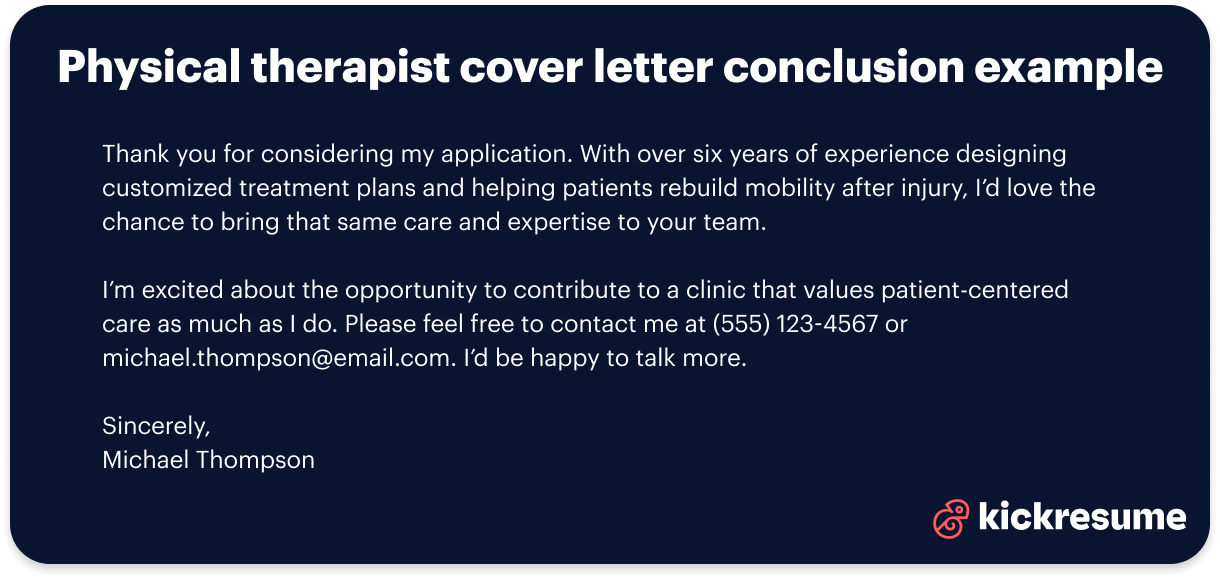
Good physical therapist cover letter closing example
Thank you for considering my application. With over six years of experience designing customized treatment plans and helping patients rebuild mobility after injury, I’d love the chance to bring that same care and expertise to your team.
I’m excited about the opportunity to contribute to a clinic that values patient-centered care as much as I do. Please feel free to contact me at (555) 123-4567 or michael.thompson@email.com. I’d be happy to talk more.
Sincerely,
Michael Thompson
Why does this work better? This conclusion is warm, confident, and easy to follow up on. It reinforces Michael’s qualifications and shows he understands the clinic’s values. And most importantly, it ends with clarity and professionalism.
You don’t need to overthink it. Just aim for a few well-placed lines that sum up what you bring to the table and show you’re genuinely interested. If the beginning of your letter opened the door, the ending should leave it open just wide enough for a callback.
9. Avoiding mistakes that can sabotage your cover letter
Even with the right training, clinical experience, and a genuine passion for helping others, a few small missteps in your cover letter can end up holding you back. But luckily, these mistakes are easy to avoid once you know what to look for.
Here are some of the most common cover letter pitfalls physical therapists make. And how to steer clear of them:
1. Sending the same cover letter to every clinic: If your letter could be copied and pasted into an application for any job at any clinic, it’s probably too generic.
2. Saying too much… or not enough: Some letters ramble. Others barely say anything at all. Both can leave a hiring manager unsure of what to make of you.
3. Focusing only on yourself: Yes, you should definitely present your experience. But if the letter is all about what you want (more hours, a chance to grow, a new challenge) it might come across as one-sided.
4. Repeating your resume line-by-line: Your resume lists what you’ve done. Your cover letter is your chance to go a layer deeper.
5. Overlooking small (but important) instructions: Sometimes clinics will ask you to reference a job ID, attach a specific form, or mention certifications. Skipping this can make your application look careless.
6. Letting typos slip through: You don’t need to be a grammar expert. But if your letter has typos or clunky phrasing, it can make the whole thing feel rushed and careless.
7. Using poor formatting: If your letter is hard to read — too dense, too cluttered, or oddly spaced — it might get skimmed over, no matter how great your experience is.
Catching these common mistakes is less about perfection and more about care. Take the time to double-check your work. It shows respect for the reader.
10. Pairing your physical therapist cover letter with a resume
Once you’ve written your cover letter, it’s tempting to fire it off and call it a day. But before you hit send, take a minute to make sure your physical therapist resume and cover letter are actually working together.
One gives context, the other gives structure. And when they’re aligned (in tone, style, and message) they’re a lot more effective at convincing a hiring manager that you’re the right fit.
Think of it this way:
- Your resume gives the facts, the degrees, licenses, job titles, and timelines. It’s efficient and structured.
- Your cover letter is more personal. It lets you explain why you do what you do, share the “how” behind your best work, and show a bit of your personality along the way.
Each one does a different job. But they should clearly belong to the same person. Not just in their content, but also in the way they look. Here’s how to keep things visually cohesive:
- Start with consistent contact info: Your name, phone number, email, and LinkedIn should appear the same way on both documents.
- Use the same font and general style: If you used Calibri 11pt on your resume, don’t switch to Times New Roman 12pt in your cover letter. Pick one professional font and stick with it.
- Mirror the formatting where it makes sense: If your resume uses bold for section headers, or a certain style for bullet points, echo that in your letter. Don’t copy and paste, just mirror the style enough that the two documents feel like they go together.
- Mind your margins and spacing: Matching margins might not seem like a big deal, but it helps everything look neater and more put together.
- Using color? Keep it consistent and subtle: A small touch of color (maybe for your name or header lines) is fine, as long as it’s professional and not distracting. If you do add color to your resume, carry the same shade into your cover letter
If formatting isn’t your favorite part of the process, don’t worry! We've got tons of professionally designed resume and cover letter templates that can help you nail the look without the layout headache. Some even come as a bundle, so your documents match right out of the box.
Let your cover letter write itself — with AI!
11. Top resources for job-seeking physical therapists
Job searching doesn't have to be a pain in the neck! With the right resources and a bit of patience, you'll find a position that gets your career moving in the right direction. You can start by checking the following:
- Industry-specific job boards: Visiting niche websites like PTJobs.com, PhysicalTherapist.com, and HealthJobsNationwide.com is just about the most straightforward approach you can take.
- General job search platforms: Platforms like Glassdoor, Indeed, ZipRecruiter, or SimplyHired aggregate job postings from all industries. But with a bit of filtering, you can discover compelling vacancies based on your specialization and preferred location.
- Networking: Don't forget to create a strong LinkedIn profile and use the platform’s job search feature to find openings. Follow companies of interest and join professional groups related to physical therapy to expand your network and uncover job opportunities.
- Professional associations: Alternatively, consider checking official websites of organizations like the American Physical Therapy Association (APTA), the World Confederation for Physical Therapy (WCPT), the Chartered Society of Physiotherapy (CSP). The can give you access to job listings, further training, and the latest industry insights and trends.
- Hospital and clinic websites: Many hospitals and clinics list job openings directly on their websites. Regularly check the careers section of local hospitals, rehabilitation centers, and healthcare facilities for new postings.
Remember, every step you take is a step closer to your dream job. So stretch your skills, flex your connections, and get ready to land that perfect role!
Healthcare Career Outlook in 2026
Employment in Healthcare is expected to grow much faster than the average for all occupations from now to 2033. (Source: U.S. Bureau of Labor Statistics)
On average, about 1.9 million openings are projected each year, driven by employment growth and the need to replace workers who leave the occupations permanently.
AI is also becoming part of everyday healthcare work. According to an AMA survey, 66% of physicians reported using AI in their practice, with admin automation among the most common use cases.
Average US base salaries across popular Healthcare roles:
- Dentist: $238,239/year
- Medical Assistant: $48,475/year
- Physician: $216,858/year
- Mental Health Therapist: $73,462/year
- Nurse: $96,354/year
- Pharmacy Technician: $40,393/year
- Physical Therapist Aide: $42,232/year
- Veterinarian: $136,583/year
- Chiropractor: $88,666/year
- Sonographer: $126,890/year
- Paramedic: $51,758/year
- Occupational Therapist: $94,666/year
Salary estimates are based on data from Indeed as of January 2026, combining anonymized salary submissions and job posting data. Actual salaries may vary depending on location, company size, and experience level.
As you can see, salaries can vary a lot across healthcare roles—so if you’re considering a career in this field, it’s worth comparing paths based on both training requirements and long-term opportunities.
Physical Therapist Cover Letter FAQ
How do I effectively convey my commitment to patient care in my cover letter?
You can share specific situations from your professional life that illustrate your dedication. Discuss any patient-centered initiatives you’ve been involved in or highlight feedback you’ve received from patients. Mention your approach to building strong patient relationships and how you personalize treatment plans to meet individual needs. This helps to show that you prioritize patient well-being and are committed to providing high-quality care.
How do I highlight my experience working with a diverse patient population in my cover letter?
Simply by mentioning specific demographics you’ve worked with, such as children, elderly patients, athletes, or patients with chronic conditions. Discuss how you adapt your treatment approaches to meet the unique needs of each group. For example, you might describe your experience in creating effective pediatric therapy programs or your work in a multicultural community health clinic.
How can I effectively convey my passion for physical therapy in my cover letter?
You can share what inspired you to enter the field and what motivates you in your daily work. Use expressive language to show your enthusiasm. For example, you could write about a memorable patient success story that reaffirmed your commitment to helping others regain their mobility and improve their quality of life. Giving emphasis to your dedication and love for the profession will resonate with potential employers.
How should I use keywords from the job listing in my physical therapist cover letter?
First of all, you need to carefully read the job listing and highlight the specific skills, qualifications, and attributes mentioned. Then, integrate these keywords naturally throughout your cover letter to demonstrate that you meet the job requirements. For example, if the job listing emphasizes “orthopedic rehabilitation” and “patient assessment,” make sure to include these terms when discussing your relevant experiences and accomplishments.
What are some common mistakes to avoid in my cover letter?
Some of the most common mistakes include: being too generic, NOT tailoring your cover letter to fit the requirements of a specific job posting,, and focusing too much on what you want rather than what you can offer. Avoid repeating your resume verbatim; instead, expand on key achievements and explain their relevance to the job.