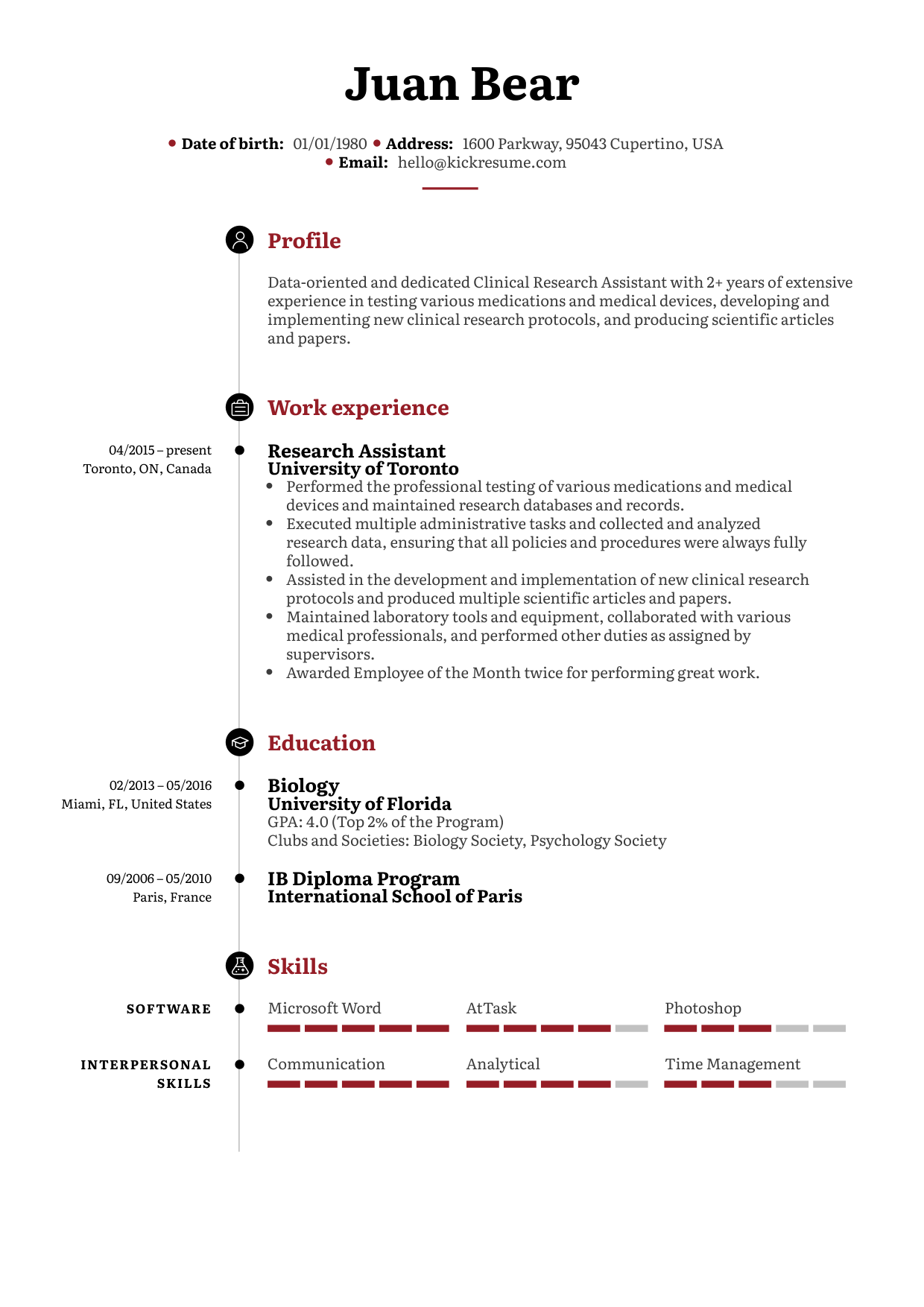
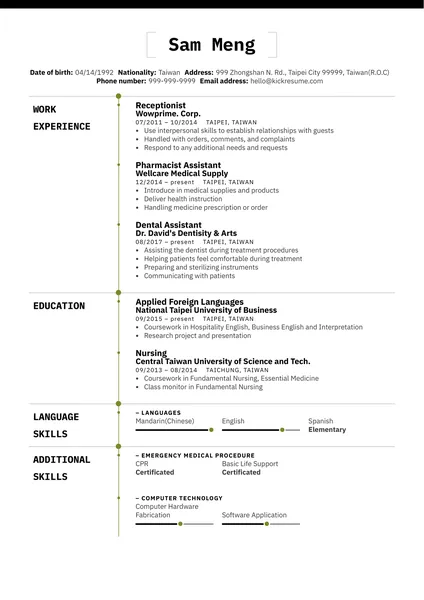
 ChatGPT
 Perplexity AI
 Claude
Your dentist resume is a crucial step toward landing the job you want. Becoming a dentist is no small feat, and while your years of training and education should certainly earn you a top-paying position, a compelling resume will help you get your foot in the door at the practice of your choice.
In this guide, we’ll walk you through all the necessary steps to optimize your resume for a job in dentistry. You’ll find lots of writing tips, great examples, useful samples, and time-saving templates to help you craft the perfect resume.


 See more examples like these
In this guide, you’ll learn:
- How to choose the right resume format for dentist roles
- How to format your dentist resume so it’s ATS-friendly
- The difference between a resume summary and a resume objective for dentists
- How to select the most relevant skills for a dentist resume
- How to present your dentist achievements and work experience with measurable impact
- Which action verbs strengthen dentist resumes
- How to structure the education section professionally
- Optional resume sections that add real value for dentists
- Common mistakes to avoid when writing a dentist resume
- How to create a complementary cover letter tailored to scientific roles
- Where to find the best resources for dentist job searching
- What to expect in terms of salary and job outlook for dentists
Still searching for your next job? Kickresume offers professionally designed resume templates, real dentist resume examples, and career tools that help you build a polished application and move forward with confidence.
Dental assistant resume sample


Why it works
- Clear clinical scope and daily workload: The resume specifies handling up to 30 patients per day, supporting multiple dentists, and working in busy clinical environments. That immediately signals hands-on experience and comfort in fast-paced dental settings.
- Strong operational and compliance focus: It highlights OSHA policies, sterilization processes, inventory control, insurance documentation, and billing. This shows the candidate understands that dental assisting is not only chair-side support, but also compliance and administrative precision.
- Well-structured and easy to scan: The layout is clean, with clearly separated sections for Career Objective, Professional Experience, Education, and Certifications. Bullet points are concise and readable, which helps both recruiters and ATS systems quickly identify relevant competencies.
What could be improved
- More measurable impact beyond workload: While patient volume is mentioned, the resume could be stronger with additional metrics such as reduced appointment wait times, improved patient satisfaction scores, lower supply costs, or increased scheduling efficiency.
- Career objective could be more specific: The objective section is solid but slightly generic. It could be strengthened by tailoring it to a specific type of practice (private clinic, orthodontics, pediatric dentistry, cosmetic dentistry) and highlighting one standout achievement instead of broad descriptors like “exceptional service.”
Dentist resume sample

Why it works
- Broad clinical scope is clearly demonstrated: The resume outlines a wide range of procedures, from restorative treatments and prosthodontics to endodontics and cosmetic dentistry. This signals versatility and the ability to handle complex, full-spectrum dental care rather than routine cases only.
- Leadership within a multi-provider practice: Mentioning collaboration with multiple doctors, assistants, hygienists, and administrative staff shows the candidate operates in a team-based environment. It implies coordination skills and experience working in structured clinical settings.
- Patient-centered performance indicators: Including metrics like 95%+ patient satisfaction and dental readiness rates strengthens credibility. It demonstrates consistent quality of care and reinforces trustworthiness, which is critical in private practice dentistry.
What could be improved
- Stronger differentiation between roles: The responsibilities in both positions feel somewhat similar. Adding clearer distinctions in scope, complexity of cases, leadership responsibilities, or business involvement (e.g., revenue growth, patient acquisition, clinic expansion) would better show career progression.
- The Strengths section is too generic: Traits like “People Person” or “Perfectionist” are broad and subjective. Replacing them with competency-based strengths such as “Advanced Treatment Planning,” “Complex Case Management,” or “Digital Dentistry Proficiency” would add more professional weight and ATS value.
Dental technician resume sample

Why it works
- Clear focus on technical laboratory contribution: The resume highlights hands-on involvement in fabricating dentures, bridges, braces, and crowns. This makes it immediately clear that the candidate is not only assisting chairside but also contributing directly to prosthetic and restorative outcomes.
- Recognition and performance credibility: Including the Employee of the Month award strengthens the candidate’s profile by showing validated performance. External recognition adds weight beyond self-described strengths.
- Demonstrated team collaboration and training exposure: The resume mentions collaboration in treatment planning and supervising new team members. This signals growth beyond purely technical execution and suggests readiness for increased responsibility.
What could be improved
- High school section is unnecessary at this stage: With completed university-level dental education and several years of professional experience, listing high school achievements and extracurriculars adds little value. Removing it would create space for more relevant technical depth.
- Technical depth could be more specific: The resume could benefit from naming concrete laboratory tools, materials, or software used (e.g., CAD/CAM systems, digital impressions, specific dental lab equipment). This would strengthen ATS performance and demonstrate stronger technical precision.
1. How to pick the right resume format for a dentist
Just like treatment plans vary from patient to patient, your resume format should reflect your specific dental career path.
The right structure depends on:
- Your career stage
- The type of dentistry you practice (general dentistry, orthodontics, oral surgery, pediatric dentistry, etc.)
- Whether you’re applying to a private clinic, hospital, or academic institution
Below are the three main resume formats and how they apply to dentist roles.
#1 Reverse-chronological resume (traditional format)
This format lists your most recent role first and works backward.
It’s the most commonly preferred structure for dental clinics and healthcare employers. It’s also the most ATS-friendly option.
It works best if:
- You’ve progressed clearly (e.g., Dental Assistant -> Associate Dentist -> Senior Dentist -> Practice Lead)
- You have consistent clinical experience
- You want to highlight patient volume, procedures performed, and increasing responsibility
For most dentists applying to private practices or hospital roles, this is the strongest and safest choice.
#2 Functional resume (skills-based format)
A functional resume focuses on competencies rather than timeline. It emphasizes your clinical skills and certifications instead of job history.
It may be useful if:
- You’re newly licensed and have limited full-time experience
- You’re transitioning between dental specialties
- You’ve completed multiple short-term residencies or training programs
That said, most dental employers prefer to clearly see where you practiced and how long. A purely functional format can sometimes raise questions about gaps or continuity.
#3 Hybrid resume (combination format)
The hybrid format blends both approaches:
- A strong clinical skills section near the top
- Followed by structured professional experience
This format works well for dentists who:
- Have advanced technical expertise (implantology, endodontics, cosmetic procedures, digital dentistry, sedation dentistry, etc.)
- Also have solid, consistent clinical experience
- Want to highlight both procedural depth and career progression
Matching resume formats to dentist career levels
#1 Entry-level dentists / recent graduates
If you’ve recently completed dental school or a residency, a hybrid resume can help you emphasize:
- Clinical rotations
- Specialty trainin
- Procedure experience
- Certifications and licenses
Even if your full-time employment history is still limited.
#2 Associate dentists / mid-level practitioners
If you’re already practicing in a clinic or group practice, the reverse-chronological format is typically the best option. It clearly shows:
- Patient volume
- Range of procedures performed
- Practice environments
- Measurable improvements (reduced chair time, improved patient satisfaction, revenue growth, etc.)
#3 Senior dentists / practice owners / specialists
For experienced dentists or those in leadership roles, a reverse-chronological or hybrid format works best. This allows you to:
- Highlight clinical expertise
- Show leadership or mentoring responsibilities
- Demonstrate business management experience (if relevant)
- Showcase advanced certifications or specialty credentials
Resume vs. CV for Dentists: What’s the difference and which one should you choose?
Even though a resume and a CV might look like the same document, there are certain differences. In most private dental practices, employers expect a resume that is typically 1–2 pages focused on clinical experience, procedures, certifications, and patient care.
However, if you’re applying for:
- Academic dentistry roles
- Research-focused positions
- University faculty or teaching roles
You may be asked to submit a CV (Curriculum Vitae) instead. A CV is longer (3-4 pages)and includes publications, research, presentations, grants, and academic achievements.
Always check the job posting carefully:
- If it says “resume,” keep it concise and clinically focused.
- If it says “CV,” include full academic details.
Final tip
If you’re applying through an Applicant Tracking System (ATS), the reverse-chronological format is almost always the safest option.
ATS software prefers:
- Clear timelines
- Standard headings (Work Experience, Skills, Education, Licensure)
- Simple, clean formatting
Choose the structure that presents your clinical competence, professionalism, and career progression in the clearest possible way.
Try our AI Resume Writer and have your resume ready in minutes!

2. How to format your dentist resume to make it ATS-friendly
Choosing the right resume format is only part of the equation. Even an experienced dentist with strong clinical results can get overlooked if their resume is poorly structured or difficult for Applicant Tracking Systems (ATS) to read.
And here’s the reality in healthcare:
Many larger dental groups, hospital systems, and corporate practices use ATS software to screen applications before they reach a hiring manager.
That means your resume needs to work for two audiences:
- Clinical directors and practice owners
- Software that scans for relevant dental keywords
If formatting gets in the way, your application might never reach the interview stage.
Resume formatting fundamentals for dentist roles
To keep your dentist resume professional and ATS-compatible, follow these best practices:
#1 Use a simple, single-column layout
Multi-column designs, tables, and complex graphics can confuse ATS systems. A clean, one-column structure ensures your clinical experience, certifications, and licenses are properly parsed.
#2 Choose a professional, readable font
Stick with widely supported fonts such as Arial, Calibri, Helvetica, or Times New Roman. In healthcare hiring, clarity and professionalism matter far more than decorative styling.
#3 Keep font sizes consistent
- Body text: 10.5–12 pt
- Section headings: 14–16 pt
A clear visual hierarchy helps recruiters quickly find your clinical experience, specialties, and licensure.
#4 Use standard section headings
ATS systems recognize conventional headings like:
- Professional Experience
- Clinical Experience
- Skills
- Education
- Licensure & Certifications
Avoid creative alternatives that may interfere with parsing.
#5 Use bullet points, not long paragraphs
Dental hiring managers scan resumes quickly. Bullet points make it easier to present:
- Procedures performed
- Patient volume
- Technologies used
- Measurable improvements
They also help ATS systems extract relevant competencies.
#6 Save your resume as PDF or DOCX
These are the safest formats for ATS compatibility. Always follow the file instructions in the job posting.
How to optimize your dentist resume for ATS scanners
ATS software doesn’t understand dentistry the way a clinical director does. It scans for specific keywords and matches them to the job description.
Your resume must include relevant dental terminology, naturally and accurately.
1. Mirror keywords from the job description
If the job posting mentions:
- Restorative dentistry
- Cosmetic procedures
- Invisalign certification
- Implant placement
- Pediatric dentistry
- Digital radiography
- Sedation dentistry
- EMR systems
Use those exact phrases in your resume where applicable.
If they write “Invisalign-certified,” include that wording directly instead of using a vague alternative.
2. Include dentistry-specific terminology
Dentist resumes perform better when they clearly list clinical competencies such as:
- Root canal therapy
- Crown and bridge procedures
- Dental implants
- Oral surgery
- Periodontal treatments
- Prophylaxis
- Treatment planning
- Digital impressions
- CAD/CAM systems
- Infection control protocols
- OSHA compliance
- HIPAA compliance
- Patient education
These keywords are often directly matched against role requirements.
3. Avoid graphics, icons, and skill rating bars
Visual skill charts like “Implants – 5/5” may look modern, but ATS systems often cannot interpret them. Your clinical strengths should be written in text format.
4. Do not hide keywords
Avoid:
- White text on white backgrounds
- Keyword stuffing
- Repeating phrases unnaturally
This can trigger automatic rejection and appear unprofessional.
5. Use clear, recognizable job titles
Dental job titles can vary between practices. If your title was internal or uncommon, consider adding a clearer equivalent.
For example:
- Associate Dentist (General Dentist)
- Dental Practitioner (Family Dentist)
- Clinical Lead (Senior Dentist)
This helps both ATS systems and hiring managers quickly understand your level of responsibility.
Use ATS-friendly templates to save time
Formatting a dentist resume manually can be challenging, especially when balancing clinical detail with readability.
ATS-optimized templates help you:
- Maintain clean structure
- Present licensure clearly
- Preserve important clinical keywords
- Ensure compatibility with screening systems
Kickresume’s resume templates are designed to balance professional healthcare presentation with ATS compatibility, helping your dentist resume pass automated filters and still look polished to clinic directors and hiring teams.
Find out your resume score!

3. How to differentiate between a resume summary and a resume objective (for dentists)
At the top of your dentist resume sits one of the most important sections: your opening statement. This will either be a resume summary or a resume objective.
Both serve the same purpose: to quickly show hiring managers what kind of dentist you are, what clinical environment you’ve worked in, and what value you bring to patients and the practice.
And this matters more than you might think.
Dental practice owners and clinical directors rarely read resumes line by line. They scan. Often quickly. Your opening section should immediately answer:
- What type of dentist are you?
- What procedures and patient populations do you work with?
- What results or impact have you delivered?
In just 3–5 concise sentences, you should highlight your clinical strengths, scope of experience, and one or two measurable outcomes.
So, should you write a summary or an objective?
Let’s break down the differences.
Writing a resume summary (for experienced dentists)
A resume summary is best if you already have professional clinical experience, whether in:
- General dentistry
- Cosmetic dentistry
- Pediatric dentistry
- Oral surgery
- Orthodontics
- Corporate dental groups or private practices
This format focuses on expertise and demonstrated results.
What should a dentist resume summary include?
- Your professional title (e.g., General Dentist, Associate Dentist, Cosmetic Dentist)
- Years of clinical experience
- Core procedures and specialties (crowns, root canals, implants, Invisalign, etc.)
- Type of environment (private practice, multi-location group, high-volume clinic, hospital setting)
- One measurable achievement (patient volume, case acceptance rate, production growth, satisfaction scores, etc.)
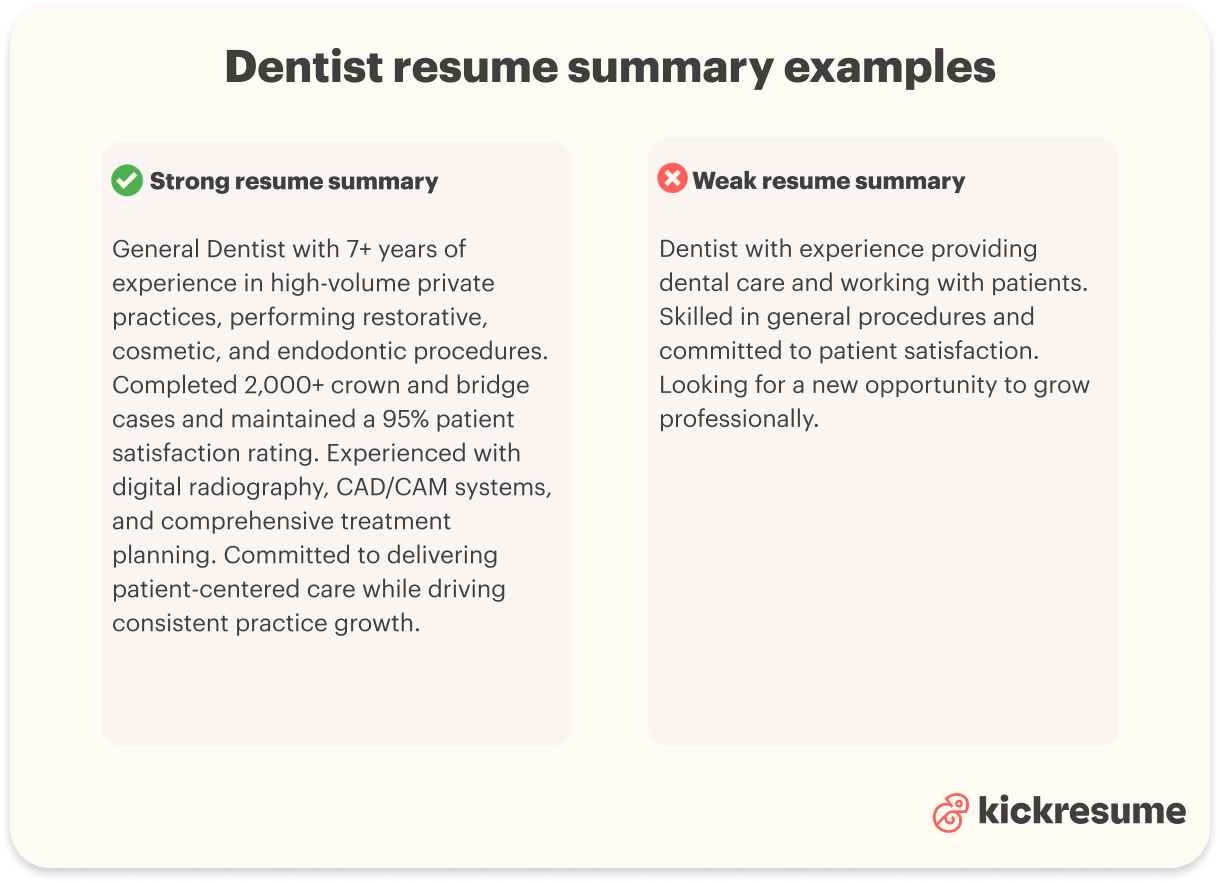
Bad dentist resume summary example
Dentist with experience providing dental care and working with patients. Skilled in general procedures and committed to patient satisfaction. Looking for a new opportunity to grow professionally.
Why this doesn’t work: It’s vague. It doesn’t mention procedures, patient volume, technologies, or measurable results. A hiring manager cannot assess experience level or clinical scope.
Good dentist resume summary example
General Dentist with 7+ years of experience in high-volume private practices, performing restorative, cosmetic, and endodontic procedures. Completed 2,000+ crown and bridge cases and maintained a 95% patient satisfaction rating. Experienced with digital radiography, CAD/CAM systems, and comprehensive treatment planning. Committed to delivering patient-centered care while driving consistent practice growth.
Why this works: It clearly defines experience level, procedure volume, technology familiarity, and measurable outcomes.
Writing a resume objective (for early-career dentists)
A resume objective works better if you are:
- A recent dental school graduate
- Completing a residency program
- Transitioning into private practice
- Moving into a new specialty focus
Instead of emphasizing years of results, an objective highlights training, direction, and readiness.
What should a dentist resume objective include?
- Your education or residency background
- The type of dental role you’re targeting
- Core procedures you’re trained in
- Clinical rotations or hands-on experience
- Your commitment to patient care and professional development
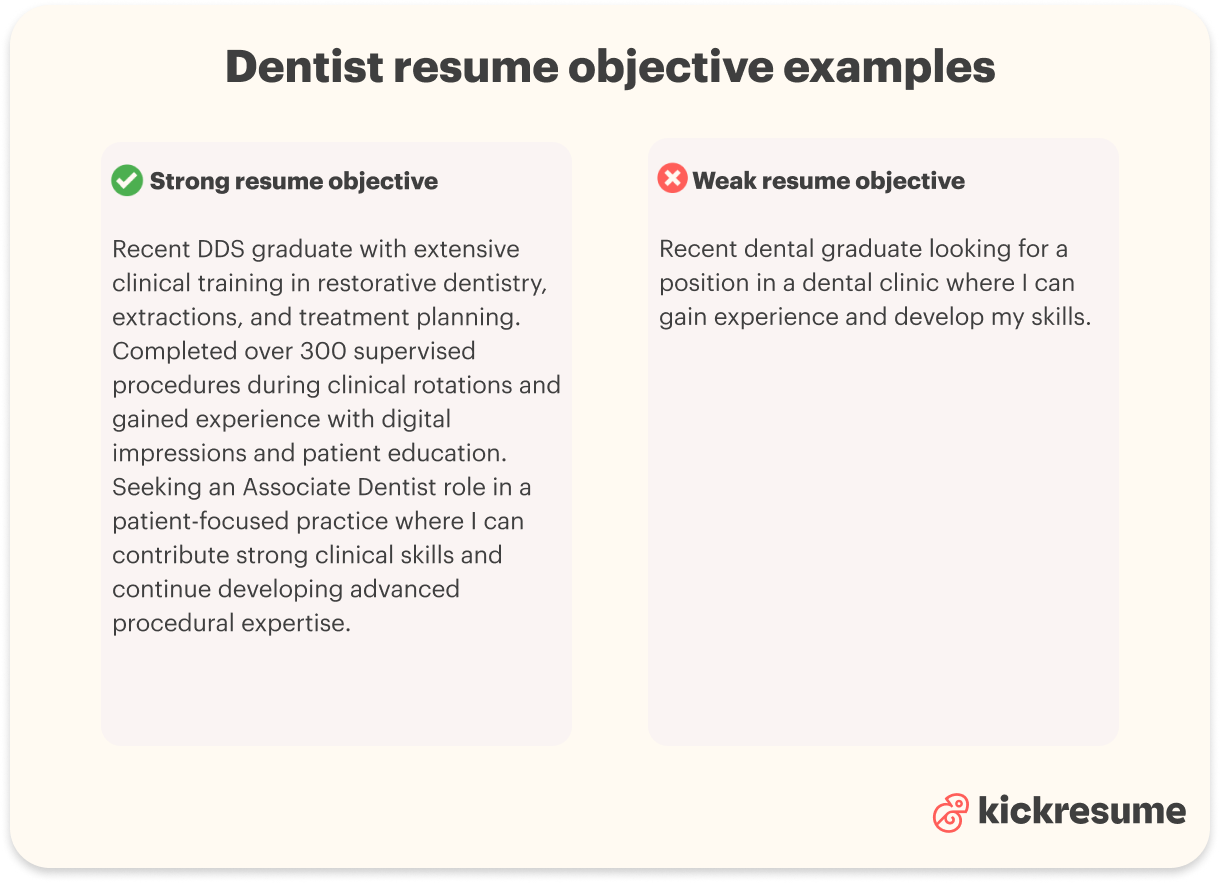
Bad dentist resume objective example
Recent dental graduate looking for a position in a dental clinic where I can gain experience and develop my skills.
Why this doesn’t work: It focuses only on what the candidate wants. It doesn’t mention procedures, training, or patient care strengths.
Good dentist resume objective example
Recent DDS graduate with extensive clinical training in restorative dentistry, extractions, and treatment planning. Completed over 300 supervised procedures during clinical rotations and gained experience with digital impressions and patient education. Seeking an Associate Dentist role in a patient-focused practice where I can contribute strong clinical skills and continue developing advanced procedural expertise.
Why this works: It shows hands-on experience, technical exposure, and a clear direction without overstating seniority.
Final tip
Avoid generic phrases such as:
- Hard-working
- Detail-oriented
- Passionate about dentistry
- Team player
In dentistry, credibility comes from:
- Clinical procedures performed
- Technologies used
- Patient outcomes
- Production metrics
- Certifications and licensure
Let your clinical competence and measurable results speak for you.
4. How to choose the right skills for your dentist resume
In dentistry, your skills are what truly differentiate you.
Two professionals may both hold the title “Dentist,” yet one may focus on high-volume restorative care while another specializes in cosmetic procedures or surgical extractions. The difference lies in clinical scope, technical expertise, and patient management abilities.
That’s why your goal isn’t to list every procedure you’ve ever observed, but to prioritize the skills that match the role you’re applying for.
The most effective strategy?
Let the job description guide you.
Before building your Skills section, ask yourself:
- Are they emphasizing restorative procedures (crowns, bridges, fillings)?
- Is cosmetic dentistry or Invisalign mentioned?
- Do they focus on production goals and case acceptance?
- Is pediatric, geriatric, or special-needs experience required?
- Are digital tools like CAD/CAM or intraoral scanners part of the role?
The answers will show you exactly which skills should appear first.
Key hard skills for a dentist resume
Hard skills in dentistry demonstrate clinical competence and technical precision. They show you can diagnose, treat, and manage cases independently and safely.
Here are some of the most valuable hard skills for dentist roles:
Clinical procedures
- Restorative dentistry (fillings, crowns, bridges)
- Root canal therapy (endodontics)
- Extractions (simple and surgical)
- Implant placement and restoration
- Cosmetic procedures (veneers, whitening)
- Invisalign and orthodontic aligner treatment
- Periodontal therapy
- Treatment planning and case presentation
Technology & tools
- Digital radiography
- Intraoral scanners
- CAD/CAM systems
- Cone Beam CT (CBCT)
- Electronic health records (EHR/Dental software)
- Digital impressions and treatment simulation
Compliance & practice knowledge
- Infection control protocols
- HIPAA compliance
- OSHA standards
- Insurance billing and coding
- Documentation accuracy
- Case acceptance strategies
These skills signal that you understand both the clinical and operational side of running or supporting a dental practice.
Essential soft skills for dentists
Technical expertise is critical, but dentistry is also highly patient-centered. Communication, trust, and emotional intelligence are just as important as procedural accuracy.
Strong soft skills for dentist roles include:
Strong soft skills for dentist roles
- Patient communication and education
- Empathy and chairside manner
- Attention to detail
- Time management in high-volume clinics
- Stress management under clinical pressure
- Team collaboration with hygienists and assistants
- Conflict resolution
- Leadership (for associate or practice-owner roles)
In dentistry, especially, patient trust and clarity of explanation directly influence treatment acceptance and long-term retention
Your Skills section should reflect that balance.
When your listed skills closely mirror the terminology used in the job description, both ATS systems and hiring managers will immediately recognize you as a strong clinical and professional match.
5. How to effectively list your achievements and clinical experience
Your Work Experience section shouldn’t read like a generic list of dental procedures. It should clearly show:
- What type of practice you worked in (private, corporate, specialty, high-volume clinic)
- Which procedures and technologies you regularly performed
- Your level of autonomy and responsibility
- The measurable impact you had on patients or the practice
The goal is simple: connect your clinical work to real results.
Bad dentist resume work experience example
Dentist
ABC Dental Clinic
June 2020 – Present
Performed dental procedures
Treated patients
Took X-rays
Maintained patient records
Why this doesn’t work: It’s vague, underdeveloped, and not formatted properly. There’s no mention of specific procedures, technology, patient volume, or results, and the text is hard to scan and read.. It also lacks structure and measurable outcomes, making it hard for recruiters to evaluate the candidate’s scope and effectiveness.
Good dentist resume work experience example
Associate Dentist
ABC Dental Clinic, Chicago, IL
June 2020 – Present
- Provided comprehensive general dentistry services, including restorative treatments, root canals, extractions, and cosmetic procedures in a high-volume practice serving 25+ patients daily.
- Increased case acceptance rate by 18% through improved patient education and visual treatment planning tools.
- Utilized digital radiography and intraoral scanning technology to enhance diagnostic accuracy and streamline workflow.
- Maintained 98% patient satisfaction rating by prioritizing clear communication and patient-centered care.
- Collaborated closely with hygienists and assistants to improve appointment efficiency, reducing average chair time by 12%.
Why this works: It’s specific, measurable, and clearly formatted. It shows clinical range, patient volume, use of modern technology, and tangible improvements to both patient outcomes and practice performance.
Early-career dentist work experience example
Dental Intern
University Dental Clinic
June 2022 – May 2023
- Assisted in restorative procedures, extractions, and preventive treatments under licensed supervision.
- Performed patient assessments and developed preliminary treatment plans.
- Gained hands-on experience with digital X-rays and electronic dental record systems.
- Contributed to improving appointment flow during peak hours by assisting in procedural preparation and post-treatment documentation.
Even without full independent practice experience, this demonstrates clinical exposure, technical familiarity, and teamwork.
Final tip
Don’t just list procedures. Show how your clinical work improved patient care, increased efficiency, or supported practice growth. That’s what turns a dentist resume from average into compelling.
6. How to select the right action verbs for your dentist resume
Action verbs may seem like a small detail, but in a dentist resume, they make a significant difference. They turn routine clinical duties into clear demonstrations of expertise, leadership, and patient impact.
Compare:
No action verbs included
Responsible for treating patients and performing procedures.
vs.
Action verbs included
Diagnosed and treated a wide range of dental conditions, performing restorative and preventive procedures in a high-volume clinical setting.
The second version sounds confident, specific, and professional.
Why action verbs matter in dentist resumes
In dental roles, hiring managers look for signs that you:
- Deliver high-quality patient care independently
- Apply clinical judgment and diagnostic skills
- Improve patient outcomes and practice efficiency
- Collaborate effectively with dental teams
The verbs you choose should reinforce those strengths.
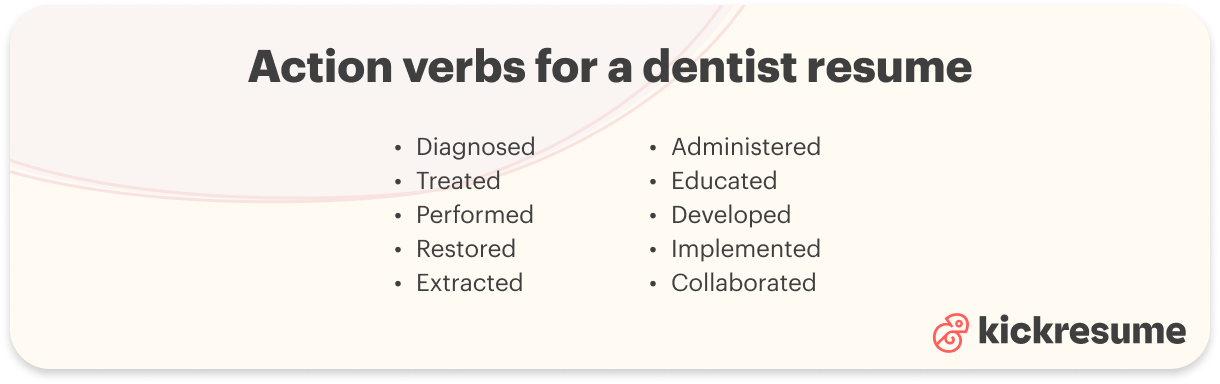
Strong action verbs for dentist resumes
Instead of vague wording, use verbs that reflect clinical expertise and responsibility:
- Diagnosed
- Treated
- Performed
- Restored
- Extracted
- Administered
- Educated
- Developed
- Implemented
- Collaborated
- Supervised
- Improved
- Optimized
- Managed
- Resolved
These verbs show hands-on clinical involvement and accountability.
Action verbs in practice
Dentist resume without action verbs
- I was responsible for patient exams.
- I helped with treatment planning.
- I handled patient concerns.
Dentist resume with action verbs
- Conducted comprehensive oral examinations and developed personalized treatment plans.
- Performed restorative procedures including crowns, fillings, and root canals.
- Addressed patient concerns and improved satisfaction through clear education and follow-up communication.
The responsibilities are similar, but the second version sounds far more professional and impactful.
How to use action verbs effectively
- Start each bullet point with a strong clinical verb
- Avoid repeating the same verb in every line
- Match verbs to your level of responsibility (performed vs. supervised vs. led)
- Connect verbs to outcomes whenever possible
Your action verbs should make it obvious that you don’t just perform procedures, but that you actively improve patient care and contribute to the success of the practice.
7. How to write the education section professionally on a dentist resume
In dentistry, education is not just a formality. It’s proof of your clinical qualification, licensing eligibility, and professional credibility.
Unlike many other fields, employers cannot hire you without the proper degree and licensure. That means your education section must be clear, complete, and professionally presented.
Whether you’re a recent dental school graduate or an experienced practitioner, this section should quickly confirm that you meet all academic and licensing requirements.
What to include in a dentist education section
Focus on credentials that directly qualify you to practice:
- Doctor of Dental Surgery (DDS) or Doctor of Dental Medicine (DMD)
- Dental school name and location
- Graduation year
- Residency or specialty training (if applicable)
- State licensure information (can also appear in a separate “Licenses & Certifications” section)
- Relevant certifications (CPR, ACLS, sedation permits, etc.)
If you’re early in your career, you can also include:
- Clinical honors or distinctions
- GPA (if strong and recent)
- Relevant externships or advanced clinical rotations
- Specialized coursework (implantology, endodontics, prosthodontics, etc.)
Example of a dentist resume education section
Doctor of Dental Surgery (DDS)
University of Michigan School of Dentistry, Ann Arbor, MI
2018 – 2022
- Clinical Honors: Restorative Dentistry and Oral Surgery
- Completed advanced clinical rotations in pediatric dentistry and implant restoration
Bachelor of Science in Biology
Michigan State University, East Lansing, MI
2014 – 2018
What if you completed additional training or specialization?
If you pursued residency or specialty education, make it clearly visible:
- General Practice Residency (GPR)
- Advanced Education in General Dentistry (AEGD)
- Orthodontics, Periodontics, Endodontics, Oral Surgery, etc.
Additional dentist specialization example
General Practice Residency (GPR)
NewYork-Presbyterian Hospital, New York, NY
2022 – 2023
If you are a specialist, your advanced training should be prominently placed, as it significantly impacts your scope of practice and earning potential.
Pro tip for experienced dentists
The more professional experience and measurable achievements you have, the less weight employers place on your education section, which is why it can be positioned after higher-impact sections like your summary, work experience, and skills. So your resume content can look like this:
- Resume summary
- Work experience
- Skills
- Education
However, your degree and licensure should always remain clearly listed and easy to verify.
In dentistry, your education section isn’t just background information. It confirms that you’re qualified to practice and sets the foundation for the clinical experience that follows. Keep it structured, professional, and aligned with your career level.
8. How to choose relevant optional sections for a dentist resume
Once you’ve covered the core sections of your resume (summary, skills, clinical experience, education), you can decide whether adding optional sections will strengthen your application.
In dentistry, optional sections can significantly increase credibility, but only if they reinforce your clinical expertise, patient care experience, or professional standing.
If a section doesn’t clearly support your ability to practice dentistry at a high level, it’s better to leave it out.
Add optional sections if:
- You hold additional certifications or clinical permits
- You completed specialized training beyond dental school
- You’ve contributed to research, publications, or continuing education
- You’ve received professional awards or recognition
- You’re involved in professional dental associations
Skip them if:
- They’re unrelated to dentistry or healthcare
- They’re outdated and no longer reflect your current skill level
- They don’t strengthen your credibility as a clinician
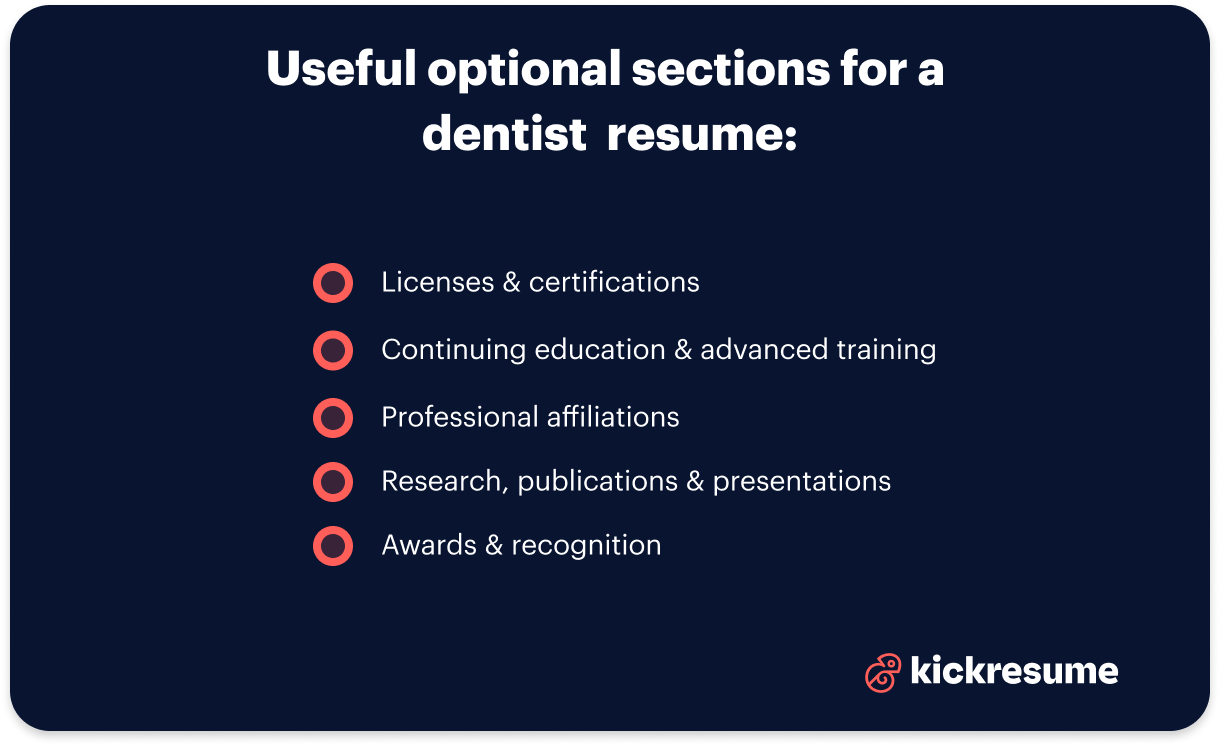
Useful optional sections for a dentist resume
1. Licenses & certifications
This is often essential in dentistry and may deserve its own dedicated section.
- State Dental License (include state and license number if appropriate)
- DEA Registration
- CPR / BLS / ACLS Certification
- IV Sedation Permit
- Nitrous Oxide Certification
- Invisalign Certification
- Implantology or Cosmetic Dentistry training
Licensure information is especially important if you’re applying across states or to hospital-based roles.
2. Continuing education & advanced training
Dentistry evolves constantly, and employers value practitioners who stay current.
Examples:
- Implant placement training
- Advanced endodontic techniques
- Digital dentistry and CAD/CAM training
- Laser dentistry certification
- Cosmetic dentistry workshops
This section signals commitment to professional growth and modern techniques.
3. Professional affiliations
Memberships demonstrate engagement with the dental community.
Examples:
- American Dental Association (ADA)
- Academy of General Dentistry (AGD)
- American Association of Orthodontists (AAO)
- Local or state dental societies
Active involvement can strengthen your professional profile, especially for practice-based roles.
4. Research, publications & presentations
More relevant for academic, hospital-based, or research-focused dental roles.
Examples:
- Peer-reviewed journal publications
- Conference presentations
- Clinical case study publications
- Research collaboration during dental school or residency
5. Awards & recognition
Recognition or awards & achievements reinforces your credibility and professional excellence.
Examples:
- Clinical Excellence Awards
- Academic Honors in Dental School
- Community Service Recognition
- Practice performance awards
Optional sections should enhance your clinical authority, not add clutter.
Ask yourself:
Does this help an employer see me as a skilled, trustworthy, and up-to-date dental professional?
If yes, include it.
If not, keep your resume focused and concise.
9. How to avoid common mistakes on a dentist resume
By this stage, you’ve invested years into clinical training, patient care, and professional development. It would be unfortunate if avoidable resume mistakes weakened that strong foundation.
Here are the most common pitfalls dentists run into, and how to avoid them.
#1 Typos and clinical inaccuracies
In healthcare, precision is non-negotiable. Misspelled procedures, incorrect terminology, or sloppy formatting can raise concerns about attention to detail.
How to avoid it
Proofread carefully. Double-check procedure names, certifications, and licensing details. If possible, ask a colleague to review your resume for accuracy and clarity.
#2 Writing long, dense paragra
Large blocks of text make it difficult for practice owners or hiring managers to quickly assess your clinical skills.
How to avoid it
Use clean bullet points and short, structured descriptions. Focus on clarity and scannability while still showing impact.
#3 Listing responsibilities instead of outcomes
Saying you “performed dental procedures” doesn’t show how effective you were as a clinician.
How to avoid it
Highlight measurable contributions when possible, for example:
- Treated 20+ patients per day in a high-volume practice
- Increased case acceptance rates by 15% through patient education
- Reduced chair time by improving workflow efficiency
- Maintained 98% patient satisfaction scores
Outcomes demonstrate competence and value.
#4 Not quantifying clinical experience
Dentistry is measurable. Without numbers, your resume may feel incomplete.
How to avoid it
Include relevant metrics such as:
- Number of patients treated per day or week
- Types and volume of procedures performed
- Case acceptance rates
- Production numbers (where appropriate)
- Years of clinical experience
- Team size supervised (if applicable)
Even approximate figures are helpful.
#5 Ignoring compliance and safety standards
Regulatory awareness is critical in dental practice.
How to avoid it
Mention relevant standards such as:
- OSHA compliance
- HIPAA regulations
- Infection control protocols
- Sterilization procedures
- State dental board requirements
This reassures employers that you understand clinical responsibility.
#6 Not tailoring the resume to the practice type
A corporate dental group, private practice, pediatric clinic, or oral surgery center may prioritize different skills, so it’s always important to tailor your resume to the specific role.
How to avoid it
Mirror the job posting. If the role emphasizes:
- Cosmetic dentistry
- Endodontics
- Implant placement
- Pediatric care
- Patient relationship management
Make sure those strengths are clearly reflected in your resume.
#7 Including irrelevant or outdated information
Old non-clinical jobs or unrelated activities can distract from your professional identity.
How to avoid it
Be selective. Every section should reinforce your credibility as a licensed dental professional.
A strong dentist resume isn’t about listing every procedure you’ve ever performed. It’s about clarity, measurable impact, and clinical credibility.
When hiring managers review your resume, they should quickly see that you provide high-quality patient care, follow strict clinical standards, and contribute positively to the practice.
11. How to create a complementary and matching cover letter for your dentist resume
Your resume highlights your clinical training, procedures performed, certifications, and measurable patient outcomes.
Your cover letter explains how you practice dentistry, how you communicate with patients, and how you contribute to a successful dental team.
While your dentist resume is structured and skills-focused, your dentist cover letter adds personality, clinical philosophy, and motivation.
What should a strong dentist cover letter do?
A well-written dentist cover letter should clearly answer:
- What areas of dentistry do you specialize in? (general dentistry, cosmetic, endodontics, pediatric, implants, etc.)
- What type of practice have you worked in? (private practice, corporate group, hospital, community clinic)
- What clinical strengths set you apart?
- Why are you interested in this specific practice?
- How will your skills improve patient care and practice performance?
Instead of repeating your resume bullet points, use your cover letter to explain your clinical approach and patient philosophy.
Dentist cover letter opening example
In my current role as a General Dentist, I provide comprehensive care to 18–25 patients per day, with a focus on restorative and preventive treatments. By improving patient education and treatment planning discussions, I increased case acceptance rates by 20% while maintaining high patient satisfaction scores. I’m excited about the opportunity to bring this patient-centered approach to your growing private practice.
This example highlights clinical scope, measurable impact, and alignment with the employer’s needs.
Resume vs. cover letter: what’s the difference?
Both documents work together, but they serve different purposes.
Resume: Structured, factual, and concise. Focused on procedures performed, certifications, licenses, technical competencies, and measurable results.
Cover letter: Narrative and relationship-driven. Focused on patient communication, clinical philosophy, teamwork, and motivation to join a specific practice.
Your resume proves you’re qualified.
Your cover letter shows you’re the right fit for this particular dental team.
How to keep your resume and cover letter aligned
In healthcare, consistency signals professionalism.
To make your documents cohesive:
- Use the same header with your name and contact details
- Keep fonts and formatting consistent
- Maintain similar spacing and margins
- Use the same subtle design style if your resume includes light visual elements
If design isn’t your focus, matching resume and cover letter templates can ensure both documents look clean and unified.
When your resume and cover letter complement each other, you present not just clinical competence, but professionalism, care, and long-term value to the practice.
Create your cover letter fast with artificial intelligence.

11. Top resources for job-seeking dentists
Becoming a dentist is a long journey that requires hard work and dedication. And you would think getting a dream job in this case would be easy, but it’s not always like that. You still need to know where to look for the right resources to get the job you want.
Here are some of the top resources for job-seeking dentists:
- Industry-specific job boards: A good place to start is by browsing dedicated job boards like DentalPost and iHireDental for openings tailored to dental professionals. Many of these platforms include filters for different roles, experience levels, and locations.
- Professional associations: Consider starting a membership with organizations like the American Dental Association (ADA) or the Academy of General Dentistry (AGD) to gain access to exclusive job boards, networking events, and other career resources.
- Continuing education and certifications: Boosting your skills is one of the best ways to stay relevant and keep up with field trends. Acquire certifications from organizations like the American Academy of CosmeticDentistry (AACD) or specialized programs on CE Zoom. Not only can these make your resume shine, but they'll also help you become a better professional.
- Networking and conferences: There are plenty of ways to network. You can attend events such as the Greater New York Dental Meeting or the Chicago Dental Society Midwinter Meeting, as they're ideal for connecting with potential employers. Or, if you’re more of a stay-at-home type, you can create a LinkedIn profile and connect and engage with other professionals in your field.
- Local dental societies and groups: Get to know your state or regional dental societies, such as the California Dental Association or the New York State Dental Association. They often offer localized job listings and professional development opportunities, and a chance to become a part of a community.
Knowing where to look for the right resources can make your job hunt much easier, whether you need to network, boost your skills, or know the right inbox where your resume should land.
Healthcare Career Outlook in 2026
Employment in Healthcare is expected to grow much faster than the average for all occupations from now to 2033. (Source: U.S. Bureau of Labor Statistics)
On average, about 1.9 million openings are projected each year, driven by employment growth and the need to replace workers who leave the occupations permanently.
AI is also becoming part of everyday healthcare work. According to an AMA survey, 66% of physicians reported using AI in their practice, with admin automation among the most common use cases.
Average US base salaries across popular Healthcare roles:
- Dentist: $238,239/year
- Medical Assistant: $48,475/year
- Physician: $216,858/year
- Mental Health Therapist: $73,462/year
- Nurse: $96,354/year
- Pharmacy Technician: $40,393/year
- Physical Therapist Aide: $42,232/year
- Veterinarian: $136,583/year
- Chiropractor: $88,666/year
- Sonographer: $126,890/year
- Paramedic: $51,758/year
- Occupational Therapist: $94,666/year
Salary estimates are based on data from Indeed as of January 2026, combining anonymized salary submissions and job posting data. Actual salaries may vary depending on location, company size, and experience level.
As you can see, salaries can vary a lot across healthcare roles—so if you’re considering a career in this field, it’s worth comparing paths based on both training requirements and long-term opportunities.
Dentist Resume FAQ
What are the most important skills to highlight on a dentist resume?
When crafting your dentist resume, make sure to highlight both your technical and your soft skills, as they’re both equally important. Show your expertise in procedures like fillings, crowns, and root canals, along with familiarity with dental software like Dentrix or Eaglesoft and skills in radiography and diagnostics. At the same time, don’t forget soft skills like clear patient communication, problem-solving, and time management, which are key to running a successful practice.
How can I make my dentist resume stand out from the competition?
Talking about your quantifiable achievements can really make your resume stand out. Use metrics like the number of patients you treated daily or improvements in clinic efficiency. If you’ve worked in a specialized clinic or used cutting-edge technologies, don’t forget to mention that in your professional summary—it’s a great way to show off your expertise
How should I list my certifications as a dentist?
Certifications are an invaluable part of your dentist resume, and if you have several, they deserve their own dedicated "Certifications" section. Certifications earned during your studies can stay in the "Education" section. However, any additional certifications or training acquired later—such as a state dental license, Invisalign certification, or advanced oral surgery—should be listed separately to showcase your ongoing professional development.
Should I include a section for continuing education or professional development?
Absolutely! As technology advances so does the dentist industry. Being on top of the newest inventions and knowing what’s happening in your field will ensure you’re relevant and qualified. Highlighting continuing education shows your commitment to staying updated. Include recent courses, certifications, or workshops, such as "Certified Invisalign Provider" or "Completed CE course in Digital Smile Design." This can set you apart as a forward-thinking and dedicated professional.
How can I tailor my resume for different dental specialties?
The golden rule of resume writing is to tailor your resume to the role you’re targeting. In this case, focus on the skills and experiences most relevant to the specialty you’re applying for. For example, if you’re applying for a role in pediatric dentistry, highlight your experience working with children, managing dental anxiety, and using child-friendly techniques. For oral surgery roles, highlight your expertise in complex procedures like wisdom tooth extractions or implant placements.


![How to Write a Professional Resume Summary? [+Examples]](https://d2xe0iugdha6pz.cloudfront.net/article-small-images/How_to_Write_a_Professional_Resume_Summary_.png)
![How to List Your Education on a Resume? [+Examples]](https://d2xe0iugdha6pz.cloudfront.net/article-small-images/How_to_Put_Education_on_a_Resume_.png)
![How to Describe Your Work Experience on a Resume? [+Examples]](https://d2xe0iugdha6pz.cloudfront.net/article-small-images/How_to_Describe_Your_Work_Experience_on_a_Resume_.png)