ChatGPT
 Perplexity AI
 Claude
A strong chemist resume sample can show you exactly how to turn your laboratory experience, research background, and technical expertise into a compelling, job-winning application. This detailed chemist resume guide brings together real resume examples, practical writing tips, and proven resume templates to help you present your scientific skills with clarity and confidence.


 See more examples like these
In this guide, you’ll learn:
- What's the difference between a resume and a CV
- How to choose the right resume format for chemist roles
- How to format your chemist resume so it’s ATS-friendly
- The difference between a resume summary and a resume objective
- How to select the most relevant laboratory and technical skills
- How to present research achievements and work experience with measurable impact
- Which action verbs strengthen scientific resumes
- How to structure the education section professionally
- Optional resume sections that add real value (publications, certifications, affiliations, etc.)
- Common mistakes to avoid when writing a chemist resume
- How to create a complementary cover letter tailored to scientific roles
- Where to find the best resources for chemistry job searching
- What to expect in terms of salary and job outlook for chemists
Still searching for your next job? Kickresume offers professionally designed resume templates, real chemist resume examples, and career tools that help you build a polished application and move forward with confidence.
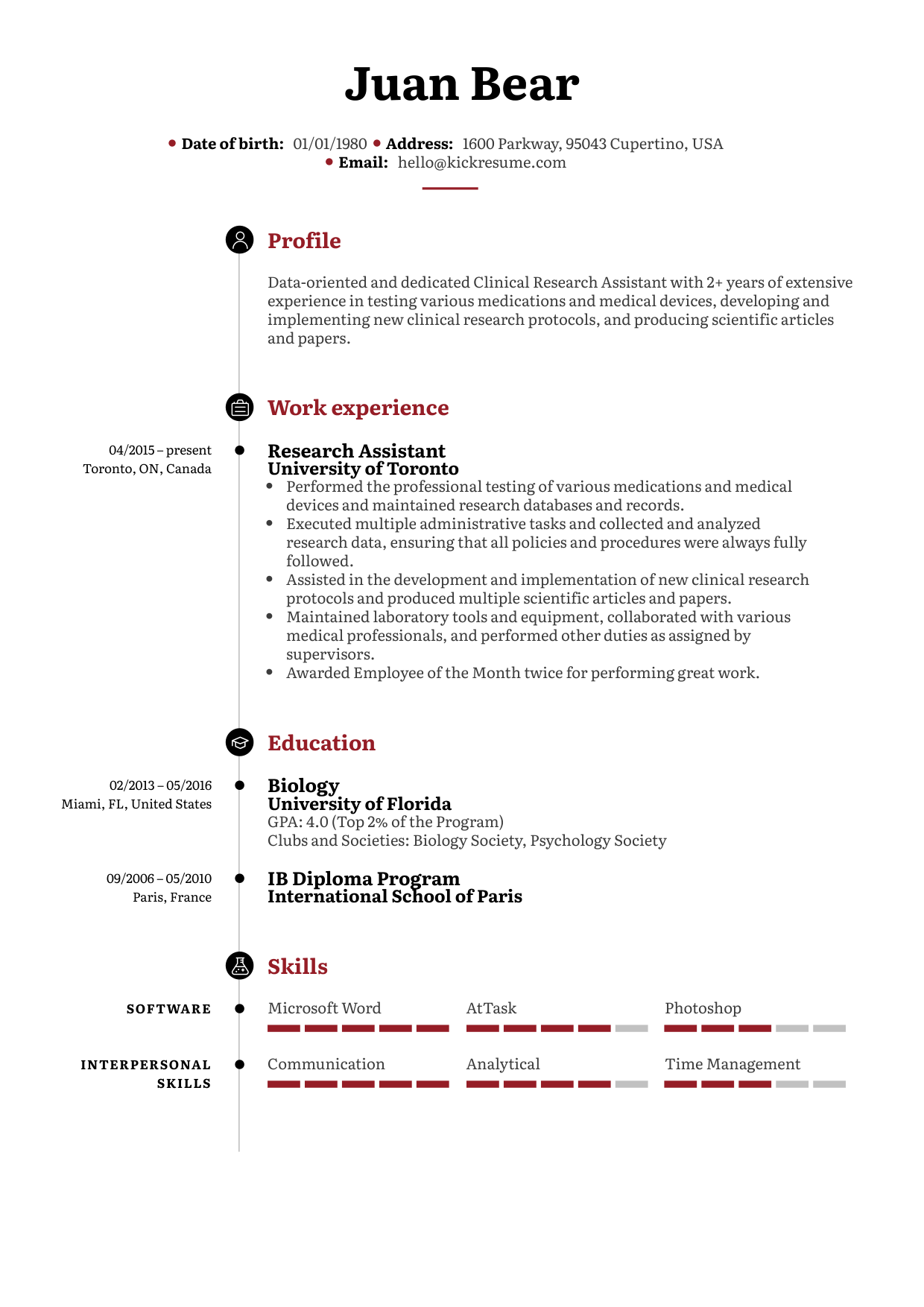
Chemistry lab assistant resume sample


What works in this resume sample:
- Clear presentation of relevant lab experience: The resume highlights hands-on laboratory tasks related to chemistry (sample preparation, instrument usage, data collection), making it immediately obvious the candidate has real lab exposure, which is exactly what employers look for in a lab assistant role.
- Technical skills are easy to spot: Key instruments and techniques (e.g., chromatography, spectrometry, titrations) are listed, helping recruiters and ATS systems quickly match the candidate to technical requirements. These skills tell the reader right away what the applicant can do in a lab setting.
- Organized and scannable format: The resume uses clean sections with bullet points that are easy to scan. This helps both ATS and human reviewers quickly identify qualifications without digging through dense paragraphs, especially helpful for early-career applicants with practical lab exposure.
What could be improved:
- Lacks measurable achievements or impact: Many bullet points describe duties (e.g. “prepared samples,” “ran tests”), but none quantify results. Adding data like “improved sample throughput by 15%” or “reduced error rates using X protocol”, would make the resume more compelling.
- Needs stronger action verbs and outcome language: Some descriptions are passive (e.g. “responsible for…”). Rewriting using stronger action verbs (e.g., executed, optimized, resolved, validated, improved) and following them with outcomes would better showcase initiative and contribution.
- Professional summary could be more targeted: If present, the opening summary should quickly position the candidate’s objective and core qualifications (e.g., “Detail-oriented Chemistry Lab Assistant with hands-on experience in analytical instrumentation and high-throughput sample testing”). A crisp summary gives immediate context and helps differentiate this candidate from others.
Chemist resume sample

What works in this resume sample:
- Strong display of scientific and technical skills: The resume clearly lists relevant lab techniques (e.g., chromatography, spectroscopy, wet chemistry), analytical tools, and software. This helps both ATS systems and hiring managers quickly recognize the candidate’s technical readiness for chemist roles.
- Clear evidence of hands-on research ownership: Bullet points include action-driven language such as “conducted groundbreaking research,” “designed and executed experiments,” and similar phrasing that demonstrates initiative and accountability. This shows the candidate actively contributed to research outcomes rather than only supporting them.
- Professional profile provides immediate context: Although labeled as “Profile” instead of “Summary,” the opening section successfully functions as a career overview, outlining specialization and research focus while positioning the candidate for chemistry-related roles.
What could be improved:
- Reorder sections to prioritize practical experience: Once a candidate has real laboratory or industry experience, that experience should take precedence over academic background. Placing the Work Experience section immediately after the Profile (with Education following later, typically after Skills) would better reflect industry expectations, where applied research and hands-on lab work matter more than coursework at this stage.
Senior scientist medicinal chemistry resume sample

What works in this resume sample:
- Clearly showcases advanced scientific expertise: The resume highlights domain-specific skills relevant to medicinal chemistry, such as compound design, SAR analysis, synthesis techniques, and pharmacokinetic evaluation. This helps hiring managers and ATS systems immediately see that the candidate is experienced in core scientific competencies for senior chemist roles.
- Strong emphasis on leadership and project ownership: Senior roles require initiative and accountability. This resume includes leadership of R&D projects, mentoring junior scientists, and coordinating cross-functional work, which demonstrates the candidate’s readiness for higher responsibility.
- Relevant scientific context and environments: The work history clearly reflects experience in drug discovery and pharmaceutical research environments, which aligns well with expectations for medicinal chemistry roles. Mentioning specific therapeutic areas, platforms, or stages of discovery provides important context for reviewers.
What could be improved:
- Quantification of scientific impact is limited: While responsibilities are well articulated, many accomplishments lack quantitative outcomes. Adding measurable results, such as improvements in lead optimization timelines, % yield increases, reduced attrition rates, or publications driven by the work, would bolster the sense of impact.
- Publications and scientific contributions could be highlighted more prominently: For senior scientists, references to peer-reviewed publications, patents, or conference presentations can significantly strengthen credibility. Listing these in a dedicated section (especially if they are substantial) would make the resume more compelling academically and industrially.
- Professional summary could better position the career level and focus: A stronger professional profile at the top (e.g., “Senior Medicinal Chemist with 10+ years of lead optimization and drug discovery experience across oncology and CNS programs”) would help reviewers quickly grasp the candidate’s niche, scale of impact, and career trajectory before diving into the body of the resume.
1. What’s the difference between a resume and a CV?
Before you start writing your chemist resume, there’s one key question you should answer first:
Are you applying with a resume or a CV?
In scientific and academic fields, this distinction matters much more than in most corporate roles.
Resume vs. CV: What’s the difference (and which one should a chemist use)?
Although people often use the terms interchangeably, a resume and a CV (Curriculum Vitae) are not the same thing, especially in chemistry, research, and academia.
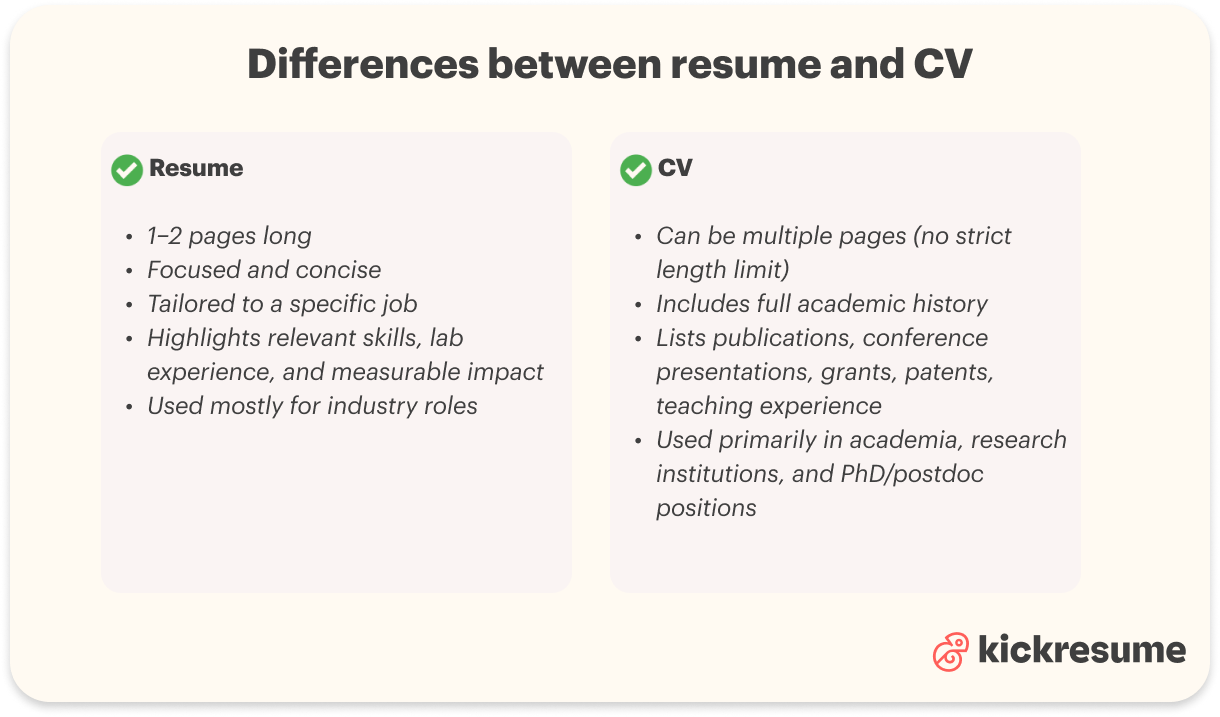
Resume:
- 1–2 pages long
- Focused and concise
- Tailored to a specific job
- Highlights relevant skills, lab experience, and measurable impact
- Used mostly for industry roles (pharma, biotech, manufacturing, QA/QC, R&D companies)
If you’re applying for roles like:
- Analytical Chemist
- QC Chemist
- Formulation Chemist
- R&D Chemist in industry
- Pharmaceutical Scientist
A resume is typically the right choice.
CV (Curriculum Vitae):
- Can be multiple pages (no strict length limit)
- Includes full academic history
- Lists publications, conference presentations, grants, patents, teaching experience
- Used primarily in academia, research institutions, and PhD/postdoc positions
If you’re applying for:
- PhD programs
- Postdoctoral research positions
- University lecturer roles
- Government research labs
You’ll likely need a CV, not a resume.
Why does this matter for chemists?
Because in science, your publications, patents, and research contributions can carry as much weight as your work experience. Choosing the wrong format can mean leaving out critical information or overwhelming an industry recruiter with unnecessary academic detail.
2. How to pick the right resume format for a chemist
Just like different lab techniques serve different purposes, different resume formats highlight different aspects of your career.
Your format should reflect:
- Your career stage
- Your type of chemistry (analytical, organic, medicinal, materials, etc.)
- Whether you’re industry-focused or transitioning from academia
Here are the three main resume formats and how they apply to chemist roles:
#1 Reverse-chronological resume (traditional format)
The reverse-chronological format lists your most recent role first and moves backward.
It’s the most recruiter-friendly and ATS-compatible format and often the safest choice.
It works best if:
- You’ve progressed clearly (e.g., Lab Assistant -> Chemist -> Senior Chemist -> Lead Scientist)
- You have steady industry experience
- You want to highlight increasing responsibility, technical complexity, and project ownership
For most chemists applying to corporate or pharmaceutical roles, this is the strongest option.
#2 Functional resume (skills-based format)
Instead of focusing on timeline and job titles, the functional format emphasizes your technical competencies and lab skills.
It may be useful if:
- You’re transitioning from academia to industry
- You have strong lab skills but limited industry experience
- Your career path includes short-term research contracts or fellowships
However, be cautious. Many ATS systems struggle with purely functional resumes, and recruiters in scientific industries often want to see where and how you gained your technical experience.
#3 Hybrid resume (combination format)
This format blends both approaches:
- A strong skills section at the top
- Followed by a structured work history
For chemists, this can be particularly effective if you:
- Have advanced technical expertise (HPLC, GC-MS, NMR, synthesis, method development, GMP compliance, etc.)
- Also have solid industry experience
- Want to highlight both scientific depth and professional progression
Matching resume formats to chemist career levels
#1 Entry-level chemists / recent graduates
If you’re just finishing your degree or transitioning from academia, a hybrid resume can help you emphasize:
- Lab techniques
- Research projects
- Instrument proficiency
- Thesis or capstone work
Even if your formal job titles are limited.
#2 Mid-level industry chemists
If you already work in pharma, biotech, manufacturing, or QA/QC, the reverse-chronological format is usually the best choice. It clearly shows:
- Your progression
- Increasing responsibility
- Measurable outcomes (method validation, yield improvement, compliance success, cost reduction)
#3 Senior scientists / technical leads
For experienced chemists leading projects or teams, a reverse-chronological or hybrid format works best. This allows you to:
- Highlight strategic contributions
- Showcase patents or major research milestones
- Demonstrate leadership in cross-functional scientific teams
Pro tip
If you’re applying through an Applicant Tracking System (ATS), the reverse-chronological format is almost always the safest option.
ATS software prefers:
- Clear timelines
- Standard headings (Work Experience, Skills, Education)
- Simple formatting
And remember to always check the job description, because if the employer explicitly requests a CV, don’t submit a resume. And if they request a resume, don’t send a 5-page academic CV unless the role is clearly research-focused.
Try our AI Resume Writer and have your resume ready in minutes!

3. How to format your chemist resume to make it ATS-friendly)
Choosing the right resume format is only the first step. Even the most technically impressive chemist resume can get overlooked if it’s poorly structured or unreadable for Applicant Tracking Systems (ATS).
And here’s the reality in pharma, biotech, manufacturing, and research:
Most mid-sized and large companies use ATS software to screen resumes before a human recruiter ever sees them. That means your resume needs to work for two audiences at once:
- Hiring managers and lab directors
- Software that scans for technical keywords
If your formatting gets in the way, your application may never reach the interview stage, no matter how strong your lab experience is.
Resume formatting fundamentals for chemist roles
To keep your chemist resume clean, professional, and ATS-compatible, follow these best practices:
- Use a simple, single-column layout: Creative multi-column designs, text boxes, and tables may look polished, but they can confuse ATS systems. A straightforward, one-column structure ensures that your technical skills, instruments, and achievements are parsed correctly.
- Choose a clear, professional font: Stick to widely supported fonts like Arial, Calibri, Helvetica, Times New Roman, because in scientific hiring, clarity matters more than style. Decorative fonts can reduce readability and look unprofessional.
- Keep font sizes consistent: Body text (10.5–12 pt), Section headings (14–16 pt). This improves readability for both humans and algorithms, because recruiters often skim resumes in seconds. Clean visual hierarchy helps them immediately locate your technical expertise and research experience.
- Use standard section headings: ATS tools are trained to recognize common resume section titles (Work Experience, Research Experience, Technical Skills, Education, Certifications, Publications, etc.), so avoid overly creative alternatives.
- Label clearly: If you’re including scientific achievements, label them clearly so both ATS and hiring managers can identify them easily.
- Use bullet points instead of long paragraphs: Details matter in scientific roles, and long text blocks make resumes difficult to scan. Bullet points help you clearly present your content, and they also allow ATS systems to extract specific competencies more accurately.
- Save your resume as PDF or DOCX: These formats are the safest for ATS compatibility, but always follow the file format instructions in the job posting.
How to optimize your chemist resume for ATS scanners
ATS software doesn’t “understand” chemistry the way a hiring manager does. It scans for specific keywords and phrases and compares them to the job description.
That means your resume needs to include the right scientific terminology, naturally and truthfully.
1. Mirror keywords from the job description
If the job posting mentions:
- Method validation
- GMP or GLP compliance
- HPLC or GC-MS
- Stability testing
- Analytical method development
- Regulatory documentation
Use those exact phrases in your resume where appropriate.
Avoid synonyms if the posting uses a specific term. For example, if they write “GMP compliance,” don’t only write “quality procedures”, but include the actual keyword.
2. Include chemistry-specific terminology
Chemist resumes perform better when they include technical keywords such as:
- HPLC / UPLC
- GC-MS
- NMR
- FTIR
- Spectroscopy
- Wet chemistry techniques
- Organic synthesis
- Method development
- Quality control (QC)
- Quality assurance (QA)
- Stability testing
- Validation protocols
- SOP documentation
- ISO standards
- Regulatory compliance
These keywords are often directly matched against job requirements.
3. Avoid graphics, icons, and rating bars
Skill bars (e.g., “HPLC – 5/5”) or icon-based layouts may look modern but can be unreadable for ATS systems. If the system cannot interpret the format, your technical skills might be ignored entirely.
4. Never hide keywords
Avoid:
- White text on white backgrounds
- Invisible keyword stuffing
- Overloading your resume with repetitive phrases
Not only can this trigger automatic rejection, but it also looks unprofessional if reviewed manually.
5. Use clear job titles
Scientific job titles can vary widely between companies. If your title was highly specific or internal, consider adding a clearer equivalent.
For example:
- Analytical Scientist (Analytical Chemist)
- R&D Associate (Research Chemist)
- QC Specialist (Quality Control Chemist)
This helps both ATS systems and recruiters immediately understand your level and focus area.
Use ATS-friendly templates to save time
Formatting a chemist resume manually can be challenging, especially when balancing technical detail with clean structure.
That’s why many professionals use ATS-optimized resume templates. These templates are designed to:
- Maintain clean formatting
- Preserve scientific keyword structure
- Stay readable for hiring managers
- Pass automated screening systems
Kickresume’s resume templates strike the right balance between technical professionalism and ATS compatibility, helping your chemist resume make it through software filters and still look polished to lab managers and scientific recruiters.
Find out your resume score!

4. How to differentiate between a resume summary and a resume objective (for chemists)
One of the most important parts of your chemist resume sits right at the top: your opening statement. This will either be a resume summary or a resume objective.
Both serve the same purpose: to immediately show hiring managers (or principal investigators) who you are, what level you operate at, and what scientific value you bring.
And this matters more than you think.
Recruiters in pharma, biotech, manufacturing, and research labs don’t read resumes word-for-word. They scan. Often quickly. Your opening section needs to answer three questions almost instantly:
- What kind of chemist are you?
- What technical environment have you worked in?
- What measurable impact have you made?
In just 3–5 concise sentences, you should highlight your expertise, core lab competencies, and one or two concrete achievements.
So, should you write a resume summary or a resume objective?
Let’s break down the differences..
Writing a resume summary (for experienced chemists)
A resume summary is ideal if you already have professional lab experience, whether in:
- Pharmaceutical development
- Analytical chemistry
- Quality control (QC)
- Research & development (R&D)
- Manufacturing or regulatory environments
This format focuses on your expertise and proven results.
What should a chemist resume summary include?
- Your professional title (e.g., Analytical Chemist, R&D Chemist, QC Chemist, Organic Chemist)
- Years of laboratory or industry experience
- Core technical skills (HPLC, GC-MS, NMR, method validation, GMP compliance, etc.)
- The type of environment you’ve worked in (regulated, GMP-compliant, academic lab, manufacturing facility, etc.)
- One measurable achievement (efficiency improvement, validation success rate, cost reduction, publication impact, etc.)
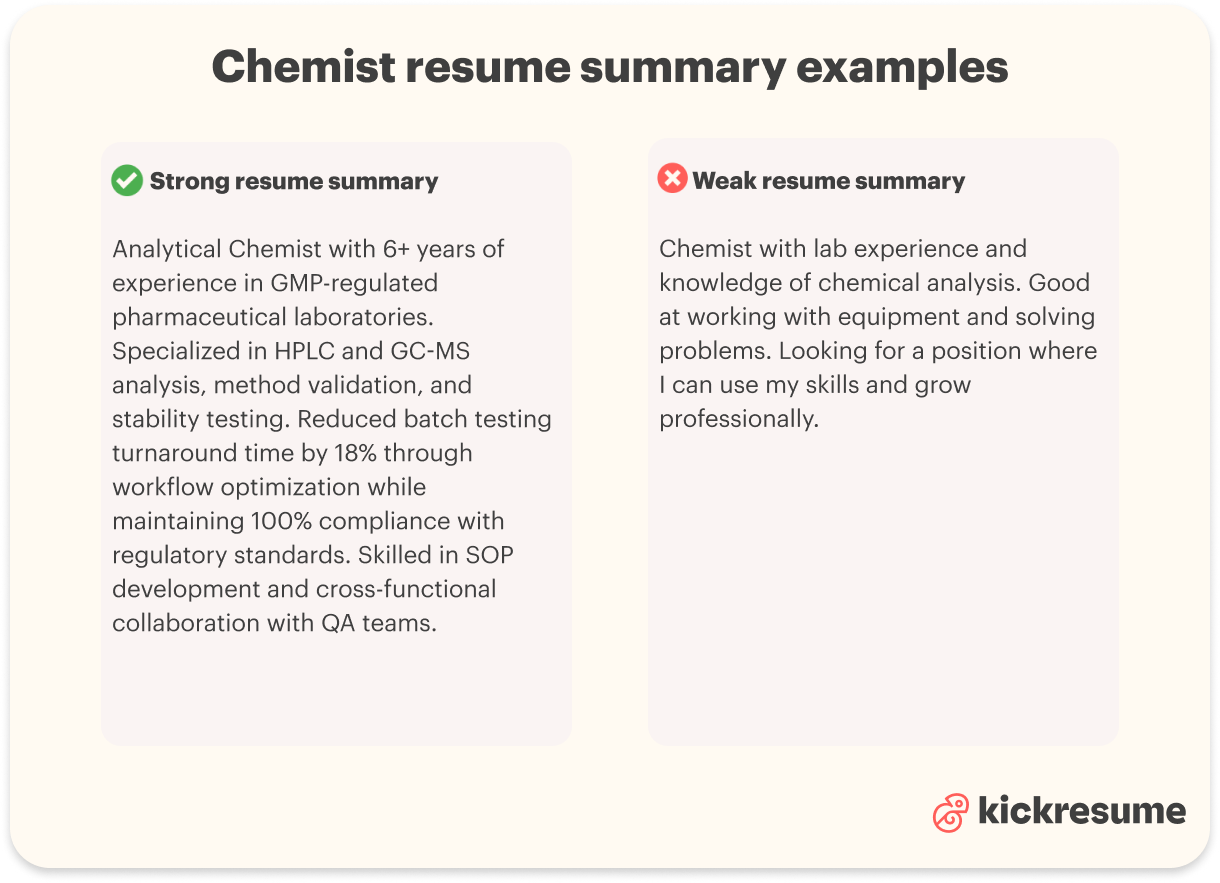
Bad chemist resume summary example
Chemist with lab experience and knowledge of chemical analysis. Good at working with equipment and solving problems. Looking for a position where I can use my skills and grow professionally.
Why this doesn’t work: It’s generic and vague. It doesn’t mention specific instruments, regulatory standards, or results. A hiring manager can’t tell whether this person worked in pharma, academia, manufacturing, or testing labs.
Good chemist resume summary example
Analytical Chemist with 6+ years of experience in GMP-regulated pharmaceutical laboratories. Specialized in HPLC and GC-MS analysis, method validation, and stability testing. Reduced batch testing turnaround time by 18% through workflow optimization while maintaining 100% compliance with regulatory standards. Skilled in SOP development and cross-functional collaboration with QA teams.
Why this works: It clearly defines specialization, regulatory exposure, technical tools, and measurable results. The reader immediately understands both technical level and impact.
Writing a resume objective (for early-career chemists)
A resume objective works better if you’re:
- A recent chemistry graduate
- Transitioning from academia to industry
- Moving from lab assistant to full chemist role
- Shifting specialization (e.g., from QC to R&D)
Instead of emphasizing long-term achievements, an objective highlights direction, training, and readiness.
What should a chemist resume objective include?
- Your current academic or professional background
- The type of chemistry role you’re targeting
- Core laboratory techniques you already use
- Any research, internship, or project experience
- Your motivation to contribute and grow
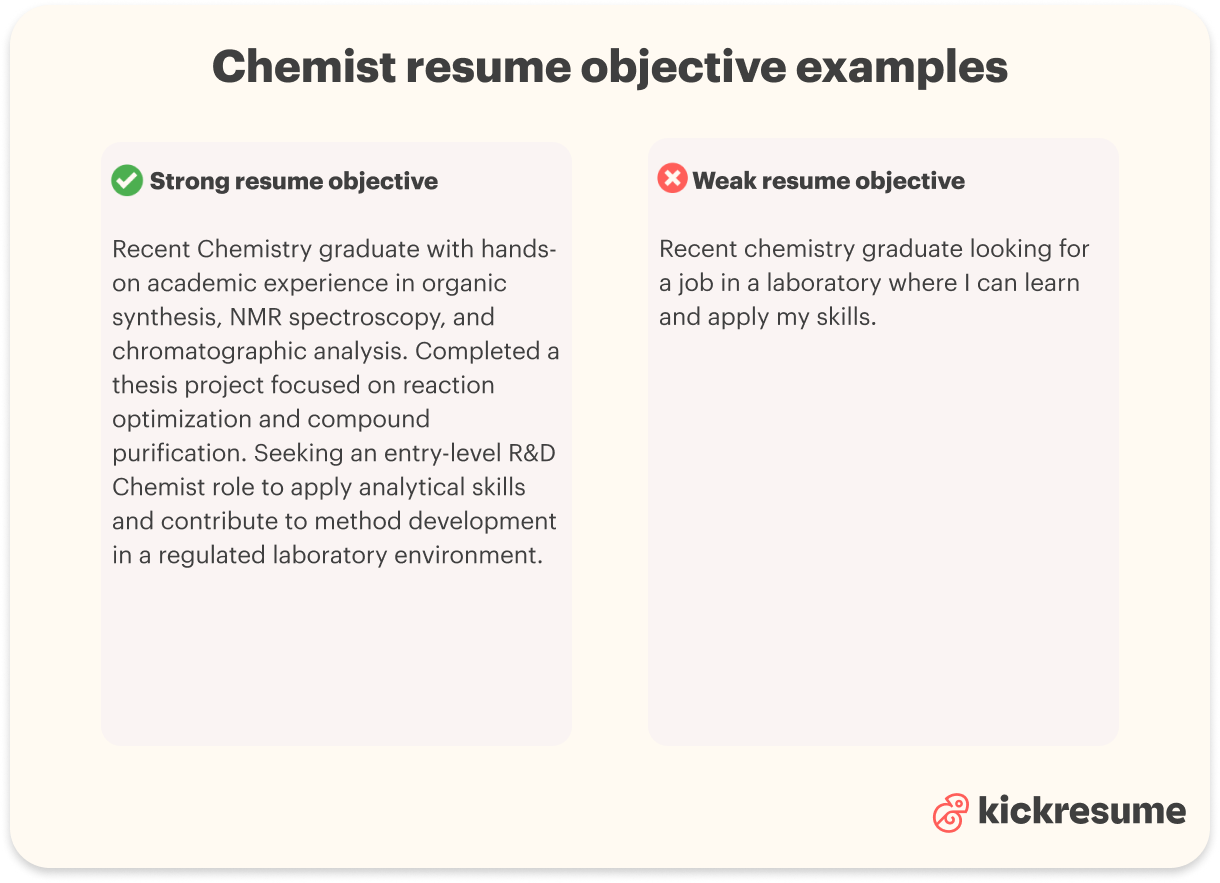
Bad chemist resume objective example
Recent chemistry graduate looking for a job in a laboratory where I can learn and apply my skills.
Why this doesn’t work: It’s vague and doesn’t mention techniques, research focus, or lab tools. There’s no indication of specialization or value.
Good chemist resume objective example
Recent Chemistry graduate with hands-on academic experience in organic synthesis, NMR spectroscopy, and chromatographic analysis. Completed a thesis project focused on reaction optimization and compound purification. Seeking an entry-level R&D Chemist role to apply analytical skills and contribute to method development in a regulated laboratory environment.
Why this works: It clearly states techniques, project focus, and career direction. Even without industry experience, it demonstrates technical foundation and readiness.
Academic vs. Industry Context (Important for Chemists)
For chemist roles, your choice between summary and objective may also depend on your target environment.
- Industry (pharma, biotech, manufacturing): Focus on technical skills, compliance, measurable efficiency, validation, production impact.
- Academia or research institutions: Emphasize publications, research focus, experimental design, grant involvement, and collaboration.
If applying for academic positions, your summary may also align closely with a short professional profile from a longer CV.
Pro tip
Avoid generic adjectives like:
- Hard-working
- Motivated
- Detail-oriented
- Team player
In scientific roles, credibility comes from:
- Specific techniques
- Regulatory standards
- Measurable lab outcomes
- Published research
- Experimental results
Let your technical competence and quantifiable contributions speak for you.
5. How to choose the right skills for your chemist resume
In chemistry roles, your skills are what truly define you.
Two candidates can both hold the title “Chemist,” but one may specialize in analytical method validation under GMP conditions, while another focuses on organic synthesis in academic research. The difference lies in the skill set.
That’s why your goal isn’t to list every lab technique you’ve ever encountered, but to highlight the ones that are most relevant to the role you’re applying for.
The smartest way to do that?
Let the job description guide you.
Before building your Skills section, ask yourself:
- Are they looking for strong analytical chemistry experience (HPLC, GC, LC-MS)?
- Is method development or validation mentioned?
- Do they emphasize GMP, GLP, or regulatory compliance?
- Are formulation, synthesis, or scale-up processes important?
- Do they require data analysis, documentation, or cross-functional collaboration?
The answers will tell you which skills should take priority on your resume.
Key hard skills for a chemist resume
Hard skills in chemistry demonstrate technical competence. They prove that you can work independently in a laboratory environment, handle instrumentation, and follow strict protocols.
Here are some of the most valuable hard skills for chemist roles across industries:
Laboratory techniques & instrumentation
- High-Performance Liquid Chromatography (HPLC)
- Gas Chromatography (GC, GC-MS)
- Liquid Chromatography–Mass Spectrometry (LC-MS)
- Nuclear Magnetic Resonance (NMR)
- UV-Vis Spectroscopy
- FTIR Spectroscopy
- Titration and wet chemistry techniques
- Method development and validation
- Sample preparation and purification
Industry & compliance knowledge
- Good Manufacturing Practice (GMP)
- Good Laboratory Practice (GLP)
- FDA or EMA regulatory awareness
- SOP development and documentation
- Stability testing
- Quality control procedures
- Batch record review
Research & technical expertise
- Organic synthesis
- Reaction optimization
- Analytical troubleshooting
- Data interpretation and statistical analysis
- Scientific report writing
- Laboratory information management systems (LIMS)
These skills signal that you understand not only chemistry theory, but also laboratory execution and compliance standards.
Essential soft skills for chemists
Technical ability is critical, but chemistry roles also require precision, collaboration, and responsibility.
Whether you’re working in pharma, biotech, environmental testing, or academic research, soft skills matter more than many candidates realize.
Strong soft skills for chemist roles
- Attention to detail and accuracy
- Critical thinking and analytical reasoning
- Problem-solving in laboratory settings
- Time management in multi-project environments
- Documentation discipline
- Cross-functional communication (QA, production, R&D teams)
- Adaptability to new instrumentation or protocols
- Team collaboration
- Safety awareness and compliance mindset
In regulated environments, specifically, precision and reliability are just as important as technical knowledge.
Academic vs. Industry Skill Emphasis
Your skills section should also reflect your target environment.
For industry chemists:
Prioritize:
- Instrumentation proficiency
- Regulatory knowledge (GMP/GLP)
- Validation and compliance
- Efficiency improvements
- Documentation accuracy
For academic or research roles:
Highlight:
- Experimental design
- Advanced analytical techniques
- Publications or research focus
- Grant or project involvement
- Data interpretation and scientific writing
Tailoring this section properly can significantly increase your chances of passing ATS filters and impressing hiring managers.
Pro tip
A strong chemist operates at the intersection of:
- Scientific theory
- Technical execution
- Regulatory discipline
- Data-driven decision-making
Your Skills section should reflect that balance.
When your listed skills closely mirror the terminology used in the job description, both ATS systems and hiring managers will immediately recognize you as a strong technical match without needing to decode your expertise.
6. How to effectively list your achievements and laboratory experience
Your Work Experience section shouldn’t read like a generic lab job description. It should clearly show:
- What type of laboratory or industry you worked in
- Which analytical techniques or instruments you used
- What level of responsibility you had
- What measurable results you achieved
The goal is simple: connect your responsibilities to real impact.
Bad chemist work experience example
Chemist
ABC Laboratory
June 2020 – Present
Performed laboratory testing
Prepared samples
Used analytical instruments
Followed SOPs
Recorded results
Why this doesn’t work: It’s too vague and it's not even properly formatted (no bullet points, no spacing). There’s no mention of specific techniques, regulatory environment, scale of responsibility, or measurable outcomes, and the whole section is hard to read.
Good chemist work experience example
Analytical Chemist
ABC Pharmaceutical Laboratories, Chicago, IL
June 2020 – Present
- Performed quantitative analysis using HPLC and GC-MS in a GMP-regulated environment.
- Developed and validated analytical methods according to ICH guidelines, reducing sample turnaround time by 20%.
- Investigated out-of-specification (OOS) results and implemented corrective actions, decreasing repeat deviations by 30%.
- Collaborated with QA teams to ensure full compliance during internal and external audits.
Why this works: It’s specific, technical, and measurable, with proper formatting and bullet points for easy readability and scannability. It names tools, standards, and shows clear improvements.
Early-career chemist work experience example
Chemistry Lab Assistant
University Research Laboratory
June 2019 – May 2023
- Prepared and purified samples using chromatography techniques.
- Maintained laboratory equipment and ensured compliance with safety protocols.
- Assisted in research experiments contributing to peer-reviewed publications.
Even without a senior title, this shows technical ability and contribution.
Pro tip
Don’t just list tasks. Show how your scientific work created measurable value.
7. How to select the right action verbs for your chemist resume
Action verbs may seem minor, but in a chemist resume, they make a big difference. They turn routine lab tasks into clear demonstrations of technical expertise, problem-solving ability, and scientific impact.
Compare:
No action verbs included
Responsible for sample analysis and lab documentation.
vs.
Action verbs included
Conducted quantitative sample analysis using HPLC and prepared GMP-compliant documentation.
The second version sounds precise, technical, and confident.
Why action verbs matter in chemistry resumes
In scientific roles, hiring managers look for signs that you:
- Apply technical knowledge independently
- Solve experimental or analytical problems
- Improve processes or ensure compliance
- Contribute to research, validation, or product development
The verbs you use should reinforce those capabilities.
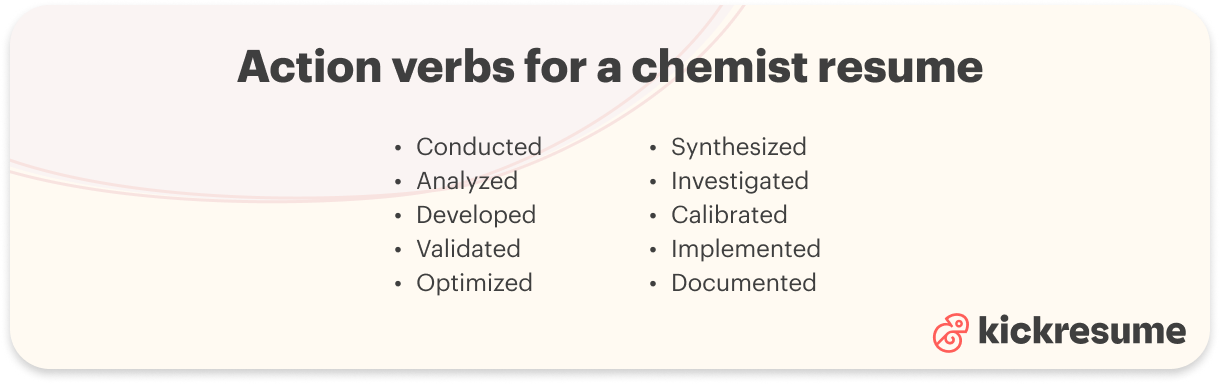
Strong action verbs for chemist resumes
Instead of vague phrases, use verbs that reflect scientific execution and impact:
- Conducted
- Analyzed
- Developed
- Validated
- Optimized
- Synthesized
- Investigated
- Calibrated
- Implemented
- Documented
- Characterized
- Formulated
- Monitored
- Reduced
- Improved
These verbs show hands-on scientific involvement, not passive participation.
Action verbs in practice: before and after
Before including action verbs
- I was responsible for running lab tests.
- I helped with method development.
- I handled deviations when needed.
After including action verbs
- Performed analytical testing using GC-MS and UV-Vis spectroscopy in a regulated laboratory environment.
- Developed and optimized analytical methods, improving accuracy and reducing processing time by 15%.
- Investigated deviations and implemented corrective actions to maintain regulatory compliance.
These examples display the same work, but after including the action verbs, the presentation is much stronger.
How to use action verbs effectively
- Start each bullet point with a clear, technical verb
- Avoid repeating the same verb too often
- Match verbs to your level (e.g., developed vs. led validation studies)
- Choose verbs that imply results, not just activity
Avoid weak phrases like:
- Responsible for
- Helped with
- Assisted in
In scientific roles, precision matters, and that applies also to your wording.
Pro tip
Your verbs should make it obvious that you actively contribute to scientific results, not just follow procedures.
8. How to write the education section professionally on a chemist resume
For chemists, education often plays a central role, especially in research, pharmaceutical, academic, or laboratory-based positions.
Unlike some other professions, your degree isn’t just background information. It signals your technical foundation, specialization, and scientific credibility.
Whether you’re applying for an entry-level lab role or a senior research position, your education section should clearly reflect your scientific training.
What to include in a chemist education section
Focus on qualifications that directly support your expertise in chemistry:
- Bachelor’s, Master’s, or Ph.D. in Chemistry, Biochemistry, Analytical Chemistry, Organic Chemistry, Medicinal Chemistry, or a related field
- Relevant specializations or thesis topics
- Research focus (especially for academic or R&D roles)
- Certifications or laboratory training (GMP, GLP, ISO standards, safety certifications)
If you’re early in your career, you can also include:
- Relevant coursework (e.g., Instrumental Analysis, Organic Synthesis, Physical Chemistry)
- Academic research projects
- Lab techniques mastered during your studies
Example of a chemist resume education section
Master of Science in Analytical Chemistry
University of Illinois, Chicago, IL
2020 – 2022
Thesis: Development of HPLC Methods for Pharmaceutical Compound Stability Testing
Bachelor of Science in Chemistry
University of Illinois, Chicago, IL
2016 – 2020
Relevant coursework: Organic Chemistry, Instrumental Analysis, Spectroscopy, Chemical Kinetics
What if you don’t have an advanced degree?
In some industrial or quality control roles, a Bachelor’s degree combined with strong laboratory experience is sufficient.
In that case, strengthen your education section by adding:
- Specialized lab training
- Industry certifications (GMP, GLP, ISO)
- Safety training
- Technical workshops
Pro tip for Ph.D. or research-level roles
If you hold a Ph.D. or extensive research background, your education section should highlight:
- Dissertation title
- Research focus
- Key techniques or instrumentation used
- Publications or conference presentations (if relevant)
For scientific positions, your education doesn’t just support your resume, because it often defines your level of qualification. Make it clear, structured, and aligned with the role you’re targeting.
9. How to choose relevant optional sections for a chemist resume
After covering the essentials (summary, skills, work experience, education), you can decide whether additional sections will strengthen your application.
In scientific roles, optional sections can significantly boost credibility, but only if they directly support your technical expertise, research background, or laboratory impact.
If they don’t add scientific value, leave them out.
Add optional sections if:
- You have certifications, licenses, or technical training relevant to laboratory or research work
- You’ve contributed to publications, patents, or major research projects
- You want to highlight specialized instrumentation, methodologies, or regulatory expertise
- You’ve received scientific awards or recognition
Skip them if:
- They’re unrelated to chemistry or laboratory work
- They’re outdated and no longer relevant to your current level
- They don’t strengthen your scientific or technical profile
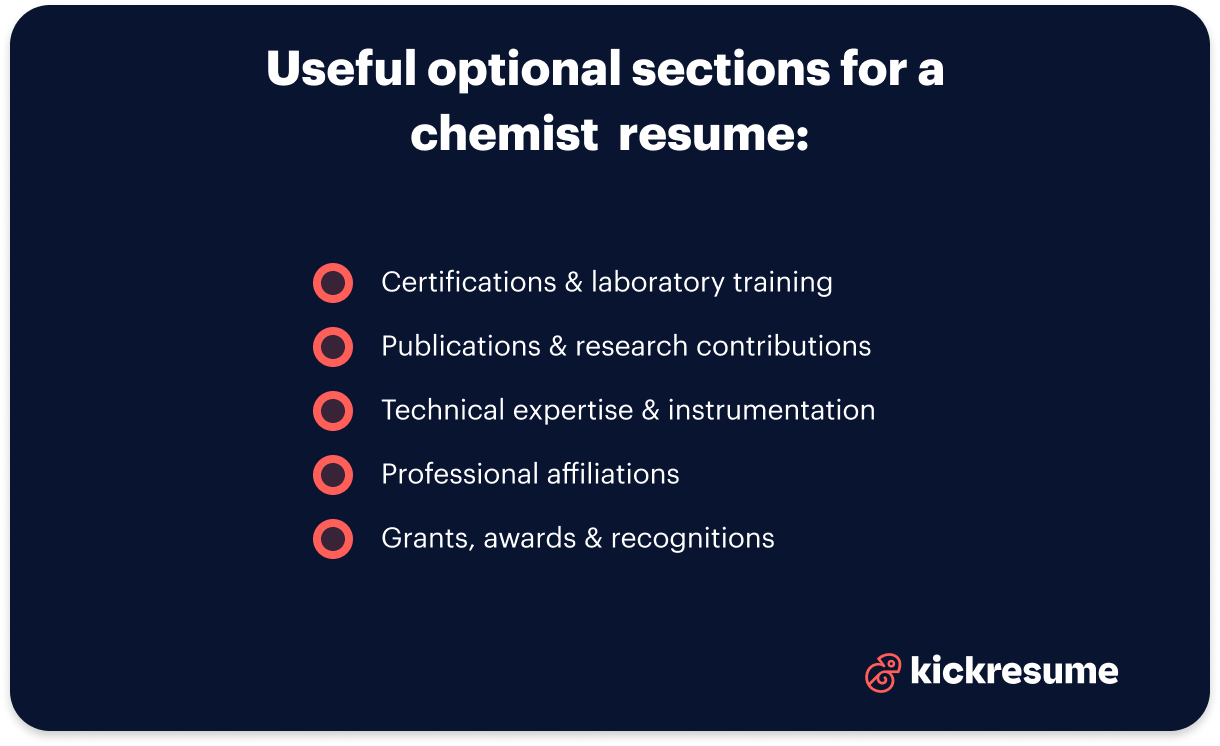
Useful optional sections for a chemist resume
1. Certifications & laboratory training
These are especially valuable in industrial, pharmaceutical, and regulated environments.
Examples
- GMP / GLP certification
- ISO compliance training
- Laboratory safety certification
- Quality control or validation training
- Specialized instrument training (HPLC, GC-MS, NMR, ICP-MS)
2. Publications & research contributions
Essential for academic, R&D, and senior scientific roles.
Examples
- Peer-reviewed journal publications
- Conference presentations or posters
- Co-authored research papers
- Patent contributions
3. Technical expertise & instrumentation
If not already covered in your skills section, you can create a focused section for advanced tools and methods.
Examples
- Chromatography techniques (HPLC, GC)
- Spectroscopy (NMR, FTIR, UV-Vis)
- Method development & validation
- Organic synthesis techniques
- Data analysis software (ChemDraw, MATLAB, LIMS systems)
4. Professional affiliations
Memberships show engagement with the scientific community.
Examples
- American Chemical Society (ACS)
- Royal Society of Chemistry (RSC)
- Industry or research consortiums
5. Grants, awards & recognitions
Scientific recognition strengthens your credibility.
Examples
- Research grants
- Academic excellence awards
- Industry innovation awards
- Fellowship or scholarship recognition
Optional sections should reinforce your scientific authority, not clutter your resume.
Ask yourself: Does this strengthen my credibility as a chemist or researcher?
If yes: include it.
If not: remove it.
10. How to avoid common mistakes on a chemist resume
So, at this point, you’ve built technical expertise, worked in labs, handled instruments, and contributed to research or product development. It’d be a shame if some avoidable mistakes weakened that strong scientific background.
Here are the most common resume pitfalls chemists should watch out for, and how to avoid them.
#1 Typos and technical inaccuracies
In scientific roles, precision matters. A misspelled chemical compound, incorrect unit, or grammar mistake can raise concerns about your attention to detail.
How to avoid it: Proofread carefully. Double-check technical terminology, chemical names, and measurement units. If possible, ask a colleague to review your resume.
#2 Overloading the resume with dense text
Large blocks of technical descriptions make your resume hard to scan.
How to avoid it: Use clear bullet points, consistent formatting, and enough white space. Keep explanations concise while still showing impact.
#3 Listing duties instead of results
Saying you “performed lab experiments” or “conducted analysis” doesn’t show your effectiveness.
How to avoid it: Focus on outcomes, because impact is what sets you apart. For example:
- Improved yield by 15%
- Reduced analysis time by 20%
- Developed a validated method adopted across the department
#4 Not quantifying achievements
Chemistry is measurable by nature. If your resume has no numbers, it might feel incomplete.
How to avoid it:
Whenever possible, include:
- Yield percentages
- Purity levels
- Turnaround time improvements
- Number of samples analyzed
- Budget or project scope
- Publication metrics
Even approximate figures are better than none.
#5 Ignoring regulatory or compliance context
In pharmaceutical, industrial, or quality-control roles, compliance is critical.
How to avoid it:
Mention relevant standards such as:
- GMP / GLP
- ISO guidelines
- FDA or EMA regulations
- Safety protocols
This shows you understand controlled environments.
#6 Keyword blindness (ATS issues)
Many research labs, pharmaceutical companies, and large organizations use ATS systems.
How to avoid it:
Mirror terminology from the job posting. If it mentions:
- Method development
- Analytical chemistry
- HPLC / GC-MS
- Validation
- Formulation development
Make sure those terms appear naturally in your resume.
#7 Adding irrelevant information
Unrelated part-time jobs, hobbies, or outdated early-career roles can dilute your scientific profile.
How to avoid it:
Be selective. Every line should strengthen your identity as a chemist or researcher.
Pro tip
A strong chemist resume isn’t about listing every experiment you’ve ever performed. It’s about clarity, measurable results, and scientific credibility.
When hiring managers scan your resume, they should immediately see that you understand the science, and you deliver reliable results.
11. How to create a complementary and matching cover letter for your chemist resume
Your resume shows your technical background, laboratory skills, and measurable results.
Your cover letter explains the thinking behind your work, how you approach experiments, solve problems, and contribute to research or product development.
While your chemist resume is structured and data-driven, a chemist cover letter adds context, scientific reasoning, and motivation.
What should a strong chemist cover letter do?
A well-written chemist cover letter should clearly answer:
- What is your scientific focus or specialization?
- What type of lab environments have you worked in (academic, pharmaceutical, industrial, R&D)?
- What technical strengths set you apart?
- Why are you interested in this specific company, lab, or research area?
- How will your expertise contribute to their projects or goals?
Instead of repeating your resume bullet points, use your cover letter to explain the impact and relevance of your work.
Chemist cover letter opening example
In my current role as an analytical chemist, I developed and validated HPLC methods that reduced testing turnaround time by 18% while maintaining full GMP compliance. I’m excited about the opportunity to apply my experience in method development and data analysis to support your formulation research team.
This example doesn’t just list tasks, as it highlights specialization, results, and alignment with the employer’s needs.
Resume vs. cover letter: what’s the difference?
They work together, but each serves a different purpose:
Resume: Structured, technical, and concise. Focused on skills, instruments, methods, and measurable outcomes.
Cover letter: Narrative and strategic. Focused on scientific approach, research interests, collaboration style, and motivation.
Your resume proves you have the technical qualifications.
Your cover letter explains why you’re the right scientific fit for this particular lab or organization.
How to keep your resume and cover letter aligned
For scientific roles, consistency reflects professionalism and attention to detail.
To keep both documents cohesive:
- Use the same header (name, contact details, LinkedIn if relevant)
- Keep fonts and formatting consistent
- Maintain clean spacing and margins
- Use the same subtle design style if you apply visual elements
If formatting isn’t your priority, matching resume and cover letter templates can ensure a clean, professional presentation without extra effort.
Pro tip
In chemistry, clarity and precision matter, that’s why your application should reflect that.
When your resume and cover letter complement each other, you present not just technical competence, but scientific credibility and purpose.
Create your cover letter fast with artificial intelligence.

12. Top resources for job-seeking chemists
Searching for a new role in chemistry can feel overwhelming, especially when opportunities are spread across academia, industry, pharmaceuticals, and research institutions. The good news is that you don’t have to rely on random searches or generic job boards.
Using the right platforms can significantly speed up your job hunt. Some websites specialize in scientific careers, others focus on academic pathways, and large job aggregators help you spot openings across multiple industries at once. Combining these resources gives you a smarter, more targeted way to find roles that actually match your expertise and specialization.
General Job Boards (Good for All Chemist Roles)
- Indeed Chemist Jobs — One of the largest global job boards with hundreds of chemist positions spanning analytical, research, QC, and industrial roles.
- ZipRecruiter Chemistry Jobs — Browse thousands of chemistry-related openings from entry level to senior scientist roles across industries.
- Monster Chemistry Jobs — Large general job board listing chemist roles as well as broader science and research opportunities.
Chemistry-Focused Job Platforms
- ACS Chemistry Careers (American Chemical Society) — Specialized chemistry career site with research, academic, and industrial openings globally.
- ChemistryJobs.com — Niche chemistry job board focused specifically on scientific roles, including research, development, and lab positions.
- iHireChemists Job Board — Dedicated chemistry job portal with career resources and alerts geared toward chemistry professionals.
- Chemistry World Jobs (European Chemistry Board) — Chemistry-specific listings primarily in Europe, including industrial, academic, and pharmaceutical roles.
- Organic Chemistry Portal Job Market — Focused job postings for organic chemists and researchers globally.
Research & Academic Opportunities
- Science Careers (Jobs in Chemistry & Research) — Search academic, postdoc, and research positions in chemistry and related sciences worldwide.
- Academic Positions in Chemistry — Platform focused on academic and research roles, including faculty, postdoctoral, and advanced research scientist openings.
- jobRxiv (Science & Research Jobs) — Job board for scientists, including chemistry roles in academia and industry.
Using a mix of general job boards and chemistry-specific platforms gives you the widest reach and helps you discover roles tailored to your level, specialization, and geographic preference.
Science Career Outlook in 2026
Employment in Science is expected to grow faster than the average for all occupations between now and 2034. (Source: U.S. Bureau of Labor Statistics). Every year, about 144,700 science jobs are expected to open, primarily due to employment growth and the need to replace workers who retire.
The career outlook for scientists in 2026 is being reshaped by AI.
- Some of the more positive outcomes show that scientists embracing AI are seeing real advantages – A 2026 research from Nature found that those using AI tools publish three times more papers and get nearly five times more citations than those who don't, with junior researchers becoming established leaders about 1.5 years earlier.
- On the more negative side, 44% of young STEM professionals feel at risk with AI.
The biggest growth in science careers will be in new fields like AI governance, bioinformatics, prompt engineering, and machine learning.
Average US base salaries across popular Science roles:
- Chemist: $83,948/year
- Scientist: $103,615/year
- Historian: $79,929/year
- Research Scientist: $124,014/year
- Research Assistant: $48,836/year
- Meteorologist: $71,762/year
- Biologist: $91,214/year
- Physicist: $162,757/year
- Mathematician: $106,179/year
- Microbiologist: $79,984year
- Environmental Scientist: $75,269/year
- Data Scientist: $129,401/year
These salary figures come from Indeed's January 2026 data, including anonymous user submissions and job postings. Your actual earnings will vary based on where you work, company size, role type, and your level of experience.
Overall, if you’re thinking about starting a career in Science—or you want to grow within the field—it’s still a great time to explore the opportunities the industry provides.
Chemist Resume FAQ
Should I write a resume or a CV for a chemist position?
The difference between using a resume or a CV depends on the role. For industry jobs (pharmaceuticals, manufacturing, QA/QC, R&D), employers typically expect a concise resume focused on skills, lab techniques, and measurable results. For academic, research, or grant-based roles, a CV is more appropriate because it includes publications, research projects, conferences, and teaching experience in greater detail.
How long should a chemist resume be?
Most chemist resumes should be one to two pages. Early-career candidates can usually stay within one page, while experienced chemists with multiple projects, methods, or regulatory work may need two pages to properly show their technical expertise and achievements.
What technical skills should I highlight on a chemist resume?
When writing about your skills, focus on lab techniques, instrumentation, and methodologies relevant to the role. Examples include chromatography (HPLC/GC), spectroscopy (NMR, FTIR, UV-Vis), method development, validation, data analysis software, GLP/GMP compliance, and safety procedures. Always tailor these to match the job description.
Should I include research projects or publications on my resume?
Yes, and especially if you’re applying for R&D, academic, or specialized scientific roles. Include key research projects, publications, or presentations that demonstrate your analytical thinking, experimental design, and subject-matter expertise. For industry roles, summarize only the most relevant ones.
How can I show impact if my work was team-based or experimental?
Even collaborative lab work can show measurable outcomes. Highlight results such as improved method accuracy, reduced testing time, successful validations, regulatory compliance, or contributions to product development. Use numbers when possible (e.g., “reduced analysis time by 30%”).
Do employers care about safety and regulatory knowledge on a chemist resume?
Absolutely. Knowledge of GLP, GMP, ISO standards, SDS handling, and laboratory safety protocols is highly valued, especially in regulated industries like pharmaceuticals, environmental testing, or food science. Including compliance experience shows reliability and attention to detail.
Is it important to tailor my chemist resume for each job application?
Yes. Chemistry roles are often highly specialized, so tailoring your resume to match the employer’s focus (analytical testing, formulation, materials science, etc.) significantly improves your chances of passing ATS screening and getting noticed by hiring managers.
Should I list all laboratory instruments I’ve ever used?
No. Focus on relevant and recent instrumentation that aligns with the position. A targeted list is much more effective than a long inventory of tools that don’t relate to the employer’s work.




![How to Write a Professional Resume Summary? [+Examples]](https://d2xe0iugdha6pz.cloudfront.net/article-small-images/How_to_Write_a_Professional_Resume_Summary_.png)
![How to List Your Education on a Resume? [+Examples]](https://d2xe0iugdha6pz.cloudfront.net/article-small-images/How_to_Put_Education_on_a_Resume_.png)
![How to Describe Your Work Experience on a Resume? [+Examples]](https://d2xe0iugdha6pz.cloudfront.net/article-small-images/How_to_Describe_Your_Work_Experience_on_a_Resume_.png)