
 ChatGPT
 Perplexity AI
 Claude
If you're updating your resume in 2026, the skills section is the one that's changed most. The market keeps moving, and in the age of AI, the list of skills that catches a recruiter's eye looks different than it did even a year ago.
Some skills come and go with each new wave of tools and trends. Others are timeless, like a programmer knowing their coding languages or a nurse knowing how to communicate with patients under pressure.
The strongest resumes in 2026 show both: the skills that prove you're staying current, and the ones that hold up year after year.
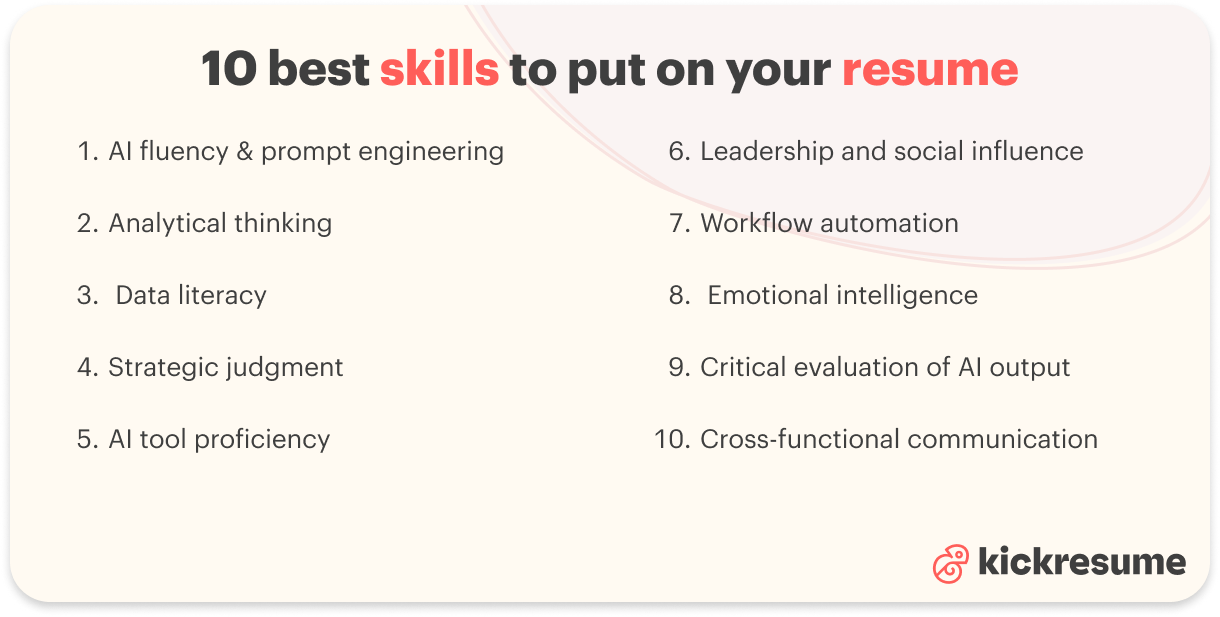
We’ve put together 10 best skills to put on your resume in the age of AI.
How AI is changing what employers look for
Skills have become the new currency of the job market, and right now they matter more than ever. Hard skills are still a big plus. But the AI revolution has shifted which hard skills are in demand.
According to The Future of Jobs Report employers expect 39% of key skills required in the job market will change by 2030.
Technical skills are projected to rise in importance faster than any other category over the next five years. But they're not climbing alone. Soft skills are rising right alongside them. Creative thinking. Resilience. Flexibility. Agility. The human stuff that decides whether all that new tech actually produces anything worth shipping.
Best skills to put on your resume in the age of AI
So which skills should actually go on your resume right now? The 10 below cover both sides of the equation. Some sharpen your edge when working with AI. Others keep you valuable in ways AI can't touch.
The strongest 2026 resumes show a mix of both, and we've ranked the list by what hits hardest with hiring managers right now.
One thing before you scroll: not every skill here belongs in the skills section of your resume. Named tools and platforms (Claude, Zapier, Tableau) get listed there. Others are better shown through your work experience bullets. For every skill below, we tell you where it fits.
1. AI fluency & prompt engineering
Creating and refining good prompts is the most important skill when you want to produce relevant, high-quality AI outputs. It's what makes AI actually give more value and save time, rather than producing mediocre output you have to rewrite anyway.
On a resume, this means going beyond a generic "AI experience" line. List the LLMs you actually use (Claude, ChatGPT, Gemini), mention specific use cases like content generation, research synthesis, code review, and if possible back it up with a measurable outcome.
Resume example (experience section):
- Built a prompt library that cut first-draft marketing copy turnaround by 60% across a 12-person team.
2. Analytical thinking
This is the single most in-demand skill in 2026, named as essential by 69% of employers in the WEF Future of Jobs Report. It's the cognitive backbone of every job that involves making sense of complex information, whether that's customer data, market shifts, or operational performance.
The trick on a resume is to avoid the word "analytical" entirely. Instead, describe one analysis you actually ran, what it revealed, and what changed as a result. The phrase doesn't matter; the evidence does.
Resume example (experience section):
- Analyzed 18 months of customer churn data to identify three drop-off points; the resulting retention initiative recovered $1.2M in annual revenue.
3. Data literacy
This skill is all about the ability to read dashboards, interpret AI outputs, and act on numbers rather than just nod at them. Every modern role now produces data that needs interpreting, so this skill keeps you valuable across industries.
If a job description asks for SQL or Tableau, include them. But the bullet underneath should describe a conclusion you drew, not a tool you used. Recruiters are screening for interpretation now, not familiarity.
Resume example (experience section):
- Identified a 23% funnel drop-off in Q2 onboarding data that informed three product changes shipped the following quarter.
4. Strategic judgment
Strategic judgment is one of the hardest skills to demonstrate on a resume, because the decisions you made are often invisible compared to the outcomes you produced.
The trick is to name the call explicitly.
Verbs like recommended, prioritized, deprioritized, or reallocated signal authorship over a decision, not just delivery of a task. Senior-level recruiters specifically scan for these.
Resume example (experience section):
- Recommended sunsetting two underperforming product lines and reallocating budget to a new vertical; the new line reached $2.1M ARR in 14 months.
5. AI tool proficiency (Claude, ChatGPT, Gemini, Copilot).
These are the leading AI assistants used across nearly every industry to generate text, code, images, and analysis. Listing them shows you can work with the tools employers are actively rolling out.
A two-part placement works best. Drop the tool names into your skills section (comma-separated, no paragraphs) so they get parsed cleanly. Then mention at least one of them in an experience bullet, ideally tied to a workflow. The skills section is for matching; the bullet is for credibility.
Resume example (skills section):
AI tools: Claude, ChatGPT, Notion AI, Zapier.
Resume example (experience section):
- Designed a Claude + Notion AI content workflow that reduced publishing cycle from 5 days to 2.
6. Leadership and social influence
Leadership is one of the most consistently demanded skills in the job market and, conveniently, also one of the easiest soft skills to make concrete on a resume. Leadership leaves traces: team sizes, hires made, decisions owned, processes built. That's exactly what hiring managers look for.
The strongest way to show this skill is through scope and outcomes rather than adjectives. Mention the team size you managed, the kinds of decisions you owned, initiatives you led, hires you made, or processes you built. Each of those is more credible than "strong leader" written anywhere.
Resume example (experience section):
- Led a remote team of 9 across three time zones; ran the hiring process for four new roles and rebuilt the onboarding flow that cut time-to-productivity from 8 weeks to 5.
7. Workflow automation (Zapier, Make, n8n, Power Automate).
These are the platforms used across nearly every modern team to chain tools together and remove manual work. Listing them positions you as someone who scales output rather than just produces it.
If you have real automation experience, it's worth leading a bullet point with it, not burying it at the end. Hiring managers in 2026 are unusually impressed by candidates who've built workflows, because it's still rare outside of engineering.
The two metrics that land here are volume processed and time saved. Name the tools (Zapier,
Make, n8n, custom scripts) so technical reviewers can gauge the depth.
Resume example (experience section):
Built a Make + GPT-4 lead-qualification workflow that processed 800+ submissions weekly at 94% accuracy, replacing 12 hours of weekly manual review.
8. Emotional intelligence
Reading the room, managing conflict, and navigating organizational politics aren't things AI can perform, only describe. As more communication moves async and through tools, the people who still read situations well stand out fast..
This is the trickiest one to put on a resume, because writing "high EQ" reads as either obvious or self-flattering. Smart candidates don't name the skill at all. They demonstrate it through what they describe.
Look for moments where you read a situation correctly: a stalled project, a frustrated client, a misaligned team. Describe what you noticed and what you did about it. The hiring manager recognizes the skill on their own, and that recognition is worth more than any label.
Resume example (experience section):
Noticed misaligned priorities between engineering and design that were silently stalling a $400K project; ran a single realignment session that unblocked the timeline within a week.
9. Critical evaluation of AI output
AI hallucinates and gets confidently wrong things, sometimes in ways that look right at first glance. Catching those errors before they ship is now actively screened for in regulated and client-facing roles, because employers need to trust their AI-assisted work.
In 2026 this is its own job title at some companies (AI editor, prompt QA, human-in-the-loop reviewer). Even if your role isn't formally one of those, framing the work as a role rather than a task makes it land harder.
Phrases like "served as final human reviewer for AI-drafted [output]" or "led the quality control process for AI-generated content" signal seniority and ownership. Generic "reviewed AI content" doesn't.
Resume example (experience section):
- Served as final human reviewer for AI-drafted client deliverables; flagged factual errors in 11% of drafts before delivery, preventing two near-miss compliance issues.
10. Cross-functional communication
Translating between technical and non-technical stakeholders is increasingly valuable as AI pushes technical concepts into roles that used to avoid them. Marketers explain models, designers cite metrics, ops people write specs, and whoever can bridge those conversations becomes indispensable.
This skill is best shown through what you can call a translator role. If you've ever sat between two teams that didn't naturally speak the same language (data and marketing, engineering and design, ops and finance), say so directly.
Framing matters. "Acted as a bridge between [team A] and [team B]" or "liaised with [team] to translate [their work] into [usable format]" shows the work clearly. The strongest version of this bullet also names the specific friction you reduced.
Resume example (experience section):
- Liaised between data science and marketing; translated model outputs into campaign briefs that improved targeting precision by 32% and cut back-and-forth meeting time in half.
How to list these skills on your resume
A strong skills section isn't just about which skills you include. It's about how you present them.
The goal is to make it easy to scan, both for the recruiter skimming your resume and for the ATS that decides whether a human even sees it in the first place.
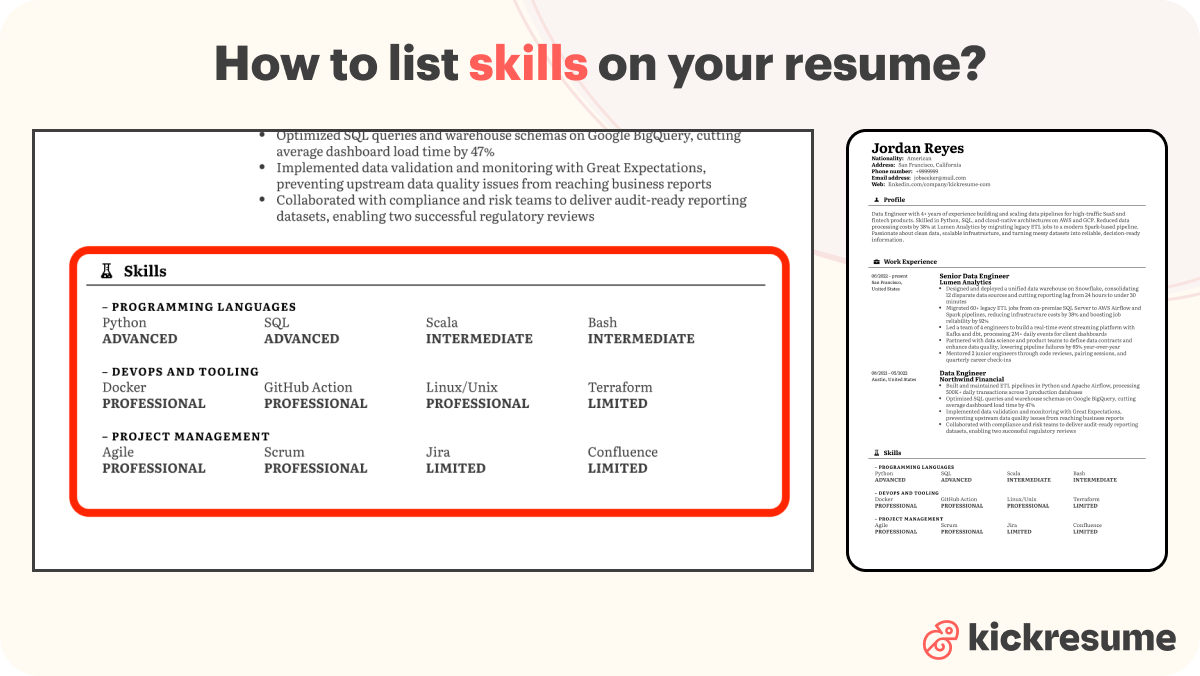
A good rule of thumb is to group your skills into logical categories. The simplest version is splitting them into hard skills and soft skills.
But if you're applying for a specific role, you can get more strategic. Try a category like "Programming Languages" that lists the ones you actually know (Python, JavaScript, SQL, whatever fits) along with your level of proficiency. The same goes for any industry-specific tools the job description calls out, whether that's Figma for design, HubSpot for marketing, or Salesforce for sales.
Here’s what a good skills section can look like:
Skills to drop from your resume
Adding the right skills only works if you also remove the wrong ones. Resumes have limited real estate, and every line that isn't earning its place is one less line working in your favor.
Here’s some skills you should avoid:
- Generic buzzwords. Words like "team player" or "problem solver" say nothing on their own. Use action verbs and let the rest of your resume actually prove you have those qualities.
- Outdated skills. Anything you haven't touched in years, like Internet Explorer, Adobe Flash, or other tools from another era. Including them quietly signals you haven't updated your resume in a long time, which is worse than just leaving the line out.
- Languages you barely speak. Stating you can "speak basic Spanish" when you only know a handful of sentences can easily backfire in an interview. and made the recruiters question your credibility.
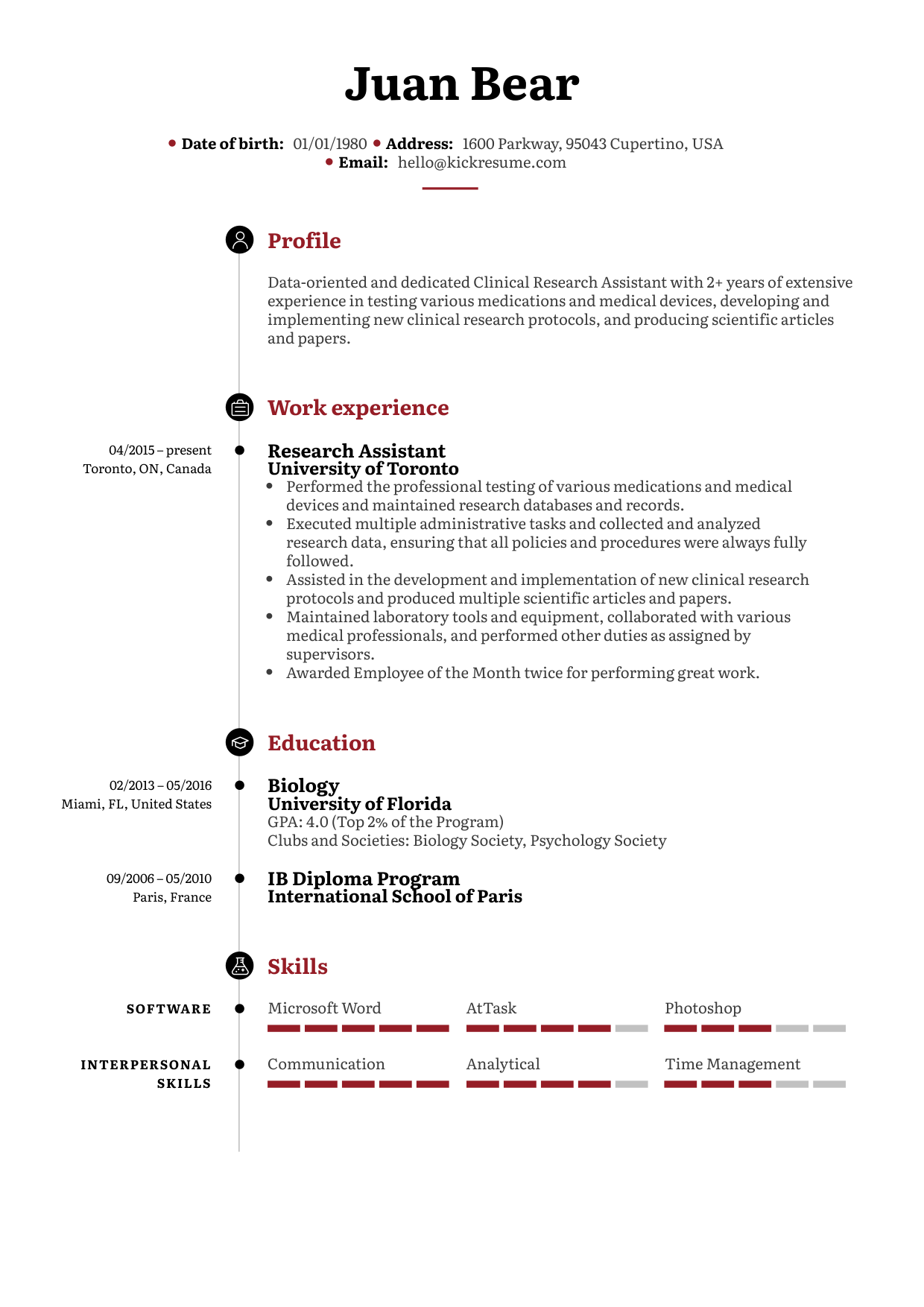
- Skill proficiency bars and ratings. The “4 out of 5” star rating systems and "Photoshop: 80%" progress bars looks modern but mean nothing to recruiters and even less to ATS scanners.
- Irrelevant skills to the job. It's cool that you can solve a Rubik's cube in under two minutes, but unless you're applying for a job at a puzzle company, it doesn't belong on your resume. Cut any skill that doesn't speak directly to the role you're aiming for.
Key Takeaways
Listing skills might seem like a pretty straightforward thing to do, but it's actually a bit more complicated. Knowing which skills recruiters are actively looking for, and which ones can give you leverage in the age of AI, can be a big plus when looking for a job.
Here are the top skills you should put on your resume:
- AI Fluency & Prompt Engineering
- Analytical Thinking
- Data Literacy
- Strategic Judgment
- AI Tool Proficiency (Named Tools)
- Leadership and Social Influence
- Workflow Automation
- Creative Thinking
- Critical Evaluation of AI Output
- Cross-Functional Communication
And while we're at it, here are some things you should avoid:
- Generic buzzwords
- Outdated skills
- Languages you barely speak
- Skill proficiency bars and ratings
- Irrelevant skills to the job
Get these right, and your resume will read as someone who's ready for where the job market is going, not stuck where it used to be. If you need a hand putting it all together, our resume builder can help you do it in minutes.


![How to Write a Professional Resume Summary? [+Examples]](https://d2xe0iugdha6pz.cloudfront.net/article-small-images/How_to_Write_a_Professional_Resume_Summary_.png)