

 ChatGPT
 Perplexity AI
 Claude
When was the last time you updated your resume? According to current market trends and requirements, upgrading your resume will significantly up your chances of landing your dream job.
All professional accomplishments and small wins from the past year—such as a promotion, a new skill, or a training workshop—should be mentioned in your CV. This way, you can stay one step ahead of your competition.
And even if it feels like not much has changed lately, there’s almost always something you can polish, improve, or remove from your resume to keep it sharp and relevant.
So let's not waste time—here are 10 tips on how to give your resume a solid makeover.
Why do you need an updated resume
Many people assume a resume is a “set it and forget it” document, but that couldn’t be further from the truth.
Your resume should grow alongside your career. Because with every year and every new job, skill, certification, or achievement, you increase your professional value.
Updating your resume regularly ensures that you're always ready for unexpected opportunities and that your application reflects your most competitive self.
Whether it's a promotion, a career change, or an exciting opening that suddenly pops up, an updated resume puts you ahead of the game. And not only that.
Updating your resume can:
-
Help you stay relevant. Industries evolve, new tools emerge, and job requirements shift faster than ever. Regularly updating your resume ensures your skills stay aligned with current trends and expectations.
-
Boost your chances of getting hired. A resume that reflects your recent achievements and ongoing growth is far more persuasive to hiring managers. It shows momentum, ambition, and relevance.
-
Reduce stress in emergencies. Better to be ready than caught off guard. Layoffs happen, and unexpected opportunities can show up out of nowhere. If your resume’s already up to date, you won’t have to panic-edit it at the worst possible time.
-
Support career pivots. When switching industries or roles, you’ll need to showcase transferable skills. Keeping your resume current helps you stay conscious of what you bring to the table.
Keeping your resume up to date is just a smart move, even if you’ve got a stable job and aren’t actively job hunting.
That said, there are a few moments when giving it a refresh becomes especially important.
Try our AI Resume Writer and have your resume ready in minutes!

When to make a resume update
Updating your resume can feel like a chore, and most people only do it when they absolutely have to.
But planning ahead and updating it regularly is a smart and strategic way to stay prepared for whatever comes your way. It keeps you relevant, helps you track your growth, and makes future updates much easier.
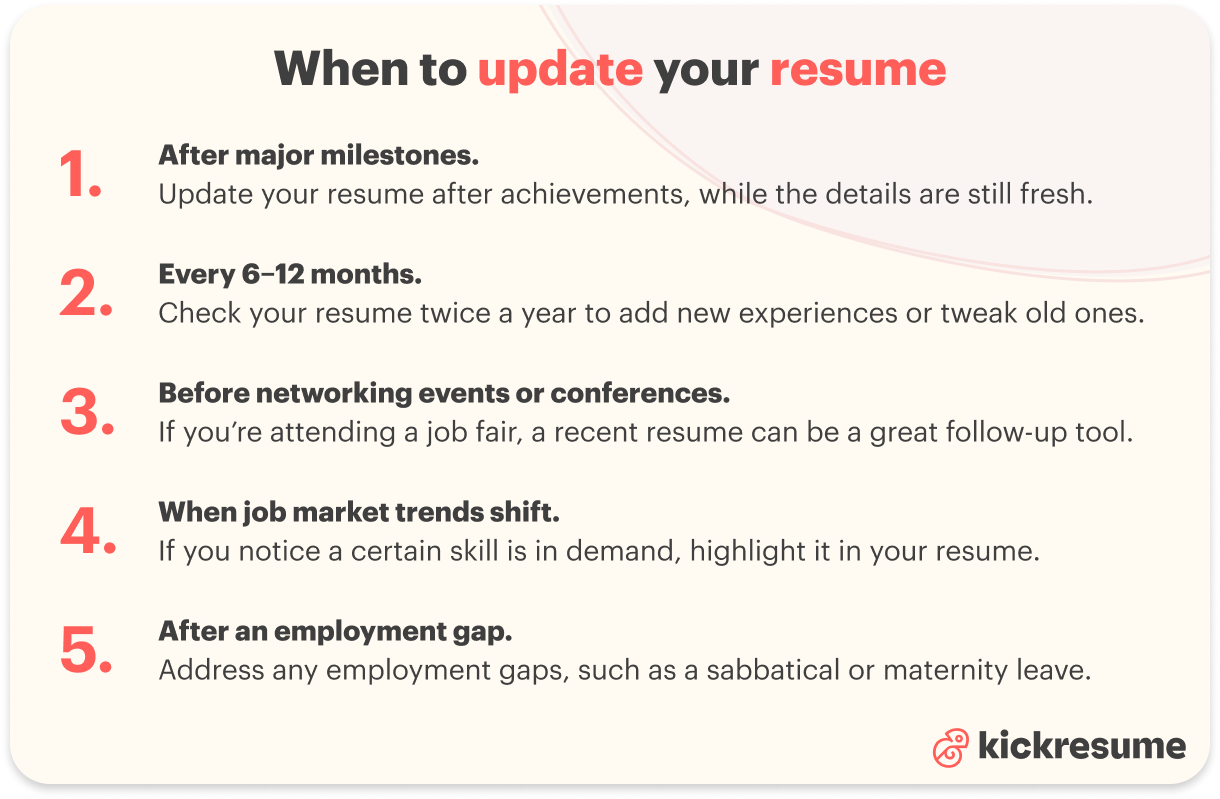
Here's when you should make resume updates:
-
After major milestones. Got a promotion? Led a project? Learned a new skill? Update your resume right after the achievement, while the details are still fresh.
-
Every 6–12 months. Set a calendar reminder. Even if you’re not job hunting, check your resume twice a year to add new experiences or tweak old ones.
-
Before networking events or conferences. If you’re meeting industry professionals or attending a job fair, a recent resume can be a great follow-up tool.
-
When job market trends shift. For example, if you notice increased demand for AI skills, remote collaboration tools, or certifications in your field, highlight your relevant experience.
-
After an employment gap. Did you take a sabbatical? Go on maternity leave? The worst thing you can do is leave it unmentioned and create a noticeable gap in your resume. During that time, you likely gained new skills and experiences that are worth including.
How to update your resume in 10 steps
It can feel tricky to mess with a resume that already works. What should you keep? What should you cut? And how do you fit it all in without making a mess of the format?
The good news is, we’ve got you covered. We’ve put together 10 simple steps to help you update your resume without stressing over what to change.
1. Do a yearly career reflection
Sometimes, it's hard to take a step back and objectively acknowledge everything that you've achieved in the past 12 months. Especially if you haven't received a promotion or you haven't changed your job.
However, once you take a look at your career from a bird's perspective, you may realize how much you've professionally grown and learned over the past year.
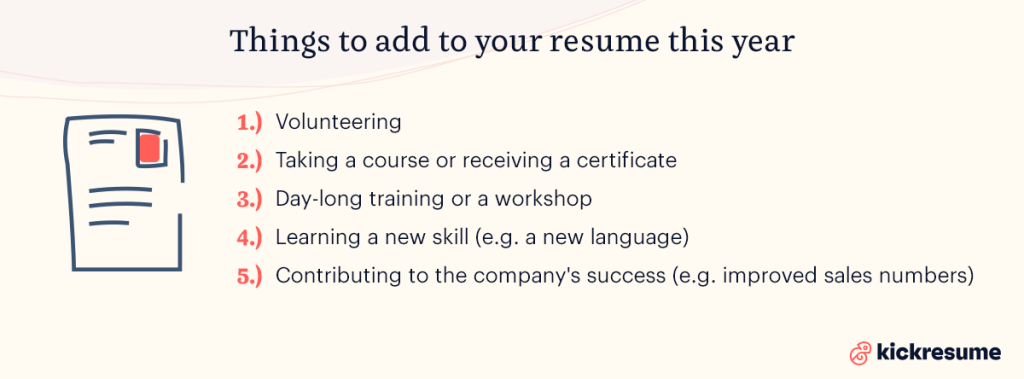
Return to your last year's calendar, scroll through it, and see if you've:
- done volunteer work
- took a course and received a certificate
- joined a day-long training or a workshop
- learned a new skill (e.g. working with software, basics of a new language, leading a project)
- contributed to the company's success (e.g., are the sales numbers better or is there an increase in visitors since you joined the team?)
If you've answered “yes” to any of these, then your resume is asking for an update. Remember, even the smallest accomplishments matter and can make a difference.
2. Know what to remove and what to keep
On the other hand, there might be some parts of your resume that you should get rid of. It's 2026, and no recruiter will be too interested in a detailed description of a task that you completed all the way back in 2005.
Why?
- Recruiters rarely look further than 15 years back unless the information is extremely impressive (e.g. degree from an excellent school) or relevant to the job they are currently hiring for. Otherwise, they're interested in your current skills and recent accomplishments.
- Resume shouldn't be too long. Including every single piece of experience might result in multiple pages of text, which can be overwhelming. The ideal resume should fit onto one or two pages. Definitely not more.
So make sure your resume focuses on your current and recent experience and excludes information irrelevant to your job search.
3. Check your keywords
On average, hiring managers take only fleeting 6.25 seconds to look at your resume before concluding whether you’re a good fit for the position. And most of that time is spent skimming through your personal information and searching for relevant keywords that match the position.
These are the keywords that recruiters usually look for:
- qualities (e.g. experienced/senior/junior)
- credentials (e.g. lawyer/certified nurse/PhD.)
- job titles (e.g. accountant/salesman/developer)
- skills (e.g. (UX/Excel/French/Java)
Moreover, nowadays, most large companies are using ATS systems to filter through dozens of applications that they receive.
Because of that, make sure you include the right keywords in your resume. You should try and use the same ones that are used in the job posting for your desired position. If you don't, there is a high chance that your resume won't even be looked at.
Luckily, checking if your resume contains the right keywords and can pass an ATS is easier than ever. Our ATS Resume Checker runs 20 different checks across key metrics, gives your resume a score, and highlights the issues that might prevent it from getting through.
4. Know what to cut out
As stated above, the key to a strong resume is to include the right words. But so is AVOIDING the bad ones.
Using irrelevant and cliché buzzwords (such as ambitious, hard-working, or goal-oriented) or lying on your resume won't get you far.
Be yourself and be authentic when writing your resume (what a cliché). You want your resume to be a true reflection of yourself and not a soulless template full of half-truths.
Fluffy jargon, clichéd phrases, exaggerations, and the overuse of vague terms are a waste of space.
Here’s a how you should NOT list your achievements:
- I am a hardworking salesman with a record of successfully closed sales
So go through your resume once more, and if some parts sound like those worn-out phrases that you’ve heard before, feel free to erase them. The easiest way to cut the empty words, talk and fluffy talk is to remove adjectives. Replace them with your accomplishments instead, and, most importantly, use action verbs.
Here’s a how you SHOULD list your achievements:
- In 2026, I have developed a method that increased the number of our company’s sales by 20%
- By doing so, I have directly facilitated the growth of our sales department
Finally, your resume is meant to be your personal profile, giving the recruiter a genuine picture of your personality and skills. It’s always better to put aside the pretense or lies and go for sincerity.
Steer clear of these pitfalls:
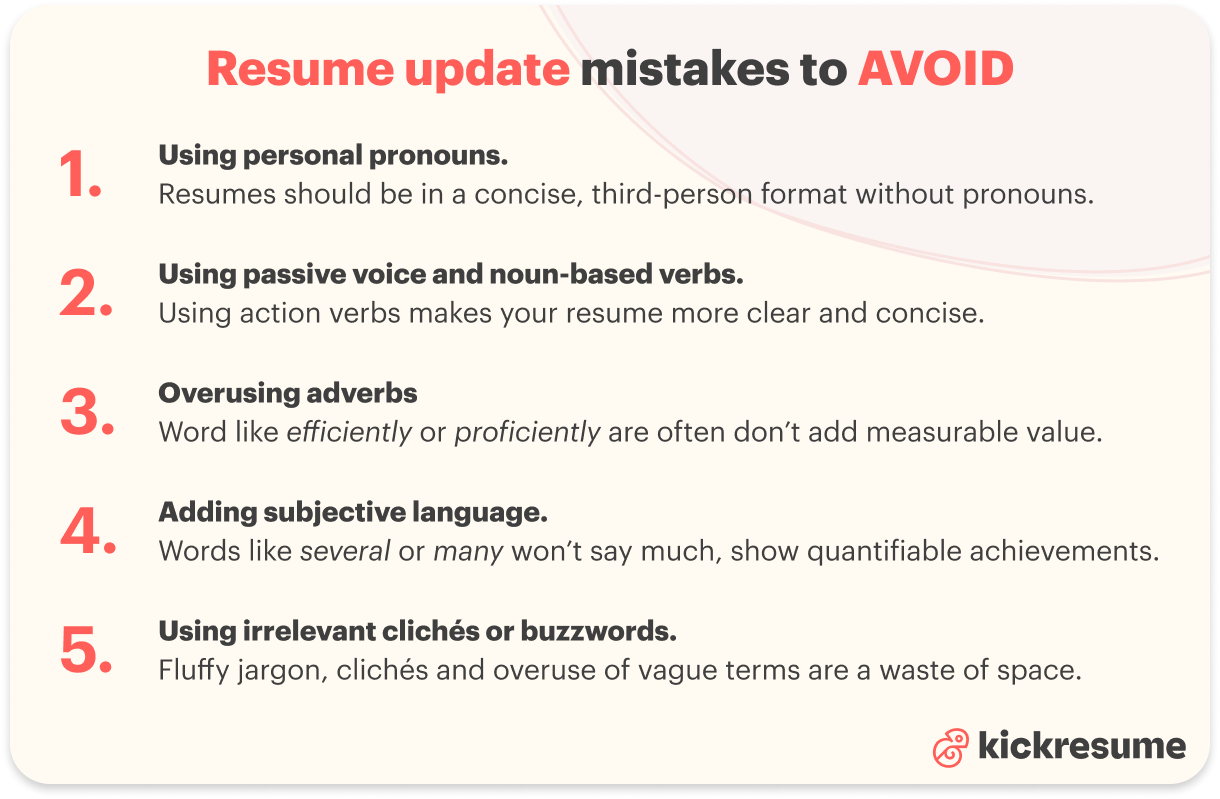
- Using personal pronouns. Llike I, my, they, their, that, our, we. Resumes should be written in a concise, third-person format without pronouns.
- Using passive voice and noun-based verbs. Action verbs make your accomplishments clearer, more direct, and easier to scan.
- Overusing adverbs. Words like efficiently, diligently, or proficiently. They’re often filler and don’t add measurable value.
- Adding subjective language. Using words like several or a high number, many won’t say anything. Be specific. Use numbers and results when possible.
- Using irrelevant clichés or buzzwords. As mentioned earlier, these won’t help. Focus on specific achievements and measurable results instead of vague terms like team player or go-getter.
5. Quantify your achievements
Speaking of quantifiable achievements and measurable results, there’s no reason to leave them off your resume. Not only do they look really professional, but they're also able to demonstrate your abilities better than a thousand words.
Just take a look at this example:
Good example of how to list your chievements
Exceeded sales goals by 25% by bringing in 40 new clients.
It does make a much more persuasive argument about one's outbound sales abilities than a statement like this one, am I right?
Bad example of how to list your chievements
An experienced sales manager with a track record of successful deals.
6. Format your resume well
Research shows that recruiters prefer resumes that have a good ratio between text and empty space. And what helps you to achieve this spatial balance are bullet points, as they are much more effective in highlighting important data compared to plain paragraphs of text.
In other words, bullet points will make your resume much more skimmable and accessible to the reader. Recruiters can grab the information quickly, and you might be identified as a good fit for the position right away (which is exactly what you want).
Finally, you should also choose the resume format that fits the needs of your career the best. These are the three most common resume formats:
-
Chronological resume. The most suitable type of resume experienced professionals. “Work experience” is the most important section of this format, so it should be placed right under the contact information. In it, you list your detailed work experiences in reverse-chronological order.
-
Functional resume. Choose this format if you’re changing careers this year. The functional format also known as a skill-based resume allows you to showcase your transferrable skills. So place the “Work experience” after the “Skills” section and make it shorter than you would in the more common chronological resume format.
-
Combination resume. The combination of the two formats above. It allows you to put the relevant information first, but the work experience section should still be quite detailed.
7. Check your contact information
While this point may seem like an easy task to complete, keeping all your contact information up to date can be tricky at times.
Once you have an existing resume, it can be tempting to just scroll below the top of the resume and jump over the contact information to pay attention to parts with more text.
However, your resume contact section is of the utmost importance, as that's the place where recruiters look once they like your profile and want to contact you. And you want to make this process as simple as possible for them.
So, have you changed your phone number or email address recently? Or have you moved? Any changes of this nature should be reflected on your professional resume asap.
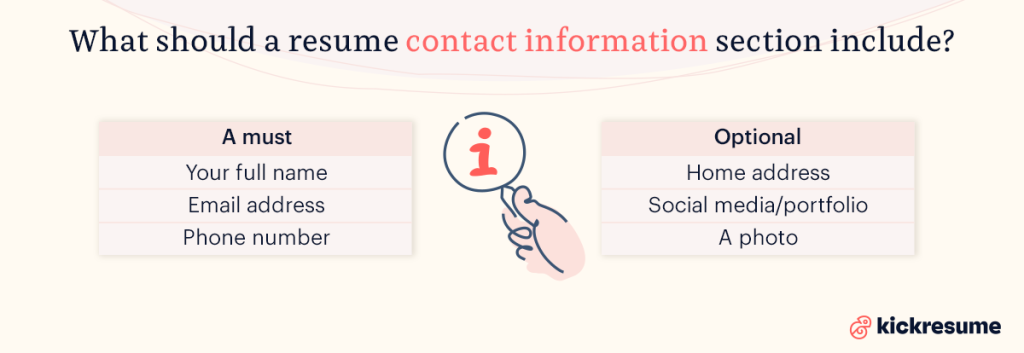
In the end, your resume contact information section should always include:
-
your full name
-
professionally sounding email address
-
phone number where you can be reached at all times
Optional parts:
-
home address (include this if you live close to your potential new job)
-
social media/LinkedIn/blog/portfolio (if relevant)
-
a photo (if its a norm in your country)
8. Focus on good resume design
First impressions matter. And when it comes to resumes, the first impressions are made visually. Strategic use of color or choosing a nice resume template can draw the attention of recruiters directly to your resume.
And it’s not only about the colors and fonts. With most companies using Applicant Tracking Systems, having an ATS-friendly design is more important than ever.
That said, bold design choices need to be used thoughtfully:
-
If you work in a creative industry or a startup, feel free to be more “out there.” Colors are very expressive, and you can showcase your personality and personal style using the design that represents you and your work the best.
-
If you're targeting a traditional or corporate role, bold colors might hurt your chances. Therefore, use a simple yet stylish resume template optimized for Applicant Tracking Systems (ATS). If you want to add color, stick to conservative shades of blue, grey, or green.
If you need to pass the ATS and you’re not sure if your resume meets the requirements, try our ATS Resume Checker. It scans your resume across more than 20 criteria, helping to maximize your ATS score.
9. Make the most out of AI
While just a few years ago you had to painfully craft the resume text all by yourself, now you don't have to as with a few carefully crafted prompts you can have a great CV in seconds.
AI seems to be taking over the world (and the job search), so make it work for you!
Whether you need a resume from scratch, tailor it to a specific profession, rewrite your content or just simply proofread and correct grammar, AI can be a great help.
Our AI Resume Writer will write the first draft of your resume for you in seconds, and all you have left to do is to edit and make sure that everything’s spot on.
Find out your resume score!

10. Tailor your resume to a specific job opening
This final tip is to be relevant at all times. But we can't repeat it enough.
Many attach the same resume to all job applications they send out. But that can really hurt your chances.
Recruiters are able to see generic resumes from miles away. Because of that, make sure that you tailor each resume that you send out based on the specific job opening.
Include the relevant keywords, highlight the most relevant experience or education, and leave out anything unnecessary.
How to update your resume when you change careers
When it comes to updating a resume, a career change is often the reason behind it.
Although these 10 steps can serve as a general guide for updating a resume, there are still a few additional things you can do as a career changer.
When changing careers, it’s not just about listing your most recent roles. It’s about rebranding your experience to speak the language of a new industry.
So if you’re pivoting into a new field, your resume needs more than a quick polish. It needs a strategic makeover.
Here’s how to update your resume when you’re making a career change:
-
Write a career summary that tells your story. A great way to explain your transition is through a strong resume summary. In 2–3 sentences, connect the dots between your past experience and your future career goals.
-
Highlight transferable skills. Don’t worry if your job titles don’t match the new field. You likely have transferable skills you can highlight and apply in your new career.
-
Reframe past job duties through a new lens. Tailor your bullet points to reflect the priorities of the industry you're entering. Remove any industry-specific jargon that may not translate well, and focus on outcomes rather than tasks.
-
Include relevant upskilling or education. Changing careers means picking up new skills. List any recent certifications, courses such as a Google certificate or LinkedIn Learning course, to show you’re bridging the gap.
-
Use a function (skill-based) resume format. If you’re short on experience, highlight your transferable skills and other achievements instead of sticking to a strict job timeline.
Final tips
Updating your resume is not something you do only when you are job hunting. It is a simple habit that keeps you ready for new opportunities and makes sure your best wins do not get forgotten.
The best time to update it is right after an achievement, when the details are still fresh.
Add what is new, remove what is outdated, make your strongest results easy to spot, and tweak a few lines so your resume matches the role you want next. That way, when a great opportunity pops up, your resume is ready, current, and one less thing to stress about.
-
Highlight experience that shows how you work today. This includes remote or hybrid work, new tools, certifications, or responsibilities that reflect how your role has evolved.
-
Build your online network. A great resume is a solid start, but why stop there? Show off your skills and professional abilities online! Platforms like LinkedIn—or Behance and Instagram if you’re in the creative industry—can help you expand your network and catch the attention of employers, partners, or clients.
-
Continuously update your resume. Relevance is key when it comes to your resume. Regular updates ensure it reflects your latest achievements and shows hiring managers that you’re actively growing in your career.
Finally, if you need more general advice about resume writing, read our full guide on how to write a resume. Or take a look at this video resume guide:
