

 ChatGPT
 Perplexity AI
 Claude
Writing a resume with no experience can feel like a daunting task. After all, you need a job to get experience, but you also need experience to get a job.
What a conundrum!
It’s a tough situation, and it’s normal to feel frustrated. But don’t lose heart.
Just because you don’t have conventional work experience, it doesn’t mean you can’t create a resume that will get you a job you want.
As a college senior, recent graduate, or entry-level applicant, your experience might naturally be a little thin. But that’s nothing to be ashamed of.
A lack of relevant experience is a common challenge for many people, especially those just starting out or looking to change their career path.
The key to writing a great no-experience resume is to get creative and find new ways to highlight the skills and qualities that make you a fantastic hire.
Want to learn how? Follow our guide to craft a resume with no work experience that will make recruiters sit up and take notice.
Choose a functional resume format
There are a few dominant resume formats in use today. They have different functions and serve different purposes.
- Chronological resume presents information in reverse chronological order, with the most recent events being placed first.
- Functional (skill-based) resume focuses on your skills, accomplishments, job traits and personal characteristics that employers expect future employees to have.
- Hybrid resume contains elements of both the chronological and functional styles of resumes by including your relevant skills and accomplishments first and then describing your employment and education in chronological order.
Most people put the events on their resumes in chronological order. They talk about the jobs they’ve held, describing the key tasks and responsibilities they’ve had and what they’ve accomplished.
But for a job seeker with little or no experience, a functional or alternatively, a hybrid resume is definitely a better option.
A functional resume format lets you highlight some sections more than others. If you don’t have much work experience, that’s totally fine, this format focuses on your transferable skills and education instead.
That’s why it’s a great choice for first-time job seekers, recent grads, career changers, or anyone without a long work history.
It also includes a resume objective instead of a resume summary. The difference?
A resume summary looks back at your past achievements, while a resume objective looks ahead. It shows where you want to go and how your skills make you a great fit for the role.
How to write a resume objective with no experience
Your resume or alternatively your resume summary, is usually the first thing a hiring manager will read.
While every resume should include one, it’s especially important when you don’t have any work experience.
A good resume summary or a resume objective helps you quickly explain who you are, what you’re looking for, and what you bring to the table.
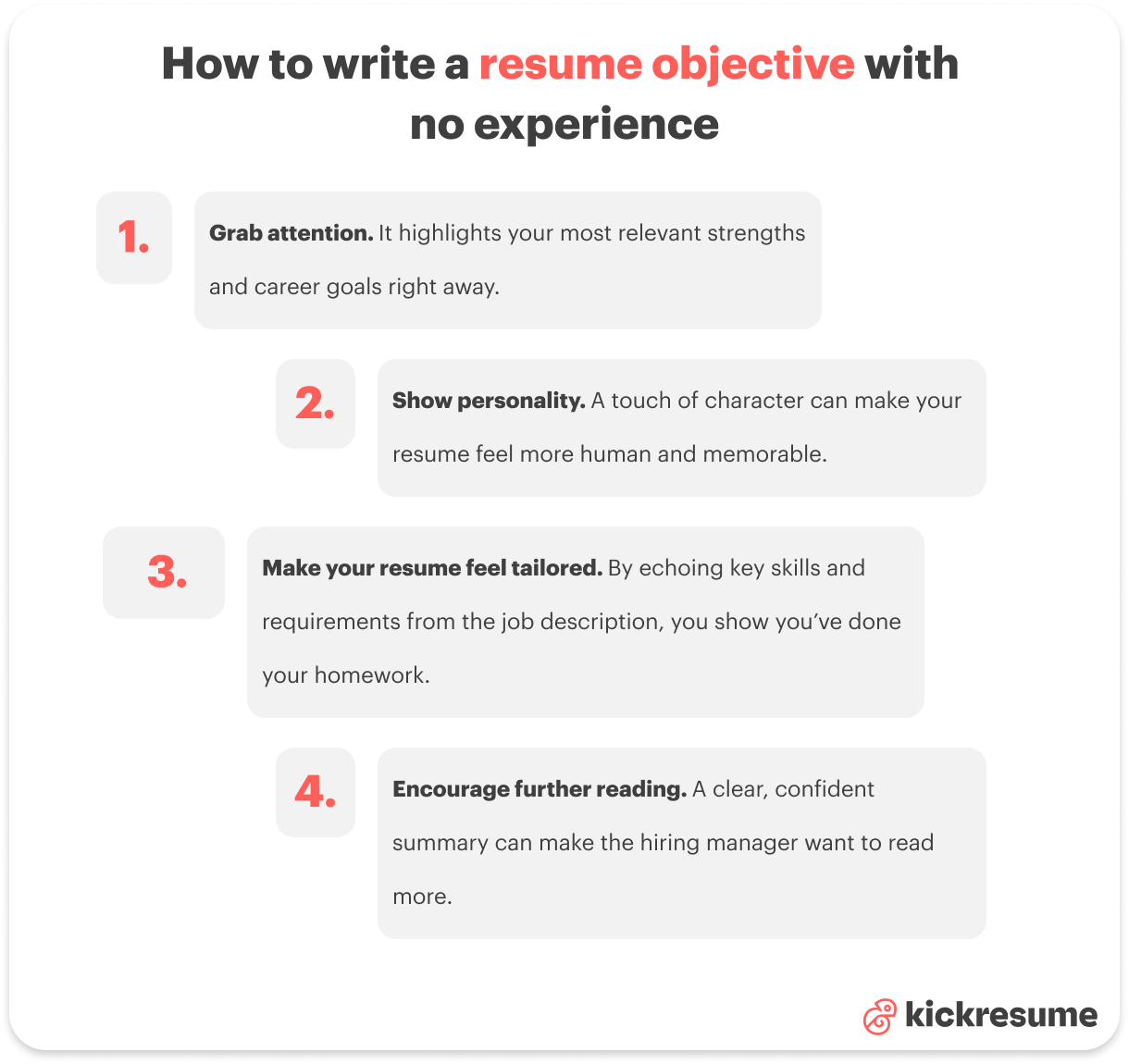
A good resume objective can:
- Grab attention. It highlights your most relevant strengths and career goals right away.
- Show personality. A touch of character can make your resume feel more human and memorable.
- Make your resume feel tailored. By echoing key skills and requirements from the job description, you show you’ve done your homework.
- Encourage further reading. A clear, confident objective can make the hiring manager want to read more.
Place your resume objective at the very top of your resume, right below your contact information. Keep it short and focused. Three or four sentences should do the trick.
Now that you know what makes a good resume objective, let’s look at some examples to see the difference between what works and what doesn’t.
Bad example of a resume objective on a resume:
“I’m a motivated individual seeking a job that will help me grow and learn new skills. I don’t have any experience yet, but I’m eager to get started and try my best. Looking for any opportunity where I can work hard and be part of a team.”
Why does it fall short?
This resume objective falls short because it’s vague and self-focused. It doesn’t mention any specific role, skills, or qualifications, and it talks more about what the candidate wants than what they can offer. The tone is too casual and lacks the professionalism and keywords that would make it relevant to a specific job.
Good example of a resume objective:
“Recent Master of Science in Finance graduate with research, time management, and problem-solving skills gained through rigorous coursework, group projects, and academic research during university studies. Experienced in managing multiple deadlines and delivering high-quality results under pressure. Seeking an opportunity to apply communication and analytical skills to support client interactions and contribute to improving project efficiency.”
Why does it work?
This resume objective is clear and specific, with a professional tone. It highlights a degree, key skills, and the type of contribution the candidate wants to make right from the start. It also uses keywords tailored to roles in finance, such as “time management,” “research,” and “communicating with clients.”
How to include skills in a resume with no experience
As mentioned earlier, choosing the right resume format is the first step to creating a strong resume when you don’t have much experience.
The right format helps you highlight what you bring to the table and allows you to focus on your education and the skills you’ve developed through school, volunteering, or extracurricular activities.
Most resumes start by listing a candidate’s most recent jobs. In your case, you’ll want to focus on your skills instead and support them with specific examples.
This section should showcase both your technical skills and transferable skills.
Start by preparing a list of your key skills along with examples of when and how you used them. By grounding each skill in a real situation, you’ll make your resume far more compelling and credible.
Think about times when you demonstrated your ability to:
- Take on responsibility
- Lead and inspire others
- Show initiative and determination
- Bridge gaps between people to promote teamwork
- Build something or solve a problem
- Improve efficiency
- Tackle a challenge in an innovative way
How to list hard and soft skills on a no-experience resume
Be specific. For example, if you’re experienced with social media, list the platforms and tools you know well. The same goes for any relevant software or programs you’ve worked with.
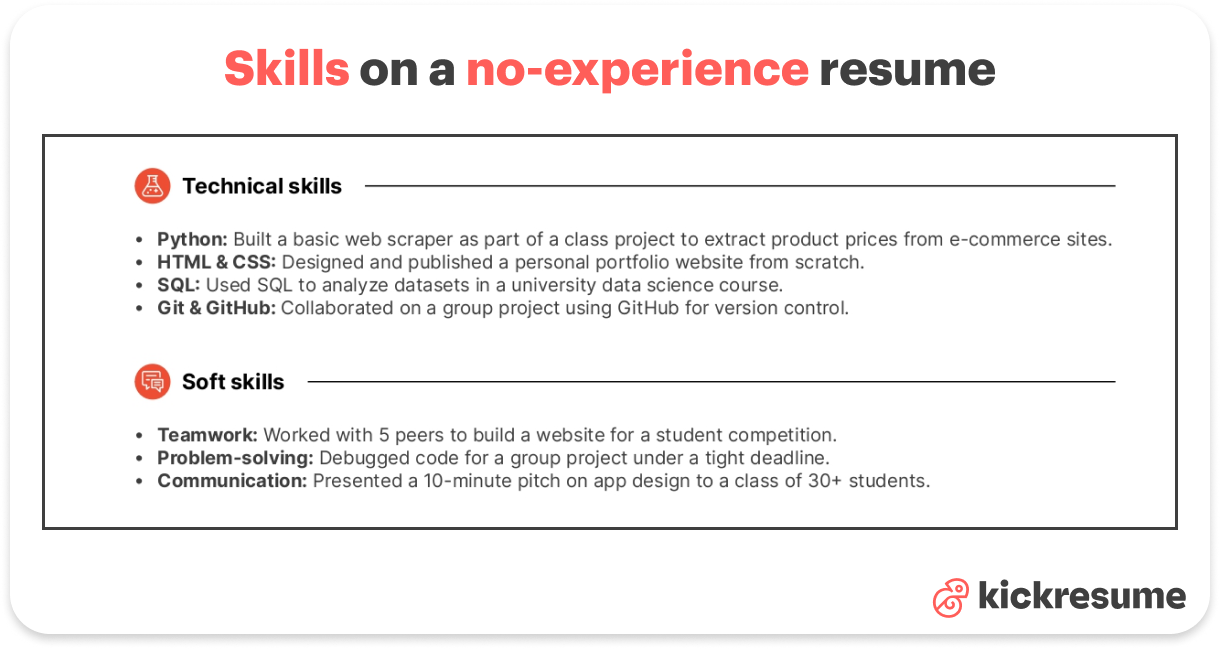
And don’t shy away from highlighting your accomplishments. For example, if you're applying for a tech role, your skills section might look like this:
Technical skills
- Python: Built a basic web scraper as part of a class project to extract product prices from e-commerce sites.
- HTML & CSS: Designed and published a personal portfolio website from scratch.
- SQL: Used SQL to analyze datasets in a university data science course.
- Git & GitHub: Collaborated on a group project using GitHub for version control.
Or if you're going for a social media or marketing role:
Digital & marketing skills
- Instagram & TikTok: Ran a themed TikTok account that reached 10K followers in 3 months by experimenting with trends and editing tools.
- Canva & Adobe Express: Created graphics and visual content for a university club’s social media pages.
- Content planning: Scheduled weekly posts using Buffer and tracked engagement with built-in analytics.
- Copywriting: Wrote captions and short-form posts optimized for engagement and brand voice.
For soft skills, be just as specific:
Soft skills
- Teamwork: Worked with 5 peers to build a website for a student competition.
- Problem-solving: Debugged code for a group project under a tight deadline.
- Communication: Presented a 10-minute pitch on app design to a class of 30+ students.
The more clearly you can show how you’ve applied your skills in real situations, the easier it is for employers to imagine you doing the same on their team.
How to include education on a resume with no experience
For students and fresh graduates, education is often the most important part of the resume. That’s why you shouldn’t hesitate to make it a priority and use it to showcase everything you've accomplished.
Play up your degree and pack your education section with details that highlight your skills, motivation, and personal qualities.
You can include things like:
- GPA or individual grades (if strong)
- Academic awards or scholarships
- Relevant coursework
- Group projects or capstone work
- Presentations or academic competitions
- Publications
- School societies or clubs
- Sports teams or leadership roles
If you’re a college graduate, you can go deeper into specialized courses or interesting projects. And even as a high school graduate, it’s worth mentioning electives you chose, why you picked them, and what you learned.
How to put education on a resume with no experience
Start with the name of the institution and the years you attended. From there, use bullet points to list your key accomplishments and anything relevant you learned during that time.
Aavoid just stating your education, simply because it doesn’t say much, won’t work in your favor, and misses the chance to show that even without work experience, you still have something valuable to offer.
Bad example of an education section on a resume with no experience:
University of Amsterdam
B.A. in Communication and Media
2019 – 2023
When creating a strong resume with no experience, it's important to make the most of your education. Don’t be afraid to treat it like a work experience section, especially if you’re a student or recent graduate.
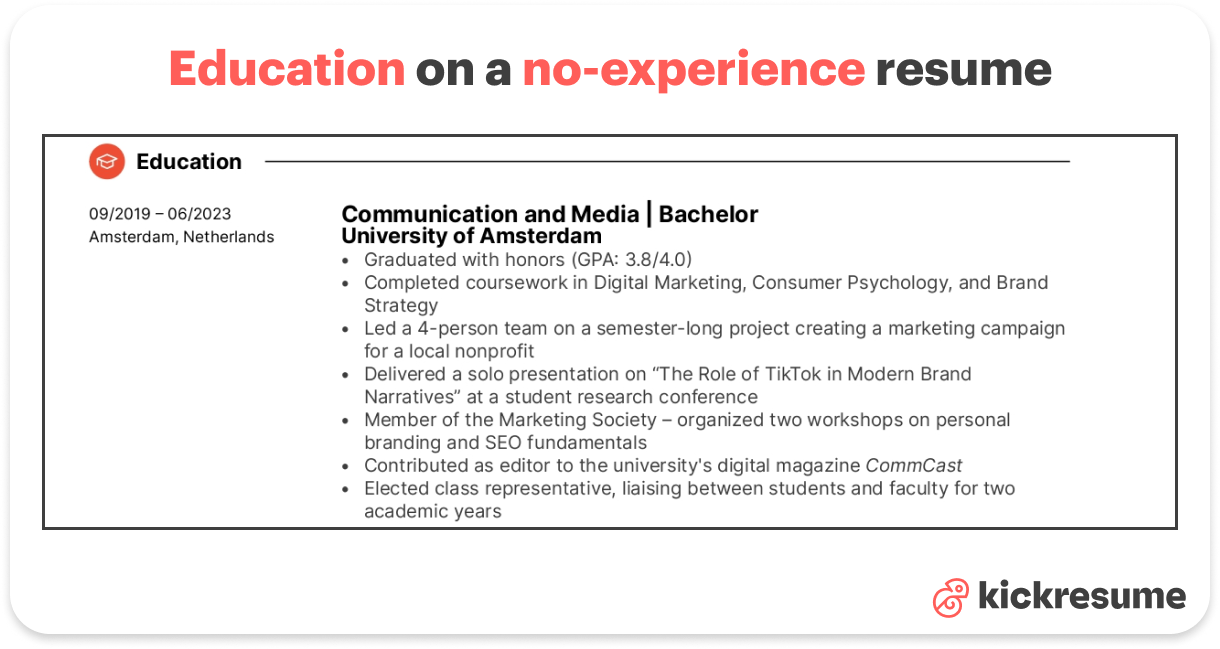
A good example of an education section on a resume with no experience:
University of Amsterdam
B.A. in Communication and Media
2019 – 2023
- Graduated with honors (GPA: 3.8/4.0)
- Completed coursework in Digital Marketing, Consumer Psychology, and Brand Strategy
- Led a 4-person team on a semester-long project creating a marketing campaign for a local nonprofit
- Delivered a solo presentation on “The Role of TikTok in Modern Brand Narratives” at a student research conference
- Member of the Marketing Society – organized two workshops on personal branding and SEO fundamentals
- Contributed as editor to the university's digital magazine CommCast
- Elected class representative, liaising between students and faculty for two academic years
When done right, your education section can speak volumes about who you are and where you're headed. Lean into your strengths, be specific, and make your education work for you.
Achievements to include on a resume with no experience
Adding an achievements section is a handy way to showcase awards or special accomplishments, and it can work as an extension of your education section if you need to round out your resume.
Start by making a list of everything you’ve done that you are really proud of. From that list, you’ll be able to narrow down things to include on your resume.
The thing is that different achievements might be relevant to different jobs you’ll be applying for. So it’s very useful to keep a full list and pick only the most relevant ones when the time comes.
Did you organize an on-campus event, present a paper at a conference, volunteer for a good cause, or write an article for the school magazine?
These are kinds of accomplishments that deserve a place in the achievements section of your resume.
Achievemenets on a resume example:
- Graduated top 5% of class in Finance, GPA 3.9/4.0.
- Organized student conference with 300+ attendees and 5 guest speakers.
- Completed Google Data Analytics Certificate with distinction.
- Raised €5,000 for local NGO through student-led charity campaign.
Treat your internships and extracurricular activities as work experience
As mentioned earlier, you can treat your other experiences the same way you would treat work experience on a traditional resume.
Even if you haven’t held a formal job yet, you want to show the recruiter that you’ve gained valuable experience elsewhere.
In addition to highlighting your education, you can present internships, volunteering, student organizations, freelance work, or even personal projects as part of your “Experience” section.
Format them just like you would a job. Include your role, the organization, dates, and a few bullet points showing what you did and what you learned.
Try our AI Resume Writer and have your resume ready in minutes!

Internships
Paid and unpaid college internships are one of the best weapons against the “experience required” line in a job posting.
Use this unique opportunity to gain some relevant work experience. An internship is also a place where you can network and make connections that you will use later during your job search.
Here’s how you can list internships on your resume:
Internships on a resume example:
Marketing intern
GreenSpark Renewable Energy | June 2024 – August 2024
- Created and scheduled social media content using Canva and Buffer, boosting engagement by 35%
- Conducted competitor analysis with Google Sheets and presented insights weekly via Google Slides
- Assisted in organizing a local outreach event, managing registrations through Eventbrite
Volunteering
Most recruiters look at volunteer experience similarly to paid work experience. In other words, just because you didn’t get paid doesn’t mean you didn’t do a good job.
Go ahead and list your volunteer roles as you would a full-time job. Detail the length of time you volunteered, relevant tasks you undertook, and the skills you gained through the experience.
Here’s how you can list volunteering on your resume:
Volunteering on a resume example:
Volunteer event coordinator Red Cross Blood Drive | February 2023 – May 2023
- Managed event planning and communication using Trello and Slack for a team of 10 volunteers
- Designed promotional flyers in Canva and ran an Instagram campaign that reached over 1,000 students
- Maintained donor sign-up and attendance records using Excel
Whether you organized events, led a team, or simply showed up consistently, it says something about your character. So treat your volunteer work like the real experience it is. Done right, it can carry just as much weight as any job experience.
Extracurricular activities
You’ll often find your extracurricular roles very similar to regular jobs.
If you’re applying for a copywriting job, for example, recruiters will be more impressed to hear that you wrote a handful of articles for your student newspaper than that you had a summer job in a local fast food restaurant.
You can either create a separate section called “Projects” where you list and briefly describe what you did.
Here’s how you can list extracurricular activities on your resume:
Extracurricular activities on resume example:
Staff writer
The Campus Herald, University Student Newspaper | September 2023 – Present
- Wrote and edited 15+ articles in Google Docs, following AP style guidelines
- Used Notion to organize editorial calendars and collaborate with the editorial team
- Conducted interviews and transcribed audio using Otter.ai, improving article turnaround time
Hobbies and interests to put on a no-experience resume
Hobbies and interests are another clever way to bring your personality into your resume and make it more engaging, while also creating an opportunity to showcase your skills and help your resume stand out.
The principle behind crafting a strong no-experience resume is the same as in any other section: be specific. Don’t just list your hobbies and interests, take it a step further and highlight what you’ve learned or accomplished through them.
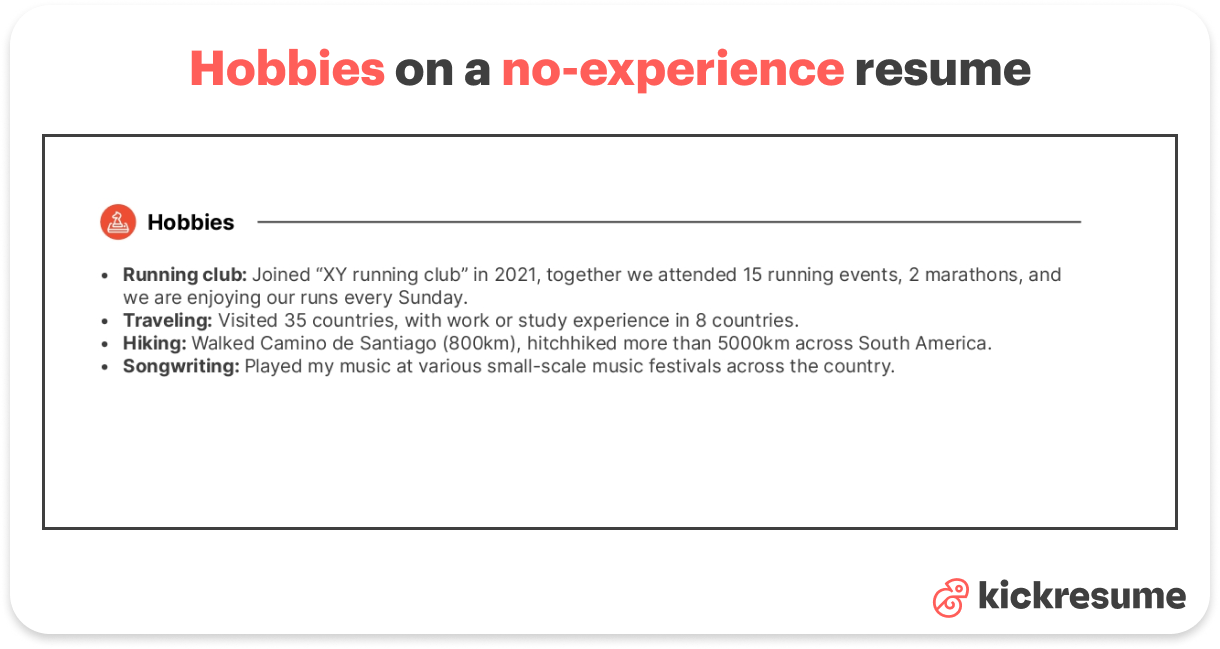
Here’s how listing hobbies and interests on a no-experience resume might look:
How to put hobbies on your resume:
- Running club: Joined “XY running club” in 2021, together we attended 15 running events, 2 marathons, and we are enjoying our runs every Sunday.
- Traveling: Visited 35 countries, with work or study experience in 8 countries.
- Hiking: Walked Camino de Santiago (800km), hitchhiked more than 5000km across South America.
- Songwriting: Played my music at various small-scale music festivals across the country.
If your resume lacks traditional work history, these personal passions amd hobbies can help paint a fuller picture of who you are and what you’re capable of. Don’t underestimate them, they might just be the thing that sparks a connection with the person reading your resume.
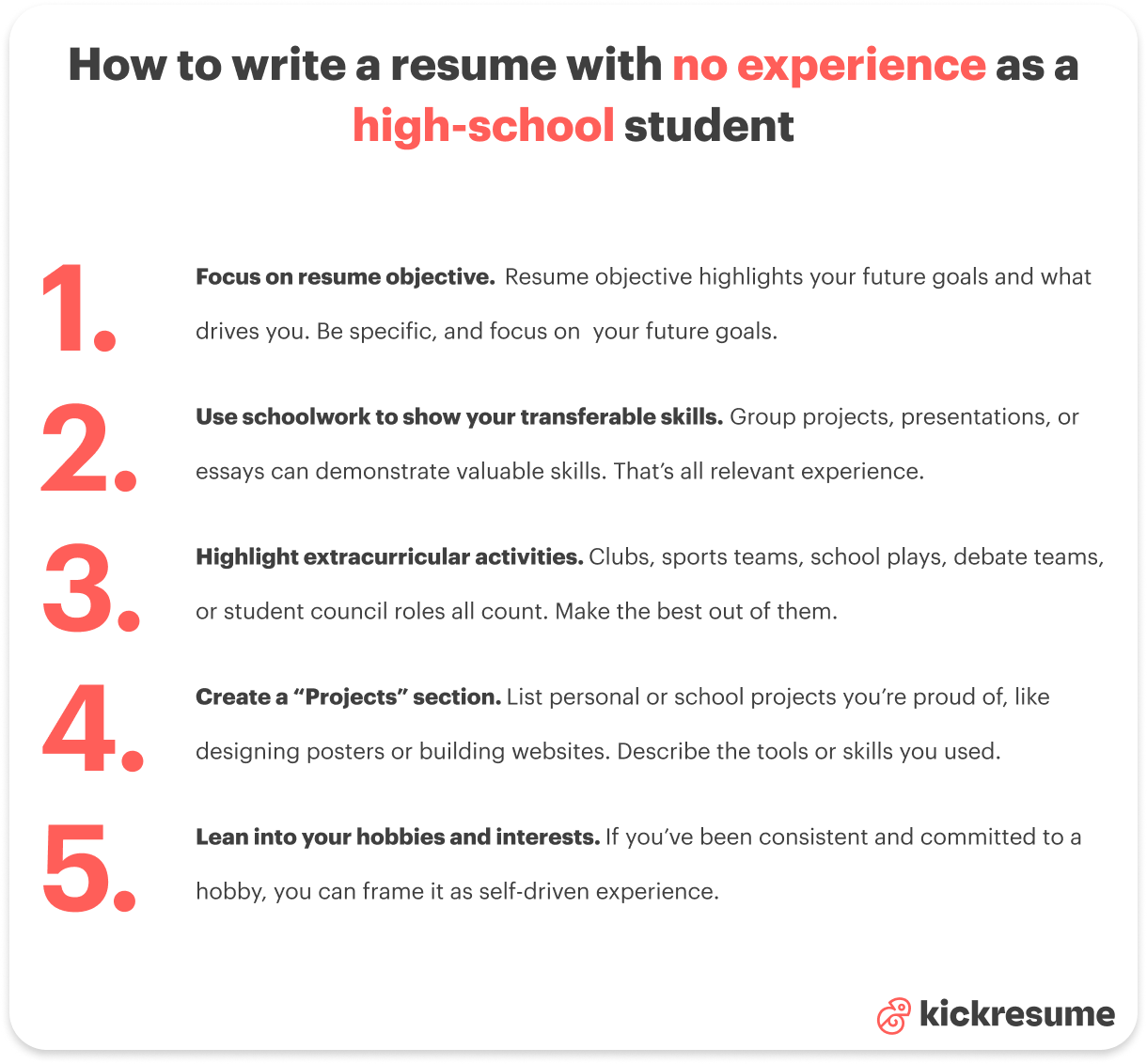
How to write a resume with no resume experience as a high-school student
Having no work experience is one thing, but coming straight out of high school can feel especially intimidating because you truly have no experience to lean on.
But don’t worry, we still have a few valuable tips to help you craft a strong resume, even if you’re fresh out of high school and looking for your first job.
- Focus on resume objective. resume objective highlights your future goals and what drives you. Be specific, and let your personality shine, even if it means writing a slightly longer sentence or two.
- Use schoolwork to show your transferable skills. Group projects, presentations, or essays can demonstrate skills like teamwork, communication, or research. Did you lead a team during a science fair? Present something to your class? That’s all relevant experience.
- Highlight extracurricular activities. Clubs, sports teams, school plays, debate teams, or student council roles all count. Even organizing a school event or helping with a fundraiser shows initiative and leadership.
- Create a “Projects” section. List personal or school projects you’re proud of. For example: building a website for a class, designing posters for an event, writing a short story collection. Just be sure to describe the tools or skills you used.
- Lean into your hobbies and interests. If you’ve been consistent and committed to a hobby (like editing videos, playing an instrument, or running a social media account), you can frame it as a self-driven experience.
The key is to be specific about what you did, what you learned, or any results achieved. Don’t be afraid to be creative, even small experiences can say a lot about what you’re capable of.
What to avoid when writing a resume with no experience
Although a no-experience resume requires creativity and making the most of all your experiences, there are still a few things you should avoid.
Stay away from including these things on your resume:
- Unrelated work experience or hobbies. They clutter your resume and distract from your relevant qualifications.
- Photographs. Although this can be debated and often depends on the country and industry you are applying to, in most cases these details are unnecessary and can lead to unconscious bias.
- Unprofessional email address. It makes you seem less serious or immature (e.g. use firstname.lastname@gmail.com instead of cooldude420@xyz.com).
- Sensitive personal details (age, date of birth, race, sex, religion, political views, etc.) These have no bearing on your ability to do the job and may open the door to discrimination.
- Buzzwords and clichés. Adding buzzwords like "team player" or "hard worker" can make your resume feel vague. Focus on showing results instead.
- Negative language. It will make a bad impression, making you look unprofessional and could hurt your chances of getting hired.
- Putting these things on your resume will either waste valuable space, offer nothing relevant to the recruiter, or—at worst—hurt your chances of landing the job.
Find out your resume score!

Final resume tips for students and first-time job seekers
So yes, writing a resume with no formal experience might feel like a challenge, but it’s far from impossible. Here are a few more tips to help you make a great no-experience resume.
- Add your personality. If you want your resume to stand out, add something memorable. Ran a marathon? Do you know all the birds by name? Skydived in the Alps? That’s resume-worthy, you can create a hobbies and interests section.
- Stay professional (even if you’re not one yet). Take the time to proofread your resume before sending it. Typos, grammar mistakes, or dull phrasing can ruin your first impression. Use action verbs and powerful adjectives to keep it engaging.
- Tailor your resume for each job you apply to. Don’t send the same resume everywhere. Swap out irrelevant skills or academic achievements for ones that match the job description. Recruiters notice when you've made the effort.
- Remember that fortune favors the prepared. Be ready to talk about your skills with confidence, control your body language in interviews, and negotiate your salary. There’s no shortcut to experience, but going the extra mile puts you ahead.
With a resume with no experience, the key is to get creative, be specific, and treat every part of your background as a chance to show what you can do.
From your education and skills to your hobbies and side projects, everything counts when presented the right way.

