Having children doesn’t just reshape daily routines. It can also influence long-term career decisions — from ambition and leadership goals to the opportunities parents choose to accept or decline.
To explore this topic further, Kickresume surveyed 1,022 respondents globally as part of its Parenthood & Productivity Survey.
While the survey included both parents and non-parents, this article focuses specifically on parents and how having children changed their career ambitions, whether they turned down professional opportunities, what drives work-related stress, and how supported they feel in the workplace.
Here’s a snapshot of the key findings:
- 35% of parents say they aim for a leadership role sooner after having children, while 29% shift toward less demanding roles. 32% report no change.
- Gen Z parents are the most ambitious: 60% say they aim for leadership sooner — the highest share across generations.
- 55% of parents have turned down a career opportunity due to parenting responsibilities. Again, among Gen Z parents, that number rises to 81%.
- 40% of mothers aim for a less demanding role, compared to 24% of fathers. And 65% of mothers report turning down opportunities (vs. 51% of fathers).
- Scheduling conflicts (27%) and lack of sleep (25%) are the most common sources of work-related stress.
- Remote or hybrid work is the most valued type of workplace support for parents (40%).
- 75% of parents feel at least somewhat supported by their workplace, though women are less likely to feel fully supported (24% vs. 36% of men).
Career ambition doesn’t decline after children — it splits, and Gen Z drives the acceleration
One of the common assumptions about parenthood and work is that ambition declines. The data suggests that reality is more complex.
In fact, 35% of parents say they now aim for a leadership role sooner. At the same time, 29% say they aim for a less demanding role.
Another 32% report no change in career goals, and only 4% say they have quit or plan to quit because of parenting.
Here’s a full breakdown:
- Yes, I aim for a leadership role sooner: 35%
- Yes, I aim for a less demanding role: 29%
- No, career goals are the same: 32%
- Yes, I quit or plan to quit because of parenting: 4%
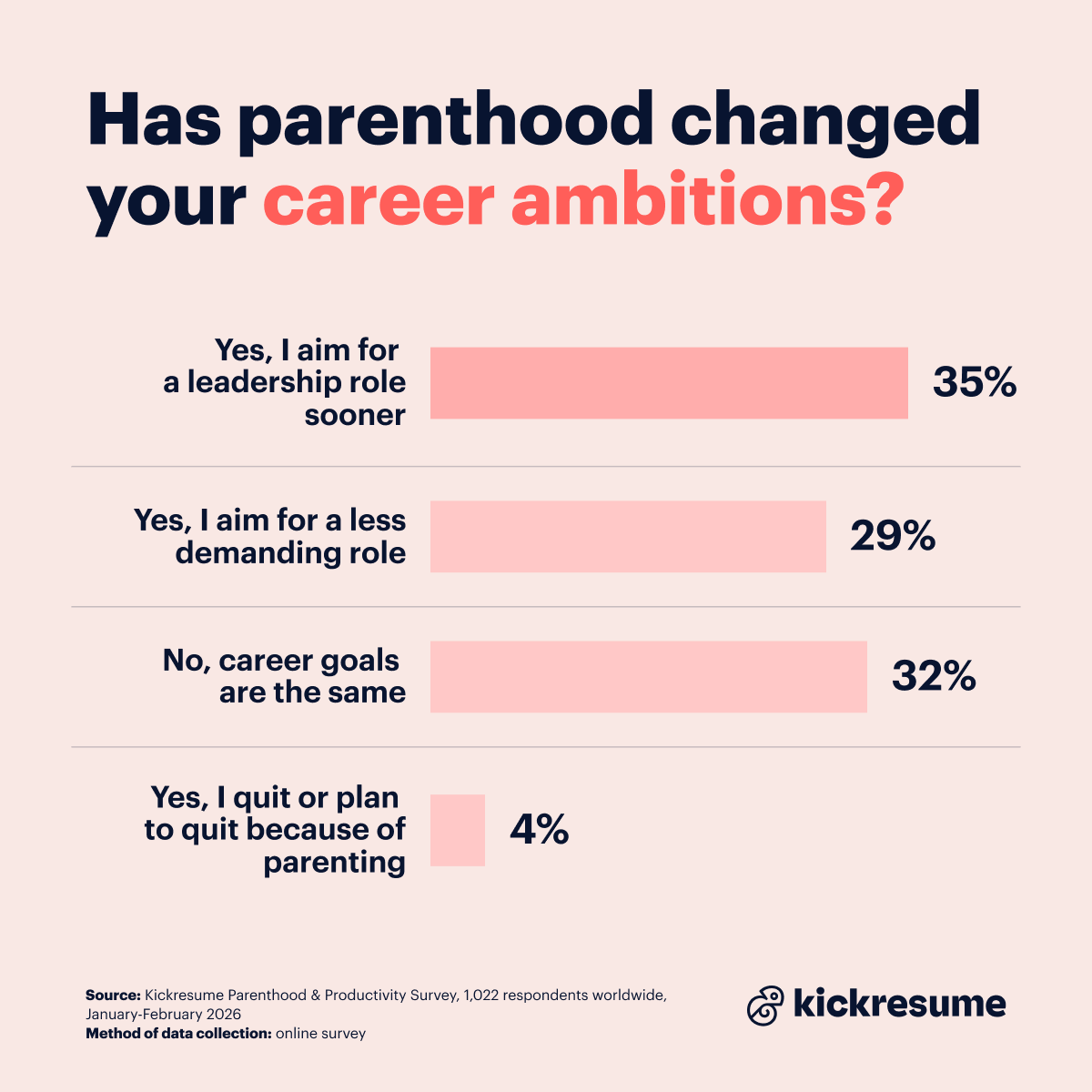
In other words, parenthood is almost as likely to intensify ambition as it is to soften it — but for roughly a third of parents, career direction stays stable.
The sharpest contrast appears across generations. Among Gen Z parents, 60% say they aim for a leadership role sooner — nearly double the global average and more than twice the share among Gen X (26%). Only 19% of Gen Z parents say they prefer a less demanding role.
Millennials fall closer to the overall average, with 38% aiming higher and 27% preferring a less demanding role.
Gen X parents show the opposite tilt. Just 26% aim for leadership sooner, while 33% shift toward a less demanding role — the highest share across generations.
This likely reflects the career stage. Gen Z parents are earlier in their careers, where income growth and advancement perhaps feel more urgent. Millennials appear to balance growth with sustainability, while Gen X parents — often further along in their careers — are more likely to prioritize stability.
Gen Z parents stand out clearly: they are the most acceleration-driven generation in the survey.
.png)
Regional contrasts are equally striking:
- In Asia, 55% of parents say they aim for leadership sooner — the highest share globally — while only 19% aim for a less demanding role.
- In both the USA and Europe, the balance shifts toward downscaling: just 23–25% aim higher, while 35% in both regions say they prefer a less demanding role.
Gender differences also emerge in how ambition shifts after children — a pattern explored in more detail later in this report.
Taken together, the data suggests that parenthood doesn’t automatically shrink ambition. It reshapes it — sometimes upward, sometimes toward stability, and sometimes it stays the same.
More than half of parents have turned down a career opportunity — and Gen Z does so most often
Career ambition is one thing. Real-life trade-offs are another.
When asked whether parents had ever turned down a work opportunity — such as a promotion, new role, or project — because of parenting responsibilities, 55% of parents said yes — at least rarely. 45% say they have never done so.
Here’s the full breakdown:
- 11% say they have done so frequently
- 24% occasionally
- 20% rarely
- 45% say never
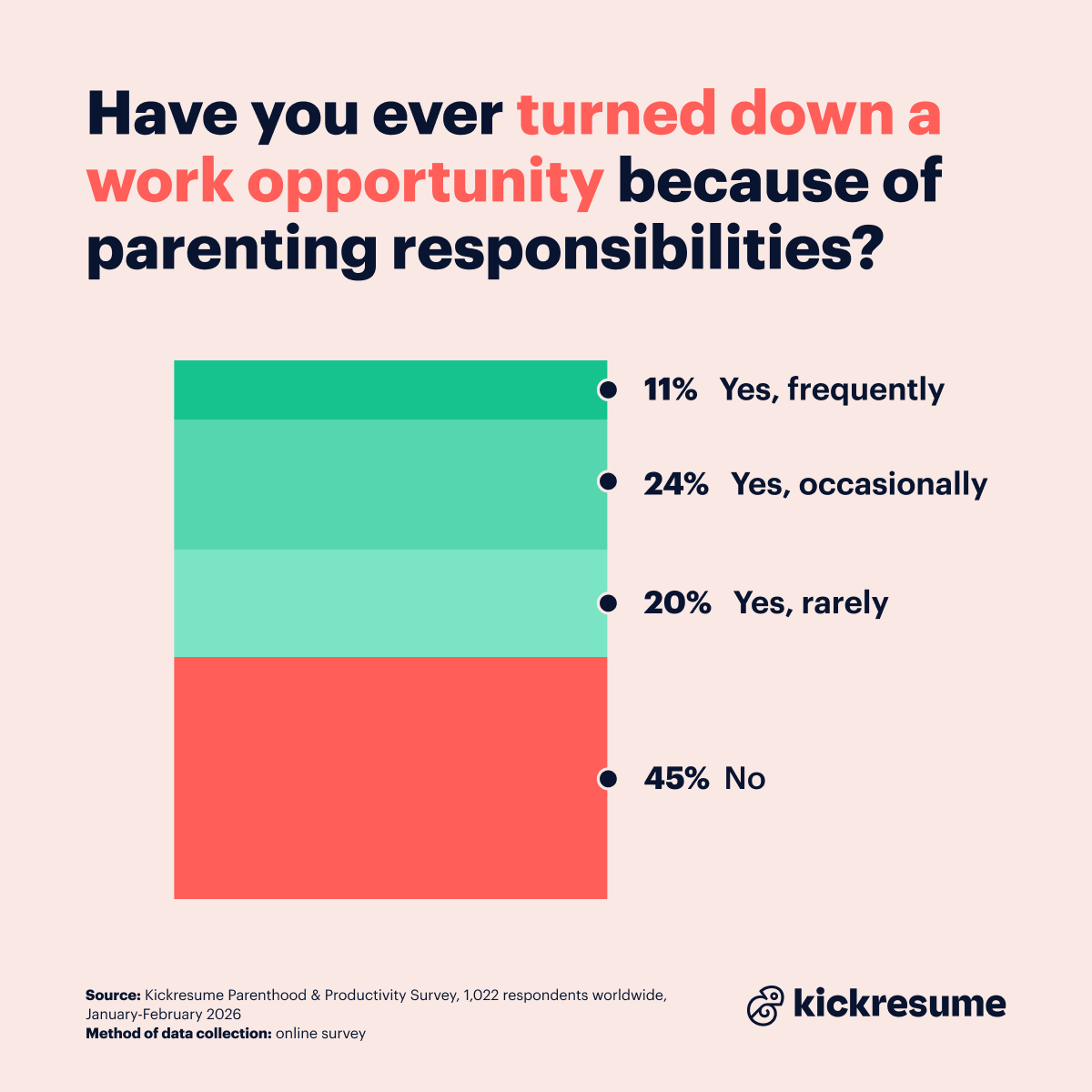
In other words, declining an opportunity isn’t an exception. For many parents, it’s part of the experience.
The generational contrast is particularly sharp. Among Gen Z parents, only 19% say they have never turned down an opportunity. That means 81% have done so at least rarely — including 22% who do so frequently.
Millennials and Gen X show a very different pattern. Nearly half of Millennials (48%) and 44% of Gen X say they have never turned down an opportunity. This suggests that younger parents face more immediate trade-offs — possibly due to earlier phases of parenthood — a period often marked by sleep disruption and tighter daily constraints.
.png)
Viewed alongside the ambition data, the generational pattern becomes even more striking. Gen Z parents combine the strongest leadership ambition (60%) with the highest rate of declining opportunities (81%). They are the most acceleration-driven — and the most likely to say no.
This suggests that long-term ambition and short-term constraints can coexist. For younger parents in particular, leadership goals remain high — even as day-to-day trade-offs increase.
Regional contrasts are also visible but more moderate:
- In the USA, only 41% say they have never turned down an opportunity, meaning 59% have done so at least once — the highest share across regions.
- In Europe and Asia, about 47–48% say they have never declined an opportunity, indicating slightly fewer reported trade-offs than in the USA.
Taken together, the data shows that career trade-offs after children are not rare — particularly among younger parents. But age is not the only dividing line.
Parenthood affects working mothers and fathers differently
Beyond generational differences, a consistent gender divide runs through the survey.
In terms of ambition, 40% of men say they aim for leadership sooner, compared to 24% who prefer a less demanding role. Among women, the pattern reverses: 40% aim for a less demanding role, while 23% aim for leadership sooner. Women are also more likely to say they have quit or plan to quit because of parenting (7% vs 3% of men).
The split also extends to career decisions. Nearly 2 in 3 mothers (65%) report turning down at least one professional opportunity due to parenting responsibilities, compared to 51% of fathers. Women are also more likely to say they do so occasionally (31% vs 21%).
Workplace support perceptions follow a similar pattern. Only 24% of women say they feel fully supported at work, compared to 36% of men.
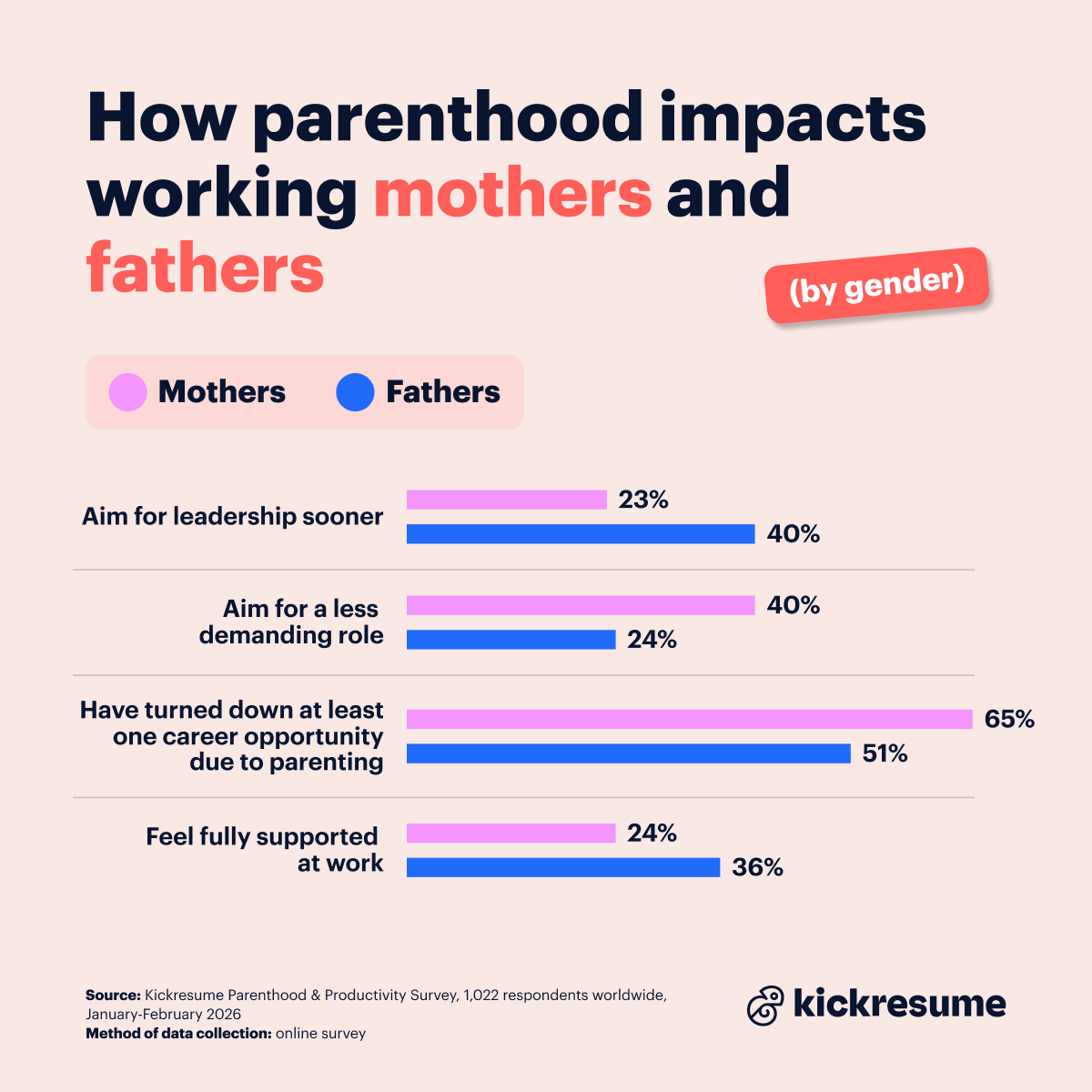
All in all, for women, parenthood often means saying no, scaling back, and navigating less support. While men’s careers are affected too, the changes are smaller and less visible.
Work-related stress is mostly driven by time pressure, not childcare costs
Work-related stress after having children isn’t dominated by one single factor. Three things cluster tightly at the top:
- 27% say scheduling conflicts
- 25% say lack of sleep
- 25% cite emotional demands or worries
- 13% point to childcare costs
- 7% report no negative impact
- 3% say other
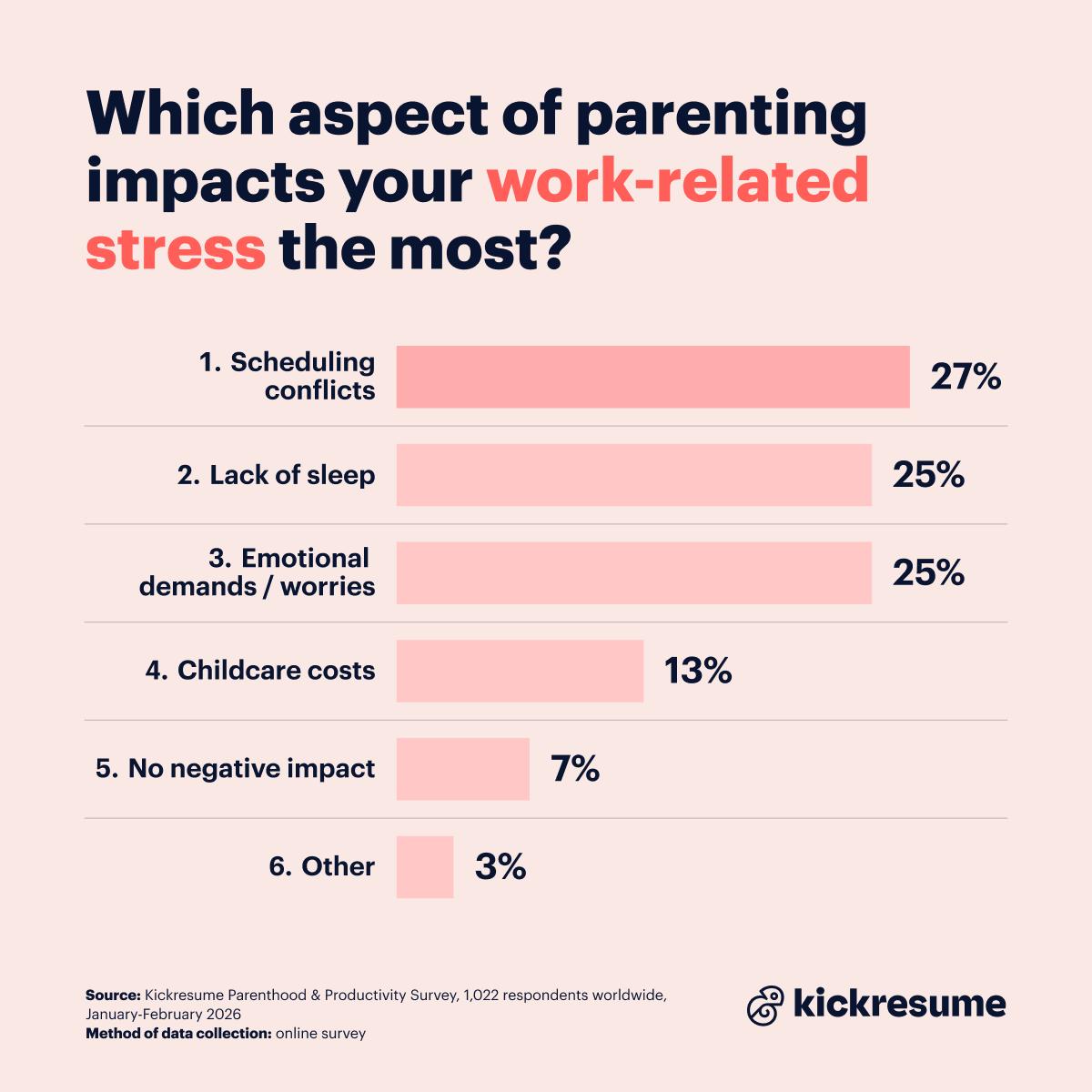
In other words, daily logistics and exhaustion outweigh financial strain for most parents. Childcare costs, while significant, rank far below time-related pressures.
The regional split shifts the pattern a bit. In the USA and Europe, scheduling conflicts clearly lead (36% in the USA, 34% in Europe). In Asia, the pattern flips: 37% cite lack of sleep, while only 15% point to scheduling conflicts.
Age amplifies that contrast. Among Gen Z parents, 35% say lack of sleep — more than any other group. Gen X parents show the opposite pattern: just 16% cite sleep, while 34% cite scheduling conflicts. Millennials fall between the two. 29% report lack of sleep, 24% scheduling conflicts, and 25% emotional demands — closely mirroring the global average.
The contrast likely reflects the age of children. Younger parents may be more affected by sleep disruption, while older parents face more complex calendar coordination.
Gender differences are less dramatic but still visible. Women are more likely to cite emotional demands (29% vs 23% of men). Men are slightly more likely to say parenting has no negative impact (8% vs 4%).
Taken together, the data suggests that post-parenthood stress is not primarily financial. It is largely structural — driven by limited time, fragmented energy, and competing demands on attention.
If time pressure and energy constraints are the primary stressors, the question becomes what kind of workplace support actually helps alleviate them.
Remote work matters more than policies — flexibility tops the list for working parents
When asked which types of workplace support matter most to them as working parents, flexibility clearly outranked formal policies or financial benefits.
Here’s the full breakdown:
- Remote or hybrid work options: 40%
- Flexible working hours: 25%
- Supportive and understanding management: 19%
- Realistic workloads and fewer last-minute demands: 7%
- Childcare support or financial benefits: 6%
- Clear parental leave and family-related policies: 3%

In other words, structural flexibility matters more than formal documentation. Parents prioritize control over when and where they work above financial or policy-based benefits.
Gender differences stand out. Among women, 47% identify remote or hybrid work as the most important form of support — compared to 36% of men. Men place slightly more emphasis on flexible hours (28% vs. 20%).
The data suggests that location flexibility may be particularly important for mothers, potentially reflecting differences in caregiving responsibilities or daily logistics.
Regional contrasts reinforce the pattern:
- In Europe, 47% of parents prioritize remote or hybrid work — the highest share globally.
- In the USA and Asia, remote work still leads (37% in both regions), but supportive management and flexible hours play a somewhat larger role.
Taken together, the findings show that working parents are not primarily asking for new policies. They are asking for flexibility — in time and location. But do workplaces deliver it?
Most parents feel supported — but full support is not evenly experienced
Flexibility may top the list of priorities — but perceived support tells a more nuanced story.
Overall, 32% of parents say they feel fully supported by their workplace. Another 43% say they feel somewhat supported.
Additionally:
- 19% say not really
- 6% say not at all
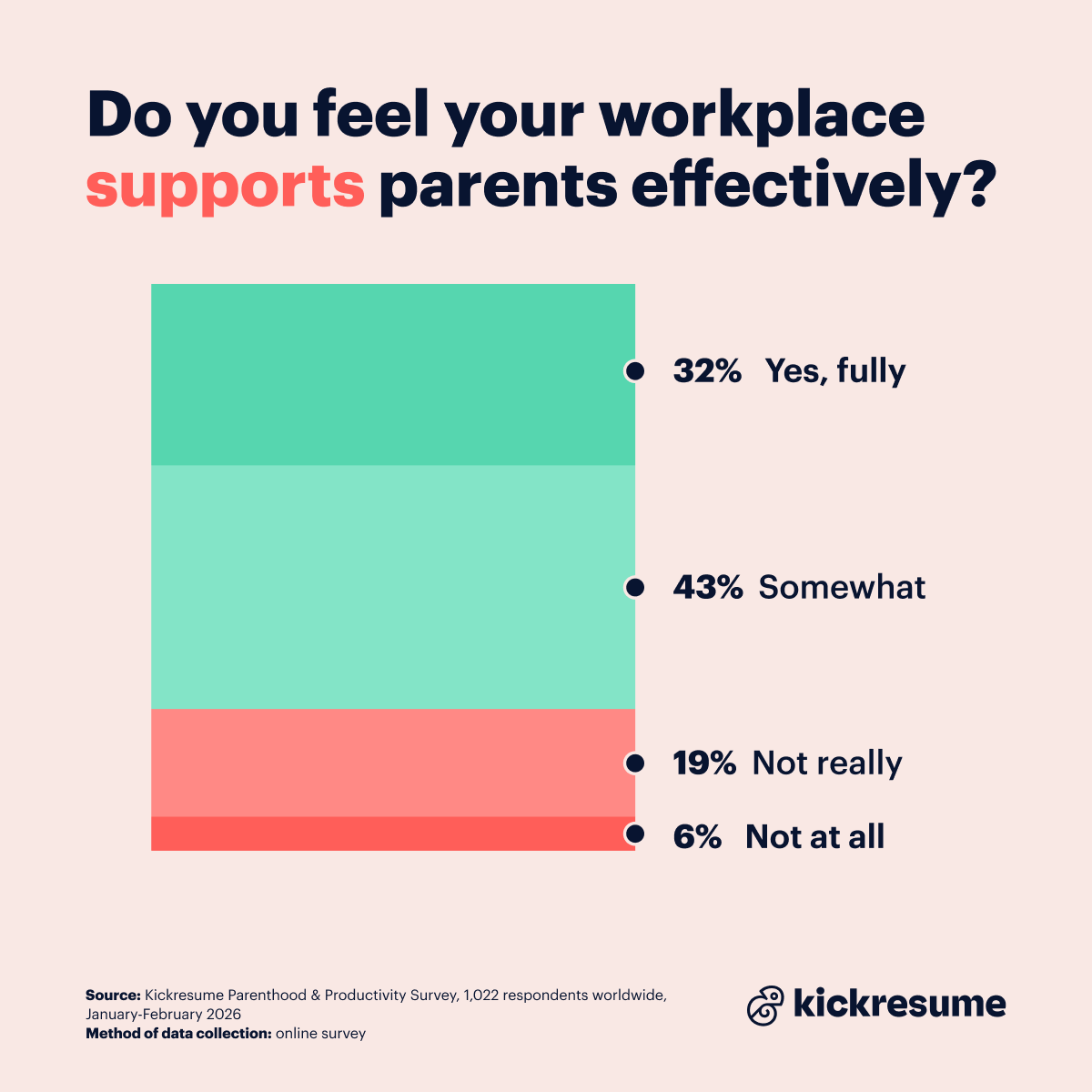
In total, 75% of parents report at least some level of workplace support. This suggests that most organizations are not failing outright. However, the intensity of support varies.
Gender differences are the clearest dividing line. Among men, 36% say they feel fully supported. Among women, that number drops to 24%. At the same time, women are more likely to say they feel only somewhat supported (49% vs. 41% of men).
The data suggests that while workplace support for parents may exist, the lived experience is not the same for everyone.
Final thoughts: How parenthood reshapes career decisions
The survey shows that parenthood doesn’t simply slow or stop ambition — it reshapes it. For some parents, it accelerates leadership goals; for others, it prompts scaling back or careful trade-offs. 35% of parents say they aim for leadership sooner after having children, while 29% move toward less demanding roles.
Ambition and compromise coexist, especially for Gen Z parents, who are the most driven yet also the most likely to decline opportunities. 60% report aiming for leadership sooner — the highest share across generations — yet 81% say they have turned down at least one career opportunity.
Gender adds another layer. Mothers are more likely to adjust their career path, while fathers generally experience fewer trade-offs. Nearly 2 in 3 mothers report declining at least one opportunity, versus just over half of fathers. Mothers are also significantly more likely to shift toward less demanding roles after having children.
But across generations and genders, the same theme emerges: real-world constraints — time, scheduling, and energy — shape decisions more than intent.
Ultimately, parenthood doesn’t erase ambition — it changes how it’s expressed. Parents make trade-offs, balance priorities, and find ways to keep moving forward. And for many, flexibility at work becomes the factor that determines whether career momentum continues — or slows.
Demographics
Role
- Parent: 55%
- Non-parent: 45%
Gender
- Male: 70%
- Female: 30%
- Non-binary or other: <1%
Age
- Under 18: 2%
- 18–28: 25%
- 29–44: 48%
- 45–60: 24%
- 61–79: 1%
- 79 or older: <1%
Location
- Africa: 12%
- Asia: 24%
- Australia/Oceania: 1%
- Europe: 29%
- Latin America: 10%
- North America: 24% (87% based in the USA)
Note
This anonymous online survey by Kickresume, conducted in January-February 2026, gathered insights from 1,022 respondents globally. All participants were reached via Kickresume's internal database.
About Kickresume
Kickresume is an AI-based career tool that helps candidates source jobs and raise salary with powerful resume and cover letter tools, skills analytics, and automated job search assistance. It has already helped more than 8 million job seekers worldwide.