Becoming a parent changes daily routines overnight. But what does it actually change at work?
To find out, Kickresume surveyed 1,022 respondents globally, including both parents and non-parents, as part of its Parenthood & Productivity Survey.
In this part of the survey, we focused specifically on parents and asked how having children changed their approach to work-life balance, which parts of their workday are most affected, whether their productivity shifted, and which skills developed through parenting carry over into the workplace.
Here’s a snapshot of the key findings:
- 38% of parents say their productivity increased after having children, while 28% report a decline. In total, 72% say their productivity did not decrease.
- In Asia, productivity gains are even more pronounced, with 45% reporting an increase.
- 36% say they have become more efficiency-focused at work since becoming parents — the most common shift in work-life balance. In Europe, this rises to 45%.
- 39% say mornings are the most affected part of their workday, and among Gen Z parents, that number jumps to 49%.
- 25% identify time management as the top skill developed through parenting that helps them at work, followed by multitasking (17%) and staying organized in controlled chaos (17%).
- 41% of mothers say they frequently apply parenting skills at work, compared to 26% of fathers.
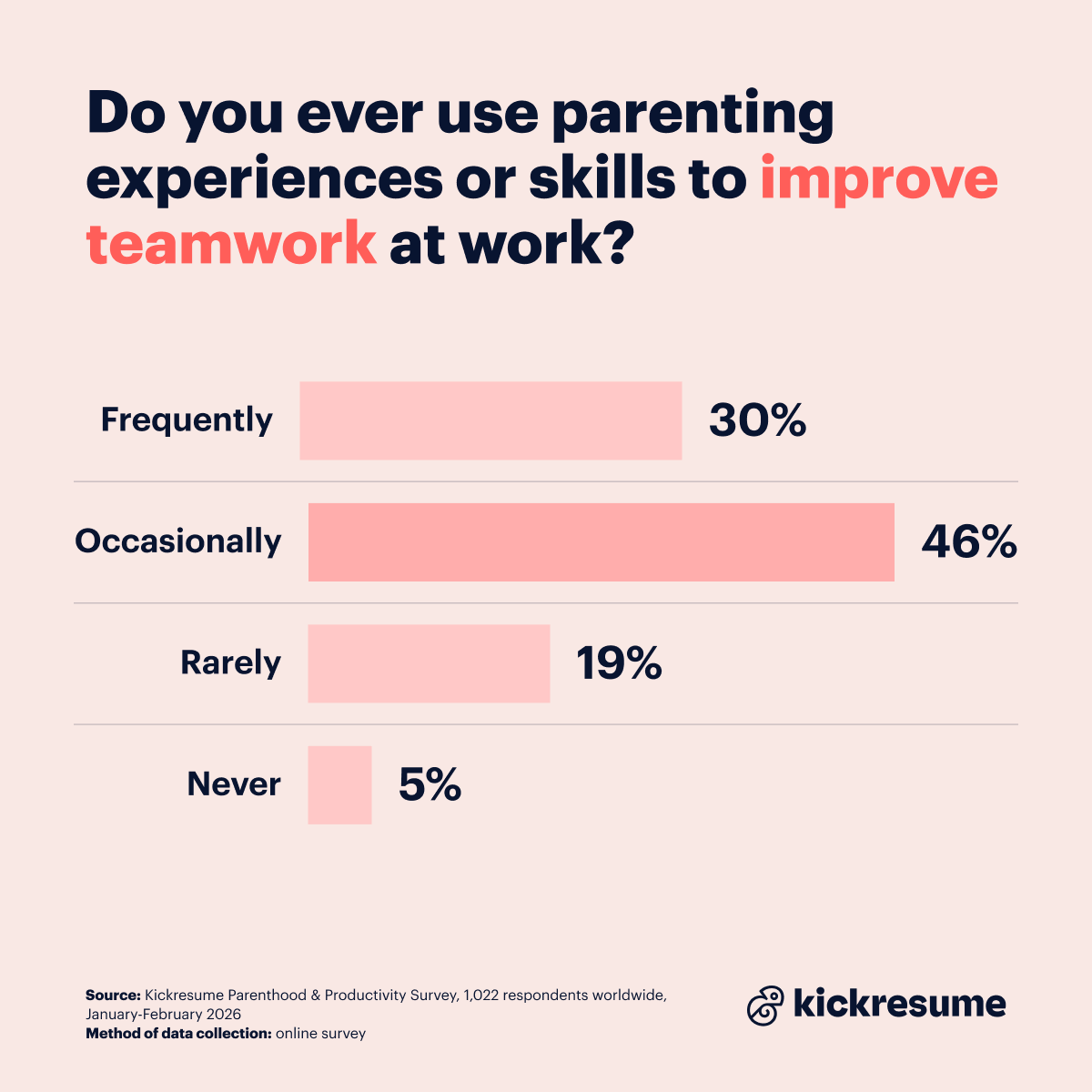
- Overall, 76% of parents say they use parenting skills to improve teamwork at least occasionally.
Productivity doesn’t collapse after kids — 38% even say it increased
One of the most common assumptions about parenthood and work is that productivity suffers. The data doesn’t fully support that.
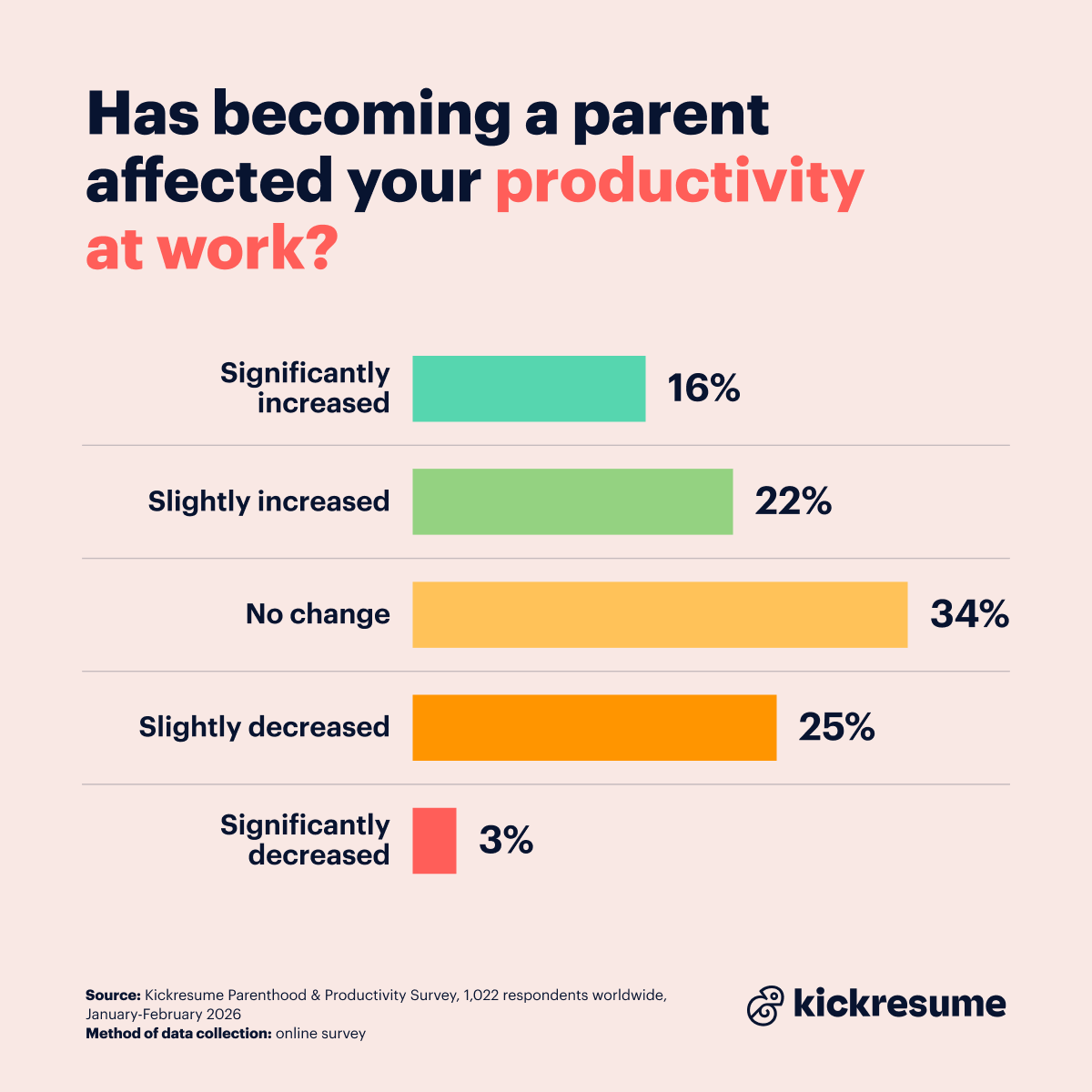
When asked whether becoming a parent affected their productivity at work, 38% of parents say their productivity increased, while 28% report a decrease. The remaining 34% say parenthood made no difference.
Here’s how the responses break down:
- 16% say productivity significantly increased
- 22% say it slightly increased
- 34% report no change
- 25% say it slightly decreased
- 3% say it significantly decreased
In other words, nearly three quarters (72%) of parents did not experience a drop in productivity after becoming parents.
The regional differences add another layer to the picture:
- In Asia, 45% report increased productivity — the highest share across all regions.
- In Europe, 42% report increased productivity, also clearly outweighing reported declines (25%).
- The USA stands out in the opposite direction: 32% report decreased productivity, compared to 25% who report an increase.
This contrast may reflect broader structural differences. Compared to much of Europe, the USA offers shorter or unpaid parental leave and higher out-of-pocket childcare costs, which can make the return to work more demanding. In Europe, longer leave policies and stronger public childcare systems may help — aligning with the higher share of parents reporting increased productivity. Asia shows an even higher share of reported productivity gains, where family-based childcare support is often more common, potentially softening the daily pressure of balancing work and parenting.
.png)
Gender differences show a more uneven experience:
- Among men, 38% report increased productivity and 26% report a decrease.
- Among women, responses are evenly split — 35% report an increase and 35% a decrease.
The results show that most parents do not experience a drop — but a substantial minority do. For many parents, output stays stable. For a significant share, it even improves. At the same time, more than a quarter report a decline.
After kids, work splits in three directions: efficiency, longer hours, and stronger boundaries
Becoming a parent changes how people approach work — but not in one single direction.
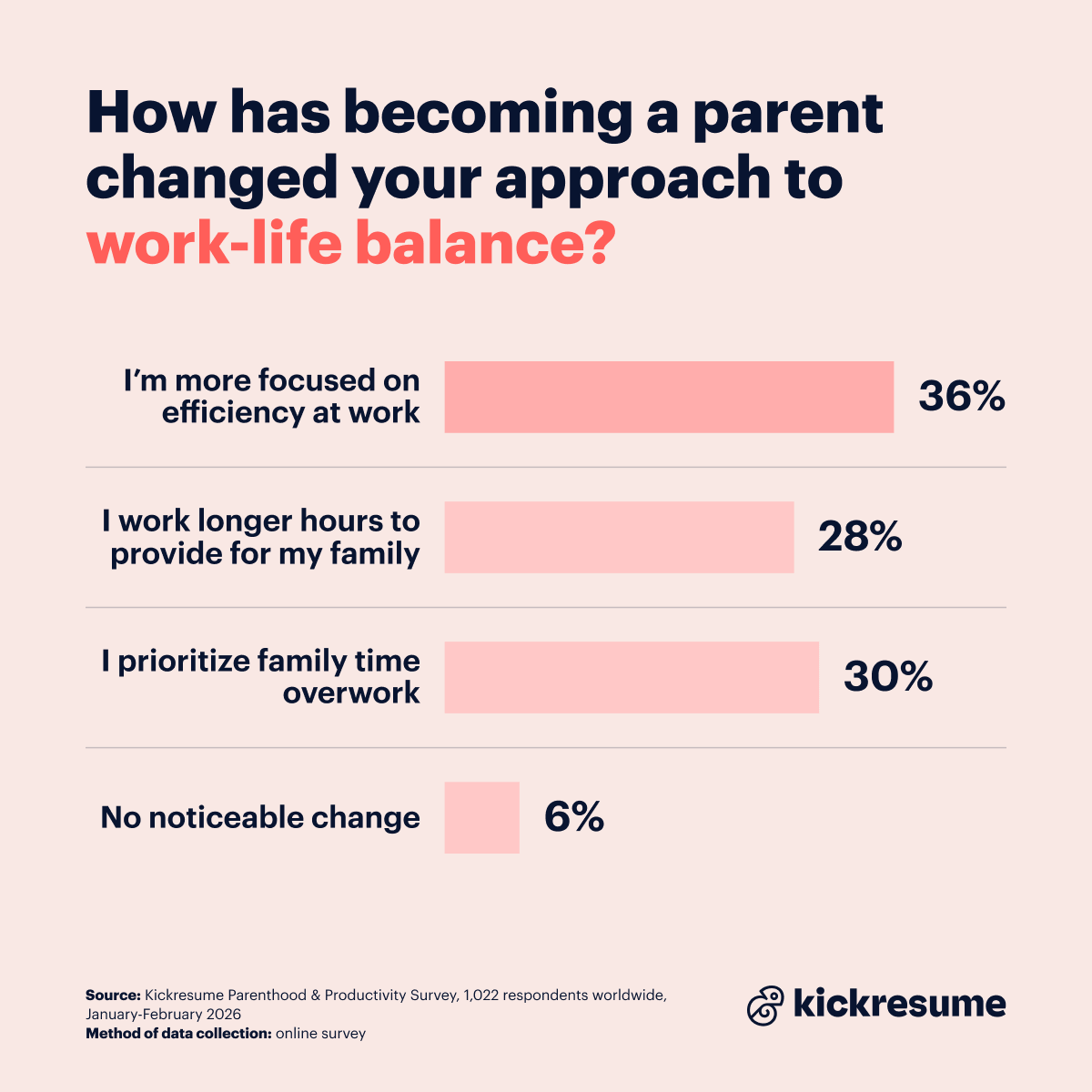
Overall, 36% of parents say they are more focused on efficiency at work, making it the most common response. At the same time, almost as many say parenthood reshaped their priorities in opposite ways: some work longer hours, others protect family time more deliberately.
Here’s the full breakdown:
- 36% say they are more focused on efficiency at work
- 30% prioritise family time over work
- 28% say they work longer hours to provide for their family
- 6% report no noticeable change
Regional differences make the shift even clearer.
In Europe, nearly half of parents (45%) say they’ve become more efficiency-focused — the highest share across all regions — while only 16% say they work longer hours. In contrast, in Asia, 29% report working longer hours, and in the USA, 25% do so.
The generational split is even sharper. Among Gen Z parents, 40% say they work longer hours — significantly more than Millennials (29%) or Gen X (26%).
At the same time, only 22% of Gen Z parents say they prioritize family time over work — the lowest share across generations. This may reflect the career stage. Gen Z parents are more likely to be earlier in their careers, with less seniority and financial stability, which can make longer hours feel necessary while building both career and family security.
Older generations, Millennials and Gen X, show a more balanced split. Around 30% in both groups prioritize family time (31% and 30%), and a similar share report increased efficiency (36% and 37%).
.png)
Taken together, the data shows that parenthood doesn’t push everyone in the same direction. For many, it sharpens efficiency. For others — especially younger parents — it increases work intensity. And for a significant share, it creates firmer boundaries around family time.
Mornings take the biggest hit — especially for Gen Z parents
Parenting doesn’t disrupt the workday evenly. For most parents, the pressure shows up first thing in the morning.
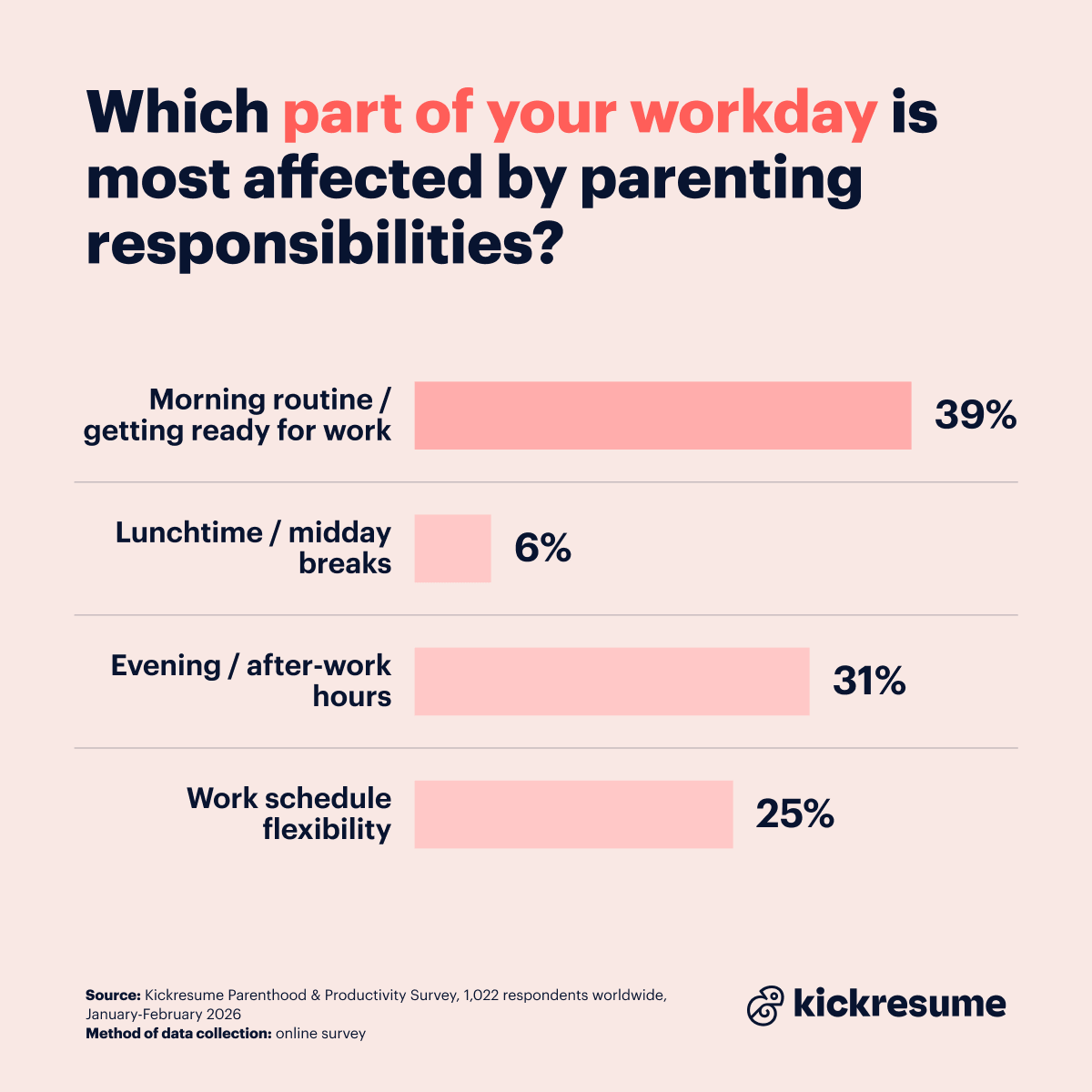
Overall, 39% of parents say the morning routine is the most affected part of their workday — more than any other time block.
Here’s the full breakdown:
- 39% say mornings / getting ready for work are most affected
- 31% say evenings / after-work hours
- 25% say work schedule flexibility overall
- 6% say lunchtime / midday breaks
The pattern becomes more visible among younger parents.
Nearly half of Gen Z parents (49%) say mornings are the most disrupted part of their day — significantly higher than Millennials (44%) and especially Gen X (29%).
Gen X shows the opposite pattern. Instead of mornings, 38% say evenings are most affected — the highest share across generations. Compared to Gen Z, older parents appear to experience more spillover into after-work hours.
.png)
Regional differences also stand out:
- In Asia, mornings are most affected for 46% of parents — above the global average.
- In the USA, the impact is more evenly split, with 33% citing mornings and 33% work schedule flexibility.
- In Europe, mornings and evenings are tied at 35% each, suggesting a more distributed impact across the day.
The data suggests that parenting pressures show up first thing in the morning — especially for younger parents — while older parents are more likely to feel the impact later in the day.
Time management tops the list of skills parents bring to work
When parents reflect on what they’ve gained from raising children, they don’t point to negotiation or delegation. They point to time.
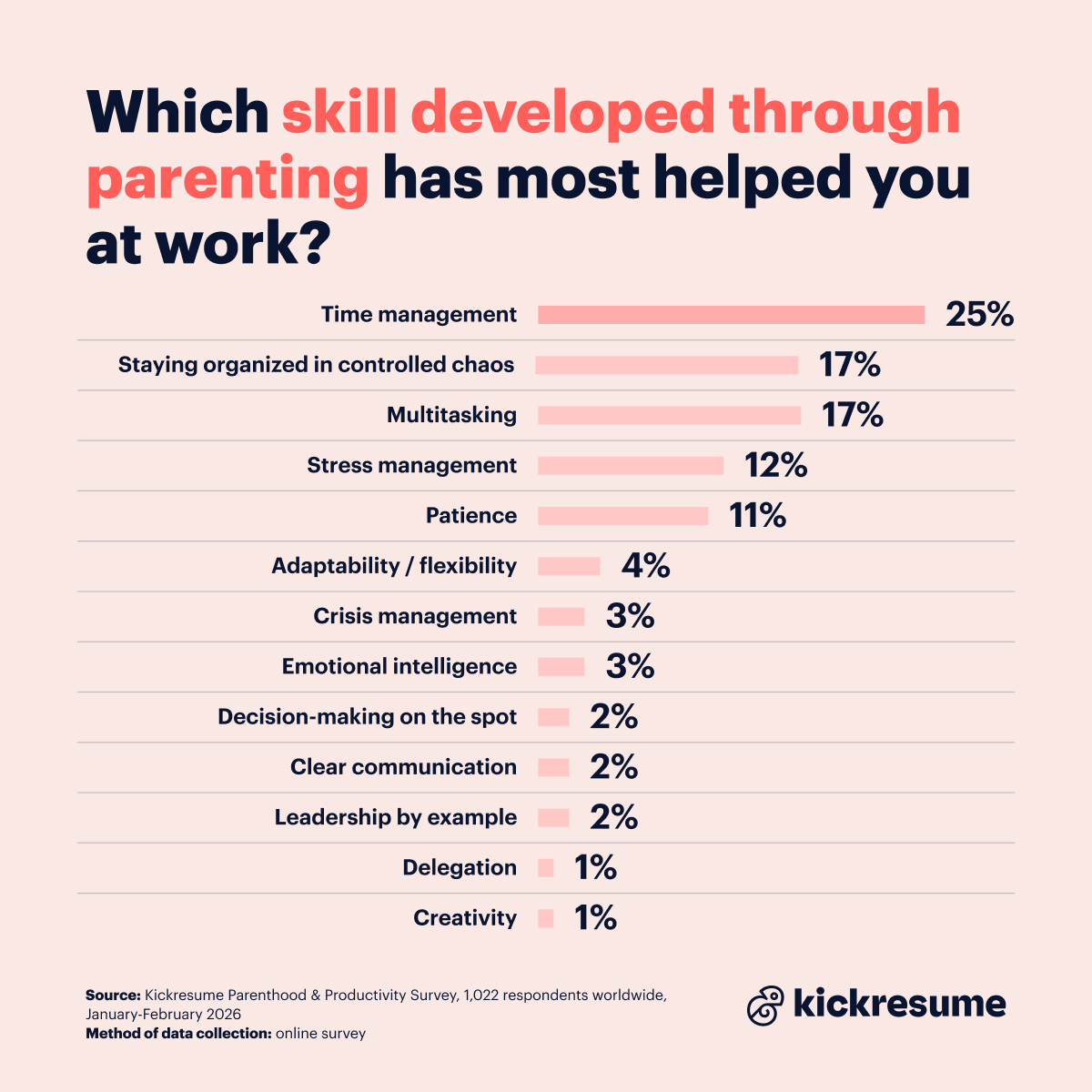
Overall, 25% of parents say time management is the parenting skill that has most helped them at work — more than any other option.
The top skills parents highlight are all highly practical:
- Time management: 25%
- Staying organized in controlled chaos: 17%
- Multitasking: 17%
- Stress management: 12%
- Patience: 11%
These responses cluster around execution: juggling priorities, handling pressure, and keeping things moving despite interruptions.
What ranks lower is also notable.
- Adaptability / flexibility: 4%
- Emotional intelligence: 3%
- Crisis management: 3%
- Delegation: 1%
- Creativity: 1%
Rather than highlighting classic leadership traits, parents most often point to skills that help them manage complexity and stay organized in fast-changing situations.
41% of mothers frequently apply parenting skills at work — compared to 26% of fathers
Parenting doesn’t just reshape individual work habits. For many, it also changes how they collaborate.
The gender gap is striking.
Among women, 41% say they frequently use parenting experiences or skills to improve teamwork at work. Among men, that number drops to 26%.
.png)
Overall, however, the vast majority of parents report using parenting skills in professional settings at least occasionally.
Here’s the full breakdown:
- 30% say they frequently apply parenting skills at work
- 46% say they do so occasionally
- 19% say rarely
- 5% say never
In total, 76% of parents say they bring parenting skills into teamwork at least sometimes.
Regional differences add another layer:
- In Asia, 37% say they frequently apply parenting skills — the highest share globally.
- In the USA, 29% say frequently and 50% occasionally.
- In Europe, only 22% say frequently, and 9% say they never do — the highest “never” rate among regions.
The data suggests that for most parents, lessons from parenting don’t stay at home. For many — and especially for mothers — it becomes part of how they approach collaboration at work.
Final thoughts: What changes at work after becoming a parent
Taken together, the survey results offer a clearer picture of how parenthood shapes work.
Productivity doesn’t automatically decline. 38% of parents report increased productivity, while 34% say it stayed the same. Only 28% report a decrease.
Work habits shift in measurable ways. 36% say they’ve become more focused on efficiency, while 30% prioritize family time more and 28% say they work longer hours. Only 6% report no noticeable change.
The impact shows up in daily routines, too. 39% say mornings are the most affected part of their workday, and among Gen Z parents, that number rises to 49%.
And parenting doesn’t stay at home. 76% say they use parenting skills at work at least occasionally, including 41% of mothers who say they do so frequently, compared to 26% of fathers.
Put simply, the data shows adjustment rather than decline.
Parenthood changes how work is organized, prioritized, and managed — but for most parents, it does not reduce overall output.
Demographics
Role
- Parent: 55%
- Non-parent: 45%
Gender
- Male: 70%
- Female: 30%
- Non-binary or other: <1%
Age
- Under 18: 2%
- 18–28: 25%
- 29–44: 48%
- 45–60: 24%
- 61–79: 1%
- 79 or older: <1%
Location
- Africa: 12%
- Asia: 24%
- Australia/Oceania: 1%
- Europe: 29%
- Latin America: 10%
- North America: 24% (87% based in the USA)
Note
This anonymous online survey by Kickresume, conducted in January-February 2026, gathered insights from 1,022 respondents globally. All participants were reached via Kickresume's internal database.
About Kickresume
Kickresume is an AI-based career tool that helps candidates source jobs and raise salary with powerful resume and cover letter tools, skills analytics, and automated job search assistance. It has already helped more than 8 million job seekers worldwide.