


Imposter syndrome — that quiet fear that you’re not as good at your job as people believe, that you’ve somehow “faked it,” and that it’s only a matter of time before you’re “found out.” This feeling is surprisingly common.
But does it play out the same way everywhere? After uncovering major differences between European and the USA work cultures in an earlier survey, we started wondering if something as personal as imposter syndrome might also look different across continents.
Does where you work shape how deeply self-doubt hits? Does it influence whether people take on new challenges or the careers they build?
Kickresume asked 1,897 professionals from around the world to share their experiences with imposter syndrome. For this report, we focused on respondents from Europe and North America (two regions with very different professional realities) to see how they compare.
Here's a quick rundown of the key findings:
- 71% of North American professionals and 63% of Europeans have experienced imposter syndrome at work.
- 56% of Europeans and 50% of North Americans have turned down or missed opportunities because they didn’t believe in themselves.
- More than half of European professionals (55%) named self-promotion as their top challenge when applying for jobs.
- Overworking was the top reaction to imposter syndrome among Gen X and senior-level professionals on both sides of the Atlantic.
- 21% of North Americans say their imposter syndrome is strongly shaped by their identity (gender, race, background), compared to just 16% of Europeans.
The most common fixes were more training (55% Europe, 52% North America) and regular feedback (51% Europe, 52% North America).
Gen X and senior-level professionals lead in overworking to cope with self-doubt
The differences between the two groups showed up right from the very first question.
When we asked respondents whether they had ever felt like an imposter at work, the majority in both regions said yes. But the numbers weren’t quite the same.
- In North America, 71% admitted to having these feelings.
- In Europe, the number was slightly lower, at 63%.
While imposter syndrome clearly isn’t rare in either region, it seems to be a little more common among North American workers. It’s a small gap, but it already suggests that where you work might shape how likely you are to question yourself.
And for many, those feelings don't just stay in their heads! When we asked how imposter syndrome affects their day-to-day behavior, respondents from both regions reported a range of emotional and practical struggles.
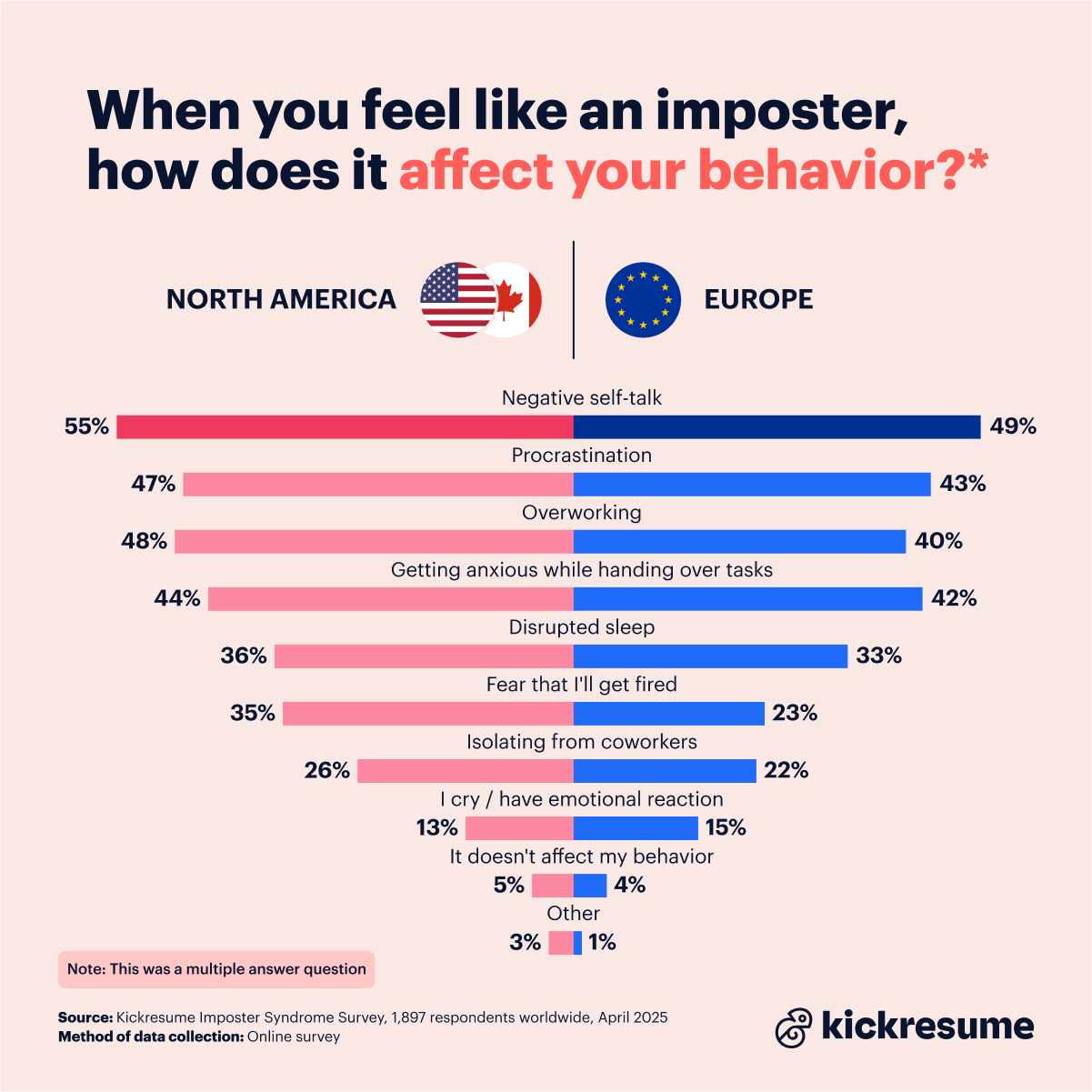
In North America, the most common reaction was negative self-talk, reported by 55% of respondents. Procrastination (47%) and overworking (48%) were also high on the list, followed closely by anxiety when handing over tasks (44%).
European respondents reported a very similar pattern, although the numbers were slightly lower across most categories. Negative self-talk (49%), procrastination (43%), and overworking (40%) were the top three struggles, just like in North America.
But North American respondents seem to experience some of its more extreme consequences a little more often than their European counterparts. North Americans were more likely to say their imposter feelings made them fear getting fired (35% vs. 23%) and slightly more likely to report isolating from coworkers (26% vs. 22%).
When we broke the data down by generation and career level, we found something even more telling:
- Overall, negative self-talk was the most common way respondents said imposter syndrome affected them, both in North America and Europe.
- But for Gen X workers, overworking actually took the top spot (with 54% in North America and 50% in Europe).
- Senior-level professionals also reported the highest rates of overwork across career levels — 58% in North America and 50% in Europe.
- These were the only groups across age and career levels where working longer hours was the number one reaction to imposter feelings.
These results might reflect a mix of professional and cultural expectations. Gen Xers and senior professionals often came up in workplaces where long hours were seen as a badge of honor. And where the pressure to "prove" yourself through hard work was deeply ingrained.
Combined with the weight of leadership, it makes sense that imposter syndrome would push them not just to doubt themselves internally, but to try and compensate by doing more externally.
The toll of feeling like a fraud: extra tasks, less pay, fewer promotions
For those grappling with imposter syndrome, the effects often bleed into their professional lives in real, tangible ways.
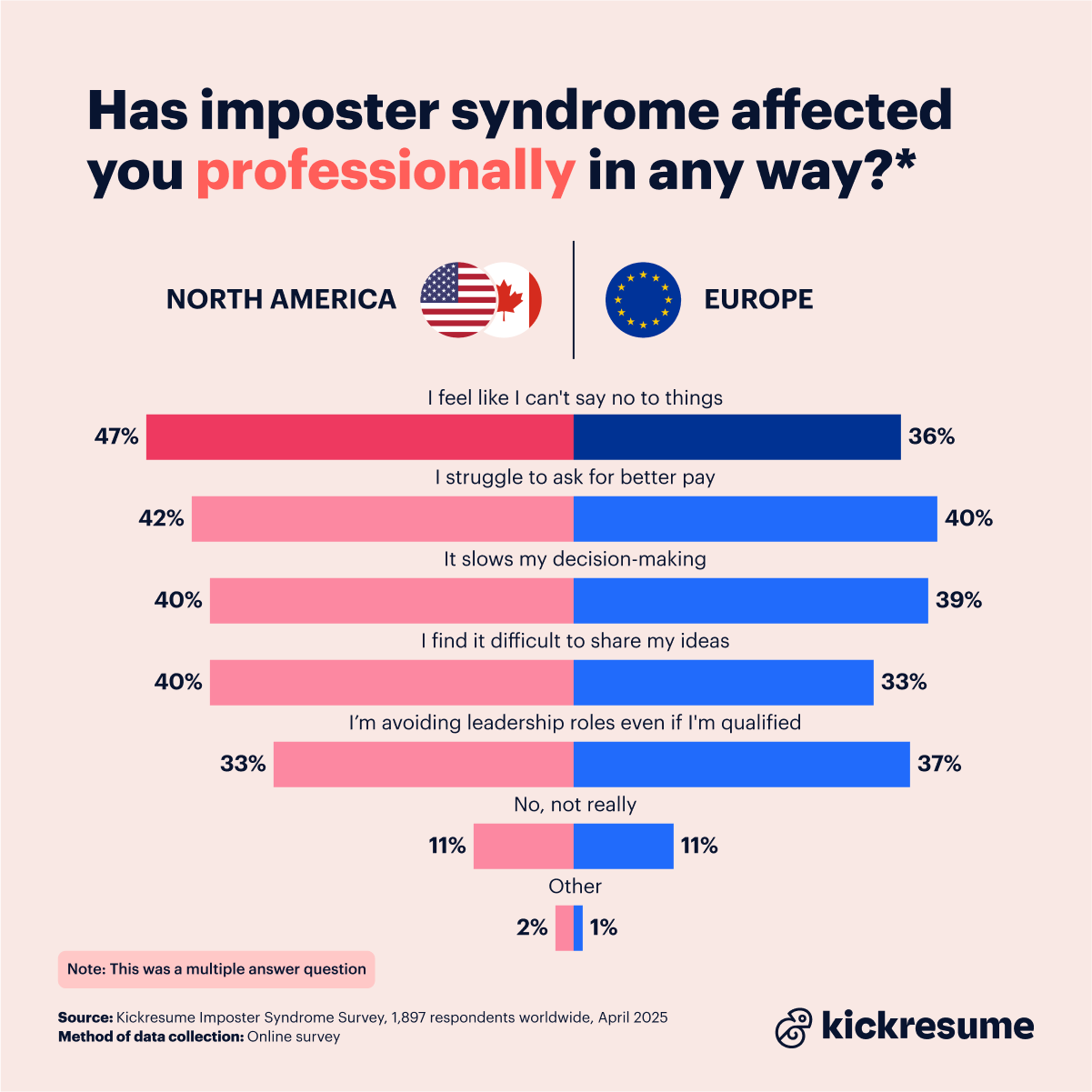
Across both regions, the top challenge was saying no to extra work:
- In North America, nearly half (47%) reported they often felt unable to turn down additional tasks.
- In Europe, the number was lower at 36%.
This gap suggests that North American workers might feel a stronger internal pressure to overextend themselves.
Leadership was another area where imposter syndrome left its mark. While 40% of North Americans had passed up leadership roles they were qualified for, only 33% of Europeans had done the same.
Other effects were more evenly distributed. But one exception stood out: more European workers (37%) than North Americans (33%) said they struggled to share their ideas. It’s a reminder that self-doubt may take a quieter but equally strong form among European workers.
Which begs the question: if imposter syndrome makes you question your value, how much influence does it have on the direction your career takes?
Imposter syndrome stalls career growth for 3 in 4 workers
The results of our survey answer that question with a resolute yes.
Across both North America and Europe, a significant number of respondents said they had turned down or missed out on promotions, new roles, or other key opportunities because they didn’t believe in themselves:
- In North America, the numbers were evenly split. 50% of the respondents said they had passed on or lost out on an opportunity due to self-doubt at least once, while 50% said they hadn’t (though 29% had considered it).
- As for the European respondents, 56% said self-doubt had cost them at least one opportunity.
One possible explanation for the higher percentage could lie in cultural norms around self-presentation. In many European countries, modesty and humility are deeply ingrained values. And confidence is often expected to be quiet, even understated. This can create a work culture where second-guessing yourself becomes normalized.
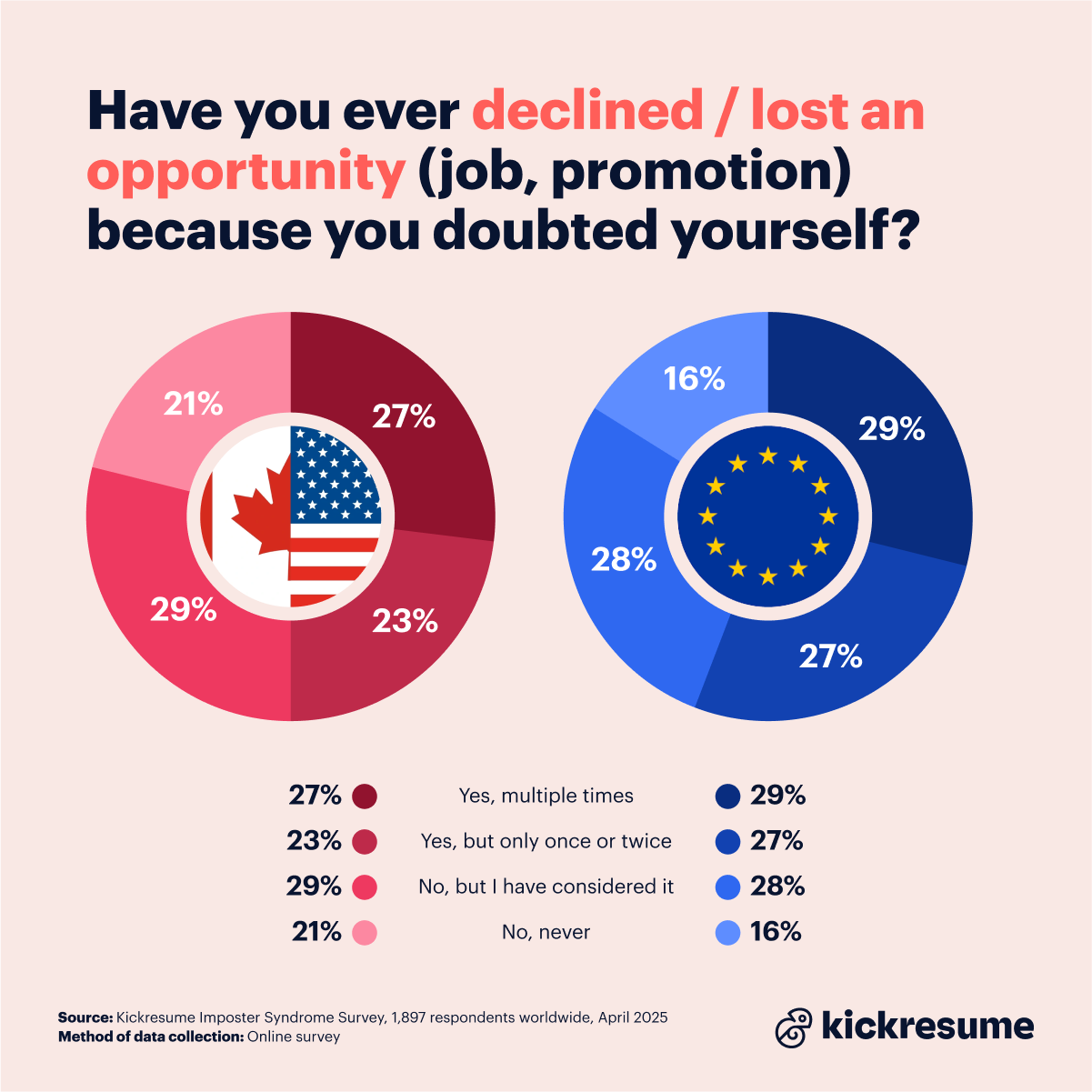
While North American and European respondents differed slightly in how often self-doubt led them to turn down isolated opportunities like a promotion or a new project, they were united on a broader point.
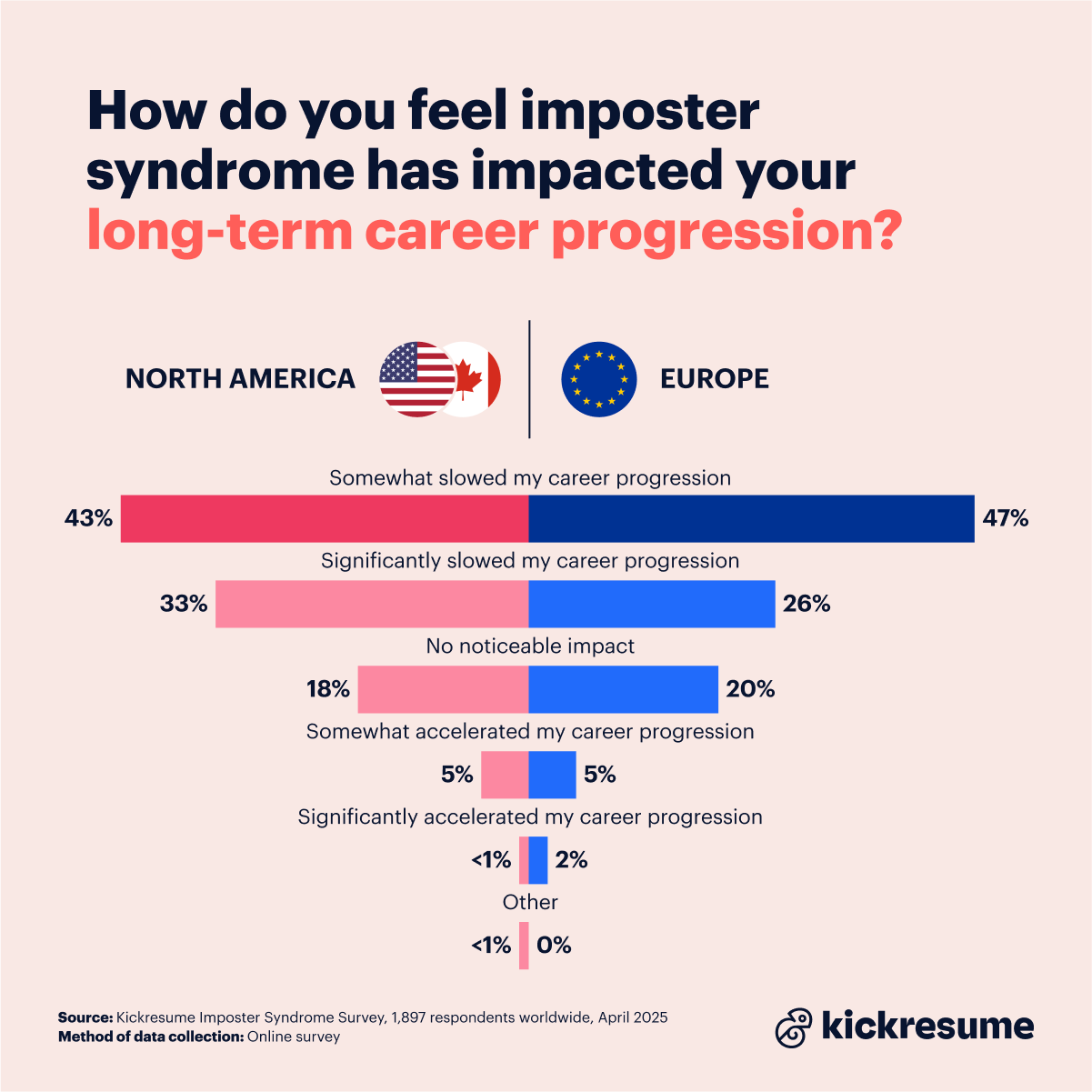
A decisive majority in both regions (76% for North America and 73% for Europe) admitted that imposter syndrome had slowed their long-term career progression:
- In North America, 43% said their career had been somewhat slowed, and another 33% said it had been significantly slowed.
- In Europe, the numbers were comparable: 47% reported a somewhat slower path, and 26% said the effect had been significant.
With these numbers in mind, the effect of imposter syndrome becomes clear: it plays out in missed chances, stalled growth, and careers that move more slowly than they should.
North Americans overthink, but Europeans just can’t brag enough
If imposter syndrome can slow one's career once they're through the door, what happens during the job search when the entire process revolves around convincing someone you’re better than other candidates?
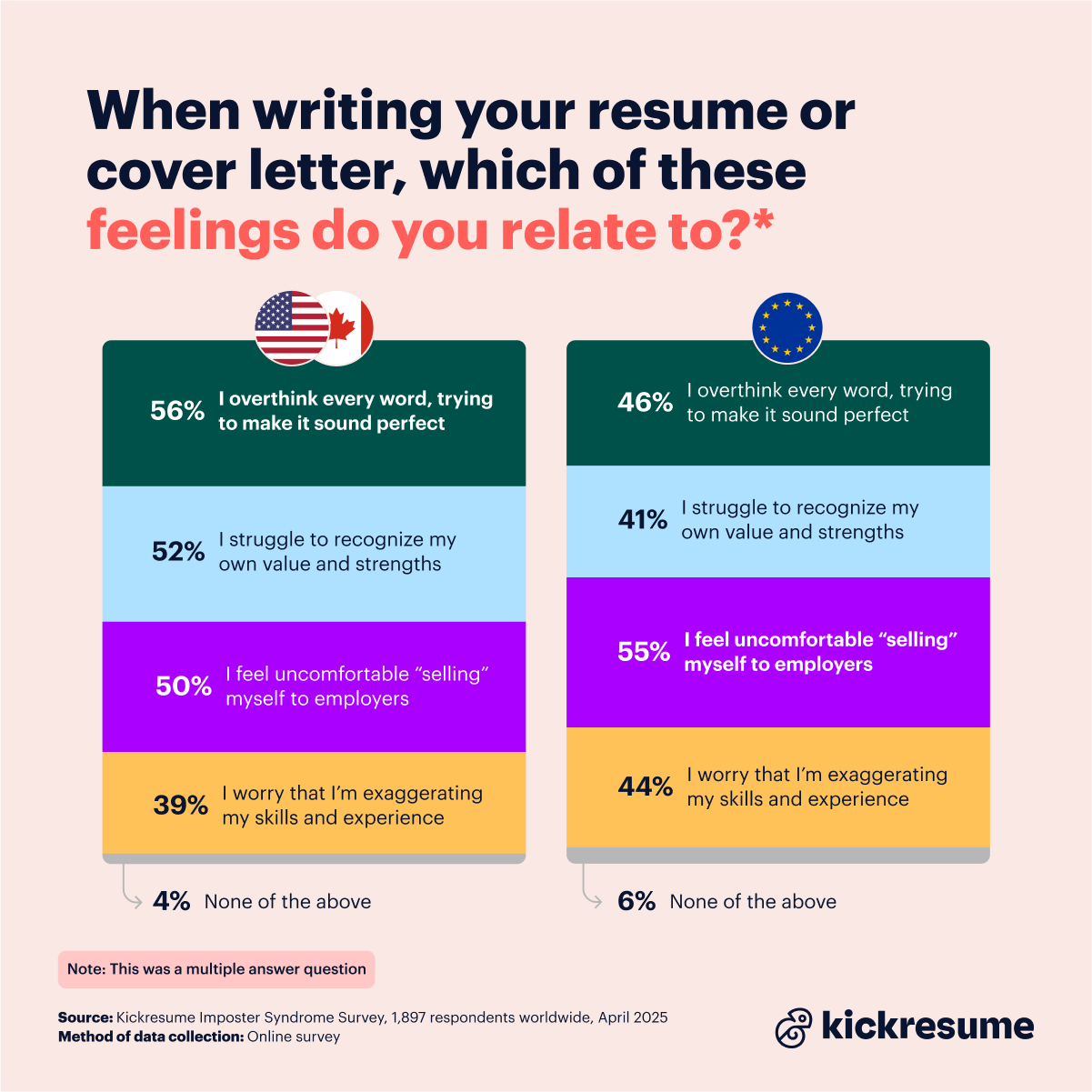
In North America, the number one issue was overthinking. 56% of respondents said they agonize over every word, trying to make their materials sound perfect. Struggling to recognize their own value came second (52%), followed by feeling uncomfortable “selling” themselves to employers (50%).
In Europe, the order shifted. The leading issue wasn’t perfectionism. It was the unease of “selling” oneself. A majority (55%) said self-promotion made them uncomfortable, followed by overthinking (46%) and difficulty acknowledging their strengths (41%).
These numbers point to an intriguing conclusion. In North America, imposter syndrome tends to manifest as intense internal pressure to get everything exactly right. But in Europe, the friction seems to be more external. Once again, this could be tied to cultural norms that value modesty and make self-advocacy feel out of place (as mentioned in the previous chapter).
The split between which answer occupied the number one spot for North American and European respondents stayed consistent across generations and career levels. All but one.
Gen Z was the only group where both regions shared the same top — struggle worrying about exaggerating skills (62% in North America and 52% in Europe).
That finding makes sense. Gen Z respondents in both regions are just beginning their professional journeys, often with limited experience to draw on. At this early stage, it’s easy to question whether you truly belong, or if your achievements really "count."
Of course, before anyone starts writing a resume or cover letter, they first have to decide whether to apply at all. And that decision, too, is often shaped by imposter syndrome.
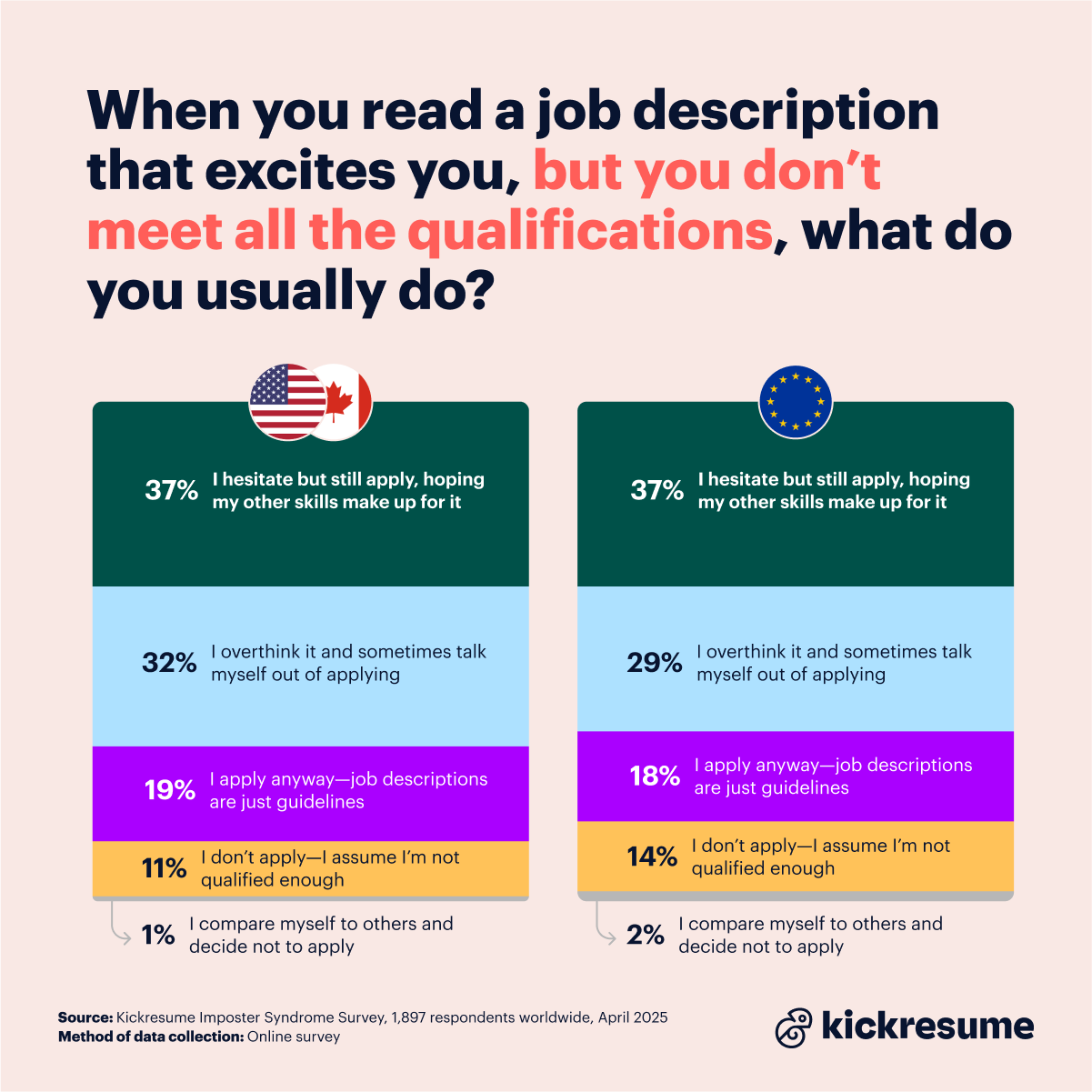
When faced with a job that excites them but doesn’t match their experience perfectly, most respondents (across both North America and Europe) said they’ll still apply, but not without hesitation:
- In both regions, 37% admitted they second-guess themselves first.
- The next most common response? Talking themselves out of it entirely. Nearly a third of North Americans (32%) and Europeans (29%) said they’ve overanalyzed the requirements to the point of convincing themselves not to bother.
- Only a small minority approaches job descriptions with confidence and treats them as a guideline rather than hard rules (19% in North America and 18% for Europe).
- And an even smaller group saw a mismatch and simply chose not to apply at all (11% of North American and 14% of European respondents).
The hesitation to apply, the fear of overstating skills, the instinct to disqualify yourself before anyone else can. All of these point to the same root issue. Across regions and generations, self-doubt narrows people’s options before they’ve even had a chance to try.
21% of North Americans link imposter syndrome to their identity
Imposter syndrome doesn’t happen in a vacuum. While personal doubt can feel intensely internal, the roots often stretch beyond the individual. Social norms, cultural expectations, systemic inequities — all can shape how people see themselves and how safe they feel being confident.
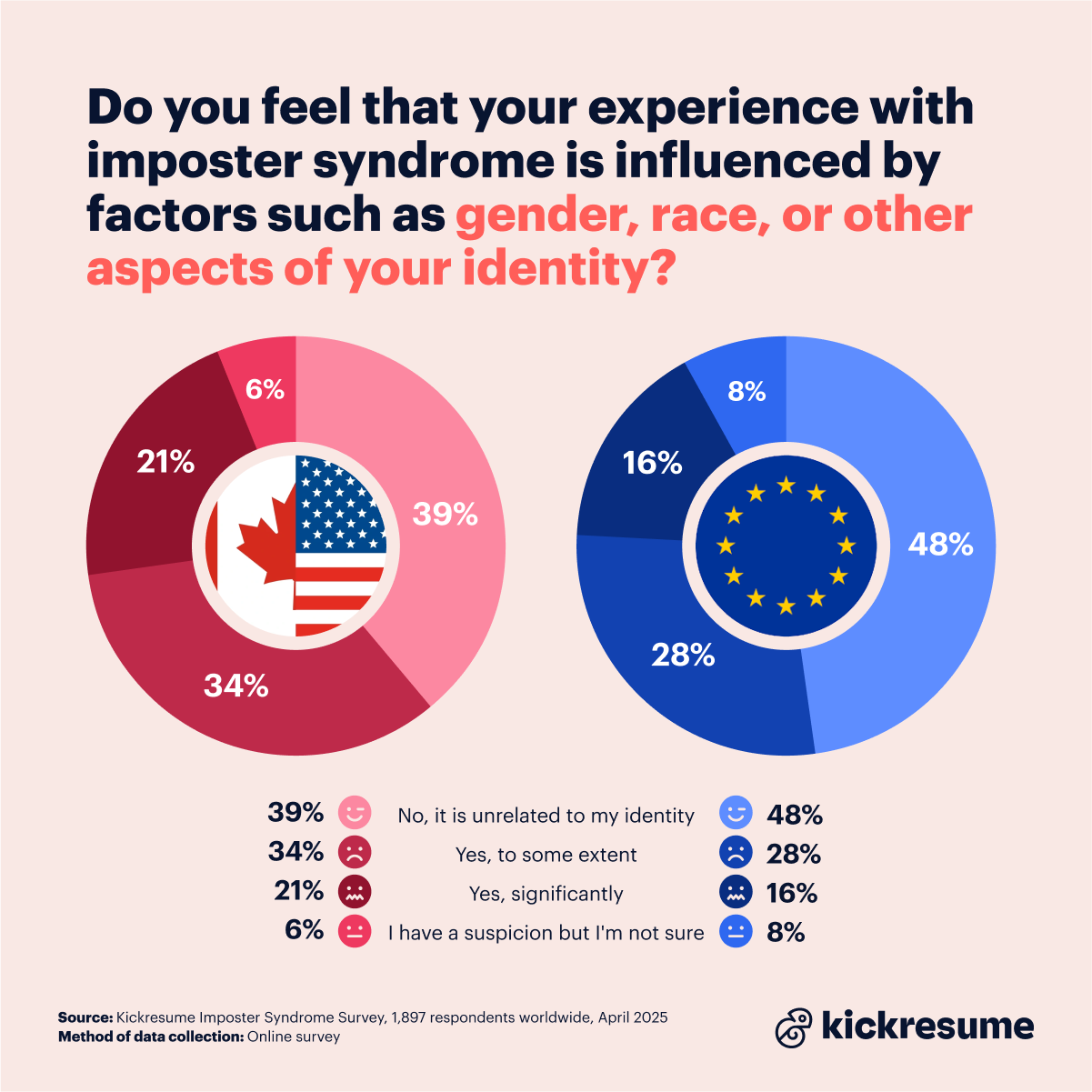
To better understand this, we asked respondents whether they felt their experience with imposter syndrome was influenced by aspects of their identity, such as gender, race, or socioeconomic background:
- In North America, nearly one in five respondents (21%) said their experience was significantly influenced by these identity-based factors.
- Another 34% said it was influenced to some extent.
- In total, over half (55%) of North American participants saw a connection between imposter syndrome and who they are.
- In Europe, just 16% of respondents felt their experience was significantly shaped by identity, and 28% said it was influenced to some extent, which brings the total to 44%.
- European respondents were more likely to say imposter syndrome was not related to identity at all (48% in Europe vs. 39% in North America).
This gap may reflect different societal conversations around identity, inclusion, and structural inequality. In North America, race, gender, and related topics are more prominently featured in workplace discourse. In Europe, these discussions, while present, often remain less explicit. That difference could shape not just people’s lived experiences, but how easily they can name them.
Training, feedback, and reassurance as top remedies for imposter syndrome
So far, our findings confirmed that imposter syndrome can stop people from applying for jobs, speaking up, or taking on new challenges. In the long run, it can even narrow their entire career path. So we asked: what would actually help?
We gave respondents a range of possible “antidotes” and asked which ones they felt could ease their imposter syndrome.
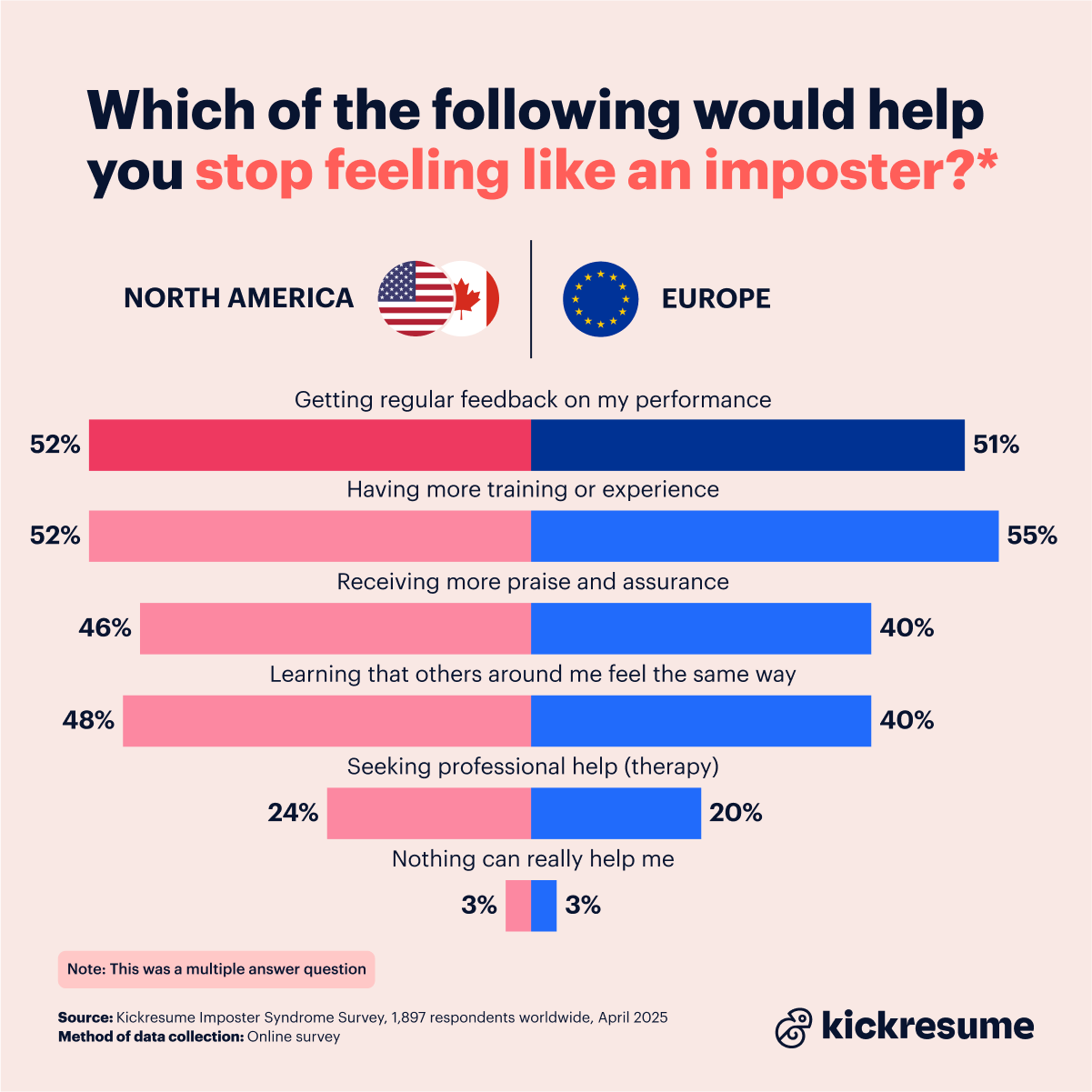
In both North America and Europe, two answers topped the list:
- More training or experience (55% in Europe, 52% in North America)
- Regular feedback on performance (51% Europe, 52% North America)
The desire for more training speaks to a natural instinct. Many believe that if they just knew more, they’d feel more secure. On the surface, this seems reasonable. You’d expect this feeling to fade as people advance in their careers, building confidence along with experience.
But our data suggests otherwise. Even among those working at the senior level, nearly half said that more training or experience would help ease their self-doubt (46% in North America, 49% in Europe).
As our respondents move forward in their careers, the bar often rises with them. What used to feel like an achievement can start to seem average. The benchmark keeps moving, and the sense of not measuring up tags along.
Other top answers also pointed to the importance of connection and reassurance:
- Learning that others feel the same way (48% in North America, 40% in Europe)
- Receiving more praise or assurance (46% North America, 40% Europe)
These numbers suggest that part of the solution lies in how teams and organizations operate. Managers who give frequent, specific feedback create clarity. Leaders who are open about their own doubts help normalize the experience.
While imposter syndrome itself doesn't seem to go away with time, the shape it takes evolves:
- At the entry level, the most popular solution was having more training or experience (57% in North America, 64% in Europe).
- Among those at the mid-level, the top response was getting regular feedback (58% in North America, 56% in Europe).
- And for those in senior positions, the most common answer was learning that others feel the same way (50% in both regions).
The perfectionists, the experts, and the soloists
Since the early 1980s, one of the most influential voices exploring how self-doubt shapes professional lives is that of Dr. Valerie Young, co-founder of the Impostor Syndrome Institute.
She identified five distinct “types” of imposter syndrome, each based on a different internal standard for what it means to be competent:
- The Perfectionist believes success means doing everything exactly right. For them, even a small mistake can overshadow an otherwise strong performance and trigger intense self-doubt.
- The Expert ties their worth to how much they know. They feel they should already have every answer, and not knowing something makes them feel like they’ve failed.
- The Superhuman sets impossible expectations across all areas of life. If they don’t excel as a professional, parent, friend, partner (and more), they feel they’re not enough.
- The Soloist insists on doing everything alone. Needing help feels like weakness. True success, they believe, only counts if they achieved it without support.
- The Natural Genius assumes that competence means speed and ease. If they struggle to learn or produce something quickly, they worry they must be a fraud.
To bring these ideas to life, we asked respondents to choose the statement that best reflected their own experience:
- “I set extremely high standards for my work, and even small mistakes make me feel like I’ve failed.” (Perfectionist)
- “I feel like I should always know everything in my field, and if I don’t, I worry that I’m not good enough.” (Expert)
- “I feel like I need to succeed in all aspects of my life (as a professional, a parent, a friend, or a partner). If I fall short in any area, I feel like I’m not good enough.” (Superhuman)
- “I prefer to work alone because I believe that I should figure things out on my own.” (Soloist)
- “If I was truly talented, things would come easily to me, so struggling to master something makes me feel like a fraud.” (Natural Genius)
Here’s how the responses broke down:
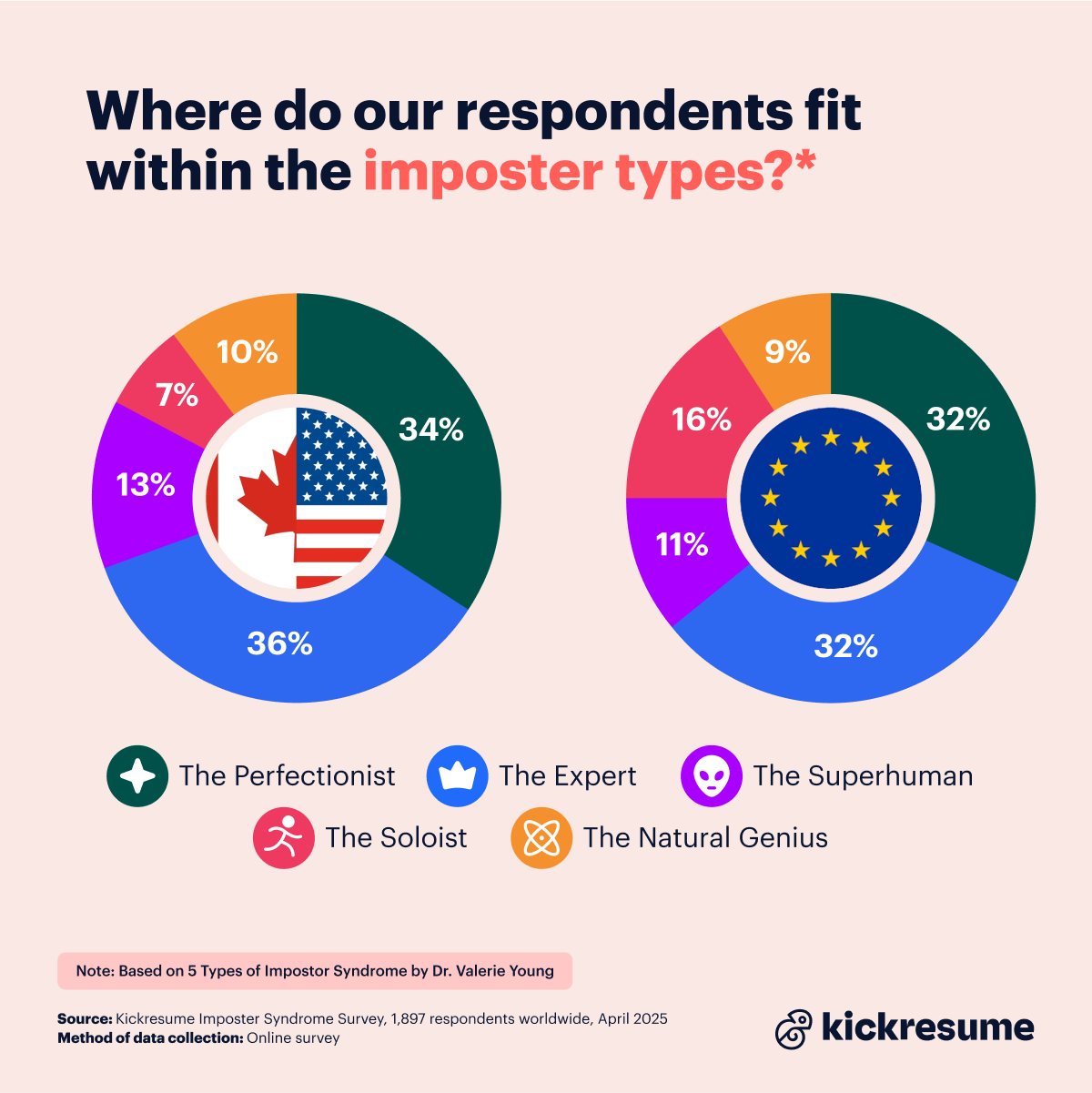
European respondents were more than twice as likely to identify with The Soloist (16%) than their North American peers (7%).
This is another difference that might reflect cultural habits. In North America, teamwork, mentorship, and collaborative work are often encouraged and rewarded. In parts of Europe, being self-reliant is more common. This might make asking for help feel like you're not doing well enough.
Final thoughts
Imposter syndrome shows up in how people work, the choices they make, and the paths they take. It leads many to question their skills, hold back from speaking up, and turn down opportunities they’re more than ready for. Over time, those small moments of doubt can slow down entire careers.
Our survey shows that imposter syndrome is a serious issue for workers in both North America and Europe. While culture does seem to shape how these feelings show up, for example, how comfortable people feel asking for help or promoting themselves, it doesn’t explain everything.
In fact, some of the strongest patterns we saw were tied not to geography, but to age and career level. This suggests that imposter syndrome is less about where you work and more about where you are in your professional journey.
One of the most valuable takeaways is that there are real ways companies can help. Clear, regular feedback helps people trust their abilities. And when leaders speak honestly about their own doubts, it creates space for others to do the same.
Demographics
Distribution of respondents by continent
- Asia – 33.3%
- North America – 28.1%
- Europe – 17.8%
- Africa – 13.5%
- South America – 5.2%
- Oceania – 2.1%
Age distribution
- 28–43 – 44.4%
- 18–27 – 30.0%
- 44–59 – 22.1%
- Under 18 – 1.9%
- 60–78 – 1.5%
- 79 or above – 0.2%
Seniority Level
- Mid-level – 41.2%
- Entry-level – 30.1%
- Senior-level – 26.0%
- C-suite / Executive (e.g., CEO, CFO) – 2.8%
Note
This anonymous online survey by Kickresume, conducted in April 2025, gathered insights from 1,897 global participants on imposter syndrome. All participants were reached via Kickresume's internal database.
About Kickresume
Kickresume is an AI-based career tool that helps candidates source jobs and raise salary with powerful resume and cover letter tools, skills analytics, and automated job search assistance. It has already helped more than 8 million job seekers worldwide.