We’ve been exploring the issue of imposter syndrome lately, with our survey revealing that 71% of professionals in North America and 63% in Europe have felt this way at work. These numbers show just how widespread imposter syndrome is, causing stress, anxiety and holding people back in their careers.
So, to dig a bit deeper into the ways imposter syndrome can manifest and why some people might be more likely to suffer from it, we teamed up with personal and professional coach Lāsma Poļikeviča. An expert in her field, Poļikeviča is accredited as an Imposter Syndrome Informed Coach™, thanks to her training from the Imposter Syndrome Institute.
She shared her insights with us, as well as her tips on how people can manage their imposter syndrome at work and how employers can help their staff members who struggle with it. She drew on academic research from psychologists to back up her advice.
Here are the key takeaways:
- People of all genders, ages, and professional backgrounds can suffer from imposter syndrome.
- Overworking, inability to accept compliments, and difficulty making decisions are all signs of someone feeling like an imposter at work.
- This issue might present differently in leaders vs. team members, with managers left feeling unable to lead effectively, and employees feeling unmotivated to progress in their careers.
- Certain personality traits can put you at greater risk of imposter syndrome.
- Marginalized people are more likely to experience this issue due to the psychological concept of stereotype threat.
- Highly competitive workplaces can give their workers imposter syndrome.
- To some extent, there might be a positive side to it, including great interpersonal skills and careful leadership.
- Organizations can help their employees who struggle with this issue by providing training and mentorship — and individuals can practice skills like mindfulness.
Anyone could get caught in the Imposter Syndrome Cycle
People suffering from Imposter syndrome often doubt their own accomplishments and feel like they will be exposed as a fraud, putting their achievements down to luck or very hard work rather than their own skill. Studies have shown that it’s common across all age groups, genders, ethnicities, and nationalities, and in a wide range of different professional settings.
When researchers Pauline Rose Clance & Suzanne Imes first named Imposter Syndrome in 1978, they identified a key sign of the condition: a self-defeating cycle in which individuals become stuck.
Lāsma Poļikeviča went into more detail about what this cycle looks like: when given a task at work, someone with Imposter syndrome might feel anxious, which will cause them to either overprepare or procrastinate as a way of coping. Completing the task brings temporary relief — but because they are unable to internalize their success, they’re left feeling worried that they only just made it and will definitely get caught out next time.
It just goes to show, one of the trickiest things about Imposter syndrome is that however hard they work and however impressive their achievements are, it’s hard for people to talk themselves out of it.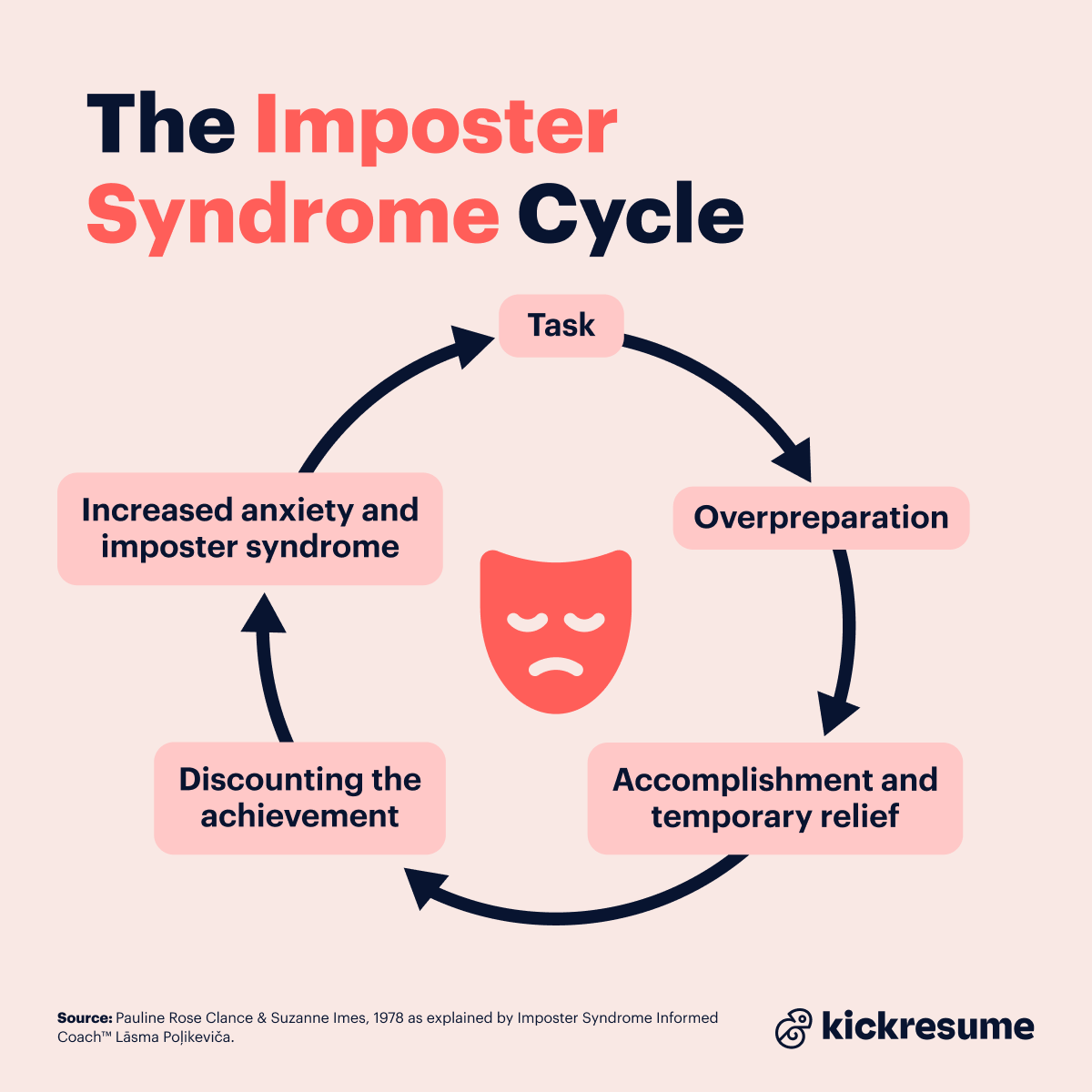
Can’t accept compliments? That’s a symptom of Imposter syndrome
If you relate to the following issues, you might have a case of Imposter syndrome — here are some common ways that it can manifest, according to the coach Lāsma Poļikeviča:
- Chronic self-doubt and fear of failure
- Putting your success down to external factors rather than your own achievements
- Overworking to compensate for perceived inadequacy
- Avoiding challenges because you’re afraid of being revealed as incapable
- Dismissing and overlooking your accomplishments and the praise you receive
The expert also shared that it can lead to issues like stress and burnout, with sufferers feeling socially withdrawn and finding it hard to concentrate. Worryingly, people with Imposter syndrome might be more likely to experience anxiety, depression, or suicidal thoughts.
In the workplace, Poļikeviča told us, Imposter syndrome can have a huge impact on people’s career development and confidence in decision-making at work (which was also found in Kickresume’s survey). However, she adds that it can also lead to reduced creativity and productivity, as well as low levels of job satisfaction.
People with Imposter syndrome might also be less likely to take part in what organizational psychologists call Organizational Citizenship Behavior — all the extra work beyond your job description that helps improve the working environment, like helping each other out and taking initiative on new company projects. This might be due to feeling burnt out and exhausted.
It can affect employees and managers differently
Lāsma Poļikeviča notes that there may be a few differences in how people experience Imposter syndrome and how it manifests, depending on their career level.
Employees might find themselves less motivated to plan their future career and make steps to progress, due to their fear of failure and self-doubt. Studies suggest that workers with less experience are more likely to feel like frauds, putting junior employees at greater risk.
Leaders, on the other hand, are under extra pressure from company expectations that, as studies have shown, can leave them feeling emotionally exhausted and less motivated to lead their teams. It might even affect the way they lead, making them less likely to take risks in their decision-making because they’re so worried about getting things wrong.
Why do people feel self-doubt? It could be their personality—or their working environment
But why are some people more likely to experience imposter syndrome than others, regardless of their career level? Lāsma Poļikeviča shared that it could be a result of psychological traits they have, the culture at their organization, or both.
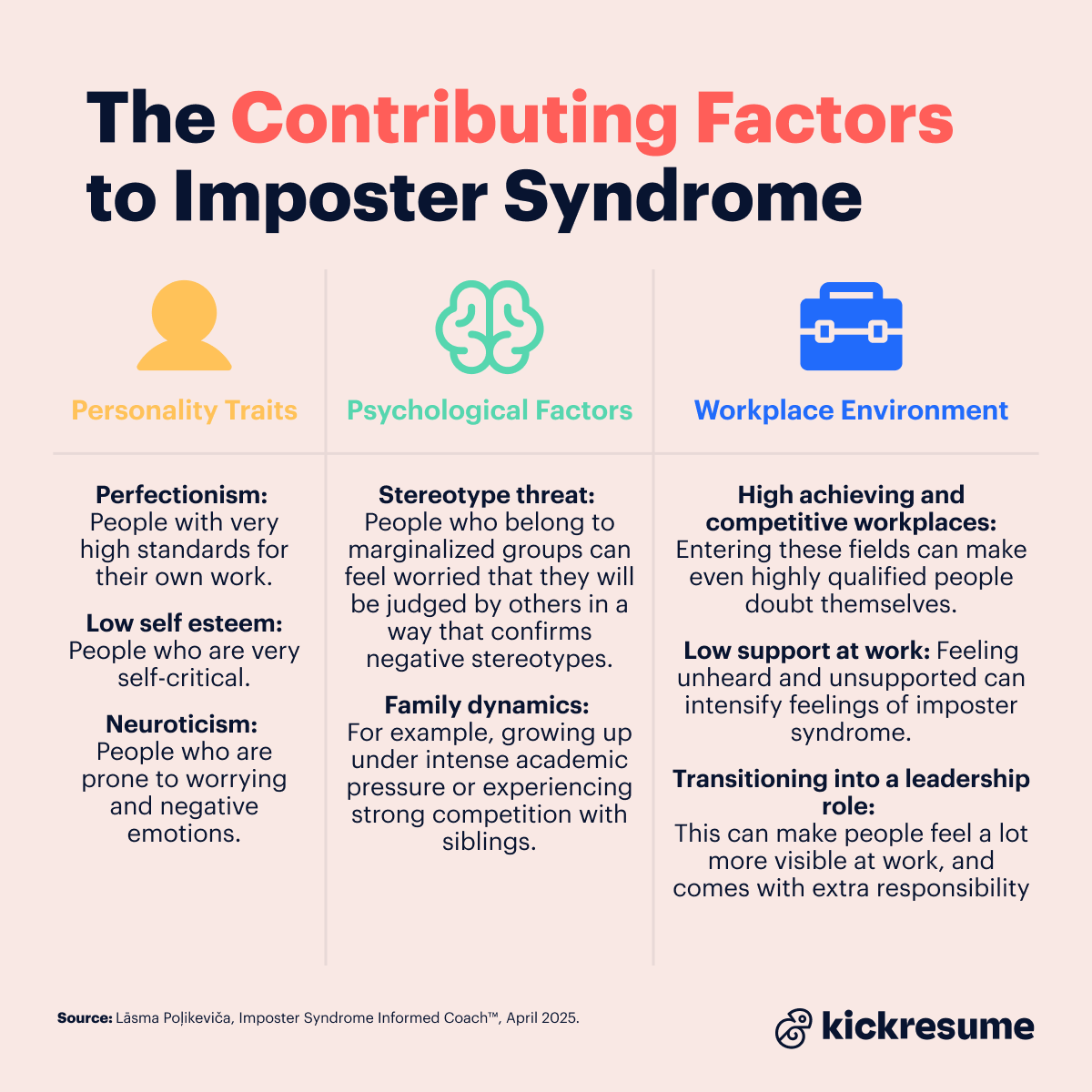
Here are the personality traits that the coach said might make you more likely to experience this issue:
- Perfectionism: In her words, people with this trait are more likely to “maintain high standards for self-evaluation, while being critical of their inability to realise these standards”.
- Low self-esteem and other issues with self-evaluation: People who are highly self-critical may be more likely to suffer from imposter syndrome.
- People with a high level of neuroticism: Neuroticism is one of the Big 5 personality traits along with conscientiousness, openness, extraversion, and agreeableness. In psychology, if you’re neurotic, it means you’re more likely to feel negative emotions, from fear and anger to guilt and loneliness.
She also linked imposter syndrome to two psychological factors outside of our personalities.
Firstly, people who belong to marginalized groups might experience “stereotype threat”, the fear that they will be judged or evaluated in a way that confirms negative stereotypes about their group. Studies have proven that this fear can undermine people's confidence, as well as how they perform on different tasks.
Secondly, the family dynamics people experienced growing up may make them more likely to experience imposter syndrome. For example, sibling rivalry or intense pressure to succeed in school may foster patterns that contribute to imposter syndrome in adulthood.
Lāsma Poļikeviča also identified a few workplace factors:
- High-achieving and competitive workplaces: People might feel less capable in these settings, despite being highly qualified. Entering a field like this could cause someone to develop imposter syndrome even if they didn't experience it before.
- Low support in the organization: People who don’t feel supported at work, or who don’t feel like they have anyone to talk to about their feelings of imposter syndrome, might struggle more.
- Transitioning into a leadership role: It increases both your responsibility and your visibility in the organization, which could trigger imposter syndrome.
It has a positive side, including empathy and social connection at work
There are actually some good things that can come out of imposter syndrome. While this may seem surprising, our own survey supports it: approximately 7% of respondents in both Europe and North America reported that imposter syndrome has, to some degree, advanced their careers. Of course, it’s never worth the risk of endangering people’s wellbeing at work.
The coach shared that people who have imposter syndrome might be likely to make a positive contribution in the following ways:
- They are likely to work hard and have a high level of self-awareness.
- People who experience this issue have been proven to be good at working together with others, focusing on other people’s needs—perhaps because they feel the need to prove themselves. However, this might vary, as some people with imposter syndrome might feel too burnt out to support their team as much as they’d like.
- While imposter syndrome makes people less likely to take risks in their decision-making, as we mentioned earlier, this carefulness might be a plus in some scenarios.
If people open up about their imposter syndrome, it can help build an empathetic work culture—especially if leaders open up. Talking to others about your feelings of imposter syndrome could really help them.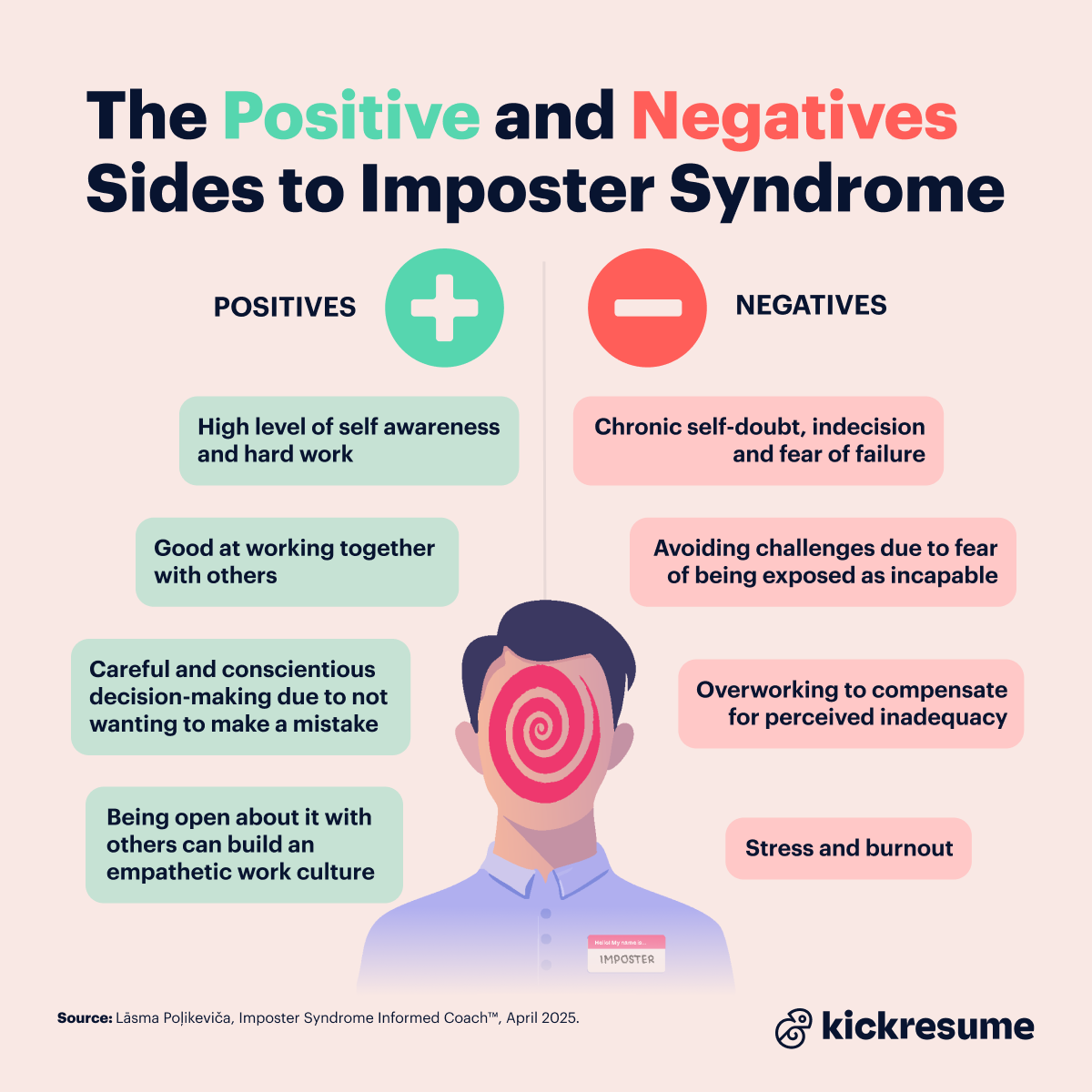
Training and development can reduce imposter syndrome’s effects
For those struggling with imposter syndrome, Lāsma Poļikeviča recommends trying cognitive behavioral techniques that train your brain to think differently by reframing negative thoughts.
Individuals might also benefit from practicing mindfulness, which can help prevent you from spiralling into anxiety and negative thoughts. Both of these strategies are more accessible than you might expect as there are plenty of worksheets, guided meditations and other resources online, often for free.
She also encourages individuals to join a support group or speak to a mentor within your organization or professional network. Talking about this issue gets it out into the open, and together, people can support each other and share coping strategies.
At an organizational level, Lāsma Poļikeviča encourages businesses to organize workshops, training sessions, and discussions themed around imposter syndrome. She also maintains that leaders, who have a big influence on company culture, should show empathy to employees and colleagues who suffer with imposter syndrome, as well as opening up about their own feelings.
In fact, our recent survey revealed that 50% of senior leaders with imposter syndrome in both North America and Europe said that learning that other people feel the same way would help them a lot.
Lāsma Poļikeviča also shared that giving your team regular constructive feedback and praising their achievements can foster a sense of clarity that reduces imposter syndrome, as well as reassures them that they’re doing a great job.
Encouraging employees to reflect on their progress and achievements will also help show them that they’re not imposters, frauds or fakes—they’re valued team members with a lot to contribute. In our survey, 52% of North Americans and 51% of Europeans confirmed that getting regular feedback would help them stop feeling like an imposter.
Conclusion
Imposter syndrome is a serious workplace issue that can affect people at any level of your organization, although how it manifests itself might vary depending on their role and seniority. While people might be more likely to be affected due to their personality or their background, the workplace itself or their role within it could be an influence too.
Despite all the stress and anxiety it causes, people who suffer from imposter syndrome can be fantastic, conscientious team members. But it’s not worth the risk to their wellbeing, so organizations should do what they can to help their staff members shed their imposter syndrome and feel more confident and secure in themselves. Training and mentorship are key, as is giving regular, helpful feedback.
Note
Kickresume spoke to Lāsma Poļikevičain April 2025 who shared her insights and drew on research by academic psychologists. Kickresume asked her to describe how imposter syndrome presents in people at different career levels and what makes someone more likely to develop this issue, as well as providing tips on how it can be overcome, at both a company and individual level. She is an Associate Certified Coach, who has received certification from the International Coaching Federation. With 5 years experience coaching individuals and teams, she has dedicated her career to understanding and addressing the psychological factors that influence our professional growth. Lāsma Poļikeviča is an Imposter Syndrome Informed Coach™, having been trained by the Imposter Syndrome Institute to specialize in this area.
About Kickresume
Kickresume is an AI-based career tool that helps candidates source jobs and raise salary with powerful resume and cover letter tools, skills analytics, and automated job search assistance. It already helped more than 8 million job seekers worldwide.