ChatGPT
 Perplexity AI
 Claude
Maybe you've been helping others integrate into companies for quite some time now; but who's going to help you with your training specialist cover letter? That'd be us! We've gathered all the best templates, cover letter samples, detailed examples, and tips that actually work. So, let us guide you through the writing process one step at a time.


 See more examples like these
In this guide, we teach you all about the key elements your training specialist cover letter should have. Keep reading to learn:
- The dos and don'ts of cover letter writing from real samples
- The best formatting tips for your training specialist clever letter
- Putting together an informative header
- Crafting a clear and focused headline
- Writing a respectful cover letter greeting
- Starting with an introduction that grabs attention
- Highlighting your experience, certifications, and training results
- Weaving powerful action verbs into the narrative
- Ending your training specialist cover letter with confidence
- Common mistakes training specialists make and how to avoid them
- Matching your cover letter with the right resume
- Where to find job listings, networking tips, and professional resources
- How to embrace AI
- What to expect in terms of salary and job growth for training specialists
Still looking for a job? These 100+ resources will tell you everything you need to get hired fast.
Training specialist cover letter sample


Why does this sample work?
- It mentions specific software: One strong point in this letter is that the applicant names the exact HR tools they’ve used (like Dayforce HCM, Zenefits, and Breezy HR). That’s helpful because it gives the employer a clear picture of what systems the candidate is already familiar with. It shows that the person isn't just listing general skills but actually has hands-on experience with tools that are common in the field.
- It ends in a confident and professional way: The closing paragraph strikes a nice balance between being polite and showing enthusiasm. The applicant expresses interest in continuing the conversation and thanks the employer without sounding overly formal or stiff. It's a clear, respectful ending that leaves the door open for the next step.
What could be improved?
- Establishing a personal link between the candidate and the employer: While the letter mentions the job title and the company name, it doesn’t really show why the applicant is interested in this particular organization. Adding one or two lines that show they’ve looked into ACC Technologies, maybe something about their values, recent work, or the kind of training programs they run, would help make the cover letter feel more tailored.
- Adding a personalized greeting: Starting the letter with “Dear Hiring Manager” is okay when you don’t know who to address it to, but if the name of the person handling the hiring is available (even just a department head), it’s better to use it. A personalized greeting shows the applicant took a little extra time to look into the company, and that kind of effort can make a small but meaningful difference. It adds warmth and a human touch.
Workforce specialist cover letter example

Why does this sample work?
- It caters to the employer’s needs: The applicant does a nice job responding directly to the job description. They show that they’ve read what the company wants and explain how they meet those needs. That makes it easy for the recruiter to connect the dots and see the applicant as a potential fit.
- It mentions a specific accomplishment: One of the standout moments in the letter is the part about improving client satisfaction from 75% to 98%. That’s the kind of specific, measurable achievement that hiring managers love to see. It gives real proof of the applicant’s impact, rather than just listing tasks or general skills. Numbers like that catch the eye and help build confidence in the candidate.
- It aligns the candidate’s goals with those of the employer: They say they’re looking for a company that values both personal and professional growth, and they believe REP Consulting fits that picture. That kind of alignment helps the employer feel like the applicant isn’t just looking for any job, but is genuinely interested in growing with this team.
What could be improved?
- The headline could be more attention-grabbing: This is a solid cover letter — it would be a shame if the recruiter dismissed it because of its generic headline. Since the letter includes a clear and impressive accomplishment, why not lead with that? Something like “Workforce Specialist Who Boosted Client Satisfaction from 75% to 98%” instantly gives the reader a reason to take a closer look.
Employee relations specialist cover letter example

Why does this sample work?
- It mentions relevant certification: The applicant includes a professional certification, Certified Human Resources Professional, which adds credibility right away. It shows they’ve taken extra steps to build expertise and stay current in their field. Including a certification like this is especially helpful in roles related to HR, where credentials often matter.
- It has a clean, easy-to-read layout: The formatting is simple, clear, and well-organized. It’s broken up into short paragraphs that are easy on the eyes, and it avoids big blocks of text that might overwhelm a reader. This makes it much more likely that a hiring manager will actually read the whole thing.
What could be improved?
- Adding some quantifiable data: The cover letter mentions a range of responsibilities (like managing staff activities and evaluating salary increases) but doesn’t say anything about results. Numbers make a difference. Even something like “streamlined the onboarding process, reducing average training time by 20%” would give a clearer picture of impact.
- Sprinkling in a few action verbs: The tone of the letter is professional, but the language leans a bit flat in places. Phrases like “have demonstrated a proficiency” could be swapped for more energetic action verbs like “led,” “launched,” or “implemented.” These kinds of words make the applicant’s experience sound more active and confident.
1. How to format your training specialist cover letter
The way your cover letter looks can influence how seriously it’s taken, sometimes before the first sentence is even read. That doesn’t mean it needs to be fancy. In fact, simple is usually better.
Your goal is to make it easy for recruiters to read your letter without getting distracted by clutter, strange fonts, or walls of text. Here’s how to keep it clean and practical:
- Stick to the basics with fonts: Use something straightforward like Calibri or Arial. Make sure the size is readable (usually 11 or 12 pt).
- Use space like it matters…because it does: Break up your paragraphs. If everything’s packed together, it’s harder to read, and your main points can get lost.
- Align everything to the left: It might not feel creative, but it works. Left-aligned text is easier to scan, especially when someone is reading fast.
- Structure it like a letter, not an essay: A solid structure keeps you on track: Start with a header, then a greeting, a short intro, your main points, and a short closing That’s it. No need to overthink it.
- Keep it to a single page: The goal isn’t to tell your full work history. Just enough to show you know the role and you’ve got what it takes to do it well.
- Bullet points can help (when used sparingly): If you have two or three points that deserve their own space, like specific training outcomes or standout metrics, they can work well in a list. Just don’t overdo it.
Once your format is in place, you’re ready to focus on what really counts: the content.
Create your cover letter fast with artificial intelligence.

2. How to create an effective cover letter header
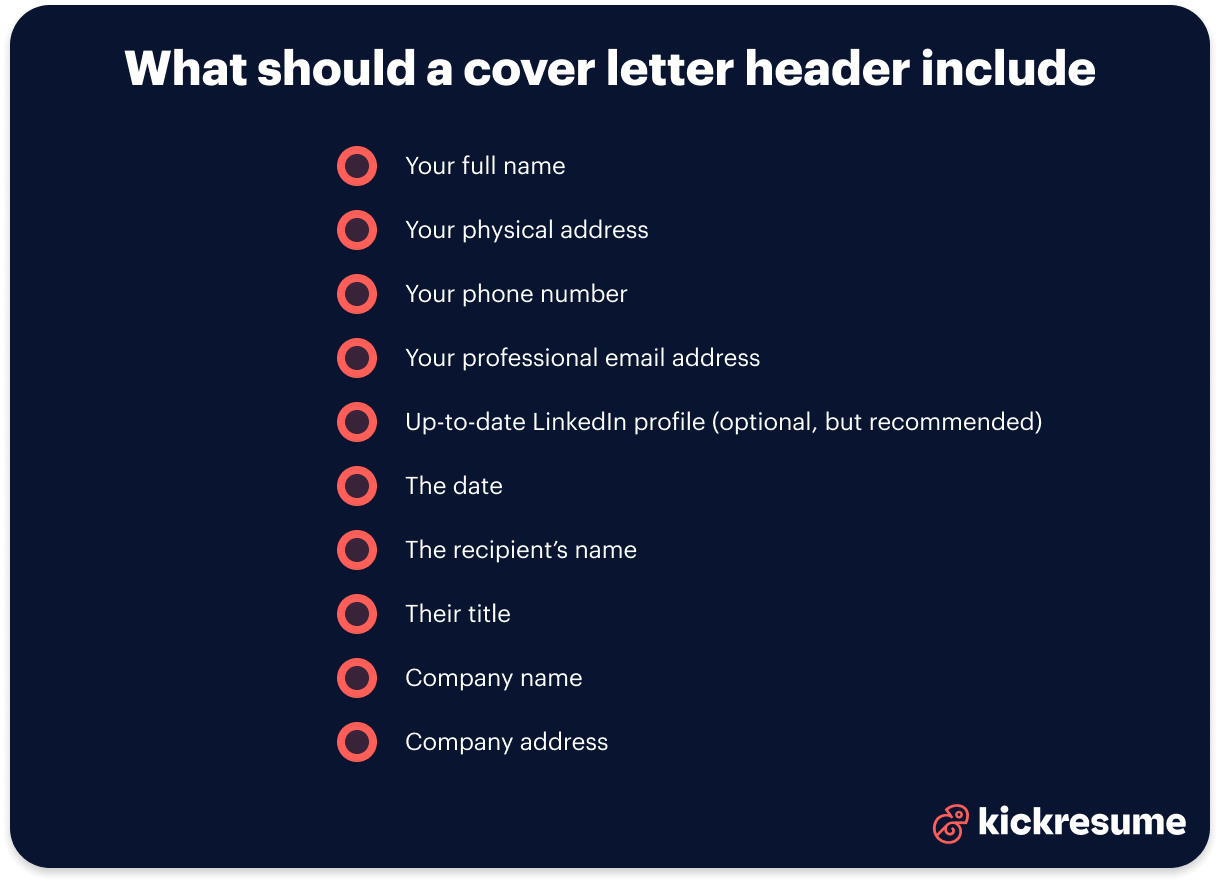
Your header isn’t the most exciting part of your cover letter. But it's one of the most important. It’s the part that tells the hiring manager how to reach you. If something’s missing or unclear, it can make things harder than they need to be.
1. Start with your own information, listed neatly at the top:
- Full name
- Phone number (with area code)
- Email address (use one that sounds professional)
- LinkedIn profile (optional, but useful if it’s up to date)
- You can also include your current job title if it’s relevant to the role
There’s no need to list your full street address unless the employer specifically asks for it.
2. Then, a few lines below, add the employer’s information:
- The name of the hiring manager (if you know it)
- Their job title
- The company’s name
- The company’s address
Let’s look at an example of how not to do it:
Bad example of a training specialist cover letter header
From: Jess T.
jesshands@email
To: Hiring Team
What's wrong with this example? This version is missing key details and feels rushed or generic.
Now peek at this example:
Good example of a training specialist cover letter header
From: Jess Taylor
(415) 555-1200
jess.taylor@email.com | linkedin.com/in/jesstaylor
To: Morgan Kim, Senior Training Manager
Bridgepoint Solutions
2200 Market Street
San Francisco, CA 94114
What makes this example look so professional? This one simply gets the job done. Everything in this example is spelled out clearly. It looks polished, professional, and complete.
A good header doesn’t call attention to itself. But it does make the rest of your letter easier to take seriously. Now that your header is looking sharp, you’re ready to move on to writing a killer cover letter headline!
3. How to craft a punchy cover letter headline
If your cover letter were a news article, the headline is what gets people to read it. Especially when the person reading it has a hundred other job applications to get through.
A headline isn’t a required part of a cover letter outline, but including one can work in your favor. It helps you get to the point fast, and it shows that you’re not just sending out the same letter to every job out there.
What makes a headline work?
A solid headline doesn’t try to be clever or poetic. It just answers a simple question: Why should someone keep reading this?
Here’s what helps:
- Say what you do: Be clear about your role or area of focus.
- Add something specific: Years of experience, the kind of training you’ve delivered, or a key result you’re proud of.
- Keep it short: One line is plenty.
Let’s compare two plumber cover letter headline examples and break down what works. And what doesn’t.
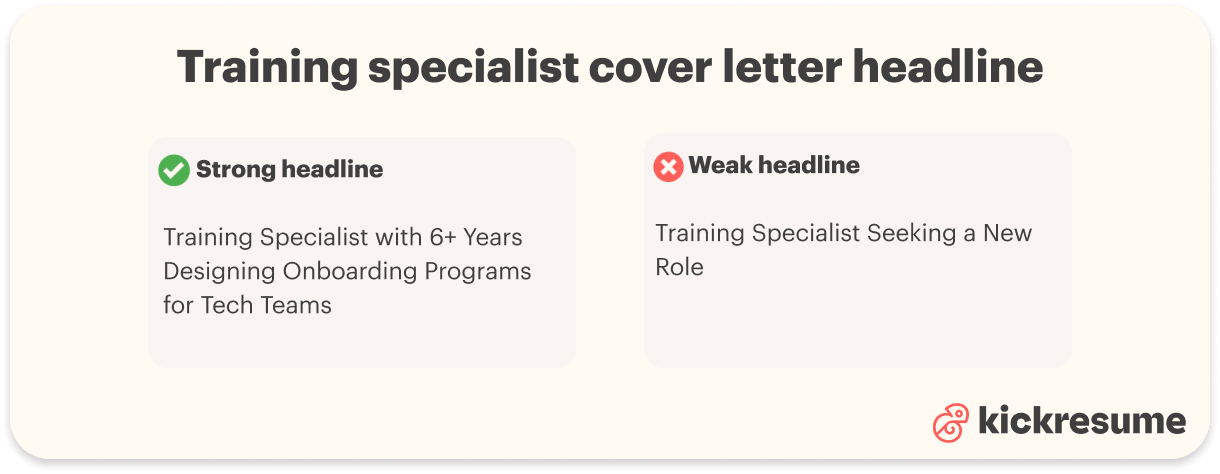
Bad example of a training specialist cover letter headline
Training Specialist Seeking a New Role
Why isn't this the way to go? This doesn’t hurt you, but it doesn’t help either. It’s vague, it’s forgettable, and it sounds like something anyone could write. There’s no hook, nothing that makes it your headline.
Good example of a training specialist cover letter headline
Training Specialist with 6+ Years Designing Onboarding Programs for Tech Teams
What makes this example better? It gives the reader something concrete. You’ve said what you do, who you’ve done it for, and how long you’ve been at it.
Tips for fresh graduates
You can still write a strong headline even if you don’t have years of experience. Focus on what’s real: your training, your focus, or the kind of work you’re ready to do.
Headline example for fresh graduates
HR Graduate with Practical Experience in Employee Training and LMS Tools
Your headline doesn’t need to be perfect. It just needs to be yours. Keep it grounded, skip the fluff, and give the reader a reason to read on.
4. How to personalize the greeting on your training specialist cover letter
When a cover letter opens with something like “To Whom It May Concern,” it shows one thing: this could’ve been sent to anyone.
If you want to show the employer you’re actually interested in them, the simplest way is to use their name.
How to find the right person to address
Here are a few quick ways to track down a name:
- Scan the job ad: Sometimes the contact person is listed near the bottom.
- Look on the company website: Try the “About” or “Team” page. You might find the head of HR or the training department.
- Check LinkedIn: Search for the company and filter by job titles like “HR Manager” or “Learning & Development Lead.”
- Make a quick call or send a message: A short email asking who’s handling applications can go a long way. And it shows initiative.
You don’t need to spend hours on this. Just a few minutes of effort can turn your greeting from generic to personal.
Once you’ve got a name, keep your greeting simple and respectful.
Examples of personalized greetings
- Dear Jordan Lee,
- Dear Mr. Carter,
- Dear Hiring Manager Jordan Lee,
If you’re not 100% sure of the person’s gender or title, skip “Mr.” or “Ms.” altogether and just use their full name.
What if you can’t find a name?
Sometimes, even after some digging, there’s just no way to figure out who’s on the other end. That’s fine. You can still address a cover letter without a name with style!
General, yet professional, greeting examples
- Dear Hiring Manager,
- Dear Learning & Development Team,
- Dear [Company Name] Recruitment Team,
Getting the greeting right doesn’t take much, but it does help your cover letter land better. It shows you're writing to someone, not just ticking a box.
5. How to write a catchy introduction
The first few lines of your cover letter do a lot of heavy lifting. How you start your cover letter matters…a lot. If your intro sounds like it was copied from a template, most hiring managers will skim it and move on.
But if you can say something real, something grounded in your experience or interest, you’ll stand out.
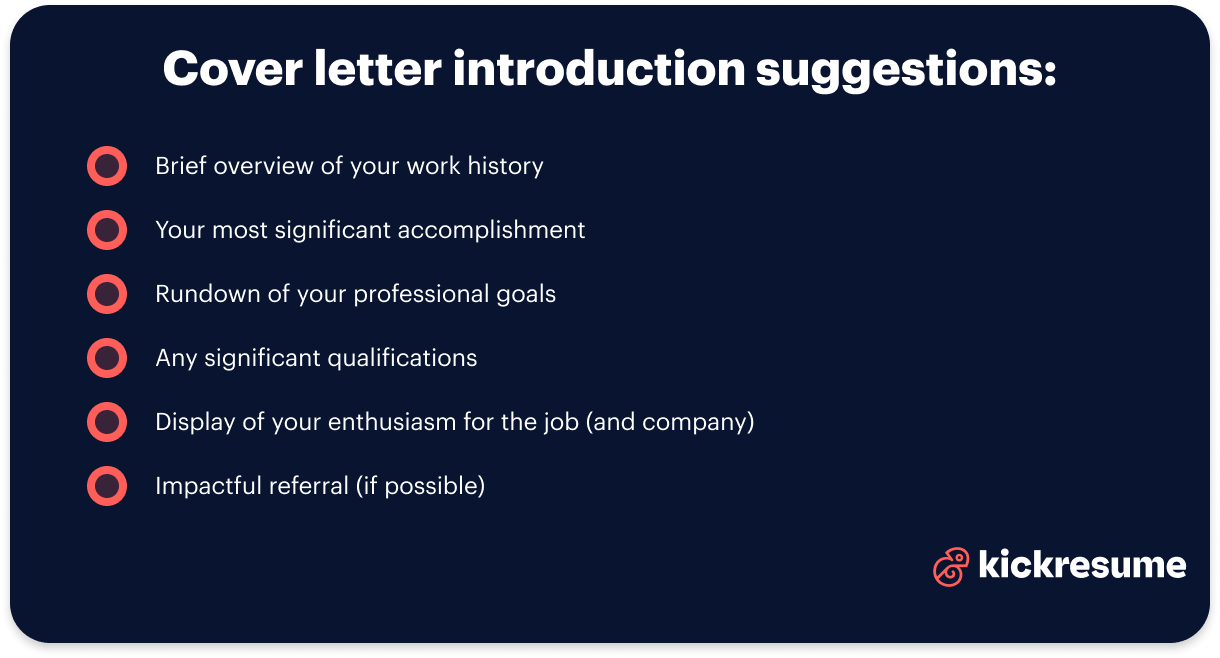
Here are a few key things you should consider including in your intro:
- Brief overview of your work history
- Your most significant accomplishment
- Any relevant qualifications
- Display of your enthusiasm for the job (and company)
- Impactful referral (if possible)
That’s it. No fluff. No dramatic statements. Just clarity and a little personality.
Let’s break down what works and what doesn’t:
Bad example of a training specialist cover letter introductio
I am writing to apply for the Training Specialist position at your company. I believe I have the necessary skills and experience for the role.
Why does this example fall flat? This could be anyone, applying anywhere. It’s safe, but vague and forgettable. No specific details. No hint of personality or interest.
Good example of a training specialist cover letter introduction
With 5+ years of experience designing hands-on learning programs for mid-size tech teams, I was excited to see that your company is expanding its L&D efforts. At my current role, one of my onboarding courses helped reduce new hire ramp-up time by 30%, and I’d love to bring that kind of impact to a team focused on long-term employee growth.
What exactly makes this example pop? It shows relevant experience, makes a clear connection to the company’s work, and gets across some real enthusiasm without going over the top.
Tips for fresh graduates
No need to apologize or overexplain. Just focus on what you do bring to the table whether that’s related experience, fresh training, or a clear reason for wanting the role. You can still deliver a great cover letter with no experience!
Training specialist cover letter opening example for fresh graduates
I recently completed a training and development certification program and am excited to apply what I’ve learned in a real-world setting. During the course, I created a sample training module that earned top marks and was later used as a best-practice example for new students. Your company stood out to me because of its focus on internal growth and I’d love to be part of that work.
Keep in mind: you don’t need to say everything in your intro. You just need to give the reader a reason to keep going. A little focus, a little heart, and you’re good to go.
6. How to show your professional value through your skills
This is the part of your cover letter where you move from polite interest to proof of value.
Hiring managers are looking for someone who can step in and solve problems. So instead of listing every tool you’ve used or every training you’ve led, focus on the skills that align with this specific role.
Start with the job description.
What are they really asking for? A rollout trainer for new systems? A content designer for hybrid learning? A people-person who can coach team leads? Pay attention to the priorities they repeat, and let those guide your choices.
How to pick the right skills
Training specialists operate at a unique intersection: you’re expected to understand systems and processes and know how to communicate them to people who learn differently, have questions, or might resist change.
So yes, hard skills definitely matter. But so do soft skills like empathy, patience, and the ability to read a room.
10 in-demand skills for training specialists
- Instructional design (ADDIE, SAM, etc.)
- E-learning authoring tools (Articulate, Captivate, etc.)
- Learning Management Systems (LMS) administration
- New hire onboarding & orientation
- Employee coaching & soft skills facilitation
- Training evaluation & feedback analysis
- Project management (especially for training rollouts)
- Interpersonal communication & active listening
- Change management & adaptability
- Data-driven decision-making (surveys, completion rates, performance metrics)
Not every job requires all ten, of course. But highlighting 3–4 of these, especially those mentioned in the job ad, gives your cover letter real weight.
How to showcase your skills
Don’t just name-drop your skills. Ground them in real outcomes. Use a simple format:
- Aim for 2 to 4 short paragraphs
- Each should highlight a specific skill, achievement, or experience
- Use clear context and numbers when possible
- Stick to what’s most relevant for this job
Situation → Skill → Result
Here are a few examples:
Presenting your skills in a training specialist cover letter
- Instructional design: “I created a blended learning program for our customer service team that combined short videos, quick-reference guides, and live Q&As. In the first quarter post-launch, we saw a 22% reduction in support escalations.”
- New hire onboarding: “After noticing gaps in our onboarding flow, I redesigned the first two weeks of training — adding job shadowing, structured check-ins, and a buddy system. New hire satisfaction scores jumped from 76% to 94%.”
- Soft skills coaching: “I ran monthly communication labs for team leads across departments. Over time, we saw a 30% drop in peer-to-peer conflict reports and an uptick in cross-team collaboration scores on our engagement survey.”
Tips for fresh graduates
Here are examples of experiences you can draw from as a recent graduate:
- Internships in HR, L&D, or organizational development
- Capstone projects focused on adult learning or instructional design
- Volunteering to teach workshops or coordinate onboarding for student orgs
- Classroom simulations or mock training modules
- Coursework involving learning theory or training technology
Presenting your skills in a training specialist as a fresh grad
During my final semester in my Organizational Development program, I partnered with a nonprofit to build and deliver a training session on time management for volunteers. Attendance was optional — but we had a full house, and post-session feedback averaged 4.7 out of 5. That’s when I knew I’d found the right path.
Your experience, whether it's 10 years deep or just getting started, is the heart of your cover letter. The more clearly you can show what you’ve done and how it connects to this role, the easier it is for the hiring manager to see you as the best fit.
Find out your resume score!

7. How to weave powerful action verbs into your training specialist cover letter
The problem with soft, vague verbs is that they blur the work you’ve done into something forgettable. Phrases like “was involved in,” “assisted with,” or “helped to” make you sound like a bystander, even when you were at the center of the work.
That's why you should always remember to sprinkle a few action verbs throughout your cover letter.
Instead of: I helped onboard new hires and showed them how to use the LMS.
Try: I facilitated onboarding for 20+ new hires, delivering hands-on LMS training and improving adoption rates by 35%.
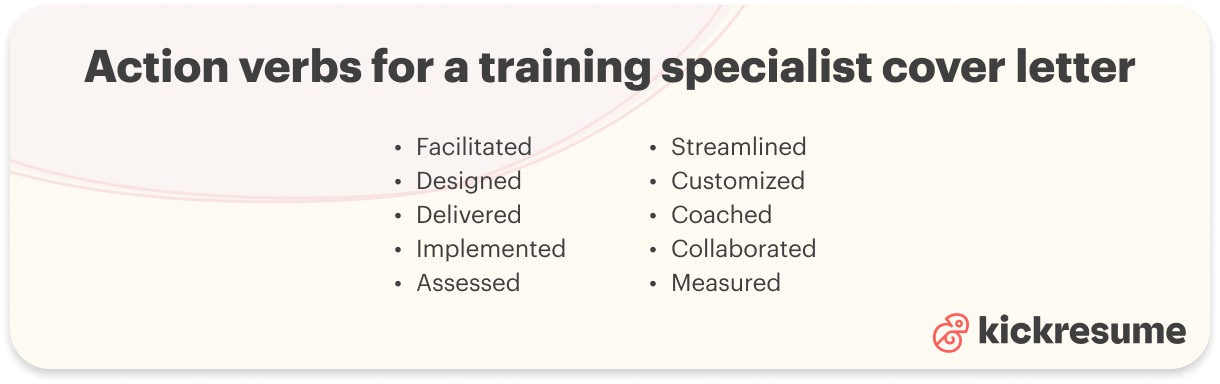
List of strong action verbs for a training specialist cover letter
- Facilitated
- Designed
- Delivered
- Implemented
- Assessed
- Streamlined
- Customized
- Coached
- Collaborated
- Measured
Here are a few more quick examples:
Before: I was responsible for creating training materials.
After: I designed tailored training materials for a new CRM rollout, leading to faster user adoption.
Before: I helped improve onboarding.
After: I revamped the onboarding program, cutting time-to-productivity by 20%..
Before: I participated in team development efforts.
After: I led cross-functional training sessions that improved interdepartmental communication scores by 15%.
You don’t need to overuse them or sound like a thesaurus, just be mindful. Swapping in stronger verbs here and there can give your writing more clarity.
But being intentional with the action verbs you use will sharpen your writing, bring your accomplishments into focus, and leave a more confident impression on the reader.
8. How to end your cover letter with a strong closing statement
You’ve made your case. You’ve shown that you know your stuff. So don’t trail off at the end with a generic thank-you and hope it’s enough.
How you end your cover letter matters as much as how you start. A good cover letter closing should sound like you’re wrapping up a meaningful conversation, not reading from a script.
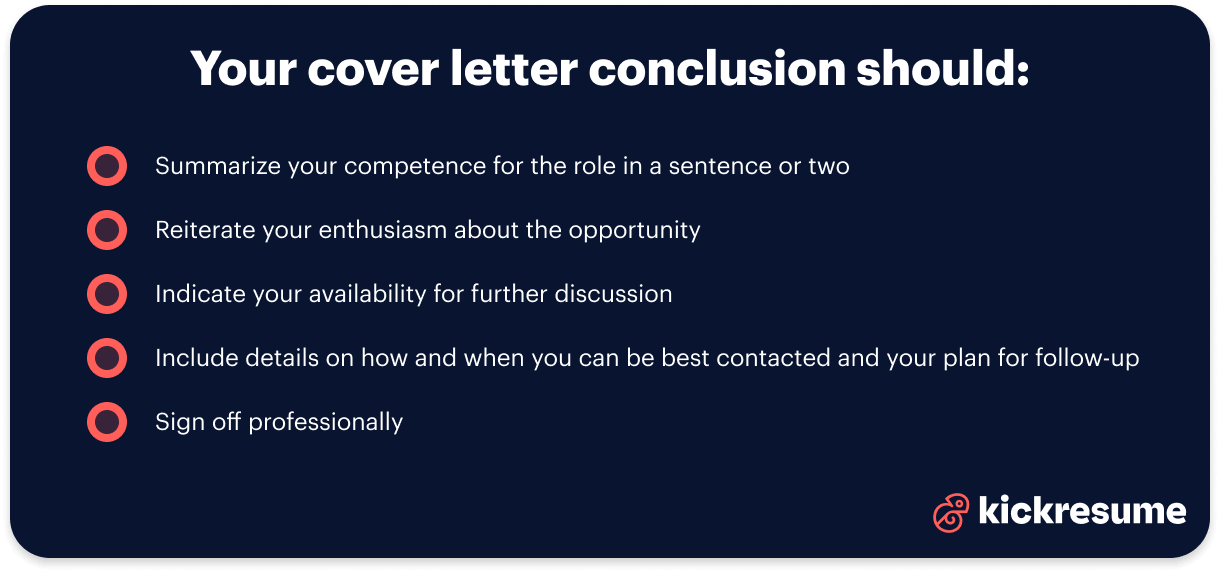
A good closing does a few simple things:
- Summary of competence: Highlight why you’re the best person for the role.
- Reiterate enthusiasm: Express genuine excitement about the opportunity.
- Contact information: Clearly state how and when you can be contacted.
- Follow-up plan: Indicate how and when you’ll follow up on your application.
- Formal sign-off: End with a professional closing.
Take a look at two examples and see which one works better:
Bad training specialist cover letter closing example
I hope to hear from you soon. Thank you for your time and consideration.
Why doesn't this example work? Polite? Sure. Memorable? Not really.
Good training specialist cover letter closing example
Thank you for taking the time to consider my application. I’m excited about the opportunity to bring my passion for learning and my track record in delivering high-impact training to a team that values growth as much as I do.
I’d be happy to talk more about how I’ve increased employee course completion rates by 40% and how I could apply that same energy here. You can reach me at (415) 555-1200 or jess.taylor@email.com.
Looking forward to connecting,
Jess Taylor
Why does this example sound so much better? Because it actually says something. It reminds the reader what the applicant brings to the table, shows real enthusiasm for the role, and clearly invites the next step. It feels confident, warm, and professional.
Examples of polite sign-offs
- Sincerely
- Best regards
- Thank you
- Warm regards (if the tone has been casual throughout)
You don’t need to overthink it. Just aim for a few well-placed lines that sum up what you bring to the table and show you’re genuinely interested. If the beginning of your letter opened the door, the ending should leave it open just wide enough for a callback.
9. How to avoid making common cover letter mistakes
You can have solid experience, sharp skills, and a real drive to help others learn and grow, but if your cover letter is weighed down by avoidable mistakes, you’re likely to miss your shot.
The good news? Most cover letter slip-ups are surprisingly easy to fix once you know what to watch out for.
1. Writing a one-size-fits-all letter: If your cover letter reads like it could apply to any job at any company, it’s going to feel impersonal. Hiring managers can spot a generic letter in seconds.
2. Treating it like a resume summary: A cover letter isn’t just a slightly wordier version of your CV. If all you’re doing is restating bullet points, you’re missing the chance to connect.
3. Talking only about what you want: Sure, you want to grow your career. But if your cover letter is all about getting experience or climbing a ladder, it can come off a bit self-serving.
4. Writing too much (or too little): An epic five-paragraph essay? Too much. A three-line email that says, “Here’s my resume”? Not enough.
5. Ignoring the fine print: Some job ads include very specific instructions: attach a portfolio, mention a reference number, include a certain phrase in your subject line.
6. Overlooking typos or clunky phrasing: Even one awkward sentence or misspelled word can undermine your professionalism.
7. Using formatting that’s hard to read: You don’t need fancy design, but you do need readability. If the letter is dense, crammed with text, or full of mismatched fonts, it’s going to hurt your chances.
Some of the biggest mistakes aren’t about what you leave out, they’re about what you leave in. Generic openings, vague claims, and terrible cover letter phrases can make even the strongest candidate sound meh.
10. How to pair your training specialist cover letter with resume
You’ve written a solid cover letter. Great! But before you send it off, here’s one last step that’s often overlooked. You need to make sure it works with your training specialist resume, not separately from it.
Each one plays a unique role, but they need to be aligned if you want to make a strong impression.
Cover letter vs. resume
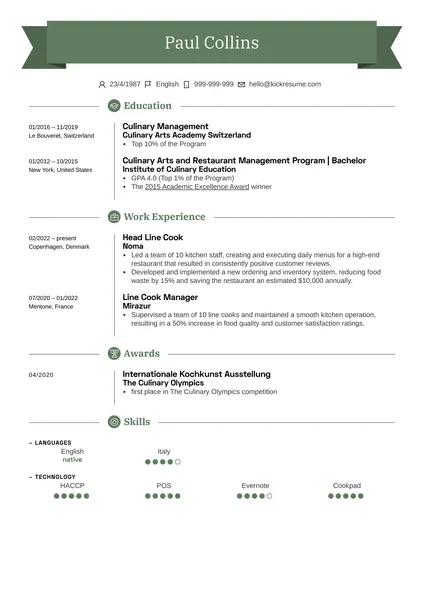
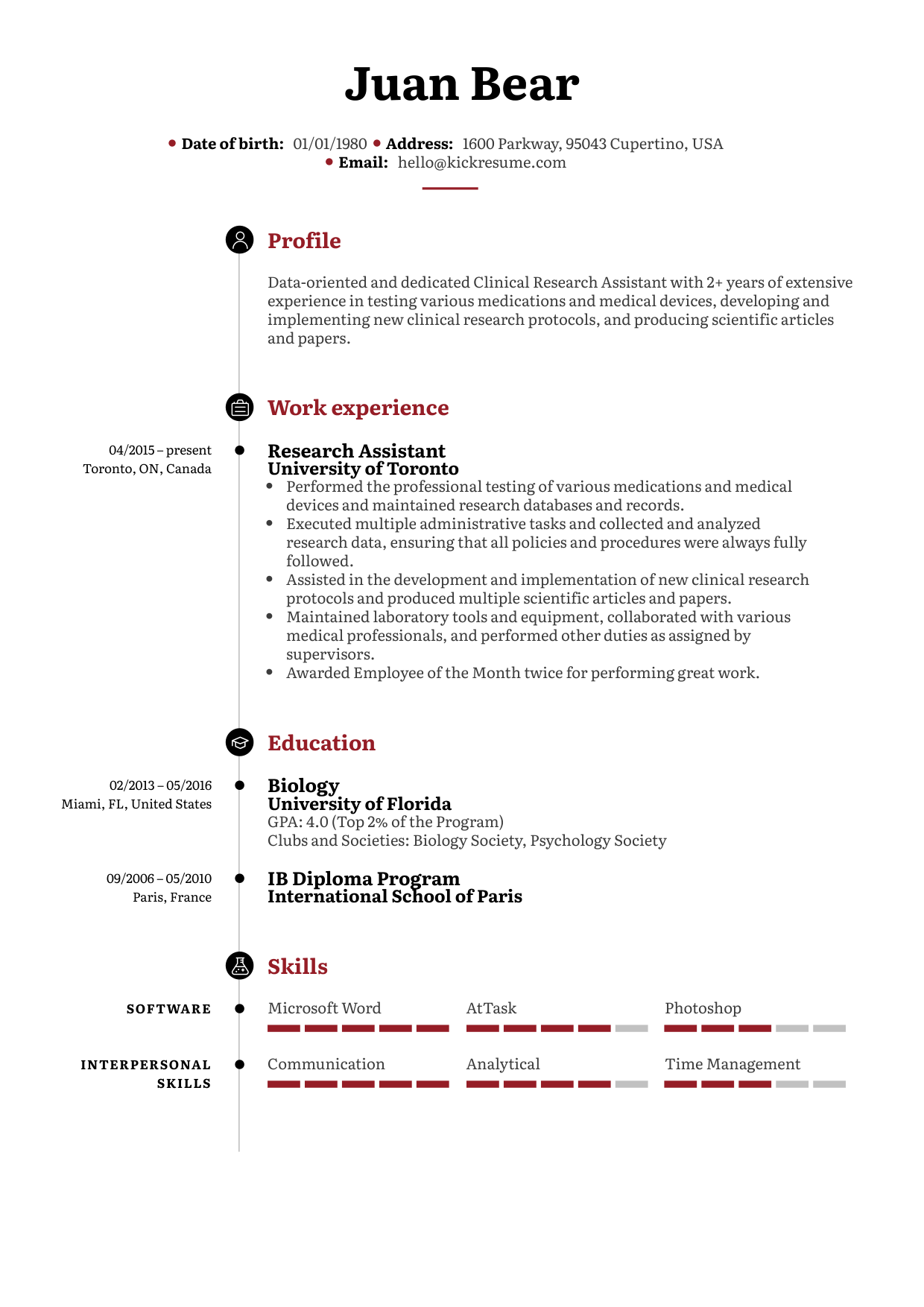
- Your resume is your blueprint — job titles, certifications, timelines, tools, and results. It’s concise and fact-based.
- Your cover letter adds context, shows personality, and highlights why those bullet points matter.
They should feel like they belong to the same person. That means more than just saying the same things in two formats. You also need to make it match visually.
Make your cover letter and resume visually cohesive
Here’s how to ensure your resume and cover letter are pulling in the same direction:
- Keep contact info consistent: Your name, phone number, email, and LinkedIn should appear the same way on both documents (same format, same order, same spelling).
- Use matching fonts and styles: If your resume is in Helvetica 11pt, don’t switch to Georgia 12pt for your letter. Choose one clean, professional font and stick with it across both.
- Align your formatting where it makes sense: Bullet style, line spacing, header format — small visual cues like these help your documents feel cohesive, even before a word is read.
- Keep color subtle and consistent: If your resume has a small accent color (like navy blue or dark green), bring that into your cover letter.
If formatting isn’t your favorite part of the process, don’t worry! We've got tons of professionally designed resume and cover letter templates that can help you nail the look without the layout headache. Some even come as a bundle, so your documents match right out of the box.
Let your cover letter write itself — with AI!
11. AI isn't here to steal your job
As AI continues to reshape workplaces across industries, the role of training specialists is also evolving.
AI is opening up new ways to personalize learning, improve outcomes, and align training more closely with business goals. Staying informed about these shifts can make your applications stronger and show that you’re ready to thrive in this new landscape.
What’s changing in the world of L&D
Modern training isn’t about one-size-fits-all PowerPoints or end-of-course quizzes anymore. Organizations are now using AI to:
- Analyze employee performance in real time: AI helps identify skill gaps and tailor learning paths accordingly (continuously).
- Create hyper-personalized training: Platforms powered by AI can adjust content, pace, and format to each employee’s goals, learning style, and performance.
- Support trainers with AI teaching assistants: AI tools can answer learner questions, recommend content, and give feedback. All this makes learning more interactive.
- Use predictive analytics for smarter planning: Want to know who’s ready for leadership roles, or which teams are at risk of burnout? AI tools can now help forecast these trends and guide your L&D strategy.
- Track ROI and impact better: AI can evaluate training effectiveness in real time and tie learning outcomes directly to business performance.
What this means for you as a training specialist
More and more, hiring managers are looking for training specialists who can work with AI tools and use learning analytics to show the impact of training.
You don’t need to be an AI engineer to stay ahead, but it helps to be familiar with the tools shaping the future of L&D:
- Synthesia / Pictory: You can create AI-generated training videos with avatars and voiceovers. Great for visual learning content.
- Docebo: An AI-powered learning management system (LMS) that offers automated content recommendations and advanced learning analytics.
- Rephrase.ai: This text-to-video tool can help you generate scenario-based microlearning videos customized to different teams or learners.
- Glean: AI assistants that help summarize, document, and train employees on processes
How to include this in your cover letter
If you’ve worked with any AI-based platforms (like adaptive learning systems, AI assessments, or data dashboards), say so!
Even if you’ve just explored them out of interest, mentioning your curiosity about AI in learning shows forward thinking.
Examples for your training specialist cover letter
- In my previous role, I partnered with the HR analytics team to integrate performance data into our training design — a shift that increased training relevance and boosted learner engagement by 20%.
- I’m particularly interested in how AI is transforming learning design and performance feedback, and I stay current on emerging tools that support personalized development.
- Recently, I began exploring tools like Synthesia and ChatGPT to streamline learning content development and improve learner engagement. I’m excited by their potential to scale training while keeping it personal!
In short, training specialists who understand the potential of AI will be in high demand. Use your cover letter to show you’re one of them.
12. Top resources for job-seeking training specialists
With your top-notch cover letter at hand, it's time to get to the fun part. The job hunt itself! If you're struggling because you don't know where to start searching for work opportunities, you can try any of the following:
- Industry-specific job board: Job boards with niche focus that specialize in listing job postings for training specialists, like ATD’s Job Bank, can serve as a great launching pad.
- General job boards: White websites like Indeed, Glassdoor, and SimplyHired, are much broader in focus, by entering keywords specific for your profession, you can narrow down the search results.
- LinkedIn: You can use it not only for networking, but also to discover job listings in the training and development field, with the ability to filter searches by industry, location, and job function.
- Professional associations: Besides job listings, professional associations like the Association for Talent Development (ATD), the eLearning Guild, or the Learning and Performance Institute (LPI) can also offer you networking opportunities, latest industry news, training opportunities, and access to specialized publications.
- Specialized publications: To keep up with the latest innovations, methods, and discussions surrounding your field of interest, consider following media such as “Training Magazine,” “TD Magazine,” or “Chief Learning Officer Magazine.”
- Continuous learning: If there's anyone that truly understands how important lifelong learning is, it's you. You can always increase your chances at landing a job by taking on extra courses and certifications. You can try online platforms like Coursera, edX, LinkedIn Learning, or Udemy.
Indeed, the vastness of work opportunities is yours to explore. But don't forget that a successful job search does not only rest on finding the right job posting. It's also about presenting yourself as the best candidate through your resume, cover letter, and during job interviews. Good luck!
Human Resources Career Outlook in 2026
Employment in human resources occupations is projected to grow faster than the average for all occupations from now to 2034. (Source: U.S. Bureau of Labor Statistics).
For example:
- Human Resources Specialists: employment is projected to grow 6% over the next decade, faster than the average for all occupations. BLS estimates around 81,800 job openings per year, largely driven by replacement needs as workers retire or move to other roles.
- Human Resources Managers: employment is projected to grow 5% over the next decade, with approximately 17,900 openings per year on average. Many of these openings are expected to come from replacement demand rather than net new role creation.
Overall, demand for HR professionals remains steady as companies continue to invest in talent acquisition, employee retention, and workplace compliance.
And even though AI isn’t replacing HR teams—it’s changing what HR work looks like day-to-day. In a Gartner survey, 38% said they were piloting, planning to implement, or had already implemented generative AI.
In practice, generative AI tends to take over repetitive tasks (drafting, summaries, screening support), while HR shifts more toward judgment-heavy work like stakeholder management, employee relations, and decision-making.
Average US base salaries across popular Human Resources roles:
- HR Manager: $85,438/year
- HR Specialist: $61,802/year
- HR Assistant: $47,887/year
- Recruiter: $66,166/year
- Senior Talent Acquisition Specialist: $100,301/year
- Training Specialist: $68,086/year
- Employee Experience Manager: $86,894/year
Salary estimates are based on data from Indeed as of January 2026, combining anonymized salary submissions and job posting data. Actual salaries may vary depending on location, company size, and experience level.
All in all, if you’re currently thinking about starting a career in HR or growing within the field, now is a great time to look into the opportunities available in this industry.
Training Specialist Cover Letter FAQ
What's the general format for a training specialist cover letter?
You want to stick to the classic professional formal letter format. Start with an engaging opening paragraph, followed by a middle section highlighting your relevant skills. And conclude by discussing what attracts you to the organization, and wrap up with a strong call to action.Lastly, don't forget to sign off appropriately.
Can humor be used in a cover letter?
Well, rather not. It's true that humor can help you stand out and show your personality, but it can also backfire if not used properly. The problem with humour is this: it's incredibly subjective. And you never know who's going to be the recipient of your cover letter.
How can I effectively use keywords in my cover letter?
Firstly, you must identify which keywords to use. Go back to the job posting, highlight any words/phrases that stand out (specific skills, required degree, soft skills, years of experience,...). Then, use them naturally in your letter, ensuring you still maintain a conversational tone. But don't overstuff your cover letter with keywords. Less can be more.
How can I stand out from the competition in my cover letter?
The best way to do that is to personalize the content of your cover letter. Do some research on the organization, understand their values, figure out their mission, or any projects/volunteering they participated in, and illustrate how your experience aligns with these. Avoid clichés and instead share unique experiences that demonstrate your suitability for the role.
Should I repeat my resume in my cover letter?
No, your cover letter should complement, not rehash your resume. Just highlight key specific examples that demonstrate your qualifications. In other words, while your resume presents the facts; your cover letter tells the story.